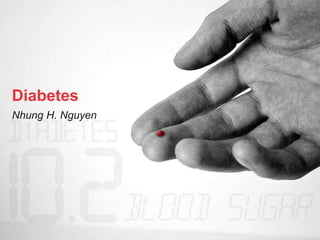
Diabetes
Nhung H. Nguyen
Definition:
• “A metabolic disease in which the body’s inability to
produce any or enough insulin causes elevated
levels of glucose in the blood.”
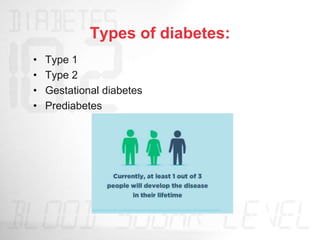
Types of diabetes:
• Type 1
• Type 2
• Gestational diabetes
• Prediabetes
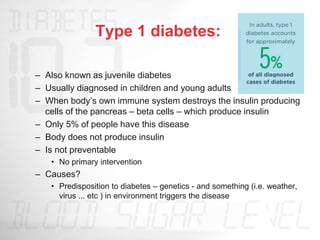
Type 1 diabetes:
– Also known as juvenile diabetes
– Usually diagnosed in children and young adults
– When body’s own immune system destroys the insulin producing
cells of the pancreas – beta cells – which produce insulin
– Only 5% of people have this disease
– Body does not produce insulin
– Is not preventable
• No primary intervention
– Causes?
• Predisposition to diabetes – genetics - and something (i.e. weather,
virus ... etc ) in environment triggers the disease
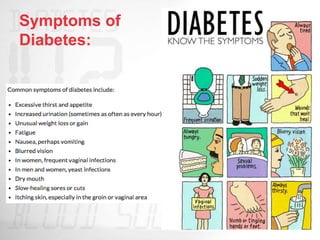
Symptoms of
Diabetes:
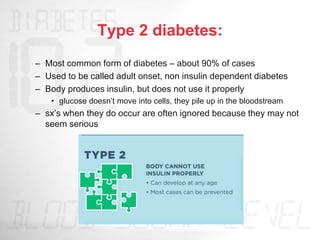
Type 2 diabetes:
– Most common form of diabetes – about 90% of cases
– Used to be called adult onset, non insulin dependent diabetes
– Body produces insulin, but does not use it properly
• glucose doesn’t move into cells, they pile up in the bloodstream
– sx’s when they do occur are often ignored because they may not
seem serious
Risk factors:
• Genetics
• Family pmHx
• Polycystic ovary syndrome
– Irregular menses
• Race
– African Americans, Hispanics and Asians > whites
• Age
– After age 45, but increases in younger adults and children
• Environmental factors
– Inactivity
– Weight gain
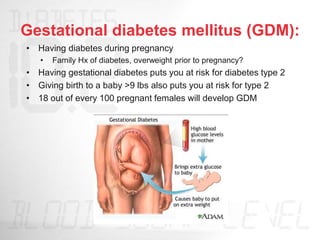
Gestational diabetes mellitus (GDM):
• Having diabetes during pregnancy
• Family Hx of diabetes, overweight prior to pregnancy?
• Having gestational diabetes puts you at risk for diabetes type 2
• Giving birth to a baby >9 lbs also puts you at risk for type 2
• 18 out of every 100 pregnant females will develop GDM
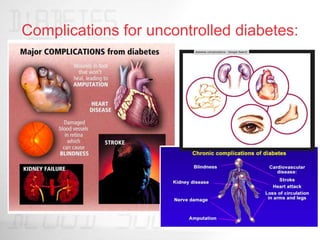
Complications for uncontrolled diabetes:
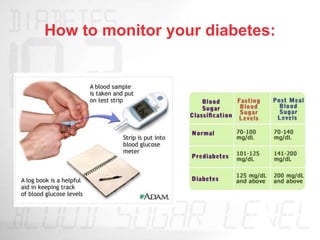
How to monitor your diabetes:
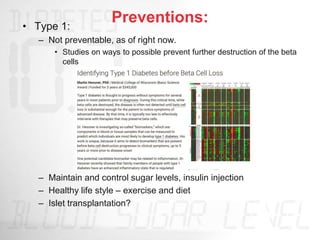
Preventions:
• Type 1:
– Not preventable, as of right now.
• Studies on ways to possible prevent further destruction of the beta
cells
– Maintain and control sugar levels, insulin injection
– Healthy life style – exercise and diet
– Islet transplantation?
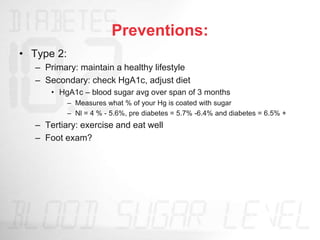
Preventions:
• Type 2:
– Primary: maintain a healthy lifestyle
– Secondary: check HgA1c, adjust diet
• HgA1c – blood sugar avg over span of 3 months
– Measures what % of your Hg is coated with sugar
– Nl = 4 % - 5.6%, pre diabetes = 5.7% -6.4% and diabetes = 6.5% +
– Tertiary: exercise and eat well
– Foot exam?
Preventions:
• Gestational diabetes:
– Physical activity
• Researchers found being physically active before and after their
pregnancy reduced their risk of GDM by about 70% or more
– Diet
• A study showed that each 10 gram increase in fiber a day reduced
their risk of GDM by 26%
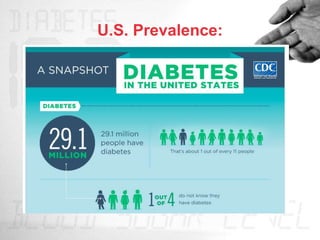
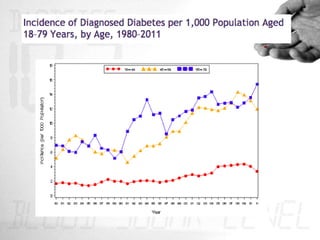
U.S. Prevalence:
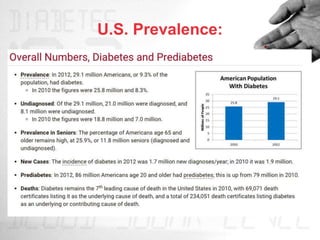
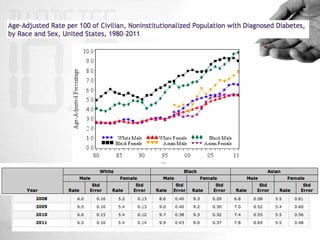
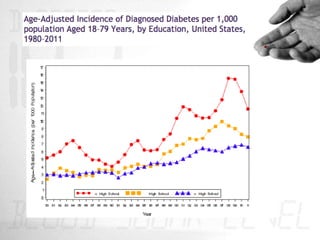
U.S. Prevalence:
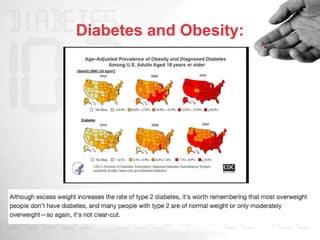
Diabetes and Obesity:
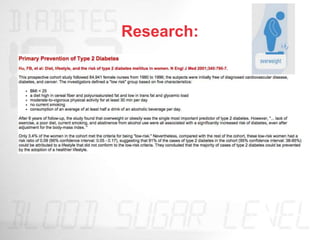
Research:
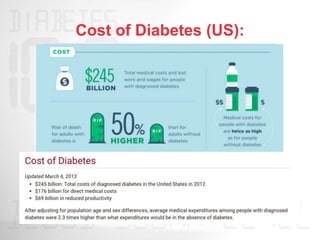
Cost of Diabetes (US):
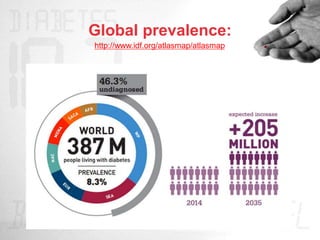
Global prevalence:
http://www.idf.org/atlasmap/atlasmap
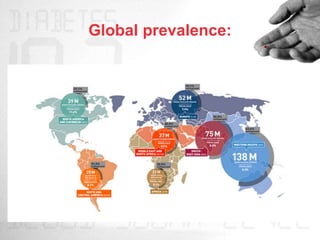
Global prevalence:
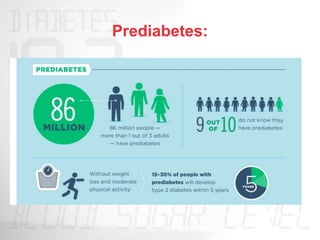
Prediabetes:
Prediabetes:
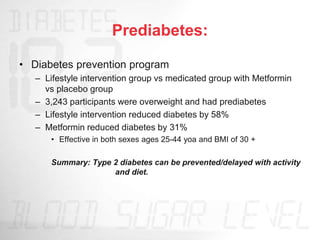
• Diabetes prevention program
– Lifestyle intervention group vs medicated group with Metformin
vs placebo group
– 3,243 participants were overweight and had prediabetes
– Lifestyle intervention reduced diabetes by 58%
– Metformin reduced diabetes by 31%
• Effective in both sexes ages 25-44 yoa and BMI of 30 +
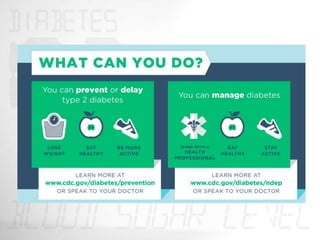
Summary: Type 2 diabetes can be prevented/delayed with activity
and diet.
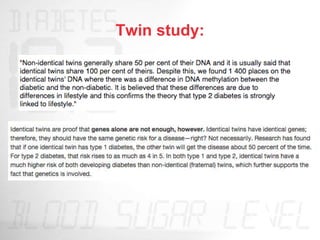
Twin study:
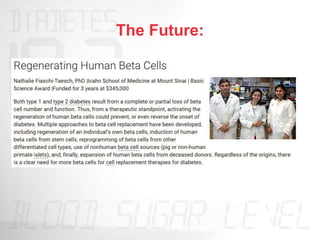
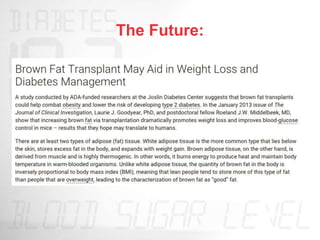
The Future:
The Future:
Websites:
• http://www.idf.org/about-diabetes
– global
• http://www.diabeteseducator.org/
• http://www.cdc.gov/diabetes/home/
• http://www.diabetes.org/
– U.S.
• Questions?

Diabetes.ppt

  • 1.
  • 2.
    Definition: • “A metabolicdisease in which the body’s inability to produce any or enough insulin causes elevated levels of glucose in the blood.”
  • 3.
    Types of diabetes: •Type 1 • Type 2 • Gestational diabetes • Prediabetes
  • 4.
    Type 1 diabetes: –Also known as juvenile diabetes – Usually diagnosed in children and young adults – When body’s own immune system destroys the insulin producing cells of the pancreas – beta cells – which produce insulin – Only 5% of people have this disease – Body does not produce insulin – Is not preventable • No primary intervention – Causes? • Predisposition to diabetes – genetics - and something (i.e. weather, virus ... etc ) in environment triggers the disease
  • 5.
  • 6.
    Type 2 diabetes: –Most common form of diabetes – about 90% of cases – Used to be called adult onset, non insulin dependent diabetes – Body produces insulin, but does not use it properly • glucose doesn’t move into cells, they pile up in the bloodstream – sx’s when they do occur are often ignored because they may not seem serious
  • 7.
    Risk factors: • Genetics •Family pmHx • Polycystic ovary syndrome – Irregular menses • Race – African Americans, Hispanics and Asians > whites • Age – After age 45, but increases in younger adults and children • Environmental factors – Inactivity – Weight gain
  • 8.
    Gestational diabetes mellitus(GDM): • Having diabetes during pregnancy • Family Hx of diabetes, overweight prior to pregnancy? • Having gestational diabetes puts you at risk for diabetes type 2 • Giving birth to a baby >9 lbs also puts you at risk for type 2 • 18 out of every 100 pregnant females will develop GDM
  • 9.
  • 10.
    How to monitoryour diabetes:
  • 11.
    Preventions: • Type 1: –Not preventable, as of right now. • Studies on ways to possible prevent further destruction of the beta cells – Maintain and control sugar levels, insulin injection – Healthy life style – exercise and diet – Islet transplantation?
  • 12.
    Preventions: • Type 2: –Primary: maintain a healthy lifestyle – Secondary: check HgA1c, adjust diet • HgA1c – blood sugar avg over span of 3 months – Measures what % of your Hg is coated with sugar – Nl = 4 % - 5.6%, pre diabetes = 5.7% -6.4% and diabetes = 6.5% + – Tertiary: exercise and eat well – Foot exam?
  • 13.
    Preventions: • Gestational diabetes: –Physical activity • Researchers found being physically active before and after their pregnancy reduced their risk of GDM by about 70% or more – Diet • A study showed that each 10 gram increase in fiber a day reduced their risk of GDM by 26%
  • 14.
  • 15.
  • 19.
  • 20.
  • 21.
  • 22.
  • 23.
  • 24.
  • 25.
    Prediabetes: • Diabetes preventionprogram – Lifestyle intervention group vs medicated group with Metformin vs placebo group – 3,243 participants were overweight and had prediabetes – Lifestyle intervention reduced diabetes by 58% – Metformin reduced diabetes by 31% • Effective in both sexes ages 25-44 yoa and BMI of 30 + Summary: Type 2 diabetes can be prevented/delayed with activity and diet.
  • 27.
  • 28.
  • 29.
  • 30.
    Websites: • http://www.idf.org/about-diabetes – global •http://www.diabeteseducator.org/ • http://www.cdc.gov/diabetes/home/ • http://www.diabetes.org/ – U.S.
  • 31.