TRACTORS AND
MACHINES
1
Upon competition of this unit the
participant will be able to identify the
safety precautions needed when
working with tractors and machinery.
LEARNING OBJECTIVE
2
You will be able to:
1. Understand the training that is necessary for employees
using tractors and other machinery on your farm.
2. Evaluate your farm procedures to ensure the use of
rollover protection, seatbelts and PTO guards.
3. Identify the requirements of 29CFR1928 sub part D 1928.57
machine guarding
LEARNER OUTCOMES
3
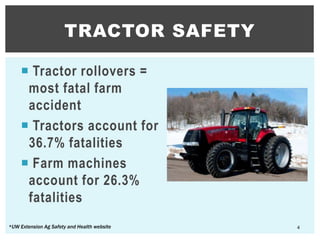
 Tractor rollovers =
most fatal farm
accident
 Tractors account for
36.7% fatalities
 Farm machines
account for 26.3%
fatalities
TRACTOR SAFETY
4
*UW Extension Ag Safety and Health website
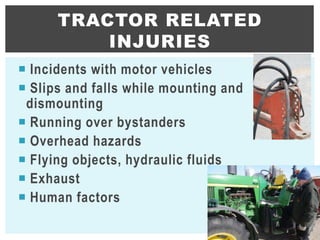
 Incidents with motor vehicles
 Slips and falls while mounting and
dismounting
 Running over bystanders
 Overhead hazards
 Flying objects, hydraulic fluids
 Exhaust
 Human factors
TRACTOR RELATED
INJURIES
5
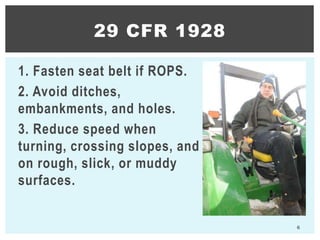
1. Fasten seat belt if ROPS.
2. Avoid ditches,
embankments, and holes.
3. Reduce speed when
turning, crossing slopes, and
on rough, slick, or muddy
surfaces.
6
29 CFR 1928
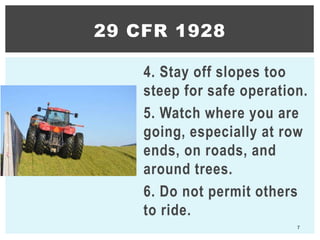
4. Stay off slopes too
steep for safe operation.
5. Watch where you are
going, especially at row
ends, on roads, and
around trees.
6. Do not permit others
to ride.
7
29 CFR 1928
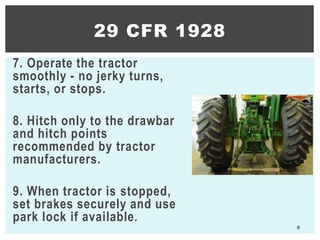
7. Operate the tractor
smoothly - no jerky turns,
starts, or stops.
8. Hitch only to the drawbar
and hitch points
recommended by tractor
manufacturers.
9. When tractor is stopped,
set brakes securely and use
park lock if available.
8
29 CFR 1928
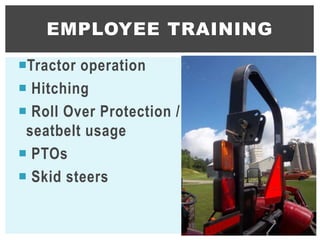
Tractor operation
 Hitching
 Roll Over Protection /
seatbelt usage
 PTOs
 Skid steers
EMPLOYEE TRAINING
9
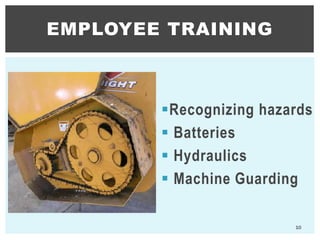
Recognizing hazards
 Batteries
 Hydraulics
 Machine Guarding
EMPLOYEE TRAINING
10
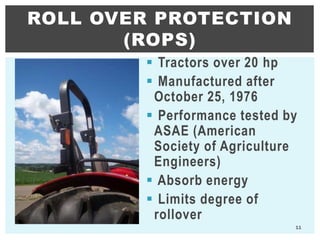
 Tractors over 20 hp
 Manufactured after
October 25, 1976
 Performance tested by
ASAE (American
Society of Agriculture
Engineers)
 Absorb energy
 Limits degree of
rollover
ROLL OVER PROTECTION
(ROPS)
11
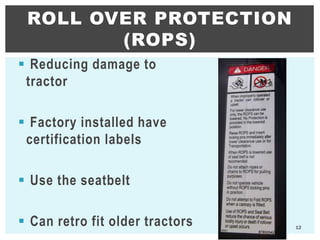
 Reducing damage to
tractor
 Factory installed have
certification labels
 Use the seatbelt
 Can retro fit older tractors
ROLL OVER PROTECTION
(ROPS)
12
 Inspect roll bars
 Inspect seatbelt
 Do not drill holes in ROPS
 Do not use as anchor point to pull things
 Replace if tractor is in a roll over
 Do not make your own
CARE OF ROPS
13
 Avoid sharp turns
 Avoid using a single brake on incline
 Avoid steep embankments
 Reduce speed
 Keep front end loaders low
 Hitch only to draw bar
REDUCING ROLL OVERS
14
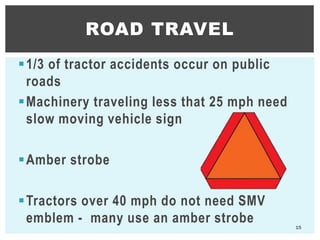
1/3 of tractor accidents occur on public
roads
Machinery traveling less that 25 mph need
slow moving vehicle sign
Amber strobe
Tractors over 40 mph do not need SMV
emblem - many use an amber strobe
ROAD TRAVEL
15
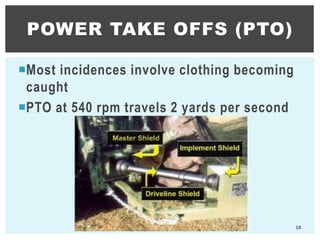
Most incidences involve clothing becoming
caught
PTO at 540 rpm travels 2 yards per second
POWER TAKE OFFS (PTO)
16
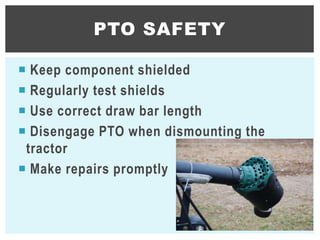
 Keep component shielded
 Regularly test shields
 Use correct draw bar length
 Disengage PTO when dismounting the
tractor
 Make repairs promptly
PTO SAFETY
17
 Walk around the machinery
 Watch your step
 Don’t wear loose clothing
 Tie back long hair
 Keep children away
PTO SAFETY
18
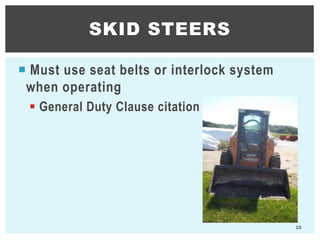
 Must use seat belts or interlock system
when operating
 General Duty Clause citation
SKID STEERS
19
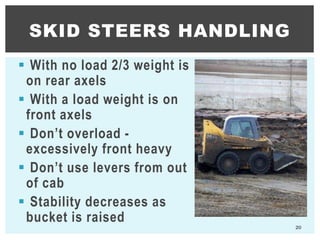
 With no load 2/3 weight is
on rear axels
 With a load weight is on
front axels
 Don’t overload -
excessively front heavy
 Don’t use levers from out
of cab
 Stability decreases as
bucket is raised
20
SKID STEERS HANDLING
 Study owner’s manual
 Check soil conditions
 Check for overhead power lines
 Never allow passengers in cab or bucket
 Do not use the bucket as a work platform
 Adjust speed to terrain
WORK SAFELY
21
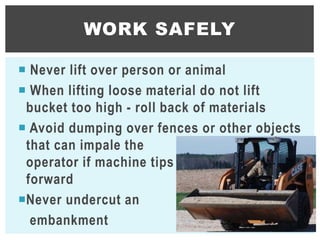
 Never lift over person or animal
 When lifting loose material do not lift
bucket too high - roll back of materials
 Avoid dumping over fences or other objects
that can impale the
operator if machine tips
forward
Never undercut an
embankment
WORK SAFELY
22
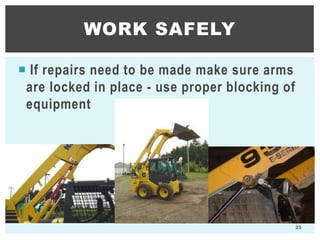
 If repairs need to be made make sure arms
are locked in place - use proper blocking of
equipment
WORK SAFELY
23
24
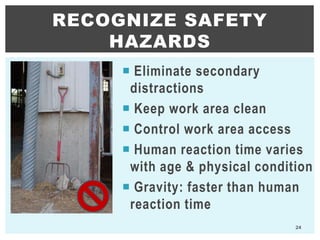
RECOGNIZE SAFETY
HAZARDS
 Eliminate secondary
distractions
 Keep work area clean
 Control work area access
 Human reaction time varies
with age & physical condition
 Gravity: faster than human
reaction time
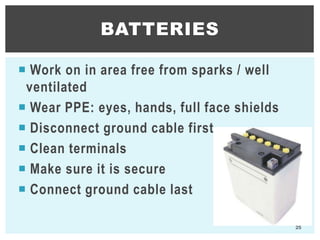
 Work on in area free from sparks / well
ventilated
 Wear PPE: eyes, hands, full face shields
 Disconnect ground cable first
 Clean terminals
 Make sure it is secure
 Connect ground cable last
BATTERIES
25
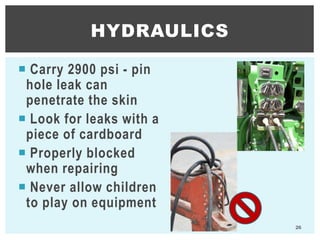
 Carry 2900 psi - pin
hole leak can
penetrate the skin
 Look for leaks with a
piece of cardboard
 Properly blocked
when repairing
 Never allow children
to play on equipment
26
HYDRAULICS
 Provide protection for the employees from
the hazards associated with moving
machinery, parts of farm equipment, and
farmstead equipment.
 Agricultural machine guarding standard
took effect October 25, 1976
MACHINE GUARDING
27
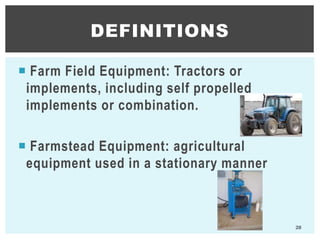
 Farm Field Equipment: Tractors or
implements, including self propelled
implements or combination.
 Farmstead Equipment: agricultural
equipment used in a stationary manner
DEFINITIONS
28
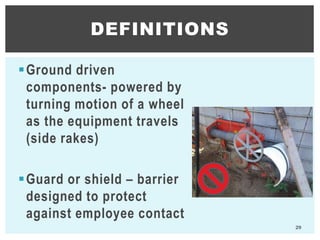
Ground driven
components- powered by
turning motion of a wheel
as the equipment travels
(side rakes)
Guard or shield – barrier
designed to protect
against employee contact
DEFINITIONS
29
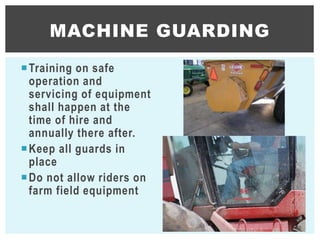
Training on safe
operation and
servicing of equipment
shall happen at the
time of hire and
annually there after.
Keep all guards in
place
Do not allow riders on
farm field equipment
MACHINE GUARDING
30
 Stop engine
 Disconnect power source
 Wait for machine to stop moving before
servicing
 Make sure everyone is clear before starting
engine or machine
 Lock out electrical power before performing
maintenance
MACHINE GUARDING
31
 Shields
 Provide protection against inadvertent contact
with the hazard
 Support 250 pounds of force from an
individual leaning or falling against it
METHODS OF GUARDING
32
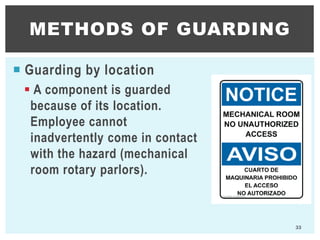
 Guarding by location
 A component is guarded
because of its location.
Employee cannot
inadvertently come in contact
with the hazard (mechanical
room rotary parlors).
METHODS OF GUARDING
33
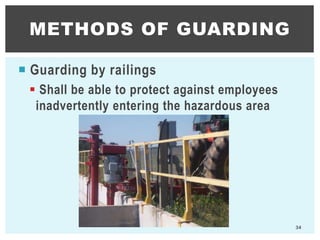
 Guarding by railings
 Shall be able to protect against employees
inadvertently entering the hazardous area
METHODS OF GUARDING
34
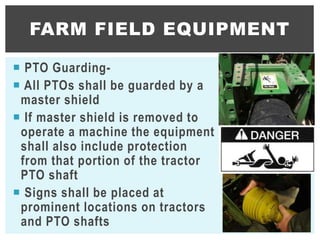
 PTO Guarding-
 All PTOs shall be guarded by a
master shield
 If master shield is removed to
operate a machine the equipment
shall also include protection
from that portion of the tractor
PTO shaft
 Signs shall be placed at
prominent locations on tractors
and PTO shafts
FARM FIELD EQUIPMENT
35
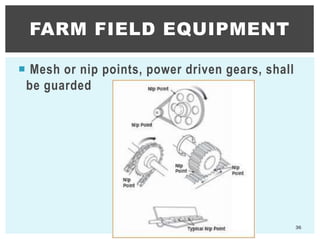
 Mesh or nip points, power driven gears, shall
be guarded
FARM FIELD EQUIPMENT
36
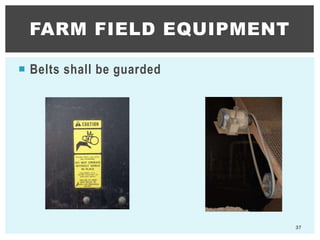
 Belts shall be guarded
FARM FIELD EQUIPMENT
37
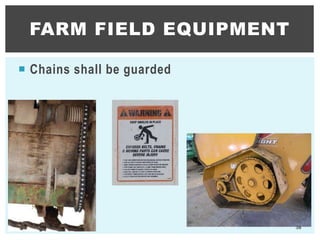
 Chains shall be guarded
FARM FIELD EQUIPMENT
38
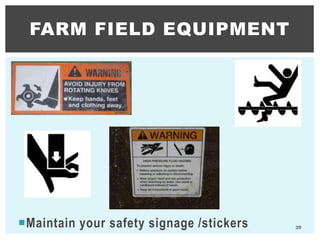
Maintain your safety signage /stickers
FARM FIELD EQUIPMENT
39
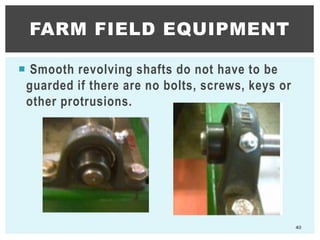
 Smooth revolving shafts do not have to be
guarded if there are no bolts, screws, keys or
other protrusions.
FARM FIELD EQUIPMENT
40
 Guards, shields and access doors shall be in
place.
 Where removal of a guard or access door will
expose employee to any component which
continues to rotate after power is disengaged
employer shall provide
 Readily visible or audible warning of rotation
 Look and listen for evidence of rotation
 Not remove the guard or access door until all
components have stopped
 Electrical disconnect
ACCESS TO MOVING PARTS
1928.57(b)(3)
41
 PTO Guarding
 Other power transmission components
 Refer back to Farm Field Equipment
FARMSTEAD EQUIPMENT
42
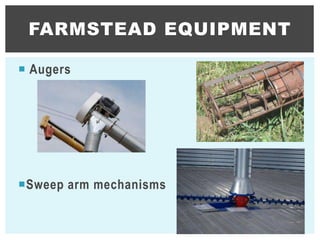
 Augers
Sweep arm mechanisms
FARMSTEAD EQUIPMENT
43
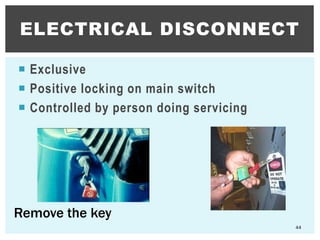
 Exclusive
 Positive locking on main switch
 Controlled by person doing servicing
ELECTRICAL DISCONNECT
44
Remove the key
 1. What are the nine areas that 1928 addresses with tractors?
1. Securely fasten your seat belt if the tractor has a ROPS.
2. Where possible, avoid operating the tractor near ditches,
embankments, and holes.
3. Reduce speed when turning, crossing slopes, and on rough, slick, or
muddy surfaces.
4. Stay off slopes too steep for safe operation.
5. Watch where you are going, especially at row ends, on roads, and
around trees.
6. Do not permit others to ride.
7. Operate the tractor smoothly - no jerky turns, starts, or stops.
8. Hitch only to the drawbar and hitch points recommended by tractor
manufacturers.
9. When tractor is stopped, set brakes securely and use park lock if
available.
REVIEW
45
2. How often must you train your employees on the use of
tractors and equipment?
At the time of hiring and yearly thereafter
REVIEW
46
3. What is the difference between farmstead equipment and
farm field equipment?
Farm stead equipment is usually permanent machines (ex.
milk machine pumps, motors on augers, elevators) Farm field
equipment is machinery that is used around the farm and in
the fields.
REVIEW
47
4. How often should you inspect your machine guards?
Daily
REVIEW
48
49
This material was produced under grant number
SH-22318-11 from the Occupational Safety and
Health Administration, U.S. Department of Labor.
It does not necessarily reflect the views or policies
of the U.S. Department of Labor, nor does
mention of trade names, commercial products, or
organizations imply endorsement by the U.S.
Government.

fy11_sh-22318-11_Mod_5_Tractors.pptx

  • 1.
  • 2.
    Upon competition ofthis unit the participant will be able to identify the safety precautions needed when working with tractors and machinery. LEARNING OBJECTIVE 2
  • 3.
    You will beable to: 1. Understand the training that is necessary for employees using tractors and other machinery on your farm. 2. Evaluate your farm procedures to ensure the use of rollover protection, seatbelts and PTO guards. 3. Identify the requirements of 29CFR1928 sub part D 1928.57 machine guarding LEARNER OUTCOMES 3
  • 4.
     Tractor rollovers= most fatal farm accident  Tractors account for 36.7% fatalities  Farm machines account for 26.3% fatalities TRACTOR SAFETY 4 *UW Extension Ag Safety and Health website
  • 5.
     Incidents withmotor vehicles  Slips and falls while mounting and dismounting  Running over bystanders  Overhead hazards  Flying objects, hydraulic fluids  Exhaust  Human factors TRACTOR RELATED INJURIES 5
  • 6.
    1. Fasten seatbelt if ROPS. 2. Avoid ditches, embankments, and holes. 3. Reduce speed when turning, crossing slopes, and on rough, slick, or muddy surfaces. 6 29 CFR 1928
  • 7.
    4. Stay offslopes too steep for safe operation. 5. Watch where you are going, especially at row ends, on roads, and around trees. 6. Do not permit others to ride. 7 29 CFR 1928
  • 8.
    7. Operate thetractor smoothly - no jerky turns, starts, or stops. 8. Hitch only to the drawbar and hitch points recommended by tractor manufacturers. 9. When tractor is stopped, set brakes securely and use park lock if available. 8 29 CFR 1928
  • 9.
    Tractor operation  Hitching Roll Over Protection / seatbelt usage  PTOs  Skid steers EMPLOYEE TRAINING 9
  • 10.
    Recognizing hazards  Batteries Hydraulics  Machine Guarding EMPLOYEE TRAINING 10
  • 11.
     Tractors over20 hp  Manufactured after October 25, 1976  Performance tested by ASAE (American Society of Agriculture Engineers)  Absorb energy  Limits degree of rollover ROLL OVER PROTECTION (ROPS) 11
  • 12.
     Reducing damageto tractor  Factory installed have certification labels  Use the seatbelt  Can retro fit older tractors ROLL OVER PROTECTION (ROPS) 12
  • 13.
     Inspect rollbars  Inspect seatbelt  Do not drill holes in ROPS  Do not use as anchor point to pull things  Replace if tractor is in a roll over  Do not make your own CARE OF ROPS 13
  • 14.
     Avoid sharpturns  Avoid using a single brake on incline  Avoid steep embankments  Reduce speed  Keep front end loaders low  Hitch only to draw bar REDUCING ROLL OVERS 14
  • 15.
    1/3 of tractoraccidents occur on public roads Machinery traveling less that 25 mph need slow moving vehicle sign Amber strobe Tractors over 40 mph do not need SMV emblem - many use an amber strobe ROAD TRAVEL 15
  • 16.
    Most incidences involveclothing becoming caught PTO at 540 rpm travels 2 yards per second POWER TAKE OFFS (PTO) 16
  • 17.
     Keep componentshielded  Regularly test shields  Use correct draw bar length  Disengage PTO when dismounting the tractor  Make repairs promptly PTO SAFETY 17
  • 18.
     Walk aroundthe machinery  Watch your step  Don’t wear loose clothing  Tie back long hair  Keep children away PTO SAFETY 18
  • 19.
     Must useseat belts or interlock system when operating  General Duty Clause citation SKID STEERS 19
  • 20.
     With noload 2/3 weight is on rear axels  With a load weight is on front axels  Don’t overload - excessively front heavy  Don’t use levers from out of cab  Stability decreases as bucket is raised 20 SKID STEERS HANDLING
  • 21.
     Study owner’smanual  Check soil conditions  Check for overhead power lines  Never allow passengers in cab or bucket  Do not use the bucket as a work platform  Adjust speed to terrain WORK SAFELY 21
  • 22.
     Never liftover person or animal  When lifting loose material do not lift bucket too high - roll back of materials  Avoid dumping over fences or other objects that can impale the operator if machine tips forward Never undercut an embankment WORK SAFELY 22
  • 23.
     If repairsneed to be made make sure arms are locked in place - use proper blocking of equipment WORK SAFELY 23
  • 24.
    24 RECOGNIZE SAFETY HAZARDS  Eliminatesecondary distractions  Keep work area clean  Control work area access  Human reaction time varies with age & physical condition  Gravity: faster than human reaction time
  • 25.
     Work onin area free from sparks / well ventilated  Wear PPE: eyes, hands, full face shields  Disconnect ground cable first  Clean terminals  Make sure it is secure  Connect ground cable last BATTERIES 25
  • 26.
     Carry 2900psi - pin hole leak can penetrate the skin  Look for leaks with a piece of cardboard  Properly blocked when repairing  Never allow children to play on equipment 26 HYDRAULICS
  • 27.
     Provide protectionfor the employees from the hazards associated with moving machinery, parts of farm equipment, and farmstead equipment.  Agricultural machine guarding standard took effect October 25, 1976 MACHINE GUARDING 27
  • 28.
     Farm FieldEquipment: Tractors or implements, including self propelled implements or combination.  Farmstead Equipment: agricultural equipment used in a stationary manner DEFINITIONS 28
  • 29.
    Ground driven components- poweredby turning motion of a wheel as the equipment travels (side rakes) Guard or shield – barrier designed to protect against employee contact DEFINITIONS 29
  • 30.
    Training on safe operationand servicing of equipment shall happen at the time of hire and annually there after. Keep all guards in place Do not allow riders on farm field equipment MACHINE GUARDING 30
  • 31.
     Stop engine Disconnect power source  Wait for machine to stop moving before servicing  Make sure everyone is clear before starting engine or machine  Lock out electrical power before performing maintenance MACHINE GUARDING 31
  • 32.
     Shields  Provideprotection against inadvertent contact with the hazard  Support 250 pounds of force from an individual leaning or falling against it METHODS OF GUARDING 32
  • 33.
     Guarding bylocation  A component is guarded because of its location. Employee cannot inadvertently come in contact with the hazard (mechanical room rotary parlors). METHODS OF GUARDING 33
  • 34.
     Guarding byrailings  Shall be able to protect against employees inadvertently entering the hazardous area METHODS OF GUARDING 34
  • 35.
     PTO Guarding- All PTOs shall be guarded by a master shield  If master shield is removed to operate a machine the equipment shall also include protection from that portion of the tractor PTO shaft  Signs shall be placed at prominent locations on tractors and PTO shafts FARM FIELD EQUIPMENT 35
  • 36.
     Mesh ornip points, power driven gears, shall be guarded FARM FIELD EQUIPMENT 36
  • 37.
     Belts shallbe guarded FARM FIELD EQUIPMENT 37
  • 38.
     Chains shallbe guarded FARM FIELD EQUIPMENT 38
  • 39.
    Maintain your safetysignage /stickers FARM FIELD EQUIPMENT 39
  • 40.
     Smooth revolvingshafts do not have to be guarded if there are no bolts, screws, keys or other protrusions. FARM FIELD EQUIPMENT 40
  • 41.
     Guards, shieldsand access doors shall be in place.  Where removal of a guard or access door will expose employee to any component which continues to rotate after power is disengaged employer shall provide  Readily visible or audible warning of rotation  Look and listen for evidence of rotation  Not remove the guard or access door until all components have stopped  Electrical disconnect ACCESS TO MOVING PARTS 1928.57(b)(3) 41
  • 42.
     PTO Guarding Other power transmission components  Refer back to Farm Field Equipment FARMSTEAD EQUIPMENT 42
  • 43.
     Augers Sweep armmechanisms FARMSTEAD EQUIPMENT 43
  • 44.
     Exclusive  Positivelocking on main switch  Controlled by person doing servicing ELECTRICAL DISCONNECT 44 Remove the key
  • 45.
     1. Whatare the nine areas that 1928 addresses with tractors? 1. Securely fasten your seat belt if the tractor has a ROPS. 2. Where possible, avoid operating the tractor near ditches, embankments, and holes. 3. Reduce speed when turning, crossing slopes, and on rough, slick, or muddy surfaces. 4. Stay off slopes too steep for safe operation. 5. Watch where you are going, especially at row ends, on roads, and around trees. 6. Do not permit others to ride. 7. Operate the tractor smoothly - no jerky turns, starts, or stops. 8. Hitch only to the drawbar and hitch points recommended by tractor manufacturers. 9. When tractor is stopped, set brakes securely and use park lock if available. REVIEW 45
  • 46.
    2. How oftenmust you train your employees on the use of tractors and equipment? At the time of hiring and yearly thereafter REVIEW 46
  • 47.
    3. What isthe difference between farmstead equipment and farm field equipment? Farm stead equipment is usually permanent machines (ex. milk machine pumps, motors on augers, elevators) Farm field equipment is machinery that is used around the farm and in the fields. REVIEW 47
  • 48.
    4. How oftenshould you inspect your machine guards? Daily REVIEW 48
  • 49.
    49 This material wasproduced under grant number SH-22318-11 from the Occupational Safety and Health Administration, U.S. Department of Labor. It does not necessarily reflect the views or policies of the U.S. Department of Labor, nor does mention of trade names, commercial products, or organizations imply endorsement by the U.S. Government.