DFS_Uninformed_Search_AI_.pptx in artificial intelligence
1.
Depth First Search(DFS)
Uninformed Search in Artificial
Intelligence | Summary
Presented by:-
NAME:-MANJUNATH T KUMBAR
USN:-2VX22RA007
2.
Working Principle
of DFS
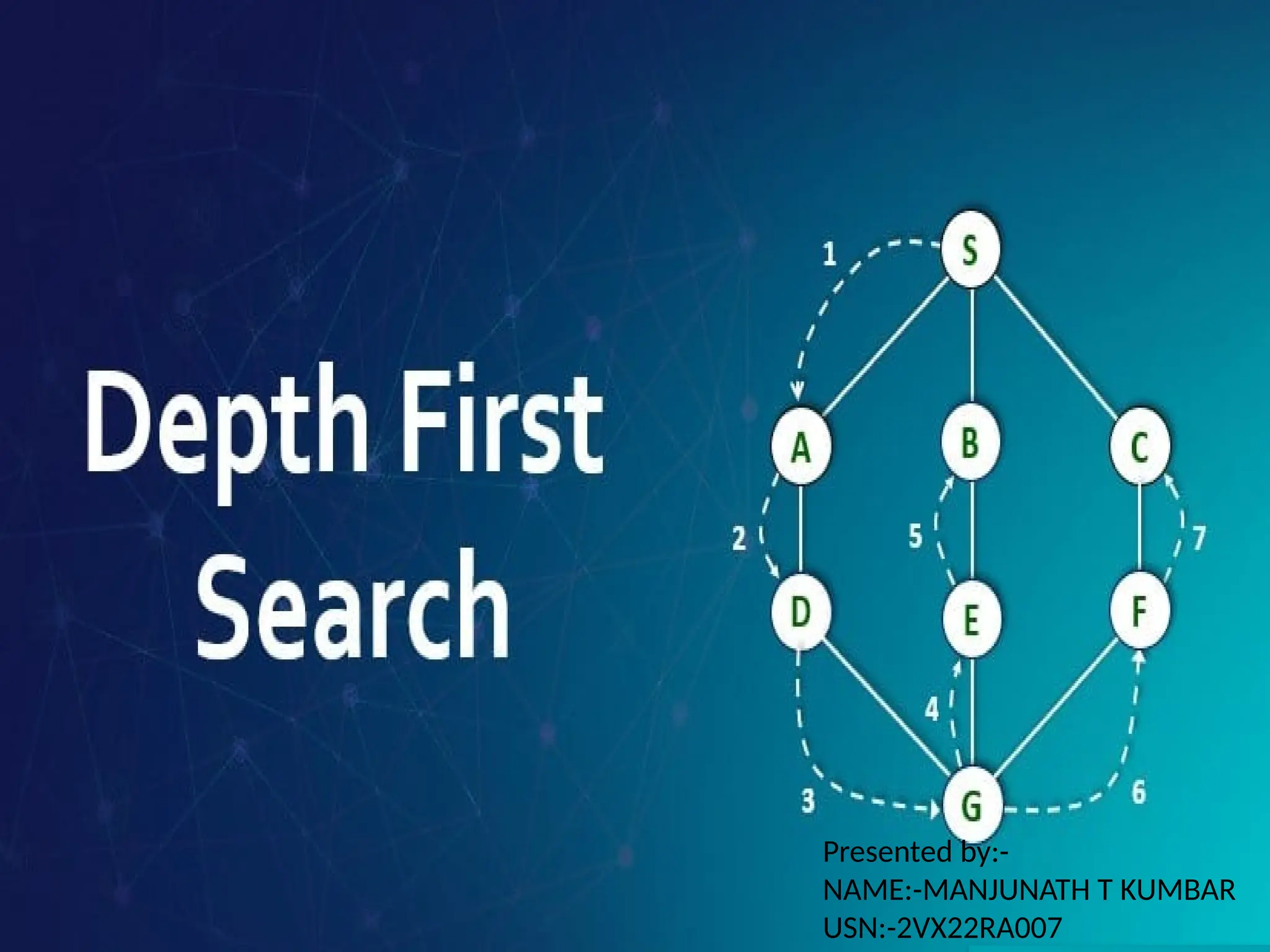
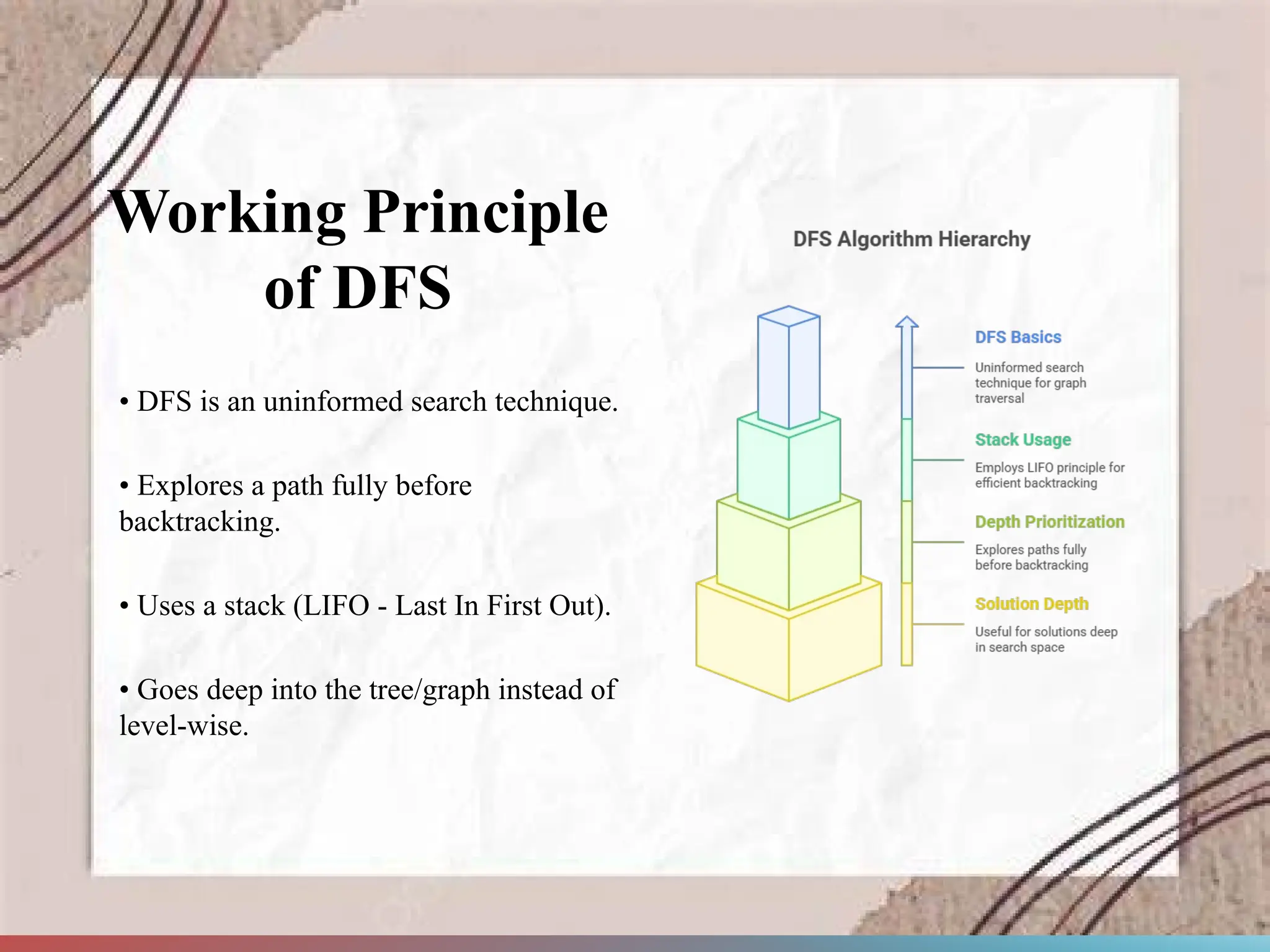
•DFS is an uninformed search technique.
• Explores a path fully before
backtracking.
• Uses a stack (LIFO - Last In First Out).
• Goes deep into the tree/graph instead of
level-wise.
3.
Structure
• DFS workswith trees or
graphs.
• Starts from the root node
and explores as far as
possible.
• If goal is found, it returns
the path to it.
4.
Traits and Limitations
•Incomplete: May not find the goal in infinite
search spaces.
• Can get stuck in cycles.
• Non-optimal: Might return a longer-cost path
even if shorter exists.
5.
Time Complexity
• O(V+ E):V = vertices, E = edges.
• AI context: O(b^d):
- b = branching factor
- d = depth of the tree
• Example: b = 2, d = 2 → 2^2 = 4 searches.
If each node gives birth to 2 children (b=2),
and the depth is 2, then 2^2 = 4 steps may be
needed.




![Depth first search [dfs]](https://cdn.slidesharecdn.com/ss_thumbnails/depthfirstsearchdfs-190926145304-thumbnail.jpg?width=640&height=640&fit=bounds)


