Device Based Left Atrial Appendage
Closure (our most lethal human
attachment)
Left atrial appendage
• Derived from the embryonic left atrium
• Blind pouch located on the anterior surface of the heart
• Multilobed, trabeculated, broad-shaped structure with a narrow neck.
• The pectinate muscles within the LAA must be delineated, as they can be
misidentified as thrombus
• The combination of TEE and CT imaging is effective in assessing LA and LAA
anatomy
• Four categories based on CT analysis:
1. Wind sock (long, dominant lobe)
2. Cauliflower (short length with complex internal structure) (most often
associated with embolic events and stroke)
3. Chicken wing (one prominent end in the LAA) (most common)
4. Cactus (dominant central lobe with secondary lobes)
• LAA appears to be the dominant source of thromboembolism in patients with AF
• LAA contraction during sinus rhythm leads to vigorous blood flow in and out the
appendage cavity
• LAA contractile dysfunction during AF can predispose to local stasis, thrombosis,
and systemic embolization
• Local therapies that exclude the LAA from the systemic circulation offer a
mechanical alternative to OAC for cardioembolic stroke protection
• Several devices for transcatheter LAA closure have been developed
ATRIAL FIBRILLATION AND STROKE
• AF results in up to a
• fivefold increased risk of stroke
• twofold increased risk of dementia
• threefold increased risk of heart failure
• 40% to 90% increased risk of overall mortality
• The risk of AF by 80 years of age in the Atherosclerosis Risk in Communities
(ARIC) study was 21% among white men, 17% among white women
• AF accounted for approximately 24% of strokes in those 80 to 89 years of age in
the Framingham Heart Study.
• AF-related ischemic strokes are more likely to be fatal than non-AF strokes, and
among survivors, AF-related strokes are greater in severity and recur more
frequently.
Rationale for LAA Occlusion
• During AF, there is decreased LAA contractility and function, leading to dilation
and remodeling and causing the appendage to function as a static pouch,
predisposing patients to blood stagnation and thrombosis
• Anatomic characteristics of the LAA associated with AF stroke risk
Neck diameter
Depth
Extent of trabeculations
Cauliflower-type morphology
• The LAA was the source of more than 90% of thrombi in cases of stroke in which
the thrombus could be identified
• These data lend support to the hypothesis that elimination of the LAA may offer a
preventive strategy for AF-related stroke.
Techniques for LAA closure
• Surgical Approaches
• Transcatheter Approaches
Surgical Approaches
• More than 60 years ago, Madden suggested that surgical resection of the LAA in
patients with AF could prevent recurrent arterial emboli
• The two general approaches to surgical LAA closure
Exclusion
Excision
• Exclusion can be performed with running or mattress sutures, with or without felt
pledgets, from the endocardial or epicardial surface or with a stapler
• Excision can be performed by stapled excision or removal and oversewing
• Postoperative residual leaks and insufficient resection occur frequently and can
be associated with thrombus and neurologic events
• Incomplete or insufficient closure is more common with suture or staple
exclusion than with excision
Left Atrial Appendage Occlusion during Cardiac Surgery to Prevent Stroke
LAAOS 3 Trial
Conclusion
• Among participants with AF who had undergone cardiac surgery, most of whom
continued to receive ongoing antithrombotic therapy, the risk of ischemic stroke or
systemic embolism was lower with concomitant left atrial appendage occlusion
performed during the surgery than without it
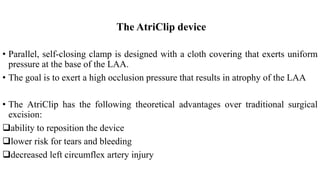
The AtriClip device
• Parallel, self‐closing clamp is designed with a cloth covering that exerts uniform
pressure at the base of the LAA.
• The goal is to exert a high occlusion pressure that results in atrophy of the LAA
• The AtriClip has the following theoretical advantages over traditional surgical
excision:
ability to reposition the device
lower risk for tears and bleeding
decreased left circumflex artery injury
• On short‐term follow‐up (3 months), >98% of patients undergoing TEE or CT
imaging had complete LAA occlusion after AtriClip.
• No device‐related adverse events or perioperative mortalities occurred
Transcatheter Approaches
1. Percutaneous Left Atrial Appendage Transcatheter Occlusion
(PLAATO) system
2. Watchman Occluder
3. Amplatzer Cardiac Plug and Amulet
4. Transcatheter Left Atrial Appendage Ligation With the Lariat Device
5. WaveCrest Occluder
6. Lambre Left Atrial Appendage Occluder
Percutaneous Left Atrial Appendage Transcatheter Occlusion
(PLAATO) system
• First percutaneous device to be prospectively evaluated for the purpose of LAA
closure
• Consisted of a self-expanding nitinol cage covered with an occlusive expanded
polytetrafluoroethylene membrane, with small anchors along the struts and
passing through the membrane to help anchor the device in the LAA
• The device was delivered through a 14-fr delivery sheath guided by
transesophageal echocardiography and fluoroscopy.
Trial Evidence
• Prospective, nonrandomized, multicenter study
• 64 AF patients who were at high risk for thromboembolism (CHADS2 score ≥2)
but who were not candidates for warfarin
• Patients were treated after the procedure with indefinite aspirin and 4 to 6 weeks
of clopidogrel.
• At the 5-year follow-up, the observed rate of stroke or transient ischemic attack
was 3.8% per year, compared with an expected rate of 6.6% based on the
CHADS2 score of the study population.
• The European prospective, multicenter, observational study
• A total of 180 high-risk AF patients were treated with the PLAATO device
• LAA occlusion was successful in 90%
• The major periprocedural complication was cardiac tamponade, which occurred in
3.3% of cases.
• At 129 patient-years of follow-up, the observed incidence of stroke was 2.3% per
year, compared with the expected 6.6%
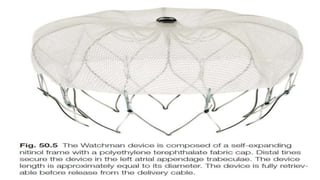
Watchman Occluder
• Device Characteristics
• Parachute shaped and consists of a nitinol frame and a polyethylene terephthalate
(PET) fabric membrane cap that faces the body of the left atrium.
• The five sizes range from 21 to 33 mm, in 3-mm increments.
• The manufacturer recommends oversizing the device by 8% to 20%
• The Watchman device is used to occlude LAAs between approximately 17 and 30
mm in diameter
• Implantation Procedure
• Device selection is determined by LAA size
• A 14-Fr double- or single-curved access sheath is introduced into the left atrium
through a transseptal puncture in the inferoposterior aspect of the interatrial
septum
• The 14-Fr access sheath is placed deep within the LAA and often telescoped over
a diagnostic pigtail catheter to prevent laceration or perforation of the thin-walled,
friable LAA
FDA Indication for Use for the Watchman Left Atrial Appendage Occluder
• The WATCHMAN is indicated to reduce the risk of thromboembolism from the
left atrial appendage in patients with nonvalvular atrial fibrillation who:
Are at an increased risk of for stroke and systemic embolism based on CHADS2
or CHA2DS2VASc scores and are recommended for OAC
Are deemed by their physicians to be suitable for warfarin
Have an appropriate rationale to seek a nonpharmacologic alternative to warfarin,
taking into account the safety and effectiveness of the device compared to
warfarin
• Specific factors may include one or more of the following:
A history of major bleeding while taking therapeutic anticoagulation therapy
A medical condition, occupation, or lifestyle placing the patient at high risk of
major bleeding secondary to trauma
Clinical Data
•PROTECT-AF Trial
•PREVAIL Trial
•EWOLUTION Registry
The Watchman Left Atrial Appendage System for Embolic Protection in Patients with Atrial
Fibrillation (PROTECT-AF) trial
• Randomly assigned 707 AF patients with a CHADS2 score of 1 or greater
• Watchman LAA closure was noninferior and superior to warfarin for the primary
efficacy end point at a mean follow-up of 3.8 ± 1.7 years warfarin (2.66 events per
100 patient-years vs. 3.66 events per 100 patient-years, P = .04)
• The rates of ischemic stroke did not differ between groups
• The rate of fatal and disabling stroke was lower in the device group
• Cardiovascular and all-cause mortality were also reduced with LAA closure
• Quality-of-life measurements were significantly improved in device group
The Prospective Randomized Evaluation of the Watchman Left Atrial
Appendage Closure Device in Patients with Atrial Fibrillation Versus Long-
Term Warfarin Therapy (PREVAIL) trial
• Randomly assigned 407 AF patients with a CHADS2 score of 2 or greater
• The aim of PREVAIL trial was to confirm procedural safety, particularly among
newer operators
• Operators without prior watchman experience implanted the device in
approximately 40% of the enrolled patients
• Implantation by new operators was not associated with reduced rates of implant
success or an increased risk of major adverse events
• Short term results(11.8 ± 5.8 months)
• the primary efficacy end point of stroke, systemic embolism, or cardiovascular
death was similar between study arms
• The rate of ischemic stroke or systemic embolism was noninferior to Watchman
LAA closure
• Long term results(47.9 ± 19.4 months )
• Watchman LAA closure was still not noninferior to warfarin for the primary
efficacy end point of stroke, systemic embolism, or cardiovascular death
EWOLUTION (Evaluating Real‐World Clinical Outcomes in Atrial
Fibrillation Patients Receiving the WATCHMAN Left Atrial
Appendage Closure Technology) Registry
• Largest prospective registry on Watchman
• Showed that at hospital discharge after device implant, patients were using VKA
(16%), DOAC (11%), DAPT (60%), single antiplatelet therapy (7%), or no
anticoagulation (6%) at all.
• After a 2 year follow‐up, the patients (85%) who discontinued their DAPT and
DOAC showed a 46% lower major bleeding rate compared with historic controls.
Watchman LAA closure in OAC-contraindicated patients
• The ASA Plavix Feasibility Study With Watchman Left Atrial Appendage
Closure Technology (ASAP) trial
• Prospective , nonrandomized study
• 150 AF
• After implantation, patients were treated with clopidogrel for 6 months and with
aspirin indefinitely.
• The rate of stroke or systemic embolism was 2.3% per year at a mean follow-up
of 14.4 ± 8.6 months(expected rate of 7.3% per year similar CHADS2 treated
with aspirin alone)
• At a median follow-up of 55.4 months, the annual rate of ischemic stroke or
systemic embolism was 1.8% (75% lower than the expected rate)
The prospective, multicenter ASAP-TOO (Assessment of the WATCHMAN
Device in Patients Unsuitable for Oral Anticoagulation) trial
• Ongoing trial
• Will enroll 900 AF patients who are deemed unsuitable for OAC
• Randomize them to either medical therapy (single or no antiplatelet therapy per
operator discretion) or watchman LAA closure followed by a modified
postimplant drug regimen of DAPT that does not include OAC.
The Watchman FLX device
• The next‐generation watchman device
• Fully recapturable and repositionable
• It has a shorter device length, 18 struts (versus 10 struts) and an atraumatic closed
distal end (versus open end)
• Watchman FLX device also has a broader size range (20–35 mm) compared with
its predecessor (21–33 mm)
• Theoretically lessen the likelihood of perforation, pericardial effusion, and
tamponade
PINNACLE FLX (The Protection Against Embolism for Non‐valvular AF
Subjects: Investigational Evaluation of the WATCHMAN FLX™ LAA
Closure Technology)
• Enrolled 400 patients
• The primary effectiveness end point (100%; P<0.0001) was the incidence of
effective closure (peridevice flow of ≤5 mm) at 12 months
• The primary safety end point (0.5%; P<0.0001) was the occurrence of death,
ischemic stroke, systemic embolism, or device‐related or procedure‐related events
requiring cardiac surgery within 7 days post procedure.
• There were no device embolizations or pericardial effusions requiring cardiac
surgery
Amplatzer Cardiac Plug and Amulet
• Device Characteristics and Procedural Approach
• Consists of a self-expanding nitinol mesh that forms a distal lobe and proximal
disk, each with a sewn polyester patch, and they are connected by a short, central
waist
• The distal lobe has hooks around its circumference that anchors the device in the
LAA, and the proximal disk covers the mouth of the LAA from within the left
atrium
• The mechanism of LAA occlusion is different from that of the Watchman, which
occludes the LAA by filling the appendage itself.
• The second-generation ACP, the Amulet, has a slightly longer distal lobe, more
stabilizing hooks, a longer central waist, and a larger-diameter proximal disk with
a recessed threaded insert
• These modifications improve device stability, position, residual leak, and the
incidence of device-associated thrombi
Clinical Data
• The safety and clinical efficacy examined in several nonrandomized, retrospective
and prospective, observational studies, many of which were single-center
experiences
• The rates of successful LAA closure are excellent
• The most frequent procedural complication appears to be pericardial effusion,
occurring at rates similar to those seen in the randomized Watchman experience,
and clinical efficacy appears acceptable
Planned or ongoing trials
• The STROKECLOSE trial (Prevention of Stroke by Left Atrial Appendage Closure in
Atrial Fibrillation Patients After Intracerebral Hemorrhage)
• will randomly assign 750 AF patients with prior intracranial hemorrhage in a 2:1 fashion
to Amulet LAA occlusion or medical therapy
• The Amulet LAA Occluder trial
• prospective, randomized, noninferiority trial of the Amulet versus the Watchman LAA
occlude
• 1600 AF patients at high thromboembolic risk who are deemed suitable for short-term
warfarin but not good candidates for long-term OAC
Transcatheter Left Atrial Appendage Ligation With the Lariat
Device
• Device Characteristics
• It enables percutaneous delivery of a pretied surgical suture to ligate the LAA.
• Done combined subxyphoid and transseptal approach
• Anatomic eligibility for the procedure is determined by cardiac CT.
• Appendages with a diameter greater than 40 mm, lobes behind the pulmonary
artery, or a posterior orientation should be avoided.
• A larger, second-generation device will allow closure of appendages as large as 45
mm in diameter.
Clinical Outcomes
• Few small, observational studies
• Major complications associated with the procedure are significant pericardial
effusions and postprocedural pericarditis.
• Results are insufficient to determine the clinical efficacy of the device for stroke
prevention.
• Bartus et al conducted a single-center, nonrandomized study that enrolled 92
patients
• Successful closure was achieved in 96% of cases.
• Pericardial effusions, occurred in three patients (3.2%), and pericarditis occurred
in two patients (2.2%).
• At the 1-year follow-up assessment, one-half of the patients remained on warfarin
therapy.
• There was no evidence of late leaks on follow-up TEE, and there were no
thromboembolic events
• In another single-center study of 21 patients undergoing lariat ligation
• Successful closure was achieved in 20 patients
• Pericardial effusion in two patients (10%) and pericarditis in three patients (15%).
• There were no thromboembolic events over 352 ± 143 days of follow-up
• Another multicenter, retrospective study examined the early safety and efficacy of
LAA closure with the Lariat device in 154 patients undergoing the procedure
• Device success was 94%.
• Procedure-related major bleeding occurred in 9.1%, and significant pericardial
effusion occurred in 10.4% of patients.
• Among the 63 patients with immediate closure and TEE follow-up, 3 patients had
LAA stump thrombus (4.8%) and 13 (20%) had residual leaks
• LAA ligation can have an antiarrhythmic effect in selected patients because the LAA can
be a source of AF.
• The lariat procedure appears to isolate LAA electrical activity
• In an observational study, the AF burden in patients with known AF triggers in the LAA
was significantly reduced at 12 months after the lariat procedure compared with baseline
AF activity.
• Outcomes of adjunctive left atrial appendage ligation utilizing the lariat compared
to pulmonary vein antral isolation alone – aMAZE trial
• Left atrial appendage ligation/pulmonary vein antral isolation failed to meet the criterion
for effectiveness, since recurrent atrial arrhythmias were similar between treatment
groups.
WaveCrest Occluder
• Device Characteristics and Procedural Approach
• The occluder consists of a self-expanding nitinol cage with a proximal ePTFE cap.
• A foam skirt is incorporated through the distal portion of the occluder cap, which
could potentially enhance LAA sealing
• When the device is implanted, the occluder is positioned to occlude the LAA, and
a set of anchors or tines are then deployed in a separate step to anchor the device
in the LAA.
• Potential advantages of this device include less traumatic deployment and more
flexibility in closing the LAA irrespective of its depth.
• The WaveCrest2 (WAveCrest vs. Watchman TranssEptal LAA Closure to
REduce AF-Mediated STroke-2) study
• Ongoing randomized clinical trial for WaveCrest versus the Watchman implant
Lambre Left Atrial Appendage Occluder
• Self-expanding device consisting of an umbrella and a cover connected by a
central waist
Left atrial appendage occlusion with lambre in atrial fibrillation:
Initial European experience
• A total of 60 patients with atrial fibrillation and contraindications to oral
anticoagulation
• Device-related complications included 2 (3.3%) pericardial effusions
• Transesophageal echocardiography at 6 months showed complete sealing of the
LAA (residual jet flow of <5 mm) in 51/54 (94.4%) patients.
• No device-related thrombus was documented
• At 12 months transient ischemic attack was observed in 1 patient (1.6%)
GUIDELINES
• AHA/ACC/HRS guidelines :
• Surgical excision of the LAA during concomitant cardiac surgery may be
considered, but its efficacy is uncertain (class IIb, level C evidence)
• The ESC guidelines :
• Surgical excision may be considered during concomitant cardiac surgery (class
IIb, level C evidence)
• Transcatheter LAA closure may be considered in patients with a high stroke risk
and contraindications to long-term OAC (class IIb, level B evidence)
THANKING YOU

Device Based Left Atrial Appendage Closure.pptx

  • 1.
    Device Based LeftAtrial Appendage Closure (our most lethal human attachment)
  • 2.
    Left atrial appendage •Derived from the embryonic left atrium • Blind pouch located on the anterior surface of the heart • Multilobed, trabeculated, broad-shaped structure with a narrow neck. • The pectinate muscles within the LAA must be delineated, as they can be misidentified as thrombus • The combination of TEE and CT imaging is effective in assessing LA and LAA anatomy
  • 3.
    • Four categoriesbased on CT analysis: 1. Wind sock (long, dominant lobe) 2. Cauliflower (short length with complex internal structure) (most often associated with embolic events and stroke) 3. Chicken wing (one prominent end in the LAA) (most common) 4. Cactus (dominant central lobe with secondary lobes)
  • 5.
    • LAA appearsto be the dominant source of thromboembolism in patients with AF • LAA contraction during sinus rhythm leads to vigorous blood flow in and out the appendage cavity • LAA contractile dysfunction during AF can predispose to local stasis, thrombosis, and systemic embolization • Local therapies that exclude the LAA from the systemic circulation offer a mechanical alternative to OAC for cardioembolic stroke protection • Several devices for transcatheter LAA closure have been developed
  • 6.
    ATRIAL FIBRILLATION ANDSTROKE • AF results in up to a • fivefold increased risk of stroke • twofold increased risk of dementia • threefold increased risk of heart failure • 40% to 90% increased risk of overall mortality
  • 7.
    • The riskof AF by 80 years of age in the Atherosclerosis Risk in Communities (ARIC) study was 21% among white men, 17% among white women • AF accounted for approximately 24% of strokes in those 80 to 89 years of age in the Framingham Heart Study. • AF-related ischemic strokes are more likely to be fatal than non-AF strokes, and among survivors, AF-related strokes are greater in severity and recur more frequently.
  • 8.
    Rationale for LAAOcclusion • During AF, there is decreased LAA contractility and function, leading to dilation and remodeling and causing the appendage to function as a static pouch, predisposing patients to blood stagnation and thrombosis • Anatomic characteristics of the LAA associated with AF stroke risk Neck diameter Depth Extent of trabeculations Cauliflower-type morphology
  • 9.
    • The LAAwas the source of more than 90% of thrombi in cases of stroke in which the thrombus could be identified • These data lend support to the hypothesis that elimination of the LAA may offer a preventive strategy for AF-related stroke.
  • 10.
    Techniques for LAAclosure • Surgical Approaches • Transcatheter Approaches
  • 11.
    Surgical Approaches • Morethan 60 years ago, Madden suggested that surgical resection of the LAA in patients with AF could prevent recurrent arterial emboli • The two general approaches to surgical LAA closure Exclusion Excision • Exclusion can be performed with running or mattress sutures, with or without felt pledgets, from the endocardial or epicardial surface or with a stapler • Excision can be performed by stapled excision or removal and oversewing
  • 12.
    • Postoperative residualleaks and insufficient resection occur frequently and can be associated with thrombus and neurologic events • Incomplete or insufficient closure is more common with suture or staple exclusion than with excision
  • 14.
    Left Atrial AppendageOcclusion during Cardiac Surgery to Prevent Stroke LAAOS 3 Trial Conclusion • Among participants with AF who had undergone cardiac surgery, most of whom continued to receive ongoing antithrombotic therapy, the risk of ischemic stroke or systemic embolism was lower with concomitant left atrial appendage occlusion performed during the surgery than without it
  • 16.
    The AtriClip device •Parallel, self‐closing clamp is designed with a cloth covering that exerts uniform pressure at the base of the LAA. • The goal is to exert a high occlusion pressure that results in atrophy of the LAA • The AtriClip has the following theoretical advantages over traditional surgical excision: ability to reposition the device lower risk for tears and bleeding decreased left circumflex artery injury
  • 17.
    • On short‐termfollow‐up (3 months), >98% of patients undergoing TEE or CT imaging had complete LAA occlusion after AtriClip. • No device‐related adverse events or perioperative mortalities occurred
  • 18.
    Transcatheter Approaches 1. PercutaneousLeft Atrial Appendage Transcatheter Occlusion (PLAATO) system 2. Watchman Occluder 3. Amplatzer Cardiac Plug and Amulet 4. Transcatheter Left Atrial Appendage Ligation With the Lariat Device 5. WaveCrest Occluder 6. Lambre Left Atrial Appendage Occluder
  • 19.
    Percutaneous Left AtrialAppendage Transcatheter Occlusion (PLAATO) system • First percutaneous device to be prospectively evaluated for the purpose of LAA closure • Consisted of a self-expanding nitinol cage covered with an occlusive expanded polytetrafluoroethylene membrane, with small anchors along the struts and passing through the membrane to help anchor the device in the LAA • The device was delivered through a 14-fr delivery sheath guided by transesophageal echocardiography and fluoroscopy.
  • 21.
    Trial Evidence • Prospective,nonrandomized, multicenter study • 64 AF patients who were at high risk for thromboembolism (CHADS2 score ≥2) but who were not candidates for warfarin • Patients were treated after the procedure with indefinite aspirin and 4 to 6 weeks of clopidogrel. • At the 5-year follow-up, the observed rate of stroke or transient ischemic attack was 3.8% per year, compared with an expected rate of 6.6% based on the CHADS2 score of the study population.
  • 22.
    • The Europeanprospective, multicenter, observational study • A total of 180 high-risk AF patients were treated with the PLAATO device • LAA occlusion was successful in 90% • The major periprocedural complication was cardiac tamponade, which occurred in 3.3% of cases. • At 129 patient-years of follow-up, the observed incidence of stroke was 2.3% per year, compared with the expected 6.6%
  • 23.
    Watchman Occluder • DeviceCharacteristics • Parachute shaped and consists of a nitinol frame and a polyethylene terephthalate (PET) fabric membrane cap that faces the body of the left atrium. • The five sizes range from 21 to 33 mm, in 3-mm increments. • The manufacturer recommends oversizing the device by 8% to 20% • The Watchman device is used to occlude LAAs between approximately 17 and 30 mm in diameter
  • 25.
    • Implantation Procedure •Device selection is determined by LAA size • A 14-Fr double- or single-curved access sheath is introduced into the left atrium through a transseptal puncture in the inferoposterior aspect of the interatrial septum • The 14-Fr access sheath is placed deep within the LAA and often telescoped over a diagnostic pigtail catheter to prevent laceration or perforation of the thin-walled, friable LAA
  • 27.
    FDA Indication forUse for the Watchman Left Atrial Appendage Occluder • The WATCHMAN is indicated to reduce the risk of thromboembolism from the left atrial appendage in patients with nonvalvular atrial fibrillation who: Are at an increased risk of for stroke and systemic embolism based on CHADS2 or CHA2DS2VASc scores and are recommended for OAC Are deemed by their physicians to be suitable for warfarin Have an appropriate rationale to seek a nonpharmacologic alternative to warfarin, taking into account the safety and effectiveness of the device compared to warfarin
  • 28.
    • Specific factorsmay include one or more of the following: A history of major bleeding while taking therapeutic anticoagulation therapy A medical condition, occupation, or lifestyle placing the patient at high risk of major bleeding secondary to trauma
  • 29.
  • 31.
    The Watchman LeftAtrial Appendage System for Embolic Protection in Patients with Atrial Fibrillation (PROTECT-AF) trial • Randomly assigned 707 AF patients with a CHADS2 score of 1 or greater • Watchman LAA closure was noninferior and superior to warfarin for the primary efficacy end point at a mean follow-up of 3.8 ± 1.7 years warfarin (2.66 events per 100 patient-years vs. 3.66 events per 100 patient-years, P = .04) • The rates of ischemic stroke did not differ between groups • The rate of fatal and disabling stroke was lower in the device group • Cardiovascular and all-cause mortality were also reduced with LAA closure • Quality-of-life measurements were significantly improved in device group
  • 32.
    The Prospective RandomizedEvaluation of the Watchman Left Atrial Appendage Closure Device in Patients with Atrial Fibrillation Versus Long- Term Warfarin Therapy (PREVAIL) trial • Randomly assigned 407 AF patients with a CHADS2 score of 2 or greater • The aim of PREVAIL trial was to confirm procedural safety, particularly among newer operators • Operators without prior watchman experience implanted the device in approximately 40% of the enrolled patients • Implantation by new operators was not associated with reduced rates of implant success or an increased risk of major adverse events
  • 33.
    • Short termresults(11.8 ± 5.8 months) • the primary efficacy end point of stroke, systemic embolism, or cardiovascular death was similar between study arms • The rate of ischemic stroke or systemic embolism was noninferior to Watchman LAA closure • Long term results(47.9 ± 19.4 months ) • Watchman LAA closure was still not noninferior to warfarin for the primary efficacy end point of stroke, systemic embolism, or cardiovascular death
  • 34.
    EWOLUTION (Evaluating Real‐WorldClinical Outcomes in Atrial Fibrillation Patients Receiving the WATCHMAN Left Atrial Appendage Closure Technology) Registry • Largest prospective registry on Watchman • Showed that at hospital discharge after device implant, patients were using VKA (16%), DOAC (11%), DAPT (60%), single antiplatelet therapy (7%), or no anticoagulation (6%) at all. • After a 2 year follow‐up, the patients (85%) who discontinued their DAPT and DOAC showed a 46% lower major bleeding rate compared with historic controls.
  • 35.
    Watchman LAA closurein OAC-contraindicated patients • The ASA Plavix Feasibility Study With Watchman Left Atrial Appendage Closure Technology (ASAP) trial • Prospective , nonrandomized study • 150 AF • After implantation, patients were treated with clopidogrel for 6 months and with aspirin indefinitely. • The rate of stroke or systemic embolism was 2.3% per year at a mean follow-up of 14.4 ± 8.6 months(expected rate of 7.3% per year similar CHADS2 treated with aspirin alone) • At a median follow-up of 55.4 months, the annual rate of ischemic stroke or systemic embolism was 1.8% (75% lower than the expected rate)
  • 36.
    The prospective, multicenterASAP-TOO (Assessment of the WATCHMAN Device in Patients Unsuitable for Oral Anticoagulation) trial • Ongoing trial • Will enroll 900 AF patients who are deemed unsuitable for OAC • Randomize them to either medical therapy (single or no antiplatelet therapy per operator discretion) or watchman LAA closure followed by a modified postimplant drug regimen of DAPT that does not include OAC.
  • 37.
    The Watchman FLXdevice • The next‐generation watchman device • Fully recapturable and repositionable • It has a shorter device length, 18 struts (versus 10 struts) and an atraumatic closed distal end (versus open end) • Watchman FLX device also has a broader size range (20–35 mm) compared with its predecessor (21–33 mm) • Theoretically lessen the likelihood of perforation, pericardial effusion, and tamponade
  • 38.
    PINNACLE FLX (TheProtection Against Embolism for Non‐valvular AF Subjects: Investigational Evaluation of the WATCHMAN FLX™ LAA Closure Technology) • Enrolled 400 patients • The primary effectiveness end point (100%; P<0.0001) was the incidence of effective closure (peridevice flow of ≤5 mm) at 12 months • The primary safety end point (0.5%; P<0.0001) was the occurrence of death, ischemic stroke, systemic embolism, or device‐related or procedure‐related events requiring cardiac surgery within 7 days post procedure. • There were no device embolizations or pericardial effusions requiring cardiac surgery
  • 39.
    Amplatzer Cardiac Plugand Amulet • Device Characteristics and Procedural Approach • Consists of a self-expanding nitinol mesh that forms a distal lobe and proximal disk, each with a sewn polyester patch, and they are connected by a short, central waist • The distal lobe has hooks around its circumference that anchors the device in the LAA, and the proximal disk covers the mouth of the LAA from within the left atrium • The mechanism of LAA occlusion is different from that of the Watchman, which occludes the LAA by filling the appendage itself.
  • 40.
    • The second-generationACP, the Amulet, has a slightly longer distal lobe, more stabilizing hooks, a longer central waist, and a larger-diameter proximal disk with a recessed threaded insert • These modifications improve device stability, position, residual leak, and the incidence of device-associated thrombi
  • 43.
    Clinical Data • Thesafety and clinical efficacy examined in several nonrandomized, retrospective and prospective, observational studies, many of which were single-center experiences • The rates of successful LAA closure are excellent • The most frequent procedural complication appears to be pericardial effusion, occurring at rates similar to those seen in the randomized Watchman experience, and clinical efficacy appears acceptable
  • 44.
    Planned or ongoingtrials • The STROKECLOSE trial (Prevention of Stroke by Left Atrial Appendage Closure in Atrial Fibrillation Patients After Intracerebral Hemorrhage) • will randomly assign 750 AF patients with prior intracranial hemorrhage in a 2:1 fashion to Amulet LAA occlusion or medical therapy • The Amulet LAA Occluder trial • prospective, randomized, noninferiority trial of the Amulet versus the Watchman LAA occlude • 1600 AF patients at high thromboembolic risk who are deemed suitable for short-term warfarin but not good candidates for long-term OAC
  • 45.
    Transcatheter Left AtrialAppendage Ligation With the Lariat Device • Device Characteristics • It enables percutaneous delivery of a pretied surgical suture to ligate the LAA. • Done combined subxyphoid and transseptal approach • Anatomic eligibility for the procedure is determined by cardiac CT. • Appendages with a diameter greater than 40 mm, lobes behind the pulmonary artery, or a posterior orientation should be avoided. • A larger, second-generation device will allow closure of appendages as large as 45 mm in diameter.
  • 46.
    Clinical Outcomes • Fewsmall, observational studies • Major complications associated with the procedure are significant pericardial effusions and postprocedural pericarditis. • Results are insufficient to determine the clinical efficacy of the device for stroke prevention.
  • 47.
    • Bartus etal conducted a single-center, nonrandomized study that enrolled 92 patients • Successful closure was achieved in 96% of cases. • Pericardial effusions, occurred in three patients (3.2%), and pericarditis occurred in two patients (2.2%). • At the 1-year follow-up assessment, one-half of the patients remained on warfarin therapy. • There was no evidence of late leaks on follow-up TEE, and there were no thromboembolic events
  • 48.
    • In anothersingle-center study of 21 patients undergoing lariat ligation • Successful closure was achieved in 20 patients • Pericardial effusion in two patients (10%) and pericarditis in three patients (15%). • There were no thromboembolic events over 352 ± 143 days of follow-up
  • 49.
    • Another multicenter,retrospective study examined the early safety and efficacy of LAA closure with the Lariat device in 154 patients undergoing the procedure • Device success was 94%. • Procedure-related major bleeding occurred in 9.1%, and significant pericardial effusion occurred in 10.4% of patients. • Among the 63 patients with immediate closure and TEE follow-up, 3 patients had LAA stump thrombus (4.8%) and 13 (20%) had residual leaks
  • 50.
    • LAA ligationcan have an antiarrhythmic effect in selected patients because the LAA can be a source of AF. • The lariat procedure appears to isolate LAA electrical activity • In an observational study, the AF burden in patients with known AF triggers in the LAA was significantly reduced at 12 months after the lariat procedure compared with baseline AF activity. • Outcomes of adjunctive left atrial appendage ligation utilizing the lariat compared to pulmonary vein antral isolation alone – aMAZE trial • Left atrial appendage ligation/pulmonary vein antral isolation failed to meet the criterion for effectiveness, since recurrent atrial arrhythmias were similar between treatment groups.
  • 51.
    WaveCrest Occluder • DeviceCharacteristics and Procedural Approach • The occluder consists of a self-expanding nitinol cage with a proximal ePTFE cap. • A foam skirt is incorporated through the distal portion of the occluder cap, which could potentially enhance LAA sealing • When the device is implanted, the occluder is positioned to occlude the LAA, and a set of anchors or tines are then deployed in a separate step to anchor the device in the LAA. • Potential advantages of this device include less traumatic deployment and more flexibility in closing the LAA irrespective of its depth.
  • 53.
    • The WaveCrest2(WAveCrest vs. Watchman TranssEptal LAA Closure to REduce AF-Mediated STroke-2) study • Ongoing randomized clinical trial for WaveCrest versus the Watchman implant
  • 54.
    Lambre Left AtrialAppendage Occluder • Self-expanding device consisting of an umbrella and a cover connected by a central waist
  • 55.
    Left atrial appendageocclusion with lambre in atrial fibrillation: Initial European experience • A total of 60 patients with atrial fibrillation and contraindications to oral anticoagulation • Device-related complications included 2 (3.3%) pericardial effusions • Transesophageal echocardiography at 6 months showed complete sealing of the LAA (residual jet flow of <5 mm) in 51/54 (94.4%) patients. • No device-related thrombus was documented • At 12 months transient ischemic attack was observed in 1 patient (1.6%)
  • 56.
    GUIDELINES • AHA/ACC/HRS guidelines: • Surgical excision of the LAA during concomitant cardiac surgery may be considered, but its efficacy is uncertain (class IIb, level C evidence) • The ESC guidelines : • Surgical excision may be considered during concomitant cardiac surgery (class IIb, level C evidence) • Transcatheter LAA closure may be considered in patients with a high stroke risk and contraindications to long-term OAC (class IIb, level B evidence)
  • 57.