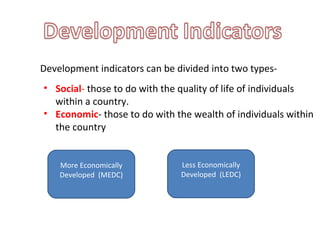
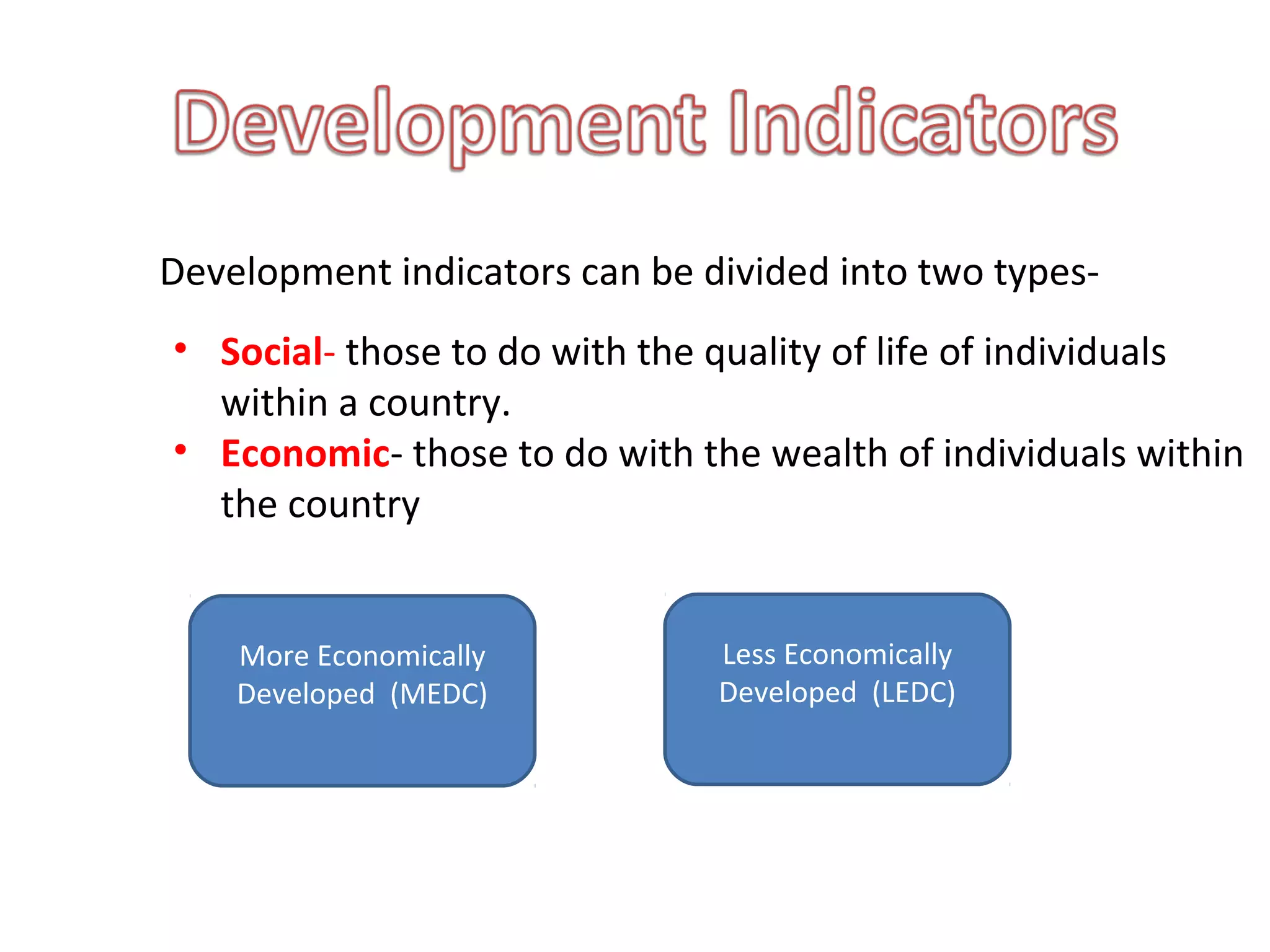
Development indicators can be divided into two types-
• Social- those to do with the quality of life of individuals
within a country.
• Economic- those to do with the wealth of individuals within
the country
More Economically
Developed (MEDC)
Less Economically
Developed (LEDC)
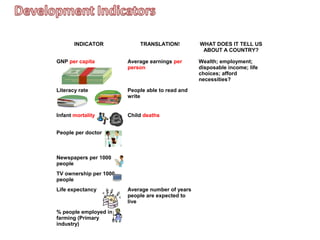
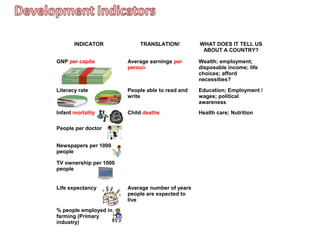
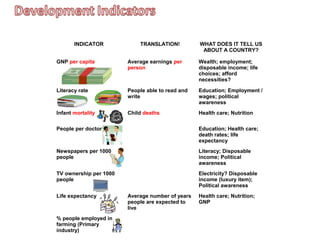
INDICATOR TRANSLATION! WHAT DOES IT TELL US
ABOUT A COUNTRY?
GNP per capita Average earnings per
person
Wealth; employment;
disposable income; life
choices; afford
necessities?
Literacy rate People able to read and
write
Infant mortality Child deaths
People per doctor
Newspapers per 1000
people
TV ownership per 1000
people
Life expectancy Average number of years
people are expected to
live
% people employed in
farming (Primary
industry)
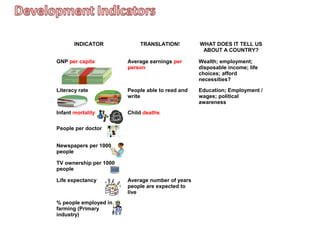
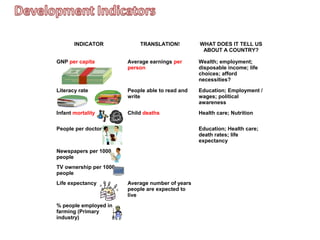
INDICATOR TRANSLATION! WHAT DOES IT TELL US
ABOUT A COUNTRY?
GNP per capita Average earnings per
person
Wealth; employment;
disposable income; life
choices; afford
necessities?
Literacy rate People able to read and
write
Education; Employment /
wages; political
awareness
Infant mortality Child deaths
People per doctor
Newspapers per 1000
people
TV ownership per 1000
people
Life expectancy Average number of years
people are expected to
live
% people employed in
farming (Primary
industry)
INDICATOR TRANSLATION! WHAT DOES IT TELL US
ABOUT A COUNTRY?
GNP per capita Average earnings per
person
Wealth; employment;
disposable income; life
choices; afford
necessities?
Literacy rate People able to read and
write
Education; Employment /
wages; political
awareness
Infant mortality Child deaths Health care; Nutrition
People per doctor
Newspapers per 1000
people
TV ownership per 1000
people
Life expectancy Average number of years
people are expected to
live
% people employed in
farming (Primary
industry)
INDICATOR TRANSLATION! WHAT DOES IT TELL US
ABOUT A COUNTRY?
GNP per capita Average earnings per
person
Wealth; employment;
disposable income; life
choices; afford
necessities?
Literacy rate People able to read and
write
Education; Employment /
wages; political
awareness
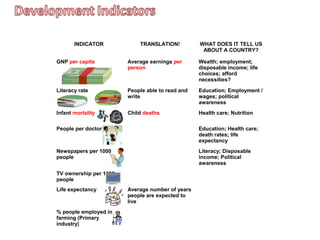
Infant mortality Child deaths Health care; Nutrition
People per doctor Education; Health care;
death rates; life
expectancy
Newspapers per 1000
people
TV ownership per 1000
people
Life expectancy Average number of years
people are expected to
live
% people employed in
farming (Primary
industry)
INDICATOR TRANSLATION! WHAT DOES IT TELL US
ABOUT A COUNTRY?
GNP per capita Average earnings per
person
Wealth; employment;
disposable income; life
choices; afford
necessities?
Literacy rate People able to read and
write
Education; Employment /
wages; political
awareness
Infant mortality Child deaths Health care; Nutrition
People per doctor Education; Health care;
death rates; life
expectancy
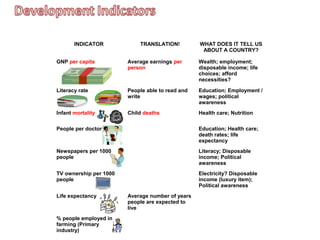
Newspapers per 1000
people
Literacy; Disposable
income; Political
awareness
TV ownership per 1000
people
Life expectancy Average number of years
people are expected to
live
% people employed in
farming (Primary
industry)
INDICATOR TRANSLATION! WHAT DOES IT TELL US
ABOUT A COUNTRY?
GNP per capita Average earnings per
person
Wealth; employment;
disposable income; life
choices; afford
necessities?
Literacy rate People able to read and
write
Education; Employment /
wages; political
awareness
Infant mortality Child deaths Health care; Nutrition
People per doctor Education; Health care;
death rates; life
expectancy
Newspapers per 1000
people
Literacy; Disposable
income; Political
awareness
TV ownership per 1000
people
Electricity? Disposable
income (luxury item);
Political awareness
Life expectancy Average number of years
people are expected to
live
% people employed in
farming (Primary
industry)
INDICATOR TRANSLATION! WHAT DOES IT TELL US
ABOUT A COUNTRY?
GNP per capita Average earnings per
person
Wealth; employment;
disposable income; life
choices; afford
necessities?
Literacy rate People able to read and
write
Education; Employment /
wages; political
awareness
Infant mortality Child deaths Health care; Nutrition
People per doctor Education; Health care;
death rates; life
expectancy
Newspapers per 1000
people
Literacy; Disposable
income; Political
awareness
TV ownership per 1000
people
Electricity? Disposable
income (luxury item);
Political awareness
Life expectancy Average number of years
people are expected to
live
Health care; Nutrition;
GNP
% people employed in
farming (Primary
industry)
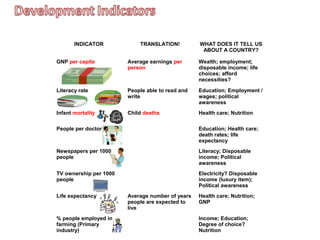
INDICATOR TRANSLATION! WHAT DOES IT TELL US
ABOUT A COUNTRY?
GNP per capita Average earnings per
person
Wealth; employment;
disposable income; life
choices; afford
necessities?
Literacy rate People able to read and
write
Education; Employment /
wages; political
awareness
Infant mortality Child deaths Health care; Nutrition
People per doctor Education; Health care;
death rates; life
expectancy
Newspapers per 1000
people
Literacy; Disposable
income; Political
awareness
TV ownership per 1000
people
Electricity? Disposable
income (luxury item);
Political awareness
Life expectancy Average number of years
people are expected to
live
Health care; Nutrition;
GNP
% people employed in
farming (Primary
industry)
Income; Education;
Degree of choice?
Nutrition
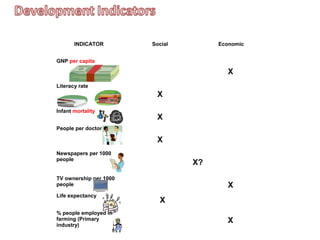
INDICATOR Social Economic
GNP per capita
Literacy rate
Infant mortality
People per doctor
Newspapers per 1000
people
TV ownership per 1000
people
Life expectancy
% people employed in
farming (Primary
industry)
X
X
X
X
X?
X
X
X
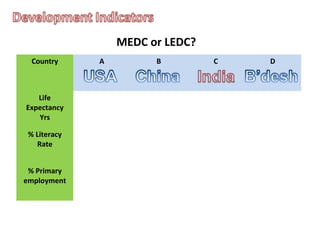
MEDC or LEDC?
Country A B C D
Life
Expectancy
Yrs
% Literacy
Rate
% Primary
employment
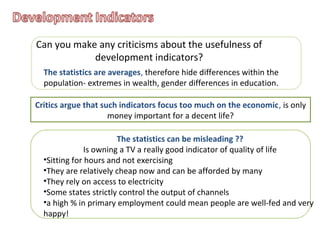
Can you make any criticisms about the usefulness of
development indicators?
The statistics are averages, therefore hide differences within the
population- extremes in wealth, gender differences in education.
Critics argue that such indicators focus too much on the economic, is only
money important for a decent life?
The statistics can be misleading ??
Is owning a TV a really good indicator of quality of life
•Sitting for hours and not exercising
•They are relatively cheap now and can be afforded by many
•They rely on access to electricity
•Some states strictly control the output of channels
•a high % in primary employment could mean people are well-fed and very
happy!
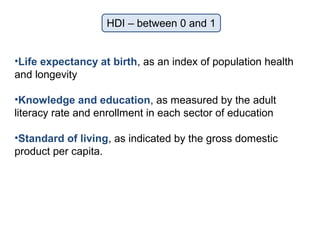
HDI – between 0 and 1
•Life expectancy at birth, as an index of population health
and longevity
•Knowledge and education, as measured by the adult
literacy rate and enrollment in each sector of education
•Standard of living, as indicated by the gross domestic
product per capita.
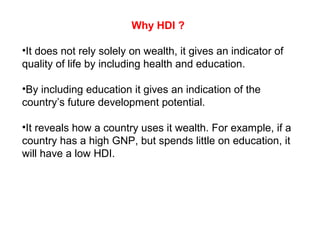
Why HDI ?
•It does not rely solely on wealth, it gives an indicator of
quality of life by including health and education.
•By including education it gives an indication of the
country’s future development potential.
•It reveals how a country uses it wealth. For example, if a
country has a high GNP, but spends little on education, it
will have a low HDI.
1
2
3
4
5
Very High Human Development
5
4
3
2
1
Low Human Development
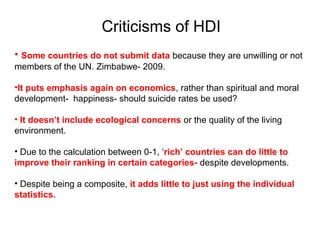
Criticisms of HDI
• Some countries do not submit data because they are unwilling or not
members of the UN. Zimbabwe- 2009.
•It puts emphasis again on economics, rather than spiritual and moral
development- happiness- should suicide rates be used?
• It doesn’t include ecological concerns or the quality of the living
environment.
• Due to the calculation between 0-1, ‘rich’ countries can do little to
improve their ranking in certain categories- despite developments.
• Despite being a composite, it adds little to just using the individual
statistics.

Development Indicators

  • 1.
    Development indicators canbe divided into two types- • Social- those to do with the quality of life of individuals within a country. • Economic- those to do with the wealth of individuals within the country More Economically Developed (MEDC) Less Economically Developed (LEDC)
  • 2.
    INDICATOR TRANSLATION! WHATDOES IT TELL US ABOUT A COUNTRY? GNP per capita Average earnings per person Wealth; employment; disposable income; life choices; afford necessities? Literacy rate People able to read and write Infant mortality Child deaths People per doctor Newspapers per 1000 people TV ownership per 1000 people Life expectancy Average number of years people are expected to live % people employed in farming (Primary industry)
  • 3.
    INDICATOR TRANSLATION! WHATDOES IT TELL US ABOUT A COUNTRY? GNP per capita Average earnings per person Wealth; employment; disposable income; life choices; afford necessities? Literacy rate People able to read and write Education; Employment / wages; political awareness Infant mortality Child deaths People per doctor Newspapers per 1000 people TV ownership per 1000 people Life expectancy Average number of years people are expected to live % people employed in farming (Primary industry)
  • 4.
    INDICATOR TRANSLATION! WHATDOES IT TELL US ABOUT A COUNTRY? GNP per capita Average earnings per person Wealth; employment; disposable income; life choices; afford necessities? Literacy rate People able to read and write Education; Employment / wages; political awareness Infant mortality Child deaths Health care; Nutrition People per doctor Newspapers per 1000 people TV ownership per 1000 people Life expectancy Average number of years people are expected to live % people employed in farming (Primary industry)
  • 5.
    INDICATOR TRANSLATION! WHATDOES IT TELL US ABOUT A COUNTRY? GNP per capita Average earnings per person Wealth; employment; disposable income; life choices; afford necessities? Literacy rate People able to read and write Education; Employment / wages; political awareness Infant mortality Child deaths Health care; Nutrition People per doctor Education; Health care; death rates; life expectancy Newspapers per 1000 people TV ownership per 1000 people Life expectancy Average number of years people are expected to live % people employed in farming (Primary industry)
  • 6.
    INDICATOR TRANSLATION! WHATDOES IT TELL US ABOUT A COUNTRY? GNP per capita Average earnings per person Wealth; employment; disposable income; life choices; afford necessities? Literacy rate People able to read and write Education; Employment / wages; political awareness Infant mortality Child deaths Health care; Nutrition People per doctor Education; Health care; death rates; life expectancy Newspapers per 1000 people Literacy; Disposable income; Political awareness TV ownership per 1000 people Life expectancy Average number of years people are expected to live % people employed in farming (Primary industry)
  • 7.
    INDICATOR TRANSLATION! WHATDOES IT TELL US ABOUT A COUNTRY? GNP per capita Average earnings per person Wealth; employment; disposable income; life choices; afford necessities? Literacy rate People able to read and write Education; Employment / wages; political awareness Infant mortality Child deaths Health care; Nutrition People per doctor Education; Health care; death rates; life expectancy Newspapers per 1000 people Literacy; Disposable income; Political awareness TV ownership per 1000 people Electricity? Disposable income (luxury item); Political awareness Life expectancy Average number of years people are expected to live % people employed in farming (Primary industry)
  • 8.
    INDICATOR TRANSLATION! WHATDOES IT TELL US ABOUT A COUNTRY? GNP per capita Average earnings per person Wealth; employment; disposable income; life choices; afford necessities? Literacy rate People able to read and write Education; Employment / wages; political awareness Infant mortality Child deaths Health care; Nutrition People per doctor Education; Health care; death rates; life expectancy Newspapers per 1000 people Literacy; Disposable income; Political awareness TV ownership per 1000 people Electricity? Disposable income (luxury item); Political awareness Life expectancy Average number of years people are expected to live Health care; Nutrition; GNP % people employed in farming (Primary industry)
  • 9.
    INDICATOR TRANSLATION! WHATDOES IT TELL US ABOUT A COUNTRY? GNP per capita Average earnings per person Wealth; employment; disposable income; life choices; afford necessities? Literacy rate People able to read and write Education; Employment / wages; political awareness Infant mortality Child deaths Health care; Nutrition People per doctor Education; Health care; death rates; life expectancy Newspapers per 1000 people Literacy; Disposable income; Political awareness TV ownership per 1000 people Electricity? Disposable income (luxury item); Political awareness Life expectancy Average number of years people are expected to live Health care; Nutrition; GNP % people employed in farming (Primary industry) Income; Education; Degree of choice? Nutrition
  • 10.
    INDICATOR Social Economic GNPper capita Literacy rate Infant mortality People per doctor Newspapers per 1000 people TV ownership per 1000 people Life expectancy % people employed in farming (Primary industry) X X X X X? X X X
  • 11.
    MEDC or LEDC? CountryA B C D Life Expectancy Yrs % Literacy Rate % Primary employment
  • 12.
    Can you makeany criticisms about the usefulness of development indicators? The statistics are averages, therefore hide differences within the population- extremes in wealth, gender differences in education. Critics argue that such indicators focus too much on the economic, is only money important for a decent life? The statistics can be misleading ?? Is owning a TV a really good indicator of quality of life •Sitting for hours and not exercising •They are relatively cheap now and can be afforded by many •They rely on access to electricity •Some states strictly control the output of channels •a high % in primary employment could mean people are well-fed and very happy!
  • 14.
    HDI – between0 and 1 •Life expectancy at birth, as an index of population health and longevity •Knowledge and education, as measured by the adult literacy rate and enrollment in each sector of education •Standard of living, as indicated by the gross domestic product per capita.
  • 15.
    Why HDI ? •Itdoes not rely solely on wealth, it gives an indicator of quality of life by including health and education. •By including education it gives an indication of the country’s future development potential. •It reveals how a country uses it wealth. For example, if a country has a high GNP, but spends little on education, it will have a low HDI.
  • 16.
  • 17.
  • 18.
    Criticisms of HDI •Some countries do not submit data because they are unwilling or not members of the UN. Zimbabwe- 2009. •It puts emphasis again on economics, rather than spiritual and moral development- happiness- should suicide rates be used? • It doesn’t include ecological concerns or the quality of the living environment. • Due to the calculation between 0-1, ‘rich’ countries can do little to improve their ranking in certain categories- despite developments. • Despite being a composite, it adds little to just using the individual statistics.