Developing	
  SOPs	


Defining	
  Systems,	
  Procedures,	
  and	
  Steps:	


In	
  development	
  of	
  SOPs	
  you	
  want	
  to	
  build	
  a	
  document	
  to	
  train	
  workers	
  to	
  do	
  
procedures	
  consistently	
  and	
  accurately.	
  This	
  ensures	
  a	
  consistently	
  high	
  quality	
  
product.	
  In	
  the	
  development	
  of	
  SOPs	
  we	
  think	
  of	
  three	
  levels:	
  Systems,	
  Procedures,	
  
and	
  Steps.	
  Examples	
  of	
  these	
  in	
  a	
  Cannabis	
  context	
  are	
  given	
  below:	


Systems:	
  
• Propagation	
  
• Vegetative	
  Growth	
  
• Flowering	
  
• Harvest/Dry	
  Cure	
  
• Soil	
  Mixing	
  
• Water	
  Irrigation	
  and	
  Fertigation	
  Systems	
  
• QC	
  and	
  Analytics	


Procedures	
  (examples	
  from	
  Propagation):	
  
• Seed	
  Germination	
  
• Seedling	
  Transplantation	
  
• Mother	
  Plant	
  Canopy	
  Management	
  
• Clone	
  Cutting	
  
• Establishing	
  Cuttings	
  in	
  Growth	
  Media	


Steps	
  (from	
  draft	
  paper	
  towel	
  seed	
  germination	
  SOP)	
  
1. Place	
  seeds	
  to	
  be	
  germinated	
  in	
  clean	
  glass	
  beaker	
  
2. Fill	
  beaker	
  with	
  water	
  and	
  soak	
  seeds	
  for	
  at	
  least	
  12	
  hours	
  but	
  not	
  more	
  then	
  
24	
  
3. Drain	
  off	
  water	
  from	
  beaker	
  containing	
  seeds	
  	
  
4. Using	
  different	
  water	
  moisten	
  paper	
  towel	
  	
  
5. Place	
  seeds	
  on	
  moist	
  paper	
  towel	
  
6. Fold	
  paper	
  towel	
  to	
  give	
  seeds	
  a	
  dark	
  environment,	
  place	
  on	
  grated	
  plate	
  to	
  
allow	
  for	
  drainage.	
  [Picture	
  needed]	
  
7. Mark	
  paper	
  towel	
  with	
  lot	
  number	
  
8. Place	
  plate	
  in	
  incubator	
  set	
  to	
  70-­‐90°	
  F	
  (strain	
  specific)	
  	
  
9. Water	
  plate	
  regularly	
  to	
  keep	
  the	
  environment	
  moist	
  	
  
10. Observe	
  for	
  first	
  signs	
  of	
  white	
  sprout	
  [picture]	
  
11. Sprouted	
  seeds	
  should	
  be	
  marked	
  and	
  reported	
  for	
  transplant	
  to	
  12	
  oz	
  
container	
  with	
  cocos.	


Sometimes	
  simple	
  step	
  SOPs	
  are	
  not	
  going	
  to	
  be	
  the	
  best	
  way	
  to	
  explain	
  a	
  
procedure.	
  Hierarchical	
  step	
  SOPs	
  are	
  for	
  tasks	
  that	
  are	
  more	
  intricate	
  and	
  likely	
  
include	
  sub-­‐steps	
  clarifying	
  technique.	
  Clone	
  cutting	
  and	
  seedling	
  transplantation	
  
are	
  possible	
  examples	
  of	
  this.	


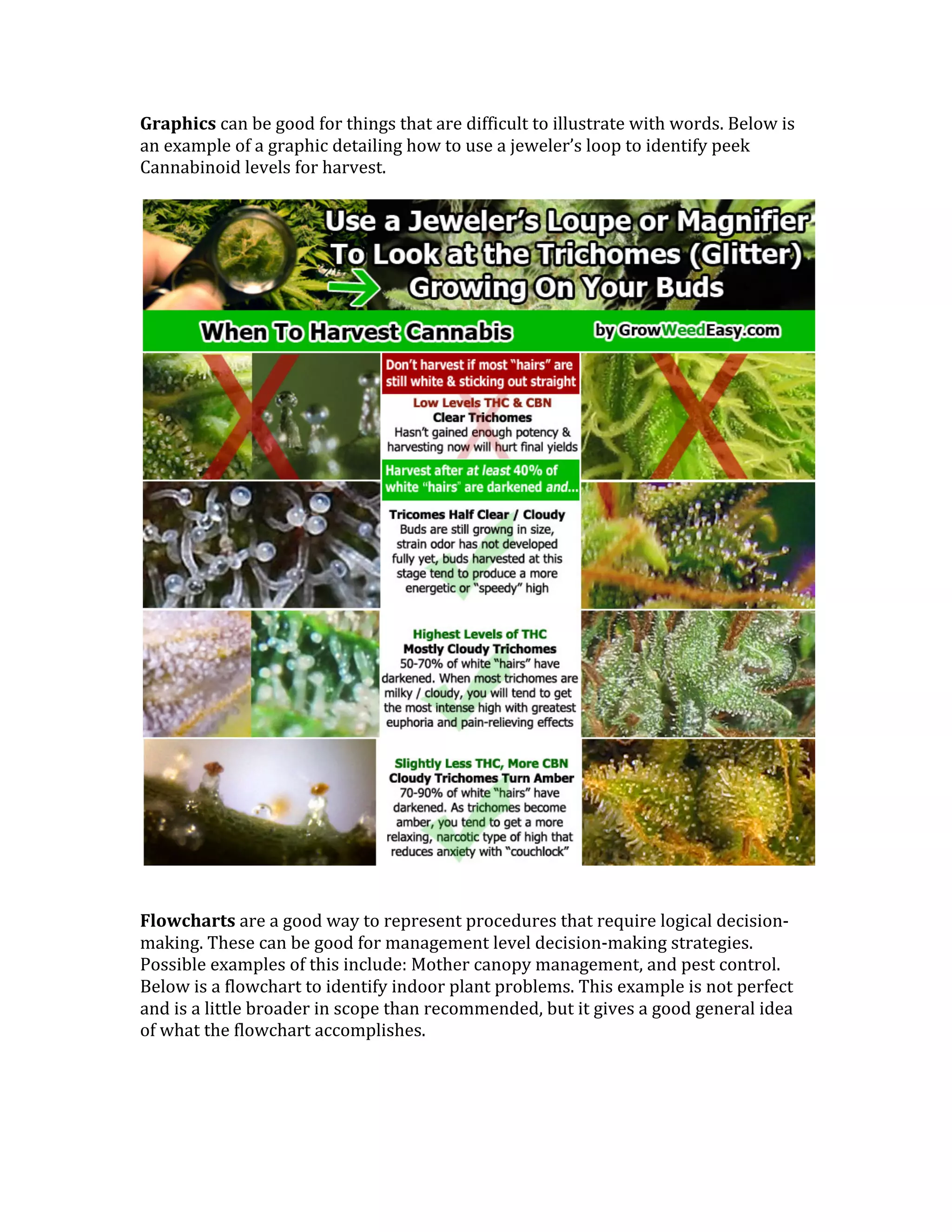
Graphics	
  can	
  be	
  good	
  for	
  things	
  that	
  are	
  difficult	
  to	
  illustrate	
  with	
  words.	
  Below	
  is	
  
an	
  example	
  of	
  a	
  graphic	
  detailing	
  how	
  to	
  use	
  a	
  jeweler’s	
  loop	
  to	
  identify	
  peek	
  
Cannabinoid	
  levels	
  for	
  harvest.	


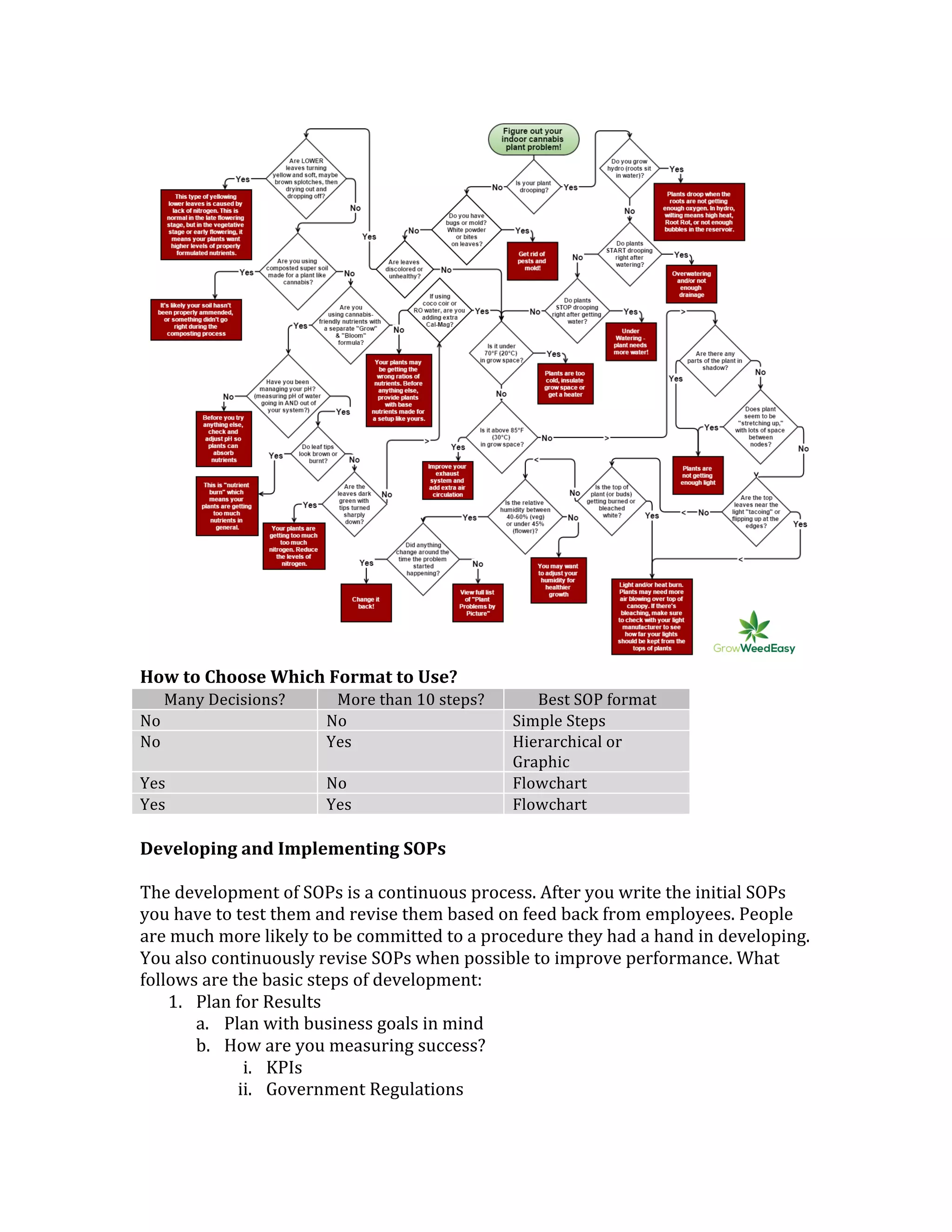
Flowcharts	
  are	
  a	
  good	
  way	
  to	
  represent	
  procedures	
  that	
  require	
  logical	
  decision-­‐
making.	
  These	
  can	
  be	
  good	
  for	
  management	
  level	
  decision-­‐making	
  strategies.	
  
Possible	
  examples	
  of	
  this	
  include:	
  Mother	
  canopy	
  management,	
  and	
  pest	
  control.	
  
Below	
  is	
  a	
  flowchart	
  to	
  identify	
  indoor	
  plant	
  problems.	
  This	
  example	
  is	
  not	
  perfect	
  
and	
  is	
  a	
  little	
  broader	
  in	
  scope	
  than	
  recommended,	
  but	
  it	
  gives	
  a	
  good	
  general	
  idea	
  
of	
  what	
  the	
  flowchart	
  accomplishes.	
  
 
How	
  to	
  Choose	
  Which	
  Format	
  to	
  Use?	
  
Many	
  Decisions?	
   More	
  than	
  10	
  steps?	
   Best	
  SOP	
  format	
  
No	
   No	
   Simple	
  Steps	
  
No	
   Yes	
   Hierarchical	
  or	
  
Graphic	
  
Yes	
   No	
   Flowchart	
  
Yes	
   Yes	
   Flowchart	


Developing	
  and	
  Implementing	
  SOPs	


The	
  development	
  of	
  SOPs	
  is	
  a	
  continuous	
  process.	
  After	
  you	
  write	
  the	
  initial	
  SOPs	
  
you	
  have	
  to	
  test	
  them	
  and	
  revise	
  them	
  based	
  on	
  feed	
  back	
  from	
  employees.	
  People	
  
are	
  much	
  more	
  likely	
  to	
  be	
  committed	
  to	
  a	
  procedure	
  they	
  had	
  a	
  hand	
  in	
  developing.	
  
You	
  also	
  continuously	
  revise	
  SOPs	
  when	
  possible	
  to	
  improve	
  performance.	
  What	
  
follows	
  are	
  the	
  basic	
  steps	
  of	
  development:	
  
1. Plan	
  for	
  Results	
  
a. Plan	
  with	
  business	
  goals	
  in	
  mind	
  
b. How	
  are	
  you	
  measuring	
  success?	
  
i. KPIs	
  
ii. Government	
  Regulations	
  
2. First	
  Draft	
  
a. Decide	
  on	
  format	
  for	
  procedure	
  (simple	
  steps,	
  flow	
  chart,	
  etc)	
  
b. Make	
  detailed	
  list	
  of	
  the	
  steps	
  in	
  the	
  order	
  that	
  they	
  are	
  done	
  
i. Can	
  be	
  useful	
  to	
  observe	
  someone	
  doing	
  the	
  task	
  
c. If	
  a	
  flowchart	
  is	
  needed,	
  determine	
  most	
  logical	
  starting	
  point.	
  Draw	
  the	
  
decisions	
  the	
  worker	
  will	
  make	
  and	
  the	
  actions	
  that	
  follow	
  the	
  decision.	
  
d. Don’t	
  try	
  to	
  be	
  perfect,	
  revisions	
  will	
  be	
  necessary	
  
3. Internal	
  Review	
  
a. Provide	
  copies	
  of	
  the	
  SOP	
  to	
  staff	
  	
  (especially	
  those	
  performing	
  the	
  task);	
  
ask	
  them	
  to	
  review	
  it	
  and	
  suggest	
  changes	
  to	
  make	
  the	
  procedure	
  clearer	
  
and	
  to	
  increase	
  performance	
  
b. Many	
  benefits	
  to	
  opening	
  up	
  the	
  development	
  process	
  	
  
4. External	
  Review	
  
a. Similar	
  to	
  internal	
  review,	
  except	
  ask	
  out-­‐of-­‐house	
  experts	
  to	
  review	
  
5. Testing	
  
a. Test	
  procedure	
  by	
  having	
  someone	
  not	
  familiar	
  with	
  the	
  workflow	
  
perform	
  each	
  step	
  exactly	
  as	
  described	
  
b. Procedure	
  writer	
  dialogues	
  with	
  testers	
  to	
  improve	
  SOPs	
  
6. Post	
  	
  
a. Create	
  final	
  draft	
  and	
  post	
  in	
  appropriate	
  locations	
  
b. There	
  should	
  always	
  be	
  a	
  master	
  SOP	
  document,	
  that	
  ideally	
  should	
  be	
  
easy	
  to	
  access	
  (on-­‐line	
  employee	
  handbook)	
  
c. Keep	
  SOPs	
  up	
  to	
  date	
  
7. Train	
  
a. Often	
  neglected	
  
b. Share	
  reason	
  why	
  procedure	
  is	
  written	
  the	
  way	
  it	
  is—don’t	
  just	
  tell	
  
them	
  how	
  to	
  do	
  it	
  
c. Trainer	
  should	
  explain	
  and	
  demonstrate	
  both	
  why	
  and	
  how	
  each	
  step	
  
in	
  the	
  SOP	
  is	
  preformed	


Effective	
  Writing	


The	
  goal	
  when	
  writing	
  SOPs	
  is	
  to	
  write	
  procedures	
  that	
  are	
  easy	
  to	
  understand,	
  
while	
  at	
  the	
  same	
  time	
  communicating	
  well.	
  Steps	
  should	
  be	
  written	
  in	
  short	
  
sentences;	
  long	
  sentences	
  are	
  harder	
  to	
  understand	
  and	
  tend	
  to	
  include	
  more	
  than	
  
one	
  step.	
  For	
  example	
  in	
  the	
  seed	
  germination	
  procedure;	
  steps	
  3	
  and	
  4	
  used	
  to	
  be	
  
one	
  step.	
  Try	
  to	
  write	
  steps	
  using	
  as	
  few	
  words	
  as	
  possible.	
  This	
  prevents	
  rambling	
  
and	
  keeps	
  writing	
  concise.	
  Use	
  acronyms	
  sparingly,	
  over-­‐use	
  of	
  industry	
  jargon	
  is	
  
not	
  conducive	
  to	
  learning.	


Level	
  of	
  Detail	


The	
  level	
  of	
  detail	
  to	
  include	
  in	
  a	
  procedure	
  is	
  a	
  difficult	
  decision.	
  You	
  must	
  include	
  
all	
  essential	
  steps	
  that	
  should	
  be	
  preformed	
  by	
  all	
  workers	
  in	
  the	
  same	
  way.	
  On	
  the	
  
other	
  hand	
  the	
  procedure	
  should	
  not	
  be	
  so	
  detailed	
  that	
  it	
  is	
  not	
  easy	
  to	
  read	
  in	
  
everyday	
  use.	


A	
  highly	
  detailed	
  procedure	
  does	
  not	
  take	
  the	
  place	
  of	
  training.	
  Recognizing	
  this	
  
keeps	
  the	
  procedure	
  writer	
  from	
  trying	
  to	
  answer	
  all	
  possible	
  questions	
  that	
  a	
  
worker	
  might	
  have.	
  SOPs	
  should	
  compliment	
  training,	
  and	
  serve	
  as	
  a	
  means	
  of	
  
review.	


Procedures	
  should	
  be	
  detailed	
  enough	
  to	
  eliminate	
  significant	
  variation	
  among	
  
workers.	
  For	
  example	
  making	
  sure	
  that	
  the	
  people	
  taking	
  clone	
  cuttings,	
  are	
  all	
  
making	
  the	
  same	
  kind	
  of	
  cuts,	
  with	
  the	
  same	
  tool,	
  at	
  the	
  same	
  angle.	


Flowcharts	
  naturally	
  have	
  a	
  low	
  level	
  of	
  detail.	
  	
  Hence,	
  it	
  is	
  important	
  to	
  reference	
  
specific	
  SOPs	
  within	
  the	
  flowchart.	
  This	
  strikes	
  a	
  balance	
  between	
  being	
  easy	
  to	
  
follow	
  and	
  providing	
  lots	
  of	
  information.	
  Details	
  of	
  specific	
  stops	
  in	
  the	
  flowchart	
  
should	
  be	
  covered	
  in	
  either	
  simple	
  step	
  or	
  hierarchical	
  step	
  SOPs.	
  

Developing SOPs

  • 1.
    Developing  SOPs     Defining  Systems,  Procedures,  and  Steps:     In  development  of  SOPs  you  want  to  build  a  document  to  train  workers  to  do   procedures  consistently  and  accurately.  This  ensures  a  consistently  high  quality   product.  In  the  development  of  SOPs  we  think  of  three  levels:  Systems,  Procedures,   and  Steps.  Examples  of  these  in  a  Cannabis  context  are  given  below:     Systems:   • Propagation   • Vegetative  Growth   • Flowering   • Harvest/Dry  Cure   • Soil  Mixing   • Water  Irrigation  and  Fertigation  Systems   • QC  and  Analytics       Procedures  (examples  from  Propagation):   • Seed  Germination   • Seedling  Transplantation   • Mother  Plant  Canopy  Management   • Clone  Cutting   • Establishing  Cuttings  in  Growth  Media       Steps  (from  draft  paper  towel  seed  germination  SOP)   1. Place  seeds  to  be  germinated  in  clean  glass  beaker   2. Fill  beaker  with  water  and  soak  seeds  for  at  least  12  hours  but  not  more  then   24   3. Drain  off  water  from  beaker  containing  seeds     4. Using  different  water  moisten  paper  towel     5. Place  seeds  on  moist  paper  towel   6. Fold  paper  towel  to  give  seeds  a  dark  environment,  place  on  grated  plate  to   allow  for  drainage.  [Picture  needed]   7. Mark  paper  towel  with  lot  number   8. Place  plate  in  incubator  set  to  70-­‐90°  F  (strain  specific)     9. Water  plate  regularly  to  keep  the  environment  moist     10. Observe  for  first  signs  of  white  sprout  [picture]   11. Sprouted  seeds  should  be  marked  and  reported  for  transplant  to  12  oz   container  with  cocos.       Sometimes  simple  step  SOPs  are  not  going  to  be  the  best  way  to  explain  a   procedure.  Hierarchical  step  SOPs  are  for  tasks  that  are  more  intricate  and  likely   include  sub-­‐steps  clarifying  technique.  Clone  cutting  and  seedling  transplantation   are  possible  examples  of  this.        
  • 2.
    Graphics  can  be  good  for  things  that  are  difficult  to  illustrate  with  words.  Below  is   an  example  of  a  graphic  detailing  how  to  use  a  jeweler’s  loop  to  identify  peek   Cannabinoid  levels  for  harvest.           Flowcharts  are  a  good  way  to  represent  procedures  that  require  logical  decision-­‐ making.  These  can  be  good  for  management  level  decision-­‐making  strategies.   Possible  examples  of  this  include:  Mother  canopy  management,  and  pest  control.   Below  is  a  flowchart  to  identify  indoor  plant  problems.  This  example  is  not  perfect   and  is  a  little  broader  in  scope  than  recommended,  but  it  gives  a  good  general  idea   of  what  the  flowchart  accomplishes.  
  • 3.
      How  to  Choose  Which  Format  to  Use?   Many  Decisions?   More  than  10  steps?   Best  SOP  format   No   No   Simple  Steps   No   Yes   Hierarchical  or   Graphic   Yes   No   Flowchart   Yes   Yes   Flowchart     Developing  and  Implementing  SOPs     The  development  of  SOPs  is  a  continuous  process.  After  you  write  the  initial  SOPs   you  have  to  test  them  and  revise  them  based  on  feed  back  from  employees.  People   are  much  more  likely  to  be  committed  to  a  procedure  they  had  a  hand  in  developing.   You  also  continuously  revise  SOPs  when  possible  to  improve  performance.  What   follows  are  the  basic  steps  of  development:   1. Plan  for  Results   a. Plan  with  business  goals  in  mind   b. How  are  you  measuring  success?   i. KPIs   ii. Government  Regulations  
  • 4.
    2. First  Draft   a. Decide  on  format  for  procedure  (simple  steps,  flow  chart,  etc)   b. Make  detailed  list  of  the  steps  in  the  order  that  they  are  done   i. Can  be  useful  to  observe  someone  doing  the  task   c. If  a  flowchart  is  needed,  determine  most  logical  starting  point.  Draw  the   decisions  the  worker  will  make  and  the  actions  that  follow  the  decision.   d. Don’t  try  to  be  perfect,  revisions  will  be  necessary   3. Internal  Review   a. Provide  copies  of  the  SOP  to  staff    (especially  those  performing  the  task);   ask  them  to  review  it  and  suggest  changes  to  make  the  procedure  clearer   and  to  increase  performance   b. Many  benefits  to  opening  up  the  development  process     4. External  Review   a. Similar  to  internal  review,  except  ask  out-­‐of-­‐house  experts  to  review   5. Testing   a. Test  procedure  by  having  someone  not  familiar  with  the  workflow   perform  each  step  exactly  as  described   b. Procedure  writer  dialogues  with  testers  to  improve  SOPs   6. Post     a. Create  final  draft  and  post  in  appropriate  locations   b. There  should  always  be  a  master  SOP  document,  that  ideally  should  be   easy  to  access  (on-­‐line  employee  handbook)   c. Keep  SOPs  up  to  date   7. Train   a. Often  neglected   b. Share  reason  why  procedure  is  written  the  way  it  is—don’t  just  tell   them  how  to  do  it   c. Trainer  should  explain  and  demonstrate  both  why  and  how  each  step   in  the  SOP  is  preformed       Effective  Writing       The  goal  when  writing  SOPs  is  to  write  procedures  that  are  easy  to  understand,   while  at  the  same  time  communicating  well.  Steps  should  be  written  in  short   sentences;  long  sentences  are  harder  to  understand  and  tend  to  include  more  than   one  step.  For  example  in  the  seed  germination  procedure;  steps  3  and  4  used  to  be   one  step.  Try  to  write  steps  using  as  few  words  as  possible.  This  prevents  rambling   and  keeps  writing  concise.  Use  acronyms  sparingly,  over-­‐use  of  industry  jargon  is   not  conducive  to  learning.       Level  of  Detail     The  level  of  detail  to  include  in  a  procedure  is  a  difficult  decision.  You  must  include   all  essential  steps  that  should  be  preformed  by  all  workers  in  the  same  way.  On  the   other  hand  the  procedure  should  not  be  so  detailed  that  it  is  not  easy  to  read  in   everyday  use.    
  • 5.
      A  highly  detailed  procedure  does  not  take  the  place  of  training.  Recognizing  this   keeps  the  procedure  writer  from  trying  to  answer  all  possible  questions  that  a   worker  might  have.  SOPs  should  compliment  training,  and  serve  as  a  means  of   review.       Procedures  should  be  detailed  enough  to  eliminate  significant  variation  among   workers.  For  example  making  sure  that  the  people  taking  clone  cuttings,  are  all   making  the  same  kind  of  cuts,  with  the  same  tool,  at  the  same  angle.       Flowcharts  naturally  have  a  low  level  of  detail.    Hence,  it  is  important  to  reference   specific  SOPs  within  the  flowchart.  This  strikes  a  balance  between  being  easy  to   follow  and  providing  lots  of  information.  Details  of  specific  stops  in  the  flowchart   should  be  covered  in  either  simple  step  or  hierarchical  step  SOPs.