DESIGN AND MANAGEMENT OF COMPUTER 
NETWORKS 
Presented By 
CSK 
@ oxford 
engineering 
college - Trichy 
APPLICATION 
REQUIREMENTS
Types of requirement analysis 
 User 
 Application 
 Device 
 Network 
 Other
Application Requirements 
 Application requirements are requirements 
that are determined from application 
information, experience, or testing, and 
represent what is needed by applications. 
 Application requirements are more technical 
than user requirements but may still be 
subjective.
Application requirement 
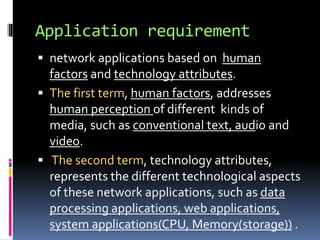
 network applications based on human 
factors and technology attributes. 
 The first term, human factors, addresses 
human perception of different kinds of 
media, such as conventional text, audio and 
video. 
 The second term, technology attributes, 
represents the different technological aspects 
of these network applications, such as data 
processing applications, web applications, 
system applications(CPU, Memory(storage)) .
Example Application requirement 
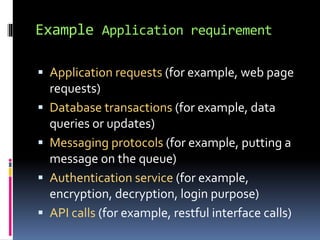
 Application requests (for example, web page 
requests) 
 Database transactions (for example, data 
queries or updates) 
 Messaging protocols (for example, putting a 
message on the queue) 
 Authentication service (for example, 
encryption, decryption, login purpose) 
 API calls (for example, restful interface calls)
Application system
Application system 
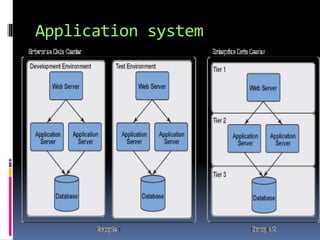
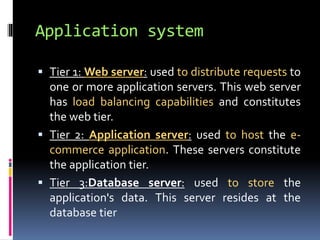
 Tier 1:Web server: used to distribute requests to 
one or more application servers. This web server 
has load balancing capabilities and constitutes 
the web tier. 
 Tier 2: Application server: used to host the e-commerce 
application. These servers constitute 
the application tier. 
 Tier 3:Database server: used to store the 
application's data. This server resides at the 
database tier
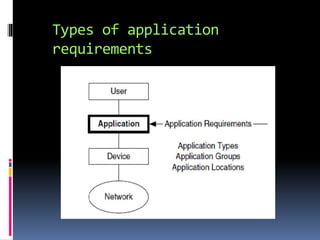
Types of application 
requirements
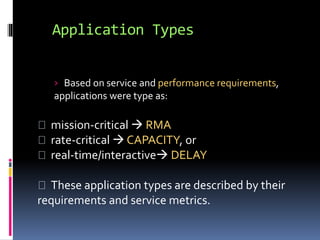
Application Types 
› Based on service and performance requirements, 
applications were type as: 
mission-critical  RMA 
rate-critical  CAPACITY, or 
real-time/interactive DELAY 
These application types are described by their 
requirements and service metrics.
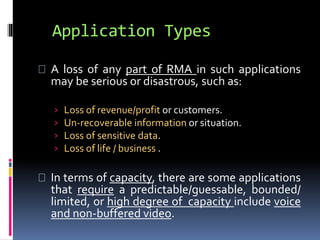
Application Types 
A loss of any part of RMA in such applications 
may be serious or disastrous, such as: 
› Loss of revenue/profit or customers. 
› Un-recoverable information or situation. 
› Loss of sensitive data. 
› Loss of life / business . 
In terms of capacity, there are some applications 
that require a predictable/guessable, bounded/ 
limited, or high degree of capacity include voice 
and non-buffered video.
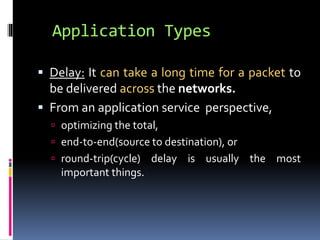
Application Types 
 Delay: It can take a long time for a packet to 
be delivered across the networks. 
 From an application service perspective, 
 optimizing the total, 
 end-to-end(source to destination), or 
 round-trip(cycle) delay is usually the most 
important things.
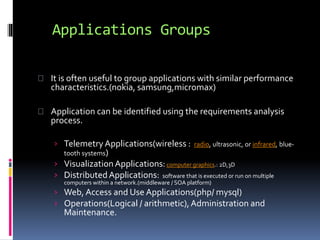
Applications Groups 
It is often useful to group applications with similar performance 
characteristics.(nokia, samsung,micromax) 
Application can be identified using the requirements analysis 
process. 
› Telemetry Applications(wireless : radio, ultrasonic, or infrared, blue-tooth 
systems) 
› Visualization Applications: computer graphics.: 2D,3D 
› Distributed Applications: software that is executed or run on multiple 
computers within a network.(middleware / SOA platform) 
› Web, Access and Use Applications(php/ mysql) 
› Operations(Logical / arithmetic), Administration and 
Maintenance.
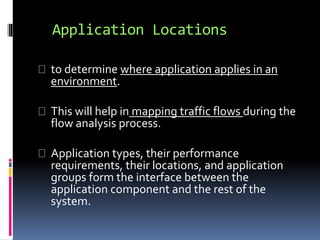
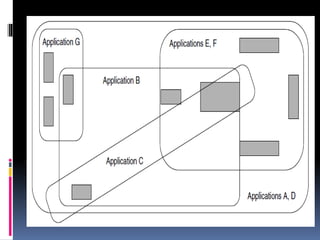
Application Locations 
to determine where application applies in an 
environment. 
This will help in mapping traffic flows during the 
flow analysis process. 
Application types, their performance 
requirements, their locations, and application 
groups form the interface between the 
application component and the rest of the 
system.
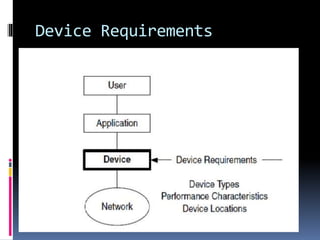
 Device : piece of equipment that has been 
made for some special purpose.
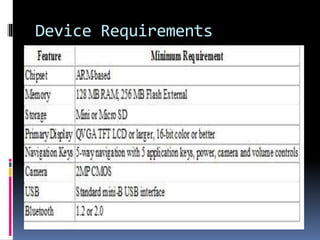
Device Requirements
Device Requirements
Device Type 
 Devices can be grouped into three categories: 
 generic computing devices: (laptop , mobile phone), 
their requirements are important from an end-to-end 
perspective, 
 they provide the interface between applications and 
the network. 
 Servers(windows/unix ): have an impact on the traffic 
flows within the system. 
 specialized devices(wireless) : (blue-tooth/IR/ blue 
tooth headset) are devices that provide specific 
functions to their users.
Performance Characteristics 
 For many environments, it may be difficult to 
determine or measure the performance 
characteristics of its devices. 
 Note that device problems frequently are 
misinterpreted as network problems. 
 Understanding at the device component level can 
help you recognize such bottlenecks/problems 
early in the analysis process.
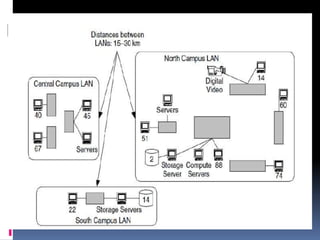
Device Locations 
 Location information helps to determine the 
relationships among components of the system. 
 Location information also helps to determine the 
traffic flow characteristics for the system. 
 The interface between the device component and 
the rest of the system consists of the types of 
devices, their location dependencies, and their 
performance characteristics.
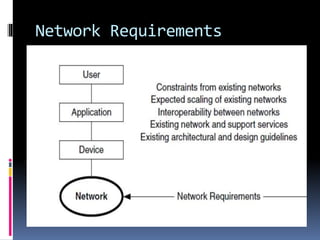
Network requirements 
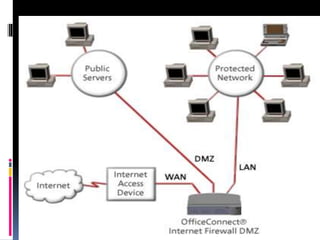
 Network : interconnected systems. 
 Components of a computer network: 
 Hosts : (PCs, laptops, handhelds) 
 routers & switches : (IP router, Ethernet switch) 
 links : (wired, wireless) 
 Protocols : (IP, TCP, CSMA/CD, CSMA/CA) 
 Applications: (network services) 
 humans and service agents
Network Requirements
Existing & Migration / populate 
 Most network architectures/designs today 
need to incorporate existing networks. 
 This includes 
 system upgrades, 
 migrating (move from one part of something to 
another part)to a new or different technology or 
 protocol, or upgrading network infrastructure.
Existing & Migration / populate 
 Sometimes the network architecture and design 

must accommodate any dependencies and 
constraints imposed by the existing network. 
 Examples include the following: 
 Scaling dependencies. How will new network 
change the size and scope of the system? or will 
the change be within the LAN/MAN/WAN 
boundaries of the existing network?
Location dependencies 
. 
 Based on the two – ways 
 Performance constraints: 
 Performance constraints:
Location dependencies 
 Performance constraints: 
 Existing network performance characteristics 
should be integrated into the performance 
requirements of the planned network. 
 Network, system, and support service dependencies. 
 Features : 
 includes network addressing strategies, security, 
choices and configurations of routing protocols, and 
naming strategies.
Location dependencies 
 Interoperability dependencies: 
 The boundaries between existing and planned 
networks are points where service information 
and performance guarantees need to be 
translated. 
 Network obsolescence/ old model. Whenever 
possible, it should be noted that parts of the 
network will need to be transitioned out of the 
planned network.
Network Management & Security 
 There are four categories of network 
management tasks: 
 Monitoring for event notification 
 Monitoring for metrics and planning 
 Network configuration 
 Troubleshooting
List of some potential network 
management requirements: 
 Monitoring methods 
 Instrumentation methods. 
 These include the network management protocols 
(SNMPv3, CMIP, RMON), parameter lists (MIBs), 
monitoring tools, and access methods. 
 Sets of characteristics for monitoring. 
 Centralized versus distributed monitoring. 
 Performance requirements.
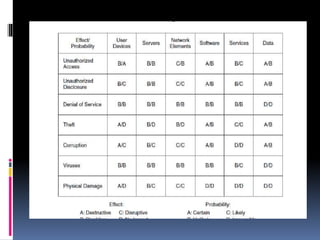
List of some potential(risk) 
network management 
requirements: 
 it is also need to be determined a security risks by 
performing a risk analysis for both the existing 
network and planned network. 
 Security requirements and the results of the risk 
analysis are used to develop a security plan and 
define security policies for the network.
THANK YOU

Requirment anlaysis , application, device, network requirements

  • 1.
    DESIGN AND MANAGEMENTOF COMPUTER NETWORKS Presented By CSK @ oxford engineering college - Trichy APPLICATION REQUIREMENTS
  • 2.
    Types of requirementanalysis  User  Application  Device  Network  Other
  • 3.
    Application Requirements Application requirements are requirements that are determined from application information, experience, or testing, and represent what is needed by applications.  Application requirements are more technical than user requirements but may still be subjective.
  • 4.
    Application requirement network applications based on human factors and technology attributes.  The first term, human factors, addresses human perception of different kinds of media, such as conventional text, audio and video.  The second term, technology attributes, represents the different technological aspects of these network applications, such as data processing applications, web applications, system applications(CPU, Memory(storage)) .
  • 5.
    Example Application requirement  Application requests (for example, web page requests)  Database transactions (for example, data queries or updates)  Messaging protocols (for example, putting a message on the queue)  Authentication service (for example, encryption, decryption, login purpose)  API calls (for example, restful interface calls)
  • 6.
  • 7.
    Application system Tier 1:Web server: used to distribute requests to one or more application servers. This web server has load balancing capabilities and constitutes the web tier.  Tier 2: Application server: used to host the e-commerce application. These servers constitute the application tier.  Tier 3:Database server: used to store the application's data. This server resides at the database tier
  • 8.
    Types of application requirements
  • 9.
    Application Types ›Based on service and performance requirements, applications were type as: mission-critical  RMA rate-critical  CAPACITY, or real-time/interactive DELAY These application types are described by their requirements and service metrics.
  • 10.
    Application Types Aloss of any part of RMA in such applications may be serious or disastrous, such as: › Loss of revenue/profit or customers. › Un-recoverable information or situation. › Loss of sensitive data. › Loss of life / business . In terms of capacity, there are some applications that require a predictable/guessable, bounded/ limited, or high degree of capacity include voice and non-buffered video.
  • 11.
    Application Types Delay: It can take a long time for a packet to be delivered across the networks.  From an application service perspective,  optimizing the total,  end-to-end(source to destination), or  round-trip(cycle) delay is usually the most important things.
  • 12.
    Applications Groups Itis often useful to group applications with similar performance characteristics.(nokia, samsung,micromax) Application can be identified using the requirements analysis process. › Telemetry Applications(wireless : radio, ultrasonic, or infrared, blue-tooth systems) › Visualization Applications: computer graphics.: 2D,3D › Distributed Applications: software that is executed or run on multiple computers within a network.(middleware / SOA platform) › Web, Access and Use Applications(php/ mysql) › Operations(Logical / arithmetic), Administration and Maintenance.
  • 13.
    Application Locations todetermine where application applies in an environment. This will help in mapping traffic flows during the flow analysis process. Application types, their performance requirements, their locations, and application groups form the interface between the application component and the rest of the system.
  • 15.
     Device :piece of equipment that has been made for some special purpose.
  • 16.
  • 17.
  • 18.
    Device Type Devices can be grouped into three categories:  generic computing devices: (laptop , mobile phone), their requirements are important from an end-to-end perspective,  they provide the interface between applications and the network.  Servers(windows/unix ): have an impact on the traffic flows within the system.  specialized devices(wireless) : (blue-tooth/IR/ blue tooth headset) are devices that provide specific functions to their users.
  • 19.
    Performance Characteristics For many environments, it may be difficult to determine or measure the performance characteristics of its devices.  Note that device problems frequently are misinterpreted as network problems.  Understanding at the device component level can help you recognize such bottlenecks/problems early in the analysis process.
  • 20.
    Device Locations Location information helps to determine the relationships among components of the system.  Location information also helps to determine the traffic flow characteristics for the system.  The interface between the device component and the rest of the system consists of the types of devices, their location dependencies, and their performance characteristics.
  • 22.
    Network requirements Network : interconnected systems.  Components of a computer network:  Hosts : (PCs, laptops, handhelds)  routers & switches : (IP router, Ethernet switch)  links : (wired, wireless)  Protocols : (IP, TCP, CSMA/CD, CSMA/CA)  Applications: (network services)  humans and service agents
  • 24.
  • 25.
    Existing & Migration/ populate  Most network architectures/designs today need to incorporate existing networks.  This includes  system upgrades,  migrating (move from one part of something to another part)to a new or different technology or  protocol, or upgrading network infrastructure.
  • 26.
    Existing & Migration/ populate  Sometimes the network architecture and design must accommodate any dependencies and constraints imposed by the existing network.  Examples include the following:  Scaling dependencies. How will new network change the size and scope of the system? or will the change be within the LAN/MAN/WAN boundaries of the existing network?
  • 27.
    Location dependencies .  Based on the two – ways  Performance constraints:  Performance constraints:
  • 28.
    Location dependencies Performance constraints:  Existing network performance characteristics should be integrated into the performance requirements of the planned network.  Network, system, and support service dependencies.  Features :  includes network addressing strategies, security, choices and configurations of routing protocols, and naming strategies.
  • 29.
    Location dependencies Interoperability dependencies:  The boundaries between existing and planned networks are points where service information and performance guarantees need to be translated.  Network obsolescence/ old model. Whenever possible, it should be noted that parts of the network will need to be transitioned out of the planned network.
  • 30.
    Network Management &Security  There are four categories of network management tasks:  Monitoring for event notification  Monitoring for metrics and planning  Network configuration  Troubleshooting
  • 31.
    List of somepotential network management requirements:  Monitoring methods  Instrumentation methods.  These include the network management protocols (SNMPv3, CMIP, RMON), parameter lists (MIBs), monitoring tools, and access methods.  Sets of characteristics for monitoring.  Centralized versus distributed monitoring.  Performance requirements.
  • 32.
    List of somepotential(risk) network management requirements:  it is also need to be determined a security risks by performing a risk analysis for both the existing network and planned network.  Security requirements and the results of the risk analysis are used to develop a security plan and define security policies for the network.
  • 34.