Building a Financial Sustainability
Plan
Reginald Walker and
Associates
By: Reginald Walker, MBA
What is a
Financial
Sustainability
Plan?
A comprehensivelong-range PLAN that provides a road
map to successfully meeting the organizations strategic
mission-drivenfinancial objectives.
Why is a Financial SustainabilityPlan (FSP)
Important?
An FSP assures the organization's ability to continue to fund its missionby:
• Proactively addressing organizational weaknesses and threats
• Providing Managementand Board a tool to measure and benchmark success
• Securing the future through deficit reductionand risk management
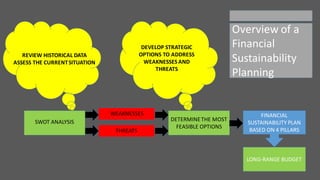
REVIEW HISTORICAL DATA
ASSESS THE CURRENTSITUATION
SWOT ANALYSIS
WEAKNESSES
THREATS
DEVELOP STRATEGIC
OPTIONS TO ADDRESS
WEAKNESSES AND
THREATS
DETERMINETHE MOST
FEASIBLE OPTIONS
FINANCIAL
SUSTAINABILITY PLAN
BASED ON 4 PILLARS
LONG-RANGE BUDGET
Overview of a
Financial
Sustainability
Planning
Review Historical Data
• How have your
programs/initiatives evolvedand
changed?
• Who have your funders been and
what have they funded?
• How much have they funded and
for how long?
ReviewHistorical Data
• What other revenue streams have
you developed?
• How fast or slowly did they
develop?
• Which programs thrived and
which are no longer operating?
ReviewCurrent
Situation
• Strengths – Internal capacities
• Weaknesses – Internal needs
• Opportunities – External openings
• Threats – External challenges
UNDERSTANDYOUR INTERNALCAPACITIESAND
PLOTIN THE SWOTFRAMEWORK
What INTERNAL organizational capacities represent
Strengths or Weaknesses related to achieving our
objectives? Examples include:
• Human Resources and expertise
• I.T. infrastructure/hardware/software
• Digital Marketing/use of social media/website
• Assets (Liquid and Fixed)
What EXTERNAL environmental conditions
represent opportunities or threats related to
achieving our objectives? Examples include:
• Organizational brand community acceptance
• Government regulations (Tax Code)
• General economic conditions
• State and local budget conditions
UNDERSTANDYOUR EXTERNALENVIRONMENT
AND PLOTIN THE SWOTFRAMEWORK
DEVELOP OPTIONSFORADDRESSING
WEAKNESSESAND THREATSTO
ACHIEVING FISCALSUSTAINABILITY
• Achieve your objectives with none of the
resources
• Achieve your objectives with a few of the
resources
• Achieve your objectives with different
resources
FSP PILLAR# 1 WhatEffectiveRevenue
ManagementMethodsHaveWeUsed
andHow do We Maintainthat?
• EffectiveDonor management
• Effectivegrant management
• Effectivecontractcompliance
• Expectedprogram outcomes
• Effectiveand regular pricing reviewfor fee for serviceand
miscellaneousrevenue
FSP PILLAR# 2 What PolicyChangesor New
Policies(That FacilitateEffectiveCost
Management)CanWe Initiate?
• Shared Services
• Outsourcing
• Programmaticjoint venturing
• Use of cloud computing/telecommuting/hoteling
FSP PILLAR # 3 What Steps Can
We Take to Reduce M&G?
• Look for intradepartmentalreorganizationopportunities to
eliminate lowvalueactivities
• Outsourcelower value activitiessuch as facilitiesmaintenance
bookkeeping and I.T. maintenanceservices
• Look for cooperativebuying serviceprovidersthat offer savings
based on the combined spending of multipleorganizations
• Seekways to becomemore energyefficientby purchasing
energyefficientbulbs, solar panels and shutoff timerson lightsin
unused rooms
FSP PILLAR # 4 How Do We
ManageRisk and Position To
Seize Future Opportunity?
• DiversifyRevenueStream
• Implement online giving
• Seek ways to expand service offerings
• Investreservesto generate interest/dividendincomeon
reservesand/or endowmentsprincipal
• Build a Quasi Endowment or Board Restricted Reserve
• Budget Programsto generateoperatingsurpluses and
reinvestin your reserve
• Hold a capitalcampaign to establishan endowmentand
fund program expendituresaccordingto a predetermined
policy
Developing a Financial Sustainability Plan

Developing a Financial Sustainability Plan

  • 1.
    Building a FinancialSustainability Plan Reginald Walker and Associates By: Reginald Walker, MBA
  • 2.
    What is a Financial Sustainability Plan? Acomprehensivelong-range PLAN that provides a road map to successfully meeting the organizations strategic mission-drivenfinancial objectives.
  • 3.
    Why is aFinancial SustainabilityPlan (FSP) Important? An FSP assures the organization's ability to continue to fund its missionby: • Proactively addressing organizational weaknesses and threats • Providing Managementand Board a tool to measure and benchmark success • Securing the future through deficit reductionand risk management
  • 4.
    REVIEW HISTORICAL DATA ASSESSTHE CURRENTSITUATION SWOT ANALYSIS WEAKNESSES THREATS DEVELOP STRATEGIC OPTIONS TO ADDRESS WEAKNESSES AND THREATS DETERMINETHE MOST FEASIBLE OPTIONS FINANCIAL SUSTAINABILITY PLAN BASED ON 4 PILLARS LONG-RANGE BUDGET Overview of a Financial Sustainability Planning
  • 5.
    Review Historical Data •How have your programs/initiatives evolvedand changed? • Who have your funders been and what have they funded? • How much have they funded and for how long?
  • 6.
    ReviewHistorical Data • Whatother revenue streams have you developed? • How fast or slowly did they develop? • Which programs thrived and which are no longer operating?
  • 7.
    ReviewCurrent Situation • Strengths –Internal capacities • Weaknesses – Internal needs • Opportunities – External openings • Threats – External challenges
  • 8.
    UNDERSTANDYOUR INTERNALCAPACITIESAND PLOTIN THESWOTFRAMEWORK What INTERNAL organizational capacities represent Strengths or Weaknesses related to achieving our objectives? Examples include: • Human Resources and expertise • I.T. infrastructure/hardware/software • Digital Marketing/use of social media/website • Assets (Liquid and Fixed)
  • 9.
    What EXTERNAL environmentalconditions represent opportunities or threats related to achieving our objectives? Examples include: • Organizational brand community acceptance • Government regulations (Tax Code) • General economic conditions • State and local budget conditions UNDERSTANDYOUR EXTERNALENVIRONMENT AND PLOTIN THE SWOTFRAMEWORK
  • 10.
    DEVELOP OPTIONSFORADDRESSING WEAKNESSESAND THREATSTO ACHIEVINGFISCALSUSTAINABILITY • Achieve your objectives with none of the resources • Achieve your objectives with a few of the resources • Achieve your objectives with different resources
  • 11.
    FSP PILLAR# 1WhatEffectiveRevenue ManagementMethodsHaveWeUsed andHow do We Maintainthat? • EffectiveDonor management • Effectivegrant management • Effectivecontractcompliance • Expectedprogram outcomes • Effectiveand regular pricing reviewfor fee for serviceand miscellaneousrevenue
  • 12.
    FSP PILLAR# 2What PolicyChangesor New Policies(That FacilitateEffectiveCost Management)CanWe Initiate? • Shared Services • Outsourcing • Programmaticjoint venturing • Use of cloud computing/telecommuting/hoteling
  • 13.
    FSP PILLAR #3 What Steps Can We Take to Reduce M&G? • Look for intradepartmentalreorganizationopportunities to eliminate lowvalueactivities • Outsourcelower value activitiessuch as facilitiesmaintenance bookkeeping and I.T. maintenanceservices • Look for cooperativebuying serviceprovidersthat offer savings based on the combined spending of multipleorganizations • Seekways to becomemore energyefficientby purchasing energyefficientbulbs, solar panels and shutoff timerson lightsin unused rooms
  • 14.
    FSP PILLAR #4 How Do We ManageRisk and Position To Seize Future Opportunity? • DiversifyRevenueStream • Implement online giving • Seek ways to expand service offerings • Investreservesto generate interest/dividendincomeon reservesand/or endowmentsprincipal • Build a Quasi Endowment or Board Restricted Reserve • Budget Programsto generateoperatingsurpluses and reinvestin your reserve • Hold a capitalcampaign to establishan endowmentand fund program expendituresaccordingto a predetermined policy