FINANCIAL PLANNING
TOOLS AND CONCEPTS
D I S C U S S T H E I M P O R TA N C E O F
P L A N N I N G .
• Ask the learners how they see themselves five years from now. Write the answers on
the board and tally repeating answers.
• Reveal that their answers are the long-term goals that they plan to achieve in the
future. Tell the learners that in the activity you did, you have demonstrated that
planning plays an important role in everyday life as the learners already have in mind a
set of plans for the next five years. Tell them that even those who said they are not yet
sure what they want five years from now will probably still have an idea of what kind of
life they want. They are still in the process of planning.
OVERVIEW
In every organization, Financial planning is important especially the
tools and concepts that determine the best uses of the Financial
resources of an organization. It helps the business to attain its
objectives and to ensure the sufficiency of funds within the organization
and reduces the uncertainties which can be a hindrance to growth of
the business to safeguard the stability and profitability in concern.
“If you fail to plan, you plan to fail”
• Financial plan is a document containing a person’s current money situation and long-term monetary
goals, as well as strategies to achieve those goals.
• In either case, it begins with a thorough evaluation of the individual’s current financial state and future
expectations.
• Financial planning is analyzing the investment and financing alternatives available to a firm
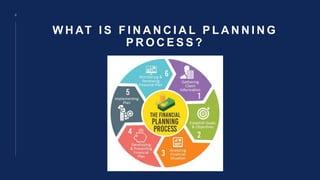
W H AT I S F I N A N C I A L P L A N N I N G
P R O C E S S ?
4
Planning is very much related to another management function, controlling. These
two management functions reinforce each other, and both are very important for
the success of an organization.
Planning is an important aspect of the firm’s operations because it provides road
maps for guiding, coordinating, and controlling the firm’s actions to achieve its
objectives (Gitman & Zutter, 2012).
Management planning is about setting the goals of the organization and identifying
ways to achieve them. This maybe be broken down into long-term plans and short-
term plans. Long-term plans reflected in a company’s business strategy. In the
process of planning, resources have be identified. These resources include work
force resources, production capacity, and financial resources.
Continue by focusing on one example given by the learners. Suppose some of the
students answered that in five years, they will be owners of a successful business. How
will they be able to attain this goal?
• Long term goal: Graduate from a university
• Short term goal: Pass the college entrance exam
T W O P H A S E S O F F I N A N C I A L
P L A N N I N G
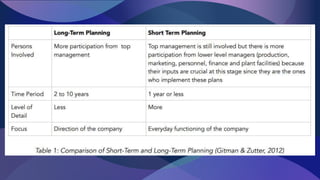
Long-term financial plans
These are a set of goals that lay out the
overall direction of the company.
- A long-term financial plan is an integrated
strategy that takes into account various
departments such as sales, production,
marketing, and operations for the purpose of
guiding these departments towards strategic
goals.
- Those long-term plans consider proposed
outlays for fixed assets, research and
development activities, marketing and product
development actions, capital structure, and
major sources of financing.
- Also included would be termination of
existing projects, product lines, or lines of
business; repayment or retirement of
outstanding debts; and any planned
acquisitions(Gitman & Zutter, 2012).
Short-term financial plans
- Specify short-term financial actions
and the anticipated impact of those
actions. Part of short term financial
plans include setting the sales forecast
and other forms of operating and
financial data. This would then
translate into operating budgets, the
cash budget, and pro forma financial
statements (Gitman & Zutter, 2012).
7
sales forecast is a prediction of future sales revenue.
pro forma financial statements – statements that show the
effects of proposed transactions and events as if they
occurred.
Pro forma – for the sake of form only.
8
Crypto: investing & trading
LONG - TERM FINANCIAL
PLANNING
o Long-term financial planning combines financial forecasting with
strategizing. It is a highly collaborative process that considers future
scenarios and helps governments navigate challenges.
o Long-term financial planning is the process of aligning financial capacity with
long-term service objectives.
Financial Forecasting – estimates the future financial outcomes for a company. They are used to
develop projections for profit and loss statements, balance sheets, and other cash flow forecasts.
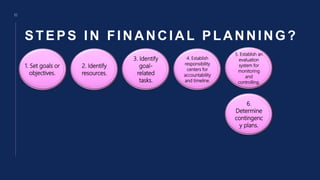
STEPS IN FINANCIAL PLANNING?
10
1. Set goals or
objectives.
2. Identify
resources.
3. Identify
goal-
related
tasks.
4. Establish
responsibility
centers for
accountability
and timeline.
5. Establish an
evaluation
system for
monitoring
and
controlling.
6.
Determine
contingenc
y plans.
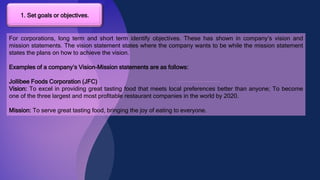
1. Set goals or objectives.
For corporations, long term and short term identify objectives. These has shown in company’s vision and
mission statements. The vision statement states where the company wants to be while the mission statement
states the plans on how to achieve the vision.
Examples of a company’s Vision-Mission statements are as follows:
Jollibee Foods Corporation (JFC)
Vision: To excel in providing great tasting food that meets local preferences better than anyone; To become
one of the three largest and most profitable restaurant companies in the world by 2020.
Mission: To serve great tasting food, bringing the joy of eating to everyone.
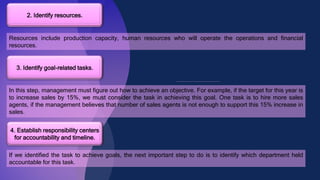
2. Identify resources.
Resources include production capacity, human resources who will operate the operations and financial
resources.
3. Identify goal-related tasks.
In this step, management must figure out how to achieve an objective. For example, if the target for this year is
to increase sales by 15%, we must consider the task in achieving this goal. One task is to hire more sales
agents, if the management believes that number of sales agents is not enough to support this 15% increase in
sales.
4. Establish responsibility centers
for accountability and timeline.
If we identified the task to achieve goals, the next important step to do is to identify which department held
accountable for this task.
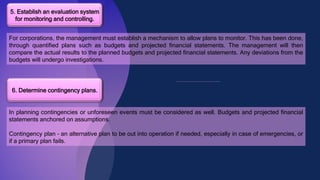
5. Establish an evaluation system
for monitoring and controlling.
For corporations, the management must establish a mechanism to allow plans to monitor. This has been done,
through quantified plans such as budgets and projected financial statements. The management will then
compare the actual results to the planned budgets and projected financial statements. Any deviations from the
budgets will undergo investigations.
6. Determine contingency plans.
In planning contingencies or unforeseen events must be considered as well. Budgets and projected financial
statements anchored on assumptions.
Contingency plan – an alternative plan to be out into operation if needed, especially in case of emergencies, or
if a primary plan fails.

3 Financial Planning Tools and Concepts.pptx

  • 1.
  • 2.
    D I SC U S S T H E I M P O R TA N C E O F P L A N N I N G . • Ask the learners how they see themselves five years from now. Write the answers on the board and tally repeating answers. • Reveal that their answers are the long-term goals that they plan to achieve in the future. Tell the learners that in the activity you did, you have demonstrated that planning plays an important role in everyday life as the learners already have in mind a set of plans for the next five years. Tell them that even those who said they are not yet sure what they want five years from now will probably still have an idea of what kind of life they want. They are still in the process of planning.
  • 3.
    OVERVIEW In every organization,Financial planning is important especially the tools and concepts that determine the best uses of the Financial resources of an organization. It helps the business to attain its objectives and to ensure the sufficiency of funds within the organization and reduces the uncertainties which can be a hindrance to growth of the business to safeguard the stability and profitability in concern. “If you fail to plan, you plan to fail” • Financial plan is a document containing a person’s current money situation and long-term monetary goals, as well as strategies to achieve those goals. • In either case, it begins with a thorough evaluation of the individual’s current financial state and future expectations. • Financial planning is analyzing the investment and financing alternatives available to a firm
  • 4.
    W H ATI S F I N A N C I A L P L A N N I N G P R O C E S S ? 4
  • 5.
    Planning is verymuch related to another management function, controlling. These two management functions reinforce each other, and both are very important for the success of an organization. Planning is an important aspect of the firm’s operations because it provides road maps for guiding, coordinating, and controlling the firm’s actions to achieve its objectives (Gitman & Zutter, 2012). Management planning is about setting the goals of the organization and identifying ways to achieve them. This maybe be broken down into long-term plans and short- term plans. Long-term plans reflected in a company’s business strategy. In the process of planning, resources have be identified. These resources include work force resources, production capacity, and financial resources.
  • 6.
    Continue by focusingon one example given by the learners. Suppose some of the students answered that in five years, they will be owners of a successful business. How will they be able to attain this goal? • Long term goal: Graduate from a university • Short term goal: Pass the college entrance exam
  • 7.
    T W OP H A S E S O F F I N A N C I A L P L A N N I N G Long-term financial plans These are a set of goals that lay out the overall direction of the company. - A long-term financial plan is an integrated strategy that takes into account various departments such as sales, production, marketing, and operations for the purpose of guiding these departments towards strategic goals. - Those long-term plans consider proposed outlays for fixed assets, research and development activities, marketing and product development actions, capital structure, and major sources of financing. - Also included would be termination of existing projects, product lines, or lines of business; repayment or retirement of outstanding debts; and any planned acquisitions(Gitman & Zutter, 2012). Short-term financial plans - Specify short-term financial actions and the anticipated impact of those actions. Part of short term financial plans include setting the sales forecast and other forms of operating and financial data. This would then translate into operating budgets, the cash budget, and pro forma financial statements (Gitman & Zutter, 2012). 7 sales forecast is a prediction of future sales revenue. pro forma financial statements – statements that show the effects of proposed transactions and events as if they occurred. Pro forma – for the sake of form only.
  • 8.
    8 Crypto: investing &trading LONG - TERM FINANCIAL PLANNING o Long-term financial planning combines financial forecasting with strategizing. It is a highly collaborative process that considers future scenarios and helps governments navigate challenges. o Long-term financial planning is the process of aligning financial capacity with long-term service objectives. Financial Forecasting – estimates the future financial outcomes for a company. They are used to develop projections for profit and loss statements, balance sheets, and other cash flow forecasts.
  • 10.
    STEPS IN FINANCIALPLANNING? 10 1. Set goals or objectives. 2. Identify resources. 3. Identify goal- related tasks. 4. Establish responsibility centers for accountability and timeline. 5. Establish an evaluation system for monitoring and controlling. 6. Determine contingenc y plans.
  • 11.
    1. Set goalsor objectives. For corporations, long term and short term identify objectives. These has shown in company’s vision and mission statements. The vision statement states where the company wants to be while the mission statement states the plans on how to achieve the vision. Examples of a company’s Vision-Mission statements are as follows: Jollibee Foods Corporation (JFC) Vision: To excel in providing great tasting food that meets local preferences better than anyone; To become one of the three largest and most profitable restaurant companies in the world by 2020. Mission: To serve great tasting food, bringing the joy of eating to everyone.
  • 12.
    2. Identify resources. Resourcesinclude production capacity, human resources who will operate the operations and financial resources. 3. Identify goal-related tasks. In this step, management must figure out how to achieve an objective. For example, if the target for this year is to increase sales by 15%, we must consider the task in achieving this goal. One task is to hire more sales agents, if the management believes that number of sales agents is not enough to support this 15% increase in sales. 4. Establish responsibility centers for accountability and timeline. If we identified the task to achieve goals, the next important step to do is to identify which department held accountable for this task.
  • 13.
    5. Establish anevaluation system for monitoring and controlling. For corporations, the management must establish a mechanism to allow plans to monitor. This has been done, through quantified plans such as budgets and projected financial statements. The management will then compare the actual results to the planned budgets and projected financial statements. Any deviations from the budgets will undergo investigations. 6. Determine contingency plans. In planning contingencies or unforeseen events must be considered as well. Budgets and projected financial statements anchored on assumptions. Contingency plan – an alternative plan to be out into operation if needed, especially in case of emergencies, or if a primary plan fails.