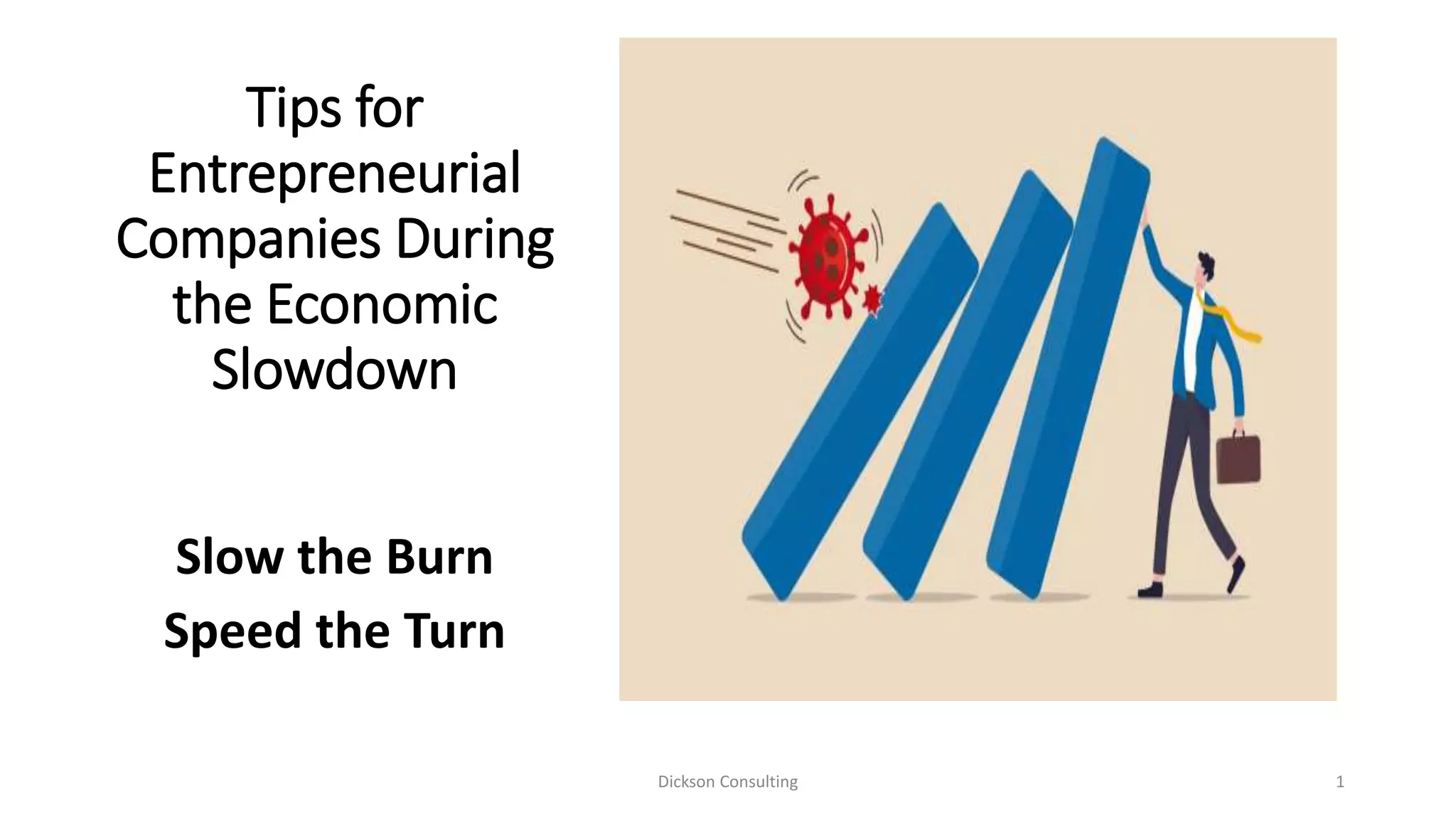
Tips for
Entrepreneurial
Companies During
the Economic
Slowdown
Slow the Burn
Speed the Turn
Dickson Consulting 1
Overview
Prepare detailed short-term forecasts
Strengthen the balance sheet
Cut costs and reduce burn rates
Focus on revenue generation
Focus on variable costs
Shift to equity-based compensation
Slow down payables
Accelerate receivables
Turn inventories
Explore funding and financing alternatives
Dickson Consulting 2
Prepare Detailed Short-Term Forecasts
Forecasts are the GPS system to tell where you are
headed.
Forecast realistic scenarios. Balance sheet and income
statement forecasts are necessary to forecast cash flow.
Update the short-term forecast frequently as conditions
change!
Obtain an independent perspective from a trusted
advisor. Dickson Consulting 3
Strengthen the Balance Sheet
Balance sheet reflects a company’s financial position at a
point in time (i.e. month end). See slide following.
Improve financial ratios, particularly those focused on
solvency and efficiency. See slides following.
More cash; fewer short-term liabilities!
Exhaust every opportunity to generate additional
working capital without taking on additional liabilities.
Dickson Consulting 4
Balance Sheet
The purpose of the balance sheet is to report the financial position of an accounting entity at a
particular point in time. It reflects an entities assets, liabilities and net equity at a point in time, usually
as of the end of a month and year. It reports what is owned, owed and the residual interest.
Assets are probable future economic benefits obtained or controlled by a particular entity as a result of
past transactions or events. Examples include cash, accounts receivable, inventory, buildings and
equipment. For example, if an entity has a factory that made computers, then it would be considered
an asset because the factory would produce cars that would be sold in the market for cash.
Liabilities are probable future sacrifices of economic benefits arising from present obligations of a
particular entity to transfer assets or provide services to other entities in the future as a result of
past transactions or events. Examples are debt, accounts payable, unearned revenues and bonds
payable.
Equity is the residual balance. Assets – liabilities = equity. Equity is commonly called stockholders’
equity if the business is a corporation as it represents the financing provided by the stockholders
along with the earnings from the business not paid out as dividends (retained earnings).
Dickson Consulting 5
Types of Assets and Liabilities
Assets
There are two different types of assets
shown on a balance sheet-current
assets and non-current assets
Current assets are assets that will be
used or turned into cash within one
year. Examples include cash, accounts
receivable, inventory, short-term
investments, supplies and prepaids.
Non-current assets comprise the
remainder of the assets. These include
accounts such as long-term
investments, land, building,
equipment, patents and intangible
assets.
Liabilities
There are two different types of liabilities
shown on a balance sheet–current liabilities
and long-term liabilities.
Current liabilities are obligations that will be
paid in cash (or other services) or satisfied
by providing services within the coming
year. Examples include accounts payable,
short-term notes payable, and taxes payable
Long-term liabilities are obligations that will
satisfied after one year. Examples include
long-term debt and deferred taxes.
Dickson Consulting 6
Financial Statement Analysis-Solvency
Quick Ratio=current assets-inventory/divided by liabilities. Also called the acid
test ratio. Indicative of short-term ability to use assets to satisfy current
liabilities.
Current Ratio=current assets divided by current
liabilities. Includes inventory that will be turned into cash.
Debt to Equity Ratio=short-term debt plus long-term debt
divided by shareholders equity.
Debt Service Coverage Ratio=EBITDA divided by annual principal plus interest
payments. Measure for lenders to determine whether an entity can make debt
payments. A higher ratio is favorable. A lower ratio indicates an entity could
have problems meeting its debt obligations.
Dickson Consulting 7
Financial Statement Analysis-Efficiency
Accounts receivable turnover=average accounts receivable for a period divided by the net credit sales or
revenues for the same period. Measures how efficiently an entity collects accounts on credit extended.
Days sales (revenue) in accounts receivable=accounts receivable divided by total credit sales in the accounting
period times days in accounting period or average accounts receivable divided by average daily credit sales. A
high days sales outstanding may indicate a customer base with credit problems or an entity that is easier with
its credit policy or collection activity.
Inventory turnover=net sales divided by average inventory at selling price or cost of goods sold divided by
average inventory at cost.. This is a measure of the number of times inventory is used or sold in a time period.
A low turnover may indicate overstocking or high inventory levels. But higher inventory levels are sometimes
maintained in anticipation of rising prices or expected shortages. If inventory levels are high there is an
additional cost for warehousing. A high inventory turnover rate may indicate inadequate inventory levels
which could result in a loss of business opportunities.
Return on Sales=operating profit or margin divided by net sales which is expressed as a percentage. It is a
measure of how efficiently an entity turns sales or revenue into profits or the amount of profit earned per
dollar of sales
Return on Equity=net income divided by shareholders equity. An overall measure of performance─profit
earned per dollar of investment. It is also considered an entities return on net assets. Return on equity is a
factor in valuation of an entities market value.
Dickson Consulting 8
Cut Costs and Reduce
Burn Rates
“A penny saved is a penny earned”. Quote
supposedly from Ben Franklin.
Is the spend really necessary on a short-
term basis? Marketing costs; business
development expenses; long-term R&D?
Early decisions to cut costs are rarely
regretted!
Dickson Consulting 9
Focus on Revenue Generation
Become a more efficient customer-focused
organization rather than a market-focused one.
Focus on revenue generation. Eliminate other
distractions.
Rethink the go-to-market plan and focus on
customers who have the resources to purchase your
product or service.
Dickson Consulting 10
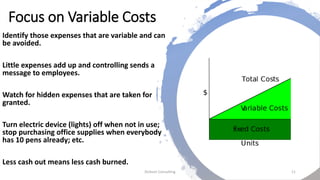
Focus on Variable Costs
Identify those expenses that are variable and can
be avoided.
Little expenses add up and controlling sends a
message to employees.
Watch for hidden expenses that are taken for
granted.
Turn electric device (lights) off when not in use;
stop purchasing office supplies when everybody
has 10 pens already; etc.
Less cash out means less cash burned.
Dickson Consulting 11
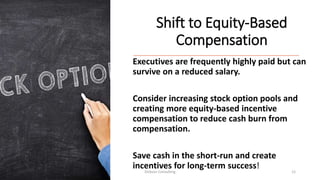
Shift to Equity-Based
Compensation
Executives are frequently highly paid but can
survive on a reduced salary.
Consider increasing stock option pools and
creating more equity-based incentive
compensation to reduce cash burn from
compensation.
Save cash in the short-run and create
incentives for long-term success!Dickson Consulting 12
Slow Down Payables
Stay in frequent contact with your vendors, at
as high as level as possible. Communicate
honestly!
Attempt to negotiated longer payment terms
or consider purchasing upfront at a discount
or in bulk.
Sometimes if you ask, you shall receive!.
Dickson Consulting 13
Accelerate Receivables
Stay in touch with your customers and monitor their
payments. Don’t let them slide!
Understand your customers business and their
position in the industry…in case they may have
financial problems.
Use ratios to evaluate individual customer and overall
collection efficiency.
Dickson Consulting 14
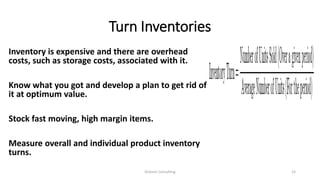
Turn Inventories
Inventory is expensive and there are overhead
costs, such as storage costs, associated with it.
Know what you got and develop a plan to get rid of
it at optimum value.
Stock fast moving, high margin items.
Measure overall and individual product inventory
turns.
Dickson Consulting 15
Explore Funding and Financing Alternatives
Pursue government PP funding if it is still available.
Apply for grants administered by the Small Business
Innovation Research and Small Business Technology
transfer programs.
Approach existing investors for short-term loans or
additional investment.
Dickson Consulting 16
Contact Information
Bob Dickson
724-272-1527
bo@dicksonconsulting.biz
www.dicksonconsulting.biz
Connect with me on LinkedIn
https://www.linkedin.com/in/dic
kson1/
Dickson Consulting 17
THE END
I hope that this presentation was
informative and useful to you!
Dickson Consulting 18

Financial Tips for Survival

  • 1.
    Tips for Entrepreneurial Companies During theEconomic Slowdown Slow the Burn Speed the Turn Dickson Consulting 1
  • 2.
    Overview Prepare detailed short-termforecasts Strengthen the balance sheet Cut costs and reduce burn rates Focus on revenue generation Focus on variable costs Shift to equity-based compensation Slow down payables Accelerate receivables Turn inventories Explore funding and financing alternatives Dickson Consulting 2
  • 3.
    Prepare Detailed Short-TermForecasts Forecasts are the GPS system to tell where you are headed. Forecast realistic scenarios. Balance sheet and income statement forecasts are necessary to forecast cash flow. Update the short-term forecast frequently as conditions change! Obtain an independent perspective from a trusted advisor. Dickson Consulting 3
  • 4.
    Strengthen the BalanceSheet Balance sheet reflects a company’s financial position at a point in time (i.e. month end). See slide following. Improve financial ratios, particularly those focused on solvency and efficiency. See slides following. More cash; fewer short-term liabilities! Exhaust every opportunity to generate additional working capital without taking on additional liabilities. Dickson Consulting 4
  • 5.
    Balance Sheet The purposeof the balance sheet is to report the financial position of an accounting entity at a particular point in time. It reflects an entities assets, liabilities and net equity at a point in time, usually as of the end of a month and year. It reports what is owned, owed and the residual interest. Assets are probable future economic benefits obtained or controlled by a particular entity as a result of past transactions or events. Examples include cash, accounts receivable, inventory, buildings and equipment. For example, if an entity has a factory that made computers, then it would be considered an asset because the factory would produce cars that would be sold in the market for cash. Liabilities are probable future sacrifices of economic benefits arising from present obligations of a particular entity to transfer assets or provide services to other entities in the future as a result of past transactions or events. Examples are debt, accounts payable, unearned revenues and bonds payable. Equity is the residual balance. Assets – liabilities = equity. Equity is commonly called stockholders’ equity if the business is a corporation as it represents the financing provided by the stockholders along with the earnings from the business not paid out as dividends (retained earnings). Dickson Consulting 5
  • 6.
    Types of Assetsand Liabilities Assets There are two different types of assets shown on a balance sheet-current assets and non-current assets Current assets are assets that will be used or turned into cash within one year. Examples include cash, accounts receivable, inventory, short-term investments, supplies and prepaids. Non-current assets comprise the remainder of the assets. These include accounts such as long-term investments, land, building, equipment, patents and intangible assets. Liabilities There are two different types of liabilities shown on a balance sheet–current liabilities and long-term liabilities. Current liabilities are obligations that will be paid in cash (or other services) or satisfied by providing services within the coming year. Examples include accounts payable, short-term notes payable, and taxes payable Long-term liabilities are obligations that will satisfied after one year. Examples include long-term debt and deferred taxes. Dickson Consulting 6
  • 7.
    Financial Statement Analysis-Solvency QuickRatio=current assets-inventory/divided by liabilities. Also called the acid test ratio. Indicative of short-term ability to use assets to satisfy current liabilities. Current Ratio=current assets divided by current liabilities. Includes inventory that will be turned into cash. Debt to Equity Ratio=short-term debt plus long-term debt divided by shareholders equity. Debt Service Coverage Ratio=EBITDA divided by annual principal plus interest payments. Measure for lenders to determine whether an entity can make debt payments. A higher ratio is favorable. A lower ratio indicates an entity could have problems meeting its debt obligations. Dickson Consulting 7
  • 8.
    Financial Statement Analysis-Efficiency Accountsreceivable turnover=average accounts receivable for a period divided by the net credit sales or revenues for the same period. Measures how efficiently an entity collects accounts on credit extended. Days sales (revenue) in accounts receivable=accounts receivable divided by total credit sales in the accounting period times days in accounting period or average accounts receivable divided by average daily credit sales. A high days sales outstanding may indicate a customer base with credit problems or an entity that is easier with its credit policy or collection activity. Inventory turnover=net sales divided by average inventory at selling price or cost of goods sold divided by average inventory at cost.. This is a measure of the number of times inventory is used or sold in a time period. A low turnover may indicate overstocking or high inventory levels. But higher inventory levels are sometimes maintained in anticipation of rising prices or expected shortages. If inventory levels are high there is an additional cost for warehousing. A high inventory turnover rate may indicate inadequate inventory levels which could result in a loss of business opportunities. Return on Sales=operating profit or margin divided by net sales which is expressed as a percentage. It is a measure of how efficiently an entity turns sales or revenue into profits or the amount of profit earned per dollar of sales Return on Equity=net income divided by shareholders equity. An overall measure of performance─profit earned per dollar of investment. It is also considered an entities return on net assets. Return on equity is a factor in valuation of an entities market value. Dickson Consulting 8
  • 9.
    Cut Costs andReduce Burn Rates “A penny saved is a penny earned”. Quote supposedly from Ben Franklin. Is the spend really necessary on a short- term basis? Marketing costs; business development expenses; long-term R&D? Early decisions to cut costs are rarely regretted! Dickson Consulting 9
  • 10.
    Focus on RevenueGeneration Become a more efficient customer-focused organization rather than a market-focused one. Focus on revenue generation. Eliminate other distractions. Rethink the go-to-market plan and focus on customers who have the resources to purchase your product or service. Dickson Consulting 10
  • 11.
    Focus on VariableCosts Identify those expenses that are variable and can be avoided. Little expenses add up and controlling sends a message to employees. Watch for hidden expenses that are taken for granted. Turn electric device (lights) off when not in use; stop purchasing office supplies when everybody has 10 pens already; etc. Less cash out means less cash burned. Dickson Consulting 11
  • 12.
    Shift to Equity-Based Compensation Executivesare frequently highly paid but can survive on a reduced salary. Consider increasing stock option pools and creating more equity-based incentive compensation to reduce cash burn from compensation. Save cash in the short-run and create incentives for long-term success!Dickson Consulting 12
  • 13.
    Slow Down Payables Stayin frequent contact with your vendors, at as high as level as possible. Communicate honestly! Attempt to negotiated longer payment terms or consider purchasing upfront at a discount or in bulk. Sometimes if you ask, you shall receive!. Dickson Consulting 13
  • 14.
    Accelerate Receivables Stay intouch with your customers and monitor their payments. Don’t let them slide! Understand your customers business and their position in the industry…in case they may have financial problems. Use ratios to evaluate individual customer and overall collection efficiency. Dickson Consulting 14
  • 15.
    Turn Inventories Inventory isexpensive and there are overhead costs, such as storage costs, associated with it. Know what you got and develop a plan to get rid of it at optimum value. Stock fast moving, high margin items. Measure overall and individual product inventory turns. Dickson Consulting 15
  • 16.
    Explore Funding andFinancing Alternatives Pursue government PP funding if it is still available. Apply for grants administered by the Small Business Innovation Research and Small Business Technology transfer programs. Approach existing investors for short-term loans or additional investment. Dickson Consulting 16
  • 17.
    Contact Information Bob Dickson 724-272-1527 bo@dicksonconsulting.biz www.dicksonconsulting.biz Connectwith me on LinkedIn https://www.linkedin.com/in/dic kson1/ Dickson Consulting 17
  • 18.
    THE END I hopethat this presentation was informative and useful to you! Dickson Consulting 18

Editor's Notes

  • #6 ASSETS RESULT IN CASH LIABILITIES USE CASH EQUITY IS THE RESIDUAL.
  • #7 SUMMARIZE ABOVE
  • #8 RATIOS FOR SHORT-TERM CASH NEEDS. ALSO RATIOS FREQUENTLY BUILD INTO DEBT AGREEMENT COVENANTS.
  • #9 VARIOUS MEASRUES OF EFFICIENCY.
  • #18 MY CONTACT INFORMATION. BUT IF YOU WANT A COPY OF THE PRESENTATION SEND CHRISTIAN A CHECK WITH AT LEAST A $10 CONTRIBUTION.