Welcome
ADVANCED STRATEGIC
MANAGEMENT
Dr. JAMSHID VP
Assistant Professor
DCMS
Farook College, Calicut
Module No - 1
 Introduction – Concepts: Strategy & SM –
Levels of Strategy – SM process – Models of
SM – Vision – Mission – Objectives – Goals –
Strategic implications of social and ethical
issues.
The Concept - Strategy
 Strategy is an action that managers take to
attain one or more of the organization’s goals.
 Strategy can also be defined as “A general
direction set for the company and its various
components to achieve a desired state in the
future”.
 A strategy is all about integrating
organizational activities and utilizing and
allocating the scarce resources within the
organizational environment so as to meet the
present objectives.
Case Study – Some of the hints
related with strategy
 ‘How to gain competitive edge over rivals?‘
 ‘What is the distinctive competency and the
unique strategic positioning that contributes to
competitive advantage?‘
 ‘How attractive is this industry and how to
sustain competitive advantage in this industry',
etc.,
Strategic Management – the
concept
 Strategic management is the management of
an organization’s resources to achieve its
goals and objectives.
 Strategic management involves setting
objectives, analyzing the competitive
environment, analyzing the internal
organization, evaluating strategies and
ensuring that management rolls out the
strategies across the organization.
Levels of Strategy
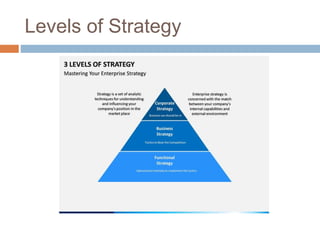
1. Corporate Level Strategy
 At this level, strategic decisions relate to
organisation-wide policies are taken care by
top-level (BOD) management with a vision of
determining “Where the company wants to be?
 It has two main aspects. 1) Formulation of
Strategy (Strategic planning). 2) Strategy
implementation.
 Ex: Major financial decisions like acquisition,
diversification and structural redesigning
belong to this level.
2. Business Level Strategy
 At this level, multifunctional strategies
developed at corporate level are formulated
and implemented for specific product market in
which the business operates.
 Decisions this level include policies involving:
 New product development
 Marketing mix
 Research and development
 personnel
Thank You

Advanced Strategic Management - Introduction

  • 1.
  • 2.
    ADVANCED STRATEGIC MANAGEMENT Dr. JAMSHIDVP Assistant Professor DCMS Farook College, Calicut
  • 3.
    Module No -1  Introduction – Concepts: Strategy & SM – Levels of Strategy – SM process – Models of SM – Vision – Mission – Objectives – Goals – Strategic implications of social and ethical issues.
  • 4.
    The Concept -Strategy  Strategy is an action that managers take to attain one or more of the organization’s goals.  Strategy can also be defined as “A general direction set for the company and its various components to achieve a desired state in the future”.  A strategy is all about integrating organizational activities and utilizing and allocating the scarce resources within the organizational environment so as to meet the present objectives.
  • 5.
    Case Study –Some of the hints related with strategy  ‘How to gain competitive edge over rivals?‘  ‘What is the distinctive competency and the unique strategic positioning that contributes to competitive advantage?‘  ‘How attractive is this industry and how to sustain competitive advantage in this industry', etc.,
  • 6.
    Strategic Management –the concept  Strategic management is the management of an organization’s resources to achieve its goals and objectives.  Strategic management involves setting objectives, analyzing the competitive environment, analyzing the internal organization, evaluating strategies and ensuring that management rolls out the strategies across the organization.
  • 7.
  • 8.
    1. Corporate LevelStrategy  At this level, strategic decisions relate to organisation-wide policies are taken care by top-level (BOD) management with a vision of determining “Where the company wants to be?  It has two main aspects. 1) Formulation of Strategy (Strategic planning). 2) Strategy implementation.  Ex: Major financial decisions like acquisition, diversification and structural redesigning belong to this level.
  • 9.
    2. Business LevelStrategy  At this level, multifunctional strategies developed at corporate level are formulated and implemented for specific product market in which the business operates.  Decisions this level include policies involving:  New product development  Marketing mix  Research and development  personnel
  • 10.