Predict Sri Lanka Extreme
Precipitation through El Nino
    Southern Oscillation

             R.M.S.P. Ratnayake
          PGIS/SC/M.Sc./ APS/10/20


            MSc in Applied Statistics
       Post Graduate Institute of Science/
            University of Peradeniya
Over view
•   Introduction
•   Motivation and Background
•   Problem
•   Objectives
•   Hypothesis
•   Methodology
•   Organization
•   Time Frame
Introduction
• Sri Lanka economy mainly depend on
  Agriculture Industry.
• Sri Lankan Agriculture mainly depend on two
  monsoons.
• Therefore extreme precipitation changes the
  natural agriculture cycle.
• Expose to Disaster and Hazard potentials.
Problem
• Extreme Precipitation requires extra effort
  beyond basic Statistical Analysis.
• There is no proper model to predict Extreme
  Precipitation.
• Heavy Precipitation is a result of multiple
  courses.
• Sri Lanka climate data are spatially coherent.
• Analysis required longer period precipitation
  data
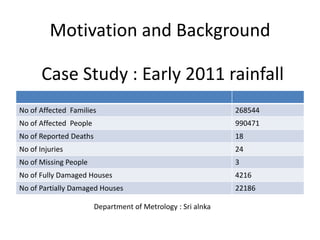
Motivation and Background

       Case Study : Early 2011 rainfall
No of Affected Families                                       268544
No of Affected People                                         990471
No of Reported Deaths                                         18
No of Injuries                                                24
No of Missing People                                          3
No of Fully Damaged Houses                                    4216
No of Partially Damaged Houses                                22186

                        Department of Metrology : Sri alnka
Objectives
• Identify Relationship between Extreme
  Precipitation and ENSO.
• Develop a model to relate Extreme
  Precipitation and ENSO.
• Validate defined model with recent data.
Hypothesis
• Null hypothesis that
 “There is a significant relationship between
  extreme precipitation and ENSO behaviour.”
• Against the alternative hypothesis that
  “There is no significant relationship between
  extreme precipitation and ENSO behaviour. ”
Others Work
• 2009 – Comparative analysis of indices of extreme
  rainfall events: variations and trends from Mexico
• 2008 - Predictability of Sri Lankan rainfall based on
  ENSO
• 1998 – ENSO influence on Intraseasonal Extreme
  Rainfall and Temperature Frequency in the
  Contiguous United State: Implications for Long
  Range Predictability
• 2011 – Research on the Relationship of ENSO and
  the Frequency of Extreme Precipitation Events in
  China
Methodology : Overview
• Data Collection
• Defining Threshold value
• Analysis
  – Distribution of Data
  – Identifying Extreme Percentile
  – Spatial Distribution of Extreme Precipitation
  – Correlation Analysis
  – Time Series Analysis
Methodology : Data Collection
• Quarterly Cumulative Rainfall data
• At least 50 years
• 11 out of 21 Stations
• Treating missing rainfall data : By Multiplying
  each year value by multiplying N/(N-m)
• NINO 3.4 – monthly data from 1951 to 2002
Methodology : Threshold value
• Gamma Distribution is used.
• Rainfall above 95% percentile.
• Separately calculated to Individual Stations
  and All Island.
Methodology : Analysis
• Distribution of Data
  – Histogram
  – Normality Test
Methodology : Analysis
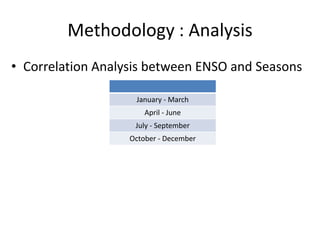
• Correlation Analysis between ENSO and Seasons

                    January - March
                       April - June
                    July - September
                   October - December
Methodology : Analysis
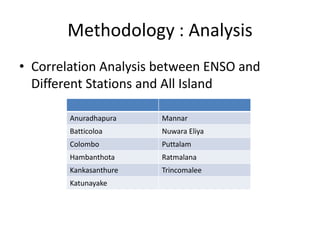
• Correlation Analysis between ENSO and
  Different Stations and All Island

        Anuradhapura    Mannar
        Batticoloa      Nuwara Eliya
        Colombo         Puttalam
        Hambanthota     Ratmalana
        Kankasanthure   Trincomalee
        Katunayake
Expected Results End of the Research
• In JFM/ AMJ/ JAS/ OND Extreme Precipitation
  days in Anuradhapura/ Batticoloa/ Colombo/
  Hambanthota/ Kankasanthure/ Katunayake/
  Mannar/ Nuwara Eliya/ Puttalam/ Ratmalana/
  Trincomalee/ All Island are significantly More
  or Less Frequent in El Nino than La Nino
Statistical Software
• R
• Excel
Organization
• Irrigation Department
• Department of Meteorology of Sri Lanka
• Foundation of Environment and Climate
  Technology
• Institute of Post Graduate Studies – University
  of Peradeniya.
Time Line
         Require    Data        Data        Study        Analyzing   Developing   Testing      Report        Presentation
         ment       Gathering   Arranging   Existing                 Model        and          preparation
         Analysis                           Approaches                            Validating

Week1
Week2
Week3
Week4
Week5
Week6
Week7
Week8
Week9
Week10
Week11
Week12
Acknowledgement
• Dr. Lareef Zubair at Foundation of
  Environment and Climate Technologies,
  Dhigana.
• Eng. R.M.W. Ratnayake at Director (Water
  Resources) Ministry of Irrigation and Water
  Resource Management.
• Post Graduate Institute of Science University
  of Peradeniya
Thanking you
 Weather is a great metaphor for life -
sometimes it's good, sometimes it's bad, and
there's nothing much you can do about it but
carry an umbrella.
                            ~Terri Guillemets

Develop statistical model to predict extreme precipitation through

  • 1.
    Predict Sri LankaExtreme Precipitation through El Nino Southern Oscillation R.M.S.P. Ratnayake PGIS/SC/M.Sc./ APS/10/20 MSc in Applied Statistics Post Graduate Institute of Science/ University of Peradeniya
  • 2.
    Over view • Introduction • Motivation and Background • Problem • Objectives • Hypothesis • Methodology • Organization • Time Frame
  • 3.
    Introduction • Sri Lankaeconomy mainly depend on Agriculture Industry. • Sri Lankan Agriculture mainly depend on two monsoons. • Therefore extreme precipitation changes the natural agriculture cycle. • Expose to Disaster and Hazard potentials.
  • 4.
    Problem • Extreme Precipitationrequires extra effort beyond basic Statistical Analysis. • There is no proper model to predict Extreme Precipitation. • Heavy Precipitation is a result of multiple courses. • Sri Lanka climate data are spatially coherent. • Analysis required longer period precipitation data
  • 5.
    Motivation and Background Case Study : Early 2011 rainfall No of Affected Families 268544 No of Affected People 990471 No of Reported Deaths 18 No of Injuries 24 No of Missing People 3 No of Fully Damaged Houses 4216 No of Partially Damaged Houses 22186 Department of Metrology : Sri alnka
  • 6.
    Objectives • Identify Relationshipbetween Extreme Precipitation and ENSO. • Develop a model to relate Extreme Precipitation and ENSO. • Validate defined model with recent data.
  • 7.
    Hypothesis • Null hypothesisthat “There is a significant relationship between extreme precipitation and ENSO behaviour.” • Against the alternative hypothesis that “There is no significant relationship between extreme precipitation and ENSO behaviour. ”
  • 8.
    Others Work • 2009– Comparative analysis of indices of extreme rainfall events: variations and trends from Mexico • 2008 - Predictability of Sri Lankan rainfall based on ENSO • 1998 – ENSO influence on Intraseasonal Extreme Rainfall and Temperature Frequency in the Contiguous United State: Implications for Long Range Predictability • 2011 – Research on the Relationship of ENSO and the Frequency of Extreme Precipitation Events in China
  • 9.
    Methodology : Overview •Data Collection • Defining Threshold value • Analysis – Distribution of Data – Identifying Extreme Percentile – Spatial Distribution of Extreme Precipitation – Correlation Analysis – Time Series Analysis
  • 10.
    Methodology : DataCollection • Quarterly Cumulative Rainfall data • At least 50 years • 11 out of 21 Stations • Treating missing rainfall data : By Multiplying each year value by multiplying N/(N-m) • NINO 3.4 – monthly data from 1951 to 2002
  • 11.
    Methodology : Thresholdvalue • Gamma Distribution is used. • Rainfall above 95% percentile. • Separately calculated to Individual Stations and All Island.
  • 12.
    Methodology : Analysis •Distribution of Data – Histogram – Normality Test
  • 13.
    Methodology : Analysis •Correlation Analysis between ENSO and Seasons January - March April - June July - September October - December
  • 14.
    Methodology : Analysis •Correlation Analysis between ENSO and Different Stations and All Island Anuradhapura Mannar Batticoloa Nuwara Eliya Colombo Puttalam Hambanthota Ratmalana Kankasanthure Trincomalee Katunayake
  • 15.
    Expected Results Endof the Research • In JFM/ AMJ/ JAS/ OND Extreme Precipitation days in Anuradhapura/ Batticoloa/ Colombo/ Hambanthota/ Kankasanthure/ Katunayake/ Mannar/ Nuwara Eliya/ Puttalam/ Ratmalana/ Trincomalee/ All Island are significantly More or Less Frequent in El Nino than La Nino
  • 16.
  • 17.
    Organization • Irrigation Department •Department of Meteorology of Sri Lanka • Foundation of Environment and Climate Technology • Institute of Post Graduate Studies – University of Peradeniya.
  • 18.
    Time Line Require Data Data Study Analyzing Developing Testing Report Presentation ment Gathering Arranging Existing Model and preparation Analysis Approaches Validating Week1 Week2 Week3 Week4 Week5 Week6 Week7 Week8 Week9 Week10 Week11 Week12
  • 19.
    Acknowledgement • Dr. LareefZubair at Foundation of Environment and Climate Technologies, Dhigana. • Eng. R.M.W. Ratnayake at Director (Water Resources) Ministry of Irrigation and Water Resource Management. • Post Graduate Institute of Science University of Peradeniya
  • 20.
    Thanking you Weatheris a great metaphor for life - sometimes it's good, sometimes it's bad, and there's nothing much you can do about it but carry an umbrella. ~Terri Guillemets