Secure Code Review
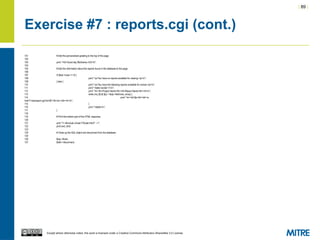
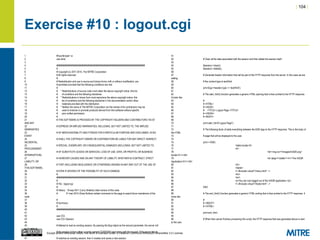
1static OSStatus SSLVerifySignedServerKeyExchange(SSLContext *ctx,
2 bool isRsa,
3 SSLBuffer signedParams,
4 uint8_t *signature,
5 UInt16 signatureLen)
6 {
7 OSStatus err;
8 ...
9 if ((err = SSLHashSHA1.update(&hashCtx, &serverRandom)) != 0)
10 goto fail;
11 if ((err = SSLHashSHA1.update(&hashCtx, &signedParams)) != 0)
12 goto fail;
13 goto fail;
14 if ((err = SSLHashSHA1.final(&hashCtx, &hashOut)) != 0)
15 goto fail;
16 ...
17
18 fail:
19
20 SSLFreeBuffer(&signedHashes);
21 SSLFreeBuffer(&hashCtx);
22 return err;
23 }
Impact: An attacker with a
privileged network position may
capture or modify data in sessions
protected by SSL/TLS
CVE 2014-1266
OOPS!
2.
Except where otherwisenoted, this work is licensed under a Creative Commons Attribution-ShareAlike 3.0 License.
D re w B u t t n er
M ark D a v ids on
Secure Code Review
3.
| 3 |
Exceptwhere otherwise noted, this work is licensed under a Creative Commons Attribution-ShareAlike 3.0 License.
All materials is licensed under a Creative
Commons “Share Alike” license.
http://creativecommons.org/licenses/by-sa/3.0/
Attribution condition: You must indicate that derivative work "Is derived from Andrew Buttner and Mark Davidson’s
'Secure Code Review’ class, available at http://OpenSecurityTraining.info/SecureCodeReview.html”
4.
| 4 |
Exceptwhere otherwise noted, this work is licensed under a Creative Commons Attribution-ShareAlike 3.0 License.
Agenda
Introductions
Background
– Application Security
– Microsoft Security Development Lifecycle
– Common Weakness Enumeration (CWE)
Secure Code Review
– Developer Interview
– Static Analysis Tools
– Manual Inspection
– Findings Report
Exercises
Closing Remarks
| 6 |
Exceptwhere otherwise noted, this work is licensed under a Creative Commons Attribution-ShareAlike 3.0 License.
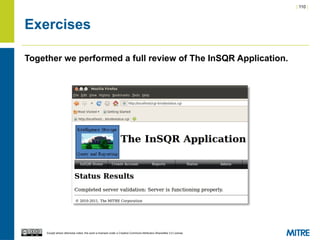
Exercises
Bulk of the class will be hands-on as together we will perform a
full review of The InSQR Application.
7.
| 7 |
Exceptwhere otherwise noted, this work is licensed under a Creative Commons Attribution-ShareAlike 3.0 License.
Background
8.
| 8 |
Exceptwhere otherwise noted, this work is licensed under a Creative Commons Attribution-ShareAlike 3.0 License.
Cost of Fixing Defects
Minimizing code defects to improve software quality and lower development costs. October 2008, ftp://ftp.software.ibm.com/software/rational/info/do-more/RAW14109USEN.pdf
The Economic Impacts of Inadequate Infrastructure for Software Testing. May 2002, http://http://www.nist.gov/director/planning/upload/report02-3.pdf
9.
| 9 |
Exceptwhere otherwise noted, this work is licensed under a Creative Commons Attribution-ShareAlike 3.0 License.
Microsoft Security Development Lifecycle
Trainin
g
Requir
ements
Design
Impleme
ntation
Verifica
tion
Releas
e
Respo
nse
http://www.microsoft.com/security/sdl/default.aspx
• Build security in early during the development process
• Focus on security throughout the development process
• Never stop thinking about security
10.
| 10 |
Exceptwhere otherwise noted, this work is licensed under a Creative Commons Attribution-ShareAlike 3.0 License.
Microsoft Security Development Lifecycle
Training Requirements Design Implementation Verification Release Response
http://www.microsoft.com/security/sdl/default.aspx
• Build security in early in the development process
• Focus on security throughout the development process
• Never stop thinking about security
Introduction to Secure Coding
Secure Code Review
Verification
11.
| 11 |
Exceptwhere otherwise noted, this work is licensed under a Creative Commons Attribution-ShareAlike 3.0 License.
Application Security
Goals
Principles
Mechanisms
Minimize Attack Surfaces Don't Trust Services
Establish Secure Defaults Separation of Duties
Least Privilege Avoid Security by Obscurity
Defense in Depth Keep Security Simple
Fail Securely Fix Issues Correctly
Confidentiality
Integrity
Availability
Authentication Error Handling
Authorization Logging
Data Validation Encryption
Session Management
12.
| 12 |
Exceptwhere otherwise noted, this work is licensed under a Creative Commons Attribution-ShareAlike 3.0 License.
Security Mechanisms to Achieve Goals
12
Confidentiality
Integrity
Availability
Authentication
Authorization
Session Management
Data Validation
Error Handling
Logging
Encryption
13.
| 13 |
Exceptwhere otherwise noted, this work is licensed under a Creative Commons Attribution-ShareAlike 3.0 License.
Security Mechanisms
The gears that drive the
engine of application security.
All mechanisms must be used
correctly to ensure proper
security functionality.
14.
| 14 |
Exceptwhere otherwise noted, this work is licensed under a Creative Commons Attribution-ShareAlike 3.0 License.
Secure Coding Words to Live By
Authentication
Enforce basic password security
Implement an account lockout for failed logins
“Forgot my password” functionality can be a problem
For web applications, use and enforce POST method
Authorization
Every function (page) must verify authorization to access
Every function (page) must verify the access context
Any client/server app must verify security on the server
Error Handling
Don’t disclose information that should remain private
Remember to cleanup completely in an error condition
Encryption
If storing passwords – hash with a salt value
If you’re using authentication – encrypt in transmission
Properly seed random number generators
Data Validation
Validate data before use in SQL Commands
Validate data before sending back to the client
Validate data before use in ‘eval’ or system
commands
Validate all data lengths before writing to buffers
Session Management
Enforce a reasonable session lifespan
Leverage existing session management solutions
Force a change of session ID after a successful login
Logging
Avoid logging sensitive data (e.g., passwords)
Beware of logging tainted data to the logs
Beware of logging excessive data
Beware of potential log spoofing
15.
| 15 |
Exceptwhere otherwise noted, this work is licensed under a Creative Commons Attribution-ShareAlike 3.0 License.
Common Weakness Enumeration
intro to CWE
16.
| 16 |
Exceptwhere otherwise noted, this work is licensed under a Creative Commons Attribution-ShareAlike 3.0 License.
CWE Top 25
CWE-89 Improper Neutralization of Special Elements used in an SQL Command ('SQL Injection')
CWE-78 Improper Neutralization of Special Elements used in an OS Command ('OS Command Injection')
CWE-120 Buffer Copy without Checking Size of Input ('Classic Buffer Overflow')
CWE-79 Improper Neutralization of Input During Web Page Generation ('Cross-site Scripting')
CWE-306 Missing Authentication for Critical Function
CWE-862 Missing Authorization
CWE-798 Use of Hard-coded Credentials
CWE-311 Missing Encryption of Sensitive Data
CWE-434 Unrestricted Upload of File with Dangerous Type
CWE-807 Reliance on Untrusted Inputs in a Security Decision
CWE-250 Execution with Unnecessary Privileges
CWE-352 Cross-Site Request Forgery (CSRF)
CWE-22 Improper Limitation of a Pathname to a Restricted Directory ('Path Traversal')
CWE-494 Download of Code Without Integrity Check
CWE-863 Incorrect Authorization
CWE-829 Inclusion of Functionality from Untrusted Control Sphere
CWE-732 Incorrect Permission Assignment for Critical Resource
CWE-676 Use of Potentially Dangerous Function
CWE-327 Use of a Broken or Risky Cryptographic Algorithm
CWE-131 Incorrect Calculation of Buffer Size
CWE-307 Improper Restriction of Excessive Authentication Attempts
CWE-601 URL Redirection to Untrusted Site ('Open Redirect')
CWE-134 Uncontrolled Format String
CWE-190 Integer Overflow or Wraparound
CWE-759 Use of a One-Way Hash without a Salt
17.
| 18 |
Exceptwhere otherwise noted, this work is licensed under a Creative Commons Attribution-ShareAlike 3.0 License.
Secure Code Review
18.
| 19 |
Exceptwhere otherwise noted, this work is licensed under a Creative Commons Attribution-ShareAlike 3.0 License.
What is a Secure Code Review
A Secure Code Review is a specialized task with the goal
of finding instances of many different types of security
related weaknesses (flaws) that may exist within a given
code base. The task involves developer interviews,
automated static analysis, manual review of the
underlying source code, and a final report to present
findings.
an important part of the Security Development Lifecycle
usually performed as part of verification
does not replace typical peer reviews
not a silver bullet … rather, it is a tool in the tool box
19.
| 20 |
Exceptwhere otherwise noted, this work is licensed under a Creative Commons Attribution-ShareAlike 3.0 License.
Five Types of Peer Reviews
A heavy-process review with multiple participants meeting together in single room. A
“moderator” and keeps everyone on task, controls the pace, and acts as arbiter of
disputes. Everyone reads through the materials beforehand to properly prepare.
Formal
A reviewer standing over the author’s workstation while the author walks the reviewer
through a set of code changes. Typically the author “drives” the review by sitting at the
keyboard and mouse, opening various files, pointing out the changes and explaining
why it was done this way.
Over-the-Shoulder
Whole files or changes are packaged up by the author and sent to reviewers via e-mail.
Reviewers examine the files, ask questions and discuss with the author and other
developers, and suggest changes.
Email Pass-
Around
Two developers writing code at a single workstation with only one developer typing at a
time and continuous free-form discussion and review.
Pair Programming
A process where specialized tools are used in all aspects of the review: collecting files,
transmitting and displaying files, commentary and defects among all participants,
collecting metrics, and giving product managers and administrators some control over
the workflow.
Tool Assisted
Cohen, J. (2013). Best Kept Secrets of Peer Code Review. Beverly, MA: SmartBear Software
20.
| 21 |
Exceptwhere otherwise noted, this work is licensed under a Creative Commons Attribution-ShareAlike 3.0 License.
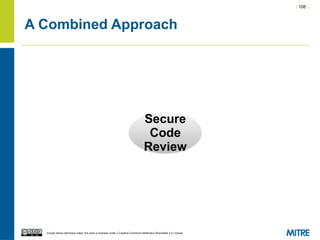
A Combined Approach
Secure
Code
Review
21.
| 22 |
Exceptwhere otherwise noted, this work is licensed under a Creative Commons Attribution-ShareAlike 3.0 License.
Secure Code Review Benefits
A project can realize a number of benefits as a results of a Secure
Code Review:
– Different perspective
– Security Experts
– Less Rework
– Fewer Bugs
– Better Code
Mossing, B. (2001, June 26). Developer's Guide to Peer Reviews. Retrieved from http://www.techrepublic.com/article/developers-guide-to-peer-reviews
22.
| 23 |
Exceptwhere otherwise noted, this work is licensed under a Creative Commons Attribution-ShareAlike 3.0 License.
Secure Code Review Challenges
Of course secure code reviews have their challenges as well:
– Time
– Preparation
– Initial frustration
– The need to show commitment
Mossing, B. (2001, June 26). Developer's Guide to Peer Reviews. Retrieved from http://www.techrepublic.com/article/developers-guide-to-peer-reviews
23.
| 24 |
Exceptwhere otherwise noted, this work is licensed under a Creative Commons Attribution-ShareAlike 3.0 License.
How to Conduct Better Reviews
The next few slides will present a some guidelines
for performing more effective and efficient
Secure Code Reviews.
24.
| 25 |
Exceptwhere otherwise noted, this work is licensed under a Creative Commons Attribution-ShareAlike 3.0 License.
How to Conduct Better Reviews
1) Don’t create a battleground.
– The goal is better software, not who’s right.
Mossing, B. (2001, June 26). Developer's Guide to Peer Reviews. Retrieved from http://www.techrepublic.com/article/developers-guide-to-peer-reviews
Map image licensed under the Creative Commons Attribution 2.0 Generic license, author is Kevin King, retrieved April 8, 2014, from
https://commons.wikimedia.org/wiki/File:Blakeley_Battleground_plan1.jpg
25.
| 26 |
Exceptwhere otherwise noted, this work is licensed under a Creative Commons Attribution-ShareAlike 3.0 License.
How to Conduct Better Reviews
2) Lay out the ground rules.
– Establish clear expectations about how the review will be performed,
including how long it will take, how much it will cost, and what role
everyone is playing.
Mossing, B. (2001, June 26). Developer's Guide to Peer Reviews. Retrieved from http://www.techrepublic.com/article/developers-guide-to-peer-reviews
Clock image licensed under the Creative Commons Attribution - Share Alike 3.0 Unported license, author is Penubag, retrieved April 8, 2014, from
https://commons.wikimedia.org/wiki/File:Wall_clock.png
Money image depicts a unit of currency issued by the United States of America. It is solely a work of the United States government, is ineligible for copyright, and is therefore in
the public domain.
26.
| 27 |
Exceptwhere otherwise noted, this work is licensed under a Creative Commons Attribution-ShareAlike 3.0 License.
How to Conduct Better Reviews
3) Maintain professionalism.
– Don’t take the criticism personally and offer only technical advice that
will improve the code. Respect others’ opinions, comments, and
suggestions.
Mossing, B. (2001, June 26). Developer's Guide to Peer Reviews. Retrieved from http://www.techrepublic.com/article/developers-guide-to-peer-reviews
Tie image licensed under the Creative Commons Attribution - Share Alike 3.0 Unported license, original uploader was Plasmafire, retrieved April 10, 2014, from
https://commons.wikimedia.org/wiki/File:Suit_tie.JPG
27.
| 28 |
Exceptwhere otherwise noted, this work is licensed under a Creative Commons Attribution-ShareAlike 3.0 License.
How to Conduct Better Reviews
4) Be careful with the scope of the review.
– Determine the size and scope of the code being reviewed. Don't bite
off more than can be chewed.
Mossing, B. (2001, June 26). Developer's Guide to Peer Reviews. Retrieved from http://www.techrepublic.com/article/developers-guide-to-peer-reviews
Hamburger image retrieved April 10, 2014, from http://thehotlist.co.uk/going-out/man-v-food-south-yorks/
28.
| 29 |
Exceptwhere otherwise noted, this work is licensed under a Creative Commons Attribution-ShareAlike 3.0 License.
How to Conduct Better Reviews
5) Document what happens.
– Write everything down, especially decisions and action items.
Mossing, B. (2001, June 26). Developer's Guide to Peer Reviews. Retrieved from http://www.techrepublic.com/article/developers-guide-to-peer-reviews
Notes image licensed under the Creative Commons Attribution - Share Alike 3.0 Unported license, author is Tony Webster, retrieved April 11, 2014, from
https://commons.wikimedia.org/wiki/File:CityCamp_Idea_Board_with_sticky_notes_4297872645_o.JPG
29.
| 30 |
Exceptwhere otherwise noted, this work is licensed under a Creative Commons Attribution-ShareAlike 3.0 License.
How to Conduct Better Reviews
6) Take a class on software inspection.
– Maybe you have an in-house code review expert, or perhaps one
team member could read a book and then train the rest of the team.
Consider using the local college/university or contact corporate
training institutions to bring a trainer on-site.
Mossing, B. (2001, June 26). Developer's Guide to Peer Reviews. Retrieved from http://www.techrepublic.com/article/developers-guide-to-peer-reviews
30.
| 31 |
Exceptwhere otherwise noted, this work is licensed under a Creative Commons Attribution-ShareAlike 3.0 License.
How to Conduct Better Reviews
7) Commit to the process.
– Maybe you tried conducting a review and it didn’t work. Try it again.
And again. Commit to the process and you will reap the benefits.
Mossing, B. (2001, June 26). Developer's Guide to Peer Reviews. Retrieved from http://www.techrepublic.com/article/developers-guide-to-peer-reviews
Wedding image licensed under the Creative Commons Attribution 2.0 Generic license, author is Jason Hutchens, retrieved April 11, 2014, from
https://commons.wikimedia.org/wiki/File:Bride_and_groom_signing_the_book.jpg
31.
| 32 |
Exceptwhere otherwise noted, this work is licensed under a Creative Commons Attribution-ShareAlike 3.0 License.
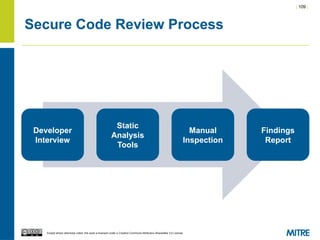
Secure Code Review Process
Developer
Interview
Static
Analysis
Tools
Manual
Inspection
Findings
Report
32.
| 33 |
Exceptwhere otherwise noted, this work is licensed under a Creative Commons Attribution-ShareAlike 3.0 License.
Developer Interview
The first step of a Secure Code Review is to meet with a developer
of the application and try to get an understanding of what the
code is attempting to do.
– saves the review team time
– determine high risk areas of the source code
– understand developer trends
– develop respect between the developers and the reviews
33.
| 34 |
Exceptwhere otherwise noted, this work is licensed under a Creative Commons Attribution-ShareAlike 3.0 License.
Developer Interview - Role Play
34.
| 35 |
Exceptwhere otherwise noted, this work is licensed under a Creative Commons Attribution-ShareAlike 3.0 License.
Develop Interview - Worksheet
Authentication
– Are users of the application authenticated or is everyone treated as an anonymous user?
– What factors are being used for authentication? For example, passwords, certificates, biometrics.
– If passwords are being used, then are there any policies in place regarding complexity or age?
– Are there any ways to bypass the authentication for testing? Are there any alternate authentication paths?
Authorization
– Are there different roles that users can be assigned based upon the context of the job being performed?
– Do you cache the authorization information? Or do you check authorization with each request?
– Are there any sensitive data files stored under the web root, hence under no authorization?
– Is authorization always checked on the server?
Session Management
– Is session state being managed / stored at all within the application and how is this being done?
– How is the session id being generated?
– If instead of passing a session id you are passing all the session data, is this data encrypted and signed?
– If a user logs into the site, is the original session deleted upon login and a new session created?
– Do sessions timeout at all?
– Is there a logout function available?
– If cookies are used, are there path and domain restrictions in the cookie?
Data Validation
– Is data received from the user validated?
– Is data validated as soon as it comes in from the user or when it is used by the code?
– How is the data validation being accomplished? (whitelisting, blacklisting, min/max, etc.)
– Are you using a database? If so, are you using prepared statements?
– Are you using HTML encode before user data goes back to the browser?
– Are regular expressions used at all during data validation?
35.
| 36 |
Exceptwhere otherwise noted, this work is licensed under a Creative Commons Attribution-ShareAlike 3.0 License.
Develop Interview - Worksheet (cont.)
Error handling
– What approach(s) to error handling is being used?
– What type of information about an error is presented to the user?
– Are stack traces ever sent back to the user? Or are they sent to logs only?
– If the database throws an error, is the error message sent to the user or is it passed to a log?
Logging
– Is any type of logging is being used within the code?
– Where are log messages that are generated being sent?
– Are the log files accessible by users that shouldn't have access to them?
– Are you ever logging any input that is not validated first, or data that has failed validation?
– Are log messages time stamped?
– Is any sensitive data written to a log (e.g. password, SSN)?
Encryption
– Is there any encryption algorithms used within the code at all? (SSL?)
– What implementation of the library is being used and where did you get it?
– What are the policies surrounding the keys being used?
– If using 3DES or AES (any block cipher) then what encryption mode is being used?
– Is there is a central function in the code that handles encryption? Where is it?
– Does the application generate and use a random number? If so, what PRNG is used? How is it seeded?
36.
| 37 |
Exceptwhere otherwise noted, this work is licensed under a Creative Commons Attribution-ShareAlike 3.0 License.
Static Analysis Tools
– Strengths
Volume
Speed
– Limitations
Breadth
Coverage
False Positives
– Costs
Price
Training
Time
The second step in the process is to use static analysis tools.
They model the source code and automatically find potential
flaws. However, they are NOT a silver bullet.
Best leveraged for an initial,
quick review of an application
37.
| 38 |
Exceptwhere otherwise noted, this work is licensed under a Creative Commons Attribution-ShareAlike 3.0 License.
Manual Inspection
The third step in the Secure Code Review Process is manual
inspection. This can be a challenging, slow, tiring task, but it also
produces the more accurate and useful results.
– Dedicate the time to doing the job right
– Embrace the challenge
reviewing really well coded / secure code can make you want to rip your eyeballs out
but it is still extremely valuable
that one little place is where everything can go wrong
others will never understand why you're so damn proud of finding an obscure coding flaw
– Don't be afraid to ask questions of the original developer / coder
– (repeat) Dedicate the time to doing the job right
38.
| 39 |
Exceptwhere otherwise noted, this work is licensed under a Creative Commons Attribution-ShareAlike 3.0 License.
"Security Concept" vs. "Syntactical Language"
Security Concept
– You don't need to be an expert in a specific language to provide
real value. For example, one can review TCL/TK code having
never touched the language before. Meaningful value can still be
provided covering the security concept bugs.
Authentication issues, Authorization issues, DV issues, etc.
Syntactical Language
– If there's an obscure framework implementation that magically
handles some aspect of logging or output encoding... then
experience with the language/framework is needed or that's going
to get missed.
In a perfect world, both areas covered.
39.
| 40 |
Exceptwhere otherwise noted, this work is licensed under a Creative Commons Attribution-ShareAlike 3.0 License.
Findings Report
The final step of a Secure Code Review is documenting the
findings and presenting them to the development team in a way
that they can understand and take action against.
– Finding Description
– CWE
– File Name & Line Number (if appropriate)
These reports are sensitive, protect them as such.
40.
| 41 |
Exceptwhere otherwise noted, this work is licensed under a Creative Commons Attribution-ShareAlike 3.0 License.
Finding Descriptions
When writing the description, put yourself in the developer's
shoes and try to provide the information that they would want.
– show the data/control flow related to the finding
– show why the finding is an issue
– briefly suggest a way to address it
BAD = XSS on line 102.
GOOD = A string is created on line 101 that uses an non-validated value from the request. This
message is then used to create a StatusMessage on line 102 and eventually is part of the page that
is sent back to the user. If a malicious header value is sent in the request, it may be possible to
perform a cross-site scripting attack. It is recommended that the supplied header value not be part of
the message sent back to the user. If the value must be part of the message, then ensure proper
validation and leverage appropriate output encoding.
41.
| 42 |
Exceptwhere otherwise noted, this work is licensed under a Creative Commons Attribution-ShareAlike 3.0 License.
Go Forth and Review!
Mossing, B. (2001, June 26). Developer's Guide to Peer Reviews. Retrieved from http://www.techrepublic.com/article/developers-guide-to-peer-reviews
"Code reviews can be a fun and interesting
part of the development process. There may
be a few drawbacks, but the end result is
usually BETTER CODE, and better code is
good for everyone. Additionally, you may even
find that as the reviewer or the reviewed, your
SKILLS AS A DEVELOPER WILL GROW."
42.
| 43 |
Exceptwhere otherwise noted, this work is licensed under a Creative Commons Attribution-ShareAlike 3.0 License.
Exercises
43.
| 44 |
Exceptwhere otherwise noted, this work is licensed under a Creative Commons Attribution-ShareAlike 3.0 License.
How this will work
The following exercises will walk us through a secure code review
of The InSQR Application.
1. Pair up into teams of 2
2. Choose a file to review
3. Record findings
4. Discussion
Secure Code Review is best learned through
practice. Consider this your first review!
44.
| 45 |
Exceptwhere otherwise noted, this work is licensed under a Creative Commons Attribution-ShareAlike 3.0 License.
Story #1 : Know what you are agreeing to
Jack: Can you review some code for us?
Jill: Sure! But I need to balance that with
some other work, can I get you the findings
by the end of the week?
Jack: No problem with the extra time. Thank
you so much for helping me out!
We need to get this code
checked in.
Jill: Before you go, where
can I get a copy of the
code?
…
Sinclair, Brendan. (September 17, 2009) Retrieved March 31, 2014, from
http://www.gamespot.com/articles/blizzard-outlines-massive-effort-behind-world-of-warcraft/1100-6228615/
45.
| 46 |
Exceptwhere otherwise noted, this work is licensed under a Creative Commons Attribution-ShareAlike 3.0 License.
Prioritize and Focus
If you get stuck reviewing more code than you can possibly get
through, then prioritize the code and focus on impact areas.
Start with files pertaining to high value targets
– authentication / authorization (e.g., login page)
– database handler
– sensitive data
– shared libraries
Set for "special" strings
– password
– key
– connection
– session
– todo
– exec / system
46.
| 47 |
Exceptwhere otherwise noted, this work is licensed under a Creative Commons Attribution-ShareAlike 3.0 License.
Exercise #1 : Where to Start?
Knowing very little about the codebase, which file(s) would you
look at first? What would some other files of interest be?
47.
| 48 |
Exceptwhere otherwise noted, this work is licensed under a Creative Commons Attribution-ShareAlike 3.0 License.
Worksheet #1
CWE File Line # Description
48.
| 50 |
Exceptwhere otherwise noted, this work is licensed under a Creative Commons Attribution-ShareAlike 3.0 License.
Story #2 : Ubercart Session Fixation
But I was told not to
"re-invent the wheel"?
49.
| 51 |
Exceptwhere otherwise noted, this work is licensed under a Creative Commons Attribution-ShareAlike 3.0 License.
Secure Coding …
1 public int authenticate (HttpSession session)
2 {
3 string username = GetInput("Enter Username");
4 string password = GetInput("Enter Password");
5
6 // Check maximum logins attempts
7 if (session.getValue("loginAttempts") > MAX_LOGIN_ATTEMPTS)
8 {
9 lockAccount(username);
10 return(FAILURE);
11 }
12
13 if (ValidUser(username, password) == SUCCESS)
14 {
15 // Kill the current session so it can no longer be used
16 session.invalidate();
17
18 // Create an entirely new session for the logged in user
19 HttpSession newSession = request.getSession(true);
20
21 newSession.putValue("login", TRUE);
22 return(SUCCESS);
23 }
24 else return(FAILURE);
25 }
50.
| 52 |
Exceptwhere otherwise noted, this work is licensed under a Creative Commons Attribution-ShareAlike 3.0 License.
Secure and HTTP Only
Secure Attribute
– cookie only sent via SSL/TLS
– ensure the cookie is always encrypted
when transmitting from client to server
HTTP Only Attribute
– cookie only accessed when
transmitting HTTP (or HTTPS) requests
– thus restricting access from other,
non-HTTP APIs such as JavaScript
Cookie image licensed under the Creative Commons Attribution - Share Alike 3.0 Unported license, author is Tiia Monto, retrieved April 17, 2014, from
https://commons.wikimedia.org/wiki/File:Cookie.png
51.
| 53 |
Exceptwhere otherwise noted, this work is licensed under a Creative Commons Attribution-ShareAlike 3.0 License.
Exercise #2 : login.cgi
1 #!/usr/bin/perl -w
2 use strict;
3
4 use CGI;
5 use CGI::Session;
6
7 # Create a new instance of a CGI object that is used to manage the request and response.
8
9 my $cgi = new CGI;
10
11 # Attempt to load an existing session. If an existing session isn't found, then create a new one. The value
of undef for the first
12 # parameter directs the server to look for and save the session data in a file on the server. (this is the
default) By passing the $cgi
13 # object as the second parameter, the server will try to retrieve the session id from either a cookie named
CGISESSID sent along
14 # with the request or a query string parameter named CGISESSID. If the server fails to find an id that
matches an existing session,
15 # then it creates and saves a new session. The third parameter directs the server to save the session
data on the server as a file
16 # in the /tmp directory.
17
18 my $session = new CGI::Session(undef, $cgi, {Directory=>'/tmp'});
19
20 # Create a cookie to send to the user that contains the session id. CGI::Session by default expects the
name of the cookie holding
21 # the session ID to be "CGISESSID". This cookie can then be passed along to the user and saved by
their browser. The cookie can
22 # then be sent back with each new request from the user enabling the server to find any existing session
data.
23
24 my $cookie = $cgi->cookie(-name=>"CGISESSID", -value=>$session->id);
25
26 # Generate header information that will be part of the HTTP response from the server. In this case we are
setting
27 # the content-type to text/html and also sending along the cookie that we just generated above.
28
29 print $cgi->header( -type => 'text/html', -cookie => $cookie );
30
31 # The start_html() function generates a generic HTML opening that is then printed to the HTTP response.
It looks like:
32 #
33 # <HTML>
34 # <HEAD>
35 # <TITLE> Login Page </TITLE>
36 # </HEAD>
37 # <BODY>
38
39 print start_html ("Login Page");
40
41 # The following block of adds everything between the END tags to the HTTP response. This is the body of
the HTML
42 # page that will be displayed to the user.
43
44 print <<END;
45 <table border=0>
46 <tr>
47
51 <!--#include virtual="/menu.html" -->
52 <br>
53 <p>Please login to access the reports or status functions.</p>
54 <form method="post" action="/cgi-bin/authenticate.cgi">
55 <table>
56 <tr>
57 <td
align=right><b>User ID:<b></td>
58
<td><input name="user" type="text"></td>
59 </tr>
60 <tr>
61 <td
align=right><b>Password:</b></td>
62
<td><input name="password" type="password"></td>
63 </tr>
64 <tr>
65 <td
colspan=2 align=center><input type="submit" value="Login"></td>
66 </tr>
67 </table>
68 <p>If you have forgotten your password, please <a href="reset.cgi">click
here</a></p>
69 <!--#include virtual="/footer.html" -->
70 END
71
72 # The end_html() function generates a generic HTML ending that is then printed to the HTTP response. It
looks like:
73 #
74 # </BODY>
75 # </HTML>
76
77 print end_html;
78
79 # When then server finishes processing this script, the HTTP response that was generated above is sent
to the user.
52.
| 54 |
Exceptwhere otherwise noted, this work is licensed under a Creative Commons Attribution-ShareAlike 3.0 License.
Worksheet #2
CWE File Line # Description
53.
| 56 |
Exceptwhere otherwise noted, this work is licensed under a Creative Commons Attribution-ShareAlike 3.0 License.
Story #3 : Tesla Motors SQL Injection
https://bitquark.co.uk/blog/2014/02/23/tesla_motors_blind_sql_injection
Tesla Motors
Design Studio
extensive use of
Drupal with a
handful of plugins
"During testing I noticed that
the script behaved a little
differently depending on the
input and investigated by
injecting some quoted strings.
After a bit of playing around I
had it, a fairly standard blind
attack vector:
' + sleep(10) + ' "
"This is a pretty nice tool which lets you
customize your Tesla before ordering. It also
gives you the option to share your creation with
others by way of a unique URL which Tesla
generates then passes through a custom URL
shortener. It was in this shortener that I found an
SQL injection vulnerability, giving me access to
Tesla's backend database, including access to
all online customer records and admin access to
the site."
access to back end database,
all online customer records,
and admin access to the site
54.
| 57 |
Exceptwhere otherwise noted, this work is licensed under a Creative Commons Attribution-ShareAlike 3.0 License.
Blind SQL Injection
** MySQL's primary functions for time delay are sleep() and benchmark(). **
mysql> SELECT * FROM sample WHERE id=1 AND sleep(15);
Empty set (15.00 sec)
So … an injection string to test if the first character of the first table in the database is
between 'a' and 'p' would look like:
/vulnerable.ext?id= 1 AND sleep ( cast ( ( SELECT ( SELECT table_name from
information_schema.tables WHERE table_schema=database() LIMIT 1 offset 0 ) regexp
0x5e5b612d705c ) AS signed ) * 15 ) ;
55.
| 58 |
Exceptwhere otherwise noted, this work is licensed under a Creative Commons Attribution-ShareAlike 3.0 License.
Blind SQL Injection
** MySQL's primary functions for time delay are sleep() and benchmark(). **
mysql> SELECT * FROM sample WHERE id=1 AND sleep(15);
Empty set (15.00 sec)
So … an injection string to test if the first character of the first table in the database is
between 'a' and 'm' would look like:
/vulnerable.ext?id= 1 AND sleep ( cast ( ( SELECT ( SELECT table_name from
information_schema.tables WHERE table_schema=database() LIMIT 1 offset 0 ) regexp
0x5e5b612d705c ) AS signed ) * 15 ) ;
Return the name of the first table (i.e., LIMIT 1 offset 0) from the
current database
56.
| 59 |
Exceptwhere otherwise noted, this work is licensed under a Creative Commons Attribution-ShareAlike 3.0 License.
Blind SQL Injection
** MySQL's primary functions for time delay are sleep() and benchmark(). **
mysql> SELECT * FROM sample WHERE id=1 AND sleep(15);
Empty set (15.00 sec)
So … an injection string to test if the first character of the first table in the database is
between 'a' and 'm' would look like:
/vulnerable.ext?id= 1 AND sleep ( cast ( ( SELECT ( SELECT table_name from
information_schema.tables WHERE table_schema=database() LIMIT 1 offset 0 ) regexp
0x5e5b612d705c ) AS signed ) * 15 ) ;
Use a regular expression to compare the returned table name with
"0x5e5b612d705c". (hex notation for "^[a-p]") The returned value
will be either 0 for no match or 1 for a match.
57.
| 60 |
Exceptwhere otherwise noted, this work is licensed under a Creative Commons Attribution-ShareAlike 3.0 License.
Blind SQL Injection
** MySQL's primary functions for time delay are sleep() and benchmark(). **
mysql> SELECT * FROM sample WHERE id=1 AND sleep(15);
Empty set (15.00 sec)
So … an injection string to test if the first character of the first table in the database is
between 'a' and 'm' would look like:
/vulnerable.ext?id= 1 AND sleep ( cast ( ( SELECT ( SELECT table_name from
information_schema.tables WHERE table_schema=database() LIMIT 1 offset 0 ) regexp
0x5e5b612d705c ) AS signed ) * 15 ) ;
Cast the value returned from regexp() as a signed int so we can
use it in the sleep command calculation.
58.
| 61 |
Exceptwhere otherwise noted, this work is licensed under a Creative Commons Attribution-ShareAlike 3.0 License.
Blind SQL Injection
** MySQL's primary functions for time delay are sleep() and benchmark(). **
mysql> SELECT * FROM sample WHERE id=1 AND sleep(15);
Empty set (15.00 sec)
So … an injection string to test if the first character of the first table in the database is
between 'a' and 'm' would look like:
/vulnerable.ext?id= 1 AND sleep ( cast ( ( SELECT ( SELECT table_name from
information_schema.tables WHERE table_schema=database() LIMIT 1 offset 0 ) regexp
0x5e5b612d705c ) AS signed ) * 15 ) ;
Sleep for 15 seconds if the test statement is TRUE. If it is FALSE,
don't sleep at all.
59.
| 62 |
Exceptwhere otherwise noted, this work is licensed under a Creative Commons Attribution-ShareAlike 3.0 License.
Blind SQL Injection
** MySQL's primary functions for time delay are sleep() and benchmark(). **
mysql> SELECT * FROM sample WHERE id=1 AND sleep(15);
Empty set (15.00 sec)
So … an injection string to test if the first character of the first table in the database is
between 'a' and 'm' would look like:
/vulnerable.ext?id= 1 AND sleep ( cast ( ( SELECT ( SELECT table_name from
information_schema.tables WHERE table_schema=database() LIMIT 1 offset 0 ) regexp
0x5e5b612d705c ) AS signed ) * 15 ) ;
The full string is passed as the parameter which is used to build
the SQL statement. Notice that no quotes were used!
60.
| 63 |
Exceptwhere otherwise noted, this work is licensed under a Creative Commons Attribution-ShareAlike 3.0 License.
Blind SQL Injection
Now that we can get each character and perform a TRUE/FALSE
test against it, we simply write a script that maps the database.
Is the first character between 'a' and 'p'?
– If yes, then is the first character between 'a' and 'h'?
If yes, then is the first character between 'a' and 'd'?
– If yes, then is the first character between 'a' and 'b'?
If yes, then is the first character 'a'?
– If yes, then the first character is 'a'.
– If no, then the first character is 'b'.
If no, then is the first character 'c'?
– If yes, then the first character is 'c'.
– If no, then the first character is 'd'.
– If no, then is the first character between 'e' and 'h'?
61.
| 64 |
Exceptwhere otherwise noted, this work is licensed under a Creative Commons Attribution-ShareAlike 3.0 License.
Exercise #3 : authenticate.cgi
1 #!/usr/bin/perl -w
2 use strict;
3
4 ########################################################################
5 #
6 # Copyright (c) 2011-2014, The MITRE Corporation
7 # All rights reserved.
8 #
9 # Redistribution and use in source and binary forms, with or without modification, are
10 # permitted provided that the following conditions are met:
11 #
12 # * Redistributions of source code must retain the above copyright notice, this list
13 # of conditions and the following disclaimer.
14 # * Redistributions in binary form must reproduce the above copyright notice, this
15 # list of conditions and the following disclaimer in the documentation and/or other
16 # materials provided with the distribution.
17 # * Neither the name of The MITRE Corporation nor the names of its contributors may be
18 # used to endorse or promote products derived from this software without specific
19 # prior written permission.
20 #
21 # THIS SOFTWARE IS PROVIDED BY THE COPYRIGHT HOLDERS AND CONTRIBUTORS "AS IS"
AND ANY
22 # EXPRESS OR IMPLIED WARRANTIES, INCLUDING, BUT NOT LIMITED TO, THE IMPLIED
WARRANTIES
23 # OF MERCHANTABILITY AND FITNESS FOR A PARTICULAR PURPOSE ARE DISCLAIMED. IN NO
EVENT
24 # SHALL THE COPYRIGHT OWNER OR CONTRIBUTORS BE LIABLE FOR ANY DIRECT, INDIRECT,
INCIDENTAL,
25 # SPECIAL, EXEMPLARY, OR CONSEQUENTIAL DAMAGES (INCLUDING, BUT NOT LIMITED TO,
PROCUREMENT
26 # OF SUBSTITUTE GOODS OR SERVICES; LOSS OF USE, DATA, OR PROFITS; OR BUSINESS
INTERRUPTION)
27 # HOWEVER CAUSED AND ON ANY THEORY OF LIABILITY, WHETHER IN CONTRACT, STRICT
LIABILITY, OR
28 # TORT (INCLUDING NEGLIGENCE OR OTHERWISE) ARISING IN ANY WAY OUT OF THE USE OF
THIS SOFTWARE,
29 # EVEN IF ADVISED OF THE POSSIBILITY OF SUCH DAMAGE.
30 #
31 ########################################################################
32 #
33 # File : authenticate.cgi
34 #
35 # History : 19-sep-2011 (Larry Shields) initial version of this code
36 # 31-mar-2014 (Drew Buttner) added comments to the page to assist future maintainers of the
code
37 #
38 # Summary: This script performs the authentication of a user. If the user can't be authenticated, then they
39 # are directed back to the login page.
40 #
41 ########################################################################
42
43 use CGI qw/:standard/;
44 use CGI::Request;
45 use CGI::Session;
46 use CGI::Cookie;
47 use DBI;
48 use MIME::Base64;
49 use lib "/etc/apache2/modules";
51 use IO::File;
52 use URI::Escape;
53 use Digest::MD5 qw(md5_hex);
54
55 # Create a new instance of a CGI object that is used to manage the request and response.
56
57 my $cgi = new CGI;
58
59 # Attempt to load an existing session. If an existing session isn't found, then create a new one. The value of undef
for the first
60 # parameter directs the server to look for and save the session data in a file on the server. (this is the default) By
passing the $cgi
61 # object as the second parameter, the server will try to retrieve the session id from either a cookie named
CGISESSID sent along
62 # with the request or a query string parameter named CGISESSID. If the server fails to find an id that matches an
existing session,
63 # then it creates and saves a new session. The third parameter directs the server to save the session data on the
server as a file
64 # in the /tmp directory.
65
66 my $session = new CGI::Session(undef, $cgi, {Directory=>'/tmp'});
67
68 # Open up a connection to the database. If a connection can't be established, then die. Note that $dbname,
$dbhost, $dbuser, and
69 # $dbpw come from the DBAuth.pm file.
70
71 my $dsn = "DBI:mysql:database=$dbname;host=$dbhost";
72 my $dbh = DBI->connect($dsn,$dbuser,decode_base64($dbpw)) or die "Could not connect to DB.";
73
74 # Open the log file as this will be used to log good and bad authentication attempts.
75
76 my $fh=new IO::File;
77 $fh->open('>> /tmp/accesslog.log');
78 my $date = scalar(localtime);
79
80 # Grab the username and password provided as parameters in the request.
81
82 my $req = new CGI::Request;
83
84 my $uname = $req->param('user');
85 my $pword = $req->param('password');
86
87 # Make sure that the user name is unescaped. (convert %XX sequences to their actual character)
88
89 $uname = uri_unescape($uname);
90
91 # Calculate the MD5 hash for the provided password. The database stores the hashes and not the actual
passwords, so
92 # we will be comparing these hashes to authenticate the user.
93
94 my $hashp = md5_hex($pword);
95
96 # Use a prepared statement to search the database for an active (state = 1) user record with the provided
username
97 # and password.
98
99 my $sql=$dbh->prepare("SELECT first,last,admin FROM users WHERE uname='$uname' AND pword LIKE
BINARY '$hashp' AND state=1");
62.
| 65 |
Exceptwhere otherwise noted, this work is licensed under a Creative Commons Attribution-ShareAlike 3.0 License.
Exercise #3 : authenticate.cgi (cont.)
101
102 # If no row was returned from the database, then the login failed. No records were found matching the provided
103 # username and password. Notify the user and ask them to try again. If a matching row was found, then login
104 # succeeded. Log the successful login in the log file and then redirect the user to their appropriate landing page.
105
106 if ($sql->rows == 0) {
107
108 # Print the opening parts of the HTML page.
109
110 print "Content-type:text/htmlnn";
111
112 print <<END;
113 <html>
114 <head>
115 <title>Login</title>
116 </head>
117 <body>
118 <table border=0>
119 <tr>
120 <td><img
src="/images/InSQR.png" border=0 /></td>
121 <td
valign="middle"><h1>The InSQR Application</h1></td>
122 </tr>
123 </table>
124 <!--#include virtual="/menu.html" -->
125 <br>
126 <h2>Login Failure</h2>
127 END
128
129 # Use a prepared statement to check if the uname was what caused the login to
fail.
130
131 my $check =$dbh->prepare("SELECT uname FROM users WHERE uname=?");
132 $check->execute($uname);
133
134 # If we can't find a matching uname in the database, then they must have entered
the
135 # user name wrong. Also make sure to log the failed attempt so we can
investigate
136 # attacks from someone trying to brute-force their way past our authentication. If
137 # we find a matching uname, then it must have been an incorrect password that
caused
138 # the authentication to fail. Remind the user that passwords are case sensitive.
139
140 if ($check->rows == 0) {
141 print $fh "$date: Login as $uname failed - no
such user.n";
142 print "<p>Invalid userid: $uname. Please check
your userid and try again.</p>";
143 } else {
144 print $fh "$date: Login as $uname failed -
incorrect password ($pword).n";
145 print "<p>Incorrect password. Passwords are
case sensitive, please verify your spelling and try again.</p>";
146 }
147
148 # Close the prepared statement as we no longer need it.
151
152 # Complete the HTML page to be sent as the response.
153
154 print '<!--#include virtual="/footer.html" -->';
155 print end_html;
156
157 } else {
158
159 # Save the logged in user's username, full name, and their admin status
to the session so that we
160 # can retrieve them later when needed.
161
162 my ($first, $last, $admin) = $sql->fetchrow_array;
163 my $name = "$first $last";
164
165 $session->param("authuser", $uname);
166 $session->param("name", $name);
167 $session->param("admin", $admin);
168
169 # Also save the admin status to the cookie.
170
171 my $admincookie = $cgi->cookie(-name=>'insqradmin',-
value=>"$admin");
172
173 # If the logged in user is an admin, then log this fact and redirect them to
the admin page. Otherwise,
174 # log the authentication as a normal user and redirect them to the reports
page.
175
176 if ($admin) {
177 print $fh "$date: Login by admin user
$uname.n";
178 print $cgi->redirect(-cookie=>[$cookie,
$admincookie],-uri=>'/cgi-bin/admin/index.cgi');
179 } else {
180 print $fh "$date: Login by normal user
$uname.n";
181 print $cgi->redirect(-cookie=>[$cookie,
$admincookie],-uri=>'/cgi-bin/reports.cgi');
182 }
183 }
184
185 # Close the log file, the prepared statement, and the database connection.
186
187 $fh->close;
188 $sql->finish;
189 $dbh->disconnect;
63.
| 66 |
Exceptwhere otherwise noted, this work is licensed under a Creative Commons Attribution-ShareAlike 3.0 License.
Worksheet #3
CWE File Line # Description
64.
| 68 |
Exceptwhere otherwise noted, this work is licensed under a Creative Commons Attribution-ShareAlike 3.0 License.
Story #4 : Heartbleed
The Heartbleed Bug was a serious vulnerability in the popular
OpenSSL cryptographic software library.
April 7, 2014
Steal info protected by SSL/TLS
– secret keys
– usernames and passwords
– sensitive content
Widespread
– high profile services were vulnerable
Nothing you could do as a user!
Heartbleed image licensed under the Creative Commons CC0 1.0 Universal Public Domain Dedication license, author is Leena Snidate, retrieved April 15, 2014, from
https://commons.wikimedia.org/wiki/File:Heartbleed.svg
65.
| 69 |
Exceptwhere otherwise noted, this work is licensed under a Creative Commons Attribution-ShareAlike 3.0 License.
CWE-125 : Out-of-Bounds Read
Heartbleed Explanation image licensed under the Creative Commons Attribution - Share Alike 3.0 Unported license, original uploader was SomeUser953, retrieved April 15, 2014,
from https://commons.wikimedia.org/wiki/File:Heartbleed_bug_explained.svg
66.
| 70 |
Exceptwhere otherwise noted, this work is licensed under a Creative Commons Attribution-ShareAlike 3.0 License.
Don't Reuse Passwords
Even if you create the strongest password, never write it down,
and protect it via best-of-breed encryption …
It just takes one bug in someone else's code to potentially leak it
to a thief …
If you reuse that password across different sites, then all your
data/money/identity is at risk.
67.
| 71 |
Exceptwhere otherwise noted, this work is licensed under a Creative Commons Attribution-ShareAlike 3.0 License.
Exercise #4 : create.cgi
1 #!/usr/bin/perl -w
2 use strict;
3
4 ########################################################################
5 #
6 # Copyright (c) 2011-2014, The MITRE Corporation
7 # All rights reserved.
8 #
9 # Redistribution and use in source and binary forms, with or without modification, are
10 # permitted provided that the following conditions are met:
11 #
12 # * Redistributions of source code must retain the above copyright notice, this list
13 # of conditions and the following disclaimer.
14 # * Redistributions in binary form must reproduce the above copyright notice, this
15 # list of conditions and the following disclaimer in the documentation and/or other
16 # materials provided with the distribution.
17 # * Neither the name of The MITRE Corporation nor the names of its contributors may be
18 # used to endorse or promote products derived from this software without specific
19 # prior written permission.
20 #
21 # THIS SOFTWARE IS PROVIDED BY THE COPYRIGHT HOLDERS AND CONTRIBUTORS "AS IS"
AND ANY
22 # EXPRESS OR IMPLIED WARRANTIES, INCLUDING, BUT NOT LIMITED TO, THE IMPLIED
WARRANTIES
23 # OF MERCHANTABILITY AND FITNESS FOR A PARTICULAR PURPOSE ARE DISCLAIMED. IN NO
EVENT
24 # SHALL THE COPYRIGHT OWNER OR CONTRIBUTORS BE LIABLE FOR ANY DIRECT, INDIRECT,
INCIDENTAL,
25 # SPECIAL, EXEMPLARY, OR CONSEQUENTIAL DAMAGES (INCLUDING, BUT NOT LIMITED TO,
PROCUREMENT
26 # OF SUBSTITUTE GOODS OR SERVICES; LOSS OF USE, DATA, OR PROFITS; OR BUSINESS
INTERRUPTION)
27 # HOWEVER CAUSED AND ON ANY THEORY OF LIABILITY, WHETHER IN CONTRACT, STRICT
LIABILITY, OR
28 # TORT (INCLUDING NEGLIGENCE OR OTHERWISE) ARISING IN ANY WAY OUT OF THE USE OF
THIS SOFTWARE,
29 # EVEN IF ADVISED OF THE POSSIBILITY OF SUCH DAMAGE.
30 #
31 ########################################################################
32 #
33 # File : create.cgi
34 #
35 # History : 19-sep-2011 (Larry Shields) initial version of this code
36 # 31-mar-2014 (Drew Buttner) added comments to the page to assist future maintainers of the
code
37 #
38 # Summary: This script is used to create new users in the system. Note that a new registration must be
39 # approved by an administrator before it becomes valid.
40 #
41 ########################################################################
42
43 use CGI qw/:standard/;
44 use CGI::Request;
45 use DBI;
46 use MIME::Base64;
47 use lib "/etc/apache2/modules";
48 use DBAuth;
49
51 # Print the first part of the HTML response to be sent back to the user.
52
53 print "Content-type:text/htmlnn";
54
55 # The start_html() function generates a generic HTML opening that is then printed to the HTTP response.
It looks like:
56 #
57 # <HTML>
58 # <HEAD>
59 # <TITLE>Account Creation</TITLE>
60 # </HEAD>
61 # <BODY>
62
63 print start_html ("Account Creation");
64
65 # The following block of adds everything between the END tags to the HTTP response. This is the body of
the HTML
66 # page that will be displayed to the user.
67
68 print <<END;
69 <table border=0>
70 <tr>
71 <td><img src="/images/InSQR.png"
border=0 /></td>
72 <td valign="middle"><h1>The InSQR
Application</h1></td>
73 </tr>
74 </table>
75 <!--#include virtual="/menu.html" -->
76 <br/>
77 <br/>
78 END
79
80 # Grab the registration data provided as parameters in the request. sq = secret question, as = secret
answer
81
82 my $req = new CGI::Request;
83
84 my $first = $req->param('first');
85 my $last = $req->param('last');
86 my $uname = $req->param('uname');
87 my $pword = $req->param('pword');
88 my $sq = $req->param('sq');
89 my $sa = $req->param('sa');
90
91 # Open up a connection to the database. If a connection can't be established, then die. Note that
$dbname and $dbhost come from
92 # the DBAuth.pm file.
93
94 my $dsn = "DBI:mysql:database=$dbname;host=$dbhost";
95 my $dbh = DBI->connect($dsn,$dbuser,decode_base64($dbpw)) or die "Could not connect to DB.";
96
97 # Validate that all fields have been supplied and that the password meets minimum length requirements. If
everything checks out,
98 # then insert the registration request into the database. Make sure that the state field is set to zero which
will notify an
99 # administrator that they will have to approve the request.
100
68.
| 72 |
Exceptwhere otherwise noted, this work is licensed under a Creative Commons Attribution-ShareAlike 3.0 License.
Exercise #4 : create.cgi (cont.)
101 if (length($first) == 0 or length($last) == 0 or length($uname) == 0 or
102 length($pword) == 0 or length($sq) == 0 or length($sa) == 0) {
103 print "<h2>Error</h2>n";
104 print "<p>All fields are required and must contain data.</p>n";
105 } elsif (length($pword) < 8) {
106 print "<h2>Error</h2>n";
107 print "<p>Password must be at least 8 characters in length.n";
108 } else {
109 my $hashp = md5_hex($pword);
110 unless ($dbh->do("INSERT INTO users (uname, pword, state, sq, sa, first,
last, admin)
111 VALUES
('$uname','$hashp',0,'$sq','$sa','$first','$last',0)")) {
112 print "<h2>Database Error</h2>n";
113 print "<p>" . $dbh->errstr . "</p>n";
114 } else {
115 print "<p>Your account request has been
created. You will be notified once your account has been activated.</p>";
116 }
117 }
118
119 # Close up the SQL object and disconnect from the database.
120
121 $sql->finish;
122 $dbh->disconnect;
123
124 # Print the bottom part of the HTML response.
125
126 print '<!--#include virtual="/footer.html" -->';
127 print end_html;
69.
| 73 |
Exceptwhere otherwise noted, this work is licensed under a Creative Commons Attribution-ShareAlike 3.0 License.
Worksheet #4
CWE File Line # Description
70.
| 75 |
Exceptwhere otherwise noted, this work is licensed under a Creative Commons Attribution-ShareAlike 3.0 License.
Story #5 : Denial of Gaming Services
• DDoS Amplification attacks
• Brings down the gaming server
• Player has nothing to broadcast
• Money isn't made
71.
| 76 |
Exceptwhere otherwise noted, this work is licensed under a Creative Commons Attribution-ShareAlike 3.0 License.
Different Types of DoS
Flooding
Excessive Allocation
Sustained Engagement
Leaks
Resource Locking
72.
| 77 |
Exceptwhere otherwise noted, this work is licensed under a Creative Commons Attribution-ShareAlike 3.0 License.
Exercise #5 : admin/index.cgi
1 #!/usr/bin/perl -w
2 use strict;
3
4 ########################################################################
5 #
6 # Copyright (c) 2011-2014, The MITRE Corporation
7 # All rights reserved.
8 #
9 # Redistribution and use in source and binary forms, with or without modification, are
10 # permitted provided that the following conditions are met:
11 #
12 # * Redistributions of source code must retain the above copyright notice, this list
13 # of conditions and the following disclaimer.
14 # * Redistributions in binary form must reproduce the above copyright notice, this
15 # list of conditions and the following disclaimer in the documentation and/or other
16 # materials provided with the distribution.
17 # * Neither the name of The MITRE Corporation nor the names of its contributors may be
18 # used to endorse or promote products derived from this software without specific
19 # prior written permission.
20 #
21 # THIS SOFTWARE IS PROVIDED BY THE COPYRIGHT HOLDERS AND CONTRIBUTORS "AS IS"
AND ANY
22 # EXPRESS OR IMPLIED WARRANTIES, INCLUDING, BUT NOT LIMITED TO, THE IMPLIED
WARRANTIES
23 # OF MERCHANTABILITY AND FITNESS FOR A PARTICULAR PURPOSE ARE DISCLAIMED. IN NO
EVENT
24 # SHALL THE COPYRIGHT OWNER OR CONTRIBUTORS BE LIABLE FOR ANY DIRECT, INDIRECT,
INCIDENTAL,
25 # SPECIAL, EXEMPLARY, OR CONSEQUENTIAL DAMAGES (INCLUDING, BUT NOT LIMITED TO,
PROCUREMENT
26 # OF SUBSTITUTE GOODS OR SERVICES; LOSS OF USE, DATA, OR PROFITS; OR BUSINESS
INTERRUPTION)
27 # HOWEVER CAUSED AND ON ANY THEORY OF LIABILITY, WHETHER IN CONTRACT, STRICT
LIABILITY, OR
28 # TORT (INCLUDING NEGLIGENCE OR OTHERWISE) ARISING IN ANY WAY OUT OF THE USE OF
THIS SOFTWARE,
29 # EVEN IF ADVISED OF THE POSSIBILITY OF SUCH DAMAGE.
30 #
31 ########################################################################
32 #
33 # File : admin/index.cgi
34 #
35 # History : 19-sep-2011 (Larry Shields) initial version of this code
36 # 31-mar-2014 (Drew Buttner) added comments to the page to assist future maintainers of the
code
37 #
38 # Summary:
39 #
40 ########################################################################
41
42 use CGI qw/:standard/;
43 use CGI::Session;
44
45 # Attempt to load an existing session. By passing the $cgi object as the second parameter, the server will
try to retrieve
46 # the session id from either a cookie named CGISESSID sent along with the request. If the server fails to
find an id that
47 # matches an existing session, then it creates and saves a new session.
51
52 # If the session does not have the parameter authuser set, then the user has not authenticated. Delete the
session and direct
53 # the user back to the login page.
54
55 unless (defined($session->param("authuser"))) {
56 $session->clear;
57 $session->delete;
58 print $cgi->redirect('http://localhost/cgi-bin/login.cgi');
59 exit;
60 }
61
62 # Generate header information that will be part of the HTTP response from the server. In this case we are
setting
63 # the content-type to text/html.
64
65 print $cgi->header(-type => 'text/html');
66
67 # The start_html() function generates a generic HTML opening that is then printed to the HTTP response.
68
69 print start_html ("Report Page");
70
71 # The following block of adds everything between the END tags to the HTTP response. This is the body of
the HTML
72 # page that will be displayed to the user.
73
74 print <<END;
75 <table border=0>
76 <tr>
77 <td><img src="/images/InSQR.png"
border=0 /></td>
78 <td valign="middle"><h1>The InSQR
Application</h1></td>
79 </tr>
80 </table>
81 <!--#include virtual="/menu.html" -->
82 <br/>
83 <br/>
84 END
85
86 # Requirements state that only one admin operation can be active at a time. To satisfy this requirement,
place a lock file
87 # in the tmp directory when an admin page is being processed by the server. Make sure we remove this
lock when we the
88 # processing has completed. The code below first declares $lockfile as the path to the lock. We then use
the -e statement
89 # to test and see if the admin lock file exists. If the file exists, then another admin operation is still in
progress.
90
91 my $lockfile="/tmp/adminloglock";
92 if (-e $lockfile) {
93 print "<p>ERROR: Cannot secure adminlog lock.</p>n";
94 print end_html;
95 exit;
96 }
97
98 # The lock is not in place, so create it.
99
73.
| 78 |
Exceptwhere otherwise noted, this work is licensed under a Creative Commons Attribution-ShareAlike 3.0 License.
Exercise #5 : admin/index.cgi (cont.)
101
102 # Grab the value of the admin flag from the cookie. This value should be either a 0 or a 1. If it is not then
something is wrong and
103 # access to the admin featurs should not be granted. Throw an error, remove the lock, and exit this page.
104
105 my $admin = cookie('insqradmin');
106 if ($admin !~ /^d*$/) {
107 print "<p>ERROR: insqradmin cookie not passing an int value?</p>n";
108 print end_html;
109 close(FH);
110 exit;
111 }
112
113 # If the user is not an admin, then do not grant them access to this page. Throw an error, remove the lock,
and exit this
114 # page.
115
116 unless ($admin) {
117 print "<p>You are not an admin. You cannot access these pages.</p>n";
118 print end_html;
119 close(FH);
120 unlink($lockfile);
121 exit;
122 }
123
124 # At this point we have verified that the user is authenticated and is an admin. Display links to the various
admin
125 # functionality.
126
127 print "Please select the admin function desired:<br/>";
128 print "<ul>";
129 print "<li><a href='approve.cgi'>Approve Pending Accounts</a></li>";
130 print "<li><a href='groupuser.html'>Add User to a Group</a></li>";
131 print "<li><a href='createreport.html'>Add a New Report</a></li>";
132 print "</ul>";
133 print "<!--#include virtual="/footer.html" -->";
134
135 # The end_html() function generates a generic HTML ending that is then printed to the HTTP response.
136
137 print end_html;
138
139 # Processing of this page has completed. Close the handle to the lock file and delete the file from the
server.
140
141 close(FH);
142 unlink($lockfile);
74.
| 79 |
Exceptwhere otherwise noted, this work is licensed under a Creative Commons Attribution-ShareAlike 3.0 License.
Worksheet #5
CWE File Line # Description
75.
| 81 |
Exceptwhere otherwise noted, this work is licensed under a Creative Commons Attribution-ShareAlike 3.0 License.
Story #6 : Tinder Triangulation
If you have three (or more) distance measurements to a target from known
locations, you can get an absolute location of the target using triangulation.
This is similar in principle to how GPS and cellphone location services work.
Tinder is a dating app
Shows singles in your area
Gives distance to a potential match
The attack
– create 3 fake tinder accounts
– set locations around where the
target may be located
– plug the returned distances into
a common triangulation formula
76.
| 82 |
Exceptwhere otherwise noted, this work is licensed under a Creative Commons Attribution-ShareAlike 3.0 License.
Data Flow
Understanding data flow is an integral part of secure code review.
It enables you to know which data could be controlled by an
adversary and which data can be trusted.
source to sink mapping
tainted data leads to exploitation
1 string strUser = request.getParameter("user");
2 string strPwd = request.getParameter("password");
3
4 string strQuery = "SELECT * FROM users
5 WHERE username = '" + strUser + "'
6 AND password = '" + strPwd + "'";
7
8 ExecuteQuery( strQuery, db_connection );
SOURCE
SINK
77.
| 83 |
Exceptwhere otherwise noted, this work is licensed under a Creative Commons Attribution-ShareAlike 3.0 License.
Exercise #6 : admin/approve.cgi
1 #!/usr/bin/perl
2 use strict;
3
4 use CGI qw/:standard/;
5 use DBI;
6 use MIME::Base64;
7 use lib "/etc/apache2/modules";
8 use DBAuth;
9
10 print <<END;
11 Content-type:text/htmlnn
12 <html>
13 <head>
14 <title>Account Creation</title>
15 </head>
16 <body>
17 <table border=0>
18 <tr>
19
<td><img src="/images/InSQR.png" border=0 /></td>
20 <td
valign="middle"><h1>The InSQR Application</h1></td>
21 </tr>
22 </table>
23 <!--#include virtual="/menu.html" -->
24 <br/>
25 <br/>
26 END
27
28 my $lockfile="/tmp/adminloglock";
29 if (-e $lockfile) {
30 print " <p>ERROR: Cannot secure adminlog
lock.</p>n";
31 print "</body>n";
32 print "</html>n";
33 exit;
34 }
35
36 open(FH,'>/tmp/adminloglock');
37
38 my $admin = cookie('insqradmin');
39 unless ($admin) {
40 print " <p>You are not an admin. You cannot
access these pages.</p>n";
41 print "</body>n";
42 print "</html>n";
43 close(FH);
44 unlink($lockfile);
45 exit;
46 }
47
48 my $dsn = "DBI:mysql:database=$dbname;host=$dbhost";
49 my $dbh = DBI->connect($dsn,$dbuser,decode_base64($dbpw)) or die "Could not connect to DB.";
50
51 print "<h2>Account Activation</h2>n";
52
53 my $sql = $dbh->prepare("SELECT uname FROM users WHERE state=0");
54 $sql->execute;
55
56 unless ($sql->rows) {
57 print "<p><b>No accounts to approve.</b></p>";
58 } else {
59 print "<table border=1>n";
60 print "<tr>n";
61 print " <th>User Name</th>n";
62 print " <th>Approve</th>n";
63 print " <th>Make Admin</th>n";
64 print "</tr>n";
65 while (my @row = $sql->fetchrow_array) {
66 print "<tr>n";
67 print "
<td>$row[0]</td>n";
68 print " <td><a
href="doapprove.cgi?uname=$row[0]">Approve</a></td>n";
69 print " <td><a
href="doapprove.cgi?uname=$row[0]&admin=1">Admin</a></td>n";
70 print "</tr>n";
71 }
72 print "</table>n";
73 }
74
75 print '<!--#include virtual="/footer.html" -->';
76 print "</body>";
77 print "</html>";
78
79 $sql->finish;
80 $dbh->disconnect;
81
82 close(FH);
83 unlink($lockfile);
78.
| 84 |
Exceptwhere otherwise noted, this work is licensed under a Creative Commons Attribution-ShareAlike 3.0 License.
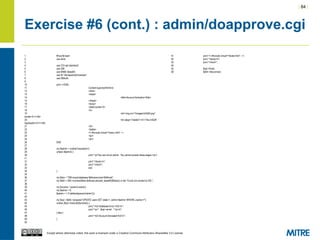
Exercise #6 (cont.) : admin/doapprove.cgi
1 #!/usr/bin/perl
2 use strict;
3
4 use CGI qw/:standard/;
5 use DBI;
6 use MIME::Base64;
7 use lib "/etc/apache2/modules";
8 use DBAuth;
9
10 print <<END;
11 Content-type:text/htmlnn
12 <html>
13 <head>
14 <title>Account Activation</title>
15 </head>
16 <body>
17 <table border=0>
18 <tr>
19 <td><img src="/images/InSQR.png"
border=0 /></td>
20 <td valign="middle"><h1>The InSQR
Application</h1></td>
21 </tr>
22 </table>
23 <!--#include virtual="/menu.html" -->
24 <br/>
25 <br/>
26 END
27
28 my $admin = cookie('insqradmin');
29 unless ($admin) {
30 print "<p>You are not an admin. You cannot access these pages.</p>
n";
31 print "</body>n";
32 print "</html>";
33 exit;
34 }
35
36 my $dsn = "DBI:mysql:database=$dbname;host=$dbhost";
37 my $dbh = DBI->connect($dsn,$dbuser,decode_base64($dbpw)) or die "Could not connect to DB.";
38
39 my $uname = param('uname');
40 my $admin = 0;
41 $admin = 1 if (defined(param('admin')));
42
43 my $sql = $dbh->prepare("UPDATE users SET state=1, admin=$admin WHERE uname=?");
44 unless ($sql->execute($uname)) {
45 print "<h2>Database Error:</h2>n";
46 print "<p>" . $sql->errstr . "<p>n";
47 } else {
48 print "<h2>Account Activated</h2>n";
49 }
50
51 print '<!--#include virtual="/footer.html" -->';
52 print "</body>n";
53 print "</html>";
54
55 $sql->finish;
56 $dbh->disconnect;
79.
| 85 |
Exceptwhere otherwise noted, this work is licensed under a Creative Commons Attribution-ShareAlike 3.0 License.
Worksheet #6
CWE File Line # Description
80.
| 87 |
Exceptwhere otherwise noted, this work is licensed under a Creative Commons Attribution-ShareAlike 3.0 License.
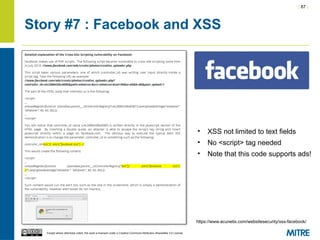
Story #7 : Facebook and XSS
https://www.acunetix.com/websitesecurity/xss-facebook/
• XSS not limited to text fields
• No <script> tag needed
• Note that this code supports ads!
81.
| 88 |
Exceptwhere otherwise noted, this work is licensed under a Creative Commons Attribution-ShareAlike 3.0 License.
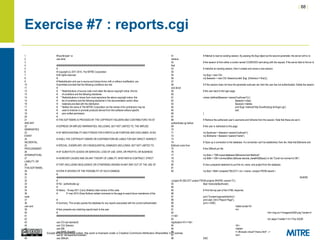
Exercise #7 : reports.cgi
1 #!/usr/bin/perl -w
2 use strict;
3
4 ########################################################################
5 #
6 # Copyright (c) 2011-2014, The MITRE Corporation
7 # All rights reserved.
8 #
9 # Redistribution and use in source and binary forms, with or without modification, are
10 # permitted provided that the following conditions are met:
11 #
12 # * Redistributions of source code must retain the above copyright notice, this list
13 # of conditions and the following disclaimer.
14 # * Redistributions in binary form must reproduce the above copyright notice, this
15 # list of conditions and the following disclaimer in the documentation and/or other
16 # materials provided with the distribution.
17 # * Neither the name of The MITRE Corporation nor the names of its contributors may be
18 # used to endorse or promote products derived from this software without specific
19 # prior written permission.
20 #
21 # THIS SOFTWARE IS PROVIDED BY THE COPYRIGHT HOLDERS AND CONTRIBUTORS "AS IS"
AND ANY
22 # EXPRESS OR IMPLIED WARRANTIES, INCLUDING, BUT NOT LIMITED TO, THE IMPLIED
WARRANTIES
23 # OF MERCHANTABILITY AND FITNESS FOR A PARTICULAR PURPOSE ARE DISCLAIMED. IN NO
EVENT
24 # SHALL THE COPYRIGHT OWNER OR CONTRIBUTORS BE LIABLE FOR ANY DIRECT, INDIRECT,
INCIDENTAL,
25 # SPECIAL, EXEMPLARY, OR CONSEQUENTIAL DAMAGES (INCLUDING, BUT NOT LIMITED TO,
PROCUREMENT
26 # OF SUBSTITUTE GOODS OR SERVICES; LOSS OF USE, DATA, OR PROFITS; OR BUSINESS
INTERRUPTION)
27 # HOWEVER CAUSED AND ON ANY THEORY OF LIABILITY, WHETHER IN CONTRACT, STRICT
LIABILITY, OR
28 # TORT (INCLUDING NEGLIGENCE OR OTHERWISE) ARISING IN ANY WAY OUT OF THE USE OF
THIS SOFTWARE,
29 # EVEN IF ADVISED OF THE POSSIBILITY OF SUCH DAMAGE.
30 #
31 ########################################################################
32 #
33 # File : authenticate.cgi
34 #
35 # History : 19-sep-2011 (Larry Shields) initial version of this code
36 # 31-mar-2014 (Drew Buttner) added comments to the page to assist future maintainers of the
code
37 #
38 # Summary: This scripts queries the database for any reports associated with the current authenticated
user and
39 # then presents any matching reports back to the user.
40 #
41 ########################################################################
42
43 use CGI qw/:standard/;
44 use CGI::Session;
45 use DBI;
46 use MIME::Base64;
47 use lib "/etc/apache2/modules";
48 use DBAuth;
51 # Attempt to load an existing session. By passing the $cgi object as the second parameter, the server will try to
retrieve
52 # the session id from either a cookie named CGISESSID sent along with the request. If the server fails to find an id
that
53 # matches an existing session, then it creates and saves a new session.
54
55 my $cgi = new CGI;
56 my $session = new CGI::Session(undef, $cgi, {Directory=>'/tmp'});
57
58 # If the session does not have the parameter authuser set, then the user has not authenticated. Delete the session
and direct
59 # the user back to the login page.
60
61 unless (defined($session->param("authuser"))) {
62 $session->clear;
63 $session->delete;
64 print $cgi->redirect('http://localhost/cgi-bin/login.cgi');
65 exit;
66 }
67
68 # Retrieve the autherized user's username and fullname from the session. Note that these are set in
authenticate.cgi before
69 # the user is redirected to this page.
70
71 my $authuser = $session->param("authuser");
72 my $fullname = $session->param("name");
73
74 # Open up a connection to the database. If a connection can't be established, then die. Note that $dbname and
$dbhost come from
75 # the DBAuth.pm file.
76
77 my $dsn = "DBI:mysql:database=$dbname;host=$dbhost";
78 my $dbh = DBI->connect($dsn,$dbuser,decode_base64($dbpw)) or die "Could not connect to DB.";
79
80 # Use a prepared statement to pull the rid, name, and project from the database.
81
82 my $sql = $dbh->prepare("SELECT r.rid, r.rname, r.project FROM reports r
WHERE
r.project IN (SELECT project FROM projects WHERE uname=?)");
83 $sql->execute($authuser);
84
85 # Print the top part of the HTML response.
86
87 print "Content-type:text/htmlnn";
88 print start_html ("Report Page");
89 print <<END;
90 <table border=0>
91 <tr>
92 <td><img src="/images/InSQR.png" border=0
/></td>
93 <td valign="middle"><h1>The InSQR
Application</h1></td>
94 </tr>
95 </table>
96 <!--#include virtual="/menu.html" -->
97 <br/>
98 END
82.
| 89 |
Exceptwhere otherwise noted, this work is licensed under a Creative Commons Attribution-ShareAlike 3.0 License.
Exercise #7 : reports.cgi (cont.)
101 # Add the personalized greeting to the top of the page.
102
103 print "<h2>Good day $fullname,</h2>n";
104
105 # Add the information about the reports found in the database to the page.
106
107 if ($sql->rows == 0) {
108 print "<p>You have no reports available for viewing.</p>n";
109 } else {
110 print "<p>You have the following reports available for review:</p>n";
111 print "<table border=1>n";
112 print "<tr><th>Project Name</th><th>Report Name</th></tr>n";
113 while (my ($i,$r,$p) = $sql->fetchrow_array) {
114 print "<tr><td>$p</td><td><a
href="viewreport.cgi?rid=$i">$r</a></td></tr>n";
115 }
116 print "</table>n";
117 }
118
119 # Print the bottom part of the HTML response.
120
121 print "<!--#include virtual="/footer.html" -->";
122 print end_html;
123
124 # Close up the SQL object and disconnect from the database.
125
126 $sql->finish;
127 $dbh->disconnect;
83.
| 90 |
Exceptwhere otherwise noted, this work is licensed under a Creative Commons Attribution-ShareAlike 3.0 License.
Worksheet #7
CWE File Line # Description
84.
| 92 |
Exceptwhere otherwise noted, this work is licensed under a Creative Commons Attribution-ShareAlike 3.0 License.
Story #8 : Password Reset & Social Engineering
Even a well thought out "forgot my password" feature can be
hacked!
pick an application to attack (e.g., Gmail)
stand up a Selenium server
create a fake survey (free coupons)
send a phishing email
ask the user for email address
initiate password reset on target
pass Captcha to be solved
strip questions and ask victim
explain SMS verification code
– “Hey you have to go through a verification process to download this software package. Please
enter your mobile number. We will send a verification code through Google to that number”.
change password
http://www.ivizsecurity.com/blog/penetration-testing/how-i-can-reset-your-gmail-password-an-mitm-based-social-engineering-attack/
85.
| 93 |
Exceptwhere otherwise noted, this work is licensed under a Creative Commons Attribution-ShareAlike 3.0 License.
Exercise #8 : reset.cgi
1 #!/usr/bin/perl
2 use strict;
3
4 ########################################################################
5 #
6 # Copyright (c) 2011-2014, The MITRE Corporation
7 # All rights reserved.
8 #
9 ########################################################################
10 #
11 # File : reset.cgi
12 # History : 19-sep-2011 (Larry Shields) initial version of this code
13 # Summary: Landing page for a user that needs to reset their password
14 #
15 ########################################################################
16
17 use CGI;
18
19 my $cgi = new CGI;
20
21 print $cgi->header(-type => 'text/html');
22
23 print start_html("Password Reset");
24
25 print <<END;
26 <table border=0>
27 <tr>
28 <td><img src="/images/InSQR.png"
border=0 /></td>
29 <td valign="middle"><h1>The InSQR
Application</h1></td>
30 </tr>
31 </table>
32 <!--#include virtual="/menu.html" -->
33 <br/>
34 <p>What is the userid for your account?</p>
35 <form method="post" action="/cgi-bin/resetchallenge.cgi">
36 <table>
37 <tr>
38 <td align=right><b>User ID:<b></td>
39 <td><input name="user"
type="text"></td>
40 </tr>
41 <tr>
42 <td colspan=2 align=center><input
type="submit" value="Submit"></td>
43 </tr>
44 </table>
45 <!--#include virtual="/footer.html" -->
46 END
47
48 print end_html;
86.
| 94 |
Exceptwhere otherwise noted, this work is licensed under a Creative Commons Attribution-ShareAlike 3.0 License.
Exercise #8 (cont.) : resetchallenge.cgi
1 #!/usr/bin/perl
2 use strict;
3
4 ########################################################################
5 #
6 # Copyright (c) 2011-2014, The MITRE Corporation
7 # All rights reserved.
8 #
9 ########################################################################
10 #
11 # File : resetchallenge.cgi
12 # History : 19-sep-2011 (Larry Shields) initial version of this code
13 # Summary:
14 #
15 ########################################################################
16
17 use CGI;
18 use DBI;
19 use MIME::Base64;
20 use lib "/etc/apache2/modules";
21 use DBAuth;
22
23 my $cgi = new CGI;
24
25 my $uname = $cgi->param('user');
26
27 my $dsn = "DBI:mysql:database=$dbname;host=$dbhost";
28 my $dbh = DBI->connect($dsn,$dbuser,decode_base64($dbpw)) or die "Could not connect to DB.";
29
30 my $sql = $dbh->prepare("SELECT sq FROM users WHERE uname=?");
31 $sql->execute($uname);
32
33 print $cgi->header(-type => 'text/html');
34 print start_html("Password Reset");
35 print <<END;
36 <table border=0>
37 <tr>
38 <td><img src="/images/InSQR.png"
border=0 /></td>
39 <td valign="middle"><h1>The InSQR
Application</h1></td>
40 </tr>
41 </table>
42 <!--#include virtual="/menu.html" -->
43 <br/>
44 END
45
46 if ($sql->rows == 0) {
47
48 print "<h2>Error</h2>n";
49 print "<p>Could not find that userid in the system. Please check the
spelling and try again.</p>n";
50
51 } else {
52
53 my ($sq) = $sql->fetchrow_array;
54
55 print "<p>For security purposes, you must answer the following question correctly to
reset the password for this account.</p>n";
56 print "<p><b>Question:</b> $sq?</p>n";
57 print "<form method='post' action='/cgi-bin/resetaccount.cgi'>n";
58 print "<table>n";
59 print "<tr>n";
60 print " <td align=right><b>Answer:<b></td>n";
61 print " <td><input name='sa' type=''ext'><input
name='uname' type='hidden' value='$uname'></td>n";
62 print "</tr>n";
63 print "<tr>n";
64 print " <td colspan=2 align=center><input type='submit'
value='Submit'></td>n";
65 print "</tr>n";
66 print "</table>n";
67 print "</form>n";
68
69 }
70
71 print "<!--#include virtual='/footer.html' -->";
72 print end_html;
73
74 $sql->finish;
75 $dbh->disconnect;
87.
| 95 |
Exceptwhere otherwise noted, this work is licensed under a Creative Commons Attribution-ShareAlike 3.0 License.
Exercise #8 (cont.) : resetaccount.cgi
1 #!/usr/bin/perl
2 use strict;
3
4 ########################################################################
5 #
6 # Copyright (c) 2011-2014, The MITRE Corporation
7 # All rights reserved.
8 #
9 ########################################################################
10 #
11 # File : resetaccount.cgi
12 # History : 19-sep-2011 (Larry Shields) initial version of this code
13 # Summary:
14 #
15 ########################################################################
16
17 use CGI;
18 use DBI;
19 use MIME::Base64;
20 use lib "/etc/apache2/modules";
21 use DBAuth;
22
23 my $cgi = new CGI;
24
25 my $uname = $cgi->param('uname');
26 my $sa = $cgi->param('sa');
27
28 my $dsn = "DBI:mysql:database=$dbname;host=$dbhost";
29 my $dbh = DBI->connect($dsn,$dbuser,decode_base64($dbpw)) or die "Could not connect to DB.";
30
31 my $sql = $dbh->prepare("SELECT uname FROM users WHERE uname=? AND sa=?");
32 $sql->execute($uname,$sa);
33
34 print $cgi->header(-type => 'text/html');
35 print start_html("Password Reset");
36 print <<END;
37 <table border=0>
38 <tr>
39 <td><img src="/images/InSQR.png"
border=0 /></td>
40 <td valign="middle"><h1>The InSQR
Application</h1></td>
41 </tr>
42 </table>
43 <!--#include virtual="/menu.html" -->
44 <br/>
45 END
46
47 if ($sql->rows == 0) {
48
49 print "<h2>Error</h2>n";
50 print "<p>Incorrect answer to security question. You cannot reset the
password for this account.</p>n";
51
52 } else {
53
54 my ($sq) = $sql->fetchrow_array;
55
56 print "<p>Password reset challenge successful. Please provide your new password,
and be sure to choose somethingn";
57 print "you will be able to remember.</p>n";
58 print "<form method='post' action='/cgi-bin/resetpassword.cgi'>n";
59 print "<table>n";
60 print "<tr>n";
61 print " <td align=right><b>New Password:<b></td>n";
62 print " <td><input name='pword' type='password'><input
type=hidden name='uname' value='$uname'></tdn";
63 print "</tr>n";
64 print "<tr>n";
65 print " <td colspan=2 align=center><input type='submit'
value='Submit'></td>n";
66 print "</tr>n";
67 print "</table>n";
68 print "</form>n";
69
70 }
71
72 print "<!--#include virtual='/footer.html' -->";
73 print end_html;
74
75 $sql->finish;
76 $dbh->disconnect;
88.
| 96 |
Exceptwhere otherwise noted, this work is licensed under a Creative Commons Attribution-ShareAlike 3.0 License.
Exercise #8 (cont.) : resetpassword.cgi
1 #!/usr/bin/perl
2 use strict;
3
4 ########################################################################
5 #
6 # Copyright (c) 2011-2014, The MITRE Corporation
7 # All rights reserved.
8 #
9 ########################################################################
10 #
11 # File : resetpassword.cgi
12 # History : 19-sep-2011 (Larry Shields) initial version of this code
13 # Summary:
14 #
15 ########################################################################
16
17 use CGI;
18 use DBI;
19 use MIME::Base64;
20 use lib "/etc/apache2/modules";
21 use DBAuth;
22 use Digest::MD5 qw(md5_hex);
23
24 my $cgi = new CGI;
25
26 my $uname = $cgi->param('uname');
27 my $pword = $cgi->param('pword');
28 my $hashp = md5_hex($pword);
29
30 my $dsn = "DBI:mysql:database=$dbname;host=$dbhost";
31 my $dbh = DBI->connect($dsn,$dbuser,decode_base64($dbpw)) or die "Could not connect to DB.";
32
33 my $sql = $dbh->prepare("UPDATE users SET pword=?, state=1 WHERE uname='$uname'");
34 $sql->execute($hashp);
35
36 print $cgi->header(-type => 'text/html');
37 print start_html("Password Reset");
38 print <<END;
39 <table border=0>
40 <tr>
41 <td><img src="/images/InSQR.png"
border=0 /></td>
42 <td valign="middle"><h1>The InSQR
Application</h1></td>
43 </tr>
44 </table>
45 <!--#include virtual="/menu.html" -->
46 <br/>
47 <p>Your password is now reset. Please login to the application normally
to view your reports.</p>
48 <!--#include virtual="/footer.html" -->
49 END
50 print end_html;
89.
| 97 |
Exceptwhere otherwise noted, this work is licensed under a Creative Commons Attribution-ShareAlike 3.0 License.
Worksheet #8
CWE File Line # Description
90.
| 99 |
Exceptwhere otherwise noted, this work is licensed under a Creative Commons Attribution-ShareAlike 3.0 License.
Story #9 : Netgear Command Injection
Root!
"Don't exploit the buffer overflow
because the command injection
that immediately follows it is
easier!"
91.
| 100 |
Exceptwhere otherwise noted, this work is licensed under a Creative Commons Attribution-ShareAlike 3.0 License.
Exercise #9 : dostatus.cgi
1 #!/usr/bin/perl -w
2 use strict;
3
4 ########################################################################
5 #
6 # Copyright (c) 2011-2014, The MITRE Corporation
7 # All rights reserved.
8 #
9 # Redistribution and use in source and binary forms, with or without modification, are
10 # permitted provided that the following conditions are met:
11 #
12 # * Redistributions of source code must retain the above copyright notice, this list
13 # of conditions and the following disclaimer.
14 # * Redistributions in binary form must reproduce the above copyright notice, this
15 # list of conditions and the following disclaimer in the documentation and/or other
16 # materials provided with the distribution.
17 # * Neither the name of The MITRE Corporation nor the names of its contributors may be
18 # used to endorse or promote products derived from this software without specific
19 # prior written permission.
20 #
21 # THIS SOFTWARE IS PROVIDED BY THE COPYRIGHT HOLDERS AND CONTRIBUTORS "AS IS"
AND ANY
22 # EXPRESS OR IMPLIED WARRANTIES, INCLUDING, BUT NOT LIMITED TO, THE IMPLIED
WARRANTIES
23 # OF MERCHANTABILITY AND FITNESS FOR A PARTICULAR PURPOSE ARE DISCLAIMED. IN NO
EVENT
24 # SHALL THE COPYRIGHT OWNER OR CONTRIBUTORS BE LIABLE FOR ANY DIRECT, INDIRECT,
INCIDENTAL,
25 # SPECIAL, EXEMPLARY, OR CONSEQUENTIAL DAMAGES (INCLUDING, BUT NOT LIMITED TO,
PROCUREMENT
26 # OF SUBSTITUTE GOODS OR SERVICES; LOSS OF USE, DATA, OR PROFITS; OR BUSINESS
INTERRUPTION)
27 # HOWEVER CAUSED AND ON ANY THEORY OF LIABILITY, WHETHER IN CONTRACT, STRICT
LIABILITY, OR
28 # TORT (INCLUDING NEGLIGENCE OR OTHERWISE) ARISING IN ANY WAY OUT OF THE USE OF
THIS SOFTWARE,
29 # EVEN IF ADVISED OF THE POSSIBILITY OF SUCH DAMAGE.
30 #
31 ########################################################################
32 #
33 # File : dostatus.cgi
34 #
35 # History : 19-sep-2011 (Larry Shields) initial version of this code
36 # 31-mar-2014 (Drew Buttner) added comments to the page to assist future maintainers of the
code
37 #
38 # Summary: This scripts shows the status of resources that this application depends on.
39 #
40 ########################################################################
41
42 use CGI;
43 use CGI::Request;
44
45 my $cgi = new CGI;
46
47 # The following three subroutines perform an array of checks for the InSQR application and report any
issues that
48 #need to be addressed.
51 sub check_files {
52 print "Completed file scan: InSQR files all functioning properly.";
53 }
54 sub check_db {
55 print "Completed DB Connection Test: DB connection is functioning
properly.";
56 }
57 sub check_server {
58 print "Completed server validation: Server is functioning properly.";
59 }
60
61 # Generate header information that will be part of the HTTP response from the server. In this case we are
setting
62 # the content-type to text/html.
63
64 print $cgi->header(-type => 'text/html');
65
66 # The start_html() function generates a generic HTML opening that is then printed to the HTTP response.
67
68 print start_html("Status Functions");
69
70 # The following block of adds everything between the END tags to the HTTP response. This is the body of
the HTML
71 # page that will be displayed to the user.
72
73 print <<END;
74 <table border=0>
75 <tr>
76 <td><img src="/images/InSQR.png"
border=0 /></td>
77 <td valign="middle"><h1>The InSQR
Application</h1></td>
78 </tr>
79 </table>
80 <!--#include virtual="/menu.html" -->
81 <br>
82 <h2>Status Results</h2>
83 END
84
85 # The following code reads the 'check' parameter from the request that was sent to this script. The value
associated
86 # with this parameter is then used to determine which status subroutine to call. The eval() function calls
the
87 # appropriate subroutine defined earlier in this script. The status report from the subroutine is then printed
to the
88 # page and sent back to the user. The $@ variable contains the output of the last function, in this case
eval().
89
90 my $check = $cgi->param('check');
91 my $function = "check_$check";
92 eval($function);
93 print " <p>";
94 print $@ if $@;
95 print "</p>n";
96
97 # Compose the footer for the HTML page being generated for the response.
98
99 print "<!--#include virtual='/footer.html' -->n";
92.
| 101 |
Exceptwhere otherwise noted, this work is licensed under a Creative Commons Attribution-ShareAlike 3.0 License.
Worksheet #9
CWE File Line # Description
93.
| 103 |
Exceptwhere otherwise noted, this work is licensed under a Creative Commons Attribution-ShareAlike 3.0 License.
Story #10 : Target Data Breach
1) Phishing email campaign
2) Zeus Banking Trojan
3) Fazio Mechnaical
4) Malwarebytes Anti-Malware
5) Publically available data
6) Target's external vendor portal
7) Lack of isolation
8) Exfiltration
94.
| 104 |
Exceptwhere otherwise noted, this work is licensed under a Creative Commons Attribution-ShareAlike 3.0 License.
Exercise #10 : logout.cgi
1 #!/usr/bin/perl -w
2 use strict;
3
4 ########################################################################
5 #
6 # Copyright (c) 2011-2014, The MITRE Corporation
7 # All rights reserved.
8 #
9 # Redistribution and use in source and binary forms, with or without modification, are
10 # permitted provided that the following conditions are met:
11 #
12 # * Redistributions of source code must retain the above copyright notice, this list
13 # of conditions and the following disclaimer.
14 # * Redistributions in binary form must reproduce the above copyright notice, this
15 # list of conditions and the following disclaimer in the documentation and/or other
16 # materials provided with the distribution.
17 # * Neither the name of The MITRE Corporation nor the names of its contributors may be
18 # used to endorse or promote products derived from this software without specific
19 # prior written permission.
20 #
21 # THIS SOFTWARE IS PROVIDED BY THE COPYRIGHT HOLDERS AND CONTRIBUTORS "AS IS"
AND ANY
22 # EXPRESS OR IMPLIED WARRANTIES, INCLUDING, BUT NOT LIMITED TO, THE IMPLIED
WARRANTIES
23 # OF MERCHANTABILITY AND FITNESS FOR A PARTICULAR PURPOSE ARE DISCLAIMED. IN NO
EVENT
24 # SHALL THE COPYRIGHT OWNER OR CONTRIBUTORS BE LIABLE FOR ANY DIRECT, INDIRECT,
INCIDENTAL,
25 # SPECIAL, EXEMPLARY, OR CONSEQUENTIAL DAMAGES (INCLUDING, BUT NOT LIMITED TO,
PROCUREMENT
26 # OF SUBSTITUTE GOODS OR SERVICES; LOSS OF USE, DATA, OR PROFITS; OR BUSINESS
INTERRUPTION)
27 # HOWEVER CAUSED AND ON ANY THEORY OF LIABILITY, WHETHER IN CONTRACT, STRICT
LIABILITY, OR
28 # TORT (INCLUDING NEGLIGENCE OR OTHERWISE) ARISING IN ANY WAY OUT OF THE USE OF
THIS SOFTWARE,
29 # EVEN IF ADVISED OF THE POSSIBILITY OF SUCH DAMAGE.
30 #
31 ########################################################################
32 #
33 # File : logout.cgi
34 #
35 # History : 19-sep-2011 (Larry Shields) initial version of this code
36 # 31-mar-2014 (Drew Buttner) added comments to the page to assist future maintainers of the
code
37 #
38 # Summary:
39 #
40 ########################################################################
41
42 use CGI;
43 use CGI::Session;
44
45 # Attempt to load an existing session. By passing the $cgi object as the second parameter, the server will
try to retrieve
46 # the session id from either a cookie named CGISESSID sent along with the request. If the server fails to
find an id that
47 # matches an existing session, then it creates and saves a new session.
51
52 # Clear all the data associated with the session and then delete the session itself.
53
54 $session->clear();
55 $session->delete();
56
57 # Generate header information that will be part of the HTTP response from the server. In this case we are
setting
58 # the content-type to text/html.
59
60 print $cgi->header(-type => 'text/html');
61
62 # The start_html() function generates a generic HTML opening that is then printed to the HTTP response.
It looks like:
63 #
64 # <HTML>
65 # <HEAD>
66 # <TITLE> Logout Page </TITLE>
67 # </HEAD>
68 # <BODY>
69
70 print start_html("Logout Page");
71
72 # The following block of adds everything between the END tags to the HTTP response. This is the body of
the HTML
73 # page that will be displayed to the user.
74
75 print <<END;
76 <table border=0>
77 <tr>
78 <td><img src="/images/InSQR.png"
border=0 /></td>
79 <td valign="middle"><h1>The InSQR
Application</h1></td>
80 </tr>
81 </table>
82 <!--#include virtual="/menu.html" -->
83 <br/>
84 <br/>
85 <p>You are now logged out of the InSQR application.</p>
86 <!--#include virtual="/footer.html" -->
87 END
88
89 # The end_html() function generates a generic HTML ending that is then printed to the HTTP response. It
looks like:
90 #
91 # </BODY>
92 # </HTML>
93
94 print end_html;
95
96 # When then server finishes processing this script, the HTTP response that was generated above is sent
to the user.
95.
| 105 |
Exceptwhere otherwise noted, this work is licensed under a Creative Commons Attribution-ShareAlike 3.0 License.
Worksheet #10
CWE File Line # Description
96.
| 107 |
Exceptwhere otherwise noted, this work is licensed under a Creative Commons Attribution-ShareAlike 3.0 License.
Closing Remarks
97.
| 108 |
Exceptwhere otherwise noted, this work is licensed under a Creative Commons Attribution-ShareAlike 3.0 License.
A Combined Approach
Secure
Code
Review
98.
| 109 |
Exceptwhere otherwise noted, this work is licensed under a Creative Commons Attribution-ShareAlike 3.0 License.
Secure Code Review Process
Developer
Interview
Static
Analysis
Tools
Manual
Inspection
Findings
Report
99.
| 110 |
Exceptwhere otherwise noted, this work is licensed under a Creative Commons Attribution-ShareAlike 3.0 License.
Exercises
Together we performed a full review of The InSQR Application.
100.
| 111 |
Exceptwhere otherwise noted, this work is licensed under a Creative Commons Attribution-ShareAlike 3.0 License.
External Resources
Best Kept Secrets of Peer Code Review
http://www.lexingtonsoft.com/assets/white/documents/best-kept-secrets-of-peer-code-review.pdf
Microsoft: Writing Secure Code, 2nd
Edition
http://www.microsoft.com/learning/en/us/book.aspx?ID=5957&locale=en-us
CERT: Secure Coding in C and C++
http://www.cert.org/books/secure-coding
Viega/McGraw: Building Secure Software
http://collaboration.csc.ncsu.edu/CSC326/Website/lectures/bss-ch1.pdf
OWASP Code Review Guide
https://www.owasp.org/index.php/OWASP_Code_Review_Guide_Table_of_Contents
NIST Static Analysis Tool Exposition (SATE)
http://samate.nist.gov/SATE.html
SAFECode: Fundamental Practices for Secure Software Development, 2nd
Edition
http://www.safecode.org/publications/SAFECode_Dev_Practices0211.pdf
101.
| 112 |
Exceptwhere otherwise noted, this work is licensed under a Creative Commons Attribution-ShareAlike 3.0 License.
Thank You!
Editor's Notes
#1 Before getting started with the course, we want to talk about a interesting story that came out of Apple in February related to code in iOS 7. The issue became public while we were working on this course and our immediate thought was how a code review could have played a role in helping identify this issue before it found its way into production code.
When a browser on your iPhone makes an SSL/TLS request to a website, the website presents a cryptographic “certificate” chain identifying itself and the authority which issued the certificate. Your device already has a list of issuing authorities which are trusted, and it will check the name of the site and the certificate it presents with that authority. If an invalid or fake certificate is provided, (e.g., one that has the wrong name for the site, or which hasn’t been issued by the authority, or which is out of date) then the browser won’t trust it and you will get a warning saying that there’s something wrong and that you shouldn’t proceed or your data could be at risk. To fully trust a site, it is important to verify the authenticity of the certificate.
Part of the validation code during a SSL/TLS key exchange in iOS is shown here on the slide. This code goes through a number of checks against the certificate that was provided. If any of them fail, then it jumps down to the end and returns the failed result. On Feb 21 Apple released a security alert and provide an update to iOS. The alert didn't give many details but it quickly caught the interest of the security community.
The alert gave an impact stating an attacker could capture protected SSL/TLS transaction. (presumably through a Man-in-the-Middle attack) This is a HUGE deal. Think about your online banking that is protected by SSL/TLS. If an attacker could capture or modify these transactions, then they could manipulate your account and steal your money.
Experts started digging into the issue and tried to see exactly what the error was and how it was fixed. It turns out that a simple developer mistake, a single line in fact was to blame. Looking at line 13 above, you can see an extra "goto fail;" statement. Since brackets were not used, then only the next line following the IF statement was part of the conditional. The second "goto fail;" was ALWAYS followed. If the previous check succeeded, then the err variable would hold "SUCCESS". Following the "goto fail;" at this point meant that all subsequent checks were skipped, and the err variable showed SUCCESS, hence the certificate would be verified.
Code reviews are instituted to find these types of mistakes. Whether this be a quick peer review before code is checked in, or a more elaborate secure code review at the end of the development cycle. Automated tools should also be able to help find this type of flaw as the checks after the second goto would be dead code.
An article (http://www.theguardian.com/technology/2014/feb/25/apples-ssl-iphone-vulnerability-how-did-it-happen-and-what-next) written on this talked to a former Apple developer and he said “Apple does not have a strong culture of testing or test-driven development. Apple relies overly on ‘dogfooding’ [using its own products] for quality processes, which in security situations is not appropriate." That same article said that Apple found the issue through "… a line-by-line review of code, almost certainly sparked by the revelations by … to have cracked SSL."
More info can be found at: http://nakedsecurity.sophos.com/2014/02/24/anatomy-of-a-goto-fail-apples-ssl-bug-explained-plus-an-unofficial-patch/
#8 One compelling reason for spending the time and effort to find defects earlier in the development lifecycle is that the cost of fixing a defect increases significantly as the development lifecycle progresses. Research, like the reports from IBM and NIST, have shown over and over that the cost of fixing a defect rises the later in the lifecycle it is found. The NIST report is diagramed in the slide and shows the cost of fixing a defect at each stage of the development lifecycle. The cost is expressed as “X”, a normalized unit of cost that can be expressed in terms of person-hours, dollars, etc. The post product release cost of fixing a defect is shown to be thirty times more than the cost of fixing a defect in the design and architecture phase. This makes sense when you think about the additional activities that have to be performed on code that has been released vs. code that is being designed. Code that has been released has the added cost of integration with other products and services, multiple deployments that must be updated, and the code must repeat the entire release process from start to finish. The return on investment for fixing a defect at the beginning of the software development lifecycle instead of after the code has been released is 30x.
In addition to the cost savings, fixing a defect early can provide other benefits. Fixing defects early improves the security and functionality of the code base, keeping your company’s name out of the news and your customers happy. All too often a simple and unnoticed error – a single equals instead of a double equals in an IF statement, duplicative GOTO statements, or statements outside of the intended scope - can have catastrophic results. C-level executives resign, the public perception of a product shifts substantially, and an entire industry can go on alert.
Lastly, and probably most importantly, fixing defects helps keep your code from being exploited, which helps keep user and application data safe and secure, which improves the security of the software ecosystem. Many user repeat the same username and password across products and services, despite our best efforts to educate them, which means that a successful breach of one system that results in a compromise of user credentials can result in that user’s account being compromised across any number of unrelated systems: online banking, personal email accounts, online shopping, and, heaven forbid, their MySpace account.
#9 Microsoft has a published, well known high level security development lifecycle, which we use to model our own thinking about secure coding. The Microsoft Security Development Lifecycle defines 17 practices spread across the 7 phases that, when followed, improve the security of software. The Microsoft SDLC includes privacy components as well.
In the Training phase, foundational concepts like secure design, threat modeling, secure coding, security testing, and best practices surrounding privacy are taught to developers. You are participating in the Training phase right now.
In the Requirements phase, security and privacy requirements are established to help identify key milestones and minimize disruptions to plans and schedules, minimum acceptable levels of security and privacy are defined, and security and privacy risk assessments are performed to help a team identify which parts of a project will require threat modeling and security design reviews.
In the Design phase, design requirements are established to help minimize schedule disruptions, the attack surface is analyzed and possibly reduced, and threat modeling is performed in order to help a team more effectively identify security vulnerabilities.
In the Implementation phase, approved tools and associated security checks help a team enforce security practices efficiently, unsafe functions are deprecated to avoid their use, and static analysis is performed to provide a scalable method of security code review.
In the Verification phase, dynamic analysis, fuzz testing, and attack surface review are performed to verify the security of the application.
In the Release phase, an incident response plan is created, a final security review is performed, and the release is certified and archived.
In the Response phase, the incident response plan from the Release phase is executed as necessary.
The reality is that even though Microsoft gets plenty of flak for their products having vulnerabilities and being exploitable, they currently do a very good of applying a security mindset throughout the software development lifecycle.
#10 The Intro to Secure Coding class focuses on the Implementation phase where the coding actually happens. That class teaches developers how to maintain a security mindset while writing software.
This course is a follow on and focuses on the Verification phase. We’ll talk primarily about peer reviews and how they can be used to identify potential weaknesses in software. The lessons learned during this course can be applied to the Implementation phase when you write your own software.
#11 This is a review slide from the Intro to Secure Coding class. In the Introduction to Secure Coding class we talked about the thee high level goals of application security:
Confidentiality is ensuring that the application only grants data access to the users that are authorized to see it.
Integrity is ensuring that data has not been modified during storage or communication.
Availability is ensuring that the application is available to perform its function when needed.
These three high level goals help improve application security. You might notice that at this point I’ve talked about how you can take actions that help improve security, but I haven’t told you what you can do to guarantee security. That is because there is nothing absolutely guarantees security. You can, however, maximize security. In order to meet the goals of Confidentially, Integrity, and Availability, there are 10 principles that you can follow.
Minimize Attack Surfaces – Reduce the number of ways users and/or third party services interact with your application. Removing duplicate functionality, removing unnecessary form fields, and removing unnecessary functionality altogether all help minimize the attack surface.
Establish secure defaults – Never assume that the user/installer of an application knows what they are doing. The application should be secure by default and any insecure configuration should be an explicit modification by the user/installer.
Least Privilege – Make sure that users have the minimum privileges necessary to perform their function. If some users require additional privileges sometimes, provide a mechanism to enter the more powerful context, perform the activity, and leave that context – one example of this is the sudo command.
Defense in Depth – Use layers of security to help improve defenses. That way if one mechanism fails, then an attack may be stopped by a different defense.
Fail Securely - Security controls should assume an attack by default and only let something pass if it is proven not to be an attack. By taking this approach, holes that we forget to cover will not lead to a valid attack, but rather to a bug report.
Don’t Trust Service – Third party services are often of unknown quality and can change at any time. Just because a service claims to do something right, doesn't mean it actually does. Therefore, as a developer you should inherently distrust data being returned from a 3rd party.
Separation of Duties – Split the roles for actions related to a security decision. You want to avoid having a single group or person being responsible for everything.
Avoid Security by Obscurity – Hackers, criminals, and the advanced persistent threat most likely can reverse engineer your source code, or find things that are supposedly hidden. Relying on obscurity is dangerous and is usually just a cover for real security not being implemented.
Keep Security Simple – Design a security architecture that works, yet in the simplest way possible. Increased complexity \will not only make it harder to implement, but it will make it harder for a peer or a security team to review.
Fix Issues Correctly – This sounds a bit funny, but people often are made aware of an attack and put in a mechanism to stop that specific attack without fixing the underlying problem. A malicious user just changes the attack and is back inside the application.
Mechanisms are the ways we go about meeting these principles and achieving our goals. The previous course went into detail on these mechanisms.
Authentication is the act of confirming that someone (or something) is who they say they claim to be.
Authorization is the act of verifying that a previously authenticated user is allowed to perform a given operation or act on a given resource, and is often known as access control.
Data Validation is the act of ensuring that the data is correct and well formed
Session Management is keeping track of a user’s state across multiple requests/responses, and is often discussed in the context of a web application.
Error Handling is the proper routing of error information. Stack traces should never make it to the user, but should be sent to a place where an admin can view them.
Logging
Encryption
#12 Reminder on how mechanisms help achieve goals. We have arrows there, but really all mechanisms apply to all goals.
#13 In the end, secure coding really comes down to the different mechanisms that are available to ensure adherence to the previously mentioned application security principles. Our job as code reviewers is to assess the implementation of these mechanisms in the product. Make sure that implementation was done properly, etc.
#14 Reminder of the words to live by from the previous class. It’s a good idea, even for the secure code review team, to go back and look at these. Focus on what the developer is trying to do.
#15 One project that everyone should be aware of, and a project we will mention a lot throughout this course, is the Common Weakness Enumeration (CWE). This is a MITRE-run initiative to enumerate and provide standard identifiers for the different coding-level security-related mistakes that developers often make. This standard identifier enable security personnel to share information about weaknesses and for tools to report findings in a way that review teams can easily grasp. There’s a lot of good description information on weaknesses, which is a benefit to both the reviewer and the developer. The reviewer doesn’t have to spend time duplicating a description that has been used many times over, and the developer doesn’t have to rely on the communication skills of the developer. Many static analysis tools use CWEs to report the weaknesses they find.
It’s important to note that a CWE describes a weakness, but not a vulnerability. In order for a weakness to become a vulnerability, it has to be exploitable. For example, I reviewed one application where the developer had made a mistake by allowing SQL Injection. I knew the developer of the application and got permission to attempt to exploit the weakness in a non-production system. It turns out that the weakness was not a vulnerability because the database was fully public, meaning I couldn’t get access to any information I didn’t already have, and the permissions were set to read only and therefore my “drop tables” command didn’t have any effect. While, in this case, the weakness turned out to not be a vulnerability, it was still a weakness that the developer fixed.
As a review team, we use CWE not only to helps us understand what we’re looking for, but helps relay our findings to developers by providing a resource with robust information. This robust information also gives developers insight on how to solve the problem.
#16 The CWE team also compiles a Top 25 list each year that helps identify the 25 most dangerous and prevalent software errors that we see today. This list is a great way to keep the most common issues in the forefront of a developer's mind and help focus effort to make sure that these errors are not introduced. This is a good list to be familiar with, in part because this list is largely composed of weaknesses that should never ever happen anymore. SQL injection is the top weakness found in software today. Prepared Statements have been around as long as I can remember – the only reason SQL injection exists is because developers don’t take care to use them.
We’ve done 25 reviews over the last 2 years, and all of them have these kinds of errors. We have yet to review a single application that doesn’t have a single finding, and very few that don’t have at least one top 25. Many of these are well known things that shouldn’t exist anymore.
#19 A secure code review is a task at the end of the SDLC that attempts to find any security related flaws that came about during the coding process. This could be due to mistakes by the developers, or maybe a change from the intended design due to coding challenges.
It involves an interview, static analysis, manual analysis, and a final report.
A secure code review does not replace the developer peer reviews that should be taking place during the coding phase. Both activities offer something different and each should be leveraged accordingly. We will talk more about this in the coming slides.
#20 Although the goals of a secure code review often differ from those of your typical peer review, there is a lot to be gained by looking at the well established methodologies for peer reviews. Peer reviews have evolved into 5 distinct types, each for a target audience and goal. Formal, over-the-shoulder, email pass-around, pair programming, and tool assisted all bring something different to the table.
#21 A Secure Code Review looks to leverage elements from each of the different types of peer reviews.
#22 What benefits can you expect from a Secure Code Review? A few of the benefits include:
A different perspective. “Another set of eyes” adds objectivity. Similar to the reason for separating your coding and testing teams, secure code reviews provide the distance needed to recognize problems.
Security Experts. The developers have enough on their plates trying to stay current with the latest frameworks and coding practices. They also are often tasked to get thing finished quickly to meet an unrealistic deadline. A Secure Code Review allows a team that focuses on secure coding to look at the code.
Less rework. Do it right the first time. Changes cost more later in the life cycle. The secure code review process catches many errors before they go to production.
Fewer bugs. It’s better to discover your own problems than to have someone (like a user) point them out to you.
Better Code. At the end of the process, the application being developed is better, and that is the ultimate goal of everyone involved in its development.
The reference to the movie "Source Code" is mostly to spice things up. The movie is about a program that allows someone to go back in time an live someone's life for 8 minutes. This is used to help find the source of a train bombing after it happened so that a future bombing can be avoided. In a way, a secure code review is similar in that we are looking to find problems before they are used in an exploit.
#23 It can’t all be roses. A few of the issues you will need to balance when you implement secure code reviews include:
Time. Some secure code reviews take a long time. But like other types of meetings, focusing on the topic, being familiar with the process, and establishing solid ground rules can help keep the time reasonable. Secure Code Reviews invest your time; bugs waste it.
Preparation. Reading unfamiliar code and correlating that code to unfamiliar documentation inevitably means questions for the programmers which takes them away from coding. However, it’s a necessary evil. Over time, however, proper preparation for the meeting should take less time, as reviewers learn what to look for and become familiar with the process.
Initial frustration. If team members are not familiar with secure code reviews, the experience can be frustrating for all participants. Teams need to devise a process for secure code reviews, implement it, and modify it only when the situation dictates. In time, members will grow accustomed to the process.
The need to show commitment. The benefit of a secure code review is sometimes hard to see. If it is not done correctly, or if the code was in good shape coming in, then the finding will be minimal. It is a challenge to stay the course and perform enough secure code reviews such that your skills improve and make the reviews more worthwhile. Your goal should be to conduct a secure code review for every application.
Since we had a movie reference for the benefits slide, we felt that one was needed for this slide as well. WarGames is a classic. It is about this kid who hacks into a secret Government system for fun and ends up kicking off a "war game". Unfortunately for him, the game is thought to be real by the US military and he quickly finds himself in some hot water. This is similar to the situation you can get yourself into if you don't review your code!!
#25 The review team is there to support the developers, not to prove that they are smarter than the developers. The developer are there to help the review team, not to show how the review team doesn't know what they are talking about.
#26 The $100,000 Series 1934 Gold Certificate feature a portrait of Woodrow Wilson. These notes were printed from December 18, 1934, through January 9, 1935, and were issued by the Treasurer of the United States to Federal Reserve Banks only against an equal amount of gold bullion held by the Treasury Department. The notes were used only for official transactions between Federal Reserve Banks and were not circulated among the general public.[6]Photographic records show that at least seven 1934 $100,000 Gold Certificates are still in existence (#s A00000001A, A00020102A, A00020106A, A00020108A, A00020109A, A00020110A, A00020113A)
#38 If it's going to take you a few hours digging through a manual to figure out if a Framework does something... that's likely a bad choice. Go ask someone who already knows the language/framework/etc. well enough to be coding in it. They may not know the answer, and then you have to look it up. But often, they can save you a ton of time and point you right at the info you need or tell you what the system does or does not do.
#39 One of the things that will become apparent very quickly doing a manual review is the difference between knowledge of security concepts and the syntactical language.
#40 a reminder, that especially if they're doing a review on code that may already be in production, that finding a security flaw is sensitive info. Yes, you have to document and share that info with those who need-to-know to get it fixed. But that information should be protected, provided only to those who have a need to have the details, findings documents should likely be encrypted as they're sent around, etc.
#42 Go forth and review
Peer reviews can be a fun and interesting part of the development process. There may be a few drawbacks, but the end result is usually better code, and better code is good for everyone. Additionally, you may even find that as the reviewer or the reviewed, your skills as a developer will grow.
#50 Our second story is related to an open source e-commerce shopping cart. A session fixation vulnerability was identified in December that allowed attackers to gain control of a user's session and access to their payment information. Remember back to the secure coding class about session fixation … one of the biggest issues is when an existing session id is used after a successful login. This allows an adversary to set the id and then trick/wait for the user into logging in. In this case, the "log in new customers after checkout feature" missed this detail. The application set up the new user and logged them in, but never invalidated the existing session.
Now you might be saying to yourself … but we were taught in the secure coding class to use existing solutions and not to re-invent the wheel. Yes, we did say that, and in this case you would still be burned. This just shows why you still need to know about these issues, and if practical you should talk to the developers or test the code that you are brining into your application. Unfortunately, as of today nothing is perfect.
https://drupal.org/node/2158651
Mark to tie in with story about Wordpress.
#51 this code is just to refresh about session fixation. This is how it is supposed to work.
#52 There are two other things related to session ids and more specifically the cookies that are often used to communicate these ids.
http://resources.infosecinstitute.com/securing-cookies-httponly-secure-flags/
#56 This is a vulnerability in the Tesla Motors Design Studio.
flaw in the URL shortener routine, not "main" functionality. But still database access, so important.
https://bitquark.co.uk/blog/2014/02/23/tesla_motors_blind_sql_injection
#57 Sleeps (pauses) for the number of seconds given by the duration argument, then returns 0. If SLEEP() is interrupted, it returns 1. The duration may have a fractional part. This function was added in MySQL 5.0.12.
#68 The Heartbleed bug occurs because of a chain of two distinct mistakes in the code. The first is an inconsistency in the stated length of the message body, and the body’s actual length. This type of weakness is described in detail by CWE-130 : "Improper Handling of Length Parameter Inconsistency". Following this weakness is an out-of-bounds memory read which is described in CWE-125 : "Out-of-bounds Read".
#87 Code to support ads.
controller id was supplied by the user and was then used directly inside a script tag.
https://www.acunetix.com/websitesecurity/xss-facebook/
#92 Selenium is a software testing framework for web applications. Selenium can automate browser locally or remotely. http://seleniumhq.org/.)

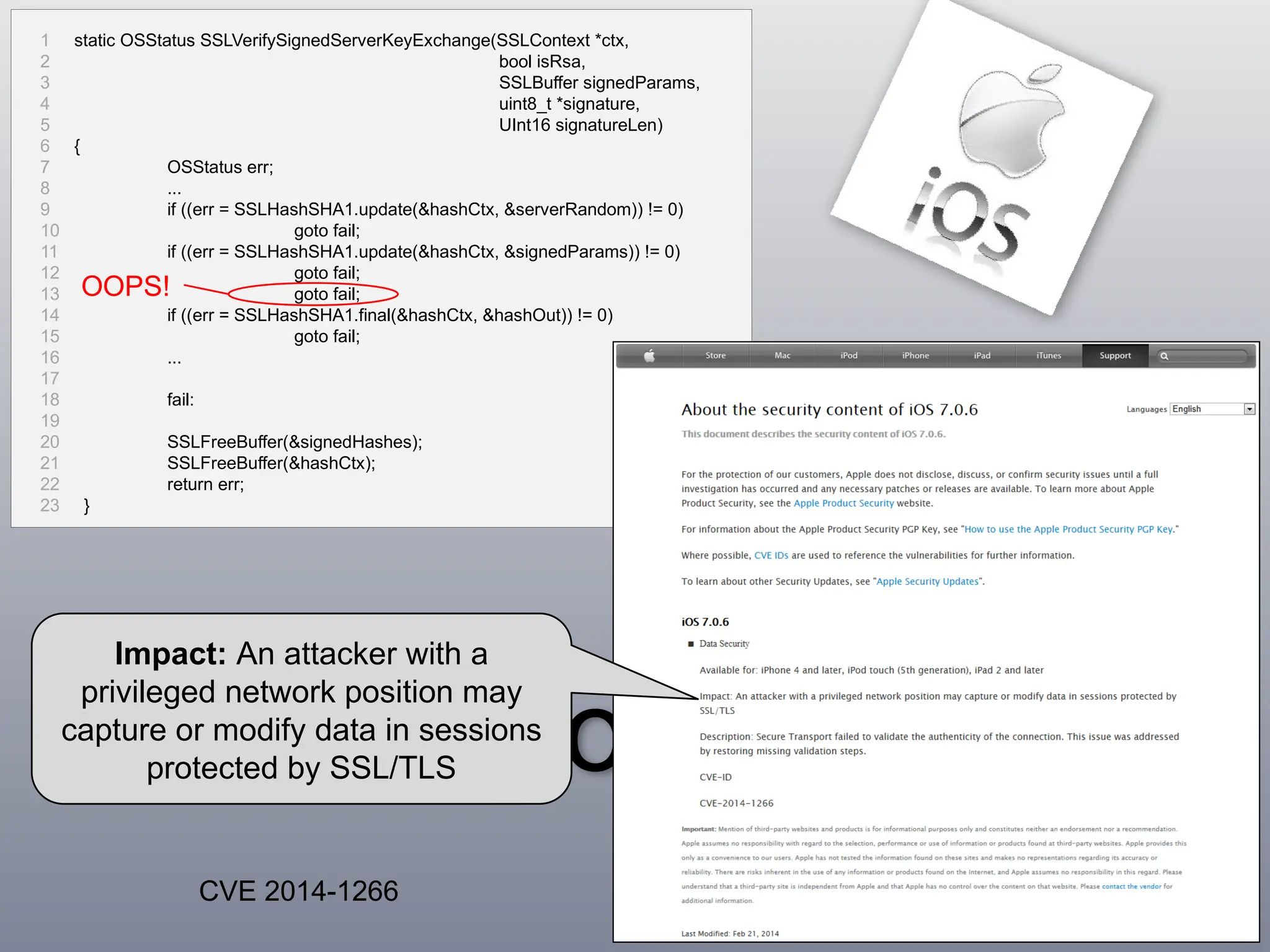
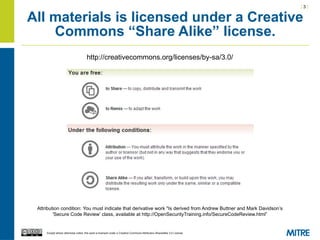
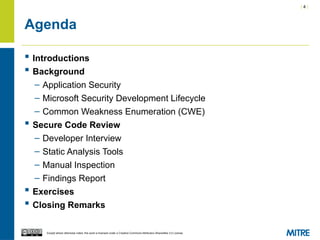
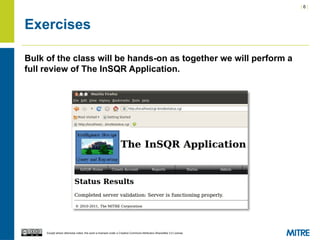
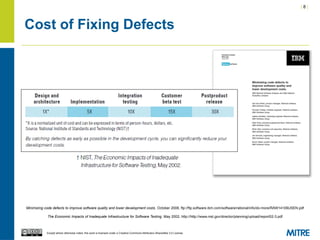
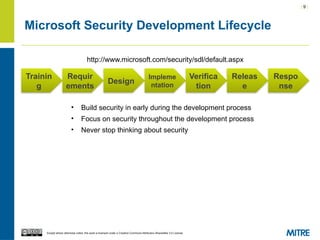
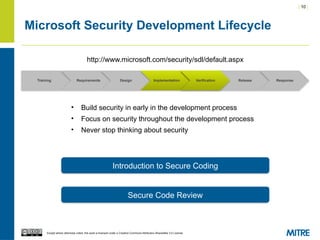
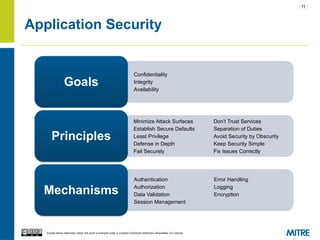
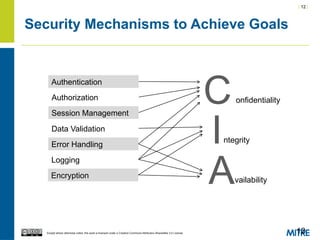
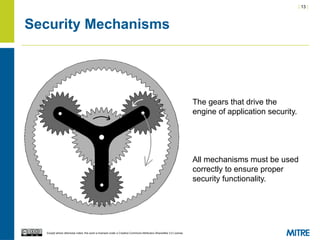
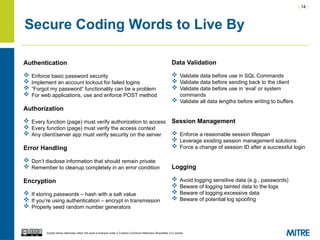
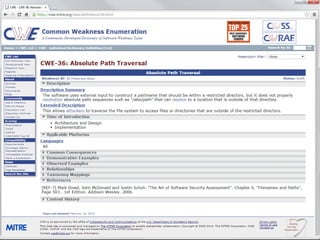
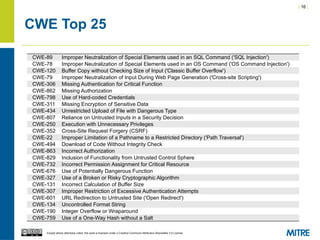
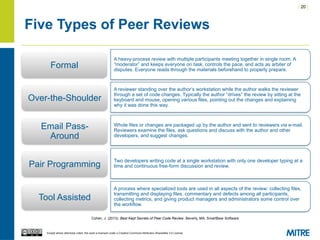
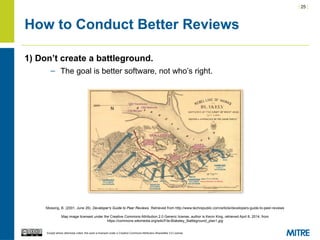
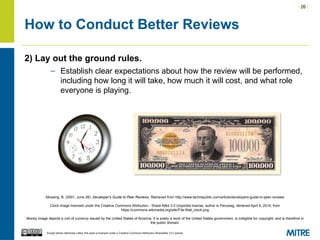
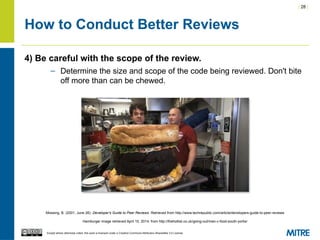
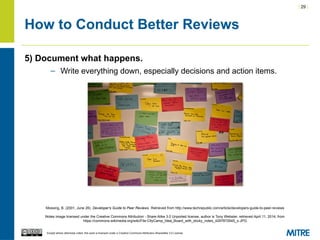
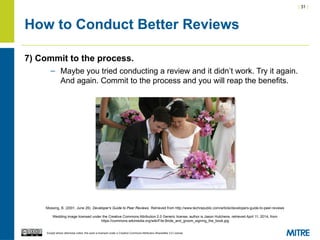
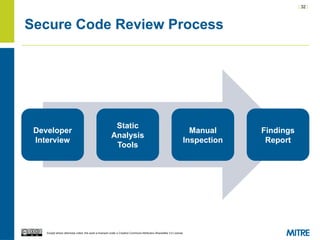
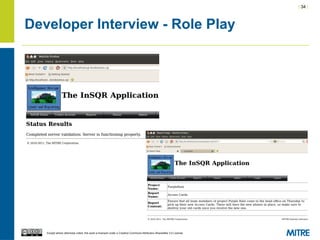
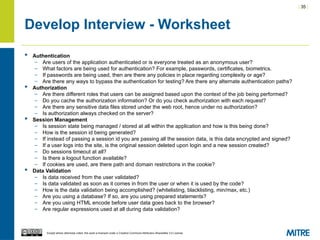
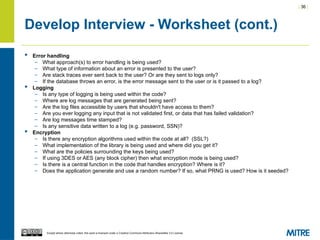
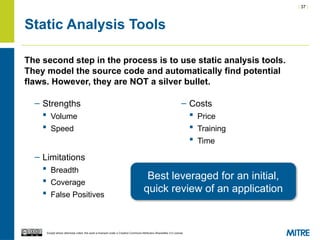
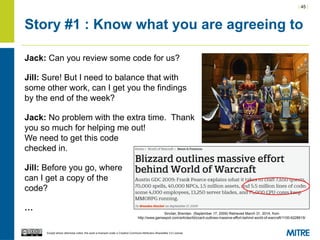
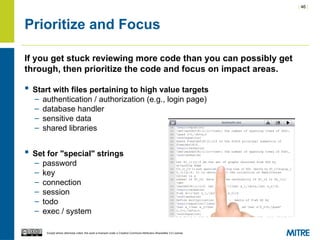
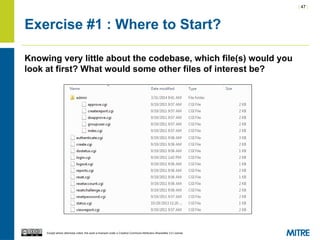
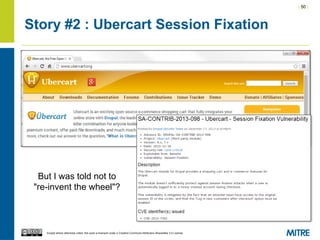
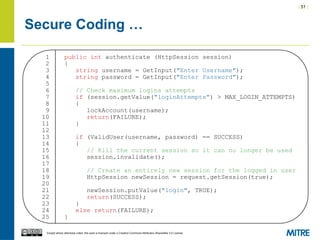
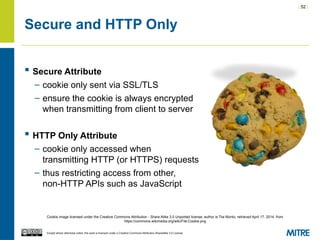
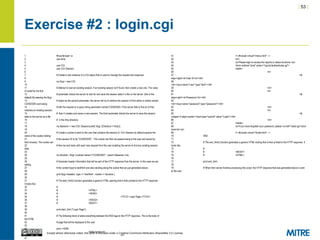
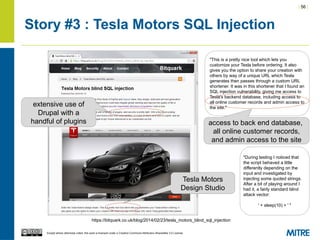
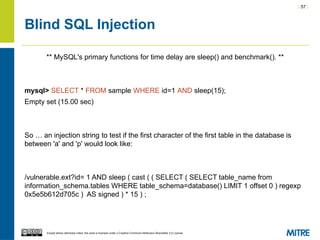
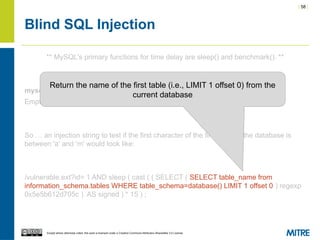
![| 59 |
Except where otherwise noted, this work is licensed under a Creative Commons Attribution-ShareAlike 3.0 License.
Blind SQL Injection
** MySQL's primary functions for time delay are sleep() and benchmark(). **
mysql> SELECT * FROM sample WHERE id=1 AND sleep(15);
Empty set (15.00 sec)
So … an injection string to test if the first character of the first table in the database is
between 'a' and 'm' would look like:
/vulnerable.ext?id= 1 AND sleep ( cast ( ( SELECT ( SELECT table_name from
information_schema.tables WHERE table_schema=database() LIMIT 1 offset 0 ) regexp
0x5e5b612d705c ) AS signed ) * 15 ) ;
Use a regular expression to compare the returned table name with
"0x5e5b612d705c". (hex notation for "^[a-p]") The returned value
will be either 0 for no match or 1 for a match.](https://image.slidesharecdn.com/securecodereview20141217-250905175014-63472ca4/85/testtesttesttesttesttesttesttesttesttesttesttesttesttest-56-320.jpg)
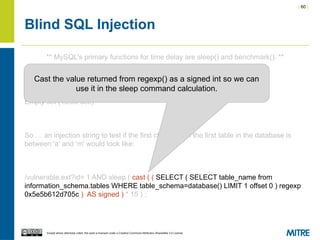
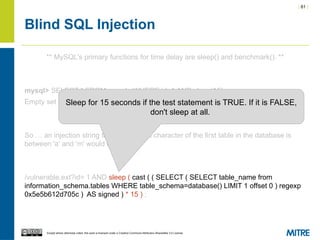
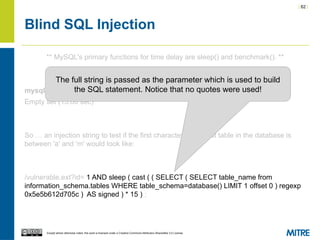
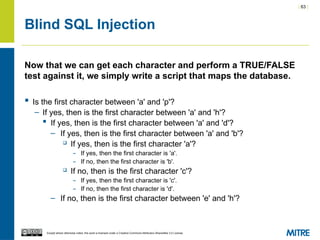
![| 65 |
Except where otherwise noted, this work is licensed under a Creative Commons Attribution-ShareAlike 3.0 License.
Exercise #3 : authenticate.cgi (cont.)
101
102 # If no row was returned from the database, then the login failed. No records were found matching the provided
103 # username and password. Notify the user and ask them to try again. If a matching row was found, then login
104 # succeeded. Log the successful login in the log file and then redirect the user to their appropriate landing page.
105
106 if ($sql->rows == 0) {
107
108 # Print the opening parts of the HTML page.
109
110 print "Content-type:text/htmlnn";
111
112 print <<END;
113 <html>
114 <head>
115 <title>Login</title>
116 </head>
117 <body>
118 <table border=0>
119 <tr>
120 <td><img
src="/images/InSQR.png" border=0 /></td>
121 <td
valign="middle"><h1>The InSQR Application</h1></td>
122 </tr>
123 </table>
124 <!--#include virtual="/menu.html" -->
125 <br>
126 <h2>Login Failure</h2>
127 END
128
129 # Use a prepared statement to check if the uname was what caused the login to
fail.
130
131 my $check =$dbh->prepare("SELECT uname FROM users WHERE uname=?");
132 $check->execute($uname);
133
134 # If we can't find a matching uname in the database, then they must have entered
the
135 # user name wrong. Also make sure to log the failed attempt so we can
investigate
136 # attacks from someone trying to brute-force their way past our authentication. If
137 # we find a matching uname, then it must have been an incorrect password that
caused
138 # the authentication to fail. Remind the user that passwords are case sensitive.
139
140 if ($check->rows == 0) {
141 print $fh "$date: Login as $uname failed - no
such user.n";
142 print "<p>Invalid userid: $uname. Please check
your userid and try again.</p>";
143 } else {
144 print $fh "$date: Login as $uname failed -
incorrect password ($pword).n";
145 print "<p>Incorrect password. Passwords are
case sensitive, please verify your spelling and try again.</p>";
146 }
147
148 # Close the prepared statement as we no longer need it.
151
152 # Complete the HTML page to be sent as the response.
153
154 print '<!--#include virtual="/footer.html" -->';
155 print end_html;
156
157 } else {
158
159 # Save the logged in user's username, full name, and their admin status
to the session so that we
160 # can retrieve them later when needed.
161
162 my ($first, $last, $admin) = $sql->fetchrow_array;
163 my $name = "$first $last";
164
165 $session->param("authuser", $uname);
166 $session->param("name", $name);
167 $session->param("admin", $admin);
168
169 # Also save the admin status to the cookie.
170
171 my $admincookie = $cgi->cookie(-name=>'insqradmin',-
value=>"$admin");
172
173 # If the logged in user is an admin, then log this fact and redirect them to
the admin page. Otherwise,
174 # log the authentication as a normal user and redirect them to the reports
page.
175
176 if ($admin) {
177 print $fh "$date: Login by admin user
$uname.n";
178 print $cgi->redirect(-cookie=>[$cookie,
$admincookie],-uri=>'/cgi-bin/admin/index.cgi');
179 } else {
180 print $fh "$date: Login by normal user
$uname.n";
181 print $cgi->redirect(-cookie=>[$cookie,
$admincookie],-uri=>'/cgi-bin/reports.cgi');
182 }
183 }
184
185 # Close the log file, the prepared statement, and the database connection.
186
187 $fh->close;
188 $sql->finish;
189 $dbh->disconnect;](https://image.slidesharecdn.com/securecodereview20141217-250905175014-63472ca4/85/testtesttesttesttesttesttesttesttesttesttesttesttesttest-62-320.jpg)
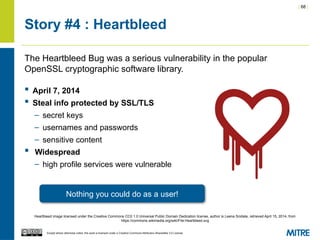
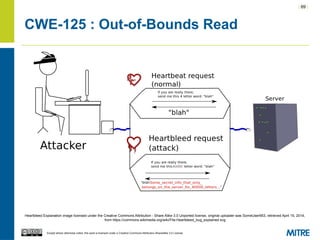
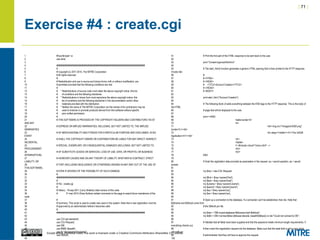
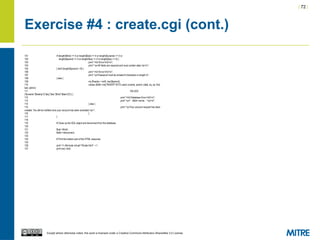
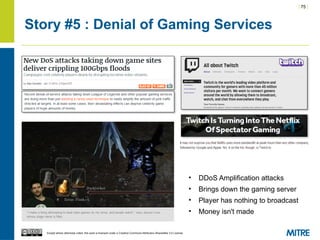
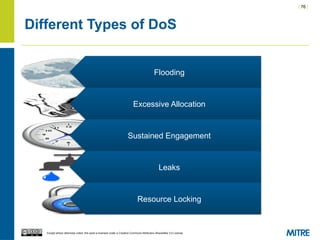
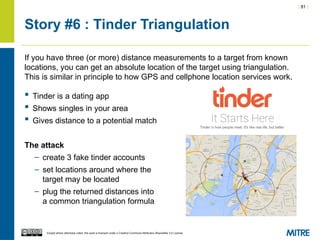
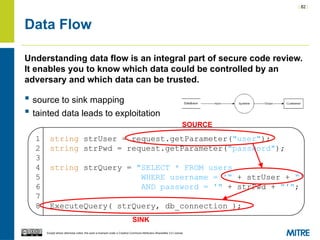
![| 83 |
Except where otherwise noted, this work is licensed under a Creative Commons Attribution-ShareAlike 3.0 License.
Exercise #6 : admin/approve.cgi
1 #!/usr/bin/perl
2 use strict;
3
4 use CGI qw/:standard/;
5 use DBI;
6 use MIME::Base64;
7 use lib "/etc/apache2/modules";
8 use DBAuth;
9
10 print <<END;
11 Content-type:text/htmlnn
12 <html>
13 <head>
14 <title>Account Creation</title>
15 </head>
16 <body>
17 <table border=0>
18 <tr>
19
<td><img src="/images/InSQR.png" border=0 /></td>
20 <td
valign="middle"><h1>The InSQR Application</h1></td>
21 </tr>
22 </table>
23 <!--#include virtual="/menu.html" -->
24 <br/>
25 <br/>
26 END
27
28 my $lockfile="/tmp/adminloglock";
29 if (-e $lockfile) {
30 print " <p>ERROR: Cannot secure adminlog
lock.</p>n";
31 print "</body>n";
32 print "</html>n";
33 exit;
34 }
35
36 open(FH,'>/tmp/adminloglock');
37
38 my $admin = cookie('insqradmin');
39 unless ($admin) {
40 print " <p>You are not an admin. You cannot
access these pages.</p>n";
41 print "</body>n";
42 print "</html>n";
43 close(FH);
44 unlink($lockfile);
45 exit;
46 }
47
48 my $dsn = "DBI:mysql:database=$dbname;host=$dbhost";
49 my $dbh = DBI->connect($dsn,$dbuser,decode_base64($dbpw)) or die "Could not connect to DB.";
50
51 print "<h2>Account Activation</h2>n";
52
53 my $sql = $dbh->prepare("SELECT uname FROM users WHERE state=0");
54 $sql->execute;
55
56 unless ($sql->rows) {
57 print "<p><b>No accounts to approve.</b></p>";
58 } else {
59 print "<table border=1>n";
60 print "<tr>n";
61 print " <th>User Name</th>n";
62 print " <th>Approve</th>n";
63 print " <th>Make Admin</th>n";
64 print "</tr>n";
65 while (my @row = $sql->fetchrow_array) {
66 print "<tr>n";
67 print "
<td>$row[0]</td>n";
68 print " <td><a
href="doapprove.cgi?uname=$row[0]">Approve</a></td>n";
69 print " <td><a
href="doapprove.cgi?uname=$row[0]&admin=1">Admin</a></td>n";
70 print "</tr>n";
71 }
72 print "</table>n";
73 }
74
75 print '<!--#include virtual="/footer.html" -->';
76 print "</body>";
77 print "</html>";
78
79 $sql->finish;
80 $dbh->disconnect;
81
82 close(FH);
83 unlink($lockfile);](https://image.slidesharecdn.com/securecodereview20141217-250905175014-63472ca4/85/testtesttesttesttesttesttesttesttesttesttesttesttesttest-77-320.jpg)