


ACCELERATE
AGILE DEVOPS / BUSINESS CASE FOR CI/CD, TDD,
AUTOMATION, ETC.
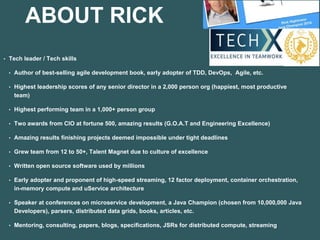
ABOUT RICK
• Tech leader / Tech skills
• Author of best-selling agile development book, early adopter of TDD, DevOps, Agile, etc.
• Highest leadership scores of any senior director in a 2,000 person org (happiest, most productive
team)
• Highest performing team in a 1,000+ person group
• Two awards from CIO at fortune 500, amazing results (G.O.A.T and Engineering Excellence)
• Amazing results finishing projects deemed impossible under tight deadlines
• Grew team from 12 to 50+, Talent Magnet due to culture of excellence
• Written open source software used by millions
• Early adopter and proponent of high-speed streaming, 12 factor deployment, container orchestration,
in-memory compute and uService architecture
• Speaker at conferences on microservice development, a Java Champion (chosen from 10,000,000 Java
Developers), parsers, distributed data grids, books, articles, etc.
• Mentoring, consulting, papers, blogs, specifications, JSRs for distributed compute, streaming
SLIDE DECK BASED ON
BOOK ACCELERATE AND
MORE• PAST
EXPERIENCE
• LATEST
TRENDS
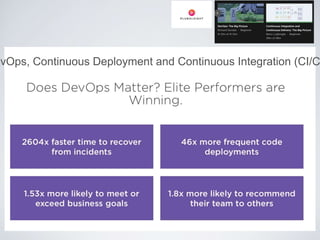
evOps, Continuous Deployment and Continuous Integration (CI/C
RULES OF THE ROAD
ACCELERATION STEPS
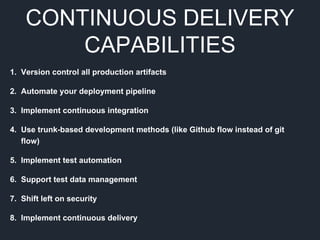
CONTINUOUS DELIVERY
CAPABILITIES
1. Version control all production artifacts
2. Automate your deployment pipeline
3. Implement continuous integration
4. Use trunk-based development methods (like Github flow instead of git
flow)
5. Implement test automation
6. Support test data management
7. Shift left on security
8. Implement continuous delivery
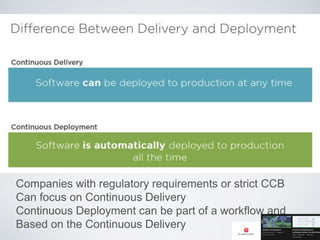
Companies with regulatory requirements or strict CCB
Can focus on Continuous Delivery
Continuous Deployment can be part of a workflow and
Based on the Continuous Delivery
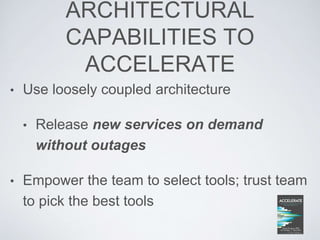
ARCHITECTURAL
CAPABILITIES TO
ACCELERATE
• Use loosely coupled architecture
• Release new services on demand
without outages
• Empower the team to select tools; trust team
to pick the best tools
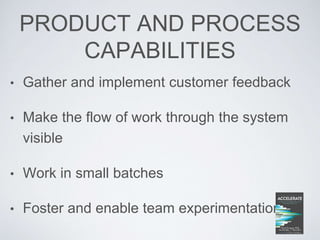
PRODUCT AND PROCESS
CAPABILITIES
• Gather and implement customer feedback
• Make the flow of work through the system
visible
• Work in small batches
• Foster and enable team experimentation
LEAN MANAGEMENT AND
MONITORING
CAPABILITIES• Have a light weight change approval process
• Monitor application and system KPIs to inform business
decisions
• Proactively check system health
• Preemptively detect and mitigate problems
• Improve process and work within WIP limits
• Set up visible dashboards to monitor/communicate WIP,
quality, applications and systems
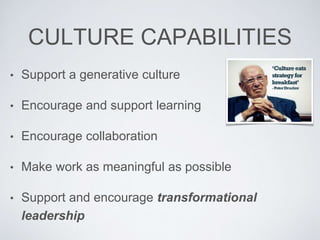
CULTURE CAPABILITIES
• Support a generative culture
• Encourage and support learning
• Encourage collaboration
• Make work as meaningful as possible
• Support and encourage transformational
leadership
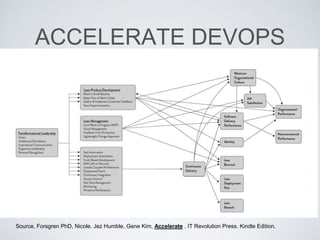
ACCELERATE DEVOPS
Source, Forsgren PhD, Nicole. Jez Humble, Gene Kim, Accelerate . IT Revolution Press. Kindle Edition.
ACCELERATION IN
PRACTICE
• Make more money
• Deliver more
• Less Burnout
• Grow the value of the
company
• Make customers happy
ORGANIZATIONAL
PERFORMANCE
• High performers 2x the rate will exceed organizational
performance goals as low performers:
• 2x profitability
• 2x productivity
• 2x market share
• 2x number of customers
ORGANIZATIONAL
PERFORMANCE PART II
• High performers twice as likely to exceed non-commercial
performance goals as low performers
• 2x better quantity of products and services
• 2x operating efficiency
• 2x customer satisfaction
• 2x quality of products/services
• 2x achieving organizational/mission goals
ORGANIZATIONAL
PERFORMANCE PART III
50% increase in market
capitalization compared to low
performers!
SOFTWARE DELIVERY
PERFORMANCE
• Deploy frequency, Lead time, mean time to restore (MTTR),
and change fail percentage do well to predict overall software
delivery performance
• Improving software delivery performance improves tempo and
stability
• Software delivery performance improves organizational
performance and quality/customer satisfaction
• Deploy frequency is highly correlated with continuous delivery
and use of version control best practices
SOFTWARE DELIVERY
PERFORMANCE II
• Lead time is highly correlated with good version control
and automated testing
• MTTR is highly correlated with version control and
monitoring
• Software delivery performance is negatively correlated
with deployment pain
• Software delivery performance is correlated with
organizational investment in DevOps
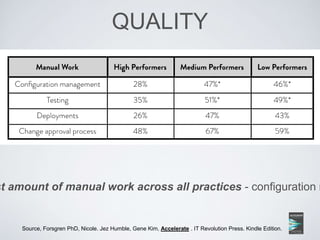
QUALITY
Source, Forsgren PhD, Nicole. Jez Humble, Gene Kim, Accelerate . IT Revolution Press. Kindle Edition.
st amount of manual work across all practices - configuration m
CULTURE
• 5 factors most associated with burnout are
negatively impacted by bad software delivery
performance
• Deployment pain and poor software delivery
practices cause organizational burnout
IMPROVE CULTURE BY
IMPROVING PRACTICES• Technical practices predict continuous delivery
• Improve organizational culture, identity, job
satisfaction, software delivery performance, less
burnout, less deployment pain, and less time
spent on rework!
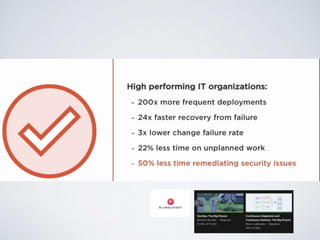
• High performers spend 50% less time
remediating security issues than low
performers
TRUNK BASED DEVELOPMENT
(LIKE GITHUB FLOW)
• ​High performers have shortest integration times
and branch lifetimes
• Branch life and integration typically lasting hours
or a day
• Low performers have longest integration times
and branch lifetimes
• Branch life and integration typically lasting days or
weeks
ARCHITECTURE
• Loosely coupled, well-encapsulated
architecture drives IT performance.
• 2017 dataset biggest contributor to
continuous delivery was loosely coupled,
well-encapsulated architecture
LEAN PRODUCT
MANAGEMENT
CAPABILITIES• Experimental approach to product
development highly correlates with
continuous delivery
• Lean product development capabilities
predict improvements in organizational
culture like reduced burnout higher software
delivery performance and overall
organizational performance
TRANSFORMATION IS A
BUSINESS IMPERATIVE• You can’t afford not to transform
• Transformation requires a deep understanding of
practices
• Having a team called DevOps is not doing DevOps
per se
• Culture of DevOps, Agility, Lean, MVP, etc. is a
clear win
• There are guides, books, practices, and information
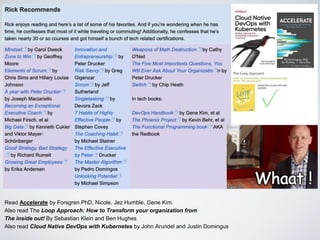
Read Accelerate by Forsgren PhD, Nicole. Jez Humble, Gene Kim.
Also read The Loop Approach: How to Transform your organization from
The inside out! By Sebastian Klein and Ben Hughes
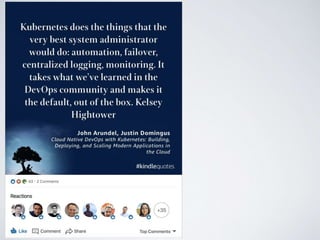
Also read Cloud Native DevOps with Kubernetes by John Arundel and Justin Domingus

Accelerate using DevOps and CI/CD.

  • 1.
    ACCELERATE AGILE DEVOPS /BUSINESS CASE FOR CI/CD, TDD, AUTOMATION, ETC.
  • 2.
    ABOUT RICK • Techleader / Tech skills • Author of best-selling agile development book, early adopter of TDD, DevOps, Agile, etc. • Highest leadership scores of any senior director in a 2,000 person org (happiest, most productive team) • Highest performing team in a 1,000+ person group • Two awards from CIO at fortune 500, amazing results (G.O.A.T and Engineering Excellence) • Amazing results finishing projects deemed impossible under tight deadlines • Grew team from 12 to 50+, Talent Magnet due to culture of excellence • Written open source software used by millions • Early adopter and proponent of high-speed streaming, 12 factor deployment, container orchestration, in-memory compute and uService architecture • Speaker at conferences on microservice development, a Java Champion (chosen from 10,000,000 Java Developers), parsers, distributed data grids, books, articles, etc. • Mentoring, consulting, papers, blogs, specifications, JSRs for distributed compute, streaming
  • 3.
    SLIDE DECK BASEDON BOOK ACCELERATE AND MORE• PAST EXPERIENCE • LATEST TRENDS
  • 6.
    evOps, Continuous Deploymentand Continuous Integration (CI/C
  • 7.
    RULES OF THEROAD ACCELERATION STEPS
  • 8.
    CONTINUOUS DELIVERY CAPABILITIES 1. Versioncontrol all production artifacts 2. Automate your deployment pipeline 3. Implement continuous integration 4. Use trunk-based development methods (like Github flow instead of git flow) 5. Implement test automation 6. Support test data management 7. Shift left on security 8. Implement continuous delivery
  • 9.
    Companies with regulatoryrequirements or strict CCB Can focus on Continuous Delivery Continuous Deployment can be part of a workflow and Based on the Continuous Delivery
  • 10.
    ARCHITECTURAL CAPABILITIES TO ACCELERATE • Useloosely coupled architecture • Release new services on demand without outages • Empower the team to select tools; trust team to pick the best tools
  • 11.
    PRODUCT AND PROCESS CAPABILITIES •Gather and implement customer feedback • Make the flow of work through the system visible • Work in small batches • Foster and enable team experimentation
  • 12.
    LEAN MANAGEMENT AND MONITORING CAPABILITIES•Have a light weight change approval process • Monitor application and system KPIs to inform business decisions • Proactively check system health • Preemptively detect and mitigate problems • Improve process and work within WIP limits • Set up visible dashboards to monitor/communicate WIP, quality, applications and systems
  • 13.
    CULTURE CAPABILITIES • Supporta generative culture • Encourage and support learning • Encourage collaboration • Make work as meaningful as possible • Support and encourage transformational leadership
  • 14.
    ACCELERATE DEVOPS Source, ForsgrenPhD, Nicole. Jez Humble, Gene Kim, Accelerate . IT Revolution Press. Kindle Edition.
  • 15.
    ACCELERATION IN PRACTICE • Makemore money • Deliver more • Less Burnout • Grow the value of the company • Make customers happy
  • 16.
    ORGANIZATIONAL PERFORMANCE • High performers2x the rate will exceed organizational performance goals as low performers: • 2x profitability • 2x productivity • 2x market share • 2x number of customers
  • 17.
    ORGANIZATIONAL PERFORMANCE PART II •High performers twice as likely to exceed non-commercial performance goals as low performers • 2x better quantity of products and services • 2x operating efficiency • 2x customer satisfaction • 2x quality of products/services • 2x achieving organizational/mission goals
  • 18.
    ORGANIZATIONAL PERFORMANCE PART III 50%increase in market capitalization compared to low performers!
  • 19.
    SOFTWARE DELIVERY PERFORMANCE • Deployfrequency, Lead time, mean time to restore (MTTR), and change fail percentage do well to predict overall software delivery performance • Improving software delivery performance improves tempo and stability • Software delivery performance improves organizational performance and quality/customer satisfaction • Deploy frequency is highly correlated with continuous delivery and use of version control best practices
  • 20.
    SOFTWARE DELIVERY PERFORMANCE II •Lead time is highly correlated with good version control and automated testing • MTTR is highly correlated with version control and monitoring • Software delivery performance is negatively correlated with deployment pain • Software delivery performance is correlated with organizational investment in DevOps
  • 21.
    QUALITY Source, Forsgren PhD,Nicole. Jez Humble, Gene Kim, Accelerate . IT Revolution Press. Kindle Edition. st amount of manual work across all practices - configuration m
  • 22.
    CULTURE • 5 factorsmost associated with burnout are negatively impacted by bad software delivery performance • Deployment pain and poor software delivery practices cause organizational burnout
  • 23.
    IMPROVE CULTURE BY IMPROVINGPRACTICES• Technical practices predict continuous delivery • Improve organizational culture, identity, job satisfaction, software delivery performance, less burnout, less deployment pain, and less time spent on rework! • High performers spend 50% less time remediating security issues than low performers
  • 24.
    TRUNK BASED DEVELOPMENT (LIKEGITHUB FLOW) • ​High performers have shortest integration times and branch lifetimes • Branch life and integration typically lasting hours or a day • Low performers have longest integration times and branch lifetimes • Branch life and integration typically lasting days or weeks
  • 25.
    ARCHITECTURE • Loosely coupled,well-encapsulated architecture drives IT performance. • 2017 dataset biggest contributor to continuous delivery was loosely coupled, well-encapsulated architecture
  • 27.
    LEAN PRODUCT MANAGEMENT CAPABILITIES• Experimentalapproach to product development highly correlates with continuous delivery • Lean product development capabilities predict improvements in organizational culture like reduced burnout higher software delivery performance and overall organizational performance
  • 28.
    TRANSFORMATION IS A BUSINESSIMPERATIVE• You can’t afford not to transform • Transformation requires a deep understanding of practices • Having a team called DevOps is not doing DevOps per se • Culture of DevOps, Agility, Lean, MVP, etc. is a clear win • There are guides, books, practices, and information
  • 29.
    Read Accelerate byForsgren PhD, Nicole. Jez Humble, Gene Kim. Also read The Loop Approach: How to Transform your organization from The inside out! By Sebastian Klein and Ben Hughes Also read Cloud Native DevOps with Kubernetes by John Arundel and Justin Domingus

Editor's Notes

  • #14 Forsgren PhD, Nicole. Accelerate . IT Revolution Press. Kindle Edition.
  • #15 Forsgren PhD, Nicole. Accelerate . IT Revolution Press. Kindle Edition.
  • #16 Forsgren PhD, Nicole. Accelerate . IT Revolution Press. Kindle Edition.
  • #17 High performers are twice as likely to exceed organizational performance goals as low performers: profitability, productivity, market share, number of customers. Forsgren PhD, Nicole. Accelerate . IT Revolution Press. Kindle Edition.
  • #18 High performers are twice as likely to exceed noncommercial performance goals as low performers: quantity of products/ services, operating efficiency, customer satisfaction, quality of products/services, achieving organizational/mission goals. Forsgren PhD, Nicole. Accelerate . IT Revolution Press. Kindle Edition.
  • #19 In a follow-up survey to the initial 2014 data collection effort, we gathered stock ticker data and performed additional analysis on responses from just over 1,000 respondents across 355 companies who volunteered the organization they worked for. For those who worked for publicly traded companies, we found the following (this analysis was not replicated in later years because our dataset was not large enough): ​–​High performers had 50% higher market capitalization growth over three years compared to low performers. Forsgren PhD, Nicole. Accelerate . IT Revolution Press. Kindle Edition.
  • #20 The four measures of software delivery performance (deploy frequency, lead time, mean time to restore, change fail percentage) are good classifiers for the software delivery performance profile. The groups we identified—high, medium, and low performers—are all significantly different across all four measures each year. Our analysis of high, medium, and low performers provides evidence that there are no trade-offs between improving performance and achieving higher levels of tempo and stability: they move in tandem. Software delivery performance predicts organizational performance and noncommercial performance. Forsgren PhD, Nicole. Accelerate . IT Revolution Press. Kindle Edition.
  • #21 Lead time is highly correlated with version control and automated testing. MTTR is highly correlated with version control and monitoring. Software delivery performance is correlated with organizational investment in DevOps. Software delivery performance is negatively correlated with deployment pain. The more painful code deployments are, the poorer the software delivery performance and culture. Forsgren PhD, Nicole. Accelerate . IT Revolution Press. Kindle Edition.
  • #22 Unplanned work and rework: ​–​High performers reported spending 49% of their time on new work and 21% on unplanned work or rework. ​–​Low performers spend 38% of their time on new work and 27% on unplanned work or rework. ​–​There is evidence of the J-curve in our rework data. Medium performers spend more time on unplanned rework than low performers, with 32% of their time spent on unplanned work or rework. Manual work: ​–​High performers report the lowest amount of manual work across all practices (configuration management, testing, deployments, change approval process) at statistically significant levels. ​–​There is evidence of the J-curve again. Medium performers do more manual work than low performers when it comes to deployment and change approval processes, and these differences are statistically significant. Forsgren PhD, Nicole. Accelerate . IT Revolution Press. Kindle Edition.
  • #23 BURNOUT AND DEPLOYMENT PAIN: Deployment pain is negatively correlated with software delivery performance and Westrum organizational culture. The five factors most highly correlated with burnout are Westrum organizational culture (negative), leaders (negative), organizational investment (negative), organizational performance (negative), and deployment pain (positive). Forsgren PhD, Nicole. Accelerate . IT Revolution Press. Kindle Edition.
  • #25 Trunk-based development: ​–​High performers have the shortest integration times and branch lifetimes, with branch life and integration typically lasting hours or a day. ​–​Low performers have the longest integration times and branch lifetimes, with branch life and integration typically lasting days or weeks. Technical practices predict continuous delivery, Westrum organizational culture, identity, job satisfaction, software delivery performance, less burnout, less deployment pain, and less time spent on rework. High performers spend 50% less time remediating security issues than low performers. Forsgren PhD, Nicole. Accelerate . IT Revolution Press. Kindle Edition.
  • #26 A loosely coupled, well-encapsulated architecture drives IT performance. In the 2017 dataset, this was the biggest contributor to continuous delivery. Forsgren PhD, Nicole. Accelerate . IT Revolution Press. Kindle Edition.
  • #28 LEAN PRODUCT MANAGEMENT CAPABILITIES The ability to take an experimental approach to product development is highly correlated with the technical practices that contribute to continuous delivery. Lean product development capabilities predict Westrum organizational culture, software delivery performance, organizational performance, and less burnout. Forsgren PhD, Nicole. Accelerate . IT Revolution Press. Kindle Edition. Forsgren PhD, Nicole. Accelerate . IT Revolution Press. Kindle Edition.