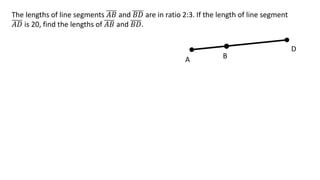
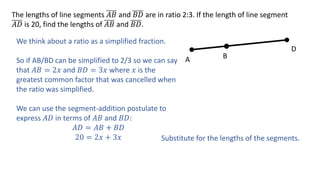
The lengths of line segments 𝐴𝐵 and 𝐵𝐷 are in ratio 2:3. If the length of line segment
𝐴𝐷 is 20, find the lengths of 𝐴𝐵 and 𝐵𝐷.
A B
D
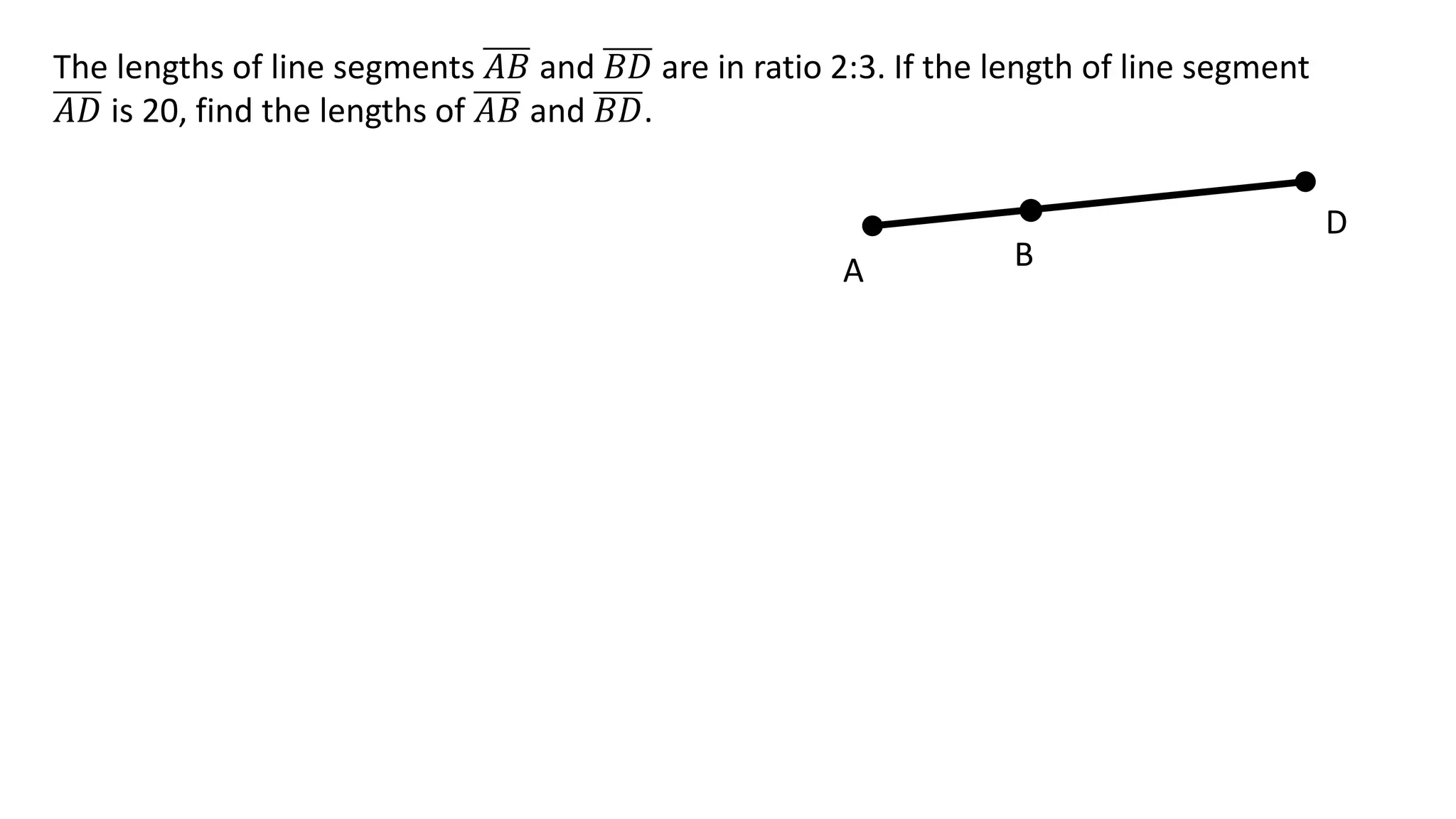
The lengths of line segments 𝐴𝐵 and 𝐵𝐷 are in ratio 2:3. If the length of line segment
𝐴𝐷 is 20, find the lengths of 𝐴𝐵 and 𝐵𝐷.
A B
D
We think about a ratio as a simplified fraction.
So if AB/BD can be simplified to 2/3 so we can say
that 𝐴𝐵 = 2𝑥 and 𝐵𝐷 = 3𝑥 where 𝑥 is the
greatest common factor that was cancelled when
the ratio was simplified.
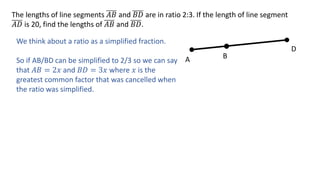
The lengths of line segments 𝐴𝐵 and 𝐵𝐷 are in ratio 2:3. If the length of line segment
𝐴𝐷 is 20, find the lengths of 𝐴𝐵 and 𝐵𝐷.
A B
D
We think about a ratio as a simplified fraction.
So if AB/BD can be simplified to 2/3 so we can say
that 𝐴𝐵 = 2𝑥 and 𝐵𝐷 = 3𝑥 where 𝑥 is the
greatest common factor that was cancelled when
the ratio was simplified.
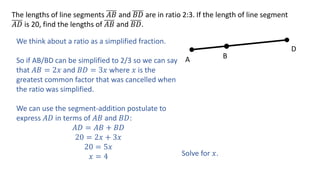
We can use the segment-addition postulate to
express 𝐴𝐷 in terms of 𝐴𝐵 and 𝐵𝐷:
𝐴𝐷 = 𝐴𝐵 + 𝐵𝐷
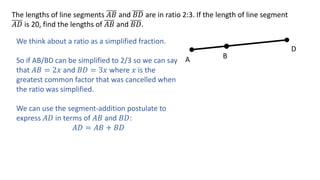
The lengths of line segments 𝐴𝐵 and 𝐵𝐷 are in ratio 2:3. If the length of line segment
𝐴𝐷 is 20, find the lengths of 𝐴𝐵 and 𝐵𝐷.
A B
D
We think about a ratio as a simplified fraction.
So if AB/BD can be simplified to 2/3 so we can say
that 𝐴𝐵 = 2𝑥 and 𝐵𝐷 = 3𝑥 where 𝑥 is the
greatest common factor that was cancelled when
the ratio was simplified.
We can use the segment-addition postulate to
express 𝐴𝐷 in terms of 𝐴𝐵 and 𝐵𝐷:
𝐴𝐷 = 𝐴𝐵 + 𝐵𝐷
20 = 2𝑥 + 3𝑥 Substitute for the lengths of the segments.
The lengths of line segments 𝐴𝐵 and 𝐵𝐷 are in ratio 2:3. If the length of line segment
𝐴𝐷 is 20, find the lengths of 𝐴𝐵 and 𝐵𝐷.
A B
D
We think about a ratio as a simplified fraction.
So if AB/BD can be simplified to 2/3 so we can say
that 𝐴𝐵 = 2𝑥 and 𝐵𝐷 = 3𝑥 where 𝑥 is the
greatest common factor that was cancelled when
the ratio was simplified.
We can use the segment-addition postulate to
express 𝐴𝐷 in terms of 𝐴𝐵 and 𝐵𝐷:
𝐴𝐷 = 𝐴𝐵 + 𝐵𝐷
20 = 2𝑥 + 3𝑥
20 = 5𝑥
𝑥 = 4 Solve for 𝑥.
The lengths of line segments 𝐴𝐵 and 𝐵𝐷 are in ratio 2:3. If the length of line segment
𝐴𝐷 is 20, find the lengths of 𝐴𝐵 and 𝐵𝐷.
A B
D
We think about a ratio as a simplified fraction.
So if AB/BD can be simplified to 2/3 so we can say
that 𝐴𝐵 = 2𝑥 and 𝐵𝐷 = 3𝑥 where 𝑥 is the
greatest common factor that was cancelled when
the ratio was simplified.
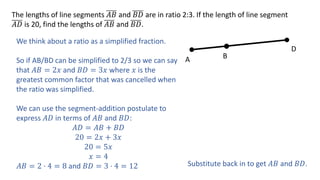
We can use the segment-addition postulate to
express 𝐴𝐷 in terms of 𝐴𝐵 and 𝐵𝐷:
𝐴𝐷 = 𝐴𝐵 + 𝐵𝐷
20 = 2𝑥 + 3𝑥
20 = 5𝑥
𝑥 = 4
𝐴𝐵 = 2 ⋅ 4 = 8 and 𝐵𝐷 = 3 ⋅ 4 = 12 Substitute back in to get 𝐴𝐵 and 𝐵𝐷.

Example Ratios

  • 1.
    The lengths ofline segments 𝐴𝐵 and 𝐵𝐷 are in ratio 2:3. If the length of line segment 𝐴𝐷 is 20, find the lengths of 𝐴𝐵 and 𝐵𝐷. A B D
  • 2.
    The lengths ofline segments 𝐴𝐵 and 𝐵𝐷 are in ratio 2:3. If the length of line segment 𝐴𝐷 is 20, find the lengths of 𝐴𝐵 and 𝐵𝐷. A B D We think about a ratio as a simplified fraction. So if AB/BD can be simplified to 2/3 so we can say that 𝐴𝐵 = 2𝑥 and 𝐵𝐷 = 3𝑥 where 𝑥 is the greatest common factor that was cancelled when the ratio was simplified.
  • 3.
    The lengths ofline segments 𝐴𝐵 and 𝐵𝐷 are in ratio 2:3. If the length of line segment 𝐴𝐷 is 20, find the lengths of 𝐴𝐵 and 𝐵𝐷. A B D We think about a ratio as a simplified fraction. So if AB/BD can be simplified to 2/3 so we can say that 𝐴𝐵 = 2𝑥 and 𝐵𝐷 = 3𝑥 where 𝑥 is the greatest common factor that was cancelled when the ratio was simplified. We can use the segment-addition postulate to express 𝐴𝐷 in terms of 𝐴𝐵 and 𝐵𝐷: 𝐴𝐷 = 𝐴𝐵 + 𝐵𝐷
  • 4.
    The lengths ofline segments 𝐴𝐵 and 𝐵𝐷 are in ratio 2:3. If the length of line segment 𝐴𝐷 is 20, find the lengths of 𝐴𝐵 and 𝐵𝐷. A B D We think about a ratio as a simplified fraction. So if AB/BD can be simplified to 2/3 so we can say that 𝐴𝐵 = 2𝑥 and 𝐵𝐷 = 3𝑥 where 𝑥 is the greatest common factor that was cancelled when the ratio was simplified. We can use the segment-addition postulate to express 𝐴𝐷 in terms of 𝐴𝐵 and 𝐵𝐷: 𝐴𝐷 = 𝐴𝐵 + 𝐵𝐷 20 = 2𝑥 + 3𝑥 Substitute for the lengths of the segments.
  • 5.
    The lengths ofline segments 𝐴𝐵 and 𝐵𝐷 are in ratio 2:3. If the length of line segment 𝐴𝐷 is 20, find the lengths of 𝐴𝐵 and 𝐵𝐷. A B D We think about a ratio as a simplified fraction. So if AB/BD can be simplified to 2/3 so we can say that 𝐴𝐵 = 2𝑥 and 𝐵𝐷 = 3𝑥 where 𝑥 is the greatest common factor that was cancelled when the ratio was simplified. We can use the segment-addition postulate to express 𝐴𝐷 in terms of 𝐴𝐵 and 𝐵𝐷: 𝐴𝐷 = 𝐴𝐵 + 𝐵𝐷 20 = 2𝑥 + 3𝑥 20 = 5𝑥 𝑥 = 4 Solve for 𝑥.
  • 6.
    The lengths ofline segments 𝐴𝐵 and 𝐵𝐷 are in ratio 2:3. If the length of line segment 𝐴𝐷 is 20, find the lengths of 𝐴𝐵 and 𝐵𝐷. A B D We think about a ratio as a simplified fraction. So if AB/BD can be simplified to 2/3 so we can say that 𝐴𝐵 = 2𝑥 and 𝐵𝐷 = 3𝑥 where 𝑥 is the greatest common factor that was cancelled when the ratio was simplified. We can use the segment-addition postulate to express 𝐴𝐷 in terms of 𝐴𝐵 and 𝐵𝐷: 𝐴𝐷 = 𝐴𝐵 + 𝐵𝐷 20 = 2𝑥 + 3𝑥 20 = 5𝑥 𝑥 = 4 𝐴𝐵 = 2 ⋅ 4 = 8 and 𝐵𝐷 = 3 ⋅ 4 = 12 Substitute back in to get 𝐴𝐵 and 𝐵𝐷.