Designers,
We need to talk about stress.
UX Bristol 2017
www.slideshare.net/bensimmonds
@bensimmonds
“I don’t really get stressed.
And anyway, stress can be good -
it keeps things exciting and
pushes you to your best”
Someone irritatingly balanced / in
denial / not in employment
You and stress?
“Oh crap oh crap oh crap oh
crap oh crap oh crap oh crap oh
crap oh crap oh crap…”
Everyone else? Just me?
www.slideshare.net/bensimmonds @bensimmonds
Me and work stress
Advertising,
London
Digital & UX,
London
Digital & UX,
Sydney
UX, Bristol Stress and performance
certification
Prep UXBristol
0 1 2 3 4 5 6 7 8 9 10 11 12 13 14 15 16 17 yrs
Oh crap
oh crap
Doing
OK
www.slideshare.net/bensimmonds @bensimmonds
Why it’s a problem
Are you sitting comfortably?
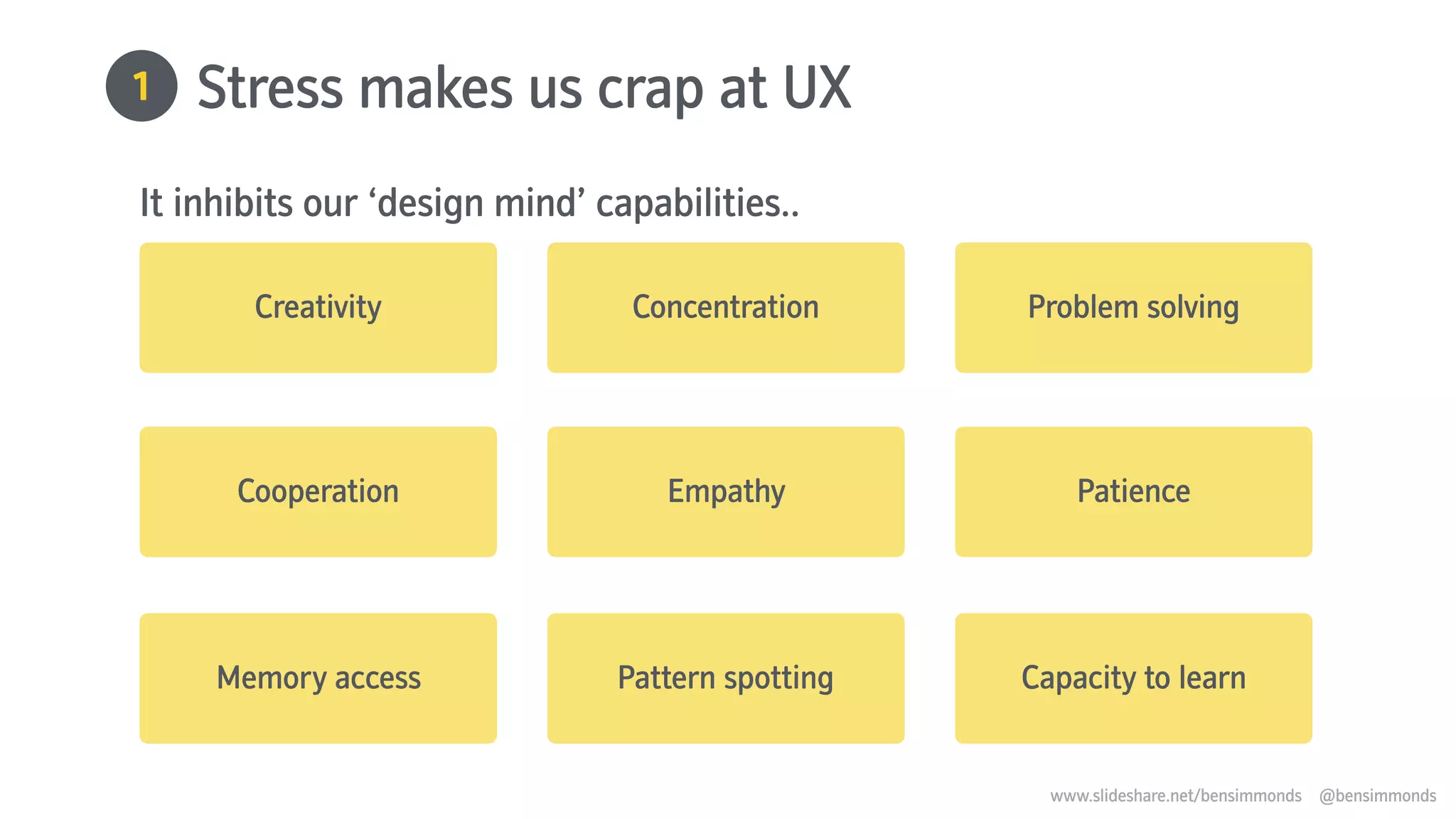
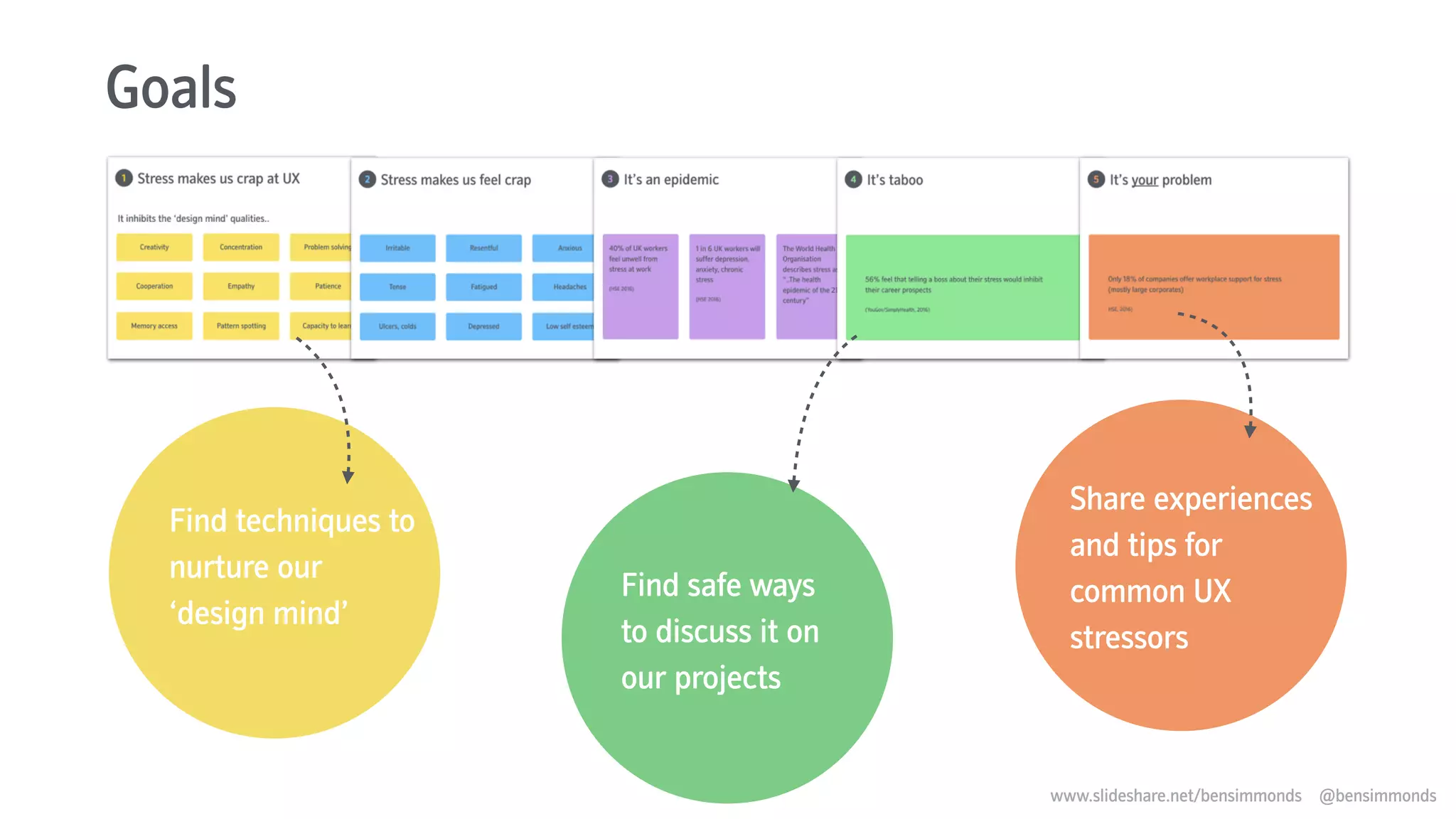
Stress makes us crap at UX1
It inhibits our ‘design mind’ capabilities..
Creativity Concentration Problem solving
Cooperation Empathy Patience
Memory access Pattern spotting Capacity to learn
www.slideshare.net/bensimmonds @bensimmonds
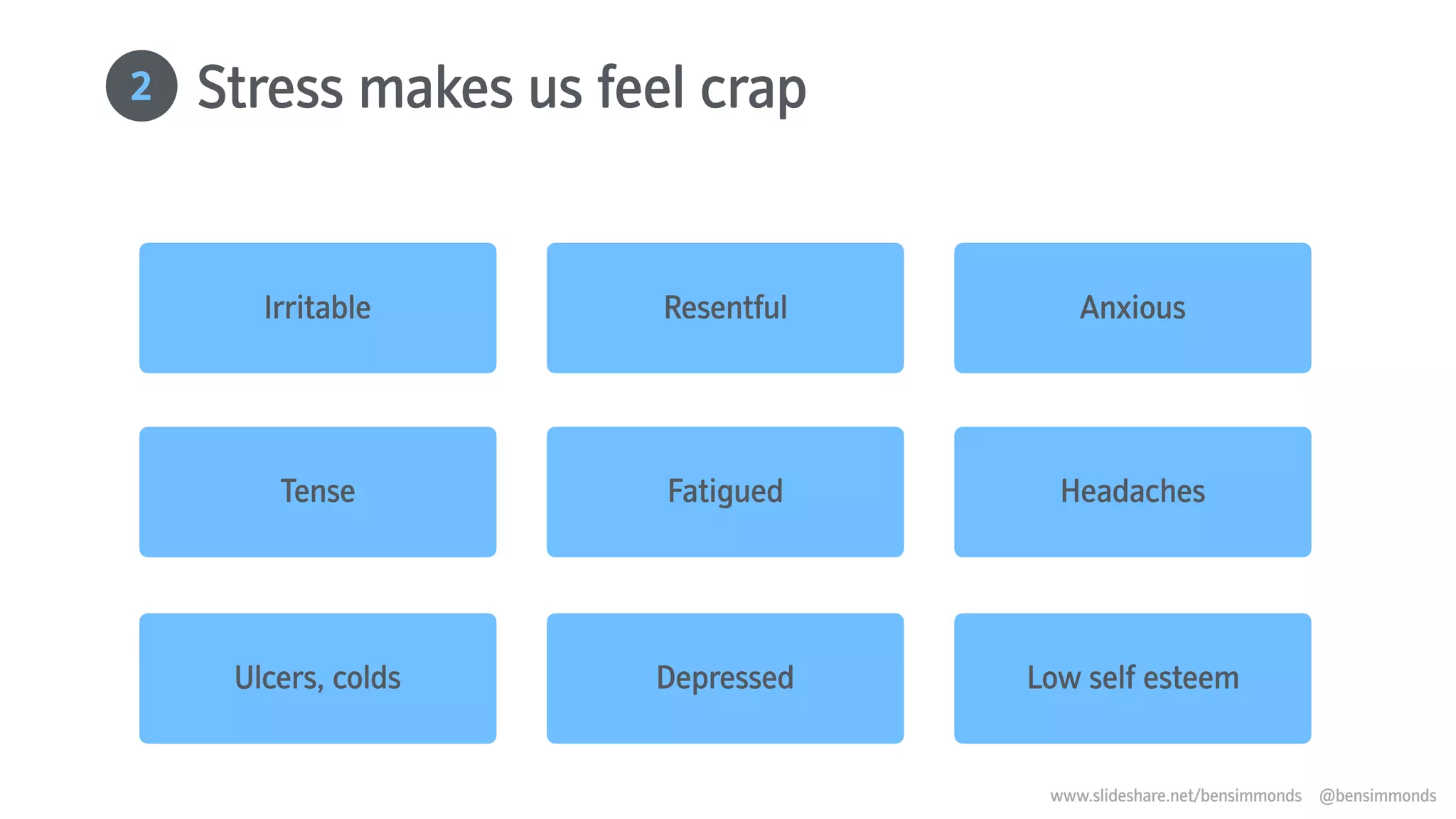
Irritable Resentful Anxious
Tense Fatigued Headaches
Ulcers, colds Depressed Low self esteem
Stress makes us feel crap2
www.slideshare.net/bensimmonds @bensimmonds
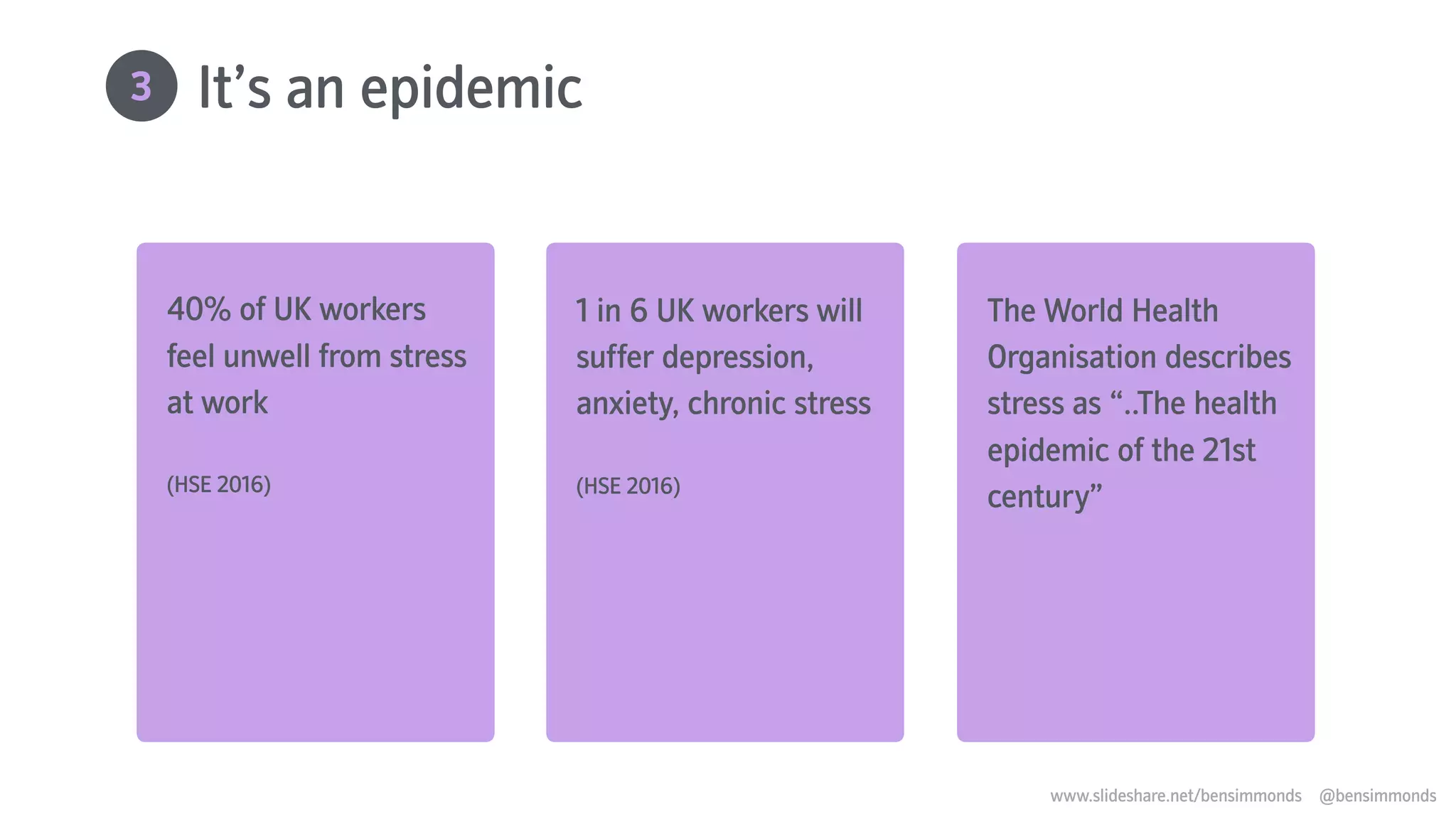
It’s an epidemic3
40% of UK workers
feel unwell from stress
at work
(HSE 2016)
1 in 6 UK workers will
suffer depression,
anxiety, chronic stress
(HSE 2016)
The World Health
Organisation describes
stress as “..The health
epidemic of the 21st
century”
www.slideshare.net/bensimmonds @bensimmonds
56% feel that telling a boss about their stress would inhibit their
career prospects
(YouGov/SimplyHealth, 2016)
It’s taboo4
www.slideshare.net/bensimmonds @bensimmonds
Only 18% of companies offer workplace support for stress (mostly
large corporates)
HSE, 2016)
It’s your problem5
www.slideshare.net/bensimmonds @bensimmonds
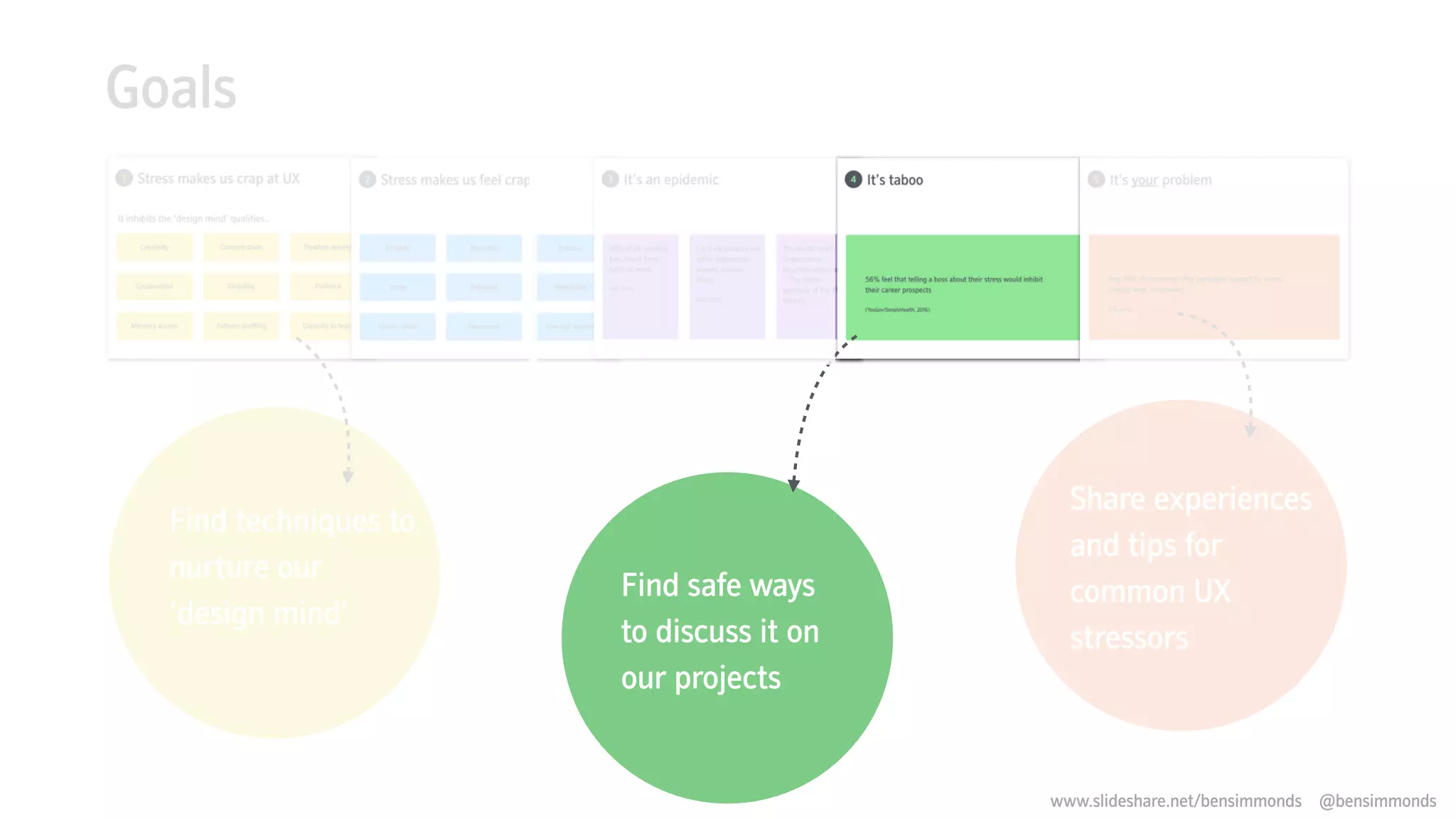
Goals
Find techniques to
nurture our
‘design mind’
Find safe ways
to discuss it on
our projects
Share experiences
and tips for
common UX
stressors
www.slideshare.net/bensimmonds @bensimmonds
Unpacking stress
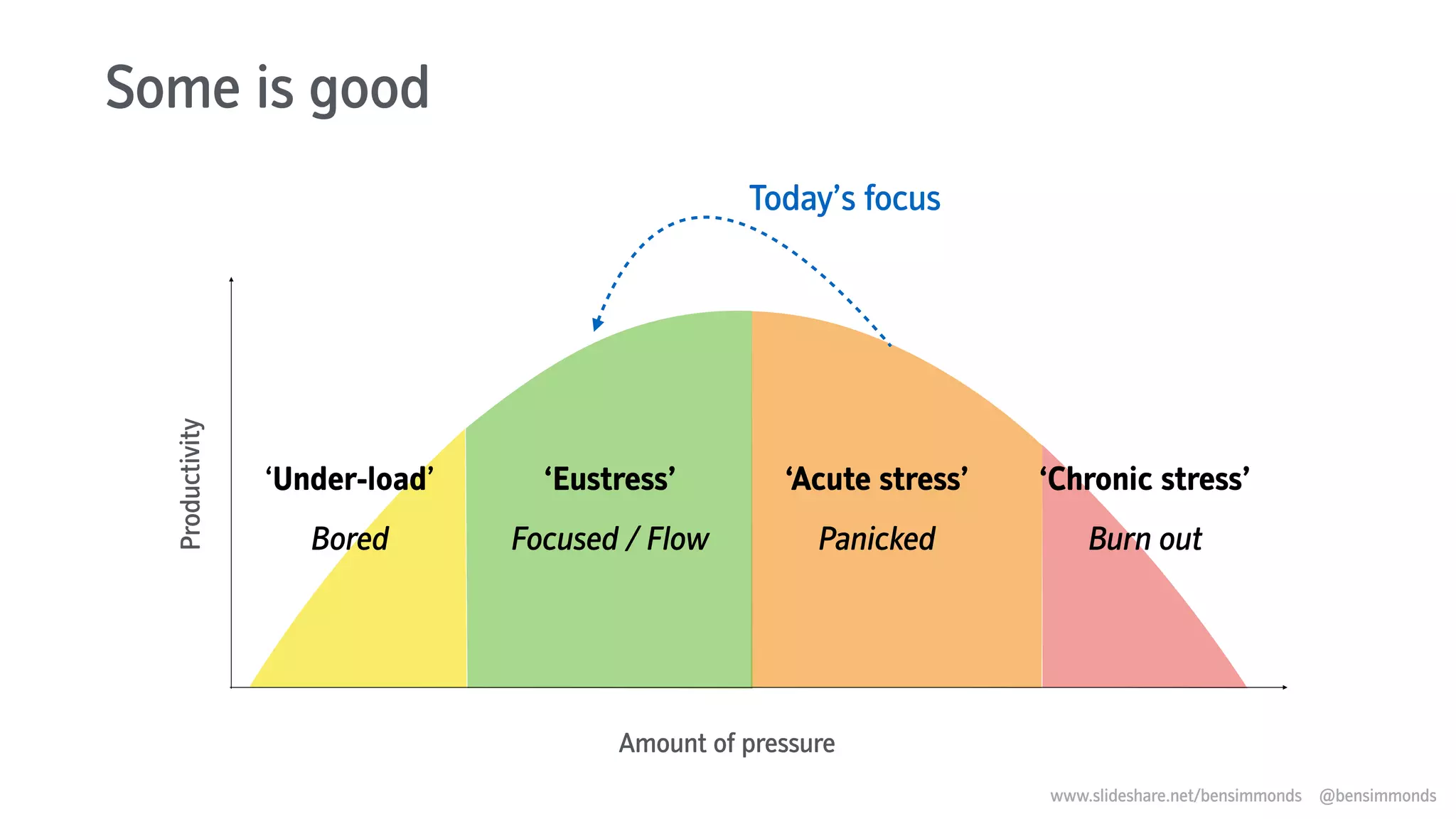
Some is good
Amount of pressure
Productivity
‘Under-load’
Bored
‘Eustress’
Focused / Flow
‘Acute stress’
Panicked
‘Chronic stress’
Burn out
Today’s focus
www.slideshare.net/bensimmonds @bensimmonds
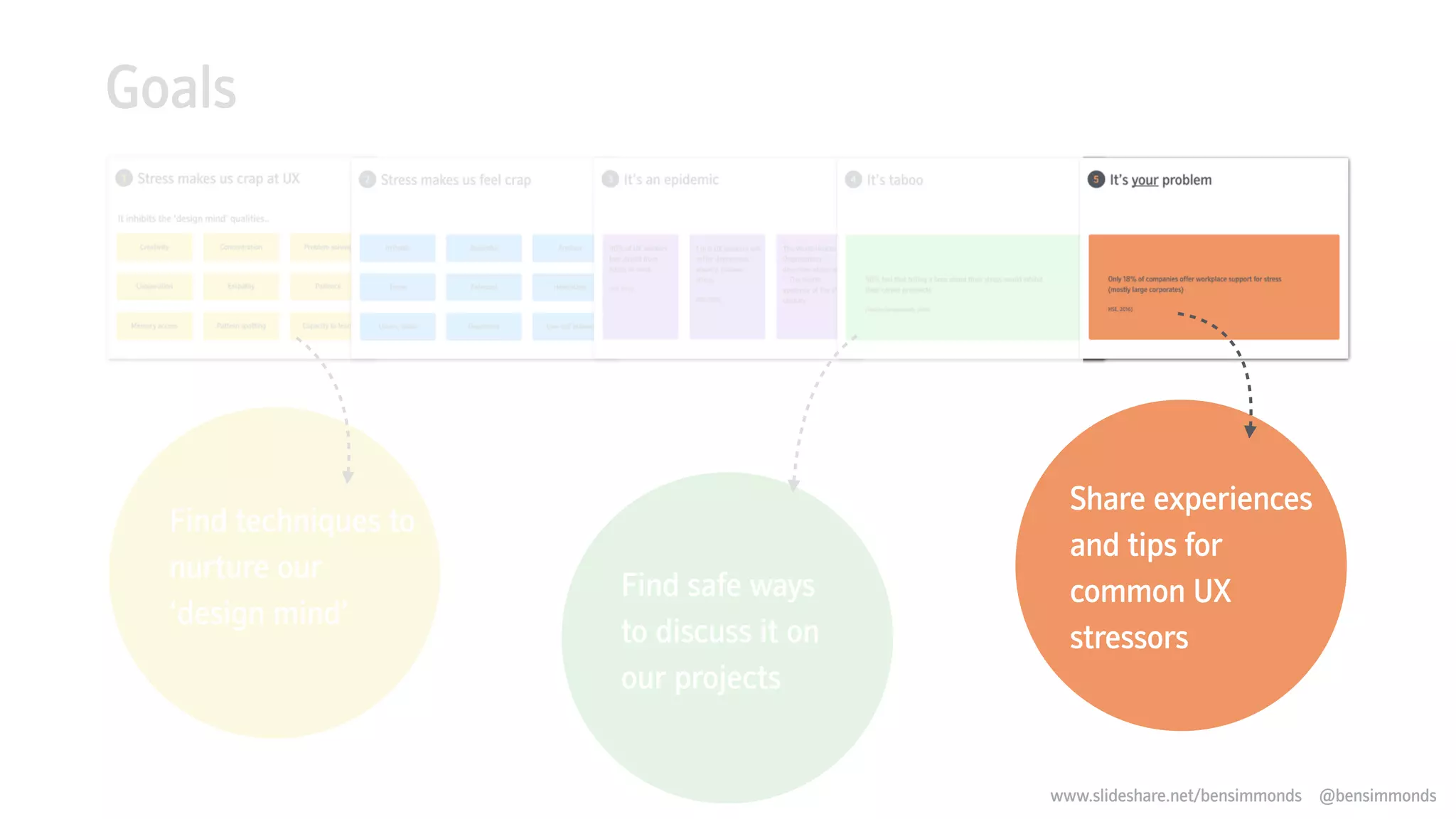
Goals
Find techniques to
nurture our
‘design mind’
Find safe ways
to discuss it on
our projects
Share experiences
and tips for
common UX
stressors
www.slideshare.net/bensimmonds @bensimmonds
• As a group/table..
• 5 minutes discussing most common stressors at work
• Certain activities?
• Certain situations?
• Certain project types?
• Write ‘em down
• Any tips, techniques, resources, checklists that help?
• Each team share 2 with the rest of the room
Work stress-spots
Activity 1
www.slideshare.net/bensimmonds @bensimmonds
What are the common stressors in UX design?
Here lies stress!
What are the situations, activities, or projects that frequently cause you stress at work?
..and this helps
What techniques, perspectives, activities help you?
5 mins
Write large so others can see!
Activity 1
www.slideshare.net/bensimmonds @bensimmonds
Goals
Find techniques to
nurture our
‘design mind’
Find safe ways
to discuss it on
our projects
Share experiences
and tips for
common UX
stressors
www.slideshare.net/bensimmonds @bensimmonds
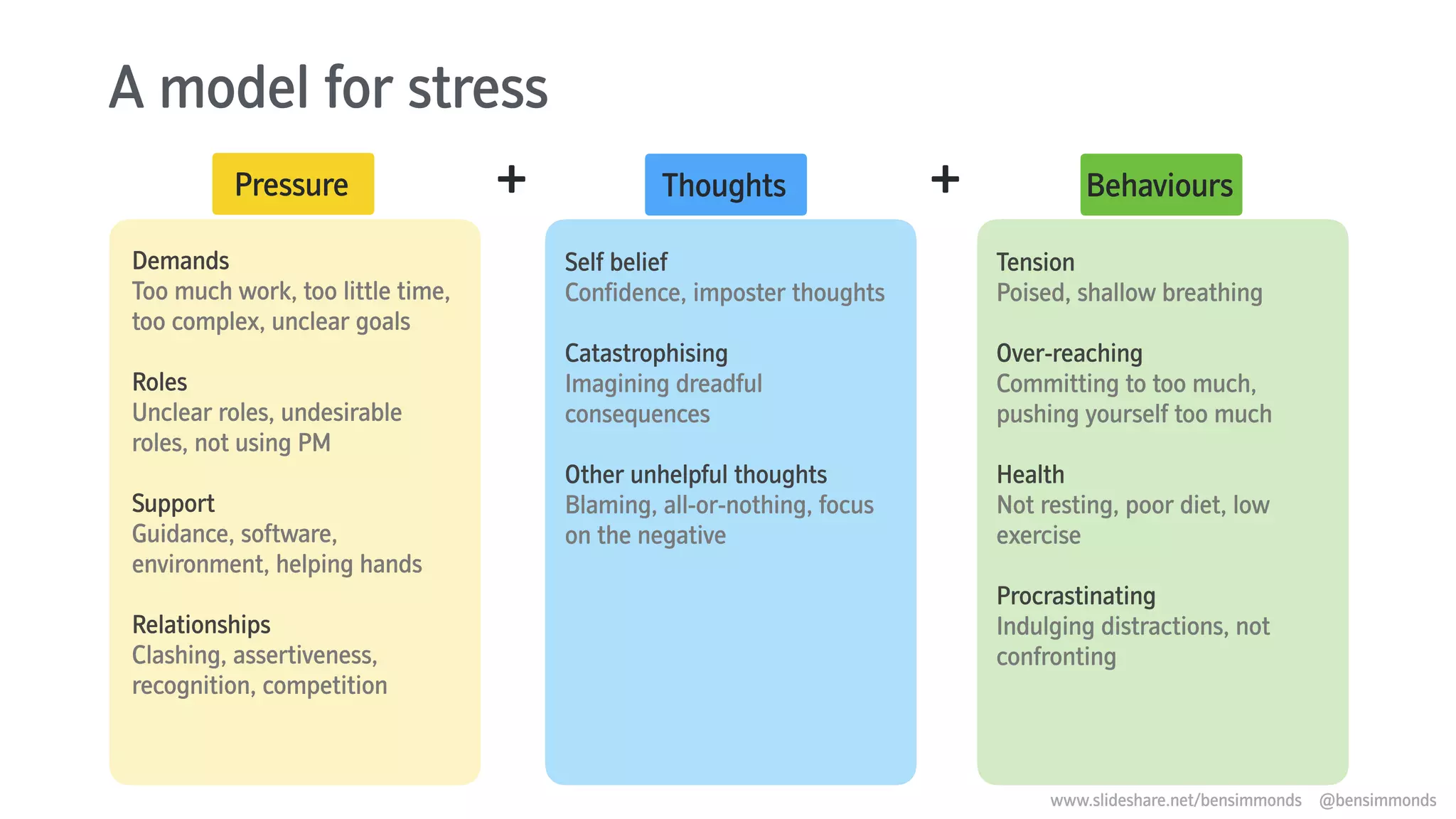
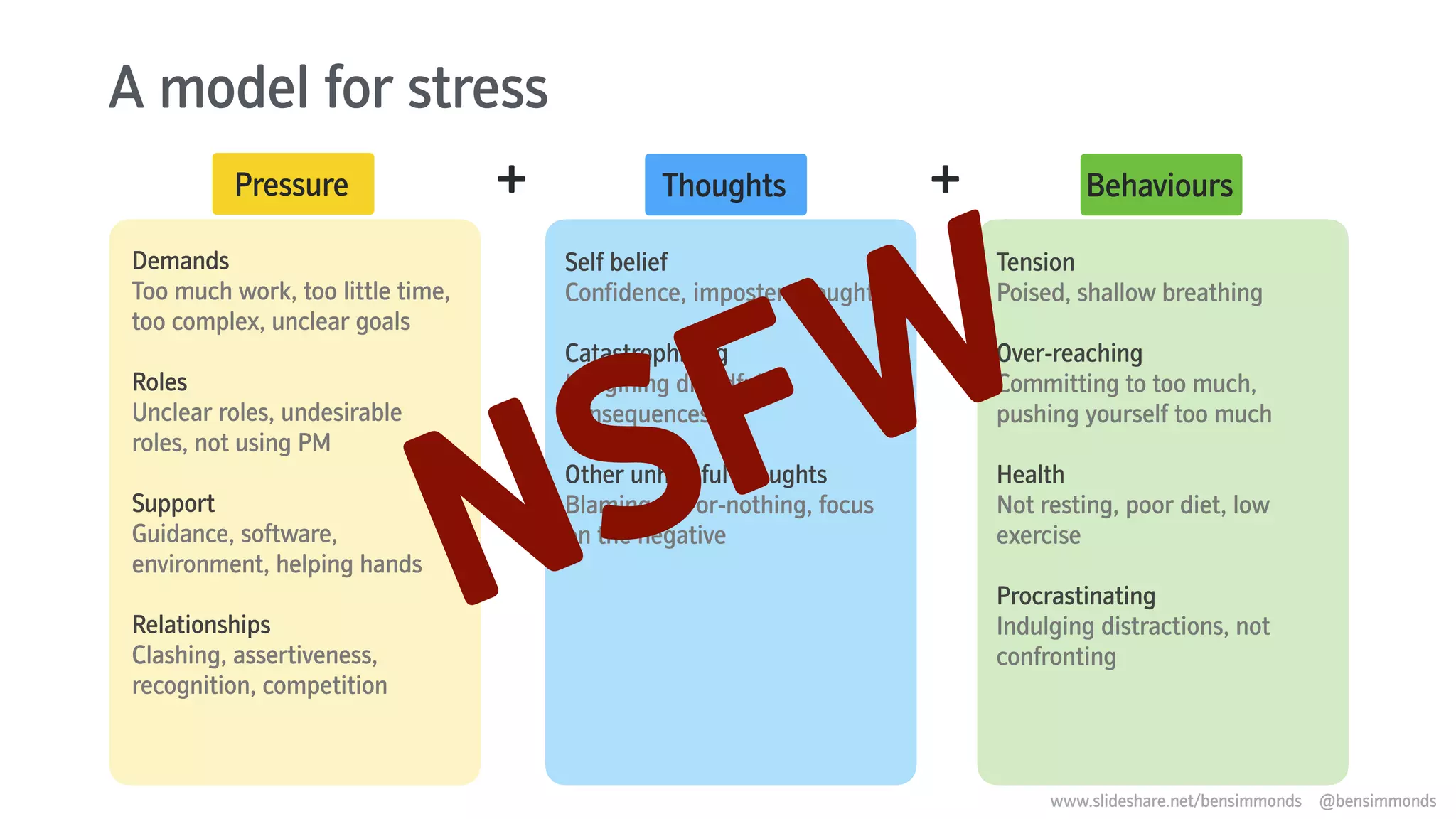
A model for stress
Pressure Stress=
Pressure Stress=++ Thoughts Behaviours
www.slideshare.net/bensimmonds @bensimmonds
Self belief
Confidence, imposter thoughts
Catastrophising
Imagining dreadful
consequences
Other unhelpful thoughts
Blaming, all-or-nothing, focus
on the negative
Tension
Poised, shallow breathing
Over-reaching
Committing to too much,
pushing yourself too much
Health
Not resting, poor diet, low
exercise
Procrastinating
Indulging distractions, not
confronting
Pressure ++ Thoughts Behaviours
Demands
Too much work, too little time,
too complex, unclear goals
Roles
Unclear roles, undesirable
roles, not using PM
Support
Guidance, software,
environment, helping hands
Relationships
Clashing, assertiveness,
recognition, competition
A model for stress
www.slideshare.net/bensimmonds @bensimmonds
Help a colleague
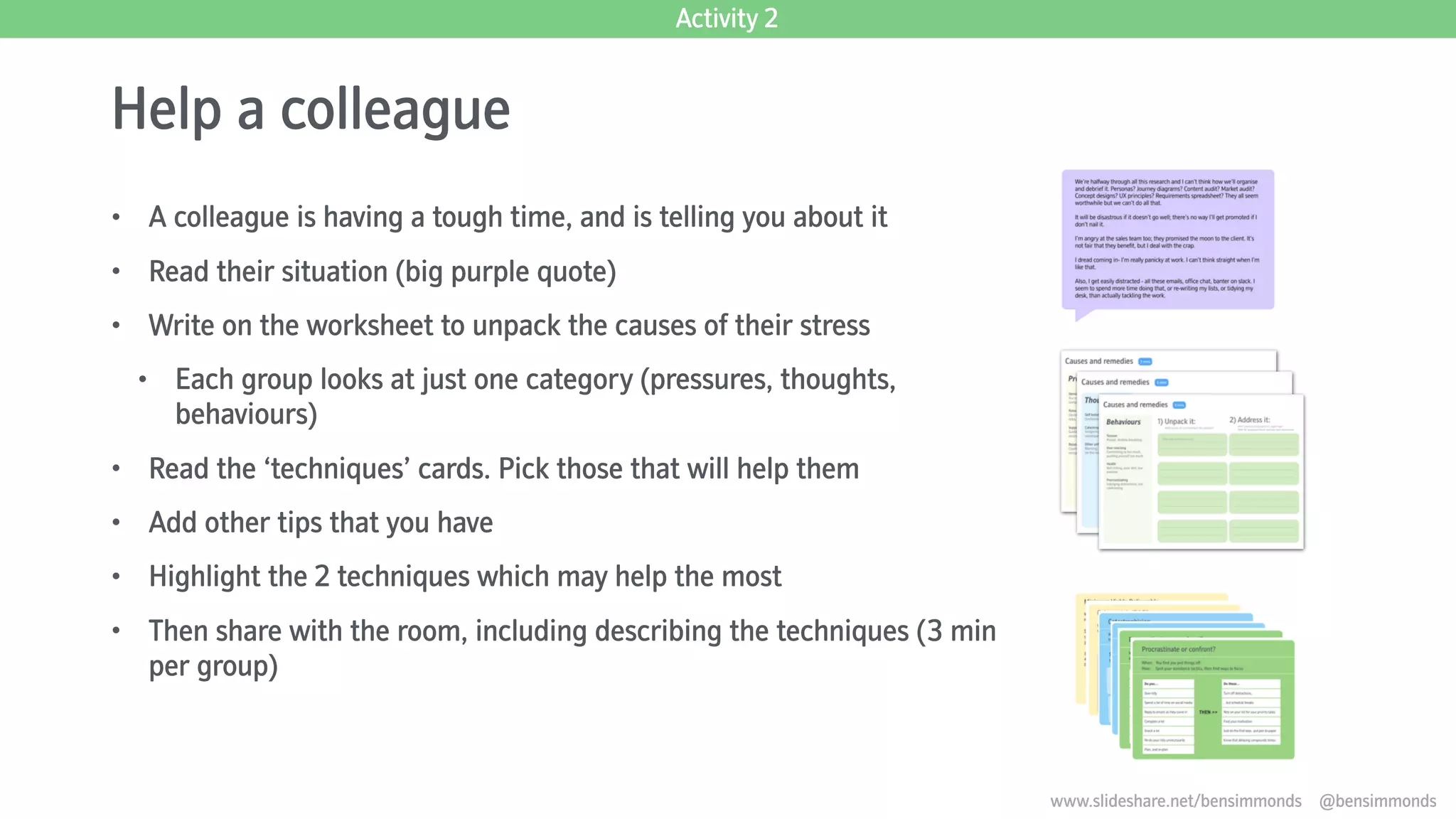
• A colleague is having a tough time, and is telling you about it
• Read their situation (big purple quote)
• Write on the worksheet to unpack the causes of their stress
• Each group looks at just one category (pressures, thoughts,
behaviours)
• Read the ‘techniques’ cards. Pick those that will help them
• Add other tips that you have
• Highlight the 2 techniques which may help the most
• Then share with the room, including describing the techniques (3 min
per group)
Activity 2
www.slideshare.net/bensimmonds @bensimmonds
Activity 2
This new project is really stressing me out. We have a decent set of requirements, but its a
monster. I’m overwhelmed at how much there is to do, and I’m not sure where to start
really.
We have a big team and I’m not entirely sure who’s doing what. I hope they’re not expecting
me to lead this?
Also, I feel a bit like the weak link in the team. I’m worried that they’ll think I’m rubbish, and
not a ‘proper’ UXer. This could be disastrous for my career; there’s no way I’ll get promoted
if I don’t nail it.
I’m really panicky at work these days, and I just can’t think straight when I’m like that. I find
it really distracting in the office too - all these emails, office chat, banter on slack. I seem to
spend more time doing that, or tidying my desk, than actually tackling the work.
And then there is this pitch-work and the blog article that I’ve agreed to take on. I can’t go
back to my boss now I’ve said I’d do it, but it’s eating into my evenings and weekends.
I’m really tired these days, and feel out-of-shape. I know I should sort that out too.
www.slideshare.net/bensimmonds @bensimmonds
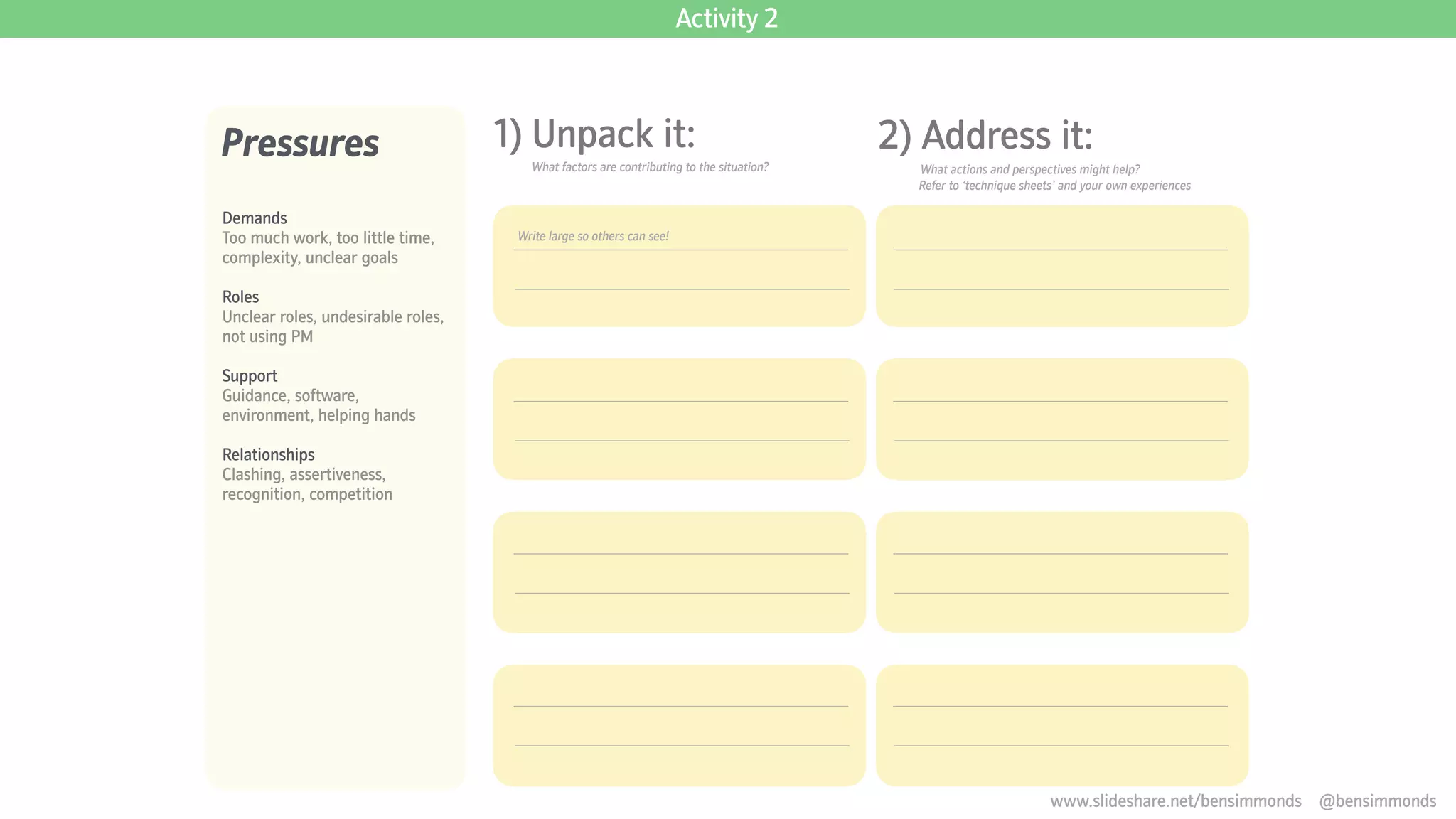
Pressures
Demands
Too much work, too little time,
complexity, unclear goals
Roles
Unclear roles, undesirable roles,
not using PM
Support
Guidance, software,
environment, helping hands
Relationships
Clashing, assertiveness,
recognition, competition
1) Unpack it: 

What factors are contributing to the situation?
2) Address it: 

What actions and perspectives might help?
Refer to ‘technique sheets’ and your own experiences
Write large so others can see!
Activity 2
www.slideshare.net/bensimmonds @bensimmonds
Thoughts
Self belief
Confidence, imposter thoughts
Catastrophising
Imagining dreadful
consequences
Other unhelpful thoughts
Blaming, all-or-nothing, focus
on the negative
1) Unpack it: 

What factors are contributing to the situation?
2) Address it: 

What actions and perspectives might help?
Refer to ‘technique sheets’ and your own experiences
Write large so others can see!
Activity 2
www.slideshare.net/bensimmonds @bensimmonds
Behaviours
Tension
Poised, shallow breathing
Over-reaching
Committing to too much,
pushing yourself too much
Health
Not resting, poor diet, low
exercise
Procrastinating
Indulging distractions, not
confronting
1) Unpack it: 

What factors are contributing to the situation?
2) Address it: 

What actions and perspectives might help?
Refer to ‘technique sheets’ and your own experiences
Write large so others can see!
Activity 2
www.slideshare.net/bensimmonds @bensimmonds
Technique cards
Activity 2
Minimum Viable Deliverable
When: We’re overwhelmed with complexity, amount, time
How: Focus on delivering value, not effort
Steps
1. Imagine our deadline is in 1 hour
2. What is the quickest but most valuable thing we could do? (a sketch, just one
section, competitor showcase, a phone-video report, reuse existing work)
3. Do this
4. Relax knowing we have a fall-back
5. Plan what more is needed (liaise with stakeholder who may be happy with our MVD)
Activity 2
www.slideshare.net/bensimmonds @bensimmonds
Getting Things Done (GTD)
When: We’re overwhelmed with the number of things we have to do
How: Create a clear, prioritised, scheduled list
Steps
1. List all tasks
2. Re-write for specificity (verb + noun)
3. Prioritise (as we see fit)
4. Group those which we can do now (3 minute rule)
5. Group those which we can delegate
6. Everything else, schedule
Activity 2
www.slideshare.net/bensimmonds @bensimmonds
Roles matrix (RACI)
When: We need clarity over who does what on a project
How: Create a matrix of tasks and roles, then define levels of involvement
Responsible Accountable Collaborator Informed
Director UX Designer Dev PM
Approach and budget A / R C C C C
Resource, risk, scope,
team comms
I C C C A / R
Research A / C R C C I
Brand A / C C R C I
Journeys A / C R C C I
UI concepts A / C R R C I
… … … … … …
Activity 2
www.slideshare.net/bensimmonds @bensimmonds
Assertiveness
When: You need courage to express your needs, or your limits
How: Create a ‘reasoned case’ first.
Steps
1. Create a ‘reasoned case’, using a format like this:
“I can do [the sign-up journey designs]
by [the end of this week]
at the standard of [client-ready],
and then I can [update the style guide]
[next week].
Are you happy with that, or should we look at priority, or fidelity, or
getting support?”
Activity 2
www.slideshare.net/bensimmonds @bensimmonds
Self belief
When: You doubt your ability to cope / deliver
How: Visualise yourself coping, and work back
Steps
1. Recall a stressful situation
2. Imagine the most stressful part. Get into that moment
3. Now, imagine that you’re actually coping really well
4. What are you doing that proves you’re coping so well? Your delivery? The work and
artefacts? Your thoughts and mood? The reactions of others?
5. Write these down
6. For each, what would it take to achieve that? Make that plan
7. So, if you do those things, do you believe you can do it well?
8. Try saying that aloud to embed it
Activity 2
www.slideshare.net/bensimmonds @bensimmonds
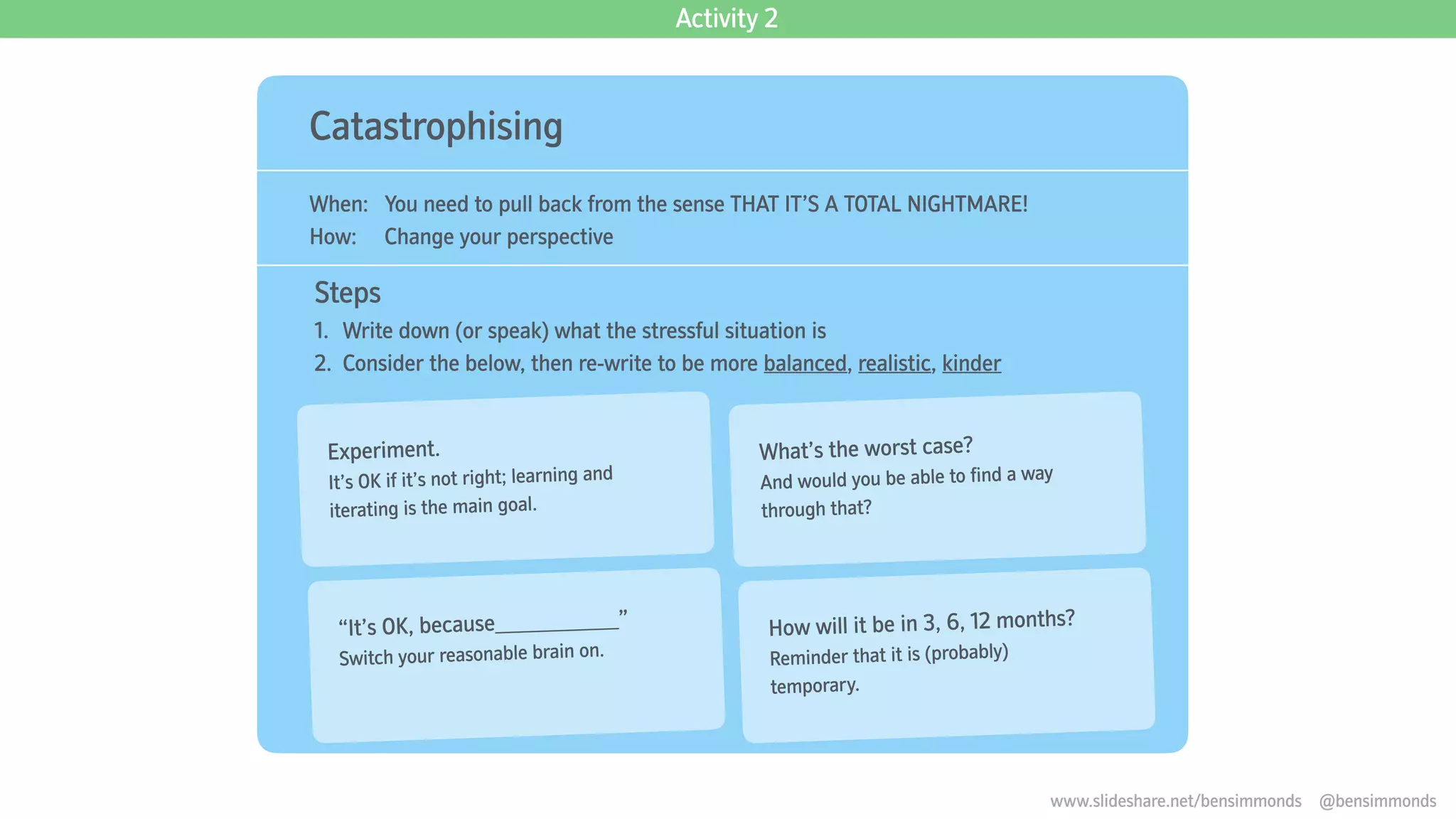
Catastrophising
When: You need to pull back from the sense THAT IT’S A TOTAL NIGHTMARE!
How: Change your perspective
Steps
1. Write down (or speak) what the stressful situation is
2. Consider the below, then re-write to be more balanced, realistic, kinder
Experiment.
It’s OK if it’s not right; learning and
iterating is the main goal.
What’s the worst case?
And would you be able to find a way
through that?
“It’s OK, because___________”
Switch your reasonable brain on.
How will it be in 3, 6, 12 months?
Reminder that it is (probably)
temporary.
Activity 2
www.slideshare.net/bensimmonds @bensimmonds
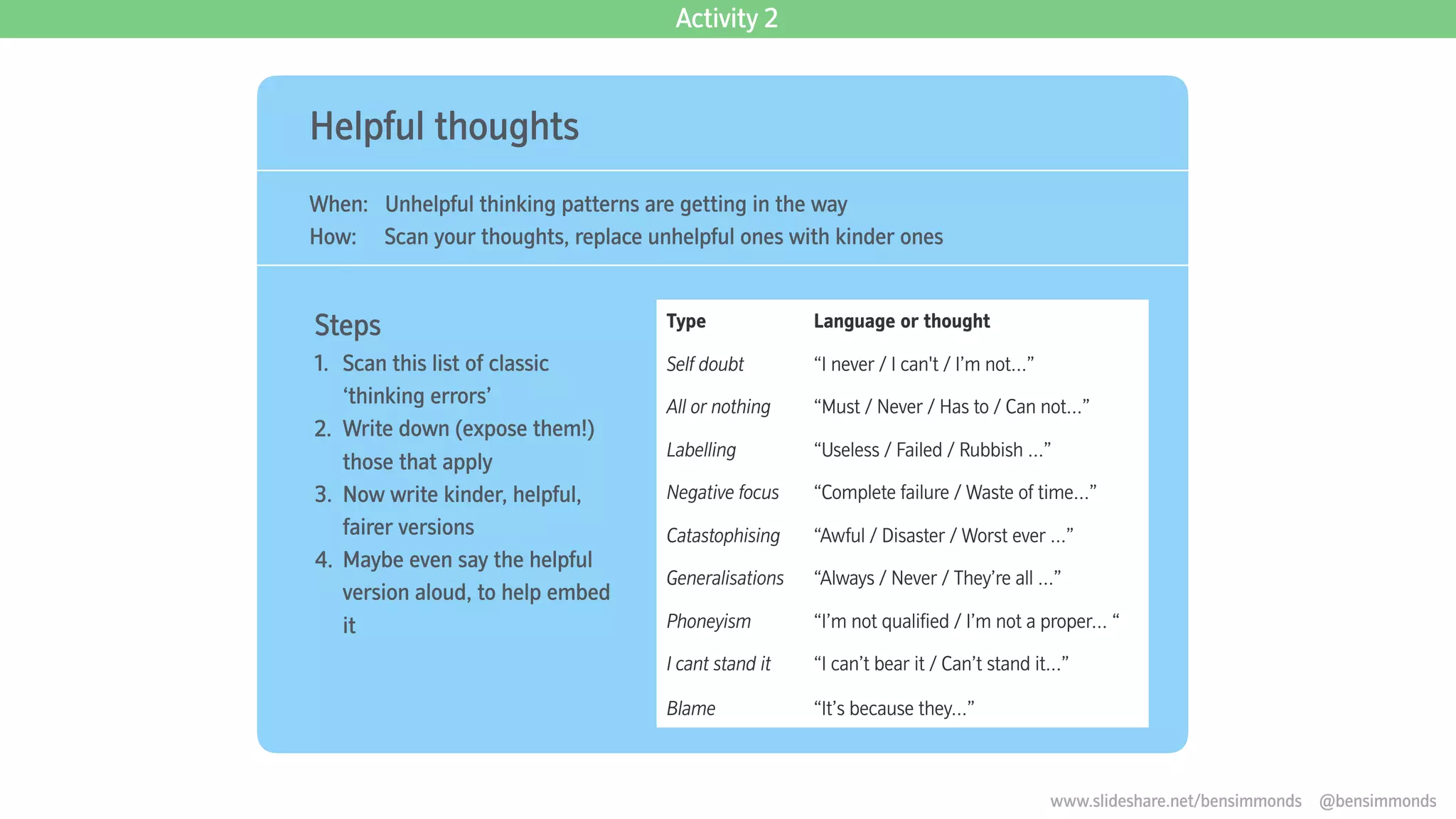
Helpful thoughts
When: Unhelpful thinking patterns are getting in the way
How: Scan your thoughts, replace unhelpful ones with kinder ones
Steps
1. Scan this list of classic
‘thinking errors’
2. Write down (expose them!)
those that apply
3. Now write kinder, helpful,
fairer versions
4. Maybe even say the helpful
version aloud, to help embed
it
Type Language or thought
Self doubt “I never / I can't / I’m not…”
All or nothing “Must / Never / Has to / Can not…”
Labelling “Useless / Failed / Rubbish …”
Negative focus “Complete failure / Waste of time…”
Catastophising “Awful / Disaster / Worst ever …”
Generalisations “Always / Never / They’re all …”
Phoneyism “I’m not qualified / I’m not a proper… “
I cant stand it “I can’t bear it / Can’t stand it…”
Blame “It’s because they…”
Activity 2
www.slideshare.net/bensimmonds @bensimmonds
Turn anxiety to excitement
When: You need a quick hack to be able to ‘turn towards’ the anxiety
How: Pretend that the anxiety is in fact excitement
Background
• The physiological response to anxiety, anger, excitement is very similar.
• However the emotions are very different. This quick fix can help us perform when
anxiety kicks in.
Steps
1. If you’re anxious, tell yourself that you are excited.
2. Back it up with an upright posture.
3. You’ll find that you’re more able to ‘turn towards’ the situation.
Activity 2
www.slideshare.net/bensimmonds @bensimmonds
Procrastinate or confront?
When: You find you put things off
How: Spot your avoidance tactics, then find ways to focus
Do you…. Do these…
Over-tidy Turn off distractions..
Spend a lot of time on social media .. but schedule breaks
Reply to emails as they come in THEN >> Rely on your list for your priority tasks
Complain a lot Find your motivation
Snack a lot Just do the first step.. put pen to paper
Re-do your lists unnecessarily Know that delaying compounds stress
Plan, and re-plan
Activity 2
www.slideshare.net/bensimmonds @bensimmonds
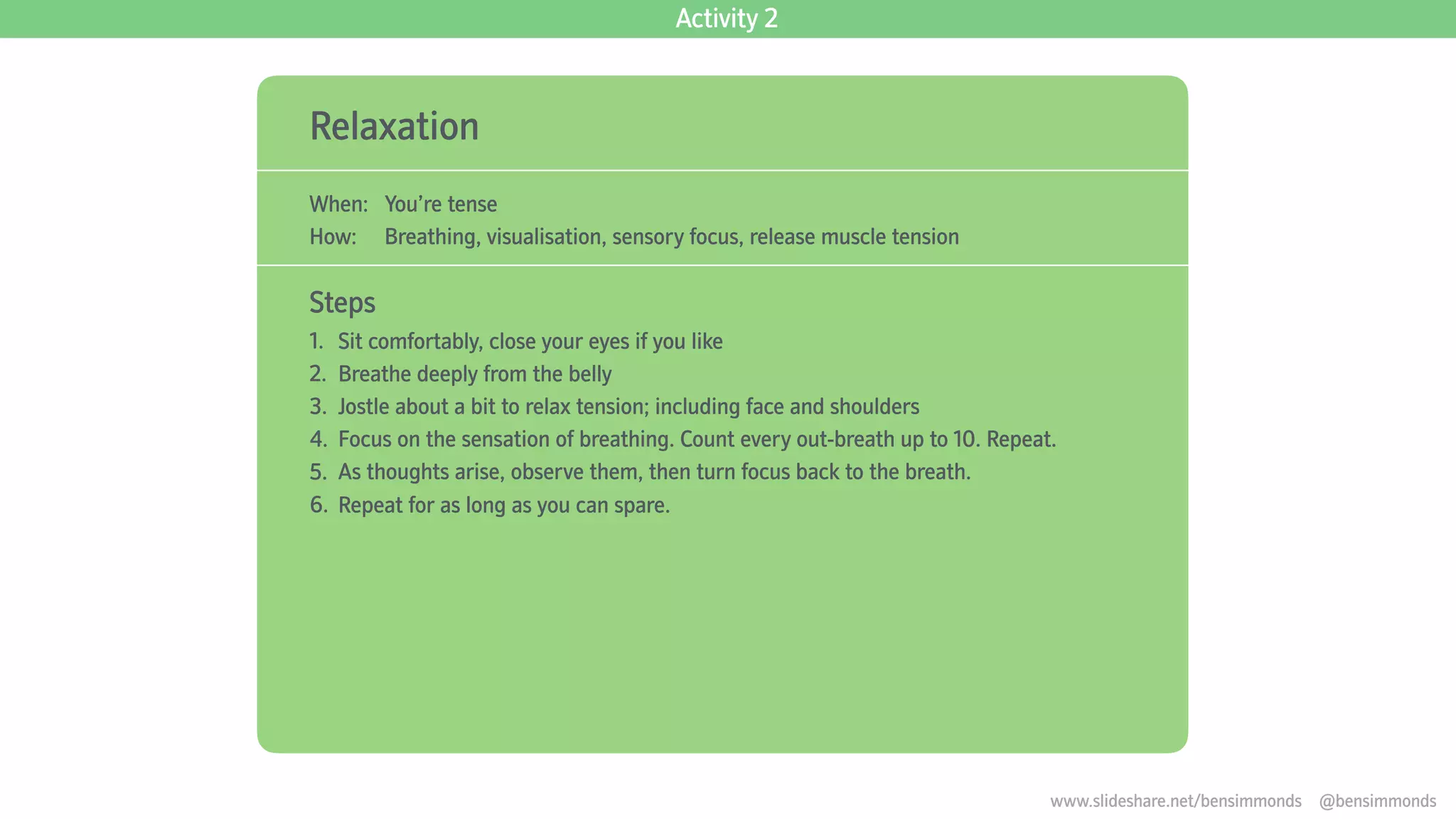
Relaxation
When: You’re tense
How: Breathing, visualisation, sensory focus, release muscle tension
Steps
1. Sit comfortably, close your eyes if you like
2. Breathe deeply from the belly
3. Jostle about a bit to relax tension; including face and shoulders
4. Focus on the sensation of breathing. Count every out-breath up to 10. Repeat.
5. As thoughts arise, observe them, then turn focus back to the breath.
6. Repeat for as long as you can spare.
Activity 2
www.slideshare.net/bensimmonds @bensimmonds
Over-committing
When: We’re in ‘hero mode’ and taking on too much
How: Various
Consider these:
1. Deliver existing tasks before taking on new ones
2. Only commit 70% of your time. Things often take longer, and fires need fighting
3. List your priorities, and plan tasks accordingly (eg: 1. Health 2. Immediate project 3.
Nurture team 4. New business 5…)
4. Where can you delegate or get support?
5. Can your PM help?
Activity 2
www.slideshare.net/bensimmonds @bensimmonds
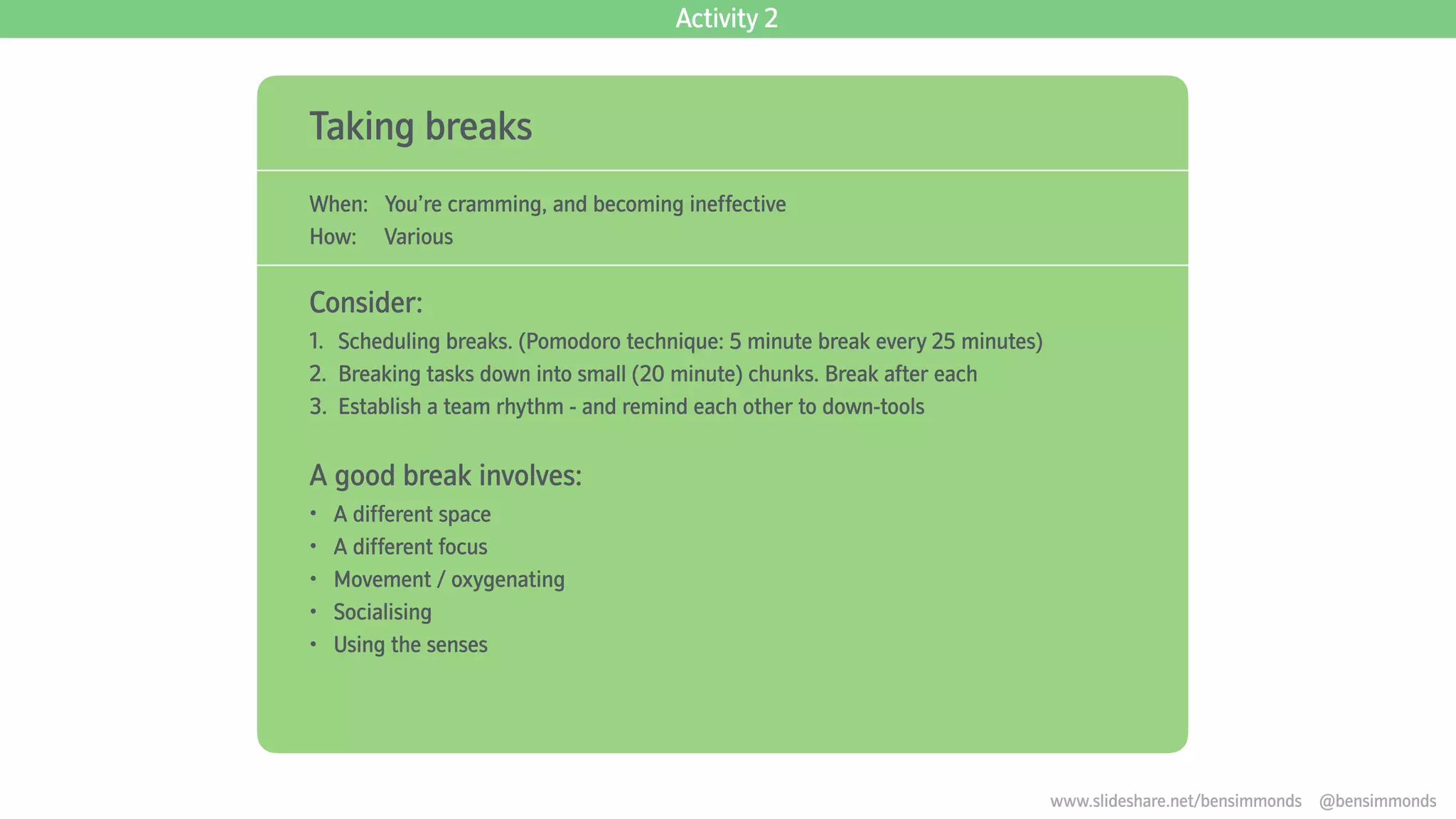
Taking breaks
When: You’re cramming, and becoming ineffective
How: Various
Consider:
1. Scheduling breaks. (Pomodoro technique: 5 minute break every 25 minutes)
2. Breaking tasks down into small (20 minute) chunks. Break after each
3. Establish a team rhythm - and remind each other to down-tools
A good break involves:
• A different space
• A different focus
• Movement / oxygenating
• Socialising
• Using the senses
Activity 2
www.slideshare.net/bensimmonds @bensimmonds
Pressures
Demands
Too much work, too little time, complex, unclear goals
Roles
Unclear roles, undesirable roles, not using PM
Support
Guidance, software, environment, helping hands
Relationships
Clashing, assertiveness, recognition, competition
Self stress diagnostic
1. Describe it: in your natural conversational language, to help expose any unhelpful thoughts
2. Unpack it: Write down any factors which are contributing to your situation
3. Address it: What actions and perspectives will help? And which will have the biggest impact?
Thoughts
Self belief
Confidence, imposter thoughts
Catastrophising
Imagining dreadful consequences
Other unhelpful thoughts
Blaming, all-or-nothing, focus on the negative
Behaviours
Tension
Poised, shallow breathing
Over-reaching
Committing to too much, pushing yourself too much
Health
Not resting, poor diet, low exercise
Procrastinating
Indulging distractions, not confronting
www.slideshare.net/bensimmonds @bensimmonds
Goals
Find techniques to
nurture our
‘design mind’
Find safe ways
to discuss it on
our projects
Share experiences
and tips for
common UX
stressors
www.slideshare.net/bensimmonds @bensimmonds
Self belief
Confidence, imposter thoughts
Catastrophising
Imagining dreadful
consequences
Other unhelpful thoughts
Blaming, all-or-nothing, focus
on the negative
Tension
Poised, shallow breathing
Over-reaching
Committing to too much,
pushing yourself too much
Health
Not resting, poor diet, low
exercise
Procrastinating
Indulging distractions, not
confronting
Pressure ++ Thoughts Behaviours
Demands
Too much work, too little time,
too complex, unclear goals
Roles
Unclear roles, undesirable
roles, not using PM
Support
Guidance, software,
environment, helping hands
Relationships
Clashing, assertiveness,
recognition, competition
A model for stress
NSFW
www.slideshare.net/bensimmonds @bensimmonds
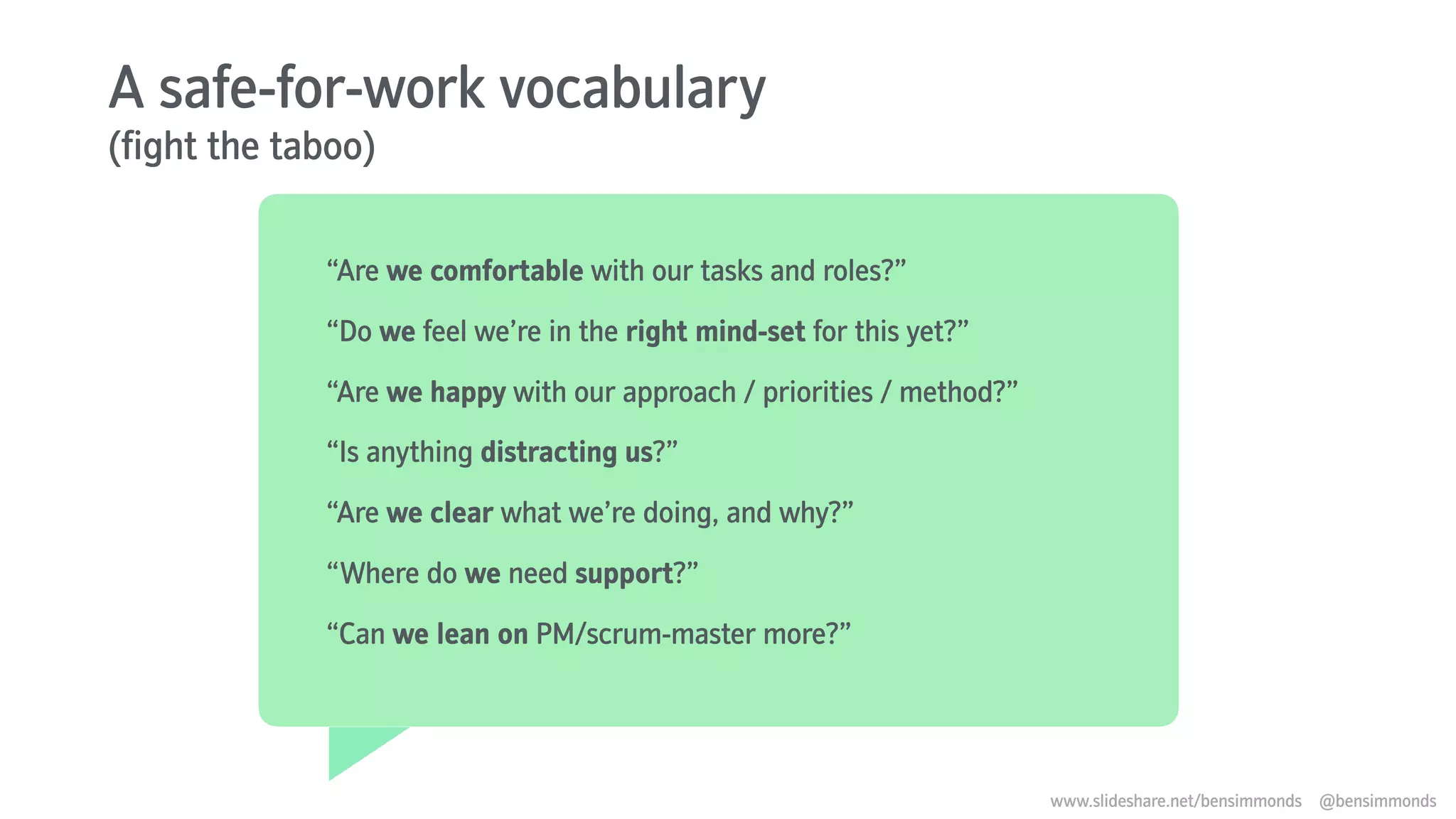
A safe-for-work vocabulary
(fight the taboo)
“Are we comfortable with our tasks and roles?”
“Do we feel we’re in the right mind-set for this yet?”
“Are we happy with our approach / priorities / method?”
“Is anything distracting us?”
“Are we clear what we’re doing, and why?”
“Where do we need support?”
“Can we lean on PM/scrum-master more?”
www.slideshare.net/bensimmonds @bensimmonds
A safe-for-work vocabulary
(fight the taboo)
• You can do better
• 2 minutes: what phrases / approaches feel right for you?
• Remember, the goal is to be able to include this stuff when
discussing the health of our projects.
• Share 2 phrases with the room
Activity 3
www.slideshare.net/bensimmonds @bensimmonds
What vocabulary & approaches work for you?
What phrases, words, or approaches feel right for you?
We want to be able to talk about stress, pressures, mind-state in our project teams to perform well, and tackle the taboo around stress.
2 mins
Write large so others can see!
Activity 3
www.slideshare.net/bensimmonds @bensimmonds
Summary
4 things to take away
We’ve shared
common UX
stress-spots
Stress
management is a
core UX skill
We have the
vocabulary to
discuss it
We have a tool-
set to navigate
stress
www.slideshare.net/bensimmonds @bensimmonds
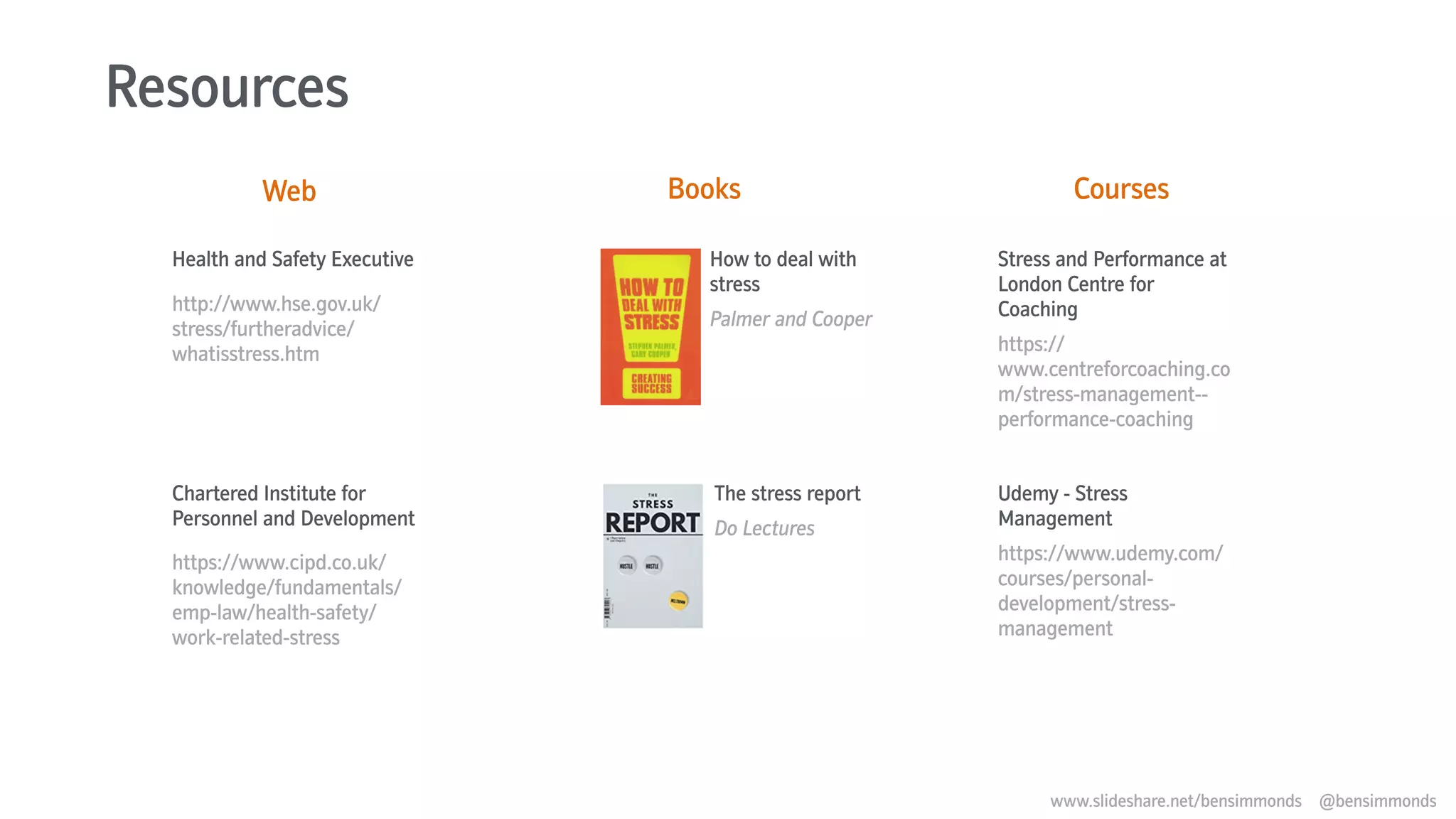
Books
Resources
Health and Safety Executive
http://www.hse.gov.uk/
stress/furtheradvice/
whatisstress.htm
How to deal with
stress
Palmer and Cooper
The stress report
Do Lectures
Courses
Stress and Performance at
London Centre for
Coaching
https://
www.centreforcoaching.co
m/stress-management--
performance-coaching
Web
Chartered Institute for
Personnel and Development
https://www.cipd.co.uk/
knowledge/fundamentals/
emp-law/health-safety/
work-related-stress
Udemy - Stress
Management
https://www.udemy.com/
courses/personal-
development/stress-
management
www.slideshare.net/bensimmonds @bensimmonds
Thank you :-)
www.slideshare.net/bensimmonds
@bensimmonds
ben@bensimmonds.co

Designers we need to talk about stress

  • 1.
    Designers, We need totalk about stress. UX Bristol 2017 www.slideshare.net/bensimmonds @bensimmonds
  • 2.
    “I don’t reallyget stressed. And anyway, stress can be good - it keeps things exciting and pushes you to your best” Someone irritatingly balanced / in denial / not in employment You and stress? “Oh crap oh crap oh crap oh crap oh crap oh crap oh crap oh crap oh crap oh crap oh crap oh crap oh crap oh crap oh crap oh crap oh crap oh crap oh crap oh crap oh crap oh crap…” Everyone else? Just me? www.slideshare.net/bensimmonds @bensimmonds
  • 3.
    Me and workstress Advertising, London Digital & UX, London Digital & UX, Sydney UX, Bristol Stress and performance certification Prep UXBristol 0 1 2 3 4 5 6 7 8 9 10 11 12 13 14 15 16 17 yrs Oh crap oh crap Doing OK www.slideshare.net/bensimmonds @bensimmonds
  • 4.
    Why it’s aproblem
  • 5.
    Are you sittingcomfortably?
  • 6.
    Stress makes uscrap at UX1 It inhibits our ‘design mind’ capabilities.. Creativity Concentration Problem solving Cooperation Empathy Patience Memory access Pattern spotting Capacity to learn www.slideshare.net/bensimmonds @bensimmonds
  • 7.
    Irritable Resentful Anxious TenseFatigued Headaches Ulcers, colds Depressed Low self esteem Stress makes us feel crap2 www.slideshare.net/bensimmonds @bensimmonds
  • 8.
    It’s an epidemic3 40%of UK workers feel unwell from stress at work (HSE 2016) 1 in 6 UK workers will suffer depression, anxiety, chronic stress (HSE 2016) The World Health Organisation describes stress as “..The health epidemic of the 21st century” www.slideshare.net/bensimmonds @bensimmonds
  • 9.
    56% feel thattelling a boss about their stress would inhibit their career prospects (YouGov/SimplyHealth, 2016) It’s taboo4 www.slideshare.net/bensimmonds @bensimmonds
  • 10.
    Only 18% ofcompanies offer workplace support for stress (mostly large corporates) HSE, 2016) It’s your problem5 www.slideshare.net/bensimmonds @bensimmonds
  • 11.
    Goals Find techniques to nurtureour ‘design mind’ Find safe ways to discuss it on our projects Share experiences and tips for common UX stressors www.slideshare.net/bensimmonds @bensimmonds
  • 12.
  • 13.
    Some is good Amountof pressure Productivity ‘Under-load’ Bored ‘Eustress’ Focused / Flow ‘Acute stress’ Panicked ‘Chronic stress’ Burn out Today’s focus www.slideshare.net/bensimmonds @bensimmonds
  • 14.
    Goals Find techniques to nurtureour ‘design mind’ Find safe ways to discuss it on our projects Share experiences and tips for common UX stressors www.slideshare.net/bensimmonds @bensimmonds
  • 15.
    • As agroup/table.. • 5 minutes discussing most common stressors at work • Certain activities? • Certain situations? • Certain project types? • Write ‘em down • Any tips, techniques, resources, checklists that help? • Each team share 2 with the rest of the room Work stress-spots Activity 1 www.slideshare.net/bensimmonds @bensimmonds
  • 16.
    What are thecommon stressors in UX design? Here lies stress! What are the situations, activities, or projects that frequently cause you stress at work? ..and this helps What techniques, perspectives, activities help you? 5 mins Write large so others can see! Activity 1 www.slideshare.net/bensimmonds @bensimmonds
  • 17.
    Goals Find techniques to nurtureour ‘design mind’ Find safe ways to discuss it on our projects Share experiences and tips for common UX stressors www.slideshare.net/bensimmonds @bensimmonds
  • 18.
    A model forstress Pressure Stress= Pressure Stress=++ Thoughts Behaviours www.slideshare.net/bensimmonds @bensimmonds
  • 19.
    Self belief Confidence, imposterthoughts Catastrophising Imagining dreadful consequences Other unhelpful thoughts Blaming, all-or-nothing, focus on the negative Tension Poised, shallow breathing Over-reaching Committing to too much, pushing yourself too much Health Not resting, poor diet, low exercise Procrastinating Indulging distractions, not confronting Pressure ++ Thoughts Behaviours Demands Too much work, too little time, too complex, unclear goals Roles Unclear roles, undesirable roles, not using PM Support Guidance, software, environment, helping hands Relationships Clashing, assertiveness, recognition, competition A model for stress www.slideshare.net/bensimmonds @bensimmonds
  • 20.
    Help a colleague •A colleague is having a tough time, and is telling you about it • Read their situation (big purple quote) • Write on the worksheet to unpack the causes of their stress • Each group looks at just one category (pressures, thoughts, behaviours) • Read the ‘techniques’ cards. Pick those that will help them • Add other tips that you have • Highlight the 2 techniques which may help the most • Then share with the room, including describing the techniques (3 min per group) Activity 2 www.slideshare.net/bensimmonds @bensimmonds
  • 21.
    Activity 2 This newproject is really stressing me out. We have a decent set of requirements, but its a monster. I’m overwhelmed at how much there is to do, and I’m not sure where to start really. We have a big team and I’m not entirely sure who’s doing what. I hope they’re not expecting me to lead this? Also, I feel a bit like the weak link in the team. I’m worried that they’ll think I’m rubbish, and not a ‘proper’ UXer. This could be disastrous for my career; there’s no way I’ll get promoted if I don’t nail it. I’m really panicky at work these days, and I just can’t think straight when I’m like that. I find it really distracting in the office too - all these emails, office chat, banter on slack. I seem to spend more time doing that, or tidying my desk, than actually tackling the work. And then there is this pitch-work and the blog article that I’ve agreed to take on. I can’t go back to my boss now I’ve said I’d do it, but it’s eating into my evenings and weekends. I’m really tired these days, and feel out-of-shape. I know I should sort that out too. www.slideshare.net/bensimmonds @bensimmonds
  • 22.
    Pressures Demands Too much work,too little time, complexity, unclear goals Roles Unclear roles, undesirable roles, not using PM Support Guidance, software, environment, helping hands Relationships Clashing, assertiveness, recognition, competition 1) Unpack it: 
 What factors are contributing to the situation? 2) Address it: 
 What actions and perspectives might help? Refer to ‘technique sheets’ and your own experiences Write large so others can see! Activity 2 www.slideshare.net/bensimmonds @bensimmonds
  • 23.
    Thoughts Self belief Confidence, imposterthoughts Catastrophising Imagining dreadful consequences Other unhelpful thoughts Blaming, all-or-nothing, focus on the negative 1) Unpack it: 
 What factors are contributing to the situation? 2) Address it: 
 What actions and perspectives might help? Refer to ‘technique sheets’ and your own experiences Write large so others can see! Activity 2 www.slideshare.net/bensimmonds @bensimmonds
  • 24.
    Behaviours Tension Poised, shallow breathing Over-reaching Committingto too much, pushing yourself too much Health Not resting, poor diet, low exercise Procrastinating Indulging distractions, not confronting 1) Unpack it: 
 What factors are contributing to the situation? 2) Address it: 
 What actions and perspectives might help? Refer to ‘technique sheets’ and your own experiences Write large so others can see! Activity 2 www.slideshare.net/bensimmonds @bensimmonds
  • 25.
  • 26.
    Minimum Viable Deliverable When:We’re overwhelmed with complexity, amount, time How: Focus on delivering value, not effort Steps 1. Imagine our deadline is in 1 hour 2. What is the quickest but most valuable thing we could do? (a sketch, just one section, competitor showcase, a phone-video report, reuse existing work) 3. Do this 4. Relax knowing we have a fall-back 5. Plan what more is needed (liaise with stakeholder who may be happy with our MVD) Activity 2 www.slideshare.net/bensimmonds @bensimmonds
  • 27.
    Getting Things Done(GTD) When: We’re overwhelmed with the number of things we have to do How: Create a clear, prioritised, scheduled list Steps 1. List all tasks 2. Re-write for specificity (verb + noun) 3. Prioritise (as we see fit) 4. Group those which we can do now (3 minute rule) 5. Group those which we can delegate 6. Everything else, schedule Activity 2 www.slideshare.net/bensimmonds @bensimmonds
  • 28.
    Roles matrix (RACI) When:We need clarity over who does what on a project How: Create a matrix of tasks and roles, then define levels of involvement Responsible Accountable Collaborator Informed Director UX Designer Dev PM Approach and budget A / R C C C C Resource, risk, scope, team comms I C C C A / R Research A / C R C C I Brand A / C C R C I Journeys A / C R C C I UI concepts A / C R R C I … … … … … … Activity 2 www.slideshare.net/bensimmonds @bensimmonds
  • 29.
    Assertiveness When: You needcourage to express your needs, or your limits How: Create a ‘reasoned case’ first. Steps 1. Create a ‘reasoned case’, using a format like this: “I can do [the sign-up journey designs] by [the end of this week] at the standard of [client-ready], and then I can [update the style guide] [next week]. Are you happy with that, or should we look at priority, or fidelity, or getting support?” Activity 2 www.slideshare.net/bensimmonds @bensimmonds
  • 30.
    Self belief When: Youdoubt your ability to cope / deliver How: Visualise yourself coping, and work back Steps 1. Recall a stressful situation 2. Imagine the most stressful part. Get into that moment 3. Now, imagine that you’re actually coping really well 4. What are you doing that proves you’re coping so well? Your delivery? The work and artefacts? Your thoughts and mood? The reactions of others? 5. Write these down 6. For each, what would it take to achieve that? Make that plan 7. So, if you do those things, do you believe you can do it well? 8. Try saying that aloud to embed it Activity 2 www.slideshare.net/bensimmonds @bensimmonds
  • 31.
    Catastrophising When: You needto pull back from the sense THAT IT’S A TOTAL NIGHTMARE! How: Change your perspective Steps 1. Write down (or speak) what the stressful situation is 2. Consider the below, then re-write to be more balanced, realistic, kinder Experiment. It’s OK if it’s not right; learning and iterating is the main goal. What’s the worst case? And would you be able to find a way through that? “It’s OK, because___________” Switch your reasonable brain on. How will it be in 3, 6, 12 months? Reminder that it is (probably) temporary. Activity 2 www.slideshare.net/bensimmonds @bensimmonds
  • 32.
    Helpful thoughts When: Unhelpfulthinking patterns are getting in the way How: Scan your thoughts, replace unhelpful ones with kinder ones Steps 1. Scan this list of classic ‘thinking errors’ 2. Write down (expose them!) those that apply 3. Now write kinder, helpful, fairer versions 4. Maybe even say the helpful version aloud, to help embed it Type Language or thought Self doubt “I never / I can't / I’m not…” All or nothing “Must / Never / Has to / Can not…” Labelling “Useless / Failed / Rubbish …” Negative focus “Complete failure / Waste of time…” Catastophising “Awful / Disaster / Worst ever …” Generalisations “Always / Never / They’re all …” Phoneyism “I’m not qualified / I’m not a proper… “ I cant stand it “I can’t bear it / Can’t stand it…” Blame “It’s because they…” Activity 2 www.slideshare.net/bensimmonds @bensimmonds
  • 33.
    Turn anxiety toexcitement When: You need a quick hack to be able to ‘turn towards’ the anxiety How: Pretend that the anxiety is in fact excitement Background • The physiological response to anxiety, anger, excitement is very similar. • However the emotions are very different. This quick fix can help us perform when anxiety kicks in. Steps 1. If you’re anxious, tell yourself that you are excited. 2. Back it up with an upright posture. 3. You’ll find that you’re more able to ‘turn towards’ the situation. Activity 2 www.slideshare.net/bensimmonds @bensimmonds
  • 34.
    Procrastinate or confront? When:You find you put things off How: Spot your avoidance tactics, then find ways to focus Do you…. Do these… Over-tidy Turn off distractions.. Spend a lot of time on social media .. but schedule breaks Reply to emails as they come in THEN >> Rely on your list for your priority tasks Complain a lot Find your motivation Snack a lot Just do the first step.. put pen to paper Re-do your lists unnecessarily Know that delaying compounds stress Plan, and re-plan Activity 2 www.slideshare.net/bensimmonds @bensimmonds
  • 35.
    Relaxation When: You’re tense How:Breathing, visualisation, sensory focus, release muscle tension Steps 1. Sit comfortably, close your eyes if you like 2. Breathe deeply from the belly 3. Jostle about a bit to relax tension; including face and shoulders 4. Focus on the sensation of breathing. Count every out-breath up to 10. Repeat. 5. As thoughts arise, observe them, then turn focus back to the breath. 6. Repeat for as long as you can spare. Activity 2 www.slideshare.net/bensimmonds @bensimmonds
  • 36.
    Over-committing When: We’re in‘hero mode’ and taking on too much How: Various Consider these: 1. Deliver existing tasks before taking on new ones 2. Only commit 70% of your time. Things often take longer, and fires need fighting 3. List your priorities, and plan tasks accordingly (eg: 1. Health 2. Immediate project 3. Nurture team 4. New business 5…) 4. Where can you delegate or get support? 5. Can your PM help? Activity 2 www.slideshare.net/bensimmonds @bensimmonds
  • 37.
    Taking breaks When: You’recramming, and becoming ineffective How: Various Consider: 1. Scheduling breaks. (Pomodoro technique: 5 minute break every 25 minutes) 2. Breaking tasks down into small (20 minute) chunks. Break after each 3. Establish a team rhythm - and remind each other to down-tools A good break involves: • A different space • A different focus • Movement / oxygenating • Socialising • Using the senses Activity 2 www.slideshare.net/bensimmonds @bensimmonds
  • 38.
    Pressures Demands Too much work,too little time, complex, unclear goals Roles Unclear roles, undesirable roles, not using PM Support Guidance, software, environment, helping hands Relationships Clashing, assertiveness, recognition, competition Self stress diagnostic 1. Describe it: in your natural conversational language, to help expose any unhelpful thoughts 2. Unpack it: Write down any factors which are contributing to your situation 3. Address it: What actions and perspectives will help? And which will have the biggest impact? Thoughts Self belief Confidence, imposter thoughts Catastrophising Imagining dreadful consequences Other unhelpful thoughts Blaming, all-or-nothing, focus on the negative Behaviours Tension Poised, shallow breathing Over-reaching Committing to too much, pushing yourself too much Health Not resting, poor diet, low exercise Procrastinating Indulging distractions, not confronting www.slideshare.net/bensimmonds @bensimmonds
  • 39.
    Goals Find techniques to nurtureour ‘design mind’ Find safe ways to discuss it on our projects Share experiences and tips for common UX stressors www.slideshare.net/bensimmonds @bensimmonds
  • 40.
    Self belief Confidence, imposterthoughts Catastrophising Imagining dreadful consequences Other unhelpful thoughts Blaming, all-or-nothing, focus on the negative Tension Poised, shallow breathing Over-reaching Committing to too much, pushing yourself too much Health Not resting, poor diet, low exercise Procrastinating Indulging distractions, not confronting Pressure ++ Thoughts Behaviours Demands Too much work, too little time, too complex, unclear goals Roles Unclear roles, undesirable roles, not using PM Support Guidance, software, environment, helping hands Relationships Clashing, assertiveness, recognition, competition A model for stress NSFW www.slideshare.net/bensimmonds @bensimmonds
  • 41.
    A safe-for-work vocabulary (fightthe taboo) “Are we comfortable with our tasks and roles?” “Do we feel we’re in the right mind-set for this yet?” “Are we happy with our approach / priorities / method?” “Is anything distracting us?” “Are we clear what we’re doing, and why?” “Where do we need support?” “Can we lean on PM/scrum-master more?” www.slideshare.net/bensimmonds @bensimmonds
  • 42.
    A safe-for-work vocabulary (fightthe taboo) • You can do better • 2 minutes: what phrases / approaches feel right for you? • Remember, the goal is to be able to include this stuff when discussing the health of our projects. • Share 2 phrases with the room Activity 3 www.slideshare.net/bensimmonds @bensimmonds
  • 43.
    What vocabulary &approaches work for you? What phrases, words, or approaches feel right for you? We want to be able to talk about stress, pressures, mind-state in our project teams to perform well, and tackle the taboo around stress. 2 mins Write large so others can see! Activity 3 www.slideshare.net/bensimmonds @bensimmonds
  • 44.
  • 45.
    4 things totake away We’ve shared common UX stress-spots Stress management is a core UX skill We have the vocabulary to discuss it We have a tool- set to navigate stress www.slideshare.net/bensimmonds @bensimmonds
  • 46.
    Books Resources Health and SafetyExecutive http://www.hse.gov.uk/ stress/furtheradvice/ whatisstress.htm How to deal with stress Palmer and Cooper The stress report Do Lectures Courses Stress and Performance at London Centre for Coaching https:// www.centreforcoaching.co m/stress-management-- performance-coaching Web Chartered Institute for Personnel and Development https://www.cipd.co.uk/ knowledge/fundamentals/ emp-law/health-safety/ work-related-stress Udemy - Stress Management https://www.udemy.com/ courses/personal- development/stress- management www.slideshare.net/bensimmonds @bensimmonds
  • 47.