COMM 202:
Career Fundamentals
T36 & T37 with Natiqa Babar
Tutorial 1: Introduction to Skills Matrices
OUR AGENDA FOR TODAY
1. Attendance
2. Getting to know your TA (aka me)
3. Course expectations
4. Putting together a Skills Matrix
5. Activity
6. Action items
Let’s get some Admin stuff out of the way!
We need your emails to send you reminders!
Please go to this link and fill out the information
(60 seconds!)
Please bring your name cards to tutorial, this is
how I will be tracking your attendance and
participation!
www.tinyurl.com/202tinder
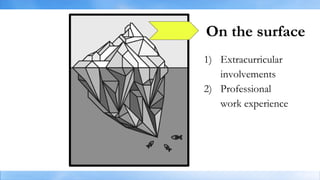
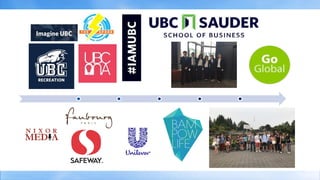
On the surface
1) Extracurricular
involvements
2) Professional
work experience
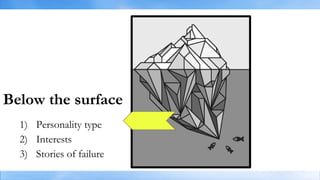
Below the surface
1) Personality type
2) Interests
3) Stories of failure
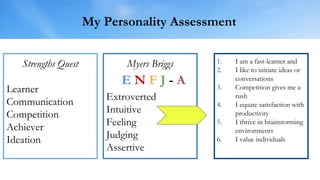
My Personality Assessment
Strengths Quest
Learner
Communication
Competition
Achiever
Ideation
Myers Briggs
E N F J - A
Extroverted
Intuitive
Feeling
Judging
Assertive
1. I am a fast-learner and
2. I like to initiate ideas or
conversations
3. Competition gives me a
rush
4. I equate satisfaction with
productivity
5. I thrive in brainstorming
environments
6. I value individuals
“Success is not final, failure is
not fatal: it is the courage to
continue that counts.”
- Winston Churchill
Course Expectations
I know
nothing !
Treat this
course like a...
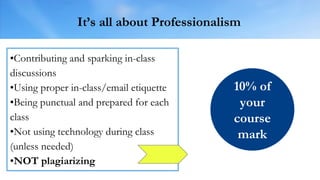
It’s all about Professionalism
•Contributing and sparking in-class
discussions
•Using proper in-class/email etiquette
•Being punctual and prepared for each
class
•Not using technology during class
(unless needed)
•NOT plagiarizing
10% of
your
course
mark
But that doesn’t mean you can’t be yourself!
In fact, you should!
•It makes you more relatable and
likeable
•It helps you build trust and form
relationships
•You’ll be happier and most satisfied in
your professional pursuit
A girl is
no one
Jk. A girl
is Arya
Stark
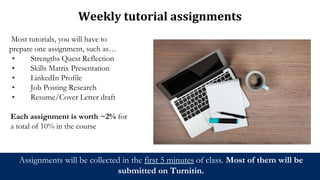
Most tutorials, you will have to
prepare one assignment, such as…
• Strengths Quest Reflection
• Skills Matrix Presentation
• LinkedIn Profile
• Job Posting Research
• Resume/Cover Letter draft
Each assignment is worth ~2% for
a total of 10% in the course
Weekly tutorial assignments
Assignments will be collected in the first 5 minutes of class. Most of them will be
submitted on Turnitin.
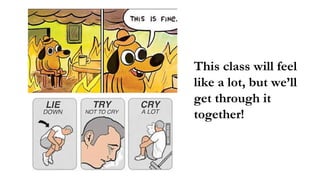
This class will feel
like a lot, but we’ll
get through it
together!
Putting together a Skills Matrix
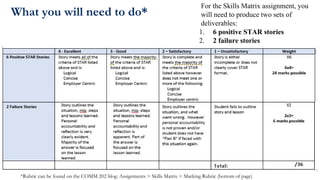
What you will need to do*
For the Skills Matrix assignment, you
will need to produce two sets of
deliverables:
1. 6 positive STAR stories
2. 2 failure stories
*Rubric can be found on the COMM 202 blog: Assignments > Skills Matrix > Marking Rubric (bottom of page)
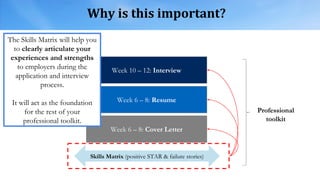
Why is this important?
Week 6 – 8: Cover Letter
Week 6 – 8: Resume
Week 10 – 12: Interview
The Skills Matrix will help you
to clearly articulate your
experiences and strengths
to employers during the
application and interview
process.
It will act as the foundation
for the rest of your
professional toolkit.
Professional
toolkit
Skills Matrix (positive STAR & failure stories)
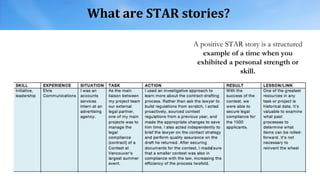
What are STAR stories?
A positive STAR story is a structured
example of a time when you
exhibited a personal strength or
skill.
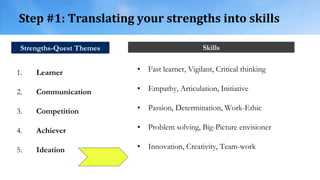
Step #1: Translating your strengths into skills
1. Learner
2. Communication
3. Competition
4. Achiever
5. Ideation
Strengths-Quest Themes Skills
• Fast learner, Vigilant, Critical thinking
• Empathy, Articulation, Initiative
• Passion, Determination, Work-Ethic
• Problem solving, Big-Picture envisioner
• Innovation, Creativity, Team-work
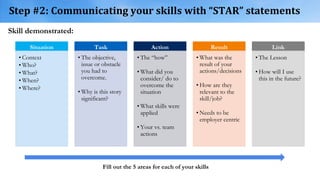
Situation
• Context
• Who?
• What?
• When?
• Where?
Task
• The objective,
issue or obstacle
you had to
overcome.
• Why is this story
significant?
Action
• The “how”
• What did you
consider/ do to
overcome the
situation
• What skills were
applied
• Your vs. team
actions
Result
• What was the
result of your
actions/decisions
• How are they
relevant to the
skill/job?
• Needs to be
employer centric
Link
• The Lesson
• How will I use
this in the future?
Skill demonstrated:
Fill out the 5 areas for each of your skills
Step #2: Communicating your skills with “STAR” statements
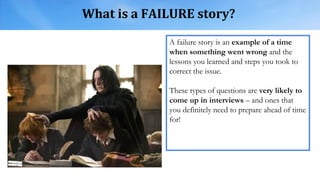
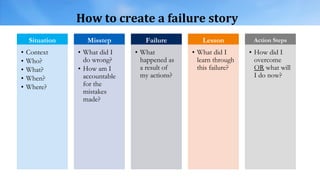
What is a FAILURE story?
A failure story is an example of a time
when something went wrong and the
lessons you learned and steps you took to
correct the issue.
These types of questions are very likely to
come up in interviews – and ones that
you definitely need to prepare ahead of time
for!
How to create a failure story
Situation
• Context
• Who?
• What?
• When?
• Where?
Misstep
• What did I
do wrong?
• How am I
accountable
for the
mistakes
made?
Failure
• What
happened as
a result of
my actions?
Lesson
• What did I
learn through
this failure?
Action Steps
• How did I
overcome
OR what will
I do now?
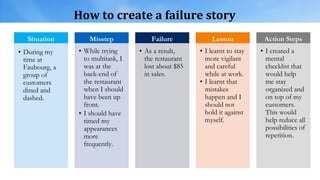
How to create a failure story
Situation
• During my
time at
Faubourg, a
group of
customers
dined and
dashed.
Misstep
• While trying
to multitask, I
was at the
back-end of
the restaurant
when I should
have been up
front.
• I should have
timed my
appearances
more
frequently.
Failure
• As a result,
the restaurant
lost about $85
in sales.
Lesson
• I learnt to stay
more vigilant
and careful
while at work.
• I learnt that
mistakes
happen and I
should not
hold it against
myself.
Action Steps
• I created a
mental
checklist that
would help
me stay
organized and
on top of my
customers.
This would
help reduce all
possibilities of
repetition.
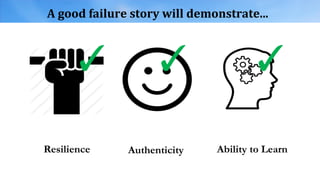
A good failure story will demonstrate...
Resilience Ability to Learn
✓ ✓ ✓
Authenticity
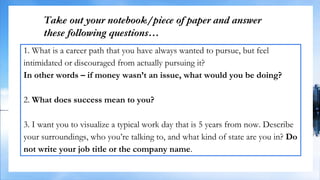
ACTIVITY TIME!
Take out your notebook/piece of paper and answer
these following questions…
1. What is a career path that you have always wanted to pursue, but feel
intimidated or discouraged from actually pursuing it?
In other words – if money wasn’t an issue, what would you be doing?
2. What does success mean to you?
3. I want you to visualize a typical work day that is 5 years from now. Describe
your surroundings, who you’re talking to, and what kind of state are you in? Do
not write your job title or the company name.
Keep this piece of
paper, and we will
revisit it in our
last tutorial.
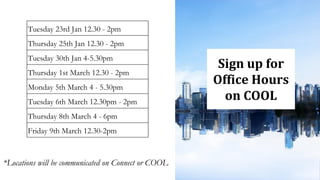
*Locations will be communicated on Connect or COOL
Tuesday 23rd Jan 12.30 - 2pm
Thursday 25th Jan 12.30 - 2pm
Tuesday 30th Jan 4-5.30pm
Thursday 1st March 12.30 - 2pm
Monday 5th March 4 - 5.30pm
Tuesday 6th March 12.30pm - 2pm
Thursday 8th March 4 - 6pm
Friday 9th March 12.30-2pm
Sign up for
Office Hours
on COOL
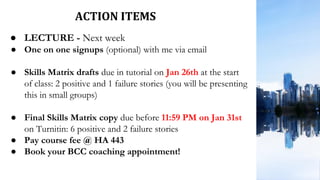
ACTION ITEMS
● LECTURE - Next week
● One on one signups (optional) with me via email
● Skills Matrix drafts due in tutorial on Jan 26th at the start
of class: 2 positive and 1 failure stories (you will be presenting
this in small groups)
● Final Skills Matrix copy due before 11:59 PM on Jan 31st
on Turnitin: 6 positive and 2 failure stories
● Pay course fee @ HA 443
● Book your BCC coaching appointment!
1. Email: comm202.4@sauder.ubc.ca
2. I need your info: please fill out the form
at www.tinyurl.com/202tinder
3. Tutorials: feel free to approach me
before or after
4. Office hours: available throughout the
term as assignments come up (keep
posted!)
Let’s stay in touch! Call me
maybe?
Any Questions?
Thanks for a great
first tutorial!

COMM 202 Tutorial 1 - Term 2

  • 1.
    COMM 202: Career Fundamentals T36& T37 with Natiqa Babar Tutorial 1: Introduction to Skills Matrices
  • 2.
    OUR AGENDA FORTODAY 1. Attendance 2. Getting to know your TA (aka me) 3. Course expectations 4. Putting together a Skills Matrix 5. Activity 6. Action items
  • 3.
    Let’s get someAdmin stuff out of the way! We need your emails to send you reminders! Please go to this link and fill out the information (60 seconds!) Please bring your name cards to tutorial, this is how I will be tracking your attendance and participation! www.tinyurl.com/202tinder
  • 4.
    On the surface 1)Extracurricular involvements 2) Professional work experience
  • 6.
    Below the surface 1)Personality type 2) Interests 3) Stories of failure
  • 7.
    My Personality Assessment StrengthsQuest Learner Communication Competition Achiever Ideation Myers Briggs E N F J - A Extroverted Intuitive Feeling Judging Assertive 1. I am a fast-learner and 2. I like to initiate ideas or conversations 3. Competition gives me a rush 4. I equate satisfaction with productivity 5. I thrive in brainstorming environments 6. I value individuals
  • 8.
    “Success is notfinal, failure is not fatal: it is the courage to continue that counts.” - Winston Churchill
  • 9.
  • 10.
    I know nothing ! Treatthis course like a...
  • 11.
    It’s all aboutProfessionalism •Contributing and sparking in-class discussions •Using proper in-class/email etiquette •Being punctual and prepared for each class •Not using technology during class (unless needed) •NOT plagiarizing 10% of your course mark
  • 12.
    But that doesn’tmean you can’t be yourself! In fact, you should! •It makes you more relatable and likeable •It helps you build trust and form relationships •You’ll be happier and most satisfied in your professional pursuit A girl is no one Jk. A girl is Arya Stark
  • 13.
    Most tutorials, youwill have to prepare one assignment, such as… • Strengths Quest Reflection • Skills Matrix Presentation • LinkedIn Profile • Job Posting Research • Resume/Cover Letter draft Each assignment is worth ~2% for a total of 10% in the course Weekly tutorial assignments Assignments will be collected in the first 5 minutes of class. Most of them will be submitted on Turnitin.
  • 14.
    This class willfeel like a lot, but we’ll get through it together!
  • 15.
    Putting together aSkills Matrix
  • 16.
    What you willneed to do* For the Skills Matrix assignment, you will need to produce two sets of deliverables: 1. 6 positive STAR stories 2. 2 failure stories *Rubric can be found on the COMM 202 blog: Assignments > Skills Matrix > Marking Rubric (bottom of page)
  • 17.
    Why is thisimportant? Week 6 – 8: Cover Letter Week 6 – 8: Resume Week 10 – 12: Interview The Skills Matrix will help you to clearly articulate your experiences and strengths to employers during the application and interview process. It will act as the foundation for the rest of your professional toolkit. Professional toolkit Skills Matrix (positive STAR & failure stories)
  • 18.
    What are STARstories? A positive STAR story is a structured example of a time when you exhibited a personal strength or skill.
  • 19.
    Step #1: Translatingyour strengths into skills 1. Learner 2. Communication 3. Competition 4. Achiever 5. Ideation Strengths-Quest Themes Skills • Fast learner, Vigilant, Critical thinking • Empathy, Articulation, Initiative • Passion, Determination, Work-Ethic • Problem solving, Big-Picture envisioner • Innovation, Creativity, Team-work
  • 20.
    Situation • Context • Who? •What? • When? • Where? Task • The objective, issue or obstacle you had to overcome. • Why is this story significant? Action • The “how” • What did you consider/ do to overcome the situation • What skills were applied • Your vs. team actions Result • What was the result of your actions/decisions • How are they relevant to the skill/job? • Needs to be employer centric Link • The Lesson • How will I use this in the future? Skill demonstrated: Fill out the 5 areas for each of your skills Step #2: Communicating your skills with “STAR” statements
  • 21.
    What is aFAILURE story? A failure story is an example of a time when something went wrong and the lessons you learned and steps you took to correct the issue. These types of questions are very likely to come up in interviews – and ones that you definitely need to prepare ahead of time for!
  • 22.
    How to createa failure story Situation • Context • Who? • What? • When? • Where? Misstep • What did I do wrong? • How am I accountable for the mistakes made? Failure • What happened as a result of my actions? Lesson • What did I learn through this failure? Action Steps • How did I overcome OR what will I do now?
  • 23.
    How to createa failure story Situation • During my time at Faubourg, a group of customers dined and dashed. Misstep • While trying to multitask, I was at the back-end of the restaurant when I should have been up front. • I should have timed my appearances more frequently. Failure • As a result, the restaurant lost about $85 in sales. Lesson • I learnt to stay more vigilant and careful while at work. • I learnt that mistakes happen and I should not hold it against myself. Action Steps • I created a mental checklist that would help me stay organized and on top of my customers. This would help reduce all possibilities of repetition.
  • 24.
    A good failurestory will demonstrate... Resilience Ability to Learn ✓ ✓ ✓ Authenticity
  • 25.
  • 26.
    Take out yournotebook/piece of paper and answer these following questions… 1. What is a career path that you have always wanted to pursue, but feel intimidated or discouraged from actually pursuing it? In other words – if money wasn’t an issue, what would you be doing? 2. What does success mean to you? 3. I want you to visualize a typical work day that is 5 years from now. Describe your surroundings, who you’re talking to, and what kind of state are you in? Do not write your job title or the company name.
  • 27.
    Keep this pieceof paper, and we will revisit it in our last tutorial.
  • 28.
    *Locations will becommunicated on Connect or COOL Tuesday 23rd Jan 12.30 - 2pm Thursday 25th Jan 12.30 - 2pm Tuesday 30th Jan 4-5.30pm Thursday 1st March 12.30 - 2pm Monday 5th March 4 - 5.30pm Tuesday 6th March 12.30pm - 2pm Thursday 8th March 4 - 6pm Friday 9th March 12.30-2pm Sign up for Office Hours on COOL
  • 29.
    ACTION ITEMS ● LECTURE- Next week ● One on one signups (optional) with me via email ● Skills Matrix drafts due in tutorial on Jan 26th at the start of class: 2 positive and 1 failure stories (you will be presenting this in small groups) ● Final Skills Matrix copy due before 11:59 PM on Jan 31st on Turnitin: 6 positive and 2 failure stories ● Pay course fee @ HA 443 ● Book your BCC coaching appointment!
  • 30.
    1. Email: comm202.4@sauder.ubc.ca 2.I need your info: please fill out the form at www.tinyurl.com/202tinder 3. Tutorials: feel free to approach me before or after 4. Office hours: available throughout the term as assignments come up (keep posted!) Let’s stay in touch! Call me maybe?
  • 31.
  • 32.
    Thanks for agreat first tutorial!