

INTERNAL USE ONLY
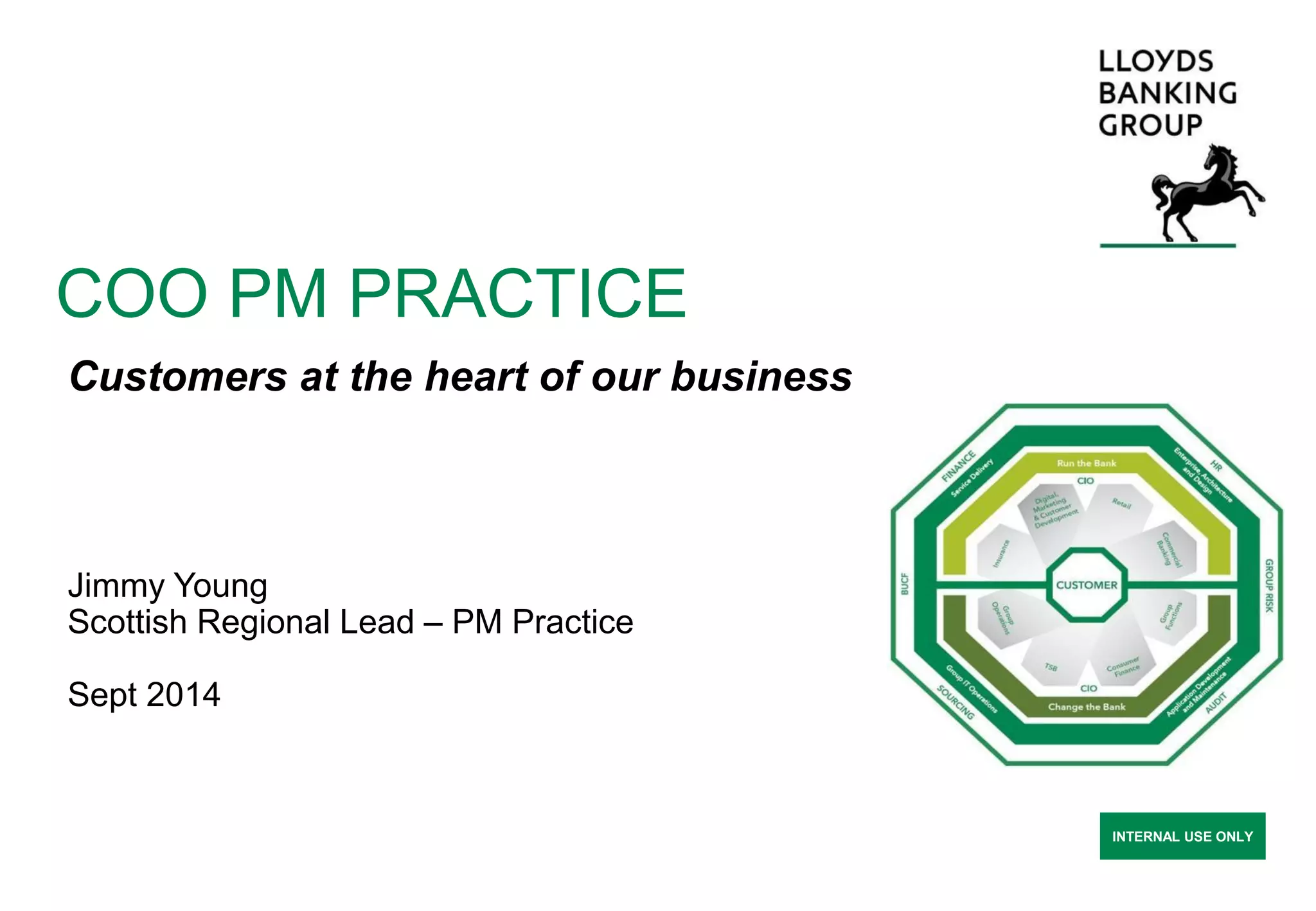
COO PM PRACTICE
Customers at the heart of our business
Jimmy Young
Scottish Regional Lead – PM Practice
Sept 2014
WHAT WE’RE GOING TO COVER
2
Background
Structure
Colleague Engagement
Resilience
SOMETHING SOFT
3
ACCORDING TO MICROSOFT – SOMETHING SOFT
4
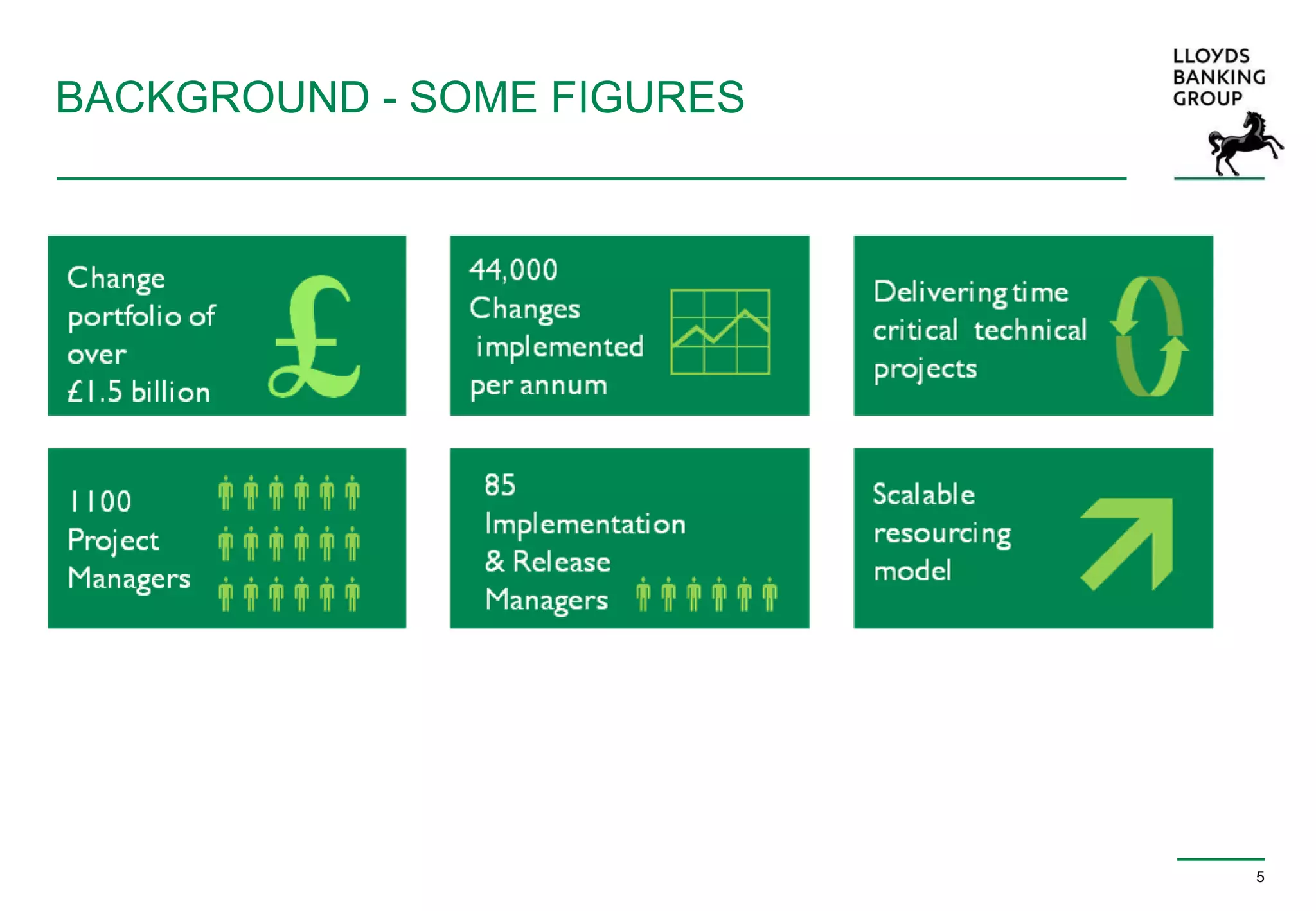
BACKGROUND - SOME FIGURES
5
6
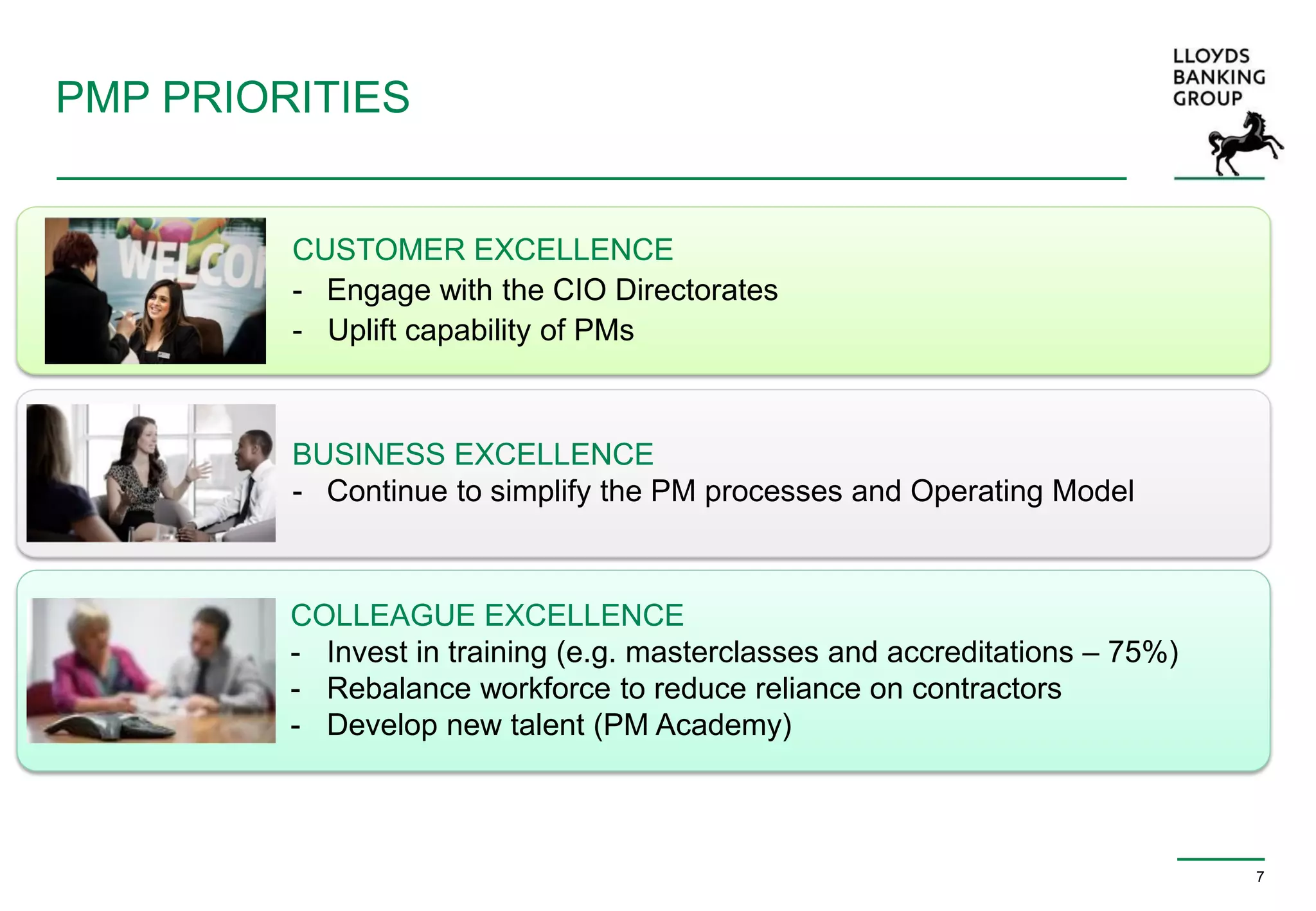
PMP PRIORITIES
7
CUSTOMER EXCELLENCE
- Engage with the CIO Directorates
- Uplift capability of PMs
BUSINESS EXCELLENCE
- Continue to simplify the PM processes and Operating Model
COLLEAGUE EXCELLENCE
- Invest in training (e.g. masterclasses and accreditations – 75%)
- Rebalance workforce to reduce reliance on contractors
- Develop new talent (PM Academy)
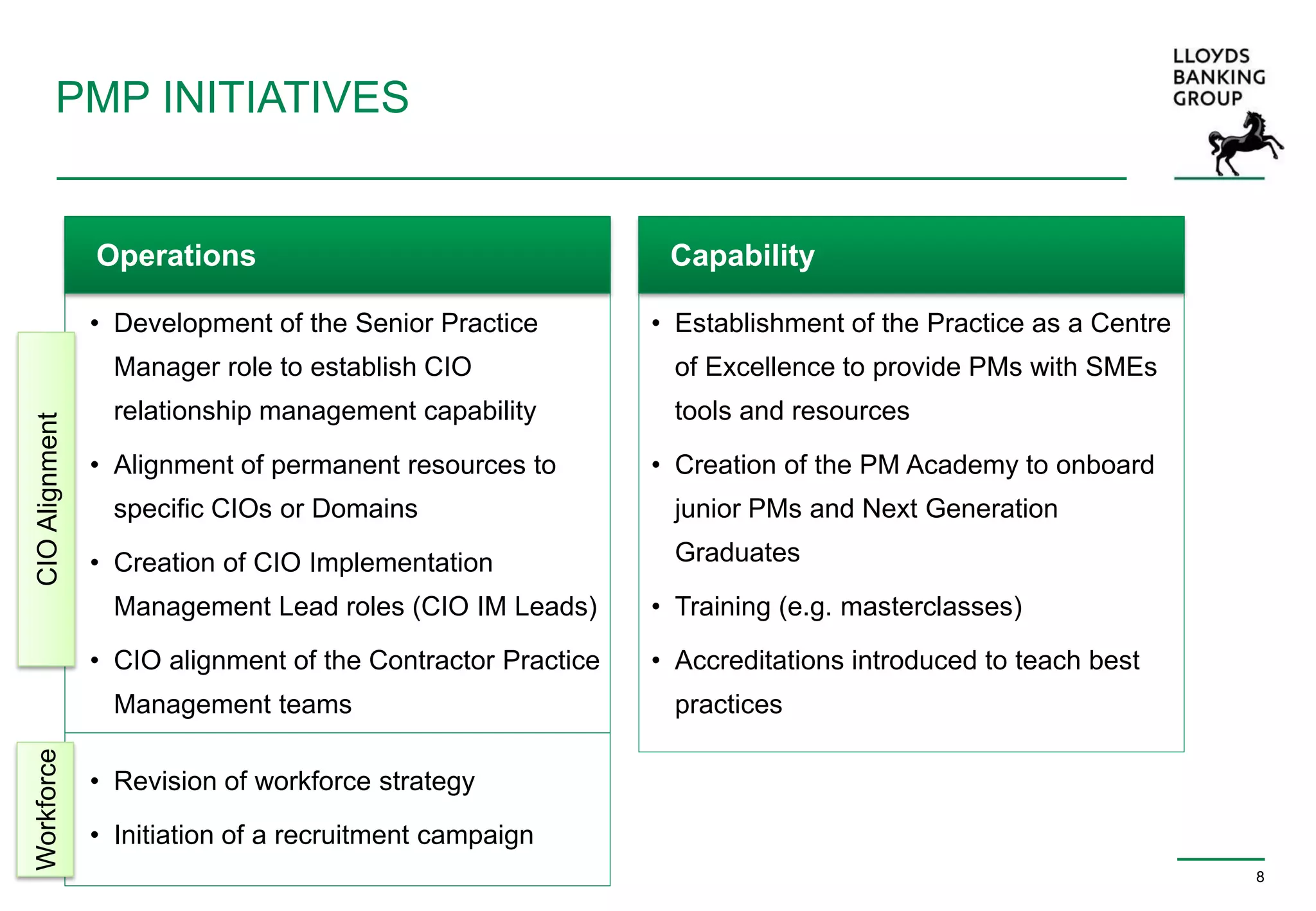
• Development of the Senior Practice
Manager role to establish CIO
relationship management capability
• Alignment of permanent resources to
specific CIOs or Domains
• Creation of CIO Implementation
Management Lead roles (CIO IM Leads)
• CIO alignment of the Contractor Practice
Management teams
PMP INITIATIVES
8
• Establishment of the Practice as a Centre
of Excellence to provide PMs with SMEs
tools and resources
• Creation of the PM Academy to onboard
junior PMs and Next Generation
Graduates
• Training (e.g. masterclasses)
• Accreditations introduced to teach best
practices
CIOAlignment
CapabilityOperations
Workforce
• Revision of workforce strategy
• Initiation of a recruitment campaign
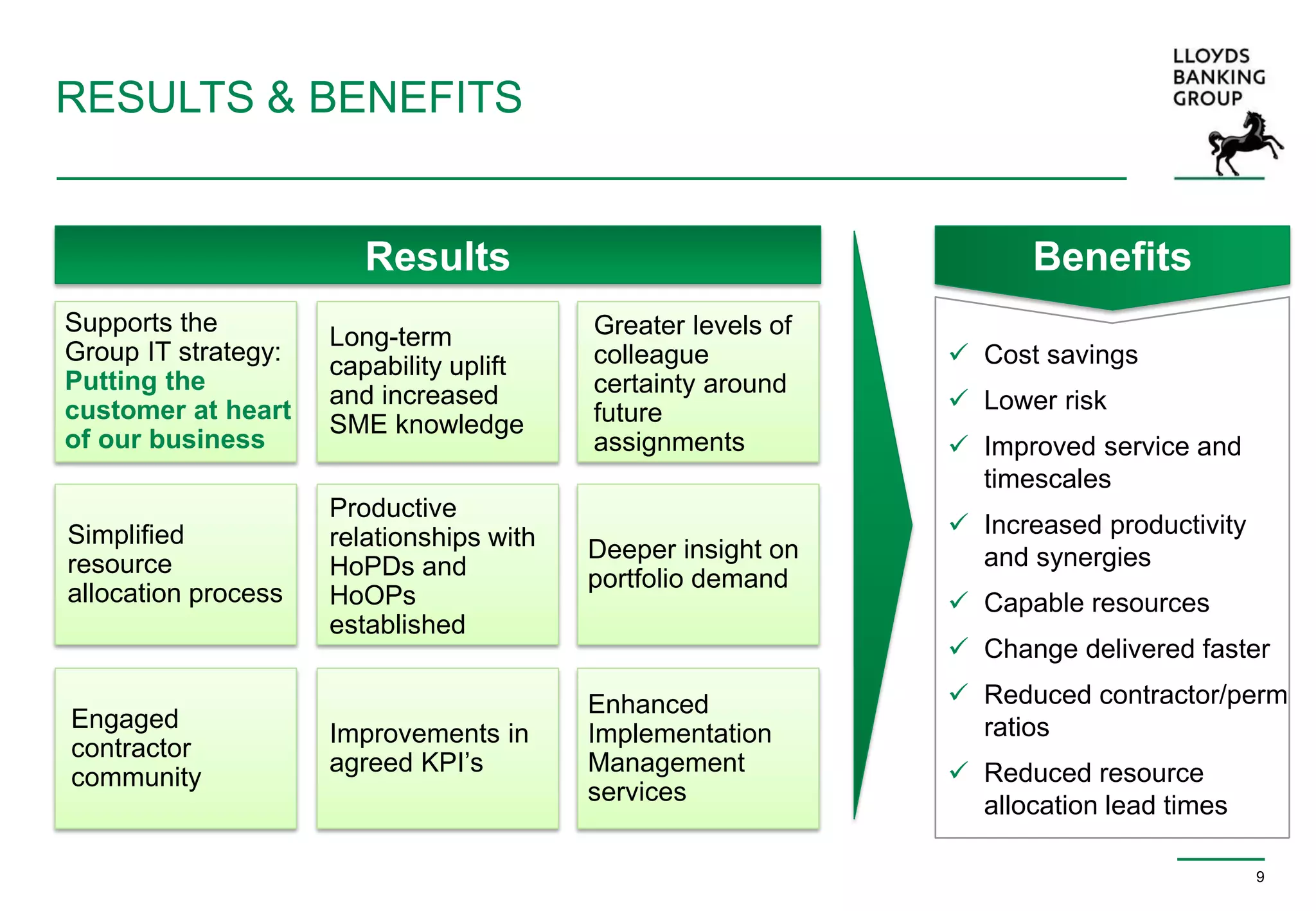
RESULTS & BENEFITS
9
Benefits
Supports the
Group IT strategy:
Putting the
customer at heart
of our business
Long-term
capability uplift
and increased
SME knowledge
 Cost savings
 Lower risk
 Improved service and
timescales
 Increased productivity
and synergies
 Capable resources
 Change delivered faster
 Reduced contractor/perm
ratios
 Reduced resource
allocation lead times
Improvements in
agreed KPI’s
Productive
relationships with
HoPDs and
HoOPs
established
Deeper insight on
portfolio demand
Greater levels of
colleague
certainty around
future
assignments
Enhanced
Implementation
Management
services
Simplified
resource
allocation process
Engaged
contractor
community
Results
COLLEAGUE ENGAGEMENT
10
• Regular surveys / Healthchecks
• Change initiatives driven by colleagues
• Recognise
• Small things matter
• D2MAD
• Work life balance
• Resilience
Resilience
Page 12
Disclaimer
All content in this presentation and within the HR Health & Wellbeing site is provided for
general information only and should not be treated as a substitute for the medical advice
of your own doctor or any other healthcare professional.
Lloyds Banking Group is not responsible or liable for any diagnosis made by a user
based on this content.
Lloyds Banking Group is not liable for the contents of any external internet sites listed,
nor does it endorse any commercial product or service mentioned or advised on any of
the sites .
Always consult your own GP if you’re in any way concerned about your health or an
independent financial adviser if you are concerned about your finances.
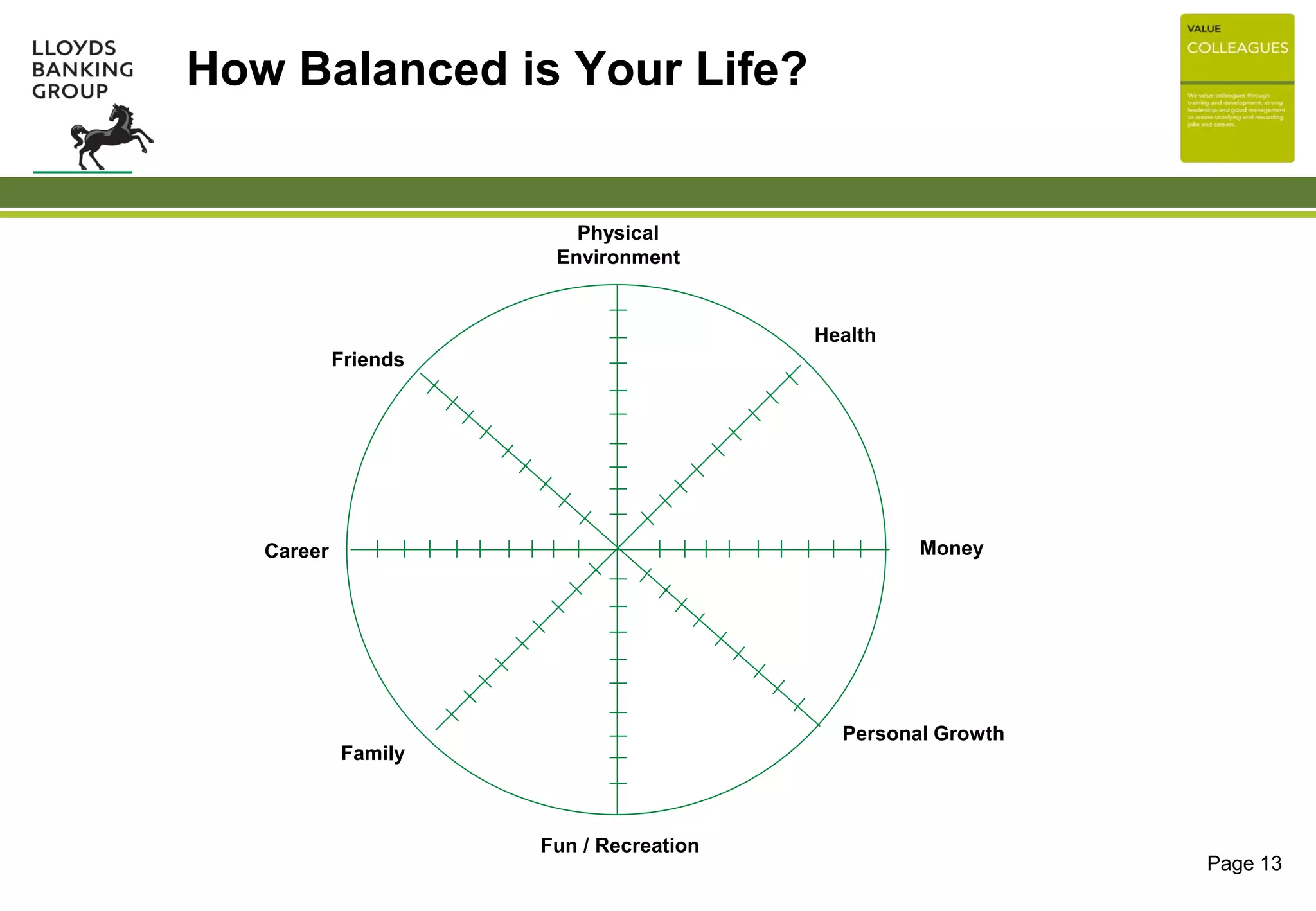
How Balanced is Your Life?
Physical
Environment
Health
Money
Personal Growth
Fun / Recreation
Family
Career
Friends
Page 13
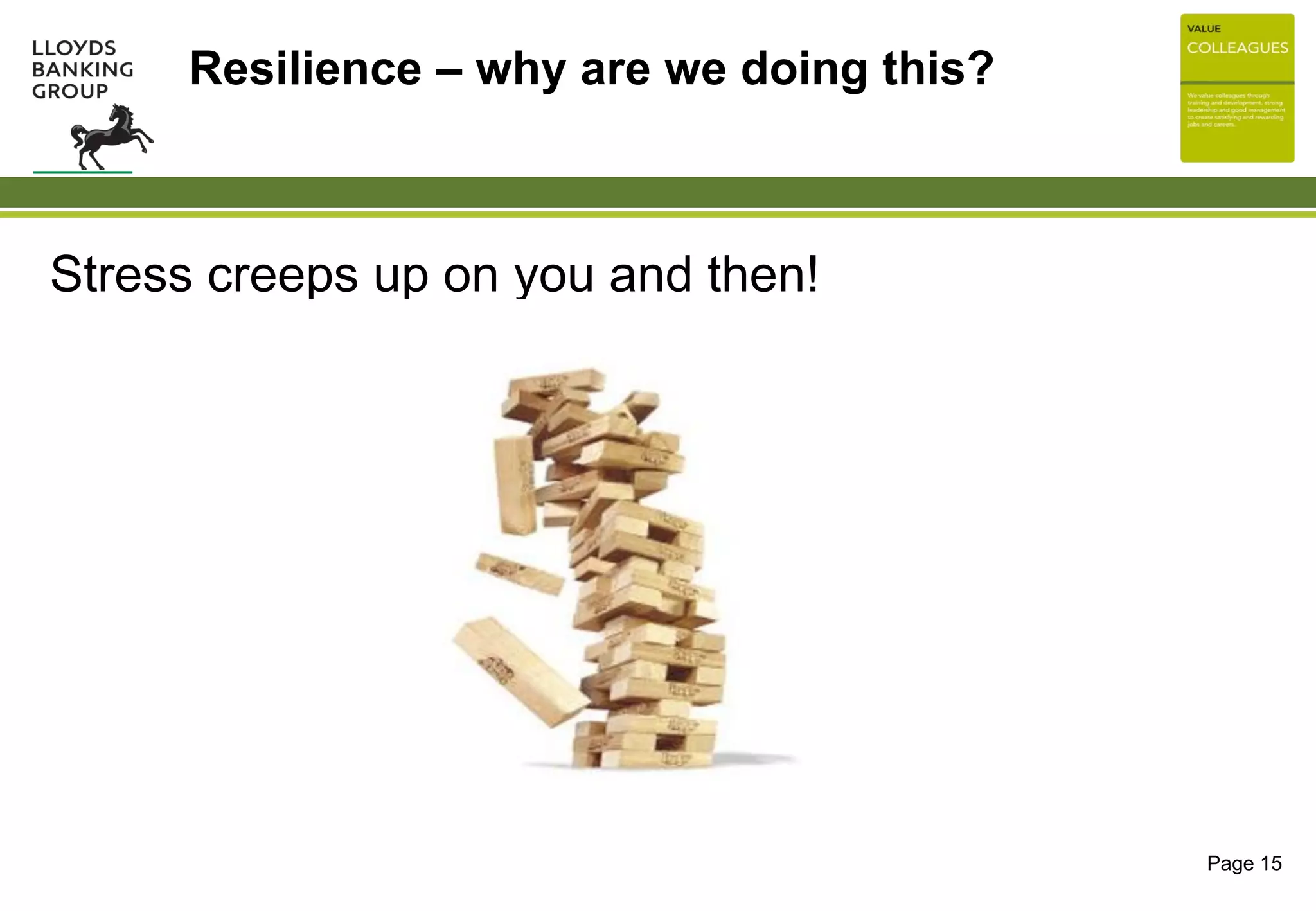
Resilience – why are we doing this?
Page 14
• We want to look after you and have you look after yourself
• We want you to look out for your family and colleagues
• We want to de-stigmatize “Stress”
• We want you to say no if you are doing too much
Resilience – why are we doing this?
Page 15
Stress creeps up on you and then!
“Resilience is the long-term capacity of an individual to
deal with change and continue to develop.”
 Stockholm Resilience Centre
Page 16
What is Resilience?
Resilience is the ability to:
 Bounce back
 Take on difficult challenges
 Respond positively to difficult situations
 Rise above adversity
 Cope when things look difficult
 Have a more positive outlook when faced with challenging situations
 Transform unfavourable situations into wisdom, insight, and compassion
Page 17
 Integration
 TSB
 Simplification
 Customer First
And not least
 Technology
 Keeping the show on the road
Our Achievements
Page 18
 Decision making always difficult
 Leaders do not have all the answers
 Time and information is not always available
 Being asked to do more with less
 Pace and volume of work to remain high
 Company / customer expectations are higher
 Technology prevalent
– Always available
– Information overload
 Ongoing pressure of needing to balance life with work
In continuing to deliver, we also need to get the next piece right..
 There is a sense of purpose – Who we are and what we stand for
 Meaningful fulfilling work, which gets the best out of our people
 We develop our people and actively managing our talent
 We focus on the right things – at work and in life
Our Achievements
High quality outcomes at pace is the expectation we have
set, but there are some realities we must manage…
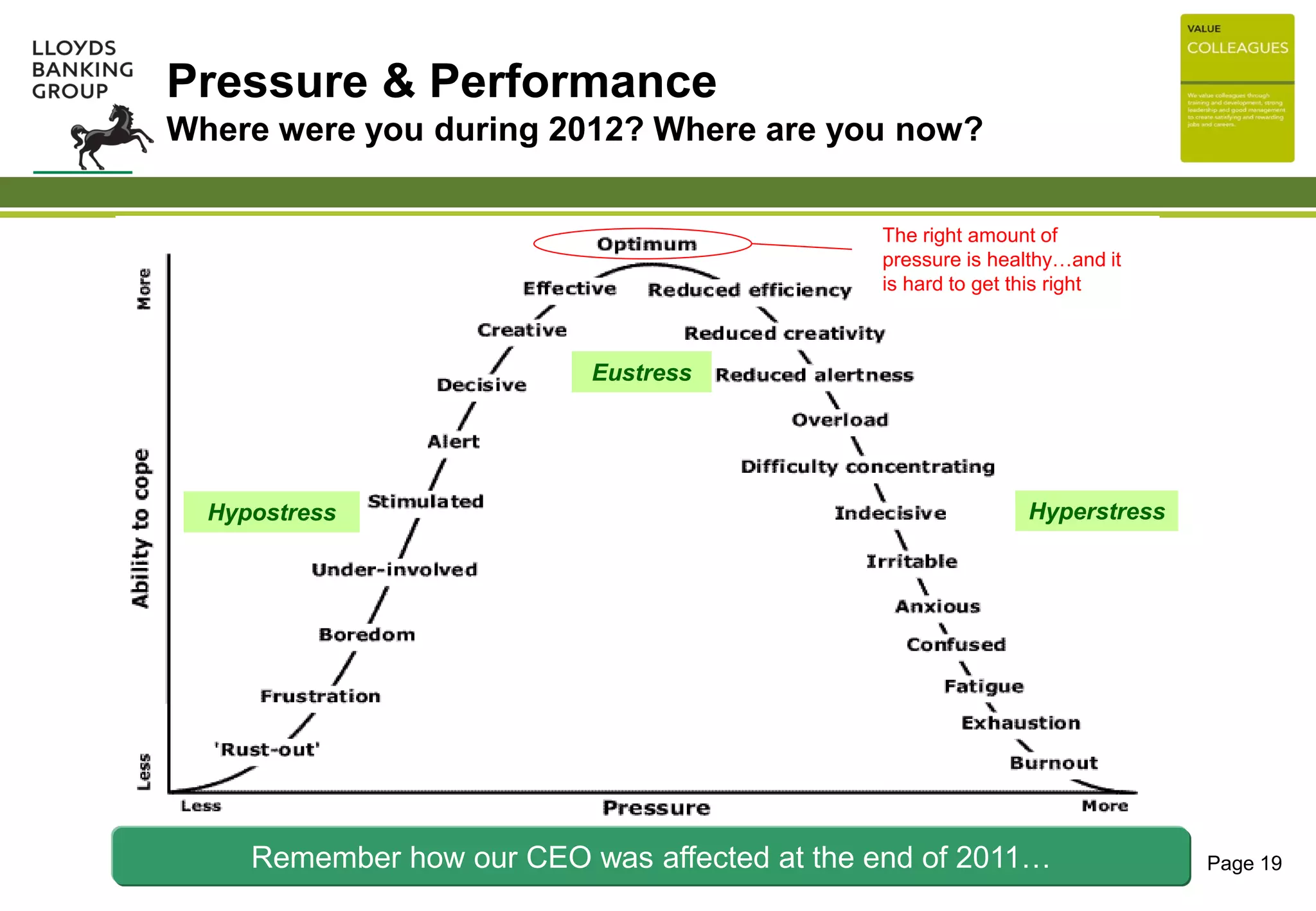
Pressure & Performance
Where were you during 2012? Where are you now?
Page 19Remember how our CEO was affected at the end of 2011…
Hypostress
Eustress
Hyperstress
The right amount of
pressure is healthy…and it
is hard to get this right
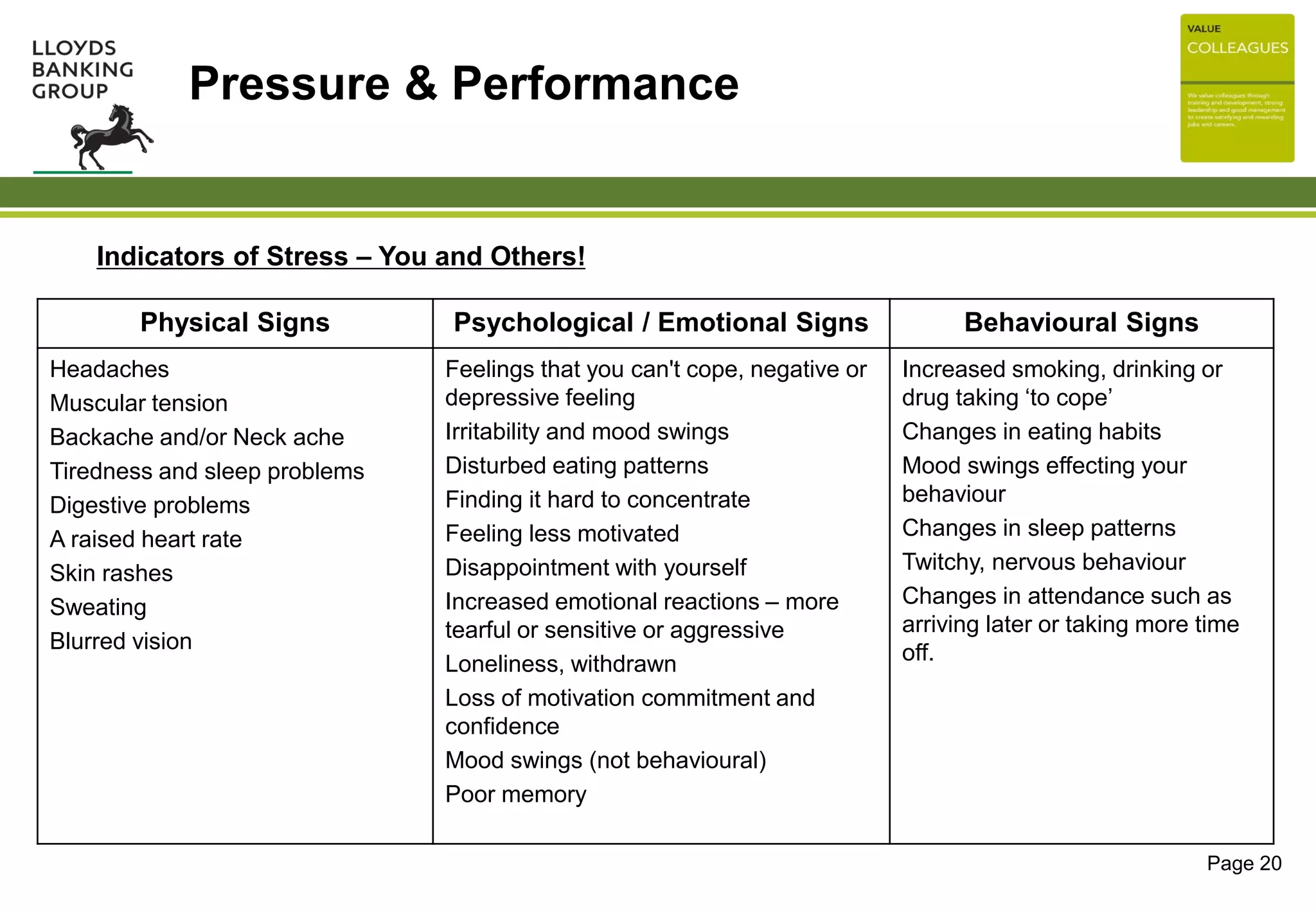
Page 20
Pressure & Performance
Indicators of Stress – You and Others!
Physical Signs Psychological / Emotional Signs Behavioural Signs
Headaches
Muscular tension
Backache and/or Neck ache
Tiredness and sleep problems
Digestive problems
A raised heart rate
Skin rashes
Sweating
Blurred vision
Feelings that you can't cope, negative or
depressive feeling
Irritability and mood swings
Disturbed eating patterns
Finding it hard to concentrate
Feeling less motivated
Disappointment with yourself
Increased emotional reactions – more
tearful or sensitive or aggressive
Loneliness, withdrawn
Loss of motivation commitment and
confidence
Mood swings (not behavioural)
Poor memory
Increased smoking, drinking or
drug taking ‘to cope’
Changes in eating habits
Mood swings effecting your
behaviour
Changes in sleep patterns
Twitchy, nervous behaviour
Changes in attendance such as
arriving later or taking more time
off.
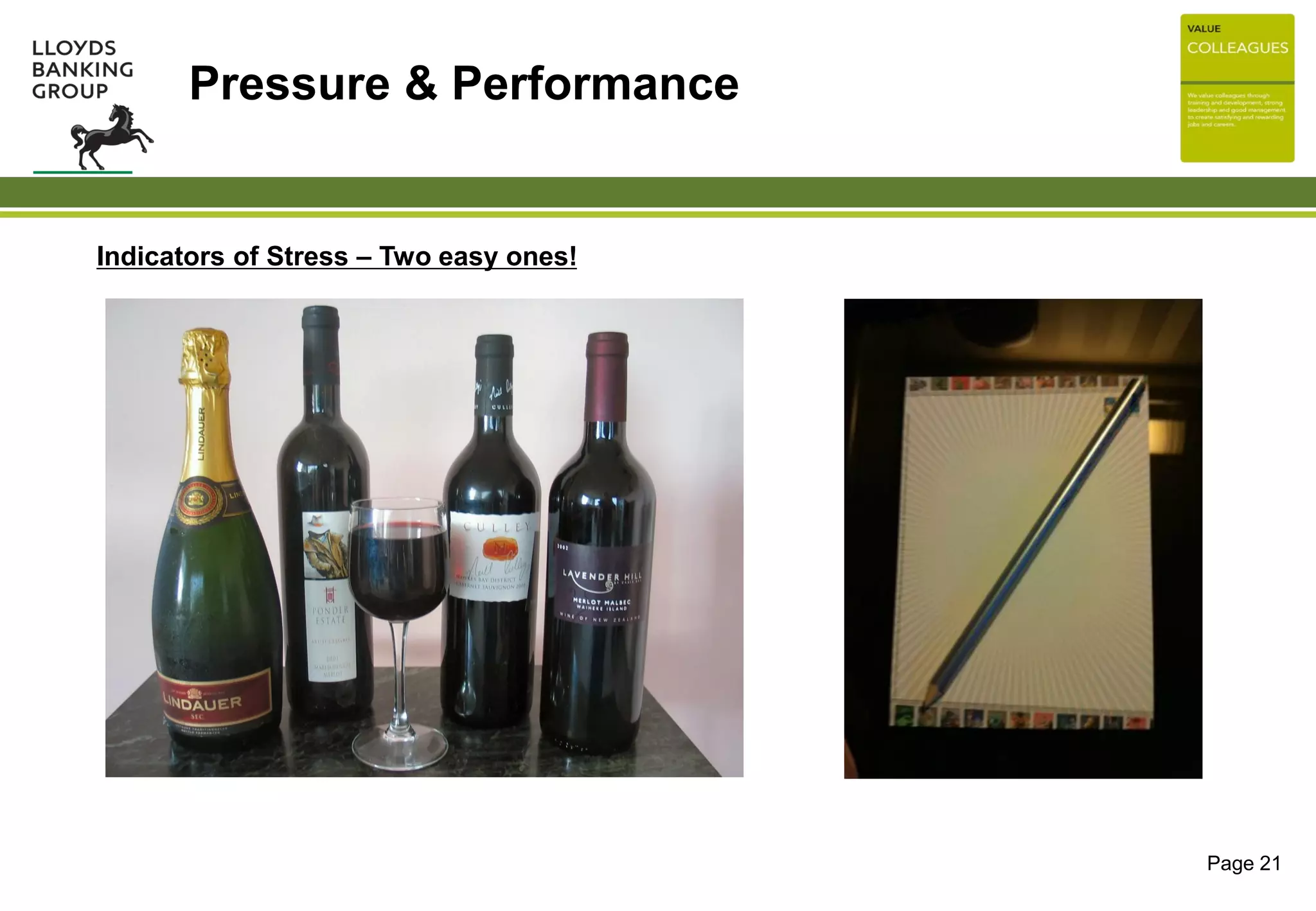
Page 21
Pressure & Performance
Indicators of Stress – Two easy ones!
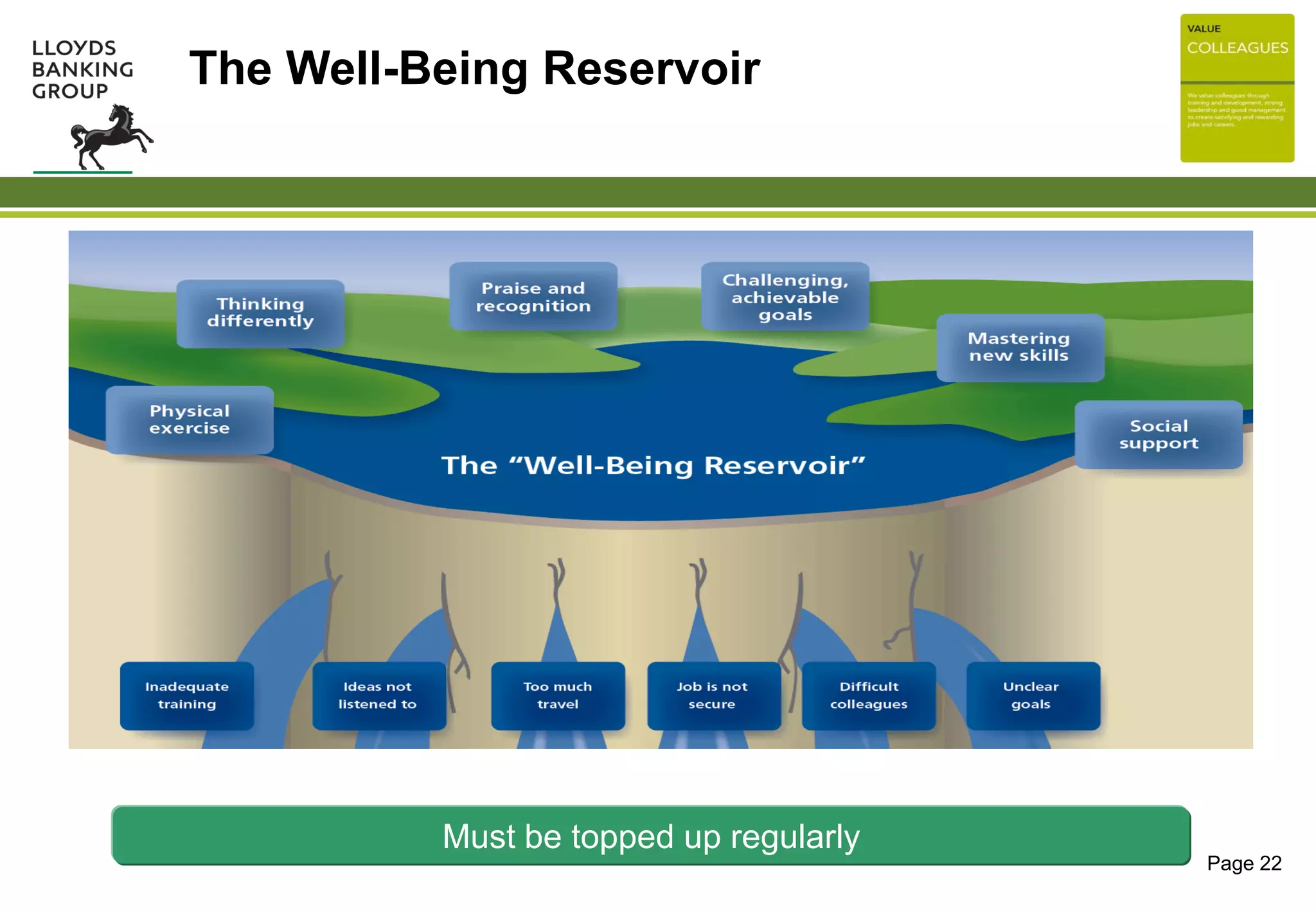
Must be topped up regularly
Page 22
The Well-Being Reservoir
Taken from www.robertsoncooper.com/well-being-resources-hub
Page 23
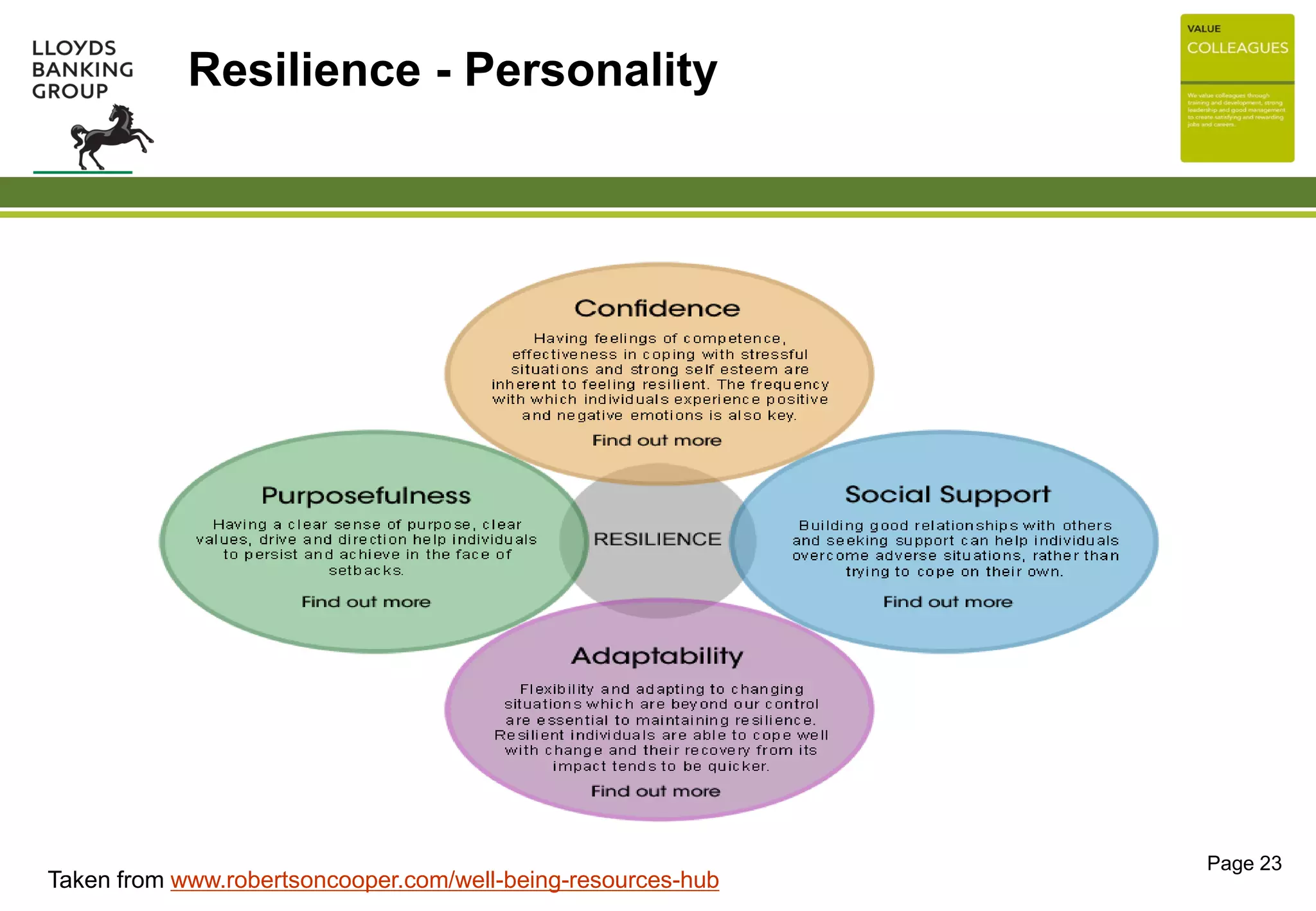
Resilience - Personality
Taken from www.robertsoncooper.com/well-being-resources-hub
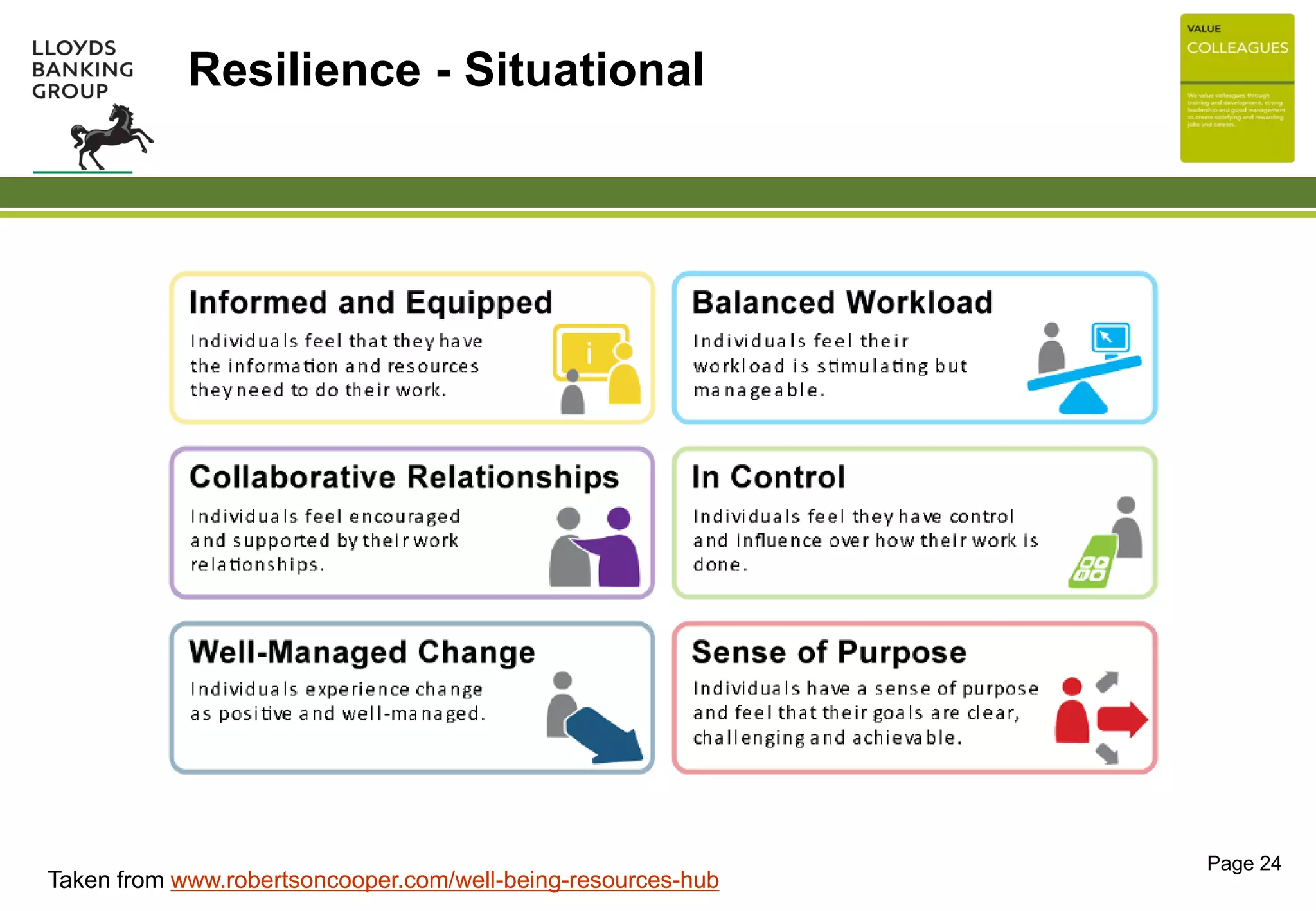
Page 24
Resilience - Situational
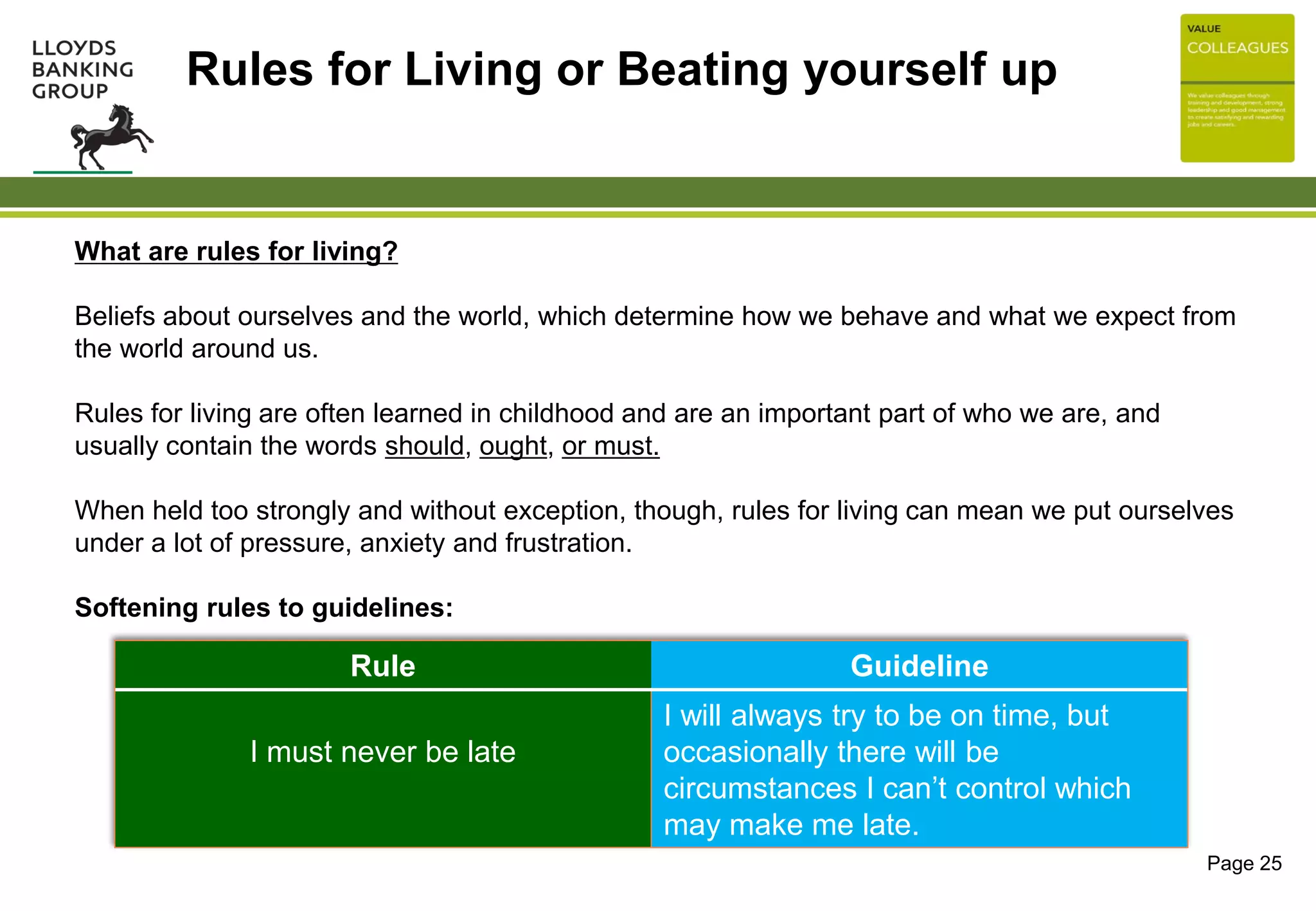
What are rules for living?
Beliefs about ourselves and the world, which determine how we behave and what we expect from
the world around us.
Rules for living are often learned in childhood and are an important part of who we are, and
usually contain the words should, ought, or must.
When held too strongly and without exception, though, rules for living can mean we put ourselves
under a lot of pressure, anxiety and frustration.
Softening rules to guidelines:
Rule Guideline
I must never be late
I will always try to be on time, but
occasionally there will be
circumstances I can’t control which
may make me late.
Page 25
Rules for Living or Beating yourself up
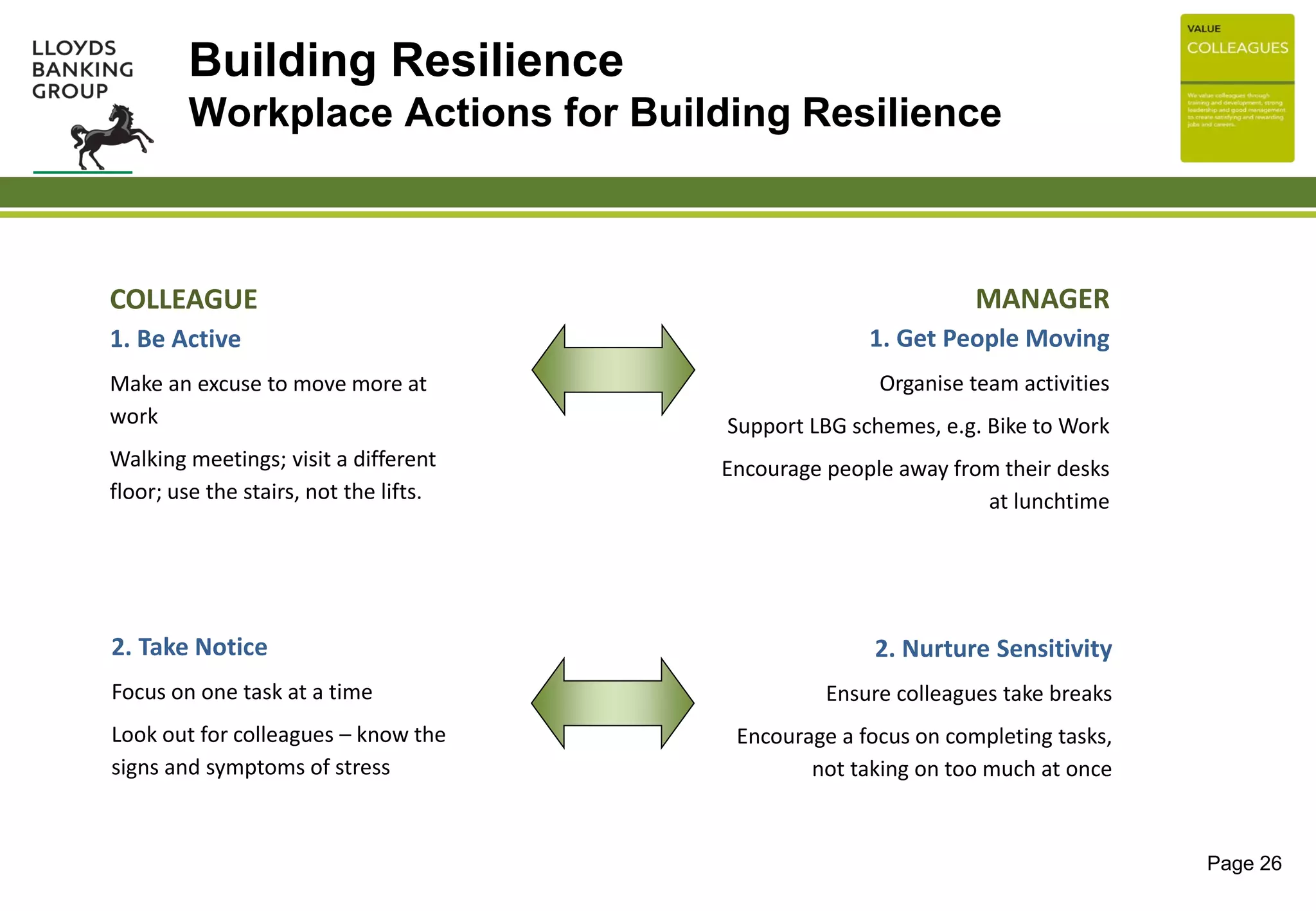
Building Resilience
Workplace Actions for Building Resilience
Page 26
COLLEAGUE
1. Be Active
Make an excuse to move more at
work
Walking meetings; visit a different
floor; use the stairs, not the lifts.
MANAGER
1. Get People Moving
Organise team activities
Support LBG schemes, e.g. Bike to Work
Encourage people away from their desks
at lunchtime
2. Take Notice
Focus on one task at a time
Look out for colleagues – know the
signs and symptoms of stress
2. Nurture Sensitivity
Ensure colleagues take breaks
Encourage a focus on completing tasks,
not taking on too much at once
Page 27
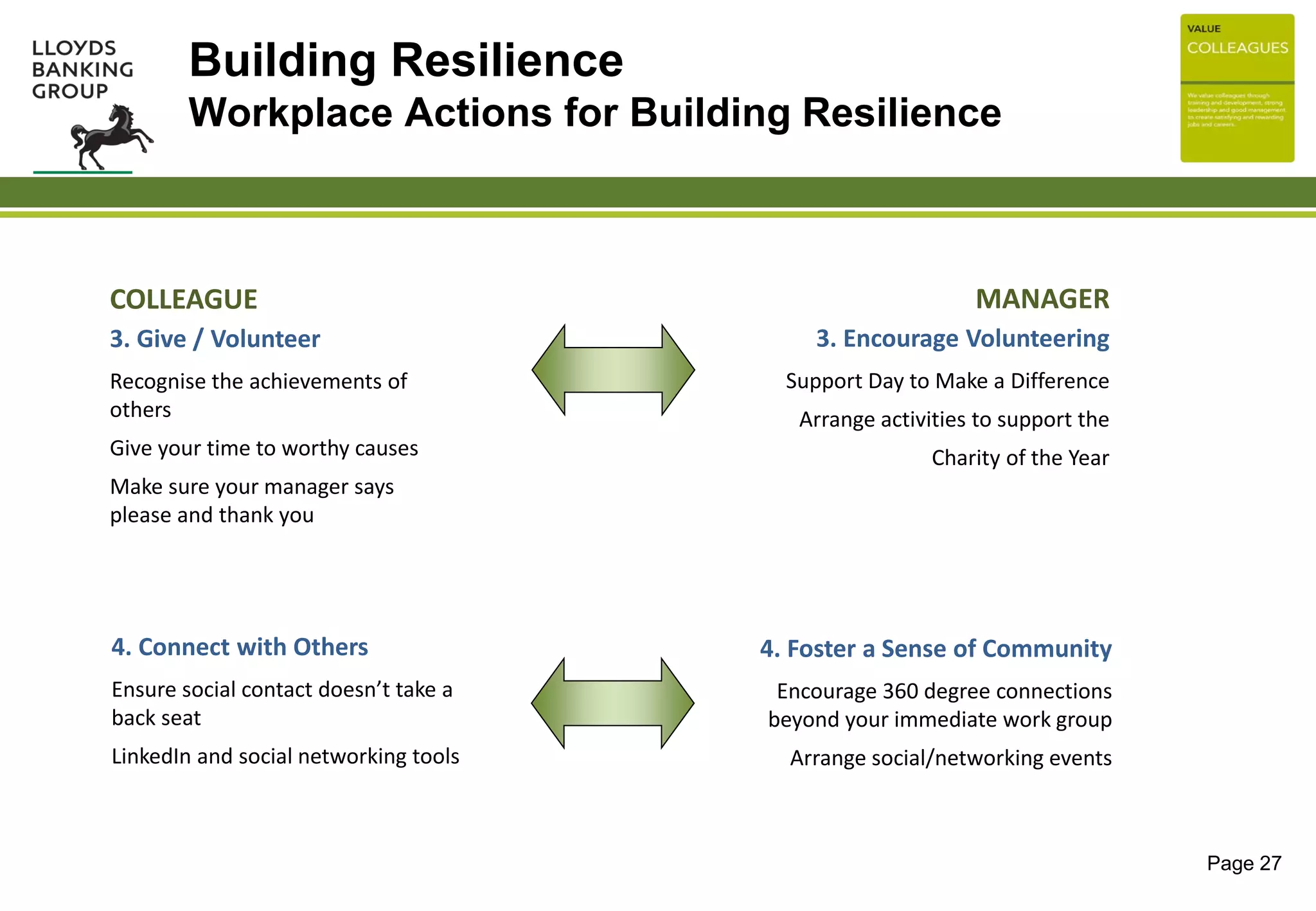
COLLEAGUE
3. Give / Volunteer
Recognise the achievements of
others
Give your time to worthy causes
Make sure your manager says
please and thank you
MANAGER
3. Encourage Volunteering
Support Day to Make a Difference
Arrange activities to support the
Charity of the Year
4. Connect with Others
Ensure social contact doesn’t take a
back seat
LinkedIn and social networking tools
4. Foster a Sense of Community
Encourage 360 degree connections
beyond your immediate work group
Arrange social/networking events
Building Resilience
Workplace Actions for Building Resilience
Page 28
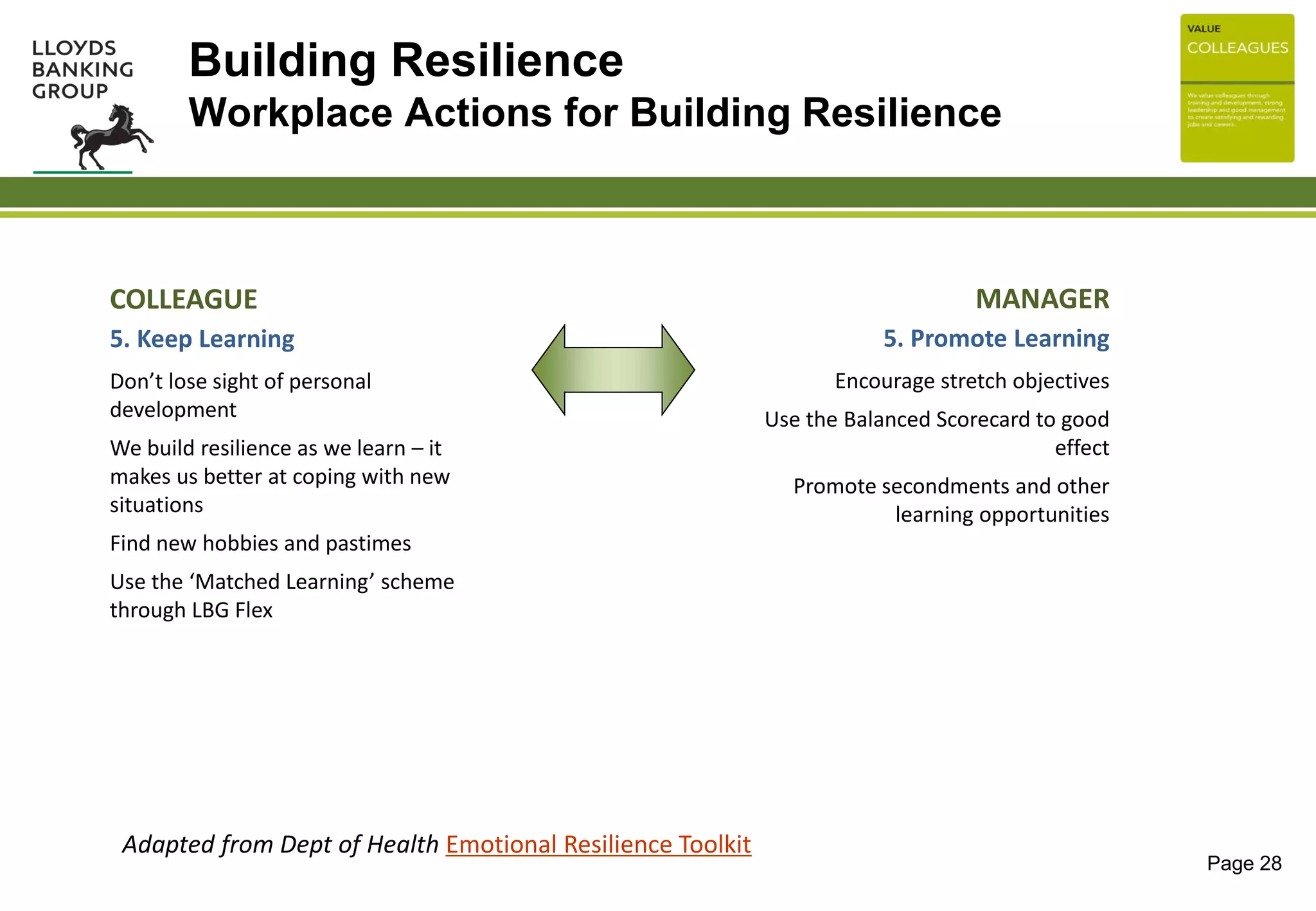
COLLEAGUE
5. Keep Learning
Don’t lose sight of personal
development
We build resilience as we learn – it
makes us better at coping with new
situations
Find new hobbies and pastimes
Use the ‘Matched Learning’ scheme
through LBG Flex
MANAGER
5. Promote Learning
Encourage stretch objectives
Use the Balanced Scorecard to good
effect
Promote secondments and other
learning opportunities
Building Resilience
Workplace Actions for Building Resilience
Adapted from Dept of Health Emotional Resilience Toolkit
Page 29
1. Talk to someone. Communication is important, whether it’s with a friend, family member or
counsellor. Communication enables you to release tension rather than keep it inside.
2. Improve your self-esteem. Self-esteem is the way you feel about yourself. Lots of things can lower our
self-esteem, such as a relationship break-up, not getting the job you wanted or putting on weight. None
of these things makes us worth less, but it can feel that way. The best way to improve your self-esteem is
to treat yourself as you would treat a valued friend, i.e. in a positive but honest way. Notice when you’re
putting yourself down. Tell yourself something positive instead.
3. Manage your stress levels. Being in a stressed state of mind a lot of the time can make it easier for
you to overreact or feel negative compared to someone who is relaxed.
Managing your stress can be a gradual process. Look at your lifestyle. If you have a lot of stress in your
life, find ways to reduce it, such as asking your partner to help with chores in the house, taking a relaxing
yoga class, or talking to your boss about changing your working hours. Introduce regular exercise and
time to yourself. These are positive changes. Taking control of your time in this way can
effectively reduce stress.
If you have anxiety with stress, breathing exercises can help.
Building Resilience
Personal Actions for Building Emotional Resilience
Page 30
4. Enjoy yourself. Doing things that you enjoy is good for your emotional health. Watching sports with a
friend, having a soak in the bath, or meeting up with friends for coffee are examples of small activities
that can improve your day. Avoid things that seem enjoyable at the time but make you feel worse
afterwards, such as alcohol, or clothes shopping if you’re on a tight budget.
5. Limit your alcohol intake. You don’t have to give up alcohol completely to be emotionally resilient,
but avoid drinking more than the recommended limit.
6. Choose a well-balanced diet
Making healthy choices about your diet can make you feel emotionally stronger. You’re doing something
positive for yourself, which lifts your self-esteem, and a good diet enables your brain and body to work
efficiently.
7. Do exercise
Even moderate exercise releases chemicals in your brain that lift your mood. It can help you to sleep
better, have more energy and keep your heart healthy.
Building Resilience
Personal Actions for Building Emotional Resilience
Page 31
8. Get enough sleep
Make sure that you make sleep a priority. Some people find this very hard at certain times in their lives,
for example, new parents and those working shifts. Ask your partner or a family member to help you so
that you can catch up on sleep.
9. Develop good relationships
Our relationships are part of who we are and how we feel. Think about your relationships with family,
friends, your partner. Do they have your best interests at heart? Do you enjoy their company? Are you
happy with the way you act towards them? Start to think about how you can improve your relationships,
then make little changes.“
10. Know the warning signs
Try to recognise when negative emotions start creeping in, whether it’s stress, anxiety or feeling sad.
When you know the warning signs you can do the things that you know will help. For example, a good
chat with a close friend or some relaxing breathing exercises.
Adapted from NHS Choices – Build up your Emotional Resilience
Building Resilience
Personal Actions for Building Emotional Resilience
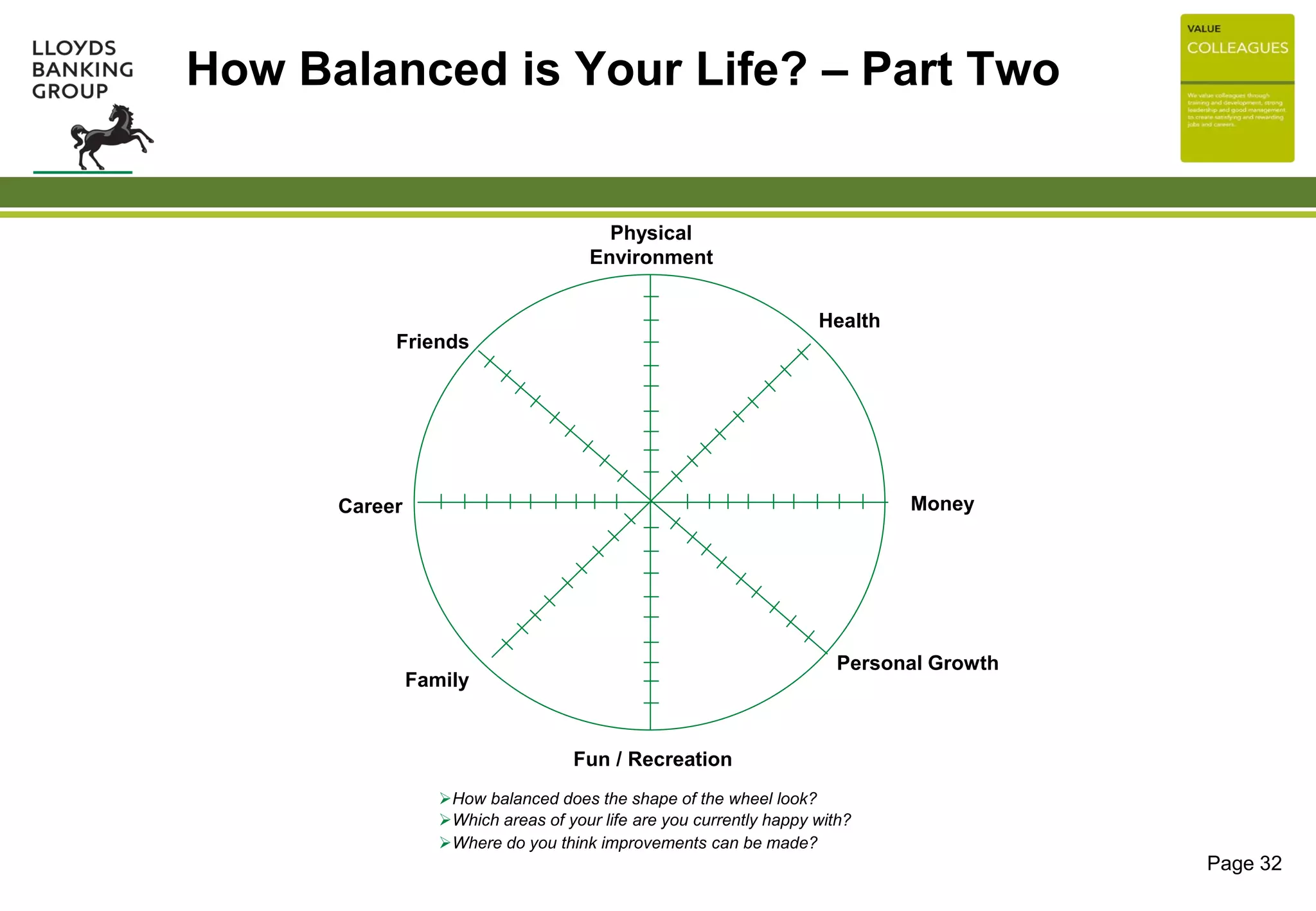
How Balanced is Your Life? – Part Two
Physical
Environment
Health
Money
Personal Growth
Fun / Recreation
Family
Career
Friends
How balanced does the shape of the wheel look?
Which areas of your life are you currently happy with?
Where do you think improvements can be made?
Page 32
Top Ten Quick Wins
1. Get a personal mobile and switch the Blackberry off when you leave work and at
weekends
2. Switch off you email notifications and schedule email time each day
3. Schedule time for your housekeeping – ART, training, BEN, etc and stick to it
4. Schedule meetings to be 50 mins - allows you to get a coffee / move between
rooms
5. Schedule lunch breaks and keep them – move them but keep them
6. Learn to say thank you to colleagues and friends
7. Learn to put your hand up and say you are too busy
8. Make sure you have someone you can talk to – at work / home / friend
9. Remember its easy to fix something before it breaks
10. Remember what its like to laugh and try it
Closing thoughts
Keep in View…
 Find your balance – everyone is different
 Make time for yourself to explore interests outside work
 Take regular exercise
 Friends & family are important
 Write your own obituary
 Don’t overload yourself – learn to push back when necessary
 Recognise when you need help and know it is fine to ask
 Everything doesn’t have to be perfect…
 Challenge your thinking
 It’s ok to fail occasionally – don’t put yourself down
 Create a healthy relationship with your line manager and peers
– we should be looking out for one another
Page 34
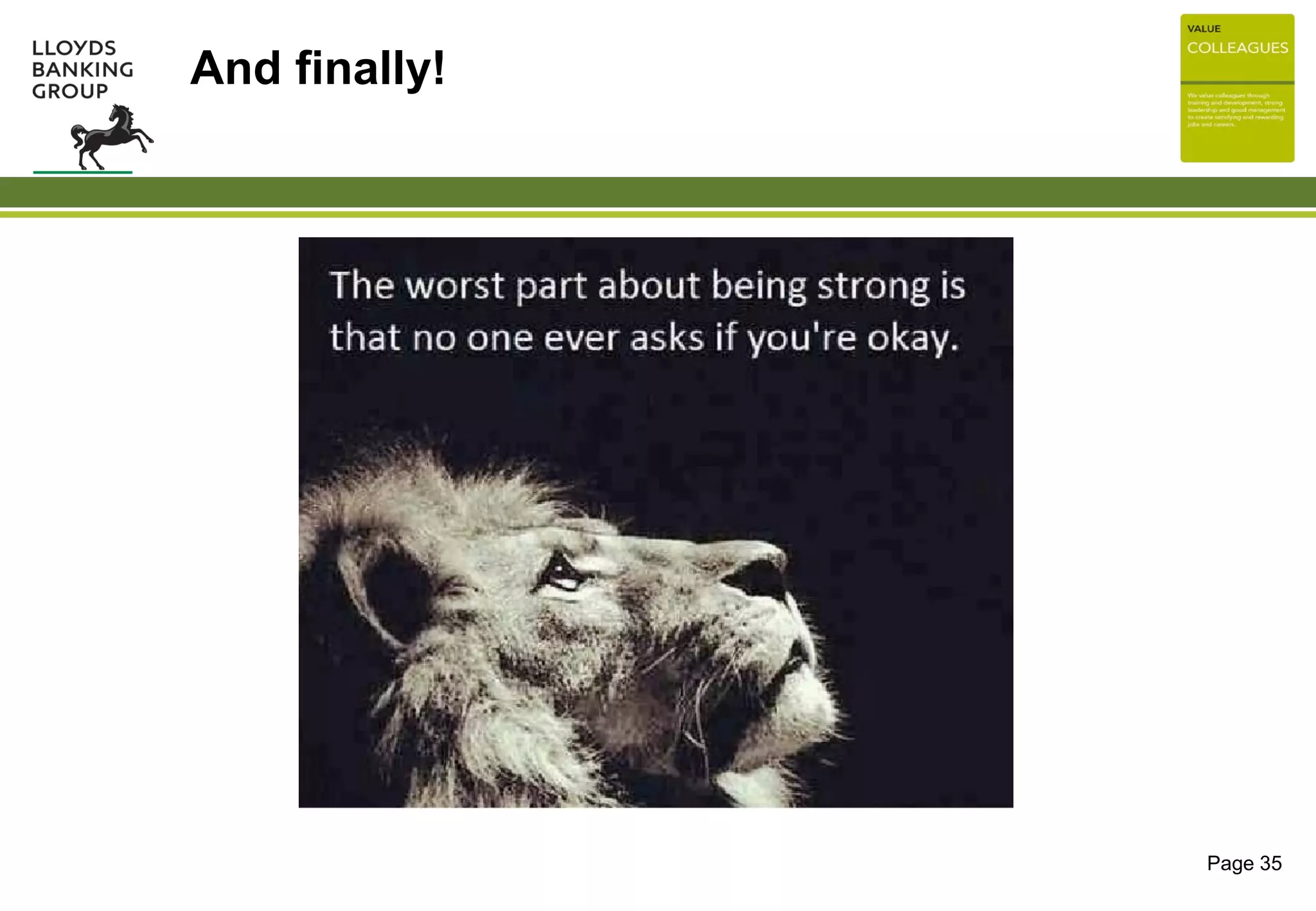
And finally!
Page 35
This presentation was delivered at
an APM event
To find out more about upcoming
events please visit our website
www.apm.org.uk/events

Building a resilient PM practice in Lloyds Banking Group

  • 1.
    INTERNAL USE ONLY COOPM PRACTICE Customers at the heart of our business Jimmy Young Scottish Regional Lead – PM Practice Sept 2014
  • 2.
    WHAT WE’RE GOINGTO COVER 2 Background Structure Colleague Engagement Resilience
  • 3.
  • 4.
    ACCORDING TO MICROSOFT– SOMETHING SOFT 4
  • 5.
  • 6.
  • 7.
    PMP PRIORITIES 7 CUSTOMER EXCELLENCE -Engage with the CIO Directorates - Uplift capability of PMs BUSINESS EXCELLENCE - Continue to simplify the PM processes and Operating Model COLLEAGUE EXCELLENCE - Invest in training (e.g. masterclasses and accreditations – 75%) - Rebalance workforce to reduce reliance on contractors - Develop new talent (PM Academy)
  • 8.
    • Development ofthe Senior Practice Manager role to establish CIO relationship management capability • Alignment of permanent resources to specific CIOs or Domains • Creation of CIO Implementation Management Lead roles (CIO IM Leads) • CIO alignment of the Contractor Practice Management teams PMP INITIATIVES 8 • Establishment of the Practice as a Centre of Excellence to provide PMs with SMEs tools and resources • Creation of the PM Academy to onboard junior PMs and Next Generation Graduates • Training (e.g. masterclasses) • Accreditations introduced to teach best practices CIOAlignment CapabilityOperations Workforce • Revision of workforce strategy • Initiation of a recruitment campaign
  • 9.
    RESULTS & BENEFITS 9 Benefits Supportsthe Group IT strategy: Putting the customer at heart of our business Long-term capability uplift and increased SME knowledge  Cost savings  Lower risk  Improved service and timescales  Increased productivity and synergies  Capable resources  Change delivered faster  Reduced contractor/perm ratios  Reduced resource allocation lead times Improvements in agreed KPI’s Productive relationships with HoPDs and HoOPs established Deeper insight on portfolio demand Greater levels of colleague certainty around future assignments Enhanced Implementation Management services Simplified resource allocation process Engaged contractor community Results
  • 10.
    COLLEAGUE ENGAGEMENT 10 • Regularsurveys / Healthchecks • Change initiatives driven by colleagues • Recognise • Small things matter • D2MAD • Work life balance • Resilience
  • 11.
  • 12.
    Page 12 Disclaimer All contentin this presentation and within the HR Health & Wellbeing site is provided for general information only and should not be treated as a substitute for the medical advice of your own doctor or any other healthcare professional. Lloyds Banking Group is not responsible or liable for any diagnosis made by a user based on this content. Lloyds Banking Group is not liable for the contents of any external internet sites listed, nor does it endorse any commercial product or service mentioned or advised on any of the sites . Always consult your own GP if you’re in any way concerned about your health or an independent financial adviser if you are concerned about your finances.
  • 13.
    How Balanced isYour Life? Physical Environment Health Money Personal Growth Fun / Recreation Family Career Friends Page 13
  • 14.
    Resilience – whyare we doing this? Page 14 • We want to look after you and have you look after yourself • We want you to look out for your family and colleagues • We want to de-stigmatize “Stress” • We want you to say no if you are doing too much
  • 15.
    Resilience – whyare we doing this? Page 15 Stress creeps up on you and then!
  • 16.
    “Resilience is thelong-term capacity of an individual to deal with change and continue to develop.”  Stockholm Resilience Centre Page 16 What is Resilience? Resilience is the ability to:  Bounce back  Take on difficult challenges  Respond positively to difficult situations  Rise above adversity  Cope when things look difficult  Have a more positive outlook when faced with challenging situations  Transform unfavourable situations into wisdom, insight, and compassion
  • 17.
    Page 17  Integration TSB  Simplification  Customer First And not least  Technology  Keeping the show on the road Our Achievements
  • 18.
    Page 18  Decisionmaking always difficult  Leaders do not have all the answers  Time and information is not always available  Being asked to do more with less  Pace and volume of work to remain high  Company / customer expectations are higher  Technology prevalent – Always available – Information overload  Ongoing pressure of needing to balance life with work In continuing to deliver, we also need to get the next piece right..  There is a sense of purpose – Who we are and what we stand for  Meaningful fulfilling work, which gets the best out of our people  We develop our people and actively managing our talent  We focus on the right things – at work and in life Our Achievements High quality outcomes at pace is the expectation we have set, but there are some realities we must manage…
  • 19.
    Pressure & Performance Wherewere you during 2012? Where are you now? Page 19Remember how our CEO was affected at the end of 2011… Hypostress Eustress Hyperstress The right amount of pressure is healthy…and it is hard to get this right
  • 20.
    Page 20 Pressure &Performance Indicators of Stress – You and Others! Physical Signs Psychological / Emotional Signs Behavioural Signs Headaches Muscular tension Backache and/or Neck ache Tiredness and sleep problems Digestive problems A raised heart rate Skin rashes Sweating Blurred vision Feelings that you can't cope, negative or depressive feeling Irritability and mood swings Disturbed eating patterns Finding it hard to concentrate Feeling less motivated Disappointment with yourself Increased emotional reactions – more tearful or sensitive or aggressive Loneliness, withdrawn Loss of motivation commitment and confidence Mood swings (not behavioural) Poor memory Increased smoking, drinking or drug taking ‘to cope’ Changes in eating habits Mood swings effecting your behaviour Changes in sleep patterns Twitchy, nervous behaviour Changes in attendance such as arriving later or taking more time off.
  • 21.
    Page 21 Pressure &Performance Indicators of Stress – Two easy ones!
  • 22.
    Must be toppedup regularly Page 22 The Well-Being Reservoir
  • 23.
  • 24.
  • 25.
    What are rulesfor living? Beliefs about ourselves and the world, which determine how we behave and what we expect from the world around us. Rules for living are often learned in childhood and are an important part of who we are, and usually contain the words should, ought, or must. When held too strongly and without exception, though, rules for living can mean we put ourselves under a lot of pressure, anxiety and frustration. Softening rules to guidelines: Rule Guideline I must never be late I will always try to be on time, but occasionally there will be circumstances I can’t control which may make me late. Page 25 Rules for Living or Beating yourself up
  • 26.
    Building Resilience Workplace Actionsfor Building Resilience Page 26 COLLEAGUE 1. Be Active Make an excuse to move more at work Walking meetings; visit a different floor; use the stairs, not the lifts. MANAGER 1. Get People Moving Organise team activities Support LBG schemes, e.g. Bike to Work Encourage people away from their desks at lunchtime 2. Take Notice Focus on one task at a time Look out for colleagues – know the signs and symptoms of stress 2. Nurture Sensitivity Ensure colleagues take breaks Encourage a focus on completing tasks, not taking on too much at once
  • 27.
    Page 27 COLLEAGUE 3. Give/ Volunteer Recognise the achievements of others Give your time to worthy causes Make sure your manager says please and thank you MANAGER 3. Encourage Volunteering Support Day to Make a Difference Arrange activities to support the Charity of the Year 4. Connect with Others Ensure social contact doesn’t take a back seat LinkedIn and social networking tools 4. Foster a Sense of Community Encourage 360 degree connections beyond your immediate work group Arrange social/networking events Building Resilience Workplace Actions for Building Resilience
  • 28.
    Page 28 COLLEAGUE 5. KeepLearning Don’t lose sight of personal development We build resilience as we learn – it makes us better at coping with new situations Find new hobbies and pastimes Use the ‘Matched Learning’ scheme through LBG Flex MANAGER 5. Promote Learning Encourage stretch objectives Use the Balanced Scorecard to good effect Promote secondments and other learning opportunities Building Resilience Workplace Actions for Building Resilience Adapted from Dept of Health Emotional Resilience Toolkit
  • 29.
    Page 29 1. Talkto someone. Communication is important, whether it’s with a friend, family member or counsellor. Communication enables you to release tension rather than keep it inside. 2. Improve your self-esteem. Self-esteem is the way you feel about yourself. Lots of things can lower our self-esteem, such as a relationship break-up, not getting the job you wanted or putting on weight. None of these things makes us worth less, but it can feel that way. The best way to improve your self-esteem is to treat yourself as you would treat a valued friend, i.e. in a positive but honest way. Notice when you’re putting yourself down. Tell yourself something positive instead. 3. Manage your stress levels. Being in a stressed state of mind a lot of the time can make it easier for you to overreact or feel negative compared to someone who is relaxed. Managing your stress can be a gradual process. Look at your lifestyle. If you have a lot of stress in your life, find ways to reduce it, such as asking your partner to help with chores in the house, taking a relaxing yoga class, or talking to your boss about changing your working hours. Introduce regular exercise and time to yourself. These are positive changes. Taking control of your time in this way can effectively reduce stress. If you have anxiety with stress, breathing exercises can help. Building Resilience Personal Actions for Building Emotional Resilience
  • 30.
    Page 30 4. Enjoyyourself. Doing things that you enjoy is good for your emotional health. Watching sports with a friend, having a soak in the bath, or meeting up with friends for coffee are examples of small activities that can improve your day. Avoid things that seem enjoyable at the time but make you feel worse afterwards, such as alcohol, or clothes shopping if you’re on a tight budget. 5. Limit your alcohol intake. You don’t have to give up alcohol completely to be emotionally resilient, but avoid drinking more than the recommended limit. 6. Choose a well-balanced diet Making healthy choices about your diet can make you feel emotionally stronger. You’re doing something positive for yourself, which lifts your self-esteem, and a good diet enables your brain and body to work efficiently. 7. Do exercise Even moderate exercise releases chemicals in your brain that lift your mood. It can help you to sleep better, have more energy and keep your heart healthy. Building Resilience Personal Actions for Building Emotional Resilience
  • 31.
    Page 31 8. Getenough sleep Make sure that you make sleep a priority. Some people find this very hard at certain times in their lives, for example, new parents and those working shifts. Ask your partner or a family member to help you so that you can catch up on sleep. 9. Develop good relationships Our relationships are part of who we are and how we feel. Think about your relationships with family, friends, your partner. Do they have your best interests at heart? Do you enjoy their company? Are you happy with the way you act towards them? Start to think about how you can improve your relationships, then make little changes.“ 10. Know the warning signs Try to recognise when negative emotions start creeping in, whether it’s stress, anxiety or feeling sad. When you know the warning signs you can do the things that you know will help. For example, a good chat with a close friend or some relaxing breathing exercises. Adapted from NHS Choices – Build up your Emotional Resilience Building Resilience Personal Actions for Building Emotional Resilience
  • 32.
    How Balanced isYour Life? – Part Two Physical Environment Health Money Personal Growth Fun / Recreation Family Career Friends How balanced does the shape of the wheel look? Which areas of your life are you currently happy with? Where do you think improvements can be made? Page 32
  • 33.
    Top Ten QuickWins 1. Get a personal mobile and switch the Blackberry off when you leave work and at weekends 2. Switch off you email notifications and schedule email time each day 3. Schedule time for your housekeeping – ART, training, BEN, etc and stick to it 4. Schedule meetings to be 50 mins - allows you to get a coffee / move between rooms 5. Schedule lunch breaks and keep them – move them but keep them 6. Learn to say thank you to colleagues and friends 7. Learn to put your hand up and say you are too busy 8. Make sure you have someone you can talk to – at work / home / friend 9. Remember its easy to fix something before it breaks 10. Remember what its like to laugh and try it
  • 34.
    Closing thoughts Keep inView…  Find your balance – everyone is different  Make time for yourself to explore interests outside work  Take regular exercise  Friends & family are important  Write your own obituary  Don’t overload yourself – learn to push back when necessary  Recognise when you need help and know it is fine to ask  Everything doesn’t have to be perfect…  Challenge your thinking  It’s ok to fail occasionally – don’t put yourself down  Create a healthy relationship with your line manager and peers – we should be looking out for one another Page 34
  • 35.
  • 36.
    This presentation wasdelivered at an APM event To find out more about upcoming events please visit our website www.apm.org.uk/events