Design principles
for
differentiated integration schemes
Dr Paolo Chiocchetti
European University Institute
Outline
Aim
The InDivEU project
Analytical framework
Differentiated integration
Conclusion
Contacts
Aim
State of the art
• differentiated integration is an increasingly relevant aspect of EU integration (Schimmelfennig &
Winzen 2020)
• extensive literature and broad agreement on its empirical features: types, frequency, causes,
consequences (Adler-Nissen 2014; Dyson and Sepos 2010; Kölliker 2001; Sielmann 2020;
Schimmelfennig & Winzen 2020)
• fragmented literature and strong disagreements on its normative assessment (Bellamy & Kröger
2017; Koenig 2015; Lord 2015)
Two-fold aim
• develop a comprehensive analytical framework for the assessment and design of international
integration schemes
• identify general recommendations concerning differentiated integration as a design option
Details
• part of the Horizon 2020 research project “InDivEU”, work package 9 “synthesis and design”
• work-in-progress, forthcoming working paper and later journal article
The InDivEU project
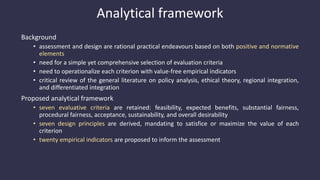
Analytical framework
Background
• assessment and design are rational practical endeavours based on both positive and normative
elements
• need for a simple yet comprehensive selection of evaluation criteria
• need to operationalize each criterion with value-free empirical indicators
• critical review of the general literature on policy analysis, ethical theory, regional integration,
and differentiated integration
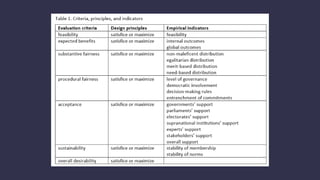
Proposed analytical framework
• seven evaluative criteria are retained: feasibility, expected benefits, substantial fairness,
procedural fairness, acceptance, sustainability, and overall desirability
• seven design principles are derived, mandating to satisfice or maximize the value of each
criterion
• twenty empirical indicators are proposed to inform the assessment
Strengths
• simple yet comprehensive: covers most key aspects in a parsimonious way
• versatile: can be applied to any kind of integration model (e.g. uniform vs differentiated),
framework (e.g. EU vs non-EU), scheme (e.g. Schengen), and aspect thereof
• value-free: objective empirical indicators which each observer can then weigh according to her
specific values and priorities
Weaknesses
• the availability, precision, and reliability of the empirical indicators can vary widely, depending
on the complexity of the scheme, the type of assessment (ex post description or ex ante
prediction), and the empirical evidence and research available
• good analytical but limited practical value in complex policy areas (e.g. prediction of outcomes
of complex policies, incomplete or unclear empirical evidence)
• final assessment ultimately depends on normative factors on which a consensus is rarely
possible
Differentiated integration
Internal differentiation
• definition: “selective limitation of the validity of international legal rules to a subset of the EU
member states” (amendment of Schimmelfennig and Winzen 2020a)
• three legal tools: EU treaties, EU legislation, inter se international treaties
• one of five main alternative integration models: uniform integration (UI), differentiated
integration (DI), flexible implementation, experimentalist governance, and no integration (NI)
Relatively common use…
• 12.4 per cent of all EU treaty articles (EUDIFF1 dataset)
• 15.3 per cent of all EU legislation (EUDIFF2 dataset)
• many inter se international agreements (e.g. European Fiscal Compact)
• applied in several key policy domains (e.g. EMU, Schengen, PESCO)
… but infinitely less than national or EU legislation
• unclear size, but both include over 100,000 pieces of legislation (in force or not)
1. Feasibility
• DI much less feasible than NI but more feasible than UI
• international treaties more feasible in areas of national competence and below 15 members;
EU regulations in opposite situations
• EU treaties little feasible due to national ratification requirements and possible referendums
(particularly in Denmark and Ireland)
2. Expected benefits
• UI (generally at a global scale) most beneficial in the case of global problems, complementary
goods, economies of scale, functional synergies, homogeneous conditions, preferences, and
capacities, and low coordination problems
• NI most beneficial in opposite situations
• DI beneficial in intermediate situations; in many cases, however, can be efficiently replaced by
UI with compensatory mechanisms for ‘losers’
• EU treaties and legislation more effective in ensuring compliance, but less adaptable to new
circumstances
3. Substantive fairness
• most integration schemes tend to have a non-maleficent, unequal, and merit-based outcomes,
with unclear need-based consequences
• typically, DI can be expected to increase non-maleficence, limit the scope for territorial and
social redistribution, and determine a growing gap between insiders and outsiders
4. Procedural fairness
• DI scales back the level of governance from the European to an intermediate level
• all DI tools enjoy a basic level of democratic legitimacy, but this is quite direct in some cases (EU
treaties, international treaties with ratification) and very indirect in others (international
treaties without ratification, technocratic decisions by appointed experts)
• DI softens national vetoes against further integration (particularly international treaties), but
not vetoes against less integration and uniformity
• DI’s commitments are as entrenched and little accountable as UI’s ones, although international
treaties are easier to violate
5. Acceptance
• some empirical evidence available, but low salience and fragmentary nature
• citizens slightly favourable toward a ‘two-speed Europe’ (net acceptance +7.0 per cent, 19 out
of 27 countries) – Eurobarometer
• governments largely opposed in principle (14/21) but more open toward ‘last resort’ instances
and specific schemes – InDivEU database
• mixed views of party actors and stakeholders – InDivEU database
6. Sustainability
• DI tends to be subject to centripetal pressures, leading to the partial or total enlargement of its
membership over time
• DI tends to produce norms as stable and hard to reform as those of UI
7. Overall desirability
• depends on the specificities of the scheme (policy problem, membership, legal framework,
broader context) and the subjective normative values and preferences of the observer
Conclusion
1. the proposed analytical framework is helpful in informing the assessment and
design of international integration schemes
2. the outcomes of differentiated integration can be very different from those of
uniform or no integration; depending on one’s normative standpoint, they can be
classified as strengths or weaknesses
3. given the importance of normative elements and the uncertainty of many
empirical ones, it seems essential to enhance the responsiveness of DI schemes
to democratic debate and decision-making, for instance by strengthening their
parliamentary oversight and softening the level of entrenchment of rules
4. on a technical level, more data collection and analysis is needed on the
preferences of relevant publics toward different integration models and tools
Stay in touch
indiveu.eui.eu
paolo.chiocchetti@eui.eu
twitter.com/p_chiocchetti

Design principles for differentiated integration schemes

  • 1.
    Design principles for differentiated integrationschemes Dr Paolo Chiocchetti European University Institute
  • 2.
    Outline Aim The InDivEU project Analyticalframework Differentiated integration Conclusion Contacts
  • 3.
    Aim State of theart • differentiated integration is an increasingly relevant aspect of EU integration (Schimmelfennig & Winzen 2020) • extensive literature and broad agreement on its empirical features: types, frequency, causes, consequences (Adler-Nissen 2014; Dyson and Sepos 2010; Kölliker 2001; Sielmann 2020; Schimmelfennig & Winzen 2020) • fragmented literature and strong disagreements on its normative assessment (Bellamy & Kröger 2017; Koenig 2015; Lord 2015) Two-fold aim • develop a comprehensive analytical framework for the assessment and design of international integration schemes • identify general recommendations concerning differentiated integration as a design option Details • part of the Horizon 2020 research project “InDivEU”, work package 9 “synthesis and design” • work-in-progress, forthcoming working paper and later journal article
  • 4.
  • 5.
    Analytical framework Background • assessmentand design are rational practical endeavours based on both positive and normative elements • need for a simple yet comprehensive selection of evaluation criteria • need to operationalize each criterion with value-free empirical indicators • critical review of the general literature on policy analysis, ethical theory, regional integration, and differentiated integration Proposed analytical framework • seven evaluative criteria are retained: feasibility, expected benefits, substantial fairness, procedural fairness, acceptance, sustainability, and overall desirability • seven design principles are derived, mandating to satisfice or maximize the value of each criterion • twenty empirical indicators are proposed to inform the assessment
  • 7.
    Strengths • simple yetcomprehensive: covers most key aspects in a parsimonious way • versatile: can be applied to any kind of integration model (e.g. uniform vs differentiated), framework (e.g. EU vs non-EU), scheme (e.g. Schengen), and aspect thereof • value-free: objective empirical indicators which each observer can then weigh according to her specific values and priorities Weaknesses • the availability, precision, and reliability of the empirical indicators can vary widely, depending on the complexity of the scheme, the type of assessment (ex post description or ex ante prediction), and the empirical evidence and research available • good analytical but limited practical value in complex policy areas (e.g. prediction of outcomes of complex policies, incomplete or unclear empirical evidence) • final assessment ultimately depends on normative factors on which a consensus is rarely possible
  • 8.
    Differentiated integration Internal differentiation •definition: “selective limitation of the validity of international legal rules to a subset of the EU member states” (amendment of Schimmelfennig and Winzen 2020a) • three legal tools: EU treaties, EU legislation, inter se international treaties • one of five main alternative integration models: uniform integration (UI), differentiated integration (DI), flexible implementation, experimentalist governance, and no integration (NI) Relatively common use… • 12.4 per cent of all EU treaty articles (EUDIFF1 dataset) • 15.3 per cent of all EU legislation (EUDIFF2 dataset) • many inter se international agreements (e.g. European Fiscal Compact) • applied in several key policy domains (e.g. EMU, Schengen, PESCO) … but infinitely less than national or EU legislation • unclear size, but both include over 100,000 pieces of legislation (in force or not)
  • 9.
    1. Feasibility • DImuch less feasible than NI but more feasible than UI • international treaties more feasible in areas of national competence and below 15 members; EU regulations in opposite situations • EU treaties little feasible due to national ratification requirements and possible referendums (particularly in Denmark and Ireland) 2. Expected benefits • UI (generally at a global scale) most beneficial in the case of global problems, complementary goods, economies of scale, functional synergies, homogeneous conditions, preferences, and capacities, and low coordination problems • NI most beneficial in opposite situations • DI beneficial in intermediate situations; in many cases, however, can be efficiently replaced by UI with compensatory mechanisms for ‘losers’ • EU treaties and legislation more effective in ensuring compliance, but less adaptable to new circumstances
  • 10.
    3. Substantive fairness •most integration schemes tend to have a non-maleficent, unequal, and merit-based outcomes, with unclear need-based consequences • typically, DI can be expected to increase non-maleficence, limit the scope for territorial and social redistribution, and determine a growing gap between insiders and outsiders 4. Procedural fairness • DI scales back the level of governance from the European to an intermediate level • all DI tools enjoy a basic level of democratic legitimacy, but this is quite direct in some cases (EU treaties, international treaties with ratification) and very indirect in others (international treaties without ratification, technocratic decisions by appointed experts) • DI softens national vetoes against further integration (particularly international treaties), but not vetoes against less integration and uniformity • DI’s commitments are as entrenched and little accountable as UI’s ones, although international treaties are easier to violate
  • 11.
    5. Acceptance • someempirical evidence available, but low salience and fragmentary nature • citizens slightly favourable toward a ‘two-speed Europe’ (net acceptance +7.0 per cent, 19 out of 27 countries) – Eurobarometer • governments largely opposed in principle (14/21) but more open toward ‘last resort’ instances and specific schemes – InDivEU database • mixed views of party actors and stakeholders – InDivEU database 6. Sustainability • DI tends to be subject to centripetal pressures, leading to the partial or total enlargement of its membership over time • DI tends to produce norms as stable and hard to reform as those of UI 7. Overall desirability • depends on the specificities of the scheme (policy problem, membership, legal framework, broader context) and the subjective normative values and preferences of the observer
  • 12.
    Conclusion 1. the proposedanalytical framework is helpful in informing the assessment and design of international integration schemes 2. the outcomes of differentiated integration can be very different from those of uniform or no integration; depending on one’s normative standpoint, they can be classified as strengths or weaknesses 3. given the importance of normative elements and the uncertainty of many empirical ones, it seems essential to enhance the responsiveness of DI schemes to democratic debate and decision-making, for instance by strengthening their parliamentary oversight and softening the level of entrenchment of rules 4. on a technical level, more data collection and analysis is needed on the preferences of relevant publics toward different integration models and tools
  • 13.