Thematic evaluation of the
Visibility of EU External Action -
Presentation of the Final Report


              Dissemination Seminar, 7th September. 2012
             9.15-14.30, Centre Albert Borschette, Brussels
       (Evaluation managed by DRN and led by ECDPM)
Content of the presentation


   Introduction
   Methodological approach
   Main findings and analysis
   Conclusions and recommendations
3
Introduction: the Evaluation Team
    James Mackie – Team Leader (ECDPM)
    Federica Petrucci – Evaluation Manager & Expert Migration
     Theme (DRN)
    Volker Hauck (ECDPM) & Raphael Brigandi – Communication
    Andrew Sherriff – Expert Conflict Theme (ECDPM)
    Mark Kowal – Expert Climate Change Theme
    Ivo Morawski – Expert Environment Theme (DRN)
    Isabella Massa – Expert Financial Crisis Theme (ODI)
    Pierre van Roosbroek – Expert Food Crisis Theme
    Bent Bonde – Communication & Tunisia Case Study
    Sara Monti – Evaluation Assistant (DRN)
                    In Bold: Team members present in the Seminar
Introduction: the Mandate
 Evaluation for 3 „Relex DGs‟: RELEX, DEV & AIDCO
    (External Relations, Development & EuropeAid)

 Terms of Reference (February 2010): the purpose:
       To provide an overall independent assessment of the visibility of
       the Commission’s external action;
       To identify key lessons to improve current and future
       Commission strategies on visibility.
 Period covered: 2006-2011
 Geographic scope: Global (except Balkans)
 Starting point in policy terms:
       2006 Draft Communication from the Relex
       Commissioner Mrs Benita Ferrero-Waldner:
      “The EU in the World: Towards a Communication Strategy for the
      European Union’s External Policy, 2006-2009” (C[2006]329)
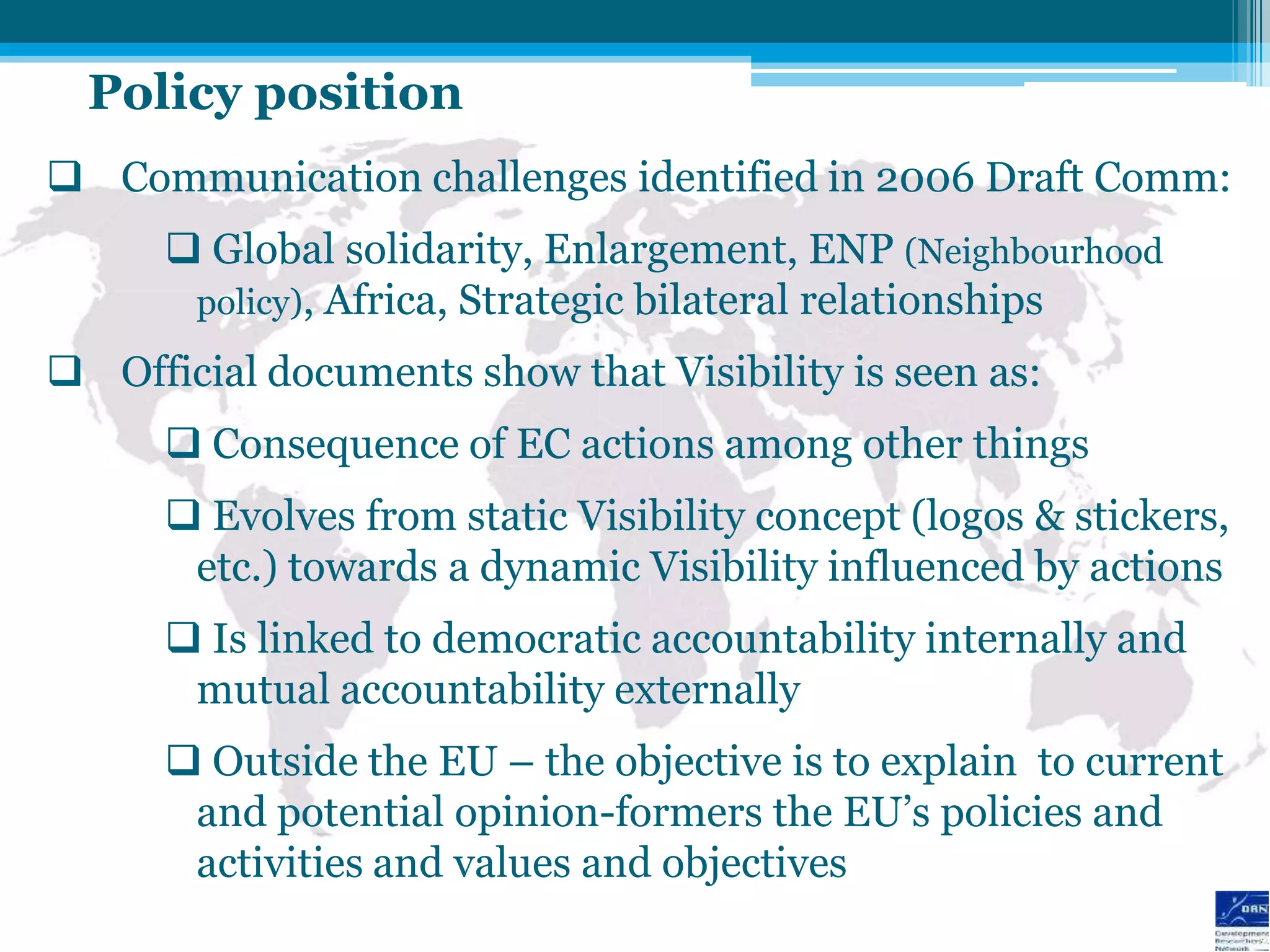
Policy position
 Communication challenges identified in 2006 Draft Comm:
       Global solidarity, Enlargement, ENP (Neighbourhood
       policy), Africa, Strategic bilateral relationships

 Official documents show that Visibility is seen as:
       Consequence of EC actions among other things
       Evolves from static Visibility concept (logos & stickers,
       etc.) towards a dynamic Visibility influenced by actions
       Is linked to democratic accountability internally and
       mutual accountability externally
       Outside the EU – the objective is to explain to current
       and potential opinion-formers the EU‟s policies and
       activities and values and objectives
7


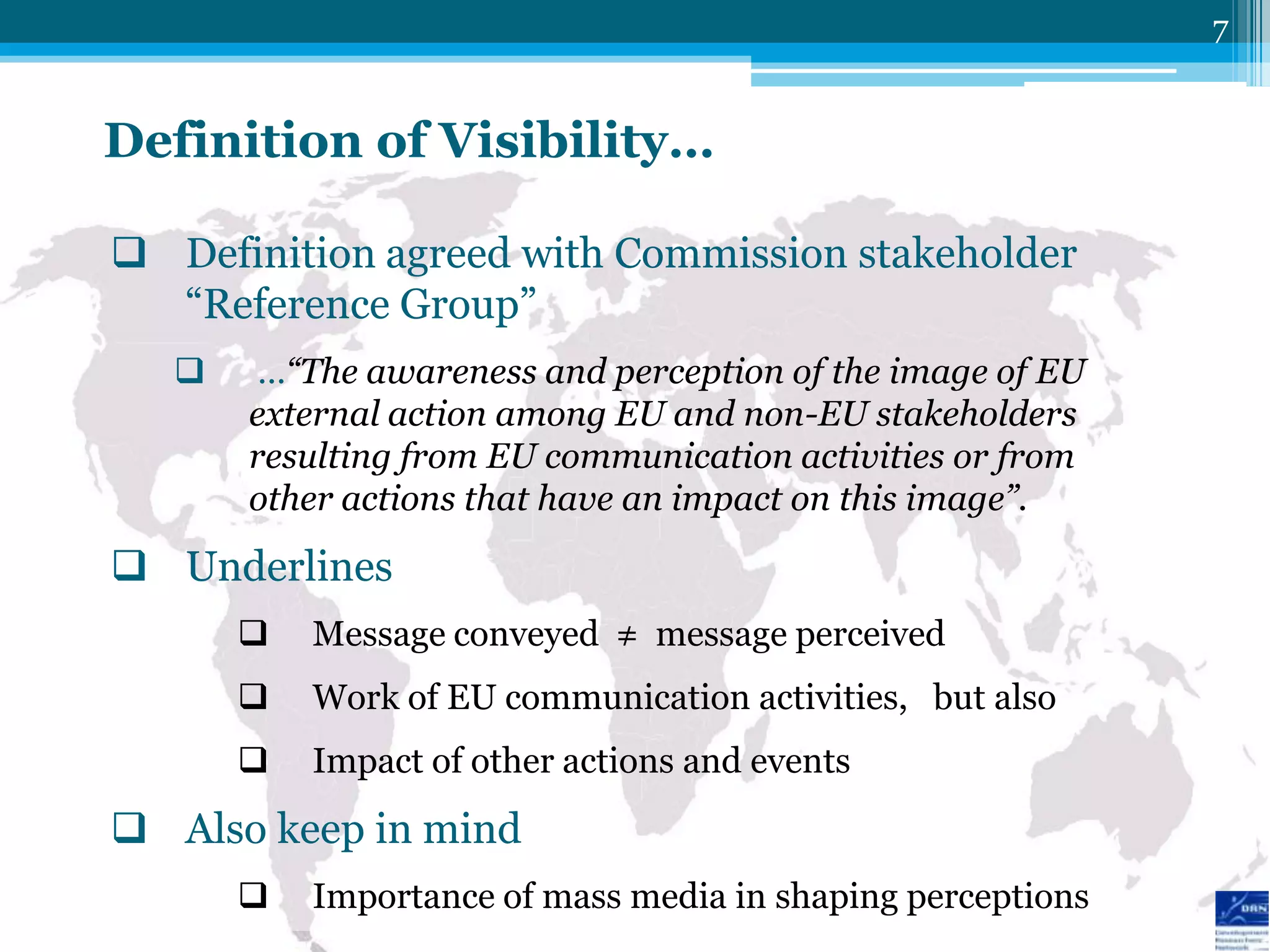
Definition of Visibility…

 Definition agreed with Commission stakeholder
  “Reference Group”
       …“The awareness and perception of the image of EU
       external action among EU and non-EU stakeholders
       resulting from EU communication activities or from
       other actions that have an impact on this image”.
 Underlines
          Message conveyed ≠ message perceived
          Work of EU communication activities, but also
          Impact of other actions and events
 Also keep in mind
          Importance of mass media in shaping perceptions
8

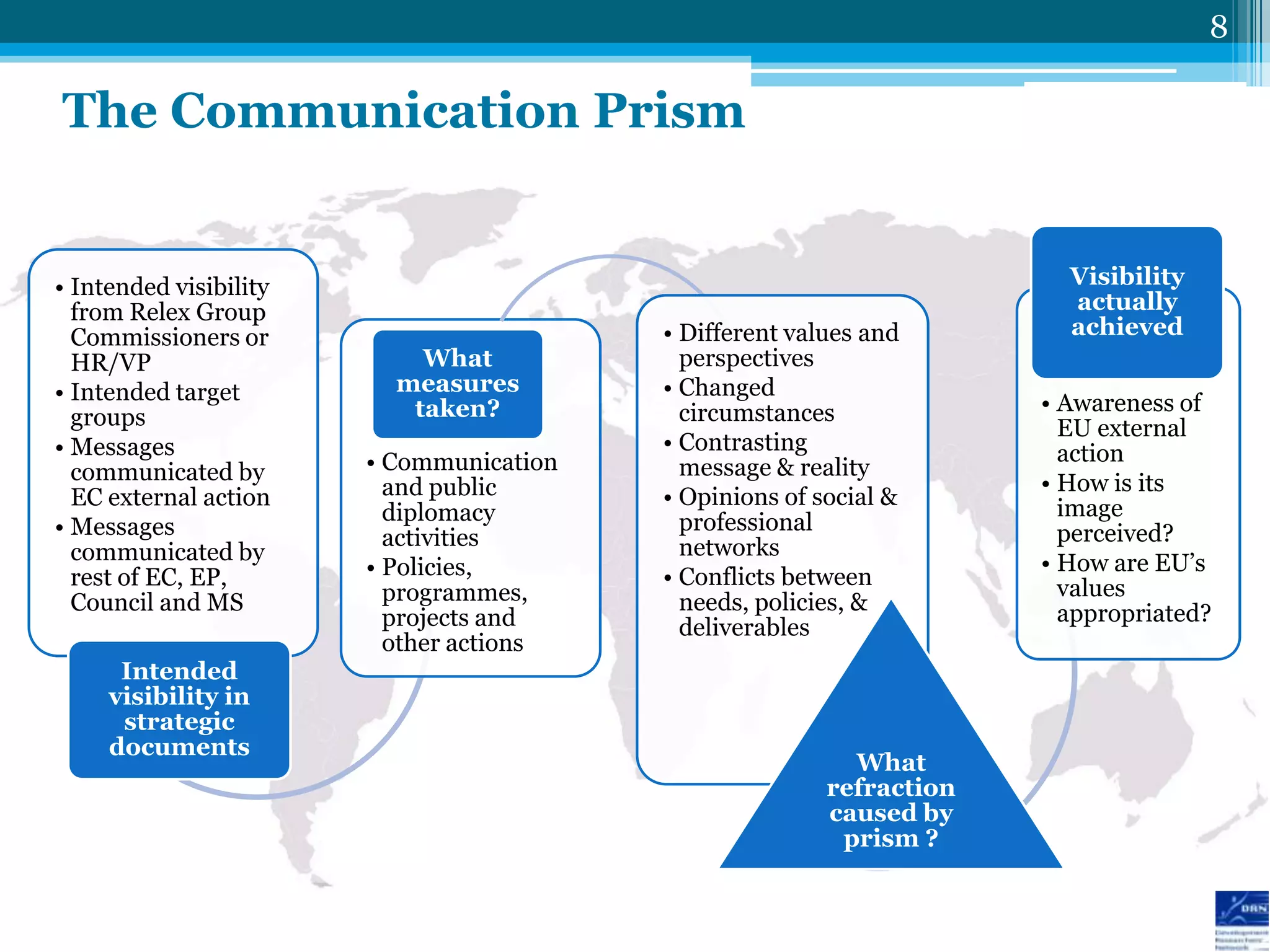
The Communication Prism


• Intended visibility                                                   Visibility
  from Relex Group                                                      actually
  Commissioners or                        • Different values and        achieved
  HR/VP                     What            perspectives
• Intended target         measures        • Changed
                           taken?           circumstances             • Awareness of
  groups                                                                EU external
• Messages                                • Contrasting                 action
  communicated by       • Communication     message & reality
                          and public                                  • How is its
  EC external action                      • Opinions of social &        image
                          diplomacy         professional
• Messages                activities                                    perceived?
  communicated by                           networks
                        • Policies,                                   • How are EU‟s
  rest of EC, EP,                         • Conflicts between           values
  Council and MS          programmes,       needs, policies, &
                          projects and                                  appropriated?
                                            deliverables
                          other actions
      Intended
     visibility in
      strategic
     documents
                                                           What
                                                         refraction
                                                         caused by
                                                          prism ?
9
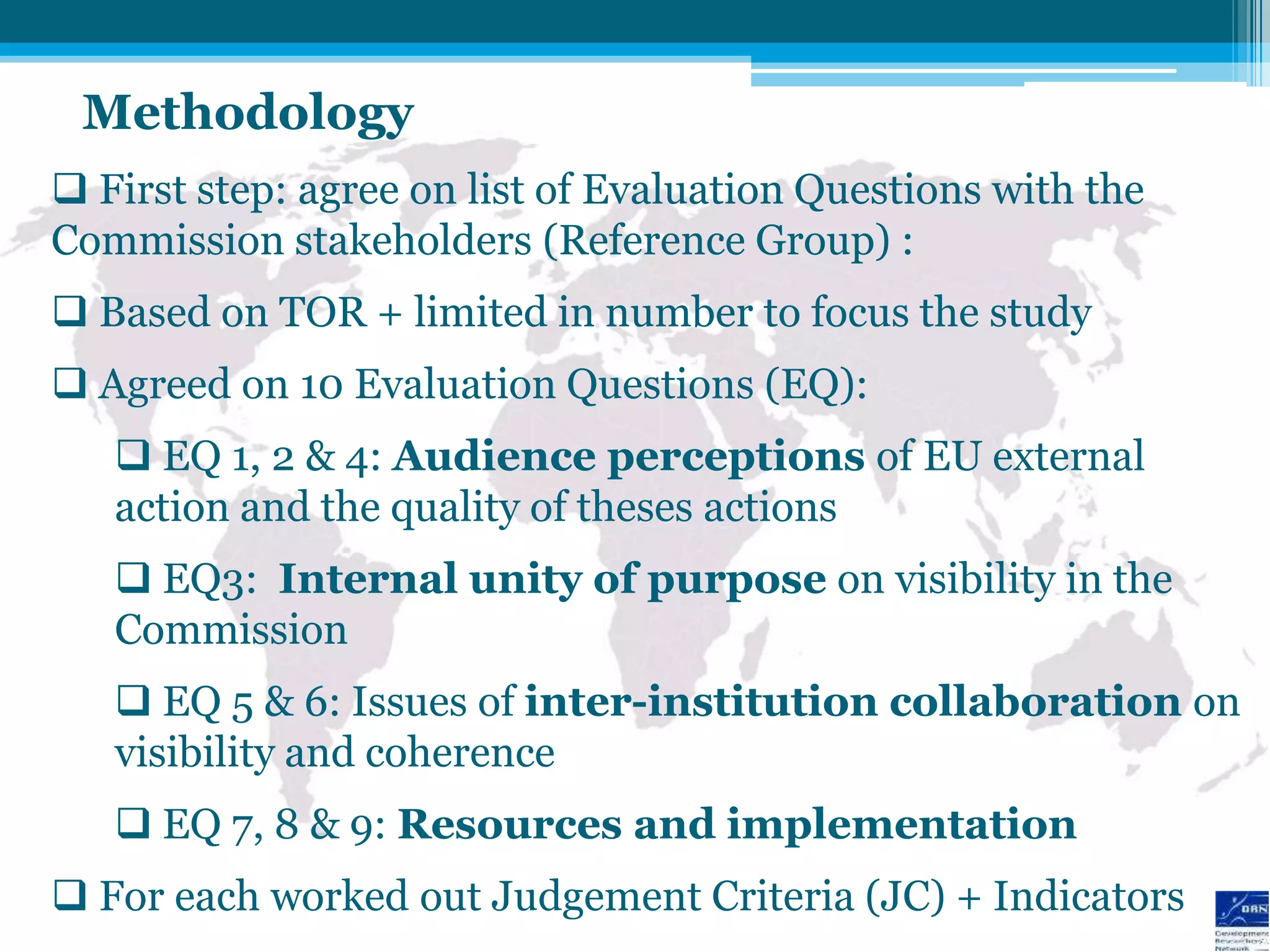
Methodology
 First step: agree on list of Evaluation Questions with the
Commission stakeholders (Reference Group) :
 Based on TOR + limited in number to focus the study
 Agreed on 10 Evaluation Questions (EQ):
    EQ 1, 2 & 4: Audience perceptions of EU external
   action and the quality of theses actions
    EQ3: Internal unity of purpose on visibility in the
   Commission
    EQ 5 & 6: Issues of inter-institution collaboration on
   visibility and coherence
    EQ 7, 8 & 9: Resources and implementation
 For each worked out Judgement Criteria (JC) + Indicators
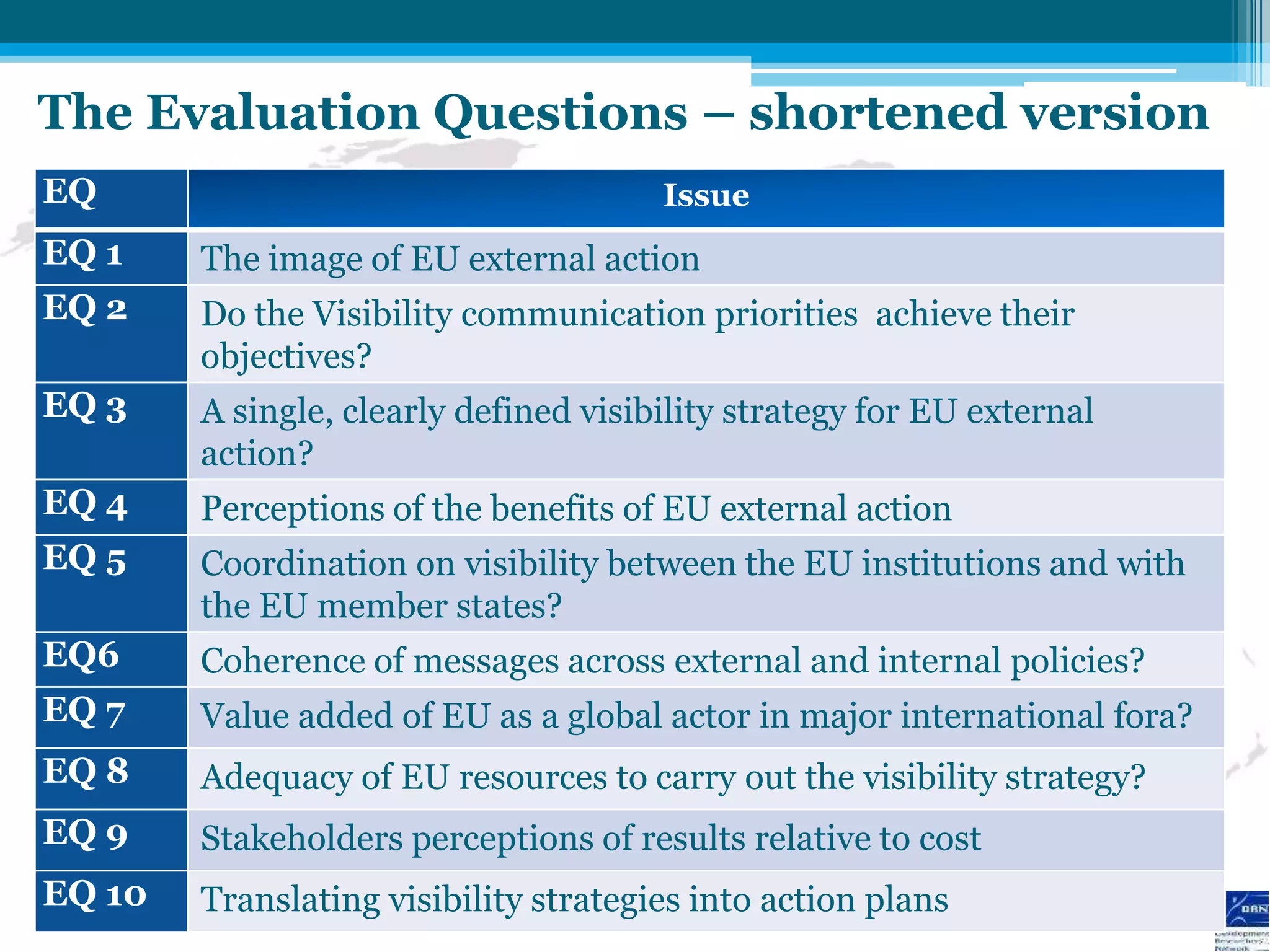
The Evaluation Questions – shortened version
EQ                                     Issue
EQ 1    The image of EU external action
EQ 2    Do the Visibility communication priorities achieve their
        objectives?
EQ 3    A single, clearly defined visibility strategy for EU external
        action?
EQ 4    Perceptions of the benefits of EU external action
EQ 5    Coordination on visibility between the EU institutions and with
        the EU member states?
EQ6     Coherence of messages across external and internal policies?
EQ 7    Value added of EU as a global actor in major international fora?
EQ 8    Adequacy of EU resources to carry out the visibility strategy?
EQ 9    Stakeholders perceptions of results relative to cost
EQ 10   Translating visibility strategies into action plans
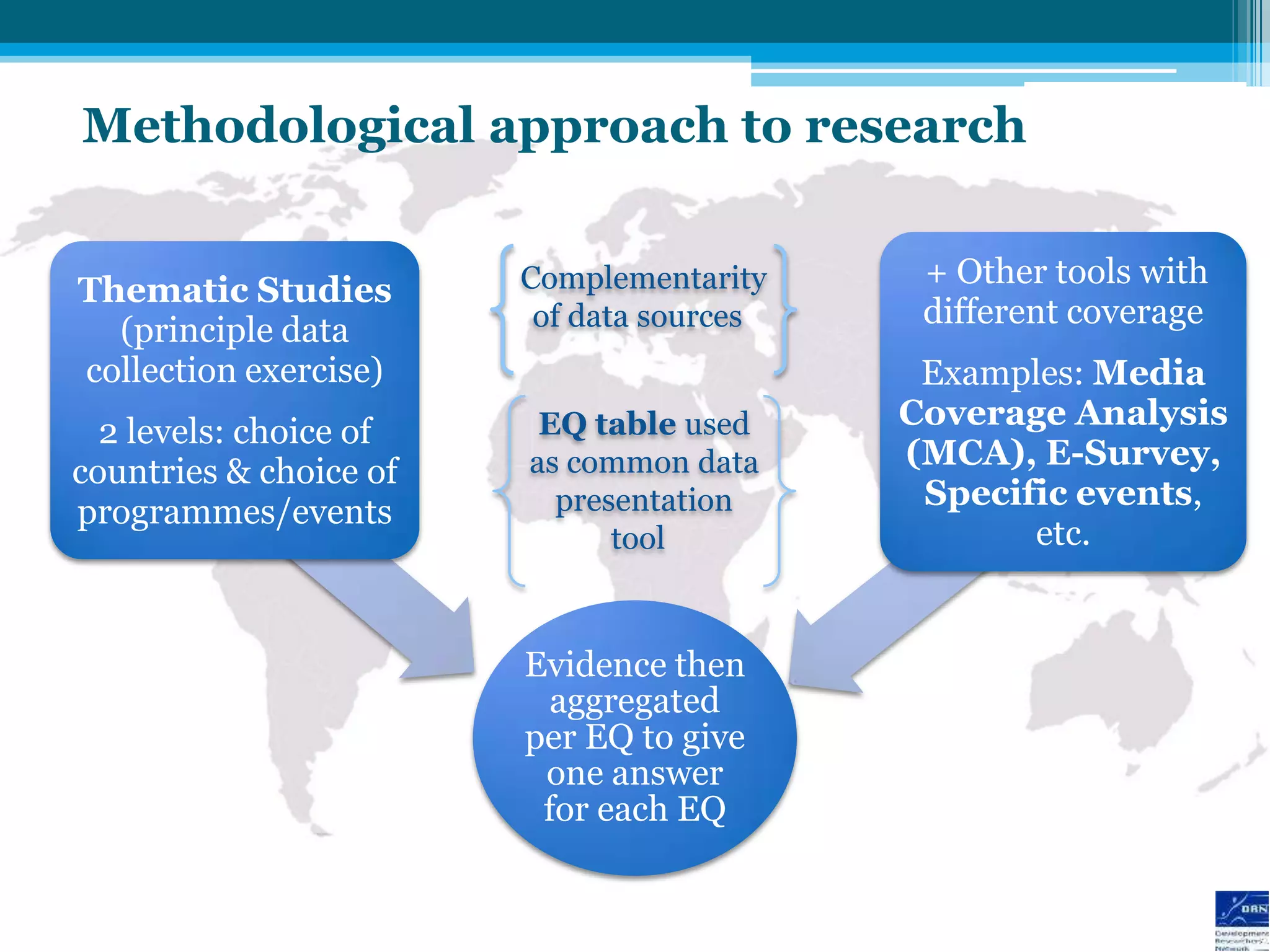
Methodological approach to research

                        Complementarity     + Other tools with
Thematic Studies
                         of data sources    different coverage
  (principle data
collection exercise)                        Examples: Media
                         EQ table used     Coverage Analysis
  2 levels: choice of
                        as common data     (MCA), E-Survey,
countries & choice of
                          presentation      Specific events,
programmes/events
                              tool                etc.


                        Evidence then
                         aggregated
                        per EQ to give
                         one answer
                         for each EQ
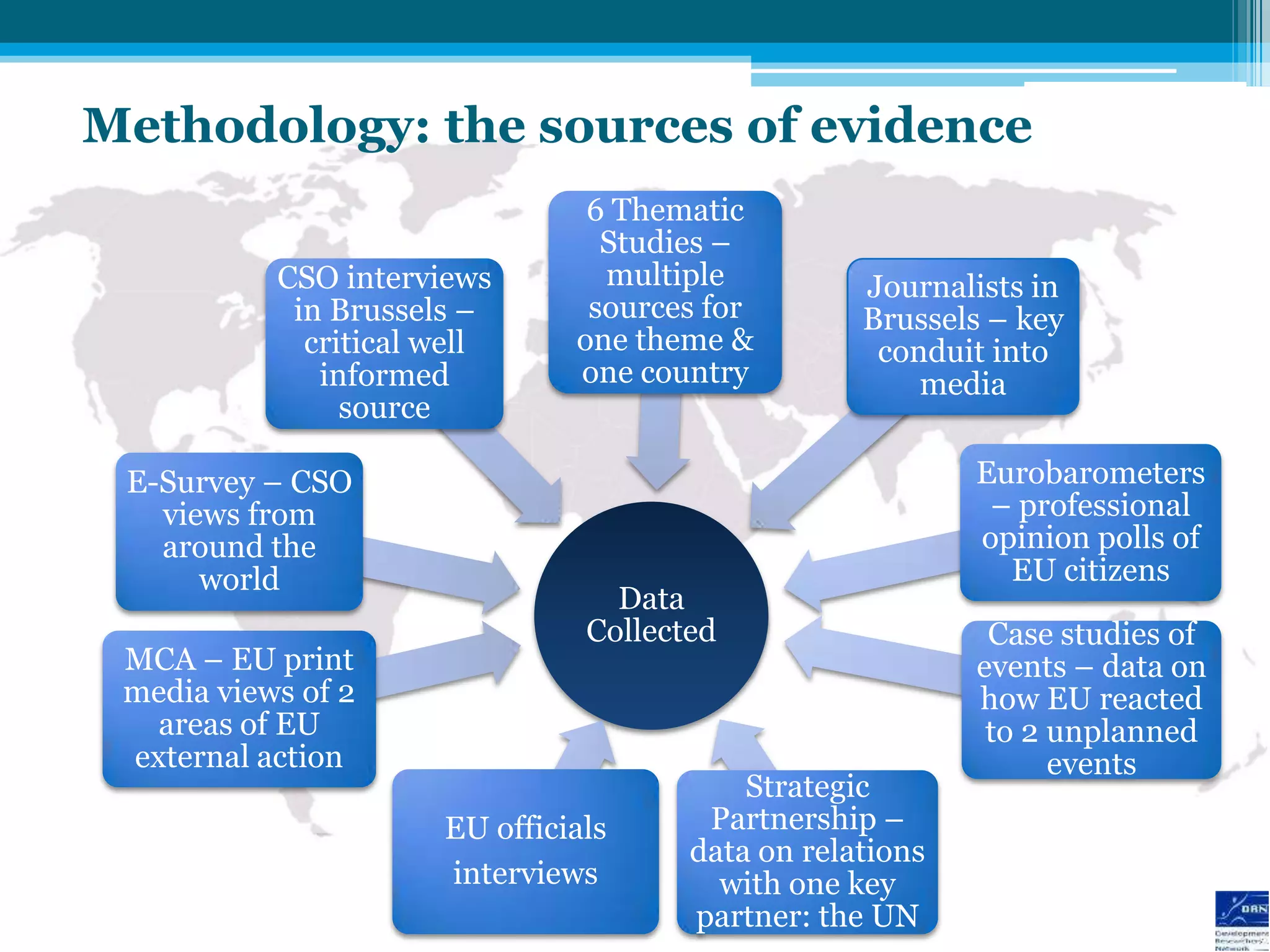
Methodology: the sources of evidence
                                6 Thematic
                                 Studies –
           CSO interviews        multiple          Journalists in
            in Brussels –       sources for        Brussels – key
             critical well     one theme &          conduit into
              informed         one country             media
                source

 E-Survey – CSO                                            Eurobarometers
   views from                                               – professional
   around the                                              opinion polls of
      world                                                  EU citizens
                                  Data
                                Collected                   Case studies of
 MCA – EU print                                            events – data on
 media views of 2                                          how EU reacted
   areas of EU                                              to 2 unplanned
 external action                                                 events
                                           Strategic
                      EU officials      Partnership –
                                       data on relations
                      interviews         with one key
                                       partner: the UN
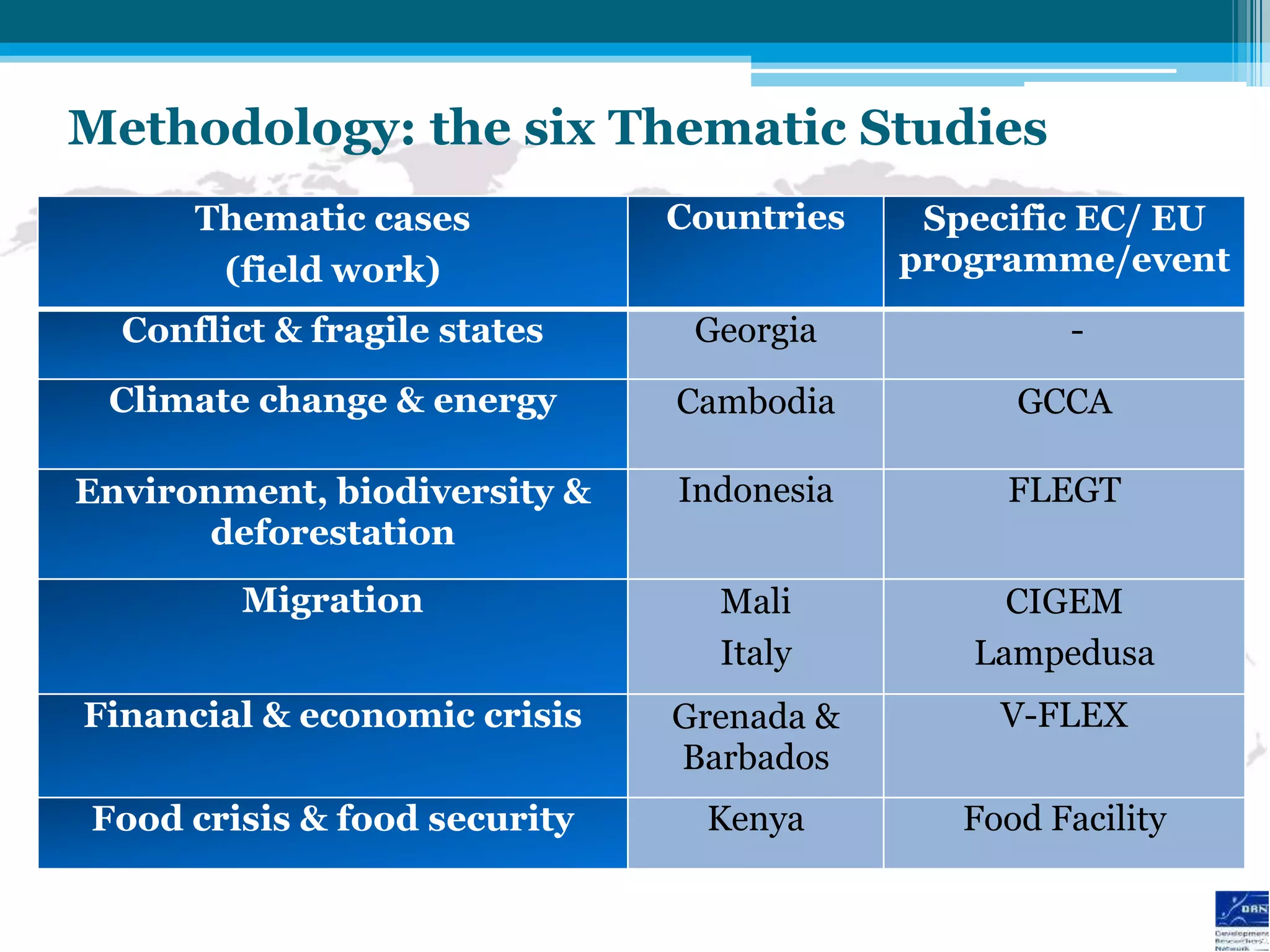
Methodology: the six Thematic Studies
      Thematic cases          Countries    Specific EC/ EU
       (field work)                       programme/event

  Conflict & fragile states    Georgia             -
 Climate change & energy      Cambodia          GCCA

Environment, biodiversity &   Indonesia        FLEGT
       deforestation
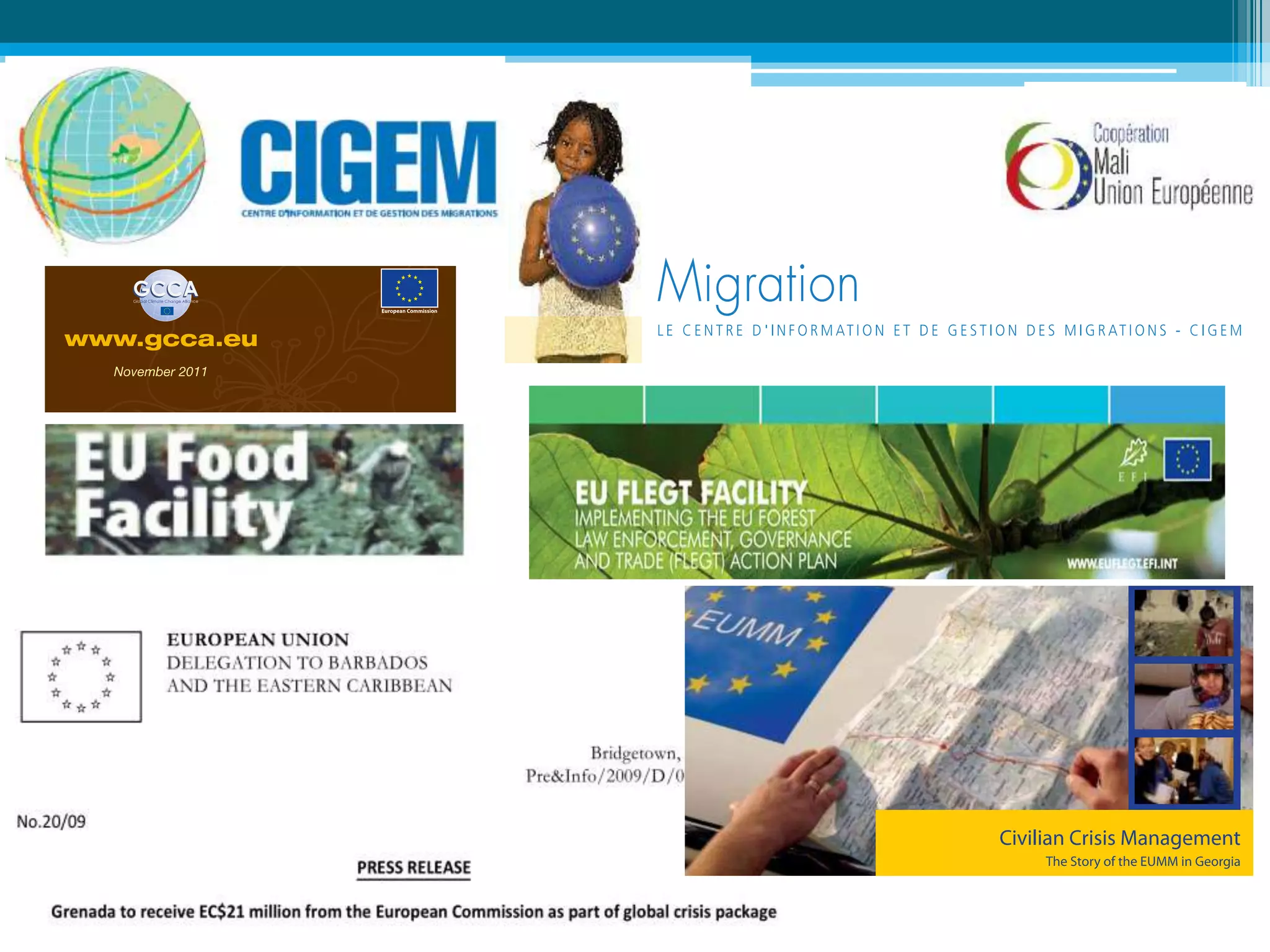
         Migration              Mali           CIGEM
                                Italy        Lampedusa
Financial & economic crisis   Grenada &        V-FLEX
                              Barbados
Food crisis & food security     Kenya        Food Facility
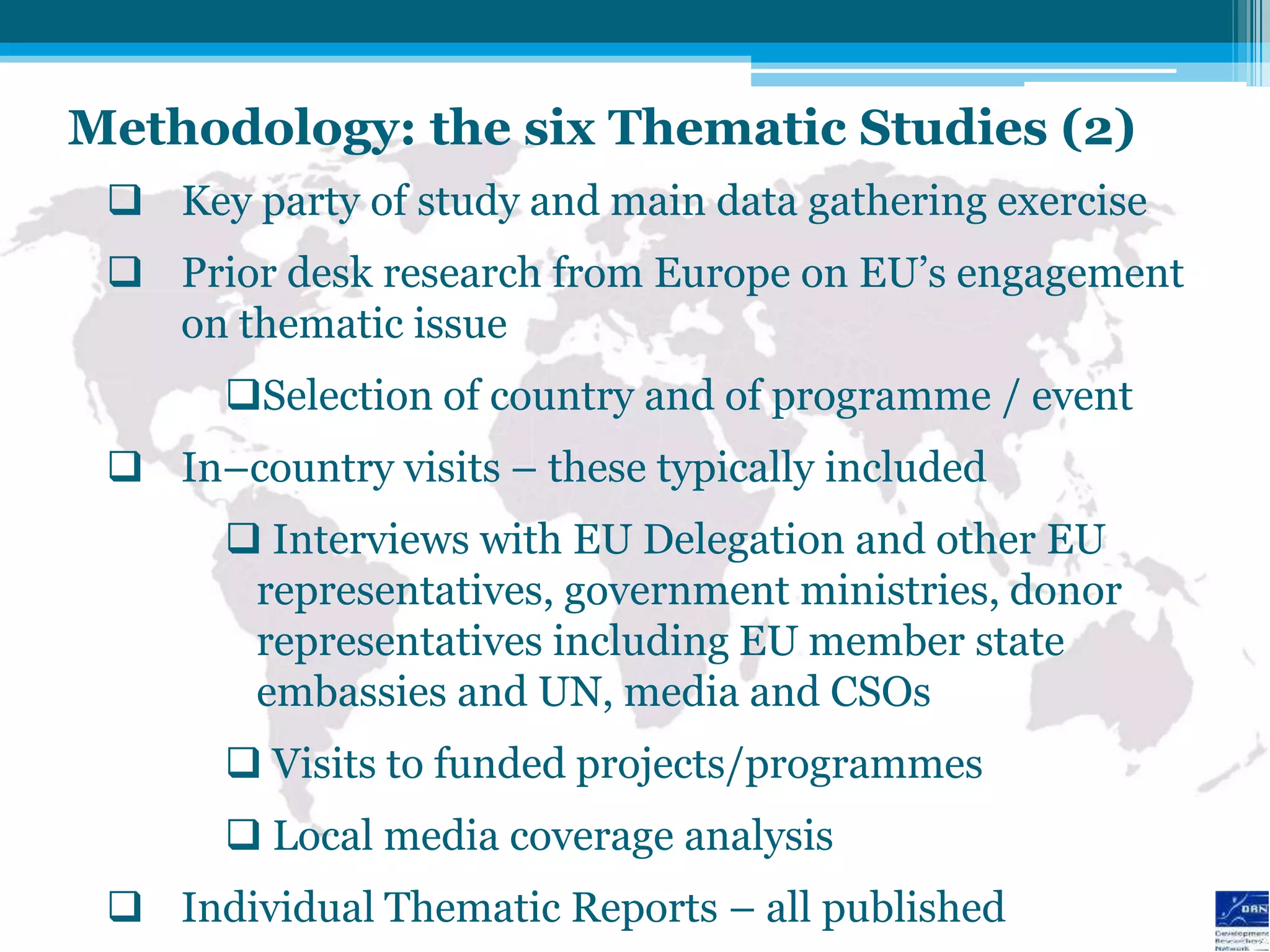
Methodology: the six Thematic Studies (2)
  Key party of study and main data gathering exercise
  Prior desk research from Europe on EU‟s engagement
   on thematic issue
       Selection of country and of programme / event
  In–country visits – these typically included
        Interviews with EU Delegation and other EU
        representatives, government ministries, donor
        representatives including EU member state
        embassies and UN, media and CSOs
        Visits to funded projects/programmes
        Local media coverage analysis
  Individual Thematic Reports – all published
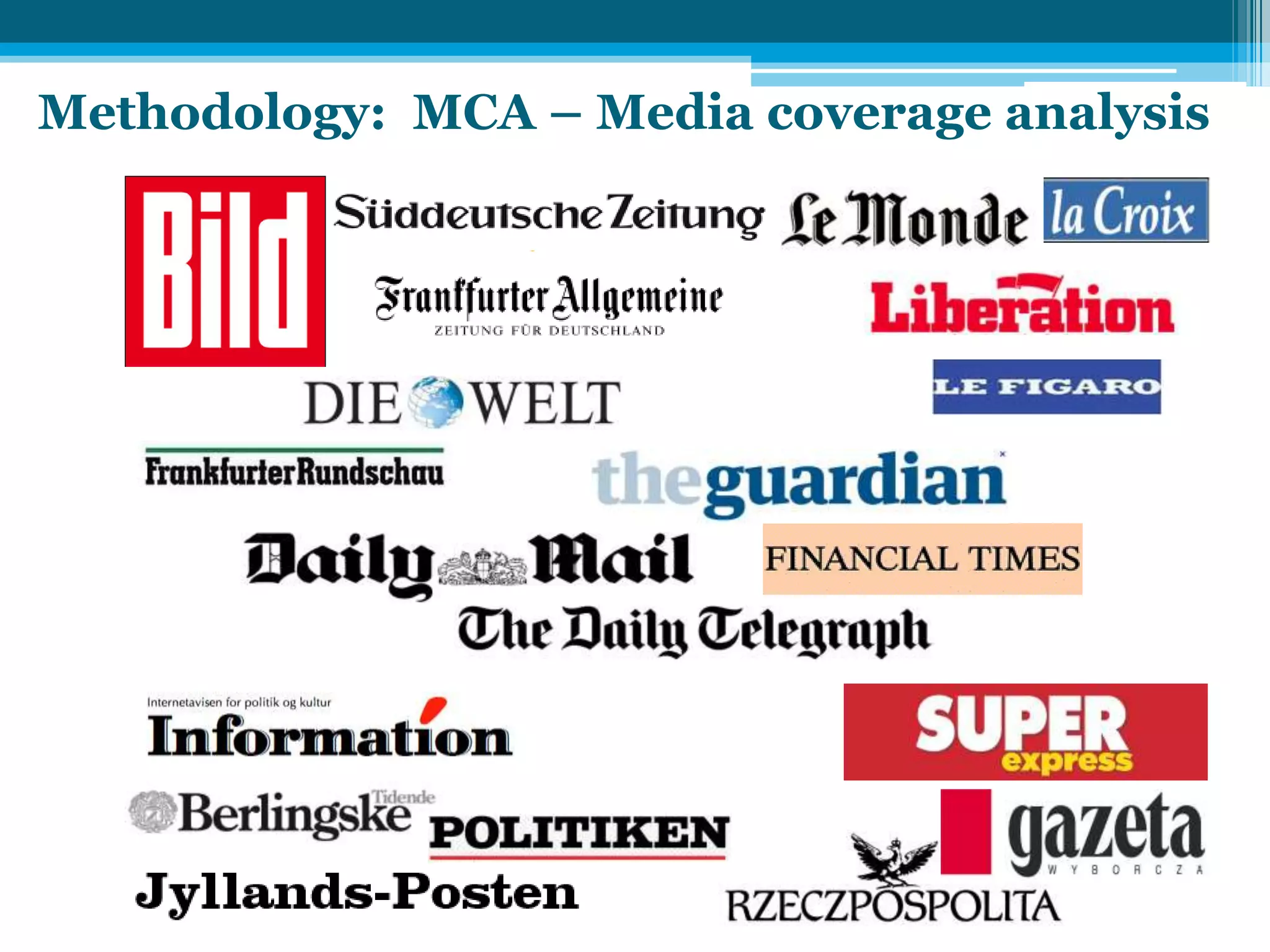
Methodology: MCA – Media coverage analysis
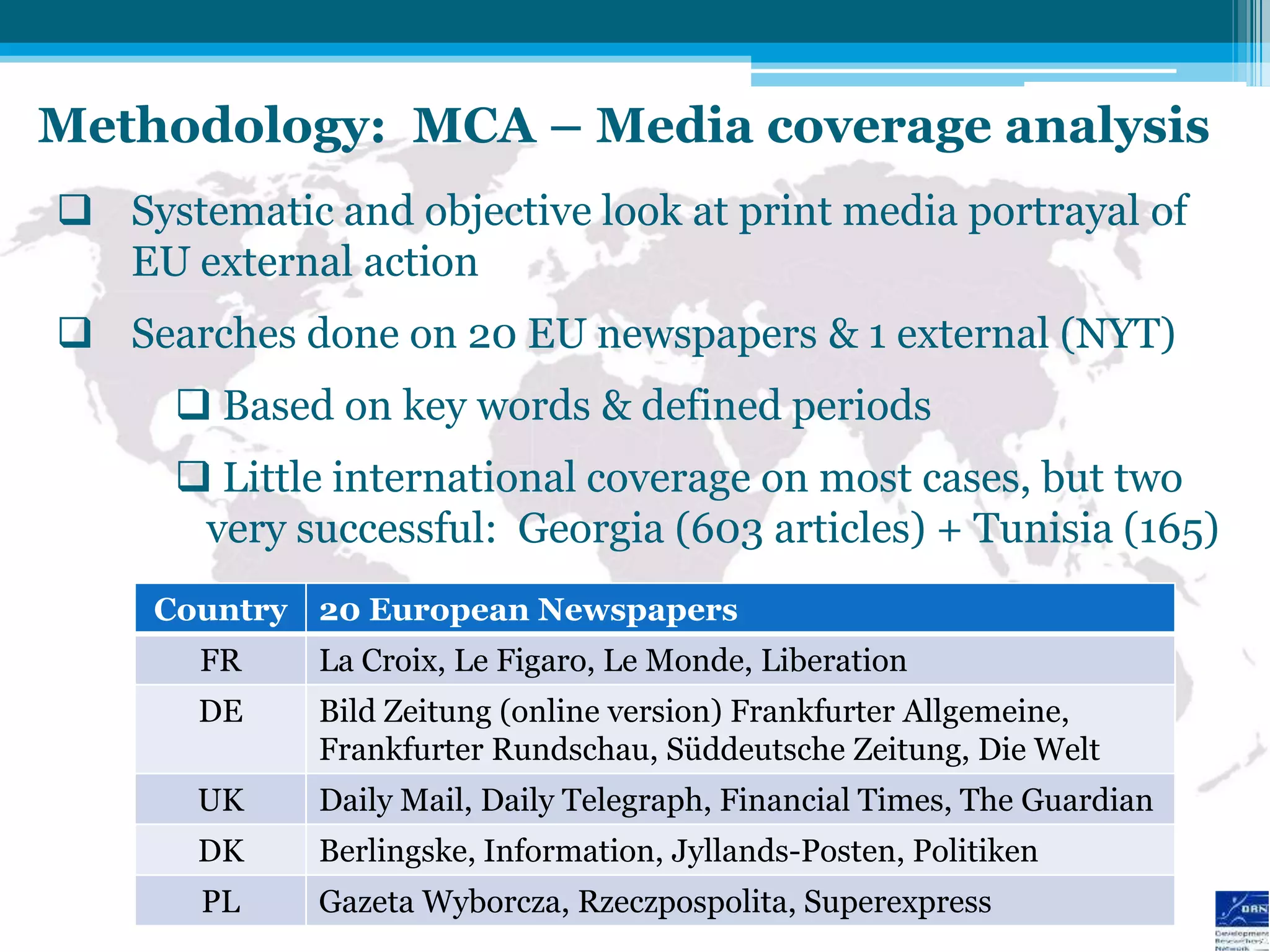
 Systematic and objective look at print media portrayal of
  EU external action
 Searches done on 20 EU newspapers & 1 external (NYT)
       Based on key words & defined periods
       Little international coverage on most cases, but two
       very successful: Georgia (603 articles) + Tunisia (165)
     Country 20 European Newspapers
       FR    La Croix, Le Figaro, Le Monde, Liberation
       DE    Bild Zeitung (online version) Frankfurter Allgemeine,
             Frankfurter Rundschau, Süddeutsche Zeitung, Die Welt
       UK    Daily Mail, Daily Telegraph, Financial Times, The Guardian
       DK    Berlingske, Information, Jyllands-Posten, Politiken
       PL    Gazeta Wyborcza, Rzeczpospolita, Superexpress
Methodology: Interviews

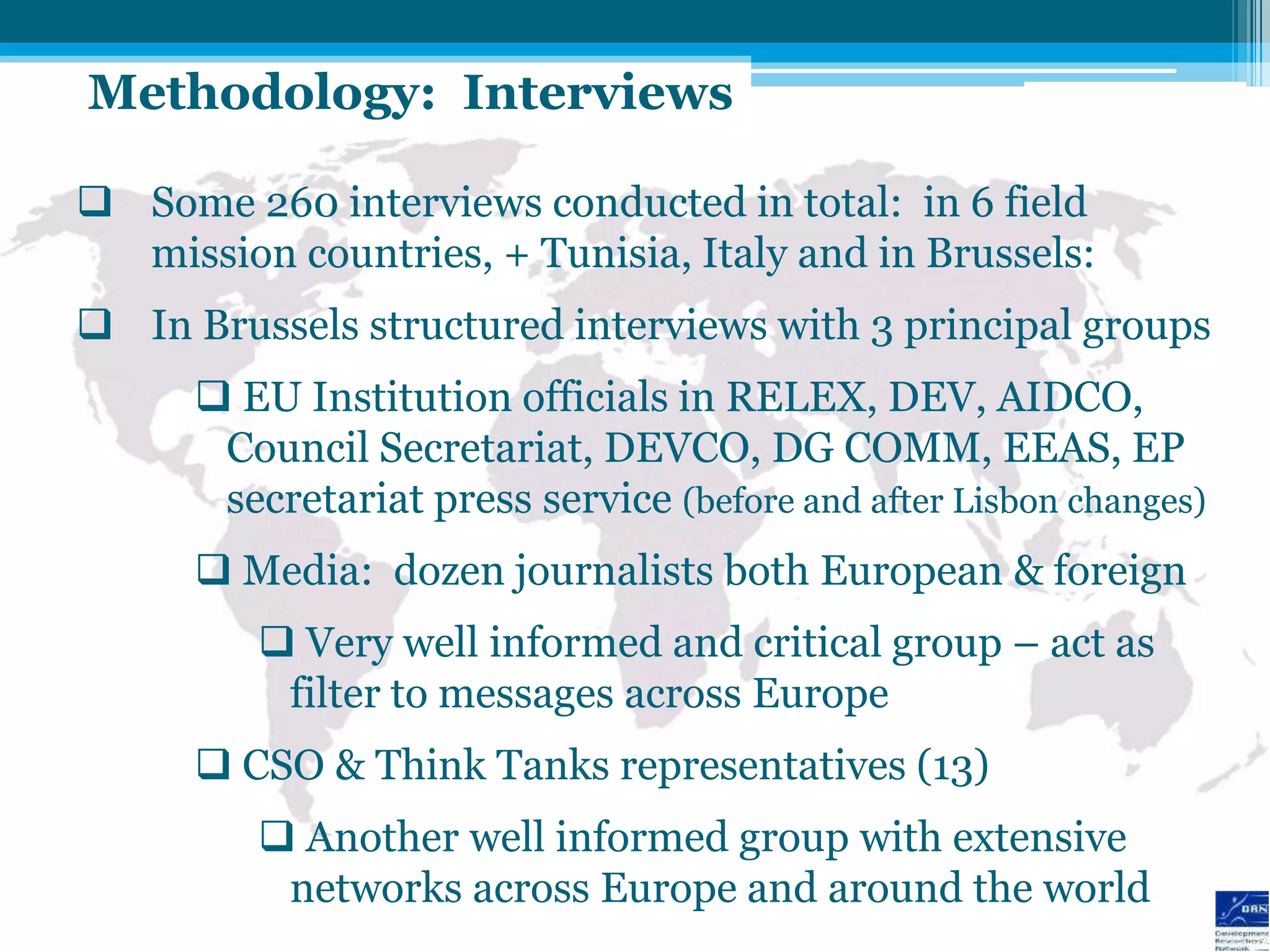
 Some 260 interviews conducted in total: in 6 field
  mission countries, + Tunisia, Italy and in Brussels:
 In Brussels structured interviews with 3 principal groups
       EU Institution officials in RELEX, DEV, AIDCO,
       Council Secretariat, DEVCO, DG COMM, EEAS, EP
       secretariat press service (before and after Lisbon changes)
       Media: dozen journalists both European & foreign
          Very well informed and critical group – act as
          filter to messages across Europe
       CSO & Think Tanks representatives (13)
          Another well informed group with extensive
          networks across Europe and around the world
Methodology: E-Survey
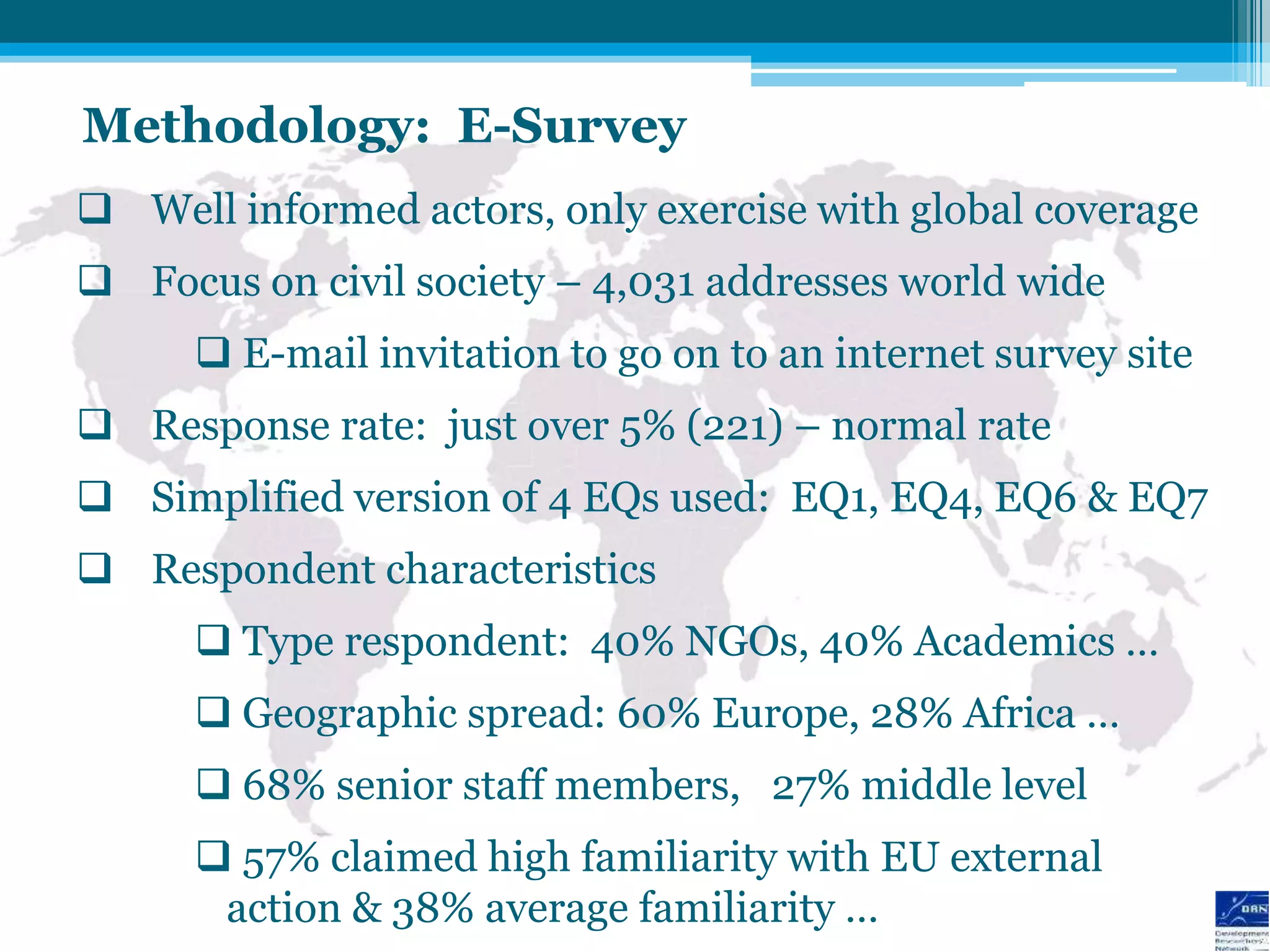
 Well informed actors, only exercise with global coverage
 Focus on civil society – 4,031 addresses world wide
       E-mail invitation to go on to an internet survey site
 Response rate: just over 5% (221) – normal rate
 Simplified version of 4 EQs used: EQ1, EQ4, EQ6 & EQ7
 Respondent characteristics
       Type respondent: 40% NGOs, 40% Academics …
       Geographic spread: 60% Europe, 28% Africa …
       68% senior staff members, 27% middle level
       57% claimed high familiarity with EU external
       action & 38% average familiarity …
Methodology: Case Studies

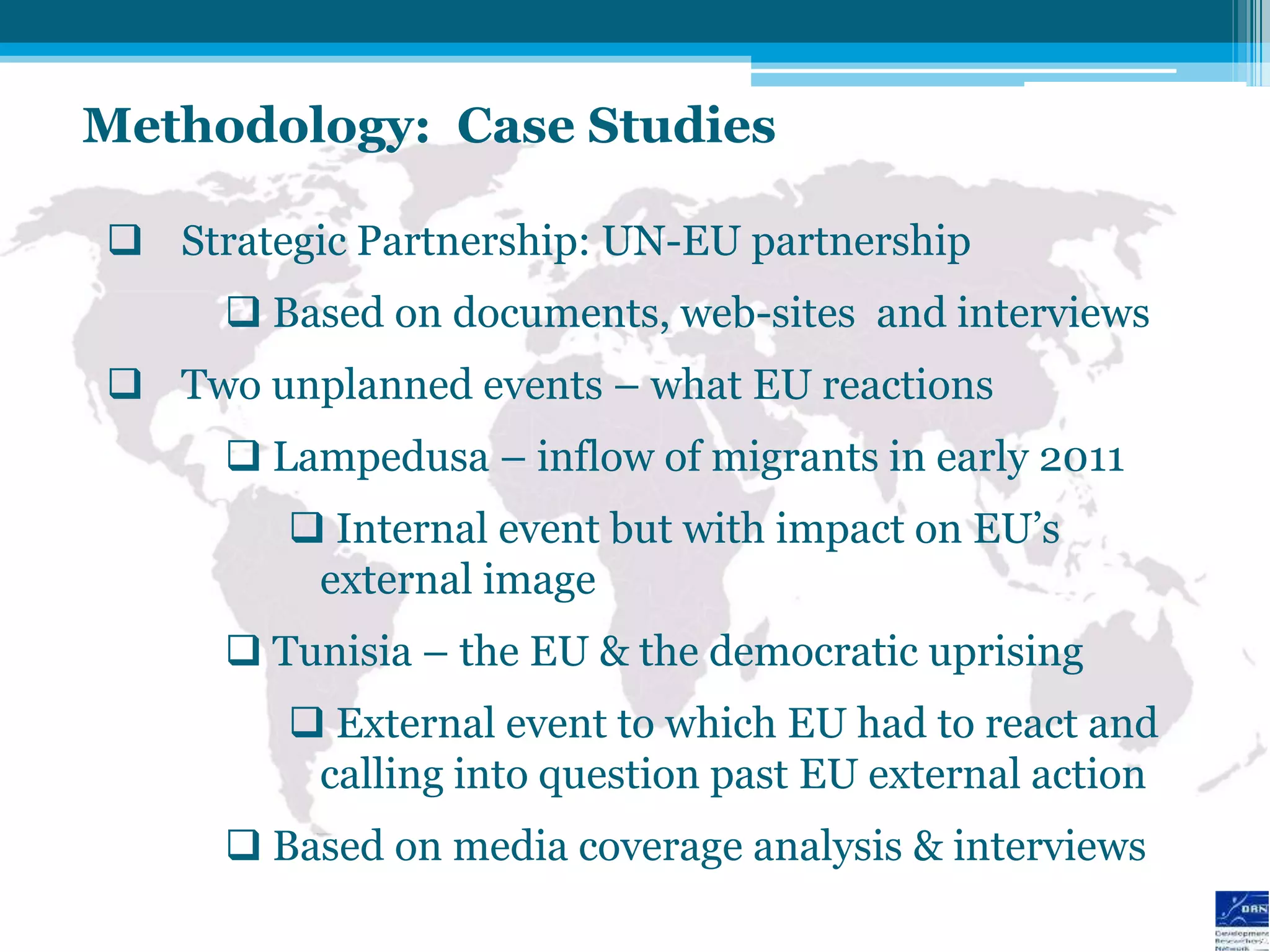
 Strategic Partnership: UN-EU partnership
      Based on documents, web-sites and interviews
 Two unplanned events – what EU reactions
      Lampedusa – inflow of migrants in early 2011
         Internal event but with impact on EU‟s
         external image
      Tunisia – the EU & the democratic uprising
         External event to which EU had to react and
         calling into question past EU external action
      Based on media coverage analysis & interviews
Methodology: Eurobarometers
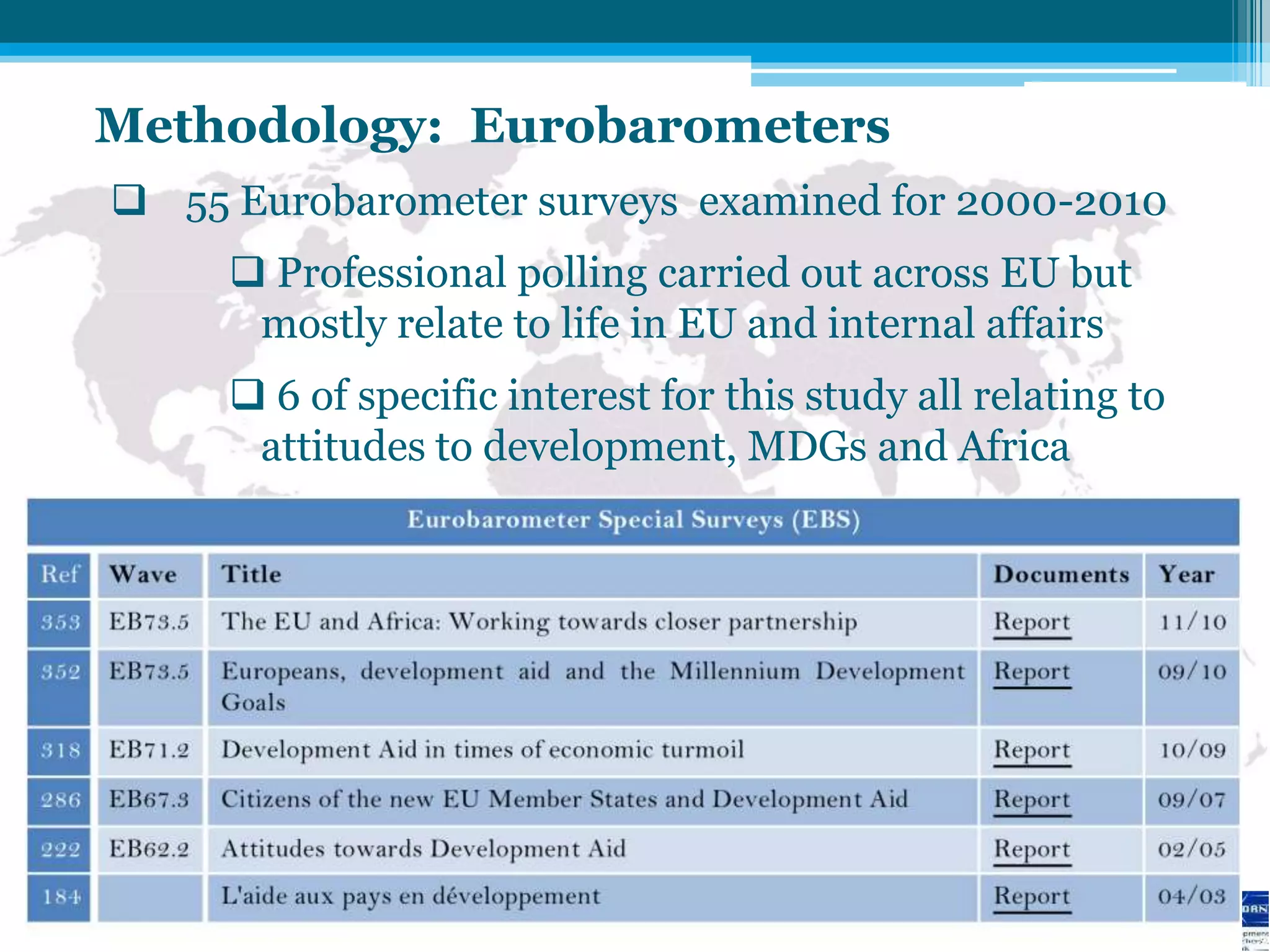
 55 Eurobarometer surveys examined for 2000-2010
      Professional polling carried out across EU but
      mostly relate to life in EU and internal affairs
      6 of specific interest for this study all relating to
      attitudes to development, MDGs and Africa
23
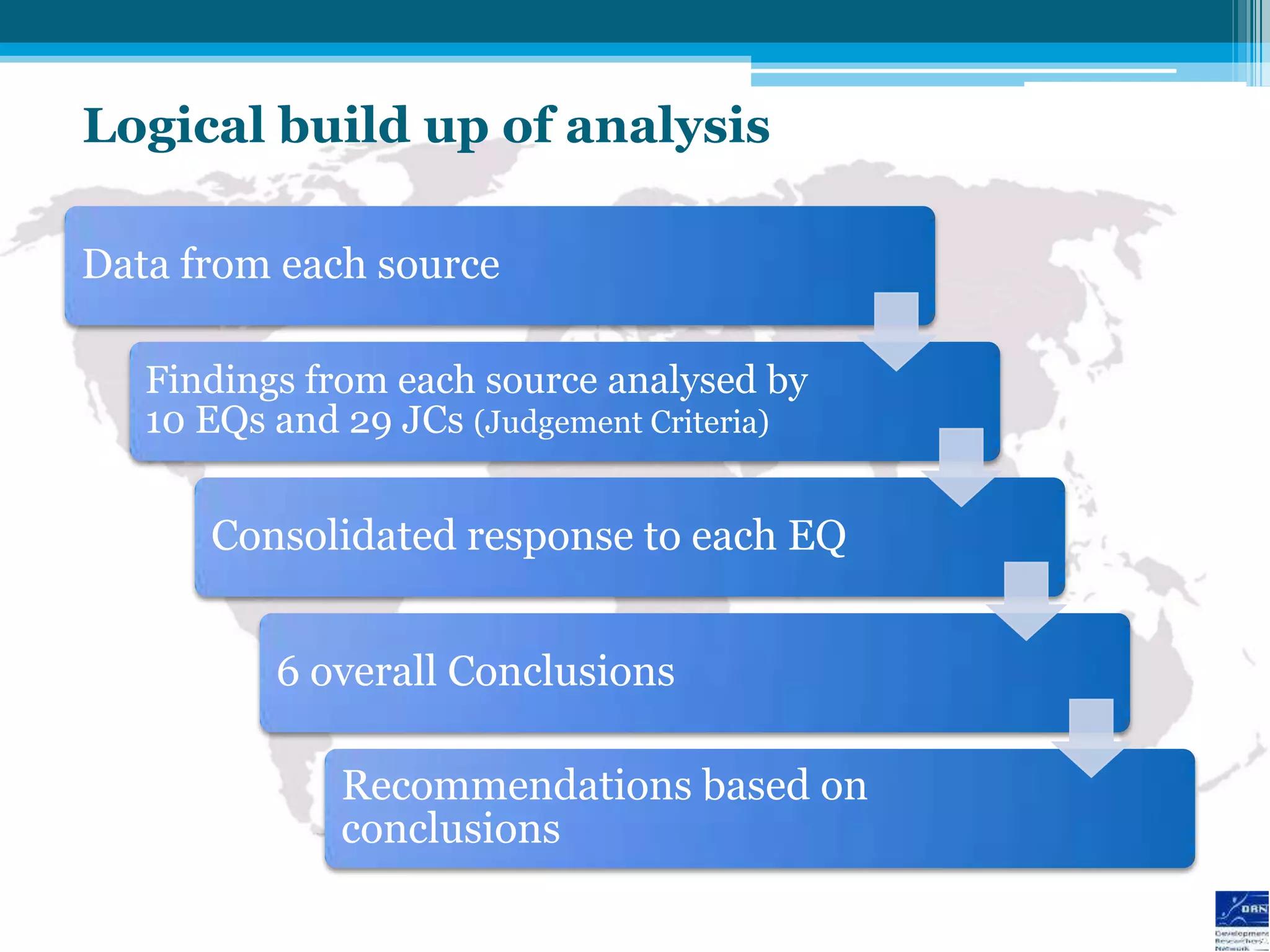
Logical build up of analysis

Data from each source

   Findings from each source analysed by
   10 EQs and 29 JCs (Judgement Criteria)


      Consolidated response to each EQ


          6 overall Conclusions

              Recommendations based on
              conclusions
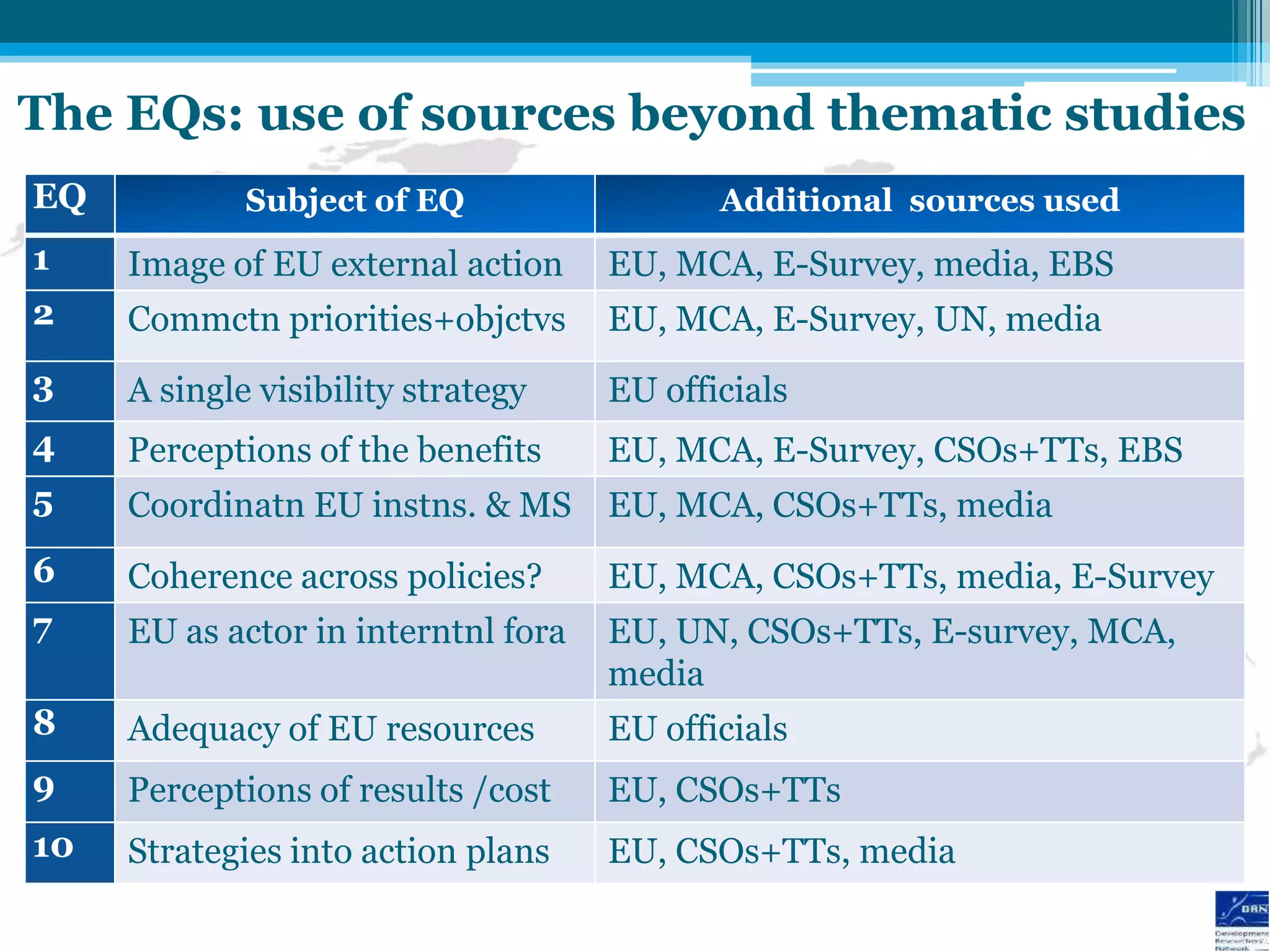
The EQs: use of sources beyond thematic studies
EQ           Subject of EQ                  Additional sources used
1    Image of EU external action     EU, MCA, E-Survey, media, EBS
2    Commctn priorities+objctvs      EU, MCA, E-Survey, UN, media
3    A single visibility strategy    EU officials
4    Perceptions of the benefits     EU, MCA, E-Survey, CSOs+TTs, EBS
5    Coordinatn EU instns. & MS      EU, MCA, CSOs+TTs, media
6    Coherence across policies?      EU, MCA, CSOs+TTs, media, E-Survey
7    EU as actor in interntnl fora   EU, UN, CSOs+TTs, E-survey, MCA,
                                     media
8    Adequacy of EU resources        EU officials
9    Perceptions of results /cost    EU, CSOs+TTs
10   Strategies into action plans    EU, CSOs+TTs, media
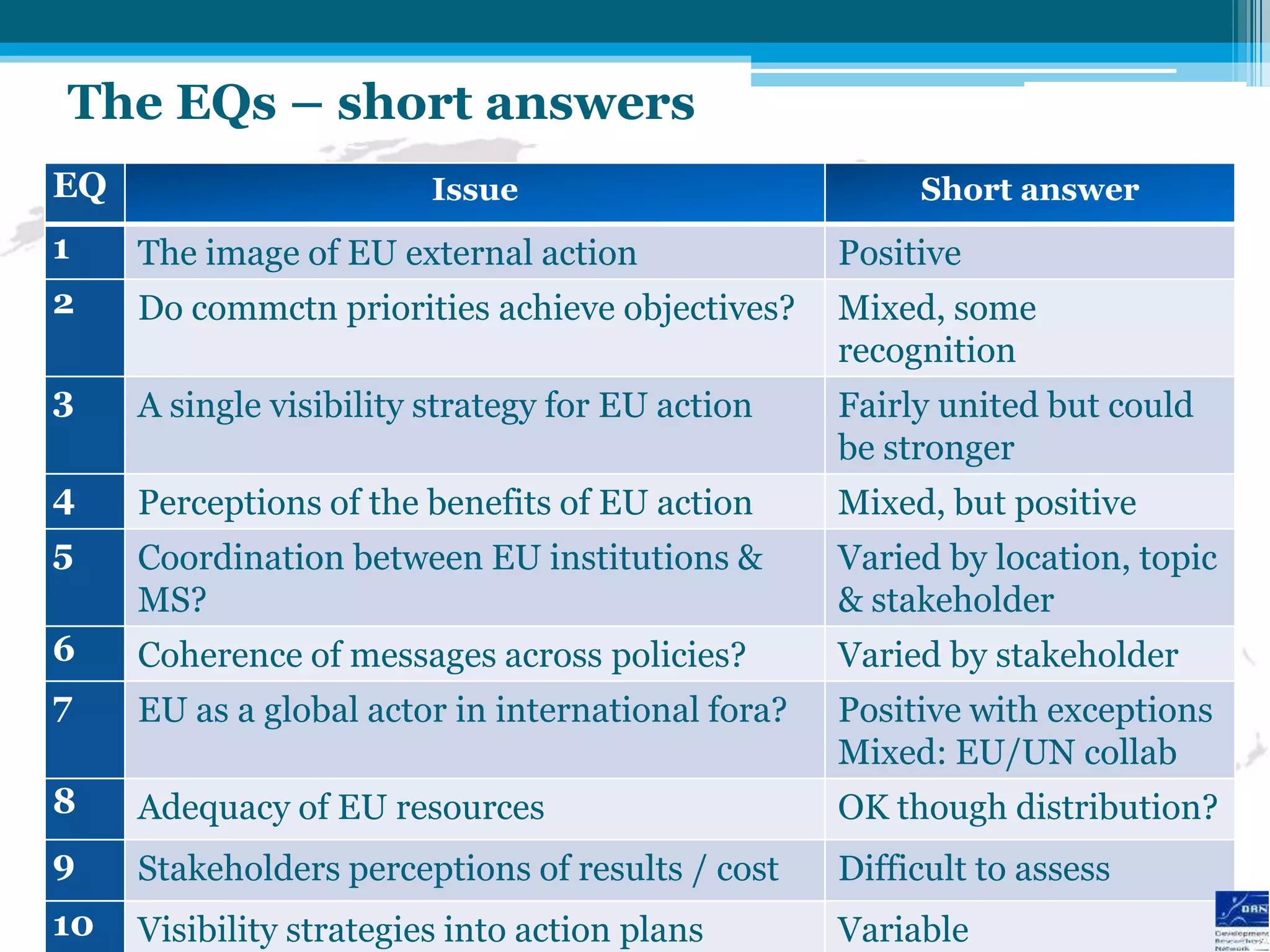
The EQs – short answers
EQ                       Issue                          Short answer
1    The image of EU external action               Positive
2    Do commctn priorities achieve objectives?     Mixed, some
                                                   recognition
3    A single visibility strategy for EU action    Fairly united but could
                                                   be stronger
4    Perceptions of the benefits of EU action      Mixed, but positive
5    Coordination between EU institutions &        Varied by location, topic
     MS?                                           & stakeholder
6    Coherence of messages across policies?        Varied by stakeholder
7    EU as a global actor in international fora?   Positive with exceptions
                                                   Mixed: EU/UN collab
8    Adequacy of EU resources                      OK though distribution?
9    Stakeholders perceptions of results / cost    Difficult to assess
10   Visibility strategies into action plans       Variable
27
Conclusions
1.   The image of EU external action is in line with pre-
     Lisbon priorities for external action communication
2. Communication on EU external action lacks overall
   direction and leadership
3. Working in partnership with others is essential but
   there is a trade-off in lower EU visibility
4. The image of EU external action varies geographically
   as well as by constituency
5. The nature of the EU imposes constraints that impact
   on its visibility
6. The resources for promoting the visibility of EU
   external action are adequate
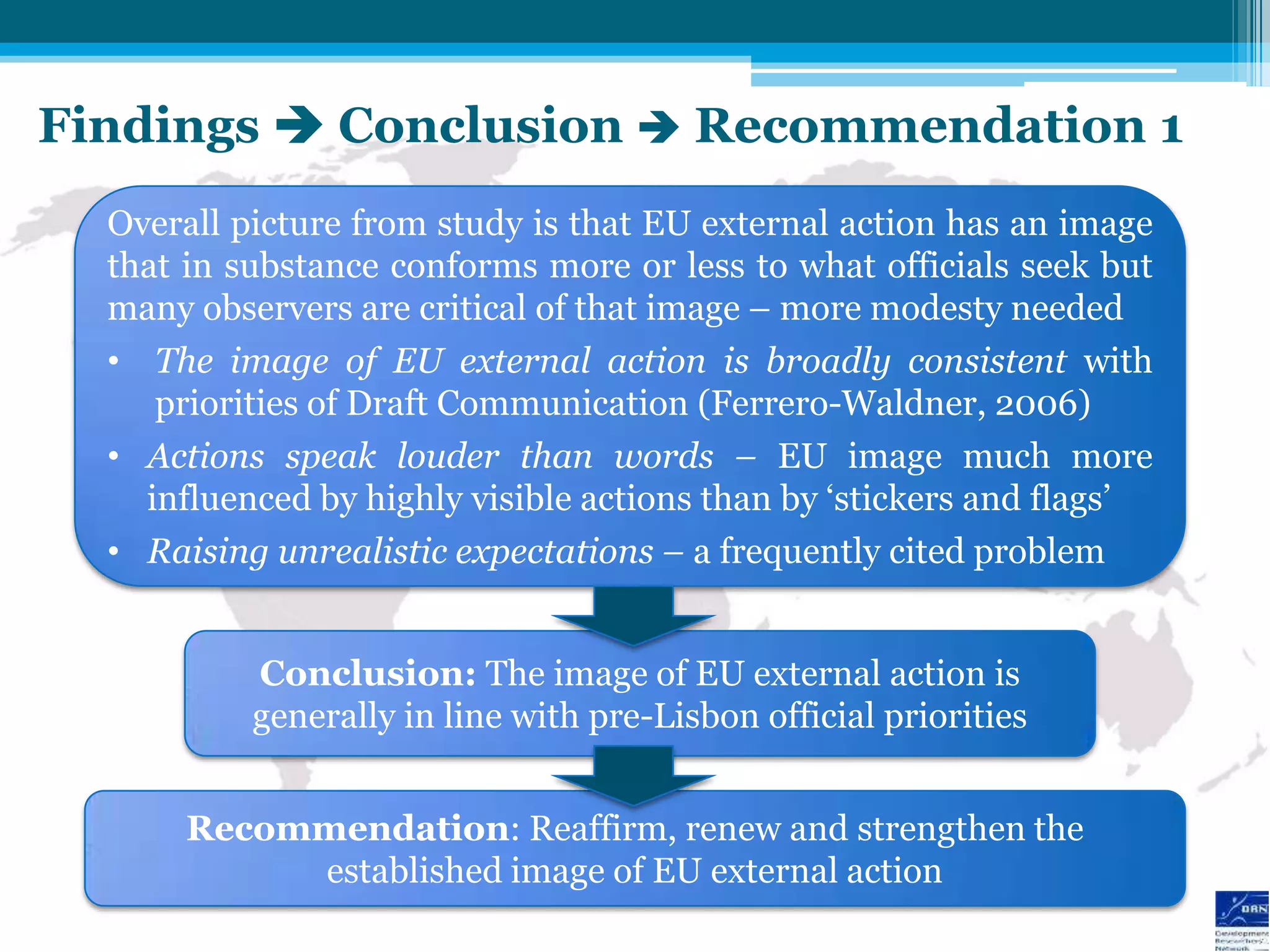
Findings  Conclusion  Recommendation 1
  Overall picture from study is that EU external action has an image
  that in substance conforms more or less to what officials seek but
  many observers are critical of that image – more modesty needed
  • The image of EU external action is broadly consistent with
     priorities of Draft Communication (Ferrero-Waldner, 2006)
  • Actions speak louder than words – EU image much more
    influenced by highly visible actions than by „stickers and flags‟
  • Raising unrealistic expectations – a frequently cited problem


           Conclusion: The image of EU external action is
           generally in line with pre-Lisbon official priorities


       Recommendation: Reaffirm, renew and strengthen the
            established image of EU external action
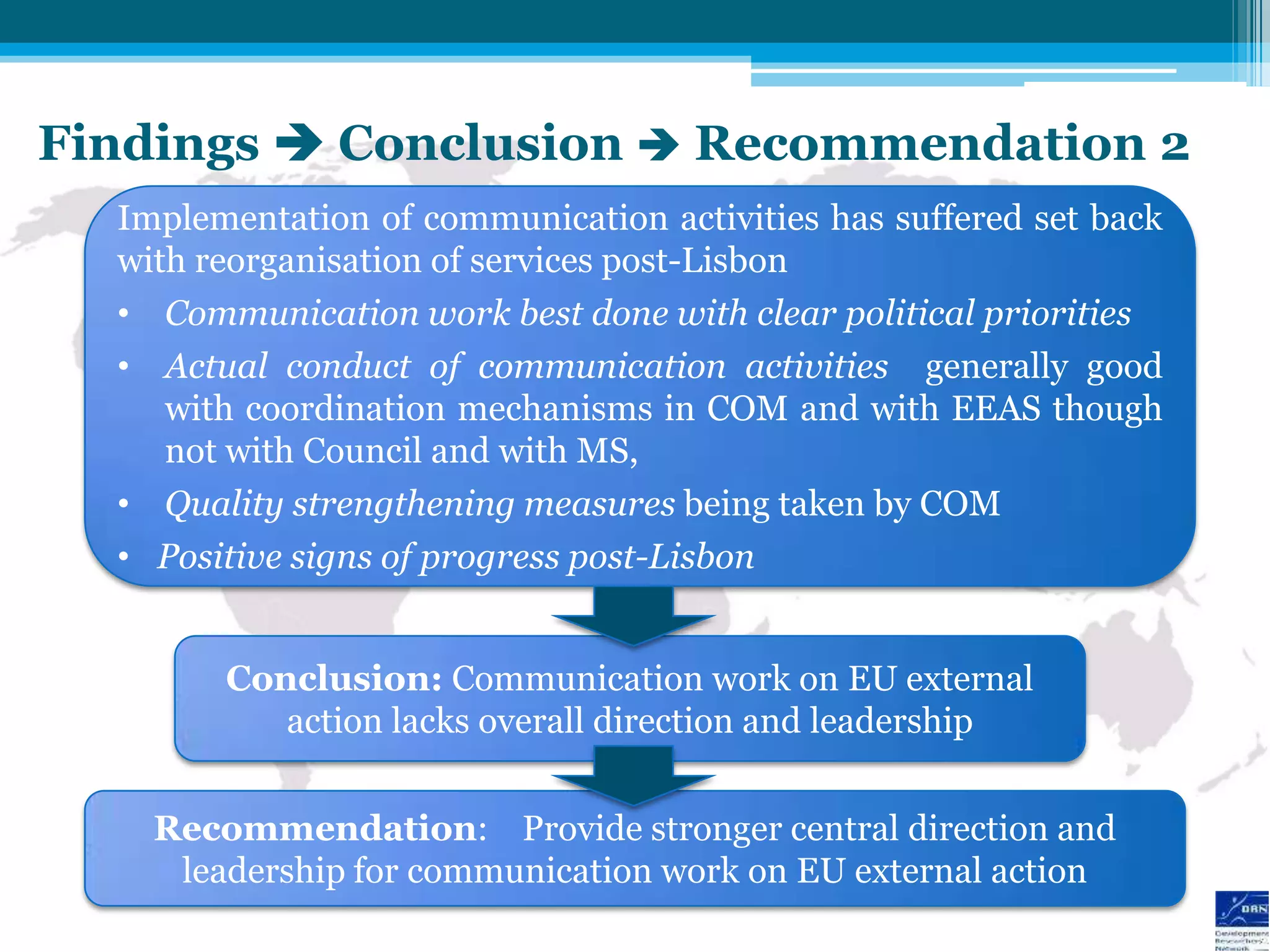
Findings  Conclusion  Recommendation 2
  Implementation of communication activities has suffered set back
  with reorganisation of services post-Lisbon
  • Communication work best done with clear political priorities
  • Actual conduct of communication activities generally good
     with coordination mechanisms in COM and with EEAS though
     not with Council and with MS,
  • Quality strengthening measures being taken by COM
  • Positive signs of progress post-Lisbon


        Conclusion: Communication work on EU external
           action lacks overall direction and leadership


    Recommendation: Provide stronger central direction and
     leadership for communication work on EU external action
Findings  Conclusion  Recommendation 3
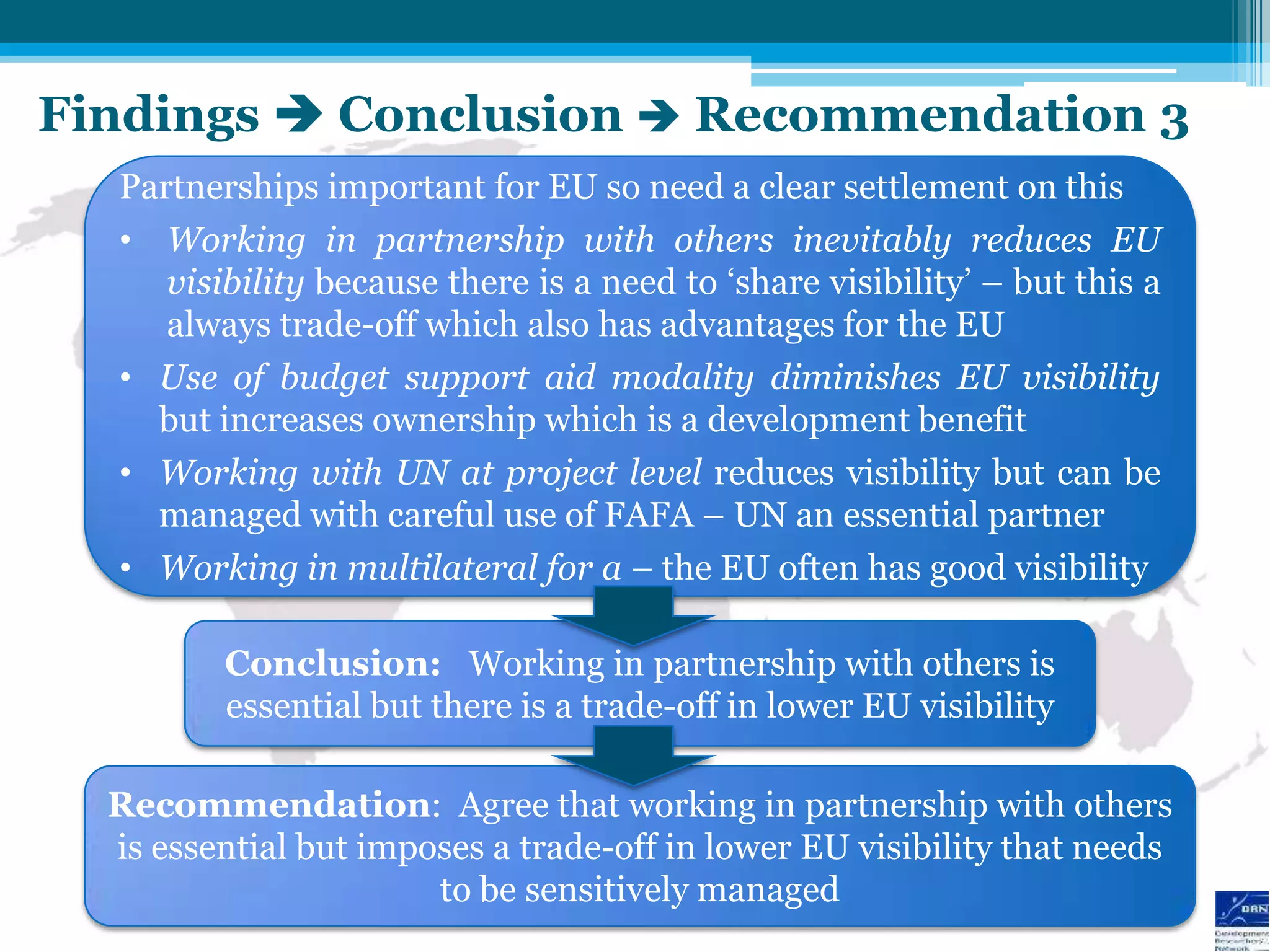
  Partnerships important for EU so need a clear settlement on this
  • Working in partnership with others inevitably reduces EU
     visibility because there is a need to „share visibility‟ – but this a
     always trade-off which also has advantages for the EU
  • Use of budget support aid modality diminishes EU visibility
    but increases ownership which is a development benefit
  • Working with UN at project level reduces visibility but can be
    managed with careful use of FAFA – UN an essential partner
  • Working in multilateral for a – the EU often has good visibility

         Conclusion: Working in partnership with others is
         essential but there is a trade-off in lower EU visibility

  Recommendation: Agree that working in partnership with others
  is essential but imposes a trade-off in lower EU visibility that needs
                       to be sensitively managed
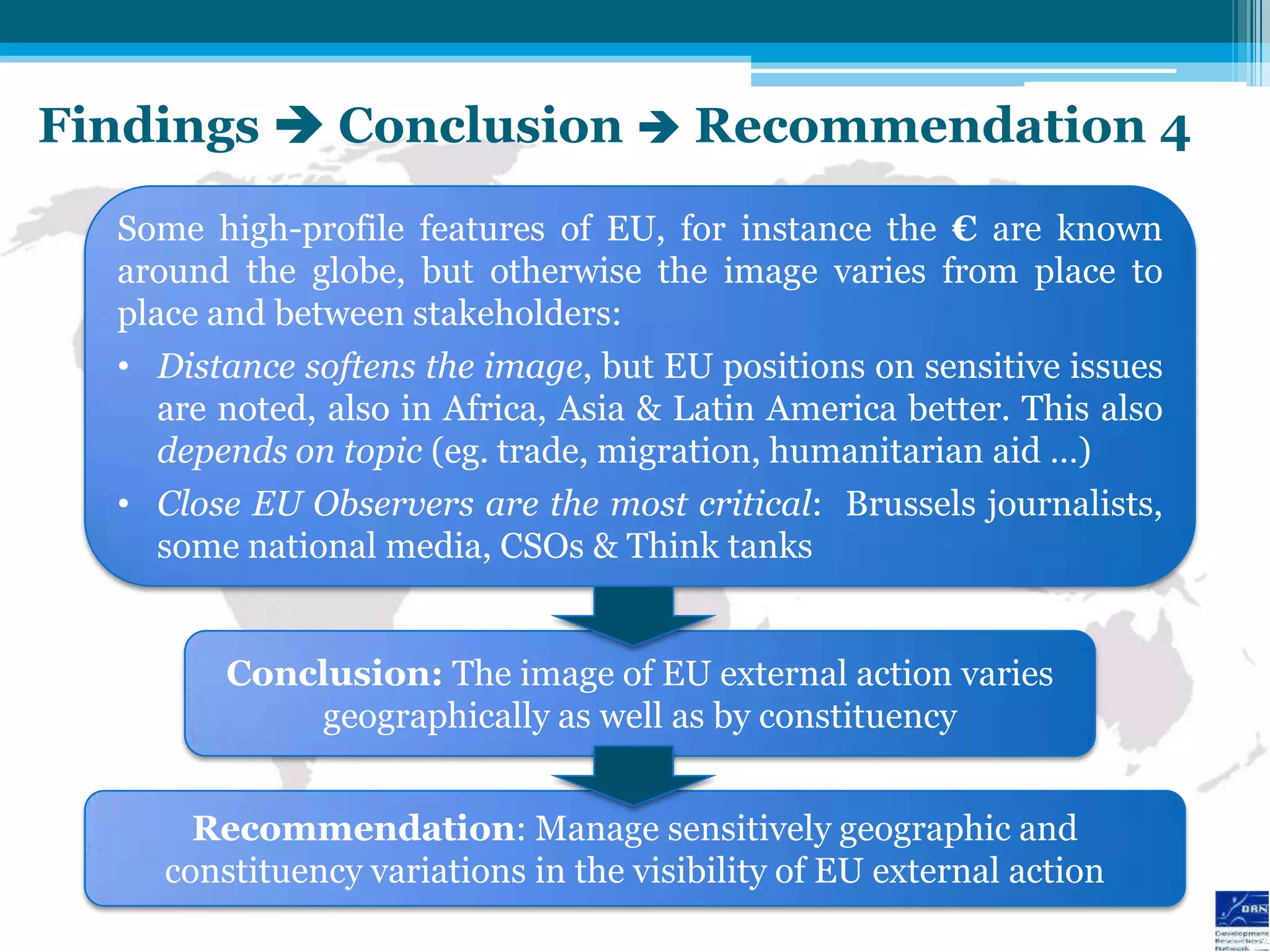
Findings  Conclusion  Recommendation 4
  Some high-profile features of EU, for instance the € are known
  around the globe, but otherwise the image varies from place to
  place and between stakeholders:
  • Distance softens the image, but EU positions on sensitive issues
     are noted, also in Africa, Asia & Latin America better. This also
     depends on topic (eg. trade, migration, humanitarian aid …)
  • Close EU Observers are the most critical: Brussels journalists,
     some national media, CSOs & Think tanks


         Conclusion: The image of EU external action varies
             geographically as well as by constituency


       Recommendation: Manage sensitively geographic and
     constituency variations in the visibility of EU external action
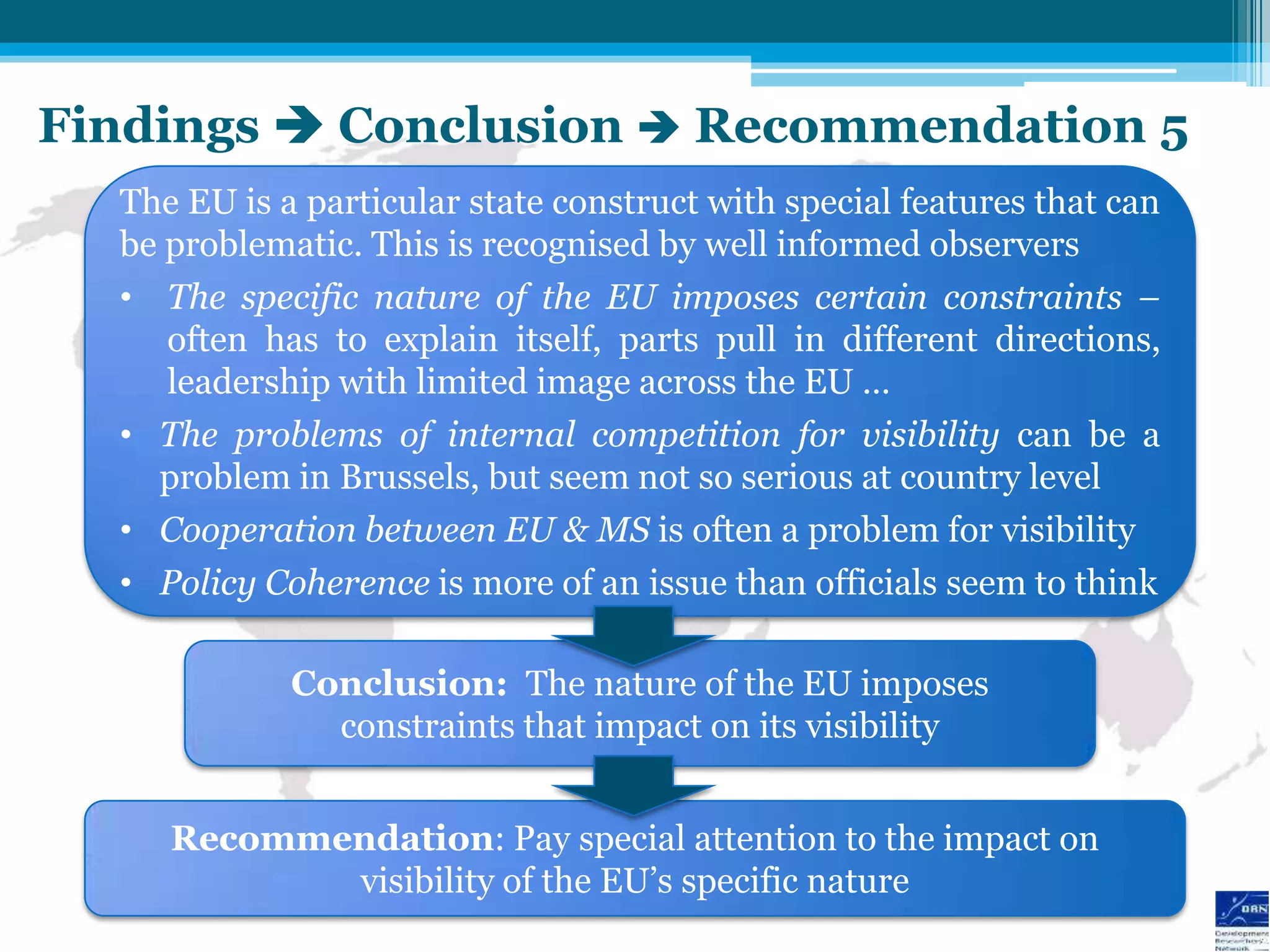
Findings  Conclusion  Recommendation 5
  The EU is a particular state construct with special features that can
  be problematic. This is recognised by well informed observers
  • The specific nature of the EU imposes certain constraints –
     often has to explain itself, parts pull in different directions,
     leadership with limited image across the EU …
  • The problems of internal competition for visibility can be a
    problem in Brussels, but seem not so serious at country level
  • Cooperation between EU & MS is often a problem for visibility
  • Policy Coherence is more of an issue than officials seem to think

             Conclusion: The nature of the EU imposes
               constraints that impact on its visibility


     Recommendation: Pay special attention to the impact on
            visibility of the EU‟s specific nature
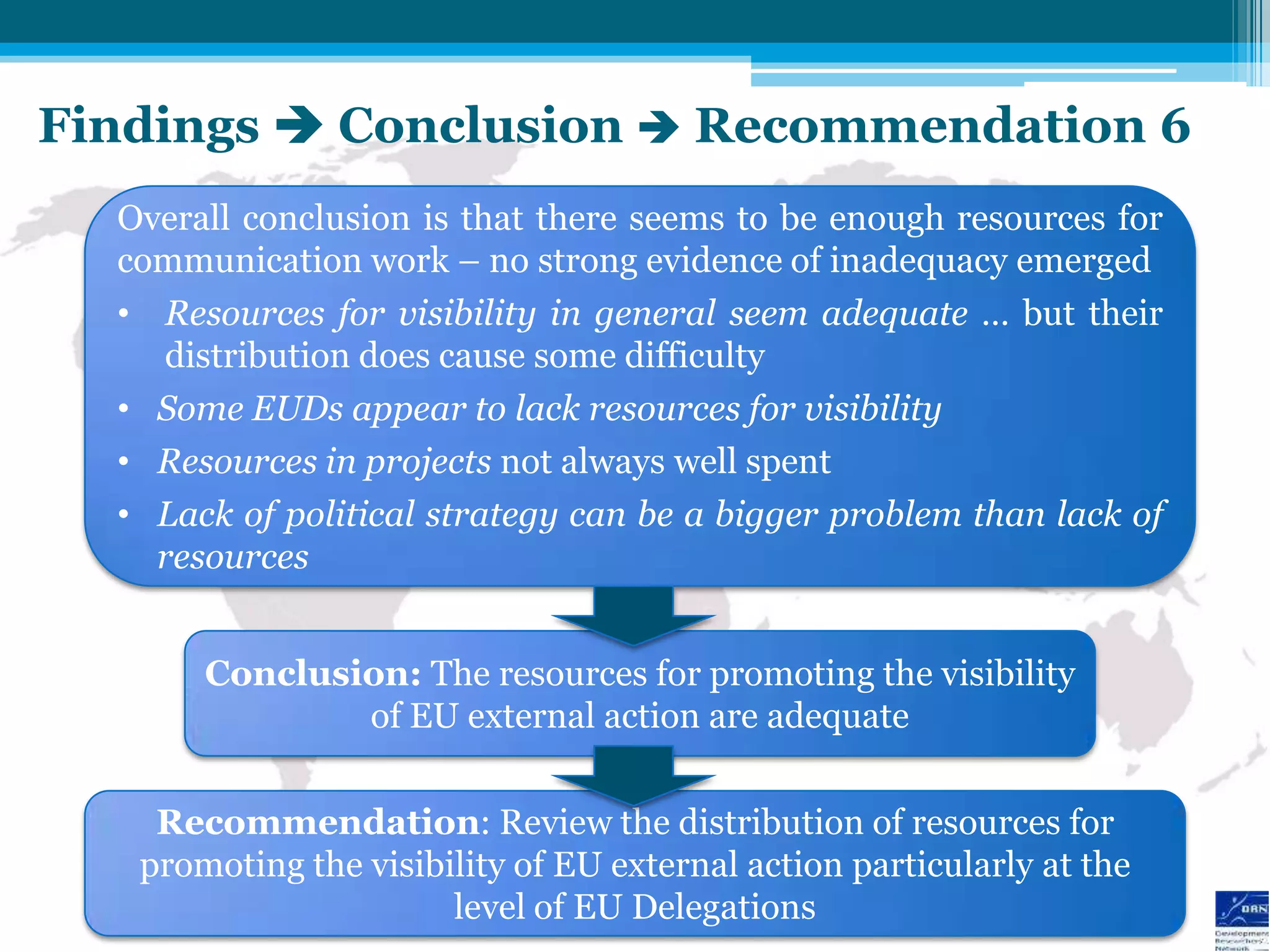
Findings  Conclusion  Recommendation 6
  Overall conclusion is that there seems to be enough resources for
  communication work – no strong evidence of inadequacy emerged
  • Resources for visibility in general seem adequate … but their
    distribution does cause some difficulty
  • Some EUDs appear to lack resources for visibility
  • Resources in projects not always well spent
  • Lack of political strategy can be a bigger problem than lack of
    resources


       Conclusion: The resources for promoting the visibility
               of EU external action are adequate


    Recommendation: Review the distribution of resources for
   promoting the visibility of EU external action particularly at the
                       level of EU Delegations
Recommendations
1.   Reaffirm, renew and strengthen the established image of
     EU external action
2.   Provide stronger central direction and leadership for
     communication work on EU external action
3.   Agree that „working in partnership‟ with others is
     essential but imposes a trade-off in lower EU visibility
     that needs to be sensitively managed
4.   Manage sensitively geographic and constituency
     variations in the visibility of EU external action
5.   Pay special attention to the impact on visibility of the
     EU‟s specific nature
6.   Review the distribution of resources for communication
     work particularly at the country level
For more information:
James Mackie – Team Leader (ECDPM) - jm@ecdpm.org
Volker Hauck – Communication (ECDPM) – vh@ecdpm.org
Andrew Sherriff – Conflict Theme (ECDPM) – as@ecdpm.org

Thematic evaluation of the visability of EU External Action

  • 1.
    Thematic evaluation ofthe Visibility of EU External Action - Presentation of the Final Report Dissemination Seminar, 7th September. 2012 9.15-14.30, Centre Albert Borschette, Brussels (Evaluation managed by DRN and led by ECDPM)
  • 2.
    Content of thepresentation  Introduction  Methodological approach  Main findings and analysis  Conclusions and recommendations
  • 3.
  • 4.
    Introduction: the EvaluationTeam  James Mackie – Team Leader (ECDPM)  Federica Petrucci – Evaluation Manager & Expert Migration Theme (DRN)  Volker Hauck (ECDPM) & Raphael Brigandi – Communication  Andrew Sherriff – Expert Conflict Theme (ECDPM)  Mark Kowal – Expert Climate Change Theme  Ivo Morawski – Expert Environment Theme (DRN)  Isabella Massa – Expert Financial Crisis Theme (ODI)  Pierre van Roosbroek – Expert Food Crisis Theme  Bent Bonde – Communication & Tunisia Case Study  Sara Monti – Evaluation Assistant (DRN) In Bold: Team members present in the Seminar
  • 5.
    Introduction: the Mandate Evaluation for 3 „Relex DGs‟: RELEX, DEV & AIDCO (External Relations, Development & EuropeAid)  Terms of Reference (February 2010): the purpose:  To provide an overall independent assessment of the visibility of the Commission’s external action;  To identify key lessons to improve current and future Commission strategies on visibility.  Period covered: 2006-2011  Geographic scope: Global (except Balkans)  Starting point in policy terms:  2006 Draft Communication from the Relex Commissioner Mrs Benita Ferrero-Waldner: “The EU in the World: Towards a Communication Strategy for the European Union’s External Policy, 2006-2009” (C[2006]329)
  • 6.
    Policy position  Communicationchallenges identified in 2006 Draft Comm:  Global solidarity, Enlargement, ENP (Neighbourhood policy), Africa, Strategic bilateral relationships  Official documents show that Visibility is seen as:  Consequence of EC actions among other things  Evolves from static Visibility concept (logos & stickers, etc.) towards a dynamic Visibility influenced by actions  Is linked to democratic accountability internally and mutual accountability externally  Outside the EU – the objective is to explain to current and potential opinion-formers the EU‟s policies and activities and values and objectives
  • 7.
    7 Definition of Visibility… Definition agreed with Commission stakeholder “Reference Group”  …“The awareness and perception of the image of EU external action among EU and non-EU stakeholders resulting from EU communication activities or from other actions that have an impact on this image”.  Underlines  Message conveyed ≠ message perceived  Work of EU communication activities, but also  Impact of other actions and events  Also keep in mind  Importance of mass media in shaping perceptions
  • 8.
    8 The Communication Prism •Intended visibility Visibility from Relex Group actually Commissioners or • Different values and achieved HR/VP What perspectives • Intended target measures • Changed taken? circumstances • Awareness of groups EU external • Messages • Contrasting action communicated by • Communication message & reality and public • How is its EC external action • Opinions of social & image diplomacy professional • Messages activities perceived? communicated by networks • Policies, • How are EU‟s rest of EC, EP, • Conflicts between values Council and MS programmes, needs, policies, & projects and appropriated? deliverables other actions Intended visibility in strategic documents What refraction caused by prism ?
  • 9.
  • 10.
    Methodology  First step:agree on list of Evaluation Questions with the Commission stakeholders (Reference Group) :  Based on TOR + limited in number to focus the study  Agreed on 10 Evaluation Questions (EQ):  EQ 1, 2 & 4: Audience perceptions of EU external action and the quality of theses actions  EQ3: Internal unity of purpose on visibility in the Commission  EQ 5 & 6: Issues of inter-institution collaboration on visibility and coherence  EQ 7, 8 & 9: Resources and implementation  For each worked out Judgement Criteria (JC) + Indicators
  • 11.
    The Evaluation Questions– shortened version EQ Issue EQ 1 The image of EU external action EQ 2 Do the Visibility communication priorities achieve their objectives? EQ 3 A single, clearly defined visibility strategy for EU external action? EQ 4 Perceptions of the benefits of EU external action EQ 5 Coordination on visibility between the EU institutions and with the EU member states? EQ6 Coherence of messages across external and internal policies? EQ 7 Value added of EU as a global actor in major international fora? EQ 8 Adequacy of EU resources to carry out the visibility strategy? EQ 9 Stakeholders perceptions of results relative to cost EQ 10 Translating visibility strategies into action plans
  • 12.
    Methodological approach toresearch Complementarity + Other tools with Thematic Studies of data sources different coverage (principle data collection exercise) Examples: Media EQ table used Coverage Analysis 2 levels: choice of as common data (MCA), E-Survey, countries & choice of presentation Specific events, programmes/events tool etc. Evidence then aggregated per EQ to give one answer for each EQ
  • 13.
    Methodology: the sourcesof evidence 6 Thematic Studies – CSO interviews multiple Journalists in in Brussels – sources for Brussels – key critical well one theme & conduit into informed one country media source E-Survey – CSO Eurobarometers views from – professional around the opinion polls of world EU citizens Data Collected Case studies of MCA – EU print events – data on media views of 2 how EU reacted areas of EU to 2 unplanned external action events Strategic EU officials Partnership – data on relations interviews with one key partner: the UN
  • 15.
    Methodology: the sixThematic Studies Thematic cases Countries Specific EC/ EU (field work) programme/event Conflict & fragile states Georgia - Climate change & energy Cambodia GCCA Environment, biodiversity & Indonesia FLEGT deforestation Migration Mali CIGEM Italy Lampedusa Financial & economic crisis Grenada & V-FLEX Barbados Food crisis & food security Kenya Food Facility
  • 16.
    Methodology: the sixThematic Studies (2)  Key party of study and main data gathering exercise  Prior desk research from Europe on EU‟s engagement on thematic issue Selection of country and of programme / event  In–country visits – these typically included  Interviews with EU Delegation and other EU representatives, government ministries, donor representatives including EU member state embassies and UN, media and CSOs  Visits to funded projects/programmes  Local media coverage analysis  Individual Thematic Reports – all published
  • 17.
    Methodology: MCA –Media coverage analysis
  • 18.
    Methodology: MCA –Media coverage analysis  Systematic and objective look at print media portrayal of EU external action  Searches done on 20 EU newspapers & 1 external (NYT)  Based on key words & defined periods  Little international coverage on most cases, but two very successful: Georgia (603 articles) + Tunisia (165) Country 20 European Newspapers FR La Croix, Le Figaro, Le Monde, Liberation DE Bild Zeitung (online version) Frankfurter Allgemeine, Frankfurter Rundschau, Süddeutsche Zeitung, Die Welt UK Daily Mail, Daily Telegraph, Financial Times, The Guardian DK Berlingske, Information, Jyllands-Posten, Politiken PL Gazeta Wyborcza, Rzeczpospolita, Superexpress
  • 19.
    Methodology: Interviews  Some260 interviews conducted in total: in 6 field mission countries, + Tunisia, Italy and in Brussels:  In Brussels structured interviews with 3 principal groups  EU Institution officials in RELEX, DEV, AIDCO, Council Secretariat, DEVCO, DG COMM, EEAS, EP secretariat press service (before and after Lisbon changes)  Media: dozen journalists both European & foreign  Very well informed and critical group – act as filter to messages across Europe  CSO & Think Tanks representatives (13)  Another well informed group with extensive networks across Europe and around the world
  • 20.
    Methodology: E-Survey  Wellinformed actors, only exercise with global coverage  Focus on civil society – 4,031 addresses world wide  E-mail invitation to go on to an internet survey site  Response rate: just over 5% (221) – normal rate  Simplified version of 4 EQs used: EQ1, EQ4, EQ6 & EQ7  Respondent characteristics  Type respondent: 40% NGOs, 40% Academics …  Geographic spread: 60% Europe, 28% Africa …  68% senior staff members, 27% middle level  57% claimed high familiarity with EU external action & 38% average familiarity …
  • 21.
    Methodology: Case Studies Strategic Partnership: UN-EU partnership  Based on documents, web-sites and interviews  Two unplanned events – what EU reactions  Lampedusa – inflow of migrants in early 2011  Internal event but with impact on EU‟s external image  Tunisia – the EU & the democratic uprising  External event to which EU had to react and calling into question past EU external action  Based on media coverage analysis & interviews
  • 22.
    Methodology: Eurobarometers  55Eurobarometer surveys examined for 2000-2010  Professional polling carried out across EU but mostly relate to life in EU and internal affairs  6 of specific interest for this study all relating to attitudes to development, MDGs and Africa
  • 23.
  • 24.
    Logical build upof analysis Data from each source Findings from each source analysed by 10 EQs and 29 JCs (Judgement Criteria) Consolidated response to each EQ 6 overall Conclusions Recommendations based on conclusions
  • 25.
    The EQs: useof sources beyond thematic studies EQ Subject of EQ Additional sources used 1 Image of EU external action EU, MCA, E-Survey, media, EBS 2 Commctn priorities+objctvs EU, MCA, E-Survey, UN, media 3 A single visibility strategy EU officials 4 Perceptions of the benefits EU, MCA, E-Survey, CSOs+TTs, EBS 5 Coordinatn EU instns. & MS EU, MCA, CSOs+TTs, media 6 Coherence across policies? EU, MCA, CSOs+TTs, media, E-Survey 7 EU as actor in interntnl fora EU, UN, CSOs+TTs, E-survey, MCA, media 8 Adequacy of EU resources EU officials 9 Perceptions of results /cost EU, CSOs+TTs 10 Strategies into action plans EU, CSOs+TTs, media
  • 26.
    The EQs –short answers EQ Issue Short answer 1 The image of EU external action Positive 2 Do commctn priorities achieve objectives? Mixed, some recognition 3 A single visibility strategy for EU action Fairly united but could be stronger 4 Perceptions of the benefits of EU action Mixed, but positive 5 Coordination between EU institutions & Varied by location, topic MS? & stakeholder 6 Coherence of messages across policies? Varied by stakeholder 7 EU as a global actor in international fora? Positive with exceptions Mixed: EU/UN collab 8 Adequacy of EU resources OK though distribution? 9 Stakeholders perceptions of results / cost Difficult to assess 10 Visibility strategies into action plans Variable
  • 27.
  • 28.
    Conclusions 1. The image of EU external action is in line with pre- Lisbon priorities for external action communication 2. Communication on EU external action lacks overall direction and leadership 3. Working in partnership with others is essential but there is a trade-off in lower EU visibility 4. The image of EU external action varies geographically as well as by constituency 5. The nature of the EU imposes constraints that impact on its visibility 6. The resources for promoting the visibility of EU external action are adequate
  • 29.
    Findings  Conclusion Recommendation 1 Overall picture from study is that EU external action has an image that in substance conforms more or less to what officials seek but many observers are critical of that image – more modesty needed • The image of EU external action is broadly consistent with priorities of Draft Communication (Ferrero-Waldner, 2006) • Actions speak louder than words – EU image much more influenced by highly visible actions than by „stickers and flags‟ • Raising unrealistic expectations – a frequently cited problem Conclusion: The image of EU external action is generally in line with pre-Lisbon official priorities Recommendation: Reaffirm, renew and strengthen the established image of EU external action
  • 30.
    Findings  Conclusion Recommendation 2 Implementation of communication activities has suffered set back with reorganisation of services post-Lisbon • Communication work best done with clear political priorities • Actual conduct of communication activities generally good with coordination mechanisms in COM and with EEAS though not with Council and with MS, • Quality strengthening measures being taken by COM • Positive signs of progress post-Lisbon Conclusion: Communication work on EU external action lacks overall direction and leadership Recommendation: Provide stronger central direction and leadership for communication work on EU external action
  • 31.
    Findings  Conclusion Recommendation 3 Partnerships important for EU so need a clear settlement on this • Working in partnership with others inevitably reduces EU visibility because there is a need to „share visibility‟ – but this a always trade-off which also has advantages for the EU • Use of budget support aid modality diminishes EU visibility but increases ownership which is a development benefit • Working with UN at project level reduces visibility but can be managed with careful use of FAFA – UN an essential partner • Working in multilateral for a – the EU often has good visibility Conclusion: Working in partnership with others is essential but there is a trade-off in lower EU visibility Recommendation: Agree that working in partnership with others is essential but imposes a trade-off in lower EU visibility that needs to be sensitively managed
  • 32.
    Findings  Conclusion Recommendation 4 Some high-profile features of EU, for instance the € are known around the globe, but otherwise the image varies from place to place and between stakeholders: • Distance softens the image, but EU positions on sensitive issues are noted, also in Africa, Asia & Latin America better. This also depends on topic (eg. trade, migration, humanitarian aid …) • Close EU Observers are the most critical: Brussels journalists, some national media, CSOs & Think tanks Conclusion: The image of EU external action varies geographically as well as by constituency Recommendation: Manage sensitively geographic and constituency variations in the visibility of EU external action
  • 33.
    Findings  Conclusion Recommendation 5 The EU is a particular state construct with special features that can be problematic. This is recognised by well informed observers • The specific nature of the EU imposes certain constraints – often has to explain itself, parts pull in different directions, leadership with limited image across the EU … • The problems of internal competition for visibility can be a problem in Brussels, but seem not so serious at country level • Cooperation between EU & MS is often a problem for visibility • Policy Coherence is more of an issue than officials seem to think Conclusion: The nature of the EU imposes constraints that impact on its visibility Recommendation: Pay special attention to the impact on visibility of the EU‟s specific nature
  • 34.
    Findings  Conclusion Recommendation 6 Overall conclusion is that there seems to be enough resources for communication work – no strong evidence of inadequacy emerged • Resources for visibility in general seem adequate … but their distribution does cause some difficulty • Some EUDs appear to lack resources for visibility • Resources in projects not always well spent • Lack of political strategy can be a bigger problem than lack of resources Conclusion: The resources for promoting the visibility of EU external action are adequate Recommendation: Review the distribution of resources for promoting the visibility of EU external action particularly at the level of EU Delegations
  • 35.
    Recommendations 1. Reaffirm, renew and strengthen the established image of EU external action 2. Provide stronger central direction and leadership for communication work on EU external action 3. Agree that „working in partnership‟ with others is essential but imposes a trade-off in lower EU visibility that needs to be sensitively managed 4. Manage sensitively geographic and constituency variations in the visibility of EU external action 5. Pay special attention to the impact on visibility of the EU‟s specific nature 6. Review the distribution of resources for communication work particularly at the country level
  • 36.
    For more information: JamesMackie – Team Leader (ECDPM) - jm@ecdpm.org Volker Hauck – Communication (ECDPM) – vh@ecdpm.org Andrew Sherriff – Conflict Theme (ECDPM) – as@ecdpm.org