TOPIC: ARDUINO BASED SMART
FIREFGHTING ROBOT CAR
ID: 8004. NAME: Abdulkarim Salah Ahmed
ID: 8355. NAME: Feisal Sheikh Mohamed
ID: 8291 NAME: Abdurizack Bashir Hassan
ID: 8114. NAME: Mohamed Dahir Abdi
ID: 8148. NAME: Mohamed
ID: 7819. NAME: Halima Dahir Ali
 INTRODUCTION
 PROBLEM STATEMENT
 PURPOSE&OBJECTIVES
 SCOPE OF THE PROJECT
 SIGNIFICANCE OF THE PROJECT
 COMPARE B/W EXISTING SYSTEM
 OPERATIONAL FRAME WORK
 SYTEM REQUIREMENT
 PROBLEM ANALYSIS IDENTIFICATION
 REQUIREMENT GETHARING TECHNIQUES
 PROCESS MODELING(DFD/UML)
 DATA MODELING(ERD)
 SYSTEM FEASIBILITY
CONTENTS
 The Fire fighting Robot is a small, portable
emergency responder robot that aids fire-fighters
in putting out high-rise fires, particularly in
extremely hazardous situations where people
cannot enter.
 The robot is used for fire detection and
extinguishing it without the interference of human
help , the robot is built for helping people in fire
prone areas in order to reduce damages caused by
fire.
Fire fighting robot is a small prototype
machine built using Arduino and Flame
Sensor & L298N Motor Driver, it
provides automatic detection of fire
from a small distance and extinguishes it
without a lot of damages.
 Fire is a big problem in our society, which causes
loss of life and property, our community does not
receive fire-fighting assistance when there is a
fire in commercial areas, homes, farms and so on.
it destroys economic infrastructure and
commercial buildings. There are not many
companies working in our country that participate
in fire-fighting.
 There is a huge economic impact that fire
brings to our society. Fire is also a serious
threat to the lives of fire-fighters. They find it
extremely challenging to reach certain areas
that could harm them due to high temperatures
or the presence of explosives.
 . If we do not find a sustainable solution to the
problems that fire poses to society, the huge
losses caused by fire will continue and the
situation will get worse.
 This robot will reduce the spread of fire, as
well as prevent the economic and human losses
caused by fire. The proposed robot will be able
to move faster and easily through lowest spaces
and thus enabling it to be more efficient.
 The purpose of the project is to create an
automatic fire fighting robot that will ease
the work of fire-fighters, Detect when there
is fire in the house or in the area, Extinguish
the fire without causing any damage in the
area.
General Objective
To develop and design a firefighting
robot through using Arduino
microcontroller.
To develop a fire
fighting robot which
equipped with fire
sensors that will
detect fire from a
calculated distance.
To detect fire from
a certain distance
and extinguish the
fire upon arrival.
To reduce the
spread of fire, as
well as prevent the
economic and
human losses
caused by fire.
 Content scope
Our project is about a fire-fighting robot that prevents fire, if fire
breaks out, the robot will quickly extinguish the fire and the
damage caused by fire will be reduced.
 Geographical scope
Geographically, the robot will be developed in Mogadishu
Somalia Particularly Shangaani District.
 Time scope
Since this is our final thesis for the Undergraduate level, within
the last two semester starting from October 2023 up to July 2024.
 The project is being innovated for future
advancement because we all understand the
damages that fire brings in our region with is lack
of proper infrastructure for the human operated fire
fighting vehicles, it takes a lot of time for them to
detect and arrive at the fire prone areas.
 To avoid the wasting of resources, lives and
damaging the property we ought to come with an
alternative that is capable of doing the task without
costing us our lives and the precious lives of the
firemen who always put themselves in line to save
others.
Autonomous-fire-fighting-robot-with-smart-
monitoring-system
If one of the flame sensors detects a fire, firstly it will
send an alert message to the user to notify them that there
is a fire in the house through their smartphone. After that,
it will start to search the accurate position of the fire from
information given by those three flame sensors.
RF REMOTE CONTROL FIRE FIGHTING ROBOT
USING MICROCONTROLLER.
The RF REMOTE system works with an 8051 family
microcontroller and a battery for power supply. In this
system, a RF receiver is interfaced to the microcontroller
for communication. Three motors are interfaced to the
microcontroller through a motor-driver IC, where in two
motors are used to change the directions of the vehicle
and the another one to control the water jet of the robot.
Arduino Smart Fire fighting robot car system
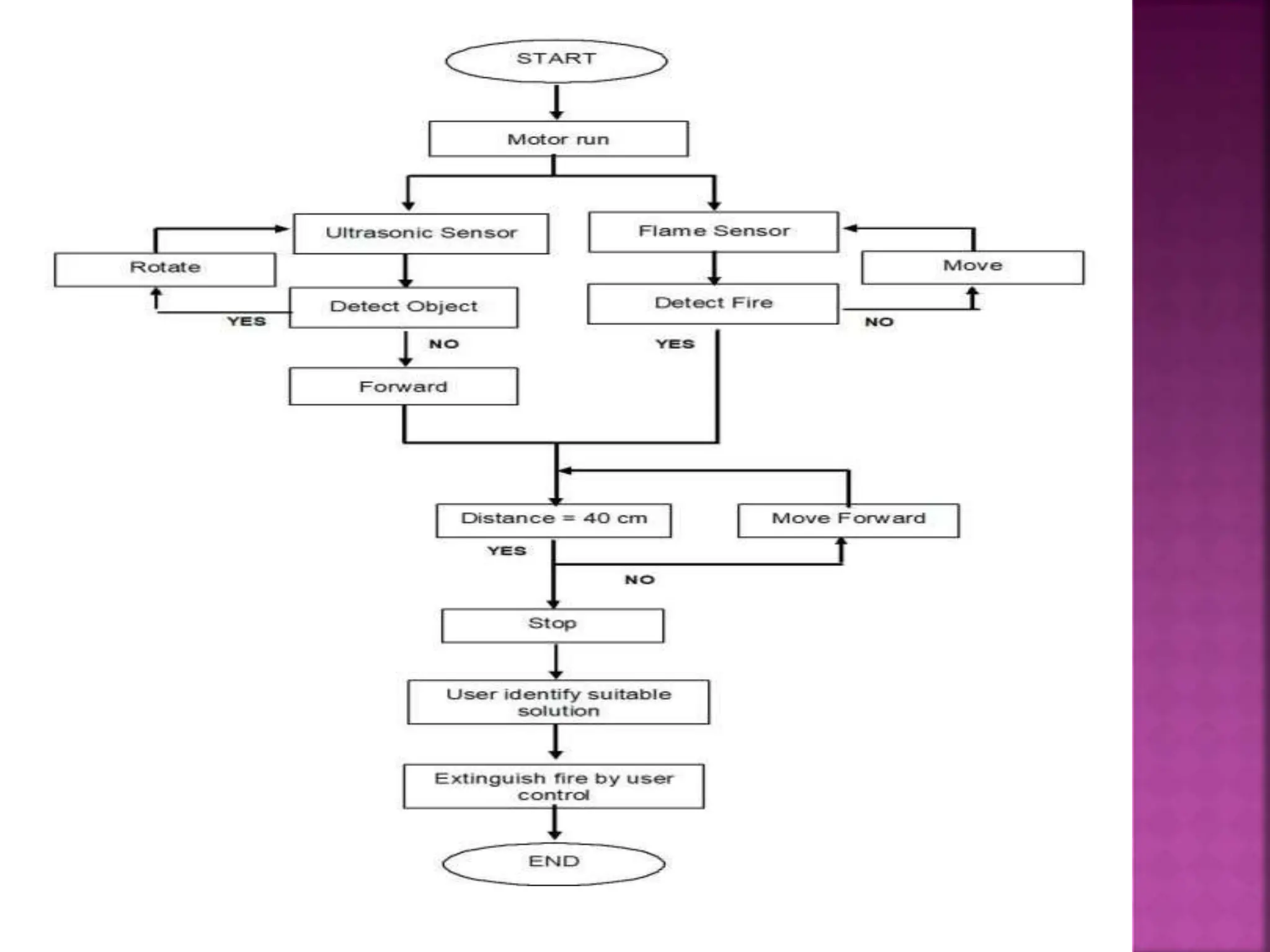
The Current fire-fighting robot have IR Flame sensor
sense the warm and heat from anybody and we
intended to code this sensor that it can sense the
flame around it. All three sensor always searching
for fire if any of the sensor will find it the robot will
turn and start walking toward the fire.
Features Mobile Control
Monitoring
Firefighting
Robot Car
RF Control
Firefighting
Robot Car
Current System Firefighting
Robot Car
User Interface Design Yes No No
Fire Detection No No Yes
Water Tank Yes Yes Yes
Training Requirements Yes Yes No
Flame Sensors Yes Yes Yes
Gas Sensors Yes Yes No
Geared Dc Motor Yes Yes Yes
Ultrasonic Sensor Yes Yes No
Human Interruption Yes Yes No
Notification SMS Yes No No
Camera Yes No No
Water Pumping Yes Yes Yes
Piezo Speaker Yes No No
Servo Motor Yes Yes Yes
Connection
Wi-Fi/Bluetooth
Yes No No
 The Operational Framework of Arduino based
smart fire fighting robot car will be the planning of
chapter one introduction, chapter two literature
review, chapter three software planning &
analysing chapter four software design, chapter
five system implementation and finally chapter six
conclusions & enhancement.
 System requirements are statements that list
the functionalities a system must have in
order to meet the needs of the user. System
requirements are the configuration that a
system must have.
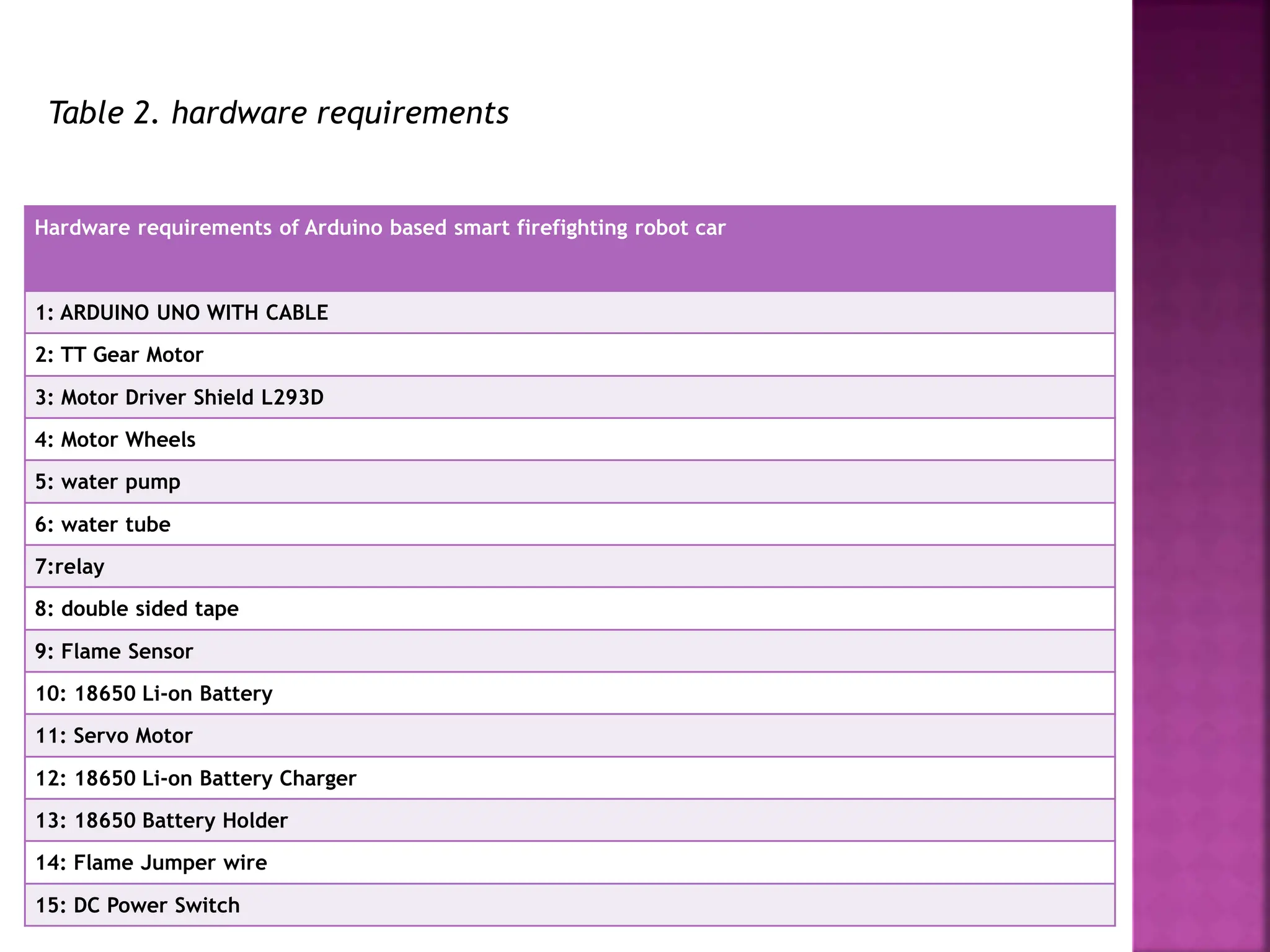
Hardware requirements of Arduino based smart firefighting robot car
1: ARDUINO UNO WITH CABLE
2: TT Gear Motor
3: Motor Driver Shield L293D
4: Motor Wheels
5: water pump
6: water tube
7:relay
8: double sided tape
9: Flame Sensor
10: 18650 Li-on Battery
11: Servo Motor
12: 18650 Li-on Battery Charger
13: 18650 Battery Holder
14: Flame Jumper wire
15: DC Power Switch
Table 2. hardware requirements
 This project will help solving a lot of challenges in the
fire fighting field . the fire fighters do their work
manually by their hands with horse pipes with
pressure, the fire fighting process is now very
problematic and can cause death, loss of limps and
more. Rescue operations are hard now considering the
lack of visual in the fire area but having a camera
mounted on an automatic vehicle which can
maneuverer through impassable areas can help
visualize the residue and help find victims easily and
save lives easily for both fire fighters and fire victims.
 We have used two techniques in gathering information
which are :
1. Interview
2. Observation
 Interview Interviewing is a frequently used
information collection technique ,its use in evaluating
all kind of information .through this we have searched
in several areas and asked several questions regarding
this project.
 We ought to utilize the information from sources
inbound the open markets that are viable of fire break
outs, the enclosed mall that also viable to fire
breakouts.
 These are few questions we have asked :
• How effective is current system of fire fighting ?
• What would you like to change in the current
traditional way of fire fighting?
• Would you want a robot to be used as a fire
fighting tool or be used by the fire fighters ?
• Will it be more effective than the human fire
fighters ?
 This is an effective way to obtain information
about a situation the venue, the activities,
participation and significant of the observation are
all described using observation data from view
point of the observer the information gathered
using observation should be truthful, precise and
thorough but not so thorough to include
unnecessary or unimportant detail that would make
the description more difficult to understand the
reader can completely comprehend with the help
of the greatest developed data.
 Process modelling is an abstraction of the software
development process . the modelling specifies the
stages and order of processes. In this case the fire
fighting robot process is a complicated process that
requires a lot of equipment and time.
 The processes of developing this fire fighting robot
prototype is fast and simple it include
1. Building the prototype with all equipment’s
2. Programming it with the necessary task supposed to
be performed.
3. Evaluation of the prototype.
4. Task evaluation for the robot.
5. Confirmation and testing.
 The data flow diagram provides a logical model that
shows what the system does .there are several different
versions of DFDs exists but they all serve the same
purpose the reason we choose to develop our new
system using DFD is that it shows easy modelling and
helps documentation for a person who will use that
new system in terms of how crossing data from one
subsystem to another.
 Data modelling is the analysis of data objects and
their relationships to other data objects. Data
modelling is often the first step in database design
and object-oriented programming as the designers
first create a conceptual model of how data items
relate to each other. Data modelling involves a
progression from conceptual model to logical
model to physical schema.
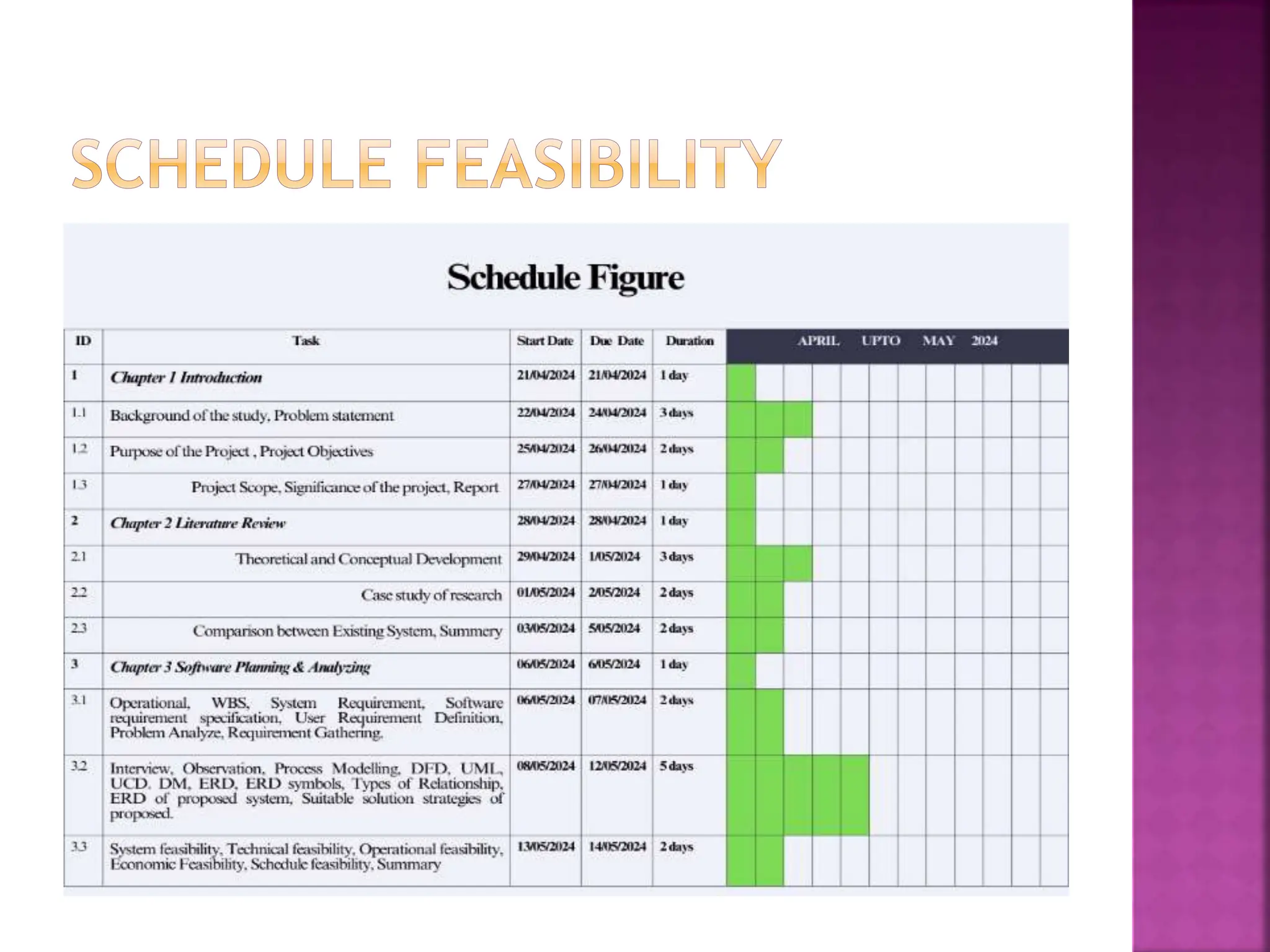
 System feasibility assesses whether the proposed
fire fighting robot system is technically,
operationally, economically, and schedule-wise
feasible. It includes the following assessments:
1. Technical Feasibility
2. Operational Feasibility
3. Economic Feasibility
4. Schedule Feasibility
 Technical feasibility evaluates if the required
technology and resources are available to develop
and implement the fire fighting robot system. It
examines factors such as the availability of
necessary sensors, control systems,
communication protocols, and hardware and
software capabilities.
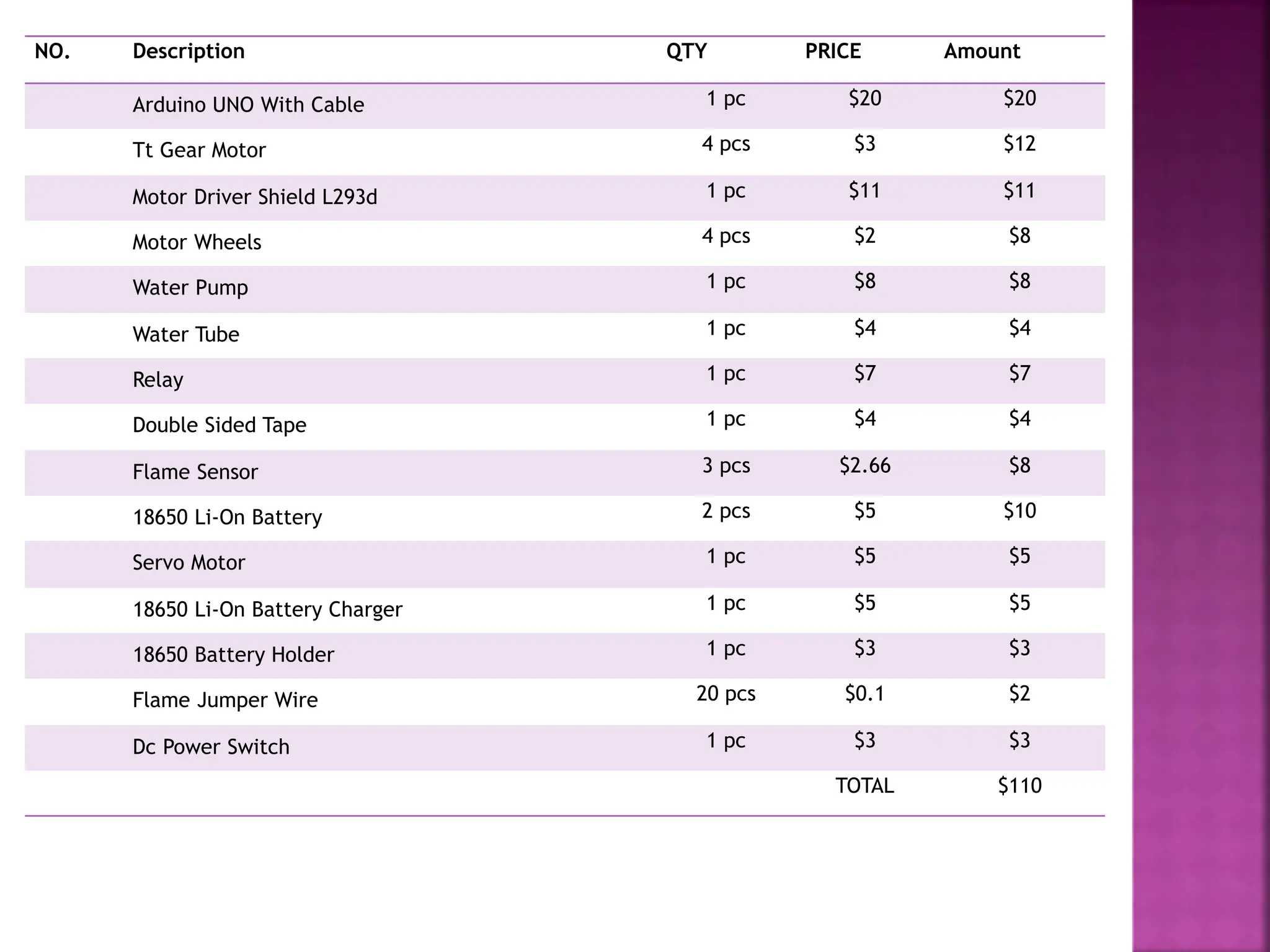
NO. Description QTY PRICE Amount
Arduino UNO With Cable 1 pc $20 $20
Tt Gear Motor 4 pcs $3 $12
Motor Driver Shield L293d 1 pc $11 $11
Motor Wheels 4 pcs $2 $8
Water Pump 1 pc $8 $8
Water Tube 1 pc $4 $4
Relay 1 pc $7 $7
Double Sided Tape 1 pc $4 $4
Flame Sensor 3 pcs $2.66 $8
18650 Li-On Battery 2 pcs $5 $10
Servo Motor 1 pc $5 $5
18650 Li-On Battery Charger 1 pc $5 $5
18650 Battery Holder 1 pc $3 $3
Flame Jumper Wire 20 pcs $0.1 $2
Dc Power Switch 1 pc $3 $3
TOTAL $110
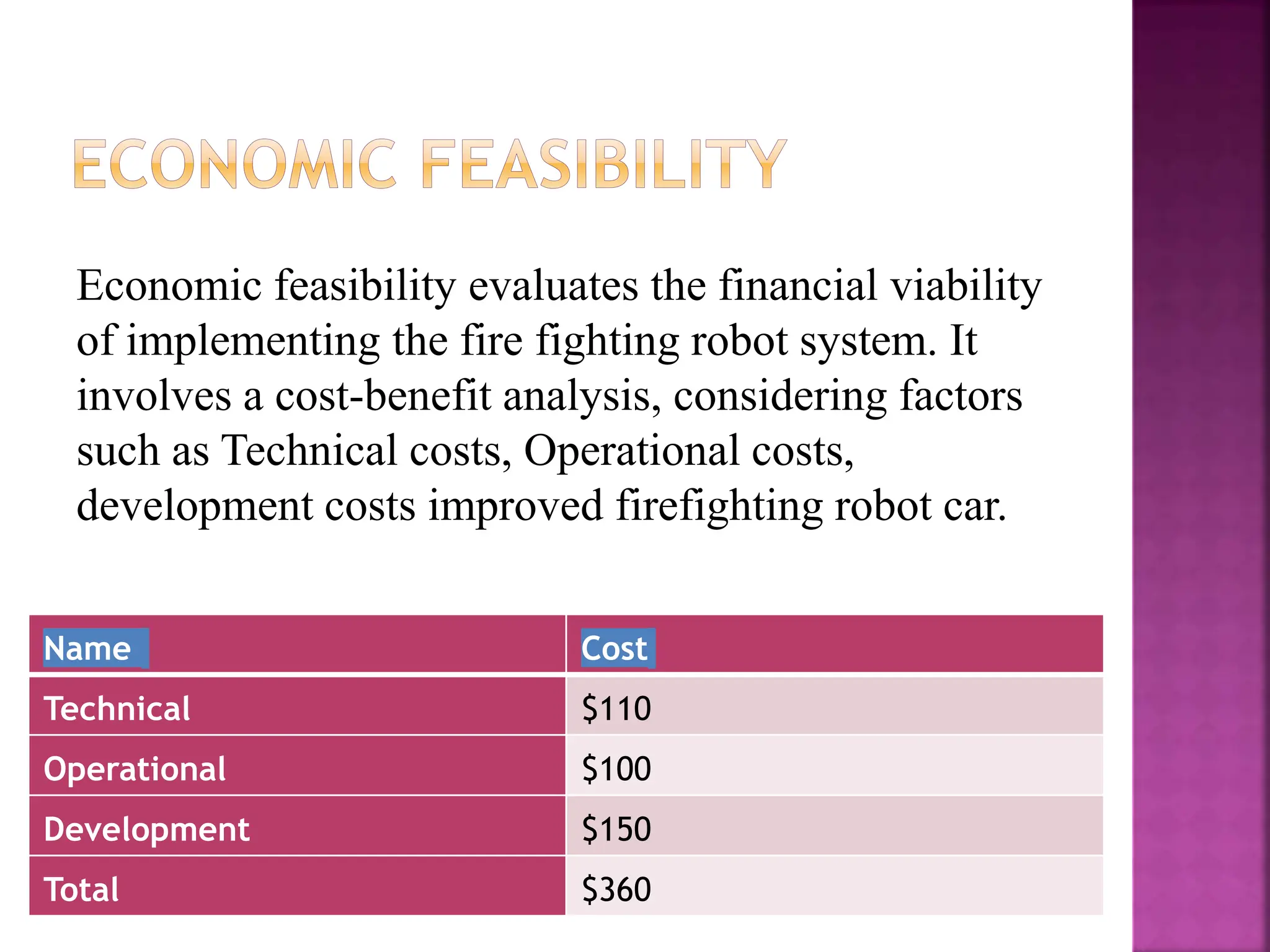
Name Cost
Technical $110
Operational $100
Development $150
Total $360
Economic feasibility evaluates the financial viability
of implementing the fire fighting robot system. It
involves a cost-benefit analysis, considering factors
such as Technical costs, Operational costs,
development costs improved firefighting robot car.
Arduino Based Smart Fire fighting robot car .pptx

Arduino Based Smart Fire fighting robot car .pptx

  • 2.
    TOPIC: ARDUINO BASEDSMART FIREFGHTING ROBOT CAR
  • 3.
    ID: 8004. NAME:Abdulkarim Salah Ahmed ID: 8355. NAME: Feisal Sheikh Mohamed ID: 8291 NAME: Abdurizack Bashir Hassan ID: 8114. NAME: Mohamed Dahir Abdi ID: 8148. NAME: Mohamed ID: 7819. NAME: Halima Dahir Ali
  • 4.
     INTRODUCTION  PROBLEMSTATEMENT  PURPOSE&OBJECTIVES  SCOPE OF THE PROJECT  SIGNIFICANCE OF THE PROJECT  COMPARE B/W EXISTING SYSTEM  OPERATIONAL FRAME WORK  SYTEM REQUIREMENT  PROBLEM ANALYSIS IDENTIFICATION  REQUIREMENT GETHARING TECHNIQUES  PROCESS MODELING(DFD/UML)  DATA MODELING(ERD)  SYSTEM FEASIBILITY CONTENTS
  • 6.
     The Firefighting Robot is a small, portable emergency responder robot that aids fire-fighters in putting out high-rise fires, particularly in extremely hazardous situations where people cannot enter.  The robot is used for fire detection and extinguishing it without the interference of human help , the robot is built for helping people in fire prone areas in order to reduce damages caused by fire.
  • 7.
    Fire fighting robotis a small prototype machine built using Arduino and Flame Sensor & L298N Motor Driver, it provides automatic detection of fire from a small distance and extinguishes it without a lot of damages.
  • 8.
     Fire isa big problem in our society, which causes loss of life and property, our community does not receive fire-fighting assistance when there is a fire in commercial areas, homes, farms and so on. it destroys economic infrastructure and commercial buildings. There are not many companies working in our country that participate in fire-fighting.
  • 9.
     There isa huge economic impact that fire brings to our society. Fire is also a serious threat to the lives of fire-fighters. They find it extremely challenging to reach certain areas that could harm them due to high temperatures or the presence of explosives.  . If we do not find a sustainable solution to the problems that fire poses to society, the huge losses caused by fire will continue and the situation will get worse.
  • 10.
     This robotwill reduce the spread of fire, as well as prevent the economic and human losses caused by fire. The proposed robot will be able to move faster and easily through lowest spaces and thus enabling it to be more efficient.
  • 11.
     The purposeof the project is to create an automatic fire fighting robot that will ease the work of fire-fighters, Detect when there is fire in the house or in the area, Extinguish the fire without causing any damage in the area.
  • 12.
    General Objective To developand design a firefighting robot through using Arduino microcontroller.
  • 13.
    To develop afire fighting robot which equipped with fire sensors that will detect fire from a calculated distance. To detect fire from a certain distance and extinguish the fire upon arrival. To reduce the spread of fire, as well as prevent the economic and human losses caused by fire.
  • 14.
     Content scope Ourproject is about a fire-fighting robot that prevents fire, if fire breaks out, the robot will quickly extinguish the fire and the damage caused by fire will be reduced.  Geographical scope Geographically, the robot will be developed in Mogadishu Somalia Particularly Shangaani District.  Time scope Since this is our final thesis for the Undergraduate level, within the last two semester starting from October 2023 up to July 2024.
  • 15.
     The projectis being innovated for future advancement because we all understand the damages that fire brings in our region with is lack of proper infrastructure for the human operated fire fighting vehicles, it takes a lot of time for them to detect and arrive at the fire prone areas.  To avoid the wasting of resources, lives and damaging the property we ought to come with an alternative that is capable of doing the task without costing us our lives and the precious lives of the firemen who always put themselves in line to save others.
  • 16.
    Autonomous-fire-fighting-robot-with-smart- monitoring-system If one ofthe flame sensors detects a fire, firstly it will send an alert message to the user to notify them that there is a fire in the house through their smartphone. After that, it will start to search the accurate position of the fire from information given by those three flame sensors.
  • 17.
    RF REMOTE CONTROLFIRE FIGHTING ROBOT USING MICROCONTROLLER. The RF REMOTE system works with an 8051 family microcontroller and a battery for power supply. In this system, a RF receiver is interfaced to the microcontroller for communication. Three motors are interfaced to the microcontroller through a motor-driver IC, where in two motors are used to change the directions of the vehicle and the another one to control the water jet of the robot.
  • 18.
    Arduino Smart Firefighting robot car system The Current fire-fighting robot have IR Flame sensor sense the warm and heat from anybody and we intended to code this sensor that it can sense the flame around it. All three sensor always searching for fire if any of the sensor will find it the robot will turn and start walking toward the fire.
  • 19.
    Features Mobile Control Monitoring Firefighting RobotCar RF Control Firefighting Robot Car Current System Firefighting Robot Car User Interface Design Yes No No Fire Detection No No Yes Water Tank Yes Yes Yes Training Requirements Yes Yes No Flame Sensors Yes Yes Yes Gas Sensors Yes Yes No Geared Dc Motor Yes Yes Yes Ultrasonic Sensor Yes Yes No Human Interruption Yes Yes No Notification SMS Yes No No Camera Yes No No Water Pumping Yes Yes Yes Piezo Speaker Yes No No Servo Motor Yes Yes Yes Connection Wi-Fi/Bluetooth Yes No No
  • 20.
     The OperationalFramework of Arduino based smart fire fighting robot car will be the planning of chapter one introduction, chapter two literature review, chapter three software planning & analysing chapter four software design, chapter five system implementation and finally chapter six conclusions & enhancement.
  • 21.
     System requirementsare statements that list the functionalities a system must have in order to meet the needs of the user. System requirements are the configuration that a system must have.
  • 22.
    Hardware requirements ofArduino based smart firefighting robot car 1: ARDUINO UNO WITH CABLE 2: TT Gear Motor 3: Motor Driver Shield L293D 4: Motor Wheels 5: water pump 6: water tube 7:relay 8: double sided tape 9: Flame Sensor 10: 18650 Li-on Battery 11: Servo Motor 12: 18650 Li-on Battery Charger 13: 18650 Battery Holder 14: Flame Jumper wire 15: DC Power Switch Table 2. hardware requirements
  • 23.
     This projectwill help solving a lot of challenges in the fire fighting field . the fire fighters do their work manually by their hands with horse pipes with pressure, the fire fighting process is now very problematic and can cause death, loss of limps and more. Rescue operations are hard now considering the lack of visual in the fire area but having a camera mounted on an automatic vehicle which can maneuverer through impassable areas can help visualize the residue and help find victims easily and save lives easily for both fire fighters and fire victims.
  • 24.
     We haveused two techniques in gathering information which are : 1. Interview 2. Observation  Interview Interviewing is a frequently used information collection technique ,its use in evaluating all kind of information .through this we have searched in several areas and asked several questions regarding this project.  We ought to utilize the information from sources inbound the open markets that are viable of fire break outs, the enclosed mall that also viable to fire breakouts.
  • 25.
     These arefew questions we have asked : • How effective is current system of fire fighting ? • What would you like to change in the current traditional way of fire fighting? • Would you want a robot to be used as a fire fighting tool or be used by the fire fighters ? • Will it be more effective than the human fire fighters ?
  • 26.
     This isan effective way to obtain information about a situation the venue, the activities, participation and significant of the observation are all described using observation data from view point of the observer the information gathered using observation should be truthful, precise and thorough but not so thorough to include unnecessary or unimportant detail that would make the description more difficult to understand the reader can completely comprehend with the help of the greatest developed data.
  • 27.
     Process modellingis an abstraction of the software development process . the modelling specifies the stages and order of processes. In this case the fire fighting robot process is a complicated process that requires a lot of equipment and time.  The processes of developing this fire fighting robot prototype is fast and simple it include 1. Building the prototype with all equipment’s 2. Programming it with the necessary task supposed to be performed. 3. Evaluation of the prototype. 4. Task evaluation for the robot. 5. Confirmation and testing.
  • 28.
     The dataflow diagram provides a logical model that shows what the system does .there are several different versions of DFDs exists but they all serve the same purpose the reason we choose to develop our new system using DFD is that it shows easy modelling and helps documentation for a person who will use that new system in terms of how crossing data from one subsystem to another.
  • 30.
     Data modellingis the analysis of data objects and their relationships to other data objects. Data modelling is often the first step in database design and object-oriented programming as the designers first create a conceptual model of how data items relate to each other. Data modelling involves a progression from conceptual model to logical model to physical schema.
  • 31.
     System feasibilityassesses whether the proposed fire fighting robot system is technically, operationally, economically, and schedule-wise feasible. It includes the following assessments: 1. Technical Feasibility 2. Operational Feasibility 3. Economic Feasibility 4. Schedule Feasibility
  • 32.
     Technical feasibilityevaluates if the required technology and resources are available to develop and implement the fire fighting robot system. It examines factors such as the availability of necessary sensors, control systems, communication protocols, and hardware and software capabilities.
  • 33.
    NO. Description QTYPRICE Amount Arduino UNO With Cable 1 pc $20 $20 Tt Gear Motor 4 pcs $3 $12 Motor Driver Shield L293d 1 pc $11 $11 Motor Wheels 4 pcs $2 $8 Water Pump 1 pc $8 $8 Water Tube 1 pc $4 $4 Relay 1 pc $7 $7 Double Sided Tape 1 pc $4 $4 Flame Sensor 3 pcs $2.66 $8 18650 Li-On Battery 2 pcs $5 $10 Servo Motor 1 pc $5 $5 18650 Li-On Battery Charger 1 pc $5 $5 18650 Battery Holder 1 pc $3 $3 Flame Jumper Wire 20 pcs $0.1 $2 Dc Power Switch 1 pc $3 $3 TOTAL $110
  • 34.
    Name Cost Technical $110 Operational$100 Development $150 Total $360 Economic feasibility evaluates the financial viability of implementing the fire fighting robot system. It involves a cost-benefit analysis, considering factors such as Technical costs, Operational costs, development costs improved firefighting robot car.

Editor's Notes

  • #2 This template can be used as a starter file to give updates for project milestones. Sections Right-click on a slide to add sections. Sections can help to organize your slides or facilitate collaboration between multiple authors. Notes Use the Notes section for delivery notes or to provide additional details for the audience. View these notes in Presentation View during your presentation. Keep in mind the font size (important for accessibility, visibility, videotaping, and online production) Coordinated colors Pay particular attention to the graphs, charts, and text boxes. Consider that attendees will print in black and white or grayscale. Run a test print to make sure your colors work when printed in pure black and white and grayscale. Graphics, tables, and graphs Keep it simple: If possible, use consistent, non-distracting styles and colors. Label all graphs and tables.
  • #5 What is the project about? Define the goal of this project Is it similar to projects in the past or is it a new effort? Define the scope of this project Is it an independent project or is it related to other projects? * Note that this slide is not necessary for weekly status meetings
  • #7 Duplicate this slide as necessary if there is more than one issue. This and related slides can be moved to the appendix or hidden if necessary.