GC Columns
• Column Configurations
• Two general types of columns are encountered in gas
chromatography,
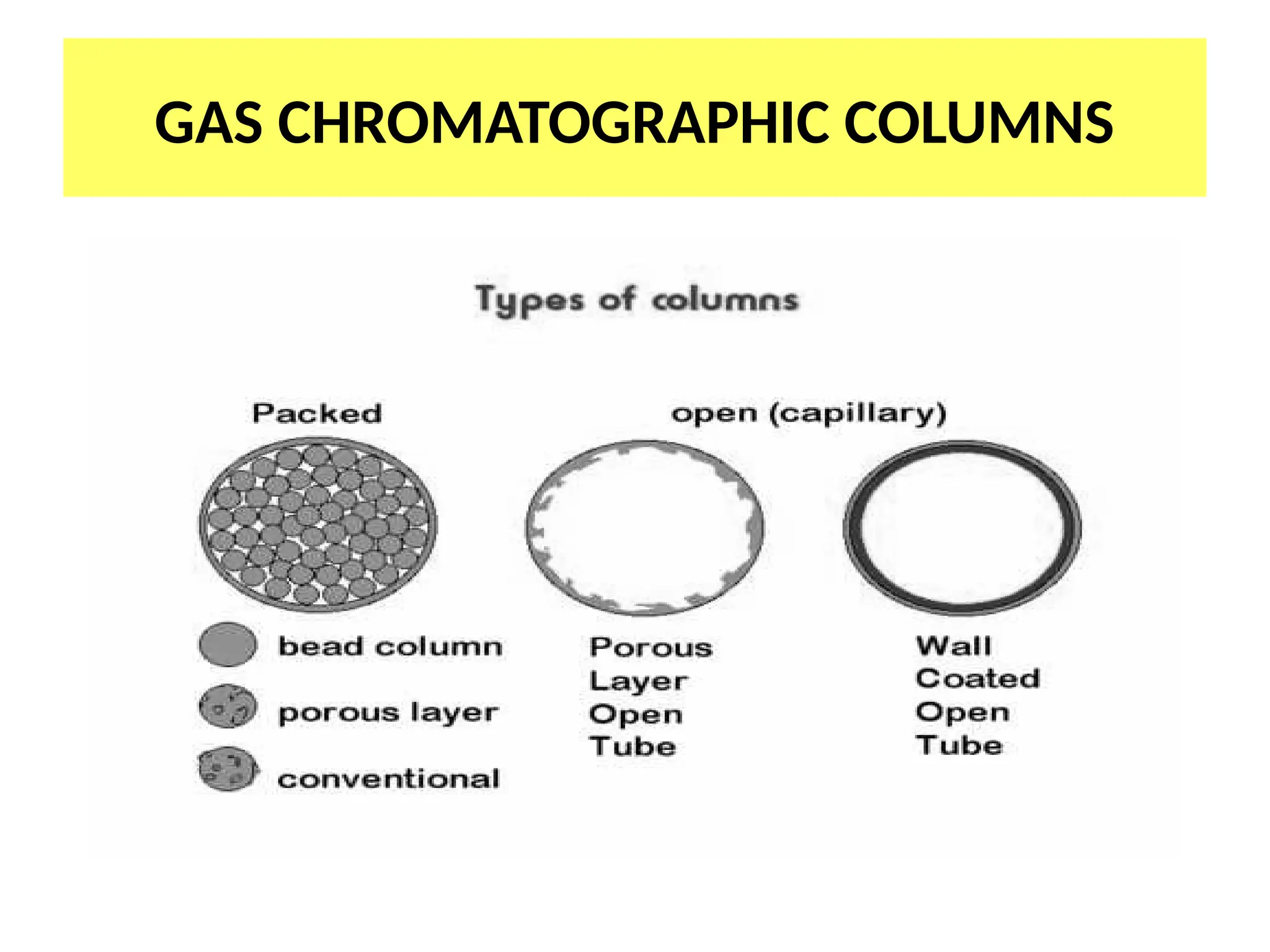
– packed
– (open tubular, or capillary).
• Columns can be short (up to 5 m), large diameter
(> 1 mm) packed column OR long, very small
diameter (< 1 mm) capillary columns.
• Each has its own use and associated advantages
and disadvantages.
GAS CHROMATOGRAPHY
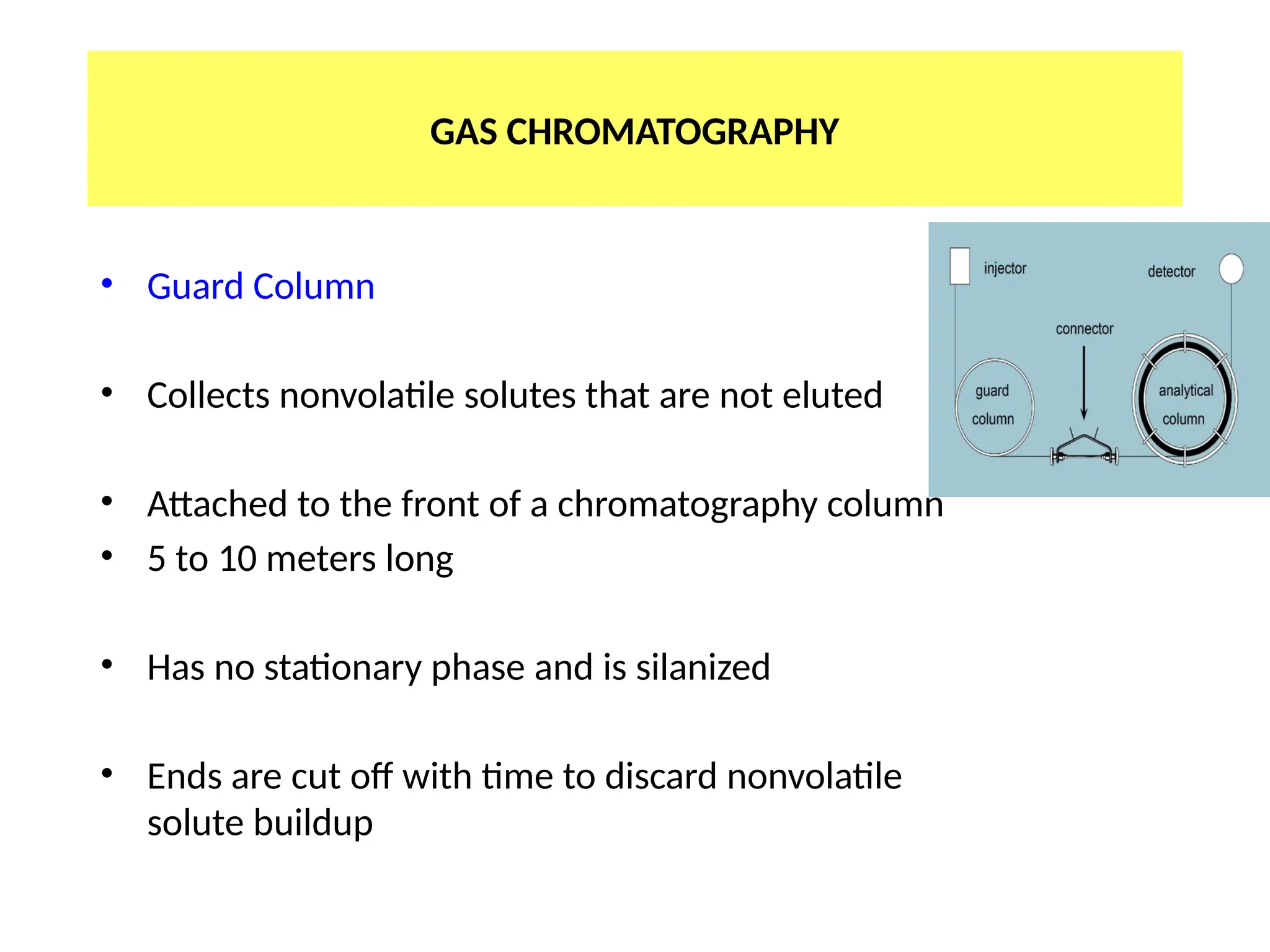
• Guard Column
• Collects nonvolatile solutes that are not eluted
• Attached to the front of a chromatography column
• 5 to 10 meters long
• Has no stationary phase and is silanized
• Ends are cut off with time to discard nonvolatile
solute buildup
GAS CHROMATOGRAPHIC COLUMNS
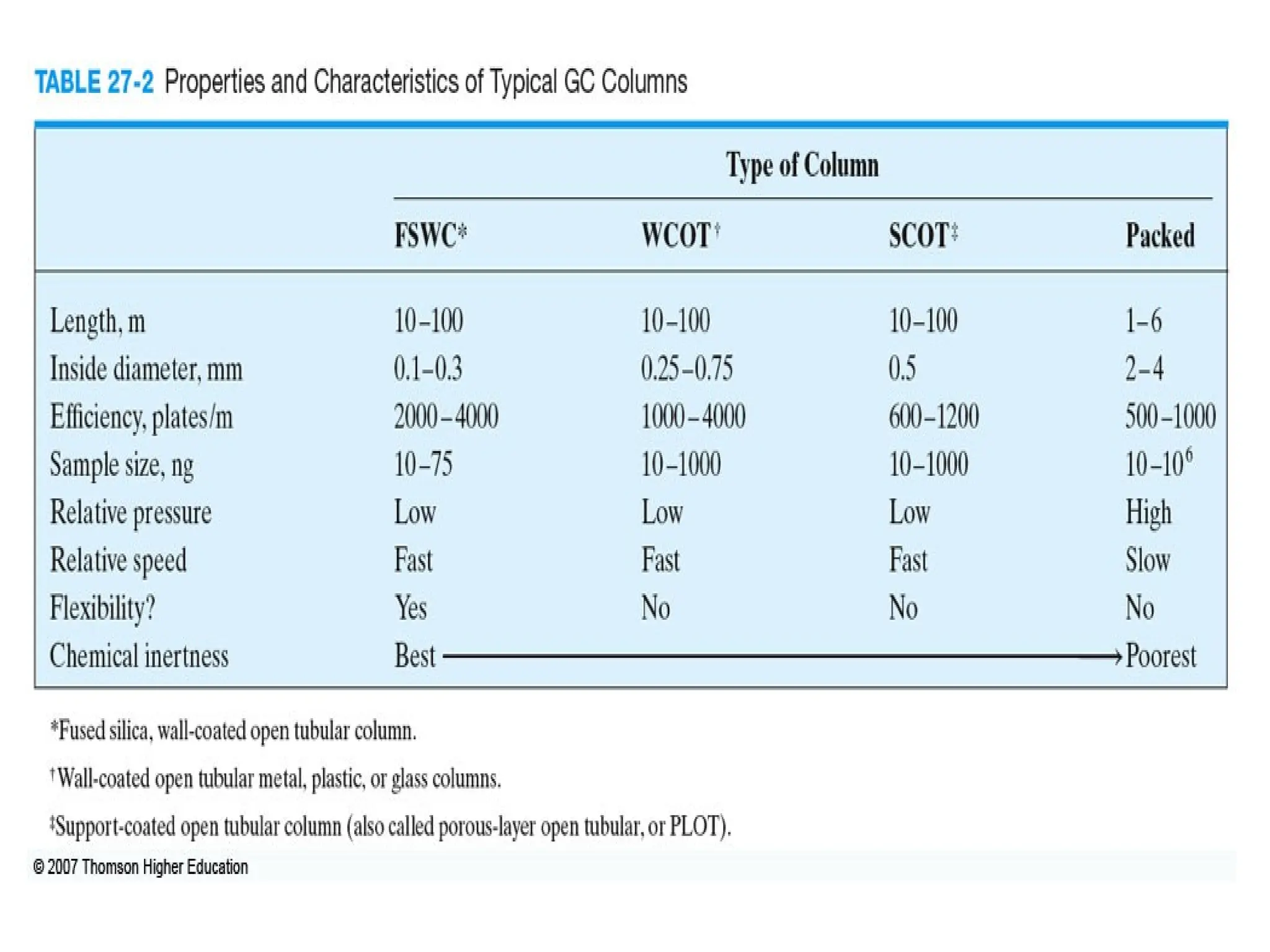
Chromatographic columns vary in length from
less than 2 m to 50 m or more. They are
constructed of stainless steel, glass, fused
silica, or Teflon. In order to fit into an oven for
thermostating, they are usually formed as
coils having diameters of 10 to 30 cm.
Packed Columns
Packed columns are fabricated from glass,
metal (stainless steel, copper, aluminum), or Teflon
tubes that typically have lengths of 2 to 3 m and
inside diameters of 2 to 4 mm. These tubes are
densely packed with a uniform, finely divided
packing material, or solid support, that is coated
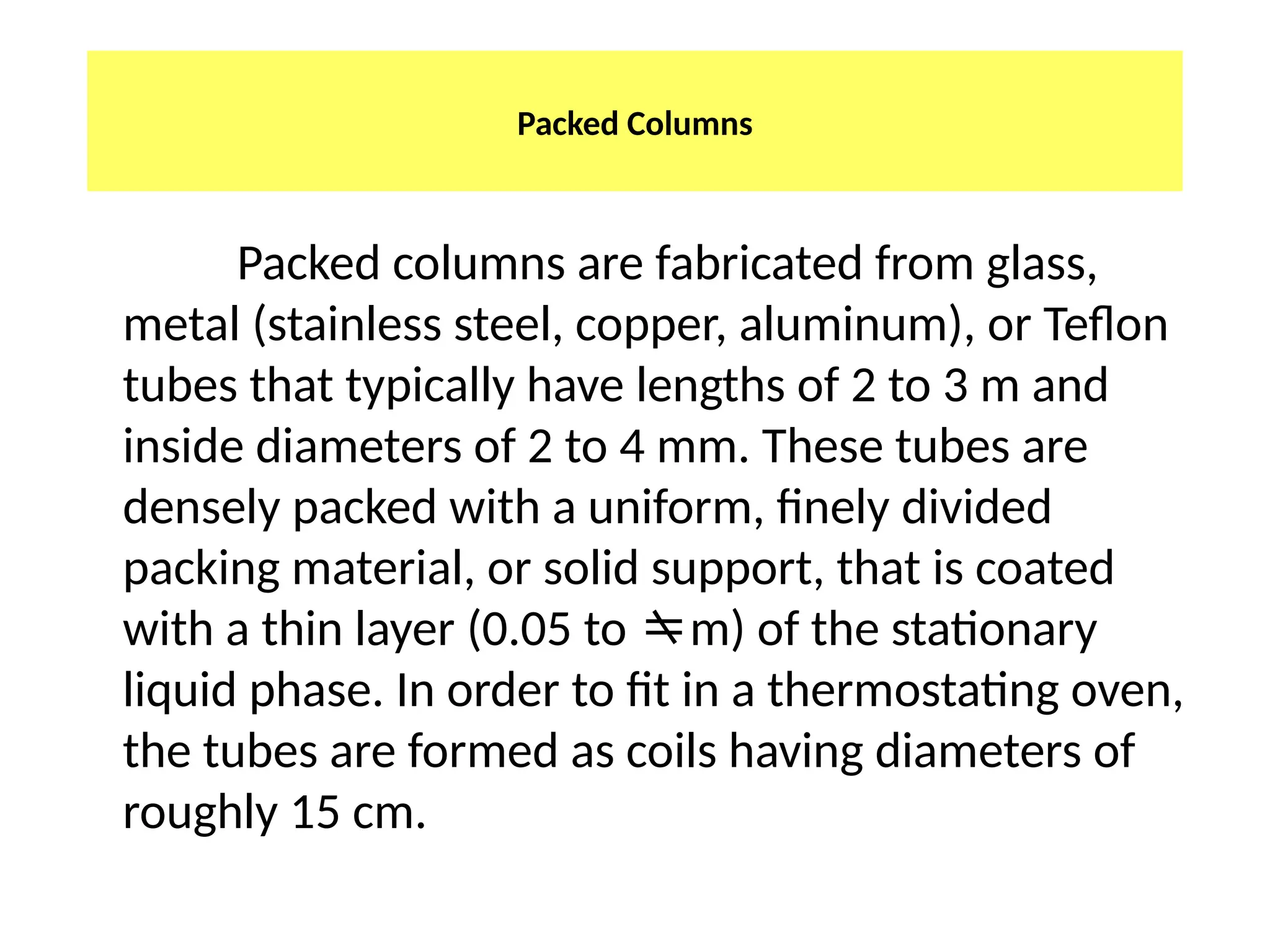
with a thin layer (0.05 to m) of the stationary
liquid phase. In order to fit in a thermostating oven,
the tubes are formed as coils having diameters of
roughly 15 cm.
GAS CHROMATOGRAPHIC COLUMNS
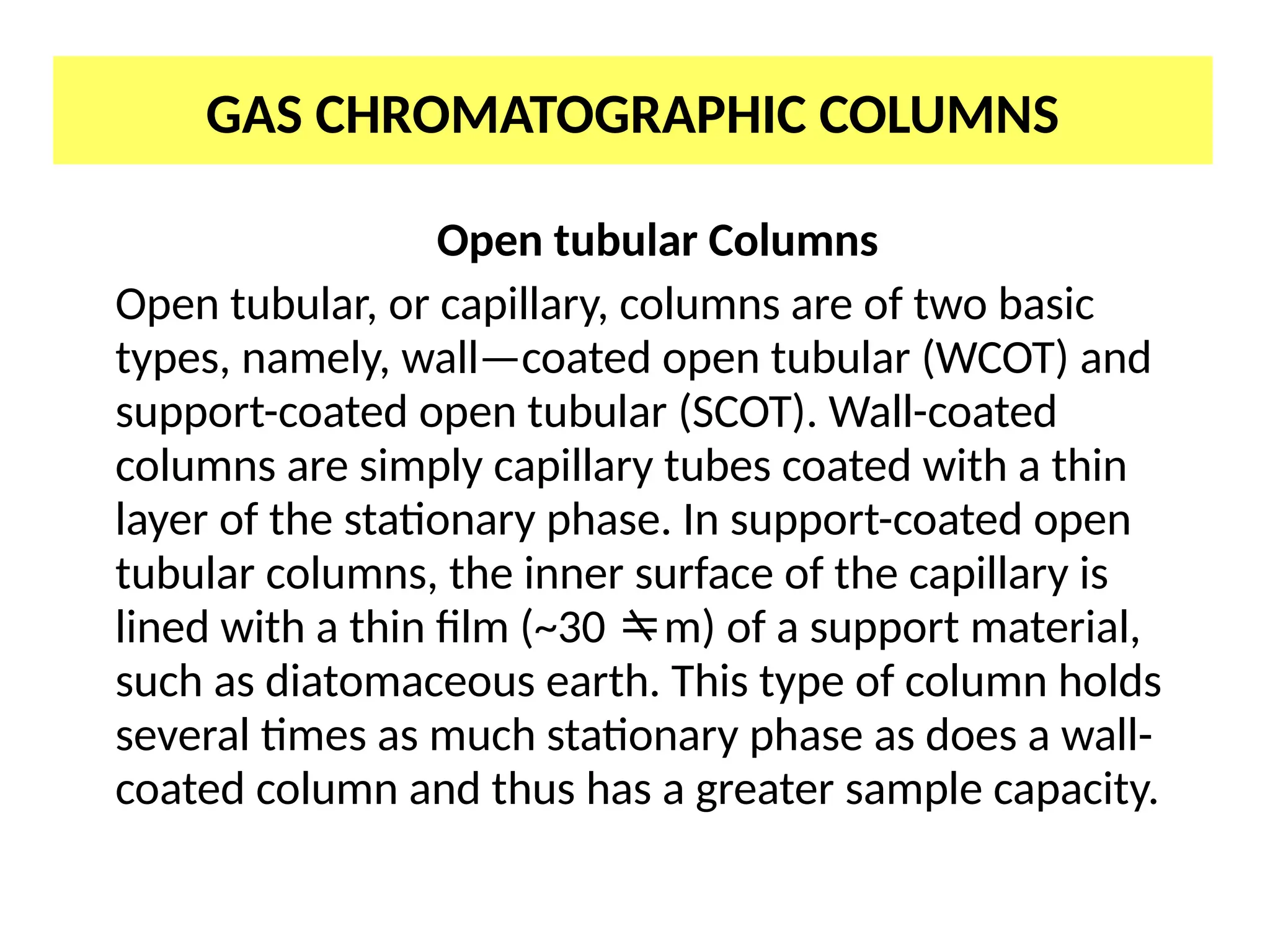
Open tubular Columns
Open tubular, or capillary, columns are of two basic
types, namely, wall—coated open tubular (WCOT) and
support-coated open tubular (SCOT). Wall-coated
columns are simply capillary tubes coated with a thin
layer of the stationary phase. In support-coated open
tubular columns, the inner surface of the capillary is
lined with a thin film (~30 m) of a support material,
such as diatomaceous earth. This type of column holds
several times as much stationary phase as does a wall-
coated column and thus has a greater sample capacity.
GAS CHROMATOGRAPHIC COLUMNS
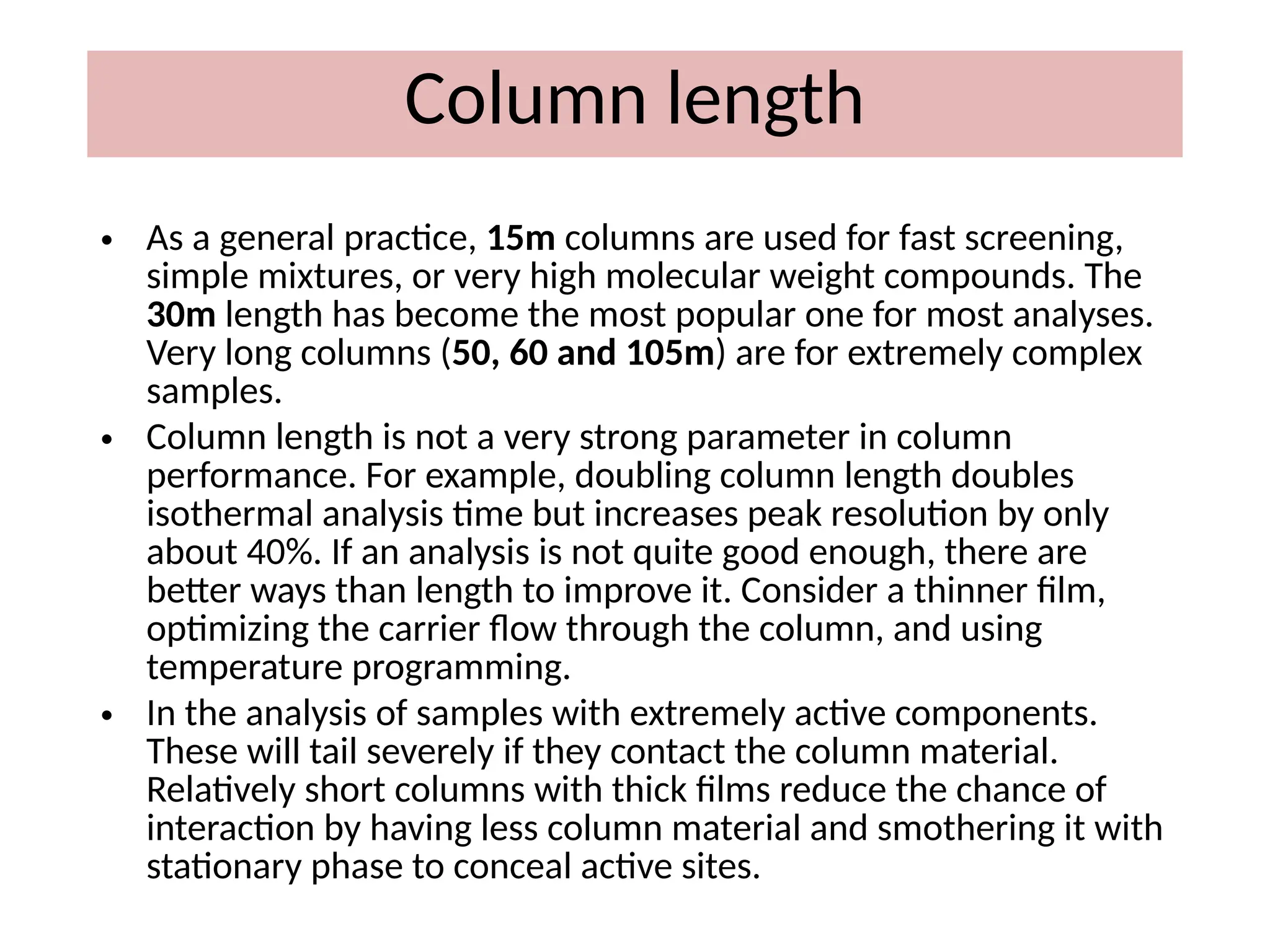
Column length
• As a general practice, 15m columns are used for fast screening,
simple mixtures, or very high molecular weight compounds. The
30m length has become the most popular one for most analyses.
Very long columns (50, 60 and 105m) are for extremely complex
samples.
• Column length is not a very strong parameter in column
performance. For example, doubling column length doubles
isothermal analysis time but increases peak resolution by only
about 40%. If an analysis is not quite good enough, there are
better ways than length to improve it. Consider a thinner film,
optimizing the carrier flow through the column, and using
temperature programming.
• In the analysis of samples with extremely active components.
These will tail severely if they contact the column material.
Relatively short columns with thick films reduce the chance of
interaction by having less column material and smothering it with
stationary phase to conceal active sites.
The Stationary Phase
Desirable properties for the immobilized liquid phase in a
gas-liquid chromatographic column include:
(1) low volatility (ideally, the boiling point of the liquid should
be at 100o
C higher than the maximum operating
temperature for the column).
(2) thermal stability.
(3) chemical inertness.
(4) solvent characteristics such that k` and  values for the
solutes to be resolved fall within a suitable range.
The retention time for a solute on a column depends upon
its distribution constant which in turn is related to the
chemical nature of the stationary phase.
GC Columns
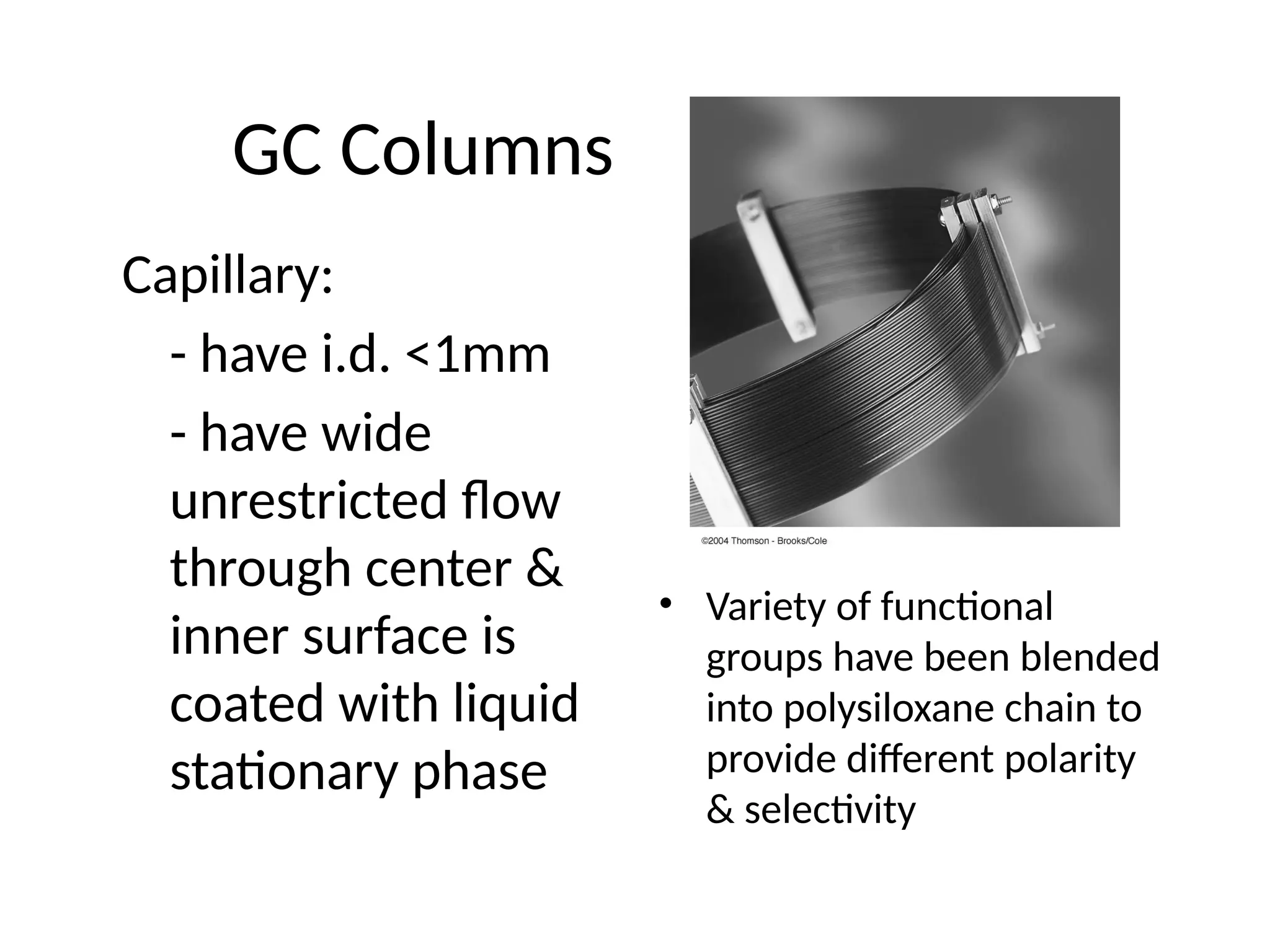
Capillary:
- have i.d. <1mm
- have wide
unrestricted flow
through center &
inner surface is
coated with liquid
stationary phase
• Variety of functional
groups have been blended
into polysiloxane chain to
provide different polarity
& selectivity
GAS CHROMATOGRAPHY
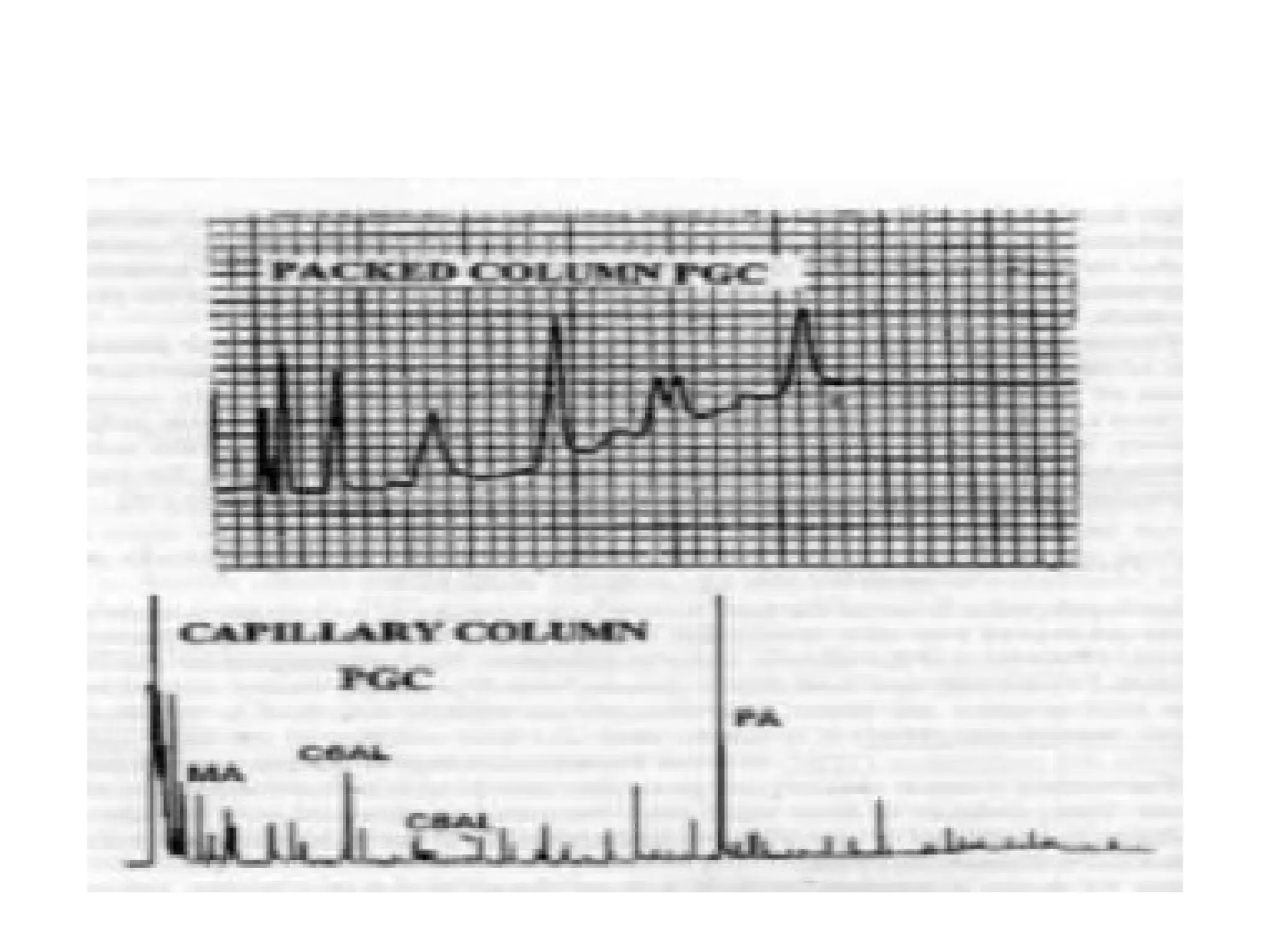
• Comparing Open Tubular Column to Packed
Column
• - Gives better separation
• - Narrower peaks
• - Handles smaller samples (analytical
chromatography
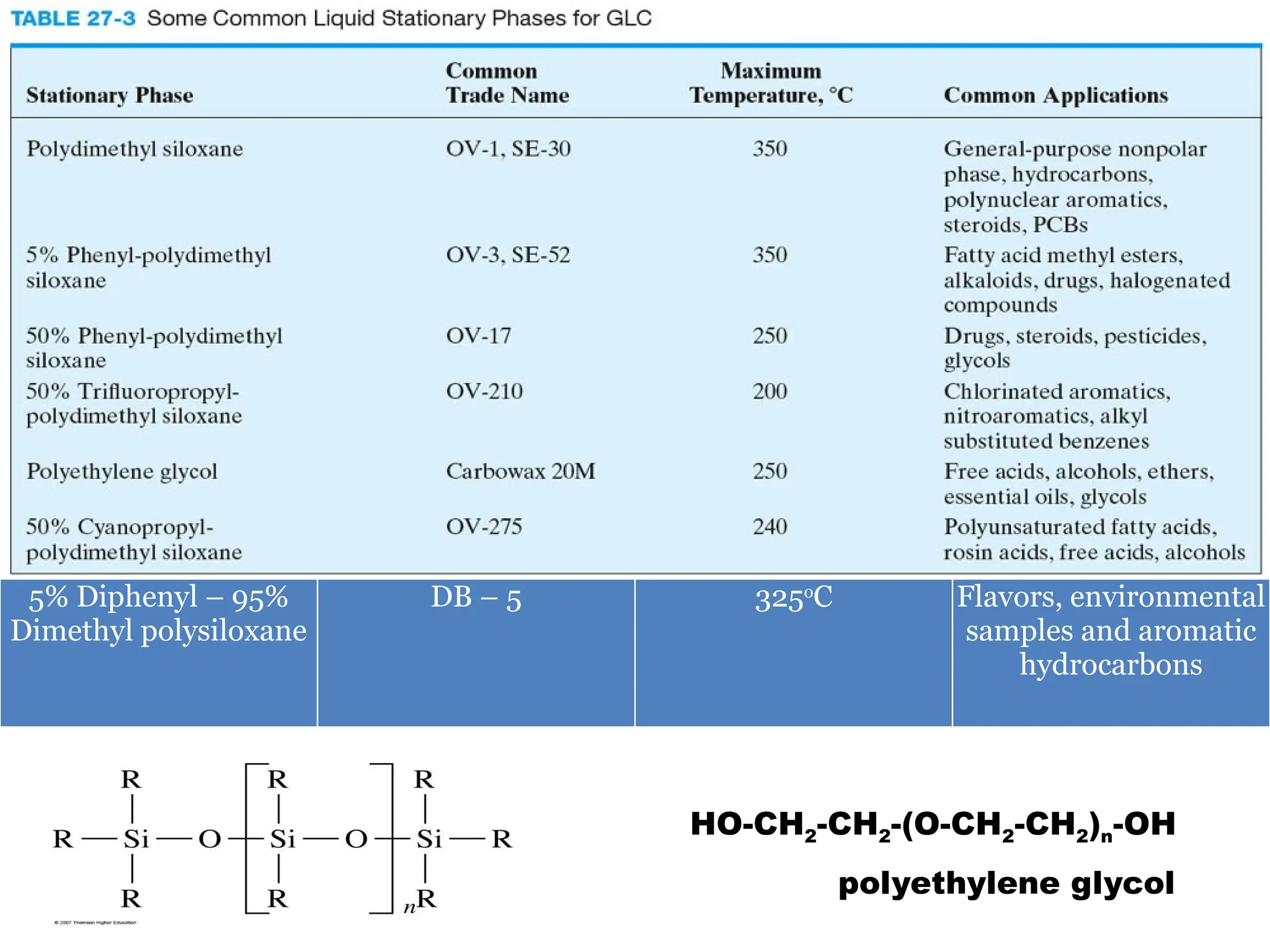
HO-CH2-CH2-(O-CH2-CH2)n-OH
polyethylene glycol
5% Diphenyl – 95%
Dimethyl polysiloxane
DB – 5 325o
C Flavors, environmental
samples and aromatic
hydrocarbons
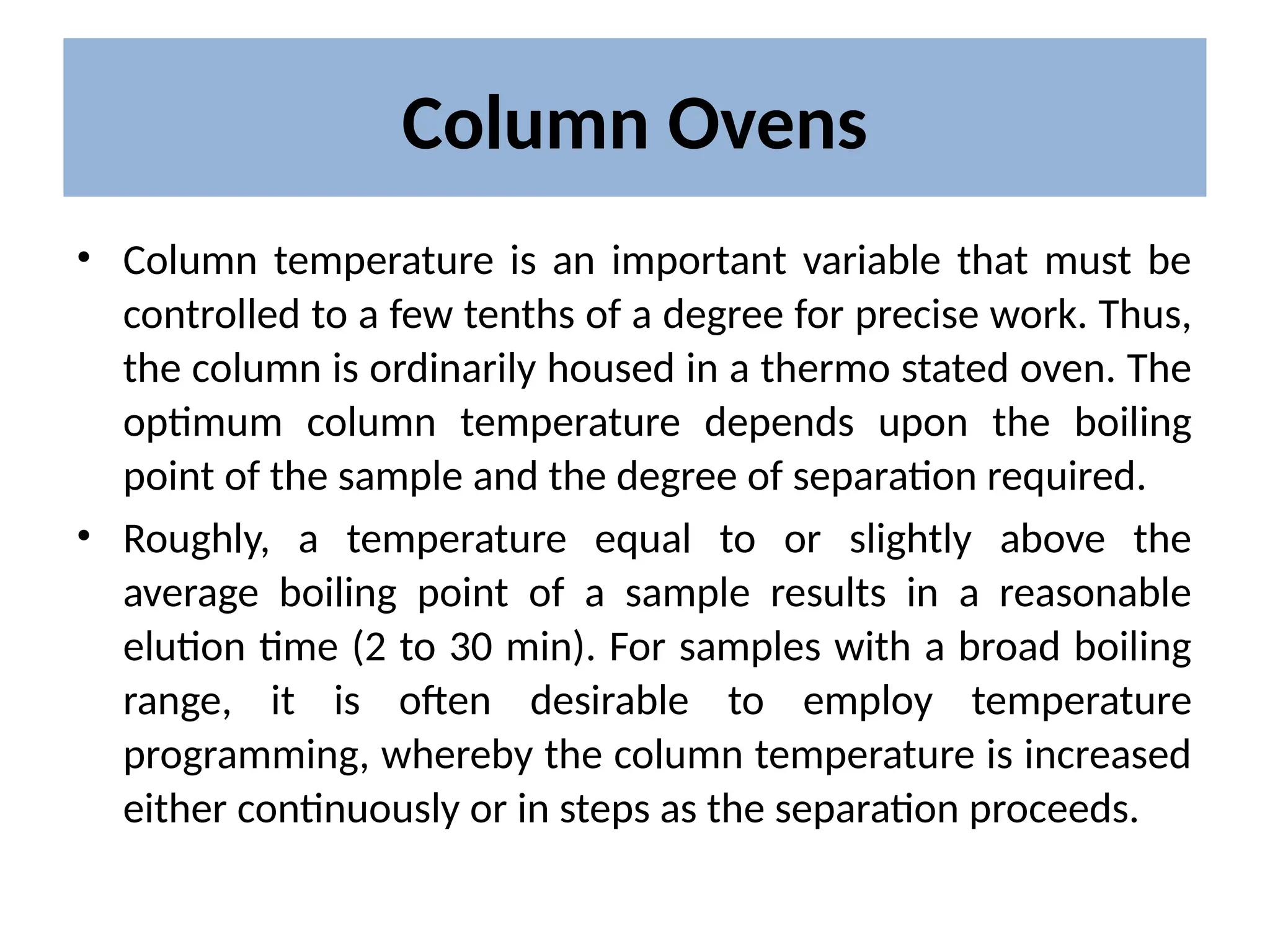
Column Ovens
• Column temperature is an important variable that must be
controlled to a few tenths of a degree for precise work. Thus,
the column is ordinarily housed in a thermo stated oven. The
optimum column temperature depends upon the boiling
point of the sample and the degree of separation required.
• Roughly, a temperature equal to or slightly above the
average boiling point of a sample results in a reasonable
elution time (2 to 30 min). For samples with a broad boiling
range, it is often desirable to employ temperature
programming, whereby the column temperature is increased
either continuously or in steps as the separation proceeds.
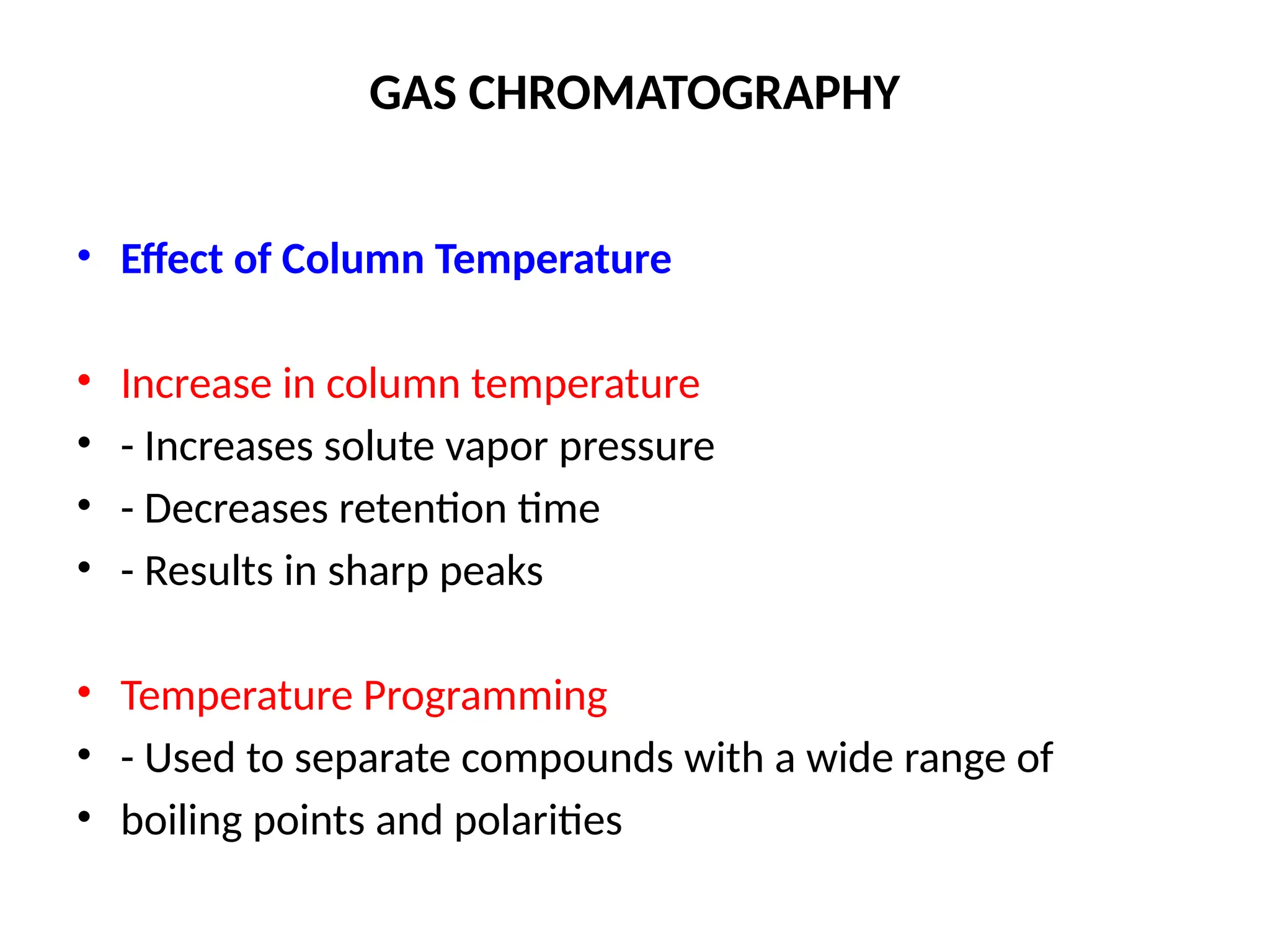
GAS CHROMATOGRAPHY
• Effect of Column Temperature
• Increase in column temperature
• - Increases solute vapor pressure
• - Decreases retention time
• - Results in sharp peaks
• Temperature Programming
• - Used to separate compounds with a wide range of
• boiling points and polarities
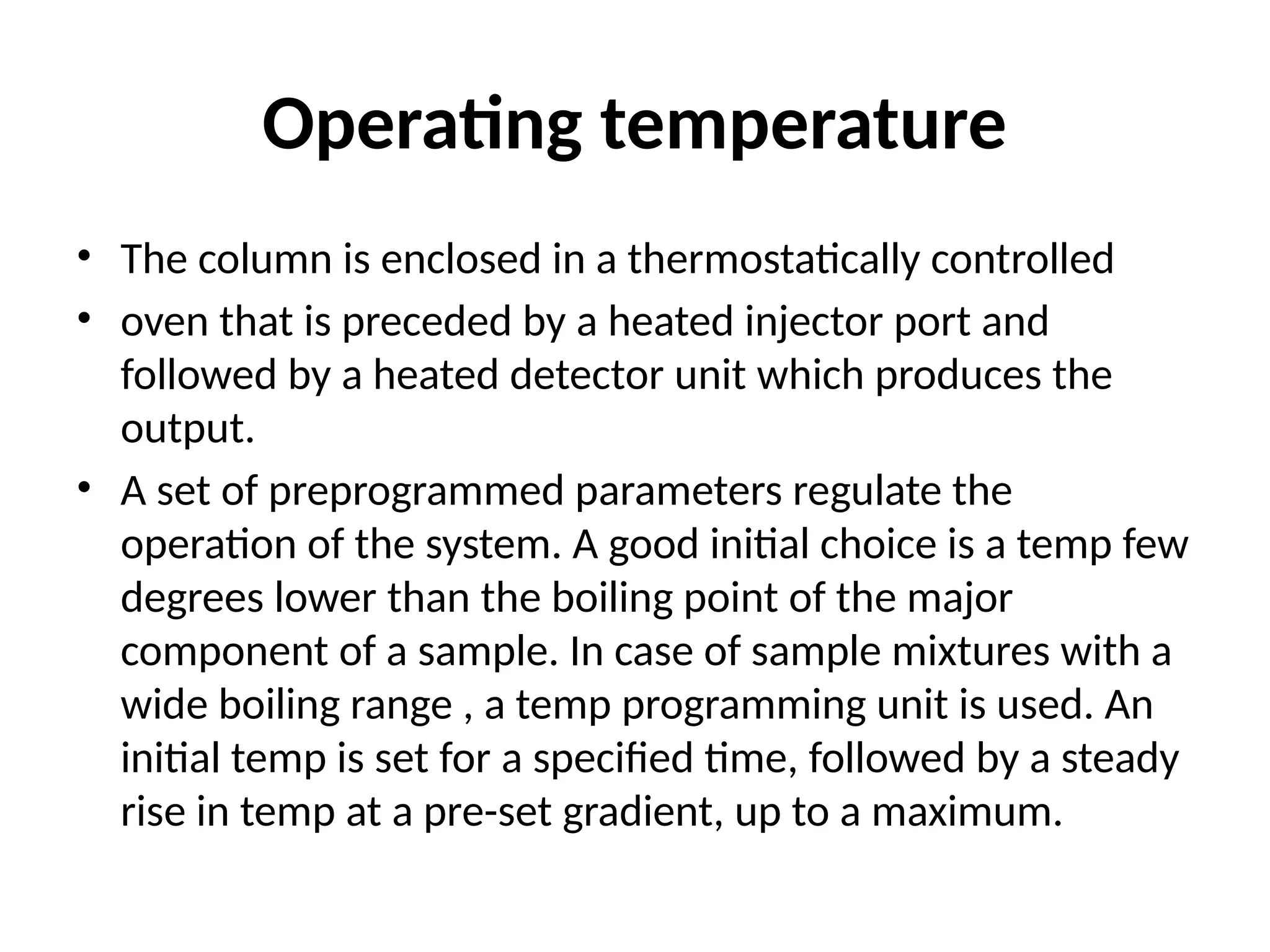
Operating temperature
• The column is enclosed in a thermostatically controlled
• oven that is preceded by a heated injector port and
followed by a heated detector unit which produces the
output.
• A set of preprogrammed parameters regulate the
operation of the system. A good initial choice is a temp few
degrees lower than the boiling point of the major
component of a sample. In case of sample mixtures with a
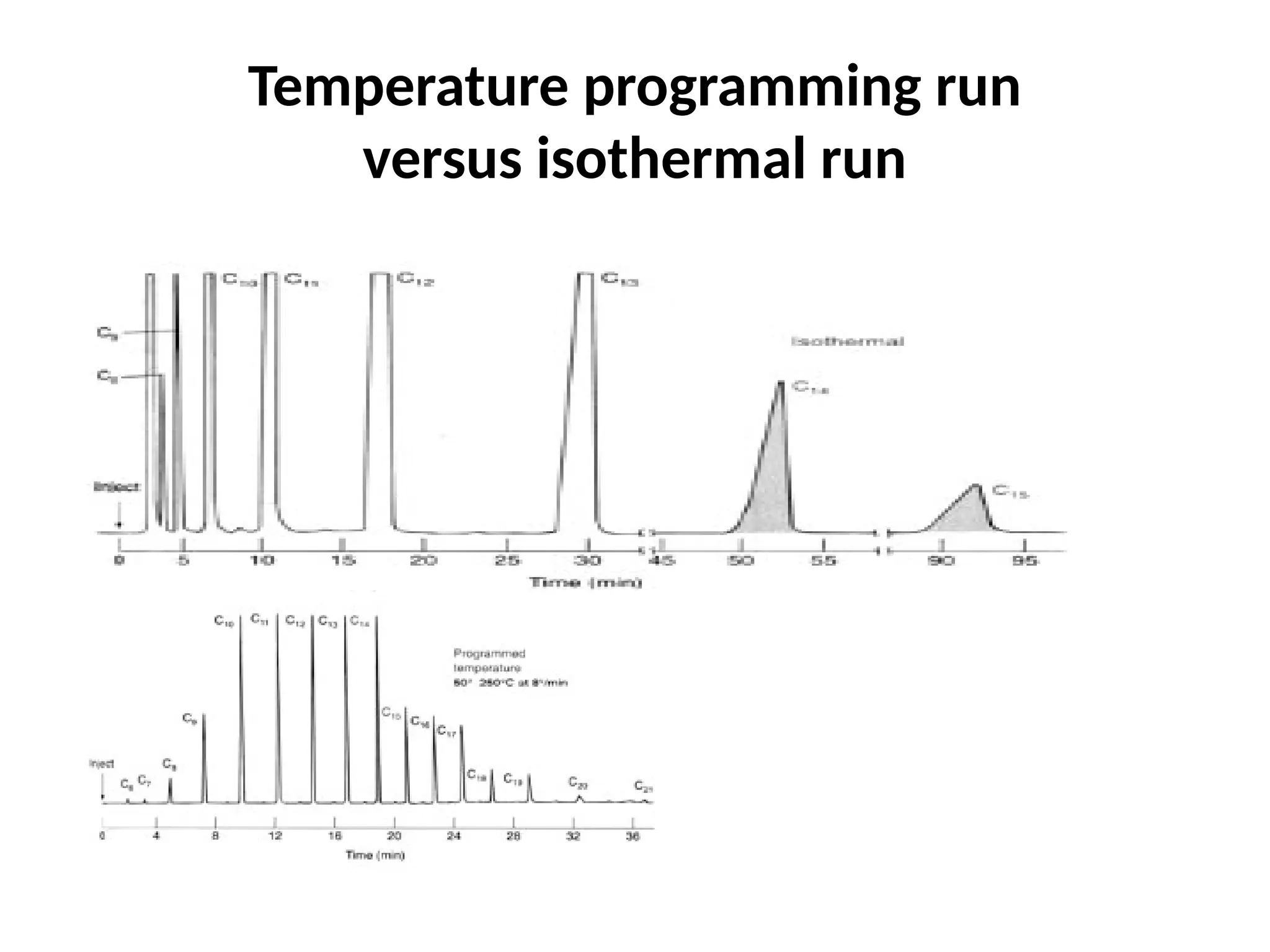
wide boiling range , a temp programming unit is used. An
initial temp is set for a specified time, followed by a steady
rise in temp at a pre-set gradient, up to a maximum.
• Preprogrammed parameters, called a
separation method, control the operation of
the system. The temp of the injector as well as
that of the detector must be some degrees
higher than the column temp.
Temperature programming run
versus isothermal run
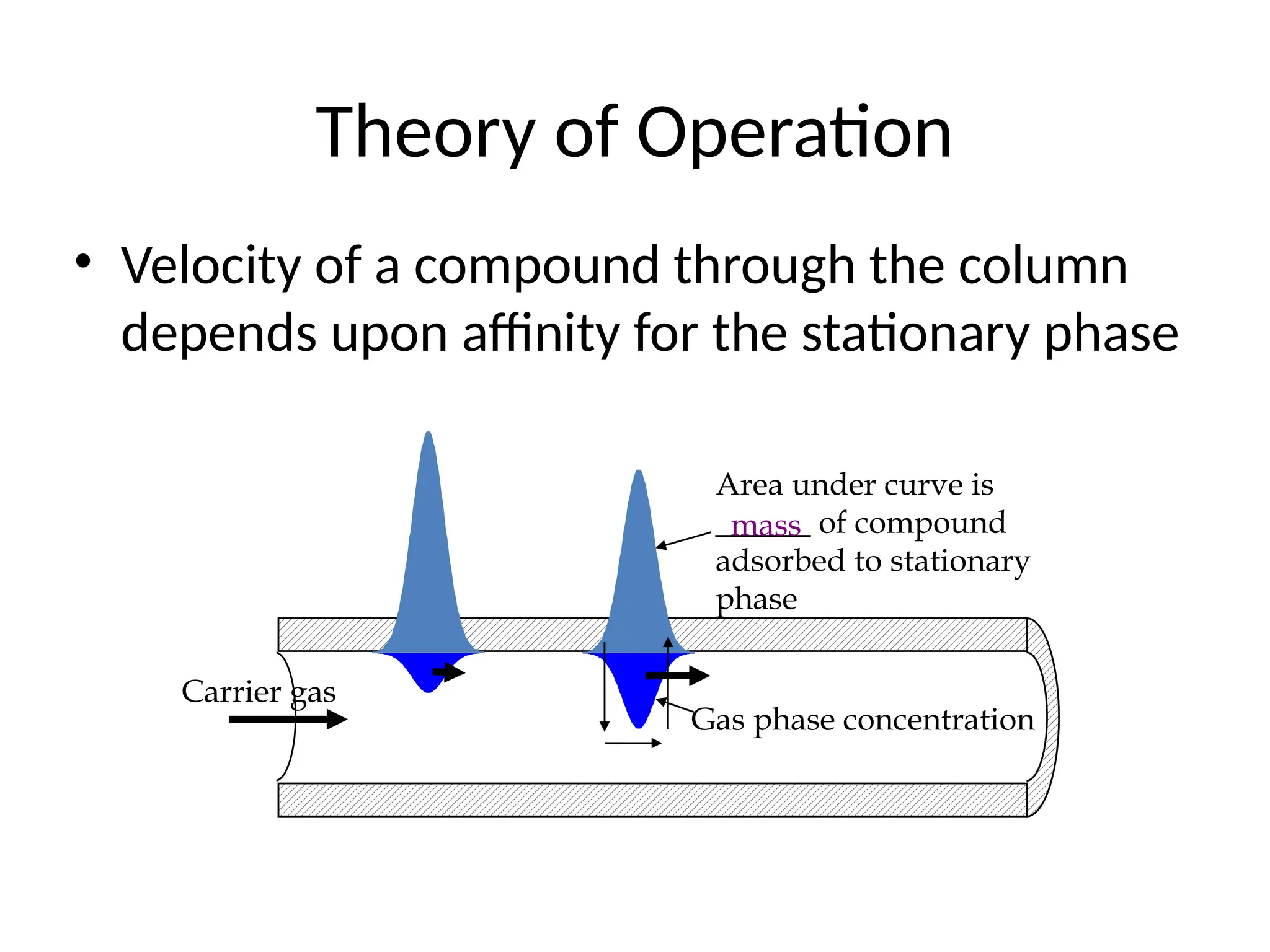
Theory of Operation
• Velocity of a compound through the column
depends upon affinity for the stationary phase
Area under curve is
______ of compound
adsorbed to stationary
phase
Gas phase concentration
Carrier gas
mass
description column for gas chromatography temperature programming.pptx

description column for gas chromatography temperature programming.pptx

  • 2.
    GC Columns • ColumnConfigurations • Two general types of columns are encountered in gas chromatography, – packed – (open tubular, or capillary). • Columns can be short (up to 5 m), large diameter (> 1 mm) packed column OR long, very small diameter (< 1 mm) capillary columns. • Each has its own use and associated advantages and disadvantages.
  • 3.
    GAS CHROMATOGRAPHY • GuardColumn • Collects nonvolatile solutes that are not eluted • Attached to the front of a chromatography column • 5 to 10 meters long • Has no stationary phase and is silanized • Ends are cut off with time to discard nonvolatile solute buildup
  • 4.
    GAS CHROMATOGRAPHIC COLUMNS Chromatographiccolumns vary in length from less than 2 m to 50 m or more. They are constructed of stainless steel, glass, fused silica, or Teflon. In order to fit into an oven for thermostating, they are usually formed as coils having diameters of 10 to 30 cm.
  • 5.
    Packed Columns Packed columnsare fabricated from glass, metal (stainless steel, copper, aluminum), or Teflon tubes that typically have lengths of 2 to 3 m and inside diameters of 2 to 4 mm. These tubes are densely packed with a uniform, finely divided packing material, or solid support, that is coated with a thin layer (0.05 to m) of the stationary liquid phase. In order to fit in a thermostating oven, the tubes are formed as coils having diameters of roughly 15 cm.
  • 6.
    GAS CHROMATOGRAPHIC COLUMNS Opentubular Columns Open tubular, or capillary, columns are of two basic types, namely, wall—coated open tubular (WCOT) and support-coated open tubular (SCOT). Wall-coated columns are simply capillary tubes coated with a thin layer of the stationary phase. In support-coated open tubular columns, the inner surface of the capillary is lined with a thin film (~30 m) of a support material, such as diatomaceous earth. This type of column holds several times as much stationary phase as does a wall- coated column and thus has a greater sample capacity.
  • 7.
  • 9.
    Column length • Asa general practice, 15m columns are used for fast screening, simple mixtures, or very high molecular weight compounds. The 30m length has become the most popular one for most analyses. Very long columns (50, 60 and 105m) are for extremely complex samples. • Column length is not a very strong parameter in column performance. For example, doubling column length doubles isothermal analysis time but increases peak resolution by only about 40%. If an analysis is not quite good enough, there are better ways than length to improve it. Consider a thinner film, optimizing the carrier flow through the column, and using temperature programming. • In the analysis of samples with extremely active components. These will tail severely if they contact the column material. Relatively short columns with thick films reduce the chance of interaction by having less column material and smothering it with stationary phase to conceal active sites.
  • 10.
    The Stationary Phase Desirableproperties for the immobilized liquid phase in a gas-liquid chromatographic column include: (1) low volatility (ideally, the boiling point of the liquid should be at 100o C higher than the maximum operating temperature for the column). (2) thermal stability. (3) chemical inertness. (4) solvent characteristics such that k` and  values for the solutes to be resolved fall within a suitable range. The retention time for a solute on a column depends upon its distribution constant which in turn is related to the chemical nature of the stationary phase.
  • 11.
    GC Columns Capillary: - havei.d. <1mm - have wide unrestricted flow through center & inner surface is coated with liquid stationary phase • Variety of functional groups have been blended into polysiloxane chain to provide different polarity & selectivity
  • 12.
    GAS CHROMATOGRAPHY • ComparingOpen Tubular Column to Packed Column • - Gives better separation • - Narrower peaks • - Handles smaller samples (analytical chromatography
  • 14.
    HO-CH2-CH2-(O-CH2-CH2)n-OH polyethylene glycol 5% Diphenyl– 95% Dimethyl polysiloxane DB – 5 325o C Flavors, environmental samples and aromatic hydrocarbons
  • 15.
    Column Ovens • Columntemperature is an important variable that must be controlled to a few tenths of a degree for precise work. Thus, the column is ordinarily housed in a thermo stated oven. The optimum column temperature depends upon the boiling point of the sample and the degree of separation required. • Roughly, a temperature equal to or slightly above the average boiling point of a sample results in a reasonable elution time (2 to 30 min). For samples with a broad boiling range, it is often desirable to employ temperature programming, whereby the column temperature is increased either continuously or in steps as the separation proceeds.
  • 16.
    GAS CHROMATOGRAPHY • Effectof Column Temperature • Increase in column temperature • - Increases solute vapor pressure • - Decreases retention time • - Results in sharp peaks • Temperature Programming • - Used to separate compounds with a wide range of • boiling points and polarities
  • 17.
    Operating temperature • Thecolumn is enclosed in a thermostatically controlled • oven that is preceded by a heated injector port and followed by a heated detector unit which produces the output. • A set of preprogrammed parameters regulate the operation of the system. A good initial choice is a temp few degrees lower than the boiling point of the major component of a sample. In case of sample mixtures with a wide boiling range , a temp programming unit is used. An initial temp is set for a specified time, followed by a steady rise in temp at a pre-set gradient, up to a maximum.
  • 18.
    • Preprogrammed parameters,called a separation method, control the operation of the system. The temp of the injector as well as that of the detector must be some degrees higher than the column temp.
  • 19.
  • 20.
    Theory of Operation •Velocity of a compound through the column depends upon affinity for the stationary phase Area under curve is ______ of compound adsorbed to stationary phase Gas phase concentration Carrier gas mass