Diabetes, Diet and the
Residential Home Resident
           Hilary Hogg
              BSc. RD
   Specialist Diabetes Dietitian


                                   Diabetes
                                   Education
                                   Services
Why is Diet important?
• Food and nutrition, alongside
  medication, is central to diabetes
  management

 However:
• The American Diabetes Association
  recommendations state:" the
  imposition of dietary restrictions on
  elderly patients with diabetes in long-
                                      Diabetes
                                         Education
                                         Services
How is diet important?
• Insufficient/ineffective Insulin
• Glucose from digesting carbohydrate
  unable to enter cells as an energy
  source
• Glucose builds up in the blood


                                  Diabetes
                                  Education
                                  Services
Diabetes
Education
Services
• Dietary Recommendations for the older
  person with diabetes can differ to the
  general recommendations for people
  with diabetes


                                   Diabetes
                                   Education
                                   Services
Basic advice for healthy eating
 for residents with diabetes :


                            Diabetes
                            Education
                            Services
Basic advice for healthy eating
  for residents with diabetes :
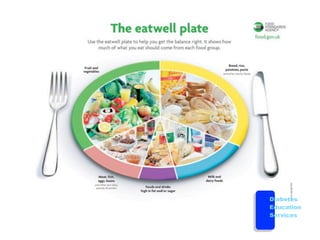
• Base meals on starchy foods (energy)


                                   Diabetes
                                   Education
                                   Services
Basic advice for healthy eating
  for residents with diabetes :
• Base meals on starchy foods (energy)
• Provide plenty of fruit and vegetables
  (fibre vitamins and minerals)


                                     Diabetes
                                     Education
                                     Services
Basic advice for healthy eating
  for residents with diabetes :
• Base meals on starchy foods (energy)
• Provide plenty of fruit and vegetables
  (fibre vitamins and minerals)
• Include protein sources – fish and meat


                                   Diabetes
                                   Education
                                   Services
Basic advice for healthy eating
  for residents with diabetes :
• Base meals on starchy foods (energy)
• Provide plenty of fruit and vegetables
  (fibre vitamins and minerals)
• Include protein sources – fish and meat
• Ensure there are dairy products in the
  diet

                                   Diabetes
                                   Education
                                   Services
Basic advice for healthy eating
  for residents with diabetes :
• Base meals on starchy foods (energy)
• Provide plenty of fruit and vegetables
  (fibre vitamins and minerals)
• Include protein sources – fish and meat
• Ensure there are dairy products in the
  diet
• Allow plenty of fluids (1500mls/day)
                                   Diabetes
                                   Education
                                   Services
Basic advice for healthy eating
   for residents with diabetes :
• Base meals on starchy foods (energy)
• Provide plenty of fruit and vegetables
  (fibre vitamins and minerals)
• Include protein sources – fish and meat
• Ensure there are dairy products in the
  diet
• Allow plenty of fluids (1500mls/day)
• Moderate fat/low sugar – slightly Diabetes
                                     Education
                                        Services
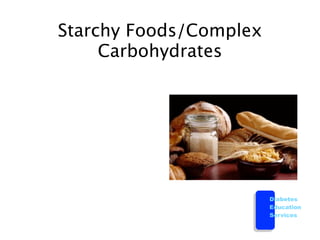
Starchy Foods/Complex
     Carbohydrates


                        Diabetes
                        Education
                        Services
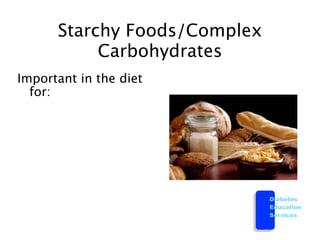
Starchy Foods/Complex
           Carbohydrates
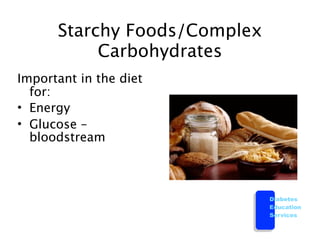
Important in the diet
  for:


                              Diabetes
                              Education
                              Services
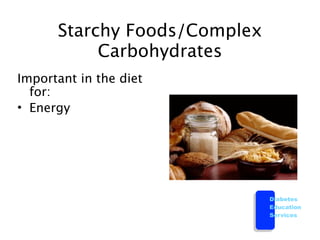
Starchy Foods/Complex
           Carbohydrates
Important in the diet
  for:
• Energy


                              Diabetes
                              Education
                              Services
Starchy Foods/Complex
           Carbohydrates
Important in the diet
  for:
• Energy
• Glucose –
  bloodstream


                              Diabetes
                              Education
                              Services
Starchy Foods/Complex
           Carbohydrates
Important in the diet
  for:
• Energy
• Glucose –
  bloodstream
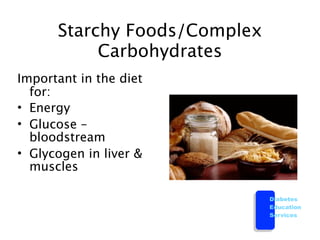
• Glycogen in liver &
  muscles

                              Diabetes
                              Education
                              Services
Starchy Foods/Complex
           Carbohydrates
Important in the diet
  for:
• Energy
• Glucose –
  bloodstream
• Glycogen in liver &
  muscles
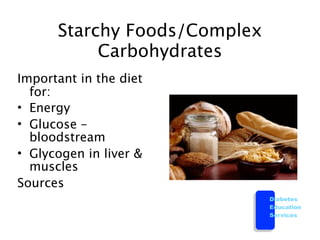
Sources
                              Diabetes
                              Education
                              Services
Starchy Foods/Complex
            Carbohydrates
Important in the diet
  for:
• Energy
• Glucose –
  bloodstream
• Glycogen in liver &
  muscles
Sources
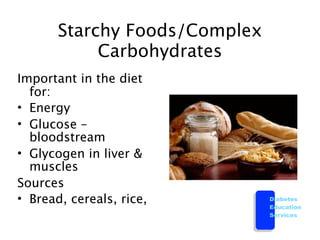
• Bread, cereals, rice,        Diabetes
                               Education
                               Services
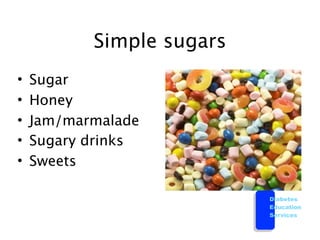
Simple sugars
•   Sugar
•   Honey
•   Jam/marmalade
•   Sugary drinks
•   Sweets

                           Diabetes
                           Education
                           Services
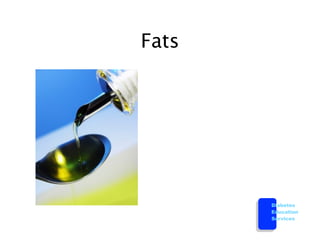
Fats


       Diabetes
       Education
       Services
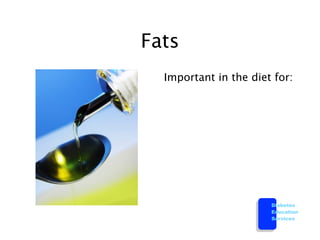
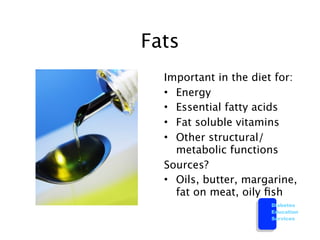
Fats
  Important in the diet for:


                       Diabetes
                       Education
                       Services
Fats
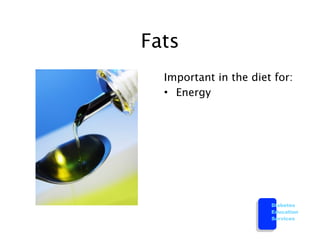
  Important in the diet for:
  • Energy


                       Diabetes
                       Education
                       Services
Fats
  Important in the diet for:
  • Energy
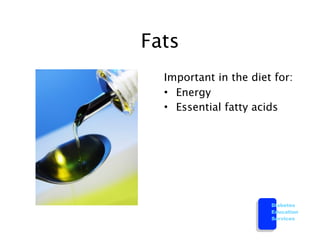
  • Essential fatty acids


                       Diabetes
                       Education
                       Services
Fats
  Important in the diet for:
  • Energy
  • Essential fatty acids
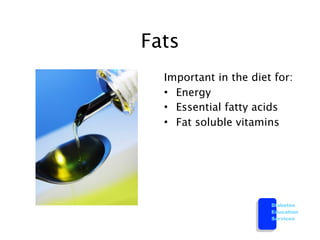
  • Fat soluble vitamins


                       Diabetes
                       Education
                       Services
Fats
  Important in the diet for:
  • Energy
  • Essential fatty acids
  • Fat soluble vitamins
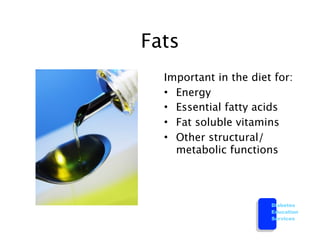
  • Other structural/
    metabolic functions


                       Diabetes
                       Education
                       Services
Fats
  Important in the diet for:
  • Energy
  • Essential fatty acids
  • Fat soluble vitamins
  • Other structural/
    metabolic functions
  Sources?


                       Diabetes
                       Education
                       Services
Fats
  Important in the diet for:
  • Energy
  • Essential fatty acids
  • Fat soluble vitamins
  • Other structural/
    metabolic functions
  Sources?
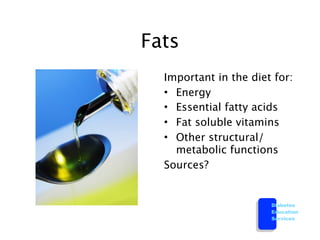
  • Oils, butter, margarine,
    fat on meat, oily fish
                      Diabetes
                      Education
                      Services
Protein


          Diabetes
          Education
          Services
Protein

• Needed for all functions and
  metabolism within the body (all
  enzymes are proteins)


                                    Diabetes
                                    Education
                                    Services
Protein

• Needed for all functions and
  metabolism within the body (all
  enzymes are proteins)
• Require adequate energy & other
  nutrients such as Zinc and B vitamins
  for effective utilisation of protein
                                    Diabetes
                                    Education
                                    Services
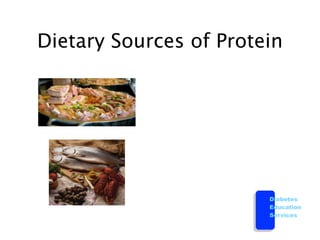
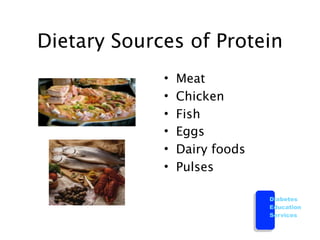
Dietary Sources of Protein


                        Diabetes
                        Education
                        Services
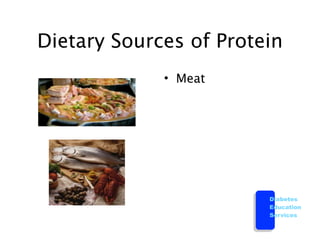
Dietary Sources of Protein
             • Meat


                        Diabetes
                        Education
                        Services
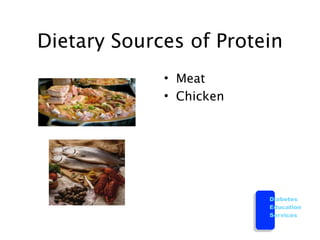
Dietary Sources of Protein
             • Meat
             • Chicken


                         Diabetes
                         Education
                         Services
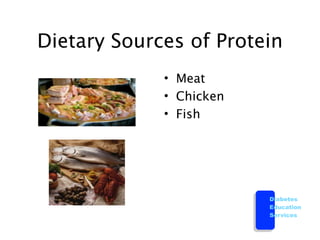
Dietary Sources of Protein
             • Meat
             • Chicken
             • Fish


                         Diabetes
                         Education
                         Services
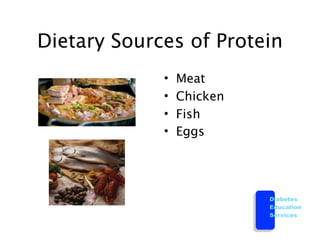
Dietary Sources of Protein
             •   Meat
             •   Chicken
             •   Fish
             •   Eggs


                           Diabetes
                           Education
                           Services
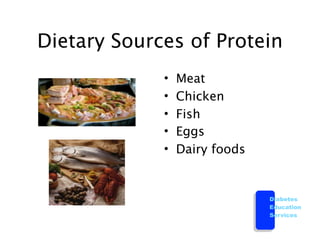
Dietary Sources of Protein
             •   Meat
             •   Chicken
             •   Fish
             •   Eggs
             •   Dairy foods


                               Diabetes
                               Education
                               Services
Dietary Sources of Protein
             •   Meat
             •   Chicken
             •   Fish
             •   Eggs
             •   Dairy foods
             •   Pulses

                               Diabetes
                               Education
                               Services
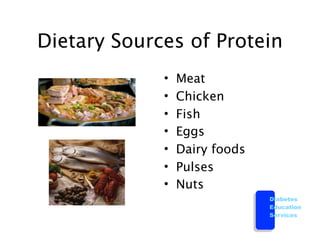
Dietary Sources of Protein
             •   Meat
             •   Chicken
             •   Fish
             •   Eggs
             •   Dairy foods
             •   Pulses
             •   Nuts
                               Diabetes
                               Education
                               Services
…….and what about fruit ?
• ALL fruit can be included – variety is good
• Up to 4 portions/day – spread out over
  the day
• 1 portion = approx a handful eg 1 apple,
  banana, 8-10 grapes, 2-3 rings of tinned
  pineapple in juice
• 1 portion of dried fruit is half to one
  tablespoon
• Fruit juice: 1-2 small glasses per day Diabetes
                                          with
                                            Education
                                            Services
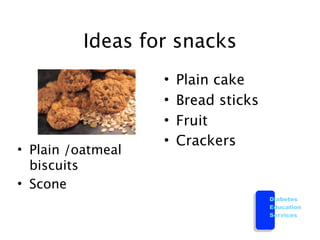
Ideas for snacks
                   •   Plain cake
                   •   Bread sticks
                   •   Fruit
                   •   Crackers
• Plain /oatmeal
  biscuits
• Scone
                                      Diabetes
                                      Education
                                      Services
Ideas for Desserts
                       • Sugar free jelly
                       • Ice cream
                         (occasionally)
                       • Stewed fruit and
                         custard
• Milky puddings
  (reduced sugar)      • Yogurt
• Sugar free instant   • Fruit crumble (low
  whip                   sugar)          Diabetes
                                           Education
                                           Services
Special Occasions
                     For example:
                     • Small portion of
                       Birthday cake,
                       Christmas pud or
Occasionally it is     mince pie
 fine to enjoy a      • Couple of squares
 treat!                of chocolate
                       (better if afterDiabetes
                                         a
                                        Education
                                        Services
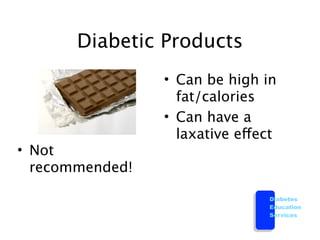
Diabetic Products
                 • Can be high in
                   fat/calories
                 • Can have a
                   laxative effect
• Not
  recommended!

                                Diabetes
                                Education
                                Services
Disease Related Malnutrition


                         Diabetes
                         Education
                         Services
Disease Related Malnutrition
              • A state of nutrition
                in which a
                deficiency, excess or
                imbalance of energy,
                protein and other
                nutrients causes
                measurable adverse
                effects on tissue/
                body structure,
                function and clinical
                                 Diabetes
                                  Education
                                  Services
Disease Related Malnutrition
• Under nutrition is   • A state of nutrition
  common in patients     in which a
  in the community       deficiency, excess or
                         imbalance of energy,
                         protein and other
                         nutrients causes
                         measurable adverse
                         effects on tissue/
                         body structure,
                         function and clinical
                                          Diabetes
                                           Education
                                           Services
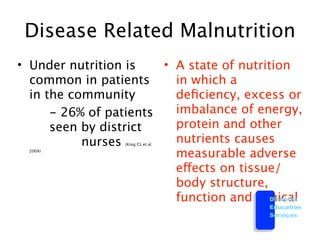
Disease Related Malnutrition
• Under nutrition is  • A state of nutrition
  common in patients    in which a
  in the community      deficiency, excess or

 
 - 26% of patients   imbalance of energy,
  
 seen by district    protein and other
  
 
      nurses       nutrients causes
                  (King CL et al
  2004)
                        measurable adverse
                        effects on tissue/
                        body structure,
                        function and clinical
                                         Diabetes
                                           Education
                                           Services
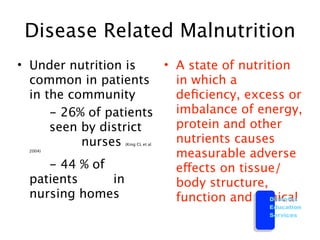
Disease Related Malnutrition
• Under nutrition is  • A state of nutrition
  common in patients    in which a
  in the community      deficiency, excess or

 
 - 26% of patients   imbalance of energy,
  
 seen by district    protein and other
  
 
      nurses       nutrients causes
                  (King CL et al
  2004)
                        measurable adverse

 
 - 44 % of           effects on tissue/
  patients 
    in      body structure,
  nursing homes         function and clinical
                                         Diabetes
                                           Education
                                           Services
Disease Related Malnutrition
• Under nutrition is  • A state of nutrition
  common in patients    in which a
  in the community      deficiency, excess or

 
 - 26% of patients   imbalance of energy,
  
 seen by district    protein and other
  
 
      nurses       nutrients causes
                                      (King CL et al
    2004)
                        measurable adverse

 
 - 44 % of           effects on tissue/
  patients 
    in      body structure,
  nursing homes         function and clinical
                                         Diabetes


   (Stratton RJ, 2005)                    Education
                                                       Services
Changes in the body as part of the


                               Diabetes
                               Education
                               Services
Changes in the body as part of the
 – Reduced sense of taste and smell
 – Poor dentition and less saliva produced
 – Impaired vision
 – Slower digestive function
 – Reduced capacity to absorb nutrients
 – Impaired kidney function
 – Reduction in lean body tissue
 – Reduced immune function
                                        Diabetes
                                        Education
                                        Services
Other aspects of the ageing process
    affecting nutritional status


                               Diabetes
                               Education
                               Services
Other aspects of the ageing process
    affecting nutritional status
• Impact of acute and chronic illness
  – Poor appetite
  – Medication


                                    Diabetes
                                    Education
                                    Services
Other aspects of the ageing process
    affecting nutritional status
• Impact of acute and chronic illness
  – Poor appetite
  – Medication
• Food quality, availability and choice.
  – Cooking methods


                                      Diabetes
                                      Education
                                      Services
Other aspects of the ageing process
    affecting nutritional status
• Impact of acute and chronic illness
  – Poor appetite
  – Medication
• Food quality, availability and choice.
  – Cooking methods
• Psychological status

                                      Diabetes
                                      Education
                                      Services
Other aspects of the ageing process
    affecting nutritional status
• Impact of acute and chronic illness
  – Poor appetite
  – Medication
• Food quality, availability and choice.
  – Cooking methods
• Psychological status
• Dehydration
                                      Diabetes
                                      Education
                                      Services
Medical conditions requiring Dietary
           Manipulation


                               Diabetes
                               Education
                               Services
Medical conditions requiring Dietary
           Manipulation
• Diabetes


                               Diabetes
                               Education
                               Services
Medical conditions requiring Dietary
           Manipulation
• Diabetes
• Dysphagia


                               Diabetes
                               Education
                               Services
Medical conditions requiring Dietary
           Manipulation
• Diabetes
• Dysphagia
• GI conditions
  – diverticulitis,IBS, Coeliac disease


                                          Diabetes
                                          Education
                                          Services
Medical conditions requiring Dietary
           Manipulation
• Diabetes
• Dysphagia
• GI conditions
  – diverticulitis,IBS, Coeliac disease
• Food Intolerance/allergy


                                          Diabetes
                                          Education
                                          Services
Medical conditions requiring Dietary
           Manipulation
• Diabetes
• Dysphagia
• GI conditions
  – diverticulitis,IBS, Coeliac disease
• Food Intolerance/allergy
• Obesity

                                          Diabetes
                                          Education
                                          Services
Medical conditions requiring Dietary
           Manipulation
• Diabetes
• Dysphagia
• GI conditions
  – diverticulitis,IBS, Coeliac disease
• Food Intolerance/allergy
• Obesity
• Renal Failure
                                          Diabetes
                                          Education
                                          Services
Who may be at risk?


                      Diabetes
                      Education
                      Services
Who may be at risk?
Residents with:


                             Diabetes
                             Education
                             Services
Who may be at risk?
Residents with:
• COPD


                             Diabetes
                             Education
                             Services
Who may be at risk?
Residents with:
• COPD
• Heart Failure


                             Diabetes
                             Education
                             Services
Who may be at risk?
Residents with:
• COPD
• Heart Failure
• Neurological conditions


                             Diabetes
                             Education
                             Services
Who may be at risk?
Residents with:
• COPD
• Heart Failure
• Neurological conditions
• Cancer


                             Diabetes
                             Education
                             Services
Who may be at risk?
Residents with:
• COPD
• Heart Failure
• Neurological conditions
• Cancer
• Dementia


                             Diabetes
                             Education
                             Services
Who may be at risk?
Residents with:
• COPD
• Heart Failure
• Neurological conditions
• Cancer
• Dementia
• Poor dentition

                             Diabetes
                             Education
                             Services
Who may be at risk?
Residents with:
• COPD
• Heart Failure
• Neurological conditions
• Cancer
• Dementia
• Poor dentition
• Arthritis
                             Diabetes
                             Education
                             Services
Screening Tools


                  Diabetes
                  Education
                  Services
Screening Tools
• Do you currently use
  any screening tools?


                              Diabetes
                              Education
                              Services
Screening Tools
• Do you currently use
  any screening tools?


                              Diabetes
                              Education
                              Services
Screening Tools
• Do you currently use
  any screening tools?


 A rapid, general,
  simple, often initial
  evaluation to detect
  presence or risk of
  malnutrition


                               Diabetes
                               Education
                               Services
Screening Tools
• Do you currently use
  any screening tools?


 A rapid, general,
  simple, often initial
  evaluation to detect
  presence or risk of
  malnutrition
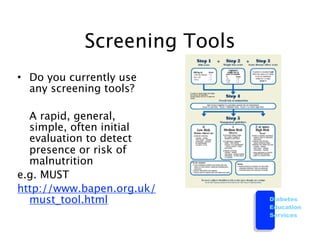
e.g. MUST

                               Diabetes
                               Education
                               Services
Screening Tools
• Do you currently use
  any screening tools?


 A rapid, general,
  simple, often initial
  evaluation to detect
  presence or risk of
  malnutrition
e.g. MUST
http://www.bapen.org.uk/
  must_tool.html              Diabetes
                              Education
                              Services
Screening Tools
• Do you currently use
  any screening tools?


 A rapid, general,
  simple, often initial
  evaluation to detect
  presence or risk of
  malnutrition
e.g. MUST
http://www.bapen.org.uk/
  must_tool.html              Diabetes
                              Education
                              Services
What should you do?


                      Diabetes
                      Education
                      Services
What should you do?
• Offer small frequent meals


                               Diabetes
                               Education
                               Services
What should you do?
• Offer small frequent meals
• Ensure all food and drinks are nutrient dense


                                         Diabetes
                                         Education
                                         Services
What should you do?
• Offer small frequent meals
• Ensure all food and drinks are nutrient dense
• Provide a balanced intake of protein,
  vitamins and minerals – tinned/frozen fruits
  or fruit desserts may be easier to manage
  than fresh fruit.


                                         Diabetes
                                         Education
                                         Services
What should you do?
• Offer small frequent meals
• Ensure all food and drinks are nutrient dense
• Provide a balanced intake of protein,
  vitamins and minerals – tinned/frozen fruits
  or fruit desserts may be easier to manage
  than fresh fruit.
• Low sugar NOT no sugar – can be in foods
  and baking
                                         Diabetes
                                         Education
                                         Services
Food Fortification – if malnutrition
   identified – first line advice:


                               Diabetes
                               Education
                               Services
Food Fortification – if malnutrition
    identified – first line advice:

 -
 full cream milk +/- sk milk powder


                                   Diabetes
                                   Education
                                   Services
Food Fortification – if malnutrition
    identified – first line advice:

 -
 full cream milk +/- sk milk powder

 -
 add extra butter/cream/oil/cheese


                                   Diabetes
                                   Education
                                   Services
Food Fortification – if malnutrition
    identified – first line advice:

 -
 full cream milk +/- sk milk powder

 -
 add extra butter/cream/oil/cheese
 
 - 
 nutritious snacks eg scone, malt
   loaf, dried 
 fruit (up to 1tbsp)


                                   Diabetes
                                   Education
                                   Services
Food Fortification – if malnutrition
    identified – first line advice:

 -
 full cream milk +/- sk milk powder

 -
 add extra butter/cream/oil/cheese
 
 - 
 nutritious snacks eg scone, malt
   loaf, dried 
 fruit (up to 1tbsp)

 - 
 encourage milky puddings/creamy
   
 
      yogurts

                                   Diabetes
                                   Education
                                   Services
Use of Supplements


                     Diabetes
                     Education
                     Services
Use of Supplements
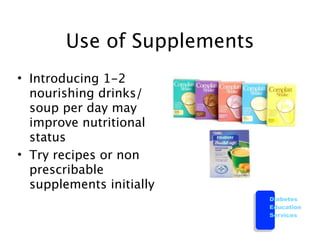
• Introducing 1-2
  nourishing drinks/
  soup per day may
  improve nutritional
  status


                            Diabetes
                            Education
                            Services
Use of Supplements
• Introducing 1-2
  nourishing drinks/
  soup per day may
  improve nutritional
  status
• Try recipes or non
  prescribable
  supplements initially
                             Diabetes
                             Education
                             Services
What to do next


                  Diabetes
                  Education
                  Services
What to do next
• If nutritional intake improves continue
  to monitor monthly


                                     Diabetes
                                     Education
                                     Services
What to do next
• If nutritional intake improves continue
  to monitor monthly
• If no improvement ask the GP to refer
  to the dietitian


                                     Diabetes
                                     Education
                                     Services
What to do next
• If nutritional intake improves continue
  to monitor monthly
• If no improvement ask the GP to refer
  to the dietitian
• Continue to monitor and record food
  and drink intake in particular for ‘at
  risk’ residents
                                     Diabetes
                                     Education
                                     Services
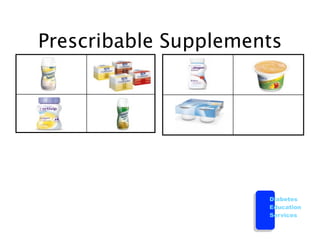
Prescribable Supplements


                      Diabetes
                      Education
                      Services
Prescribable Supplements


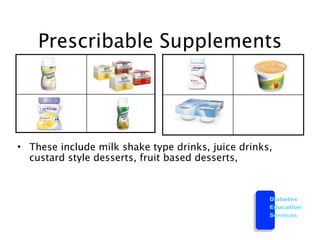
• These include milk shake type drinks, juice drinks,
  custard style desserts, fruit based desserts,


                                                    Diabetes
                                                    Education
                                                    Services
Prescribable Supplements


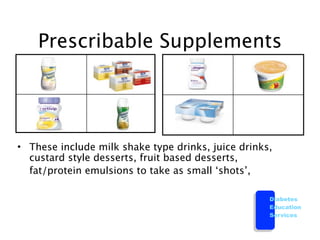
• These include milk shake type drinks, juice drinks,
  custard style desserts, fruit based desserts,

 fat/protein emulsions to take as small ‘shots’,

                                                    Diabetes
                                                    Education
                                                    Services
Prescribable Supplements


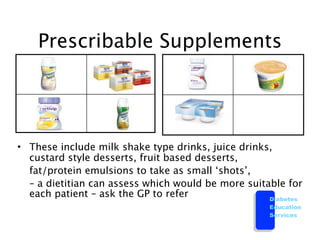
• These include milk shake type drinks, juice drinks,
  custard style desserts, fruit based desserts,

 fat/protein emulsions to take as small ‘shots’,

 – a dietitian can assess which would be more suitable for
  each patient – ask the GP to refer                Diabetes
                                                     Education
                                                     Services
….and if resident is
• Nutritionally balanced diet still
  important
• Starchy carbohydrate with all meals
• Offer healthier/low sugar between
  meal snacks if hungry- (family /regular
  visitors)                         eg
  sugar free jelly/fruit/plain biscuit
• Consider giving smaller portions of  Diabetes
                                         Education
                                         Services
The Way Forward


                  Diabetes
                  Education
                  Services
The Way Forward
• Monitor as
  appropriate –
  weight/blood
  glucose


                           Diabetes
                           Education
                           Services
The Way Forward
• Monitor as
  appropriate –
  weight/blood
  glucose
• Encourage a
  nutritionally
  balanced and varied
  diet
                           Diabetes
                           Education
                           Services
Thank you!

 Any
Questions?


                 Diabetes
                 Education
                 Services

Des dietitian presentation for torquay

  • 1.
    Diabetes, Diet andthe Residential Home Resident Hilary Hogg BSc. RD Specialist Diabetes Dietitian Diabetes Education Services
  • 2.
    Why is Dietimportant? • Food and nutrition, alongside medication, is central to diabetes management However: • The American Diabetes Association recommendations state:" the imposition of dietary restrictions on elderly patients with diabetes in long- Diabetes Education Services
  • 3.
    How is dietimportant? • Insufficient/ineffective Insulin • Glucose from digesting carbohydrate unable to enter cells as an energy source • Glucose builds up in the blood Diabetes Education Services
  • 4.
  • 5.
    • Dietary Recommendationsfor the older person with diabetes can differ to the general recommendations for people with diabetes Diabetes Education Services
  • 6.
    Basic advice forhealthy eating for residents with diabetes : Diabetes Education Services
  • 7.
    Basic advice forhealthy eating for residents with diabetes : • Base meals on starchy foods (energy) Diabetes Education Services
  • 8.
    Basic advice forhealthy eating for residents with diabetes : • Base meals on starchy foods (energy) • Provide plenty of fruit and vegetables (fibre vitamins and minerals) Diabetes Education Services
  • 9.
    Basic advice forhealthy eating for residents with diabetes : • Base meals on starchy foods (energy) • Provide plenty of fruit and vegetables (fibre vitamins and minerals) • Include protein sources – fish and meat Diabetes Education Services
  • 10.
    Basic advice forhealthy eating for residents with diabetes : • Base meals on starchy foods (energy) • Provide plenty of fruit and vegetables (fibre vitamins and minerals) • Include protein sources – fish and meat • Ensure there are dairy products in the diet Diabetes Education Services
  • 11.
    Basic advice forhealthy eating for residents with diabetes : • Base meals on starchy foods (energy) • Provide plenty of fruit and vegetables (fibre vitamins and minerals) • Include protein sources – fish and meat • Ensure there are dairy products in the diet • Allow plenty of fluids (1500mls/day) Diabetes Education Services
  • 12.
    Basic advice forhealthy eating for residents with diabetes : • Base meals on starchy foods (energy) • Provide plenty of fruit and vegetables (fibre vitamins and minerals) • Include protein sources – fish and meat • Ensure there are dairy products in the diet • Allow plenty of fluids (1500mls/day) • Moderate fat/low sugar – slightly Diabetes Education Services
  • 13.
    Starchy Foods/Complex Carbohydrates Diabetes Education Services
  • 14.
    Starchy Foods/Complex Carbohydrates Important in the diet for: Diabetes Education Services
  • 15.
    Starchy Foods/Complex Carbohydrates Important in the diet for: • Energy Diabetes Education Services
  • 16.
    Starchy Foods/Complex Carbohydrates Important in the diet for: • Energy • Glucose – bloodstream Diabetes Education Services
  • 17.
    Starchy Foods/Complex Carbohydrates Important in the diet for: • Energy • Glucose – bloodstream • Glycogen in liver & muscles Diabetes Education Services
  • 18.
    Starchy Foods/Complex Carbohydrates Important in the diet for: • Energy • Glucose – bloodstream • Glycogen in liver & muscles Sources Diabetes Education Services
  • 19.
    Starchy Foods/Complex Carbohydrates Important in the diet for: • Energy • Glucose – bloodstream • Glycogen in liver & muscles Sources • Bread, cereals, rice, Diabetes Education Services
  • 20.
    Simple sugars • Sugar • Honey • Jam/marmalade • Sugary drinks • Sweets Diabetes Education Services
  • 21.
    Fats Diabetes Education Services
  • 22.
    Fats Importantin the diet for: Diabetes Education Services
  • 23.
    Fats Importantin the diet for: • Energy Diabetes Education Services
  • 24.
    Fats Importantin the diet for: • Energy • Essential fatty acids Diabetes Education Services
  • 25.
    Fats Importantin the diet for: • Energy • Essential fatty acids • Fat soluble vitamins Diabetes Education Services
  • 26.
    Fats Importantin the diet for: • Energy • Essential fatty acids • Fat soluble vitamins • Other structural/ metabolic functions Diabetes Education Services
  • 27.
    Fats Importantin the diet for: • Energy • Essential fatty acids • Fat soluble vitamins • Other structural/ metabolic functions Sources? Diabetes Education Services
  • 28.
    Fats Importantin the diet for: • Energy • Essential fatty acids • Fat soluble vitamins • Other structural/ metabolic functions Sources? • Oils, butter, margarine, fat on meat, oily fish Diabetes Education Services
  • 29.
    Protein Diabetes Education Services
  • 30.
    Protein • Needed forall functions and metabolism within the body (all enzymes are proteins) Diabetes Education Services
  • 31.
    Protein • Needed forall functions and metabolism within the body (all enzymes are proteins) • Require adequate energy & other nutrients such as Zinc and B vitamins for effective utilisation of protein Diabetes Education Services
  • 32.
    Dietary Sources ofProtein Diabetes Education Services
  • 33.
    Dietary Sources ofProtein • Meat Diabetes Education Services
  • 34.
    Dietary Sources ofProtein • Meat • Chicken Diabetes Education Services
  • 35.
    Dietary Sources ofProtein • Meat • Chicken • Fish Diabetes Education Services
  • 36.
    Dietary Sources ofProtein • Meat • Chicken • Fish • Eggs Diabetes Education Services
  • 37.
    Dietary Sources ofProtein • Meat • Chicken • Fish • Eggs • Dairy foods Diabetes Education Services
  • 38.
    Dietary Sources ofProtein • Meat • Chicken • Fish • Eggs • Dairy foods • Pulses Diabetes Education Services
  • 39.
    Dietary Sources ofProtein • Meat • Chicken • Fish • Eggs • Dairy foods • Pulses • Nuts Diabetes Education Services
  • 40.
    …….and what aboutfruit ? • ALL fruit can be included – variety is good • Up to 4 portions/day – spread out over the day • 1 portion = approx a handful eg 1 apple, banana, 8-10 grapes, 2-3 rings of tinned pineapple in juice • 1 portion of dried fruit is half to one tablespoon • Fruit juice: 1-2 small glasses per day Diabetes with Education Services
  • 41.
    Ideas for snacks • Plain cake • Bread sticks • Fruit • Crackers • Plain /oatmeal biscuits • Scone Diabetes Education Services
  • 42.
    Ideas for Desserts • Sugar free jelly • Ice cream (occasionally) • Stewed fruit and custard • Milky puddings (reduced sugar) • Yogurt • Sugar free instant • Fruit crumble (low whip sugar) Diabetes Education Services
  • 43.
    Special Occasions For example: • Small portion of Birthday cake, Christmas pud or Occasionally it is mince pie fine to enjoy a • Couple of squares treat! of chocolate (better if afterDiabetes a Education Services
  • 44.
    Diabetic Products • Can be high in fat/calories • Can have a laxative effect • Not recommended! Diabetes Education Services
  • 45.
    Disease Related Malnutrition Diabetes Education Services
  • 46.
    Disease Related Malnutrition • A state of nutrition in which a deficiency, excess or imbalance of energy, protein and other nutrients causes measurable adverse effects on tissue/ body structure, function and clinical Diabetes Education Services
  • 47.
    Disease Related Malnutrition •Under nutrition is • A state of nutrition common in patients in which a in the community deficiency, excess or imbalance of energy, protein and other nutrients causes measurable adverse effects on tissue/ body structure, function and clinical Diabetes Education Services
  • 48.
    Disease Related Malnutrition •Under nutrition is • A state of nutrition common in patients in which a in the community deficiency, excess or - 26% of patients imbalance of energy, seen by district protein and other nurses nutrients causes (King CL et al 2004) measurable adverse effects on tissue/ body structure, function and clinical Diabetes Education Services
  • 49.
    Disease Related Malnutrition •Under nutrition is • A state of nutrition common in patients in which a in the community deficiency, excess or - 26% of patients imbalance of energy, seen by district protein and other nurses nutrients causes (King CL et al 2004) measurable adverse - 44 % of effects on tissue/ patients in body structure, nursing homes function and clinical Diabetes Education Services
  • 50.
    Disease Related Malnutrition •Under nutrition is • A state of nutrition common in patients in which a in the community deficiency, excess or - 26% of patients imbalance of energy, seen by district protein and other nurses nutrients causes (King CL et al 2004) measurable adverse - 44 % of effects on tissue/ patients in body structure, nursing homes function and clinical Diabetes (Stratton RJ, 2005) Education Services
  • 51.
    Changes in thebody as part of the Diabetes Education Services
  • 52.
    Changes in thebody as part of the – Reduced sense of taste and smell – Poor dentition and less saliva produced – Impaired vision – Slower digestive function – Reduced capacity to absorb nutrients – Impaired kidney function – Reduction in lean body tissue – Reduced immune function Diabetes Education Services
  • 53.
    Other aspects ofthe ageing process affecting nutritional status Diabetes Education Services
  • 54.
    Other aspects ofthe ageing process affecting nutritional status • Impact of acute and chronic illness – Poor appetite – Medication Diabetes Education Services
  • 55.
    Other aspects ofthe ageing process affecting nutritional status • Impact of acute and chronic illness – Poor appetite – Medication • Food quality, availability and choice. – Cooking methods Diabetes Education Services
  • 56.
    Other aspects ofthe ageing process affecting nutritional status • Impact of acute and chronic illness – Poor appetite – Medication • Food quality, availability and choice. – Cooking methods • Psychological status Diabetes Education Services
  • 57.
    Other aspects ofthe ageing process affecting nutritional status • Impact of acute and chronic illness – Poor appetite – Medication • Food quality, availability and choice. – Cooking methods • Psychological status • Dehydration Diabetes Education Services
  • 58.
    Medical conditions requiringDietary Manipulation Diabetes Education Services
  • 59.
    Medical conditions requiringDietary Manipulation • Diabetes Diabetes Education Services
  • 60.
    Medical conditions requiringDietary Manipulation • Diabetes • Dysphagia Diabetes Education Services
  • 61.
    Medical conditions requiringDietary Manipulation • Diabetes • Dysphagia • GI conditions – diverticulitis,IBS, Coeliac disease Diabetes Education Services
  • 62.
    Medical conditions requiringDietary Manipulation • Diabetes • Dysphagia • GI conditions – diverticulitis,IBS, Coeliac disease • Food Intolerance/allergy Diabetes Education Services
  • 63.
    Medical conditions requiringDietary Manipulation • Diabetes • Dysphagia • GI conditions – diverticulitis,IBS, Coeliac disease • Food Intolerance/allergy • Obesity Diabetes Education Services
  • 64.
    Medical conditions requiringDietary Manipulation • Diabetes • Dysphagia • GI conditions – diverticulitis,IBS, Coeliac disease • Food Intolerance/allergy • Obesity • Renal Failure Diabetes Education Services
  • 65.
    Who may beat risk? Diabetes Education Services
  • 66.
    Who may beat risk? Residents with: Diabetes Education Services
  • 67.
    Who may beat risk? Residents with: • COPD Diabetes Education Services
  • 68.
    Who may beat risk? Residents with: • COPD • Heart Failure Diabetes Education Services
  • 69.
    Who may beat risk? Residents with: • COPD • Heart Failure • Neurological conditions Diabetes Education Services
  • 70.
    Who may beat risk? Residents with: • COPD • Heart Failure • Neurological conditions • Cancer Diabetes Education Services
  • 71.
    Who may beat risk? Residents with: • COPD • Heart Failure • Neurological conditions • Cancer • Dementia Diabetes Education Services
  • 72.
    Who may beat risk? Residents with: • COPD • Heart Failure • Neurological conditions • Cancer • Dementia • Poor dentition Diabetes Education Services
  • 73.
    Who may beat risk? Residents with: • COPD • Heart Failure • Neurological conditions • Cancer • Dementia • Poor dentition • Arthritis Diabetes Education Services
  • 74.
    Screening Tools Diabetes Education Services
  • 75.
    Screening Tools • Doyou currently use any screening tools? Diabetes Education Services
  • 76.
    Screening Tools • Doyou currently use any screening tools? Diabetes Education Services
  • 77.
    Screening Tools • Doyou currently use any screening tools? A rapid, general, simple, often initial evaluation to detect presence or risk of malnutrition Diabetes Education Services
  • 78.
    Screening Tools • Doyou currently use any screening tools? A rapid, general, simple, often initial evaluation to detect presence or risk of malnutrition e.g. MUST Diabetes Education Services
  • 79.
    Screening Tools • Doyou currently use any screening tools? A rapid, general, simple, often initial evaluation to detect presence or risk of malnutrition e.g. MUST http://www.bapen.org.uk/ must_tool.html Diabetes Education Services
  • 80.
    Screening Tools • Doyou currently use any screening tools? A rapid, general, simple, often initial evaluation to detect presence or risk of malnutrition e.g. MUST http://www.bapen.org.uk/ must_tool.html Diabetes Education Services
  • 81.
    What should youdo? Diabetes Education Services
  • 82.
    What should youdo? • Offer small frequent meals Diabetes Education Services
  • 83.
    What should youdo? • Offer small frequent meals • Ensure all food and drinks are nutrient dense Diabetes Education Services
  • 84.
    What should youdo? • Offer small frequent meals • Ensure all food and drinks are nutrient dense • Provide a balanced intake of protein, vitamins and minerals – tinned/frozen fruits or fruit desserts may be easier to manage than fresh fruit. Diabetes Education Services
  • 85.
    What should youdo? • Offer small frequent meals • Ensure all food and drinks are nutrient dense • Provide a balanced intake of protein, vitamins and minerals – tinned/frozen fruits or fruit desserts may be easier to manage than fresh fruit. • Low sugar NOT no sugar – can be in foods and baking Diabetes Education Services
  • 86.
    Food Fortification –if malnutrition identified – first line advice: Diabetes Education Services
  • 87.
    Food Fortification –if malnutrition identified – first line advice: - full cream milk +/- sk milk powder Diabetes Education Services
  • 88.
    Food Fortification –if malnutrition identified – first line advice: - full cream milk +/- sk milk powder - add extra butter/cream/oil/cheese Diabetes Education Services
  • 89.
    Food Fortification –if malnutrition identified – first line advice: - full cream milk +/- sk milk powder - add extra butter/cream/oil/cheese - nutritious snacks eg scone, malt loaf, dried fruit (up to 1tbsp) Diabetes Education Services
  • 90.
    Food Fortification –if malnutrition identified – first line advice: - full cream milk +/- sk milk powder - add extra butter/cream/oil/cheese - nutritious snacks eg scone, malt loaf, dried fruit (up to 1tbsp) - encourage milky puddings/creamy yogurts Diabetes Education Services
  • 91.
    Use of Supplements Diabetes Education Services
  • 92.
    Use of Supplements •Introducing 1-2 nourishing drinks/ soup per day may improve nutritional status Diabetes Education Services
  • 93.
    Use of Supplements •Introducing 1-2 nourishing drinks/ soup per day may improve nutritional status • Try recipes or non prescribable supplements initially Diabetes Education Services
  • 94.
    What to donext Diabetes Education Services
  • 95.
    What to donext • If nutritional intake improves continue to monitor monthly Diabetes Education Services
  • 96.
    What to donext • If nutritional intake improves continue to monitor monthly • If no improvement ask the GP to refer to the dietitian Diabetes Education Services
  • 97.
    What to donext • If nutritional intake improves continue to monitor monthly • If no improvement ask the GP to refer to the dietitian • Continue to monitor and record food and drink intake in particular for ‘at risk’ residents Diabetes Education Services
  • 98.
    Prescribable Supplements Diabetes Education Services
  • 99.
    Prescribable Supplements • Theseinclude milk shake type drinks, juice drinks, custard style desserts, fruit based desserts, Diabetes Education Services
  • 100.
    Prescribable Supplements • Theseinclude milk shake type drinks, juice drinks, custard style desserts, fruit based desserts, fat/protein emulsions to take as small ‘shots’, Diabetes Education Services
  • 101.
    Prescribable Supplements • Theseinclude milk shake type drinks, juice drinks, custard style desserts, fruit based desserts, fat/protein emulsions to take as small ‘shots’, – a dietitian can assess which would be more suitable for each patient – ask the GP to refer Diabetes Education Services
  • 102.
    ….and if residentis • Nutritionally balanced diet still important • Starchy carbohydrate with all meals • Offer healthier/low sugar between meal snacks if hungry- (family /regular visitors) eg sugar free jelly/fruit/plain biscuit • Consider giving smaller portions of Diabetes Education Services
  • 103.
    The Way Forward Diabetes Education Services
  • 104.
    The Way Forward •Monitor as appropriate – weight/blood glucose Diabetes Education Services
  • 105.
    The Way Forward •Monitor as appropriate – weight/blood glucose • Encourage a nutritionally balanced and varied diet Diabetes Education Services
  • 106.
    Thank you! Any Questions? Diabetes Education Services

Editor's Notes

  • #2 \n
  • #3 \n
  • #4 \n
  • #5 \n
  • #6 \n
  • #7 \n
  • #8 \n
  • #9 \n
  • #10 \n
  • #11 \n
  • #12 \n
  • #13 \n
  • #14 \n
  • #15 \n
  • #16 \n
  • #17 \n
  • #18 \n
  • #19 \n
  • #20 \n
  • #21 \n
  • #22 \n
  • #23 \n
  • #24 \n
  • #25 \n
  • #26 \n
  • #27 \n
  • #28 \n
  • #29 \n
  • #30 \n
  • #31 \n
  • #32 \n
  • #33 \n
  • #34 \n
  • #35 \n
  • #36 \n
  • #37 \n
  • #38 \n
  • #39 \n
  • #40 \n
  • #41 \n
  • #42 \n
  • #43 \n
  • #44 \n
  • #45 \n
  • #46 \n
  • #47 \n
  • #48 Increased risk of degenerative diseases – heart disease, arthritis cancers 50% more likely to be malnourished with dementias\n\n\nRisk of dehydration is much higher – \nskin is thinner and therefore more water is lost via this route\nThe kidneys are not able to concentrate urine as well\nThirst mechanism is not sensitive\n\nImplications are immense\nIncrease drowsy, confusion, unpleasant taste in mouth loss of skin elasticity, increased risk of pressure sore development, Constipation UTIs Electrolyte imbalance and altered cardiac function.\n
  • #49 Increased risk of degenerative diseases – heart disease, arthritis cancers 50% more likely to be malnourished with dementias\n\n\nRisk of dehydration is much higher – \nskin is thinner and therefore more water is lost via this route\nThe kidneys are not able to concentrate urine as well\nThirst mechanism is not sensitive\n\nImplications are immense\nIncrease drowsy, confusion, unpleasant taste in mouth loss of skin elasticity, increased risk of pressure sore development, Constipation UTIs Electrolyte imbalance and altered cardiac function.\n
  • #50 Increased risk of degenerative diseases – heart disease, arthritis cancers 50% more likely to be malnourished with dementias\n\n\nRisk of dehydration is much higher – \nskin is thinner and therefore more water is lost via this route\nThe kidneys are not able to concentrate urine as well\nThirst mechanism is not sensitive\n\nImplications are immense\nIncrease drowsy, confusion, unpleasant taste in mouth loss of skin elasticity, increased risk of pressure sore development, Constipation UTIs Electrolyte imbalance and altered cardiac function.\n
  • #51 Increased risk of degenerative diseases – heart disease, arthritis cancers 50% more likely to be malnourished with dementias\n\n\nRisk of dehydration is much higher – \nskin is thinner and therefore more water is lost via this route\nThe kidneys are not able to concentrate urine as well\nThirst mechanism is not sensitive\n\nImplications are immense\nIncrease drowsy, confusion, unpleasant taste in mouth loss of skin elasticity, increased risk of pressure sore development, Constipation UTIs Electrolyte imbalance and altered cardiac function.\n
  • #52 \n
  • #53 \n
  • #54 \n
  • #55 \n
  • #56 \n
  • #57 \n
  • #58 \n
  • #59 \n
  • #60 \n
  • #61 \n
  • #62 \n
  • #63 \n
  • #64 \n
  • #65 \n
  • #66 \n
  • #67 \n
  • #68 \n
  • #69 \n
  • #70 \n
  • #71 \n
  • #72 \n
  • #73 \n
  • #74 \n
  • #75 \n
  • #76 \n
  • #77 \n
  • #78 \n
  • #79 \n
  • #80 \n
  • #81 \n
  • #82 \n
  • #83 \n
  • #84 \n
  • #85 \n
  • #86 \n
  • #87 \n
  • #88 \n
  • #89 \n
  • #90 \n
  • #91 \n