Skin lesions with oral
manifestations
SKIN LESIONS
•A skin lesion is an abnormal lump, bump, ulcer,
sore or colored area on the skin. Common skin
lesions include moles and actinic keratosis,
among others.
Oral manifestations: are symptoms or conditions in the mouth that
can occur as a result of diseases affecting other organs
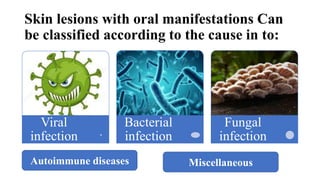
Skin lesions with oral manifestations Can
be classified according to the cause in to:
Viral
infection
Bacterial
infection
Fungal
infection
Autoimmune diseases Miscellaneous
I- Viral infection
Herpes Zoster
Hand Foot Mouth
Disease
HIV
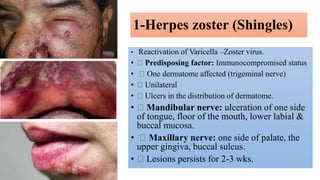
1-Herpes zoster (Shingles)
• Reactivation of Varicella –Zoster virus.
• Predisposing factor: Immunocompromised status
• One dermatome affected (trigeminal nerve)
• Unilateral
• Ulcers in the distribution of dermatome.
• Mandibular nerve: ulceration of one side
of tongue, floor of the mouth, lower labial &
buccal mucosa.
• Maxillary nerve: one side of palate, the
upper gingiva, buccal sulcus.
• Lesions persists for 2-3 wks.
• Herpes Zoster Oticus (Ramsay Hunt Syndrome) (infection of the
inner, middle and external ear).
• Ophthalmic Herpes Zoster (reactivation of varcella zoster
infection involving the eye.
• Post Herpetic Neuralgia (common complication of shingles,
causing burning sensation).
• Diagnosis: clinically
• Treatment: -Analgesics -Antivirals(within 72 hrs of onset of the
lesions):acyclovir, famciclovir, valacyclovir, & gabapentin.
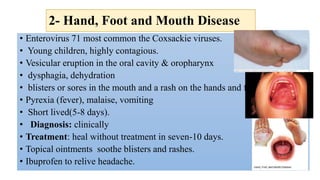
2- Hand, Foot and Mouth Disease
• Enterovirus 71 most common the Coxsackie viruses.
• Young children, highly contagious.
• Vesicular eruption in the oral cavity & oropharynx
• dysphagia, dehydration
• blisters or sores in the mouth and a rash on the hands and feet.
• Pyrexia (fever), malaise, vomiting
• Short lived(5-8 days).
• Diagnosis: clinically
• Treatment: heal without treatment in seven-10 days.
• Topical ointments soothe blisters and rashes.
• Ibuprofen to relive headache.
3- Acquired immunodeficiency syndrome
(AIDS)
• The AIDS epidemic was first recognized in the USA in 1981.
• Results from the depletion of T-lymphocyte (CD4+)
HIV is measured through the CD4 cell count and the HIV viral load.
AIDS is defined as a CD4
count of less than 200 cells/μl, (normal 500-1500 cells/μl).
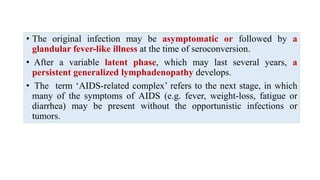
• The original infection may be asymptomatic or followed by a
glandular fever-like illness at the time of seroconversion.
• After a variable latent phase, which may last several years, a
persistent generalized lymphadenopathy develops.
• The term ‘AIDS-related complex’ refers to the next stage, in which
many of the symptoms of AIDS (e.g. fever, weight-loss, fatigue or
diarrhea) may be present without the opportunistic infections or
tumors.
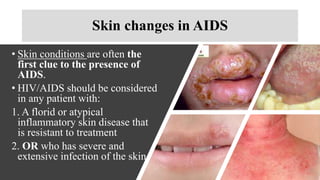
Skin changes in AIDS
• Skin conditions are often the
first clue to the presence of
AIDS.
• HIV/AIDS should be considered
in any patient with:
1. A florid or atypical
inflammatory skin disease that
is resistant to treatment
2. OR who has severe and
extensive infection of the skin
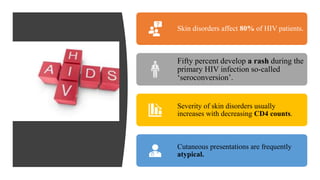
Skin disorders affect 80% of HIV patients.
Fifty percent develop a rash during the
primary HIV infection so-called
‘seroconversion’.
Severity of skin disorders usually
increases with decreasing CD4 counts.
Cutaneous presentations are frequently
atypical.
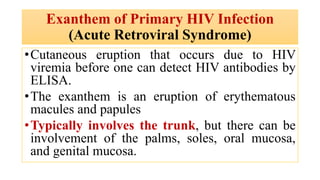
Exanthem of Primary HIV Infection
(Acute Retroviral Syndrome)
•Cutaneous eruption that occurs due to HIV
viremia before one can detect HIV antibodies by
ELISA.
•The exanthem is an eruption of erythematous
macules and papules
•Typically involves the trunk, but there can be
involvement of the palms, soles, oral mucosa,
and genital mucosa.
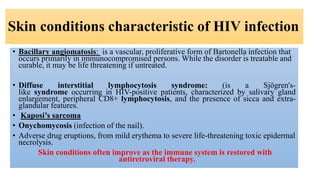
Skin conditions characteristic of HIV infection
• Bacillary angiomatosis: is a vascular, proliferative form of Bartonella infection that
occurs primarily in immunocompromised persons. While the disorder is treatable and
curable, it may be life threatening if untreated.
• Diffuse interstitial lymphocytosis syndrome: (is a Sjögren's-
like syndrome occurring in HIV-positive patients, characterized by salivary gland
enlargement, peripheral CD8+ lymphocytosis, and the presence of sicca and extra-
glandular features.
• Kaposi’s sarcoma
• Onychomycosis (infection of the nail).
• Adverse drug eruptions, from mild erythema to severe life-threatening toxic epidermal
necrolysis.
Skin conditions often improve as the immune system is restored with
antiretroviral therapy.
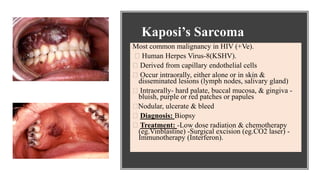
Kaposi’s Sarcoma
Most common malignancy in HIV (+Ve).
Human Herpes Virus-8(KSHV).
Derived from capillary endothelial cells
Occur intraorally, either alone or in skin &
disseminated lesions (lymph nodes, salivary gland)
Intraorally- hard palate, buccal mucosa, & gingiva -
bluish, purple or red patches or papules
Nodular, ulcerate & bleed
Diagnosis: Biopsy
Treatment: -Low dose radiation & chemotherapy
(eg.Vinblastine) -Surgical excision (eg.CO2 laser) -
Immunotherapy (Interferon).
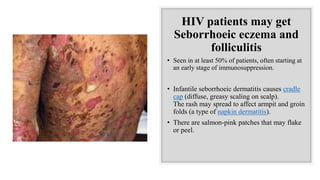
HIV patients may get
Seborrhoeic eczema and
folliculitis
• Seen in at least 50% of patients, often starting at
an early stage of immunosuppression.
• Infantile seborrhoeic dermatitis causes cradle
cap (diffuse, greasy scaling on scalp).
The rash may spread to affect armpit and groin
folds (a type of napkin dermatitis).
• There are salmon-pink patches that may flake
or peel.
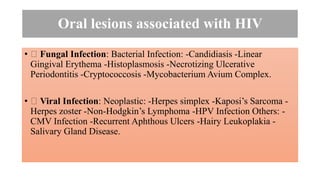
Oral lesions associated with HIV
• Fungal Infection: Bacterial Infection: -Candidiasis -Linear
Gingival Erythema -Histoplasmosis -Necrotizing Ulcerative
Periodontitis -Cryptococcosis -Mycobacterium Avium Complex.
• Viral Infection: Neoplastic: -Herpes simplex -Kaposi’s Sarcoma -
Herpes zoster -Non-Hodgkin’s Lymphoma -HPV Infection Others: -
CMV Infection -Recurrent Aphthous Ulcers -Hairy Leukoplakia -
Salivary Gland Disease.
Treatment
• Antiretroviral therapy (ART) is the use of HIV medicines to treat
HIV infection. People on ART take a combination of HIV medicines
(called an HIV treatment regimen) every day.
• A main goal of ART is to reduce a person’s viral load to an
undetectable level. An undetectable viral load means that the level of
HIV in the blood is too low to be detected by a viral load test.
II- Bacterial infection
Tuberculosis
Syphilis
1- Tuberculosis
• Chronic, granulomatous, infectious disease
• Cause: Mycobacterium tuberculosis
• Clinical features:
• Oral lesions – rare secondary to pulmonary tuberculosis
• Pharynx- not common Primary infection (Tonsils, Adenoids)
Secondary to coughing heavily of infected sputum
• Ulcer: multiple, painful, irregular, undermined border, granulating
floor, usually covered by a gray-yellowish exudate, inflamed & indurated
surrounding tissue.
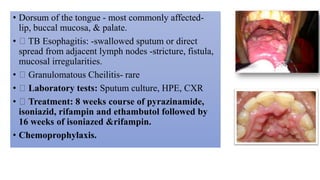
• Dorsum of the tongue - most commonly affected-
lip, buccal mucosa, & palate.
• TB Esophagitis: -swallowed sputum or direct
spread from adjacent lymph nodes -stricture, fistula,
mucosal irregularities.
• Granulomatous Cheilitis- rare
• Laboratory tests: Sputum culture, HPE, CXR
• Treatment: 8 weeks course of pyrazinamide,
isoniazid, rifampin and ethambutol followed by
16 weeks of isoniazed &rifampin.
• Chemoprophylaxis.
2- Syphilis
• Cause: Treponema pallidum
• Acquired -Congenital
• 1. Primary Syphilis
• 2. Secondary Syphilis
• 3. Tertiary Syphilis
Primary
Syphilis
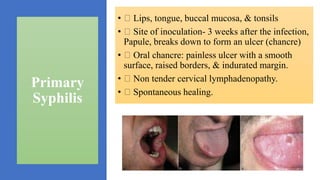
• Lips, tongue, buccal mucosa, & tonsils
• Site of inoculation- 3 weeks after the infection,
Papule, breaks down to form an ulcer (chancre)
• Oral chancre: painless ulcer with a smooth
surface, raised borders, & indurated margin.
• Non tender cervical lymphadenopathy.
• Spontaneous healing.
Secondary Syphilis
• Most infectious
• Secondary stage – after 6–8 weeks & lasts for 2-10 weeks
• Clinical features: Malaise, low-grade fever, headache,
lacrimation, sore throat, weight loss, myalgia, arthralgia, &
generalized lymphadenopathy.
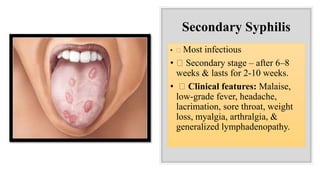
Secondary Syphilis
• Most infectious
• Secondary stage – after 6–8
weeks & lasts for 2-10 weeks.
• Clinical features: Malaise,
low-grade fever, headache,
lacrimation, sore throat, weight
loss, myalgia, arthralgia, &
generalized lymphadenopathy.
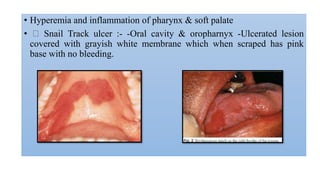
• Hyperemia and inflammation of pharynx & soft palate
• Snail Track ulcer :- -Oral cavity & oropharnyx -Ulcerated lesion
covered with grayish white membrane which when scraped has pink
base with no bleeding.
Tertiary Syphilis
• Tertiary syphilis - after a period of 4–7 years
• Typically painless
• No lymphadenopathy unless secondary infection
• Gumma: -Characteristic lesion -Hard palate, Nasal septum, Tonsil,
PPW, or Larynx
• VDRL may be negative
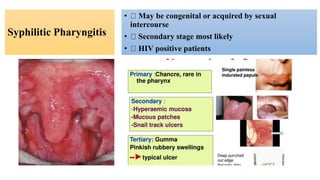
Syphilitic Pharyngitis
• May be congenital or acquired by sexual
intercourse
• Secondary stage most likely
• HIV positive patients
Congenital Syphilis
• Early: first 3 months of life, manifest as snuffles
• Nasal discharge purulent Late: Manifest at puberty Gummatous
lesion
• Oral lesions: high-arched palate, short mandible, Hutchinson’s
teeth, and Moon’s or mulberry molars
Congenital syphilis
• 1.Immunoflurorescence or dark field microscopy.
• 2. Biopsy
• 3.Serology Non-treponemal antibody tests: -VDRL, RPR -For
screening and treatment follow up Treponema specific antibody
tests: -FTA-ABS test, TPHA -For confirmation -Usually remains
positive for life.
• Treatment: Penicillin (DOC) Ceftriaxone, Erythromycin, or
Doxycycline.
III- Fungal infection
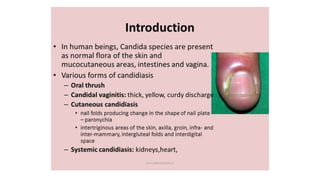
• Candidiasis:
• Candidiasis is a fungal infection caused by yeasts that belong to the
genus Candida. Some of the hundreds of Candida species can cause
infection in humans; the most common is Candida albicans.
• Candidiasis that develops in the mouth or throat is called “thrush” or
oropharyngeal candidiasis.
Predisposing Factor
• Change in oral microbial flora
• – Administration of antibiotics especially broad spectrum –
• Xerostomia secondary to anticholinergic agents
• – Salivary gland disease
• • Local Irritation
• – Denture, orthodontic appliance
• – Heavy smoking
Predisposing factor
• Drug therapy
• – Corticosteroid or cyto-toxic drug or immunosuppressive drug
• – Radiation therapy
• Other systemic disease
• – Leukemia
• – Lymphoma
• – Diabetes
• – Tuberculosis
• – Epithelial dysplsia
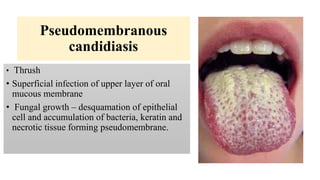
Pseudomembranous
candidiasis
• Thrush
• Superficial infection of upper layer of oral
mucous membrane
• Fungal growth – desquamation of epithelial
cell and accumulation of bacteria, keratin and
necrotic tissue forming pseudomembrane.
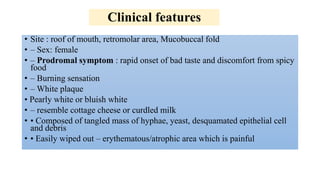
Clinical features
• Site : roof of mouth, retromolar area, Mucobuccal fold
• – Sex: female
• – Prodromal symptom : rapid onset of bad taste and discomfort from spicy
food
• – Burning sensation
• – White plaque
• Pearly white or bluish white
• – resemble cottage cheese or curdled milk
• • Composed of tangled mass of hyphae, yeast, desquamated epithelial cell
and debris
• • Easily wiped out – erythematous/atrophic area which is painful
Treatment of oral Candidiasis
• Topically or systematic
• • 7 days treatment
• • Oral symptoms disappears in 2-5 days
• • Relapse common – underlying immunodeficiency
• • Removal of causative factors – Ill fitting denture – Withdrawal or
change of antibiotics – Proper cleaning of denture and use of
antifungal agent.
• Topical treatment include: Nystatin, Amphotericin B, Clotrimazole
IV-Immune mediated diseases
Systemic lupus
erytheromatosus Lichen planus
Pemphigus
vulgaris
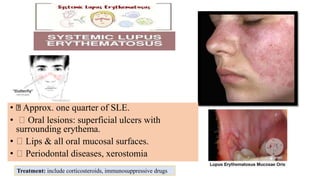
1- Systemic Lupus Erythematosus(SLE)
Systemic lupus erythematosus (SLE), also known simply as lupus, is
an autoimmune disease in which the body's immune system mistakenly
attacks healthy tissue in many parts of the body.
Symptoms vary between people and may be mild to severe. Common
symptoms include painful and swollen joints, fever, chest pain, hair
loss, mouth ulcers, swollen lymph nodes, feeling tired, and a
red rash which is most commonly on the face. Often there are periods
of illness, called flares, and periods of remission during which there are
few symptoms.
Treatment: include corticosteroids, immunosuppressive drugs
• Approx. one quarter of SLE.
• Oral lesions: superficial ulcers with
surrounding erythema.
• Lips & all oral mucosal surfaces.
• Periodontal diseases, xerostomia
Lichen Planus
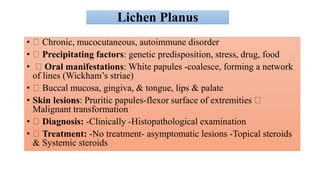
• Chronic, mucocutaneous, autoimmune disorder
• Precipitating factors: genetic predisposition, stress, drug, food
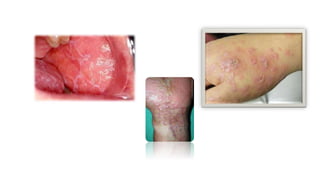
• Oral manifestations: White papules -coalesce, forming a network
of lines (Wickham’s striae)
• Buccal mucosa, gingiva, & tongue, lips & palate
• Skin lesions: Pruritic papules-flexor surface of extremities
Malignant transformation
• Diagnosis: -Clinically -Histopathological examination
• Treatment: -No treatment- asymptomatic lesions -Topical steroids
& Systemic steroids
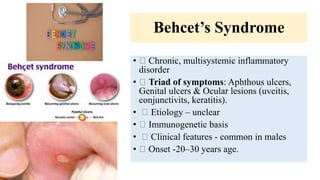
Behcet’s Syndrome
• Chronic, multisystemic inflammatory
disorder
• Triad of symptoms: Aphthous ulcers,
Genital ulcers & Ocular lesions (uveitis,
conjunctivits, keratitis).
• Etiology – unclear
• Immunogenetic basis
• Clinical features - common in males
• Onset -20–30 years age.
Diagnostic criteria
• 1. Recurrent oral ulcers (aphthae).
• 2. Recurrent genital ulcers.
• 3. Ocular lesions (conjunctivitis, iritis with hypopyon, uveitis, retinal
vasculitis, reduced visual acuity.
• 4. Skin lesions (papules, pustules, folliculitis, erythema nodosum,
ulcers, & rarely necrotic lesions)
• 5. Positive Pathergy test: The test is called positive, when the needle
puncture causes a sterile red nodule or pustule that is greater than 2mm
in diameter at 24 to 48 hours.
• Diagnosis:
• For accurate diagnosis, recurrent oral ulcers plus two of the four
criteria must be present
• Treatment:
• Mild cases- Topical steroid
• Severe cases- Systemic steroid, & other immunosuppressive drugs
(Ciclosporin, Thalidomide, Colchicine, Dapsone).
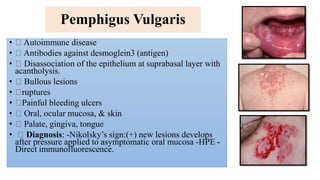
Pemphigus Vulgaris
• Autoimmune disease
• Antibodies against desmoglein3 (antigen)
• Disassociation of the epithelium at suprabasal layer with
acantholysis.
• Bullous lesions
• ruptures
• Painful bleeding ulcers
• Oral, ocular mucosa, & skin
• Palate, gingiva, tongue
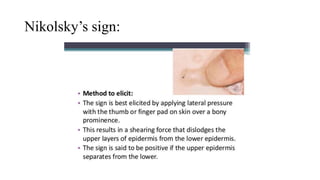
• Diagnosis: -Nikolsky’s sign:(+) new lesions develops
after pressure applied to asymptomatic oral mucosa -HPE -
Direct immunofluorescence.
Nikolsky’s sign:
• Treatment: Systemic steroids & immunosuppressive agents (eg.
mycophenolate mofetil)
• Paraneoplastic Pemphigus:
• Occurs in association with underlying neoplasms eg. Lymphoproliferative
disease or thymoma
• Often partial response to systemic steroids.
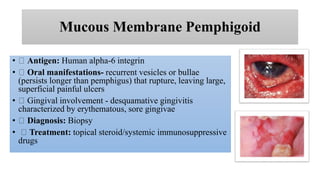
Mucous Membrane Pemphigoid
• Antigen: Human alpha-6 integrin
• Oral manifestations- recurrent vesicles or bullae
(persists longer than pemphigus) that rupture, leaving large,
superficial painful ulcers
• Gingival involvement - desquamative gingivitis
characterized by erythematous, sore gingivae
• Diagnosis: Biopsy
• Treatment: topical steroid/systemic immunosuppressive
drugs
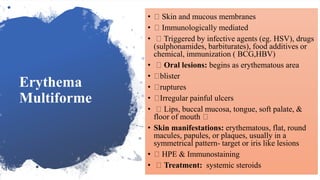
Erythema
Multiforme
• Skin and mucous membranes
• Immunologically mediated
• Triggered by infective agents (eg. HSV), drugs
(sulphonamides, barbiturates), food additives or
chemical, immunization ( BCG,HBV)
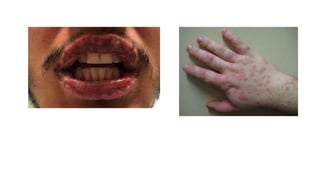
• Oral lesions: begins as erythematous area
• blister
• ruptures
• Irregular painful ulcers
• Lips, buccal mucosa, tongue, soft palate, &
floor of mouth
• Skin manifestations: erythematous, flat, round
macules, papules, or plaques, usually in a
symmetrical pattern- target or iris like lesions
• HPE & Immunostaining
• Treatment: systemic steroids
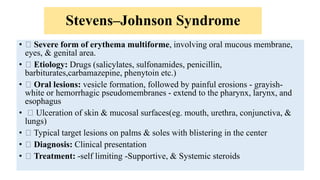
Stevens–Johnson Syndrome
• Severe form of erythema multiforme, involving oral mucous membrane,
eyes, & genital area.
• Etiology: Drugs (salicylates, sulfonamides, penicillin,
barbiturates,carbamazepine, phenytoin etc.)
• Oral lesions: vesicle formation, followed by painful erosions - grayish-
white or hemorrhagic pseudomembranes - extend to the pharynx, larynx, and
esophagus
• Ulceration of skin & mucosal surfaces(eg. mouth, urethra, conjunctiva, &
lungs)
• Typical target lesions on palms & soles with blistering in the center
• Diagnosis: Clinical presentation
• Treatment: -self limiting -Supportive, & Systemic steroids
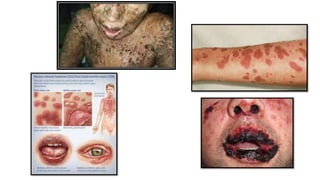
Toxic Epidermal Necrolysis
• Severe skin & mucous membrane disease
• Etiology: Drugs
• Clinical features: low-grade fever, malaise, arthralgia, conjunctival
burning sensation, skin tenderness, & erythema
• blisters appear-skin - lifted up - whole body surface appears scalded
Nikolsky’s sign –positive
• Oral manifestations: diffuse erythema, vesicles and painful
erosions - lips & periorally, buccal mucosa, tongue, & palate
• Diagnosis: Clinically
• Treatment: Systemic steroids, antibiotics, fluids, and electrolytes
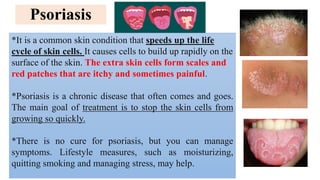
Psoriasis
*It is a common skin condition that speeds up the life
cycle of skin cells. It causes cells to build up rapidly on the
surface of the skin. The extra skin cells form scales and
red patches that are itchy and sometimes painful.
*Psoriasis is a chronic disease that often comes and goes.
The main goal of treatment is to stop the skin cells from
growing so quickly.
*There is no cure for psoriasis, but you can manage
symptoms. Lifestyle measures, such as moisturizing,
quitting smoking and managing stress, may help.
Symptoms
• Red patches of skin covered with thick, silvery scales.
• Small scaling spots (commonly seen in children).
• Dry, cracked skin that may bleed.
• Itching, burning or soreness.
• Thickened, pitted or ridged nails.
• Swollen and stiff joints.
• Psoriasis patches can range from a few spots of dandruff-like
scaling to major eruptions that cover large areas.
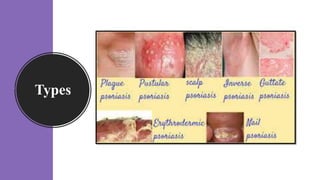
Types
• It is an inflammatory disease that affects multiple organs in the body,
but mostly the lungs and lymph glands. In people with sarcoidosis,
abnormal masses or nodules (called granulomas) consisting of
inflamed tissues form in certain organs of the body. These
granulomas may alter the normal structure and possibly the
function of the affected organ.
• It may be a type of autoimmune disease associated with an abnormal
immune response, but what triggers this response is uncertain.
• Age: any age.
• Sex: women more
• Race: people of African descent have high risk
• Family history: increase if someone in the family has had sarcoidosis.
• General symptoms:
• Fatigue
• Swollen lymph nodes
• Weight loss
• Pain and swelling in joints.
• In maxillofacial region, the salivary glands are frequently involved but
xerostomia and bilateral parotid swelling are present.
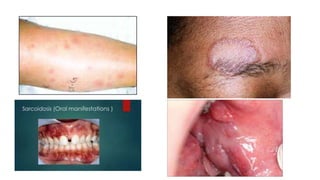
• Appear as erythematous granular lesion
Symptoms
Treatment
• There is no cure for sarcoidosis, but the disease may get better on its
own over time.
• Treatments generally fall into two categories -- maintenance of good
health practices and drug treatment.
• The oral corticosteroid prednisone is the most commonly used treatment.
Dermatology

Dermatology

  • 1.
    Skin lesions withoral manifestations
  • 2.
    SKIN LESIONS •A skinlesion is an abnormal lump, bump, ulcer, sore or colored area on the skin. Common skin lesions include moles and actinic keratosis, among others. Oral manifestations: are symptoms or conditions in the mouth that can occur as a result of diseases affecting other organs
  • 3.
    Skin lesions withoral manifestations Can be classified according to the cause in to: Viral infection Bacterial infection Fungal infection Autoimmune diseases Miscellaneous
  • 4.
    I- Viral infection HerpesZoster Hand Foot Mouth Disease HIV
  • 5.
    1-Herpes zoster (Shingles) •Reactivation of Varicella –Zoster virus. • Predisposing factor: Immunocompromised status • One dermatome affected (trigeminal nerve) • Unilateral • Ulcers in the distribution of dermatome. • Mandibular nerve: ulceration of one side of tongue, floor of the mouth, lower labial & buccal mucosa. • Maxillary nerve: one side of palate, the upper gingiva, buccal sulcus. • Lesions persists for 2-3 wks.
  • 6.
    • Herpes ZosterOticus (Ramsay Hunt Syndrome) (infection of the inner, middle and external ear). • Ophthalmic Herpes Zoster (reactivation of varcella zoster infection involving the eye. • Post Herpetic Neuralgia (common complication of shingles, causing burning sensation). • Diagnosis: clinically • Treatment: -Analgesics -Antivirals(within 72 hrs of onset of the lesions):acyclovir, famciclovir, valacyclovir, & gabapentin.
  • 7.
    2- Hand, Footand Mouth Disease • Enterovirus 71 most common the Coxsackie viruses. • Young children, highly contagious. • Vesicular eruption in the oral cavity & oropharynx • dysphagia, dehydration • blisters or sores in the mouth and a rash on the hands and feet. • Pyrexia (fever), malaise, vomiting • Short lived(5-8 days). • Diagnosis: clinically • Treatment: heal without treatment in seven-10 days. • Topical ointments soothe blisters and rashes. • Ibuprofen to relive headache.
  • 8.
    3- Acquired immunodeficiencysyndrome (AIDS) • The AIDS epidemic was first recognized in the USA in 1981. • Results from the depletion of T-lymphocyte (CD4+) HIV is measured through the CD4 cell count and the HIV viral load. AIDS is defined as a CD4 count of less than 200 cells/μl, (normal 500-1500 cells/μl).
  • 9.
    • The originalinfection may be asymptomatic or followed by a glandular fever-like illness at the time of seroconversion. • After a variable latent phase, which may last several years, a persistent generalized lymphadenopathy develops. • The term ‘AIDS-related complex’ refers to the next stage, in which many of the symptoms of AIDS (e.g. fever, weight-loss, fatigue or diarrhea) may be present without the opportunistic infections or tumors.
  • 10.
    Skin changes inAIDS • Skin conditions are often the first clue to the presence of AIDS. • HIV/AIDS should be considered in any patient with: 1. A florid or atypical inflammatory skin disease that is resistant to treatment 2. OR who has severe and extensive infection of the skin
  • 11.
    Skin disorders affect80% of HIV patients. Fifty percent develop a rash during the primary HIV infection so-called ‘seroconversion’. Severity of skin disorders usually increases with decreasing CD4 counts. Cutaneous presentations are frequently atypical.
  • 12.
    Exanthem of PrimaryHIV Infection (Acute Retroviral Syndrome) •Cutaneous eruption that occurs due to HIV viremia before one can detect HIV antibodies by ELISA. •The exanthem is an eruption of erythematous macules and papules •Typically involves the trunk, but there can be involvement of the palms, soles, oral mucosa, and genital mucosa.
  • 13.
    Skin conditions characteristicof HIV infection • Bacillary angiomatosis: is a vascular, proliferative form of Bartonella infection that occurs primarily in immunocompromised persons. While the disorder is treatable and curable, it may be life threatening if untreated. • Diffuse interstitial lymphocytosis syndrome: (is a Sjögren's- like syndrome occurring in HIV-positive patients, characterized by salivary gland enlargement, peripheral CD8+ lymphocytosis, and the presence of sicca and extra- glandular features. • Kaposi’s sarcoma • Onychomycosis (infection of the nail). • Adverse drug eruptions, from mild erythema to severe life-threatening toxic epidermal necrolysis. Skin conditions often improve as the immune system is restored with antiretroviral therapy.
  • 14.
    Kaposi’s Sarcoma Most commonmalignancy in HIV (+Ve). Human Herpes Virus-8(KSHV). Derived from capillary endothelial cells Occur intraorally, either alone or in skin & disseminated lesions (lymph nodes, salivary gland) Intraorally- hard palate, buccal mucosa, & gingiva - bluish, purple or red patches or papules Nodular, ulcerate & bleed Diagnosis: Biopsy Treatment: -Low dose radiation & chemotherapy (eg.Vinblastine) -Surgical excision (eg.CO2 laser) - Immunotherapy (Interferon).
  • 15.
    HIV patients mayget Seborrhoeic eczema and folliculitis • Seen in at least 50% of patients, often starting at an early stage of immunosuppression. • Infantile seborrhoeic dermatitis causes cradle cap (diffuse, greasy scaling on scalp). The rash may spread to affect armpit and groin folds (a type of napkin dermatitis). • There are salmon-pink patches that may flake or peel.
  • 16.
    Oral lesions associatedwith HIV • Fungal Infection: Bacterial Infection: -Candidiasis -Linear Gingival Erythema -Histoplasmosis -Necrotizing Ulcerative Periodontitis -Cryptococcosis -Mycobacterium Avium Complex. • Viral Infection: Neoplastic: -Herpes simplex -Kaposi’s Sarcoma - Herpes zoster -Non-Hodgkin’s Lymphoma -HPV Infection Others: - CMV Infection -Recurrent Aphthous Ulcers -Hairy Leukoplakia - Salivary Gland Disease.
  • 17.
    Treatment • Antiretroviral therapy(ART) is the use of HIV medicines to treat HIV infection. People on ART take a combination of HIV medicines (called an HIV treatment regimen) every day. • A main goal of ART is to reduce a person’s viral load to an undetectable level. An undetectable viral load means that the level of HIV in the blood is too low to be detected by a viral load test.
  • 18.
  • 19.
    1- Tuberculosis • Chronic,granulomatous, infectious disease • Cause: Mycobacterium tuberculosis • Clinical features: • Oral lesions – rare secondary to pulmonary tuberculosis • Pharynx- not common Primary infection (Tonsils, Adenoids) Secondary to coughing heavily of infected sputum • Ulcer: multiple, painful, irregular, undermined border, granulating floor, usually covered by a gray-yellowish exudate, inflamed & indurated surrounding tissue.
  • 20.
    • Dorsum ofthe tongue - most commonly affected- lip, buccal mucosa, & palate. • TB Esophagitis: -swallowed sputum or direct spread from adjacent lymph nodes -stricture, fistula, mucosal irregularities. • Granulomatous Cheilitis- rare • Laboratory tests: Sputum culture, HPE, CXR • Treatment: 8 weeks course of pyrazinamide, isoniazid, rifampin and ethambutol followed by 16 weeks of isoniazed &rifampin. • Chemoprophylaxis.
  • 21.
    2- Syphilis • Cause:Treponema pallidum • Acquired -Congenital • 1. Primary Syphilis • 2. Secondary Syphilis • 3. Tertiary Syphilis
  • 22.
    Primary Syphilis • Lips, tongue,buccal mucosa, & tonsils • Site of inoculation- 3 weeks after the infection, Papule, breaks down to form an ulcer (chancre) • Oral chancre: painless ulcer with a smooth surface, raised borders, & indurated margin. • Non tender cervical lymphadenopathy. • Spontaneous healing.
  • 23.
    Secondary Syphilis • Mostinfectious • Secondary stage – after 6–8 weeks & lasts for 2-10 weeks • Clinical features: Malaise, low-grade fever, headache, lacrimation, sore throat, weight loss, myalgia, arthralgia, & generalized lymphadenopathy.
  • 24.
    Secondary Syphilis • Mostinfectious • Secondary stage – after 6–8 weeks & lasts for 2-10 weeks. • Clinical features: Malaise, low-grade fever, headache, lacrimation, sore throat, weight loss, myalgia, arthralgia, & generalized lymphadenopathy.
  • 25.
    • Hyperemia andinflammation of pharynx & soft palate • Snail Track ulcer :- -Oral cavity & oropharnyx -Ulcerated lesion covered with grayish white membrane which when scraped has pink base with no bleeding.
  • 26.
    Tertiary Syphilis • Tertiarysyphilis - after a period of 4–7 years • Typically painless • No lymphadenopathy unless secondary infection • Gumma: -Characteristic lesion -Hard palate, Nasal septum, Tonsil, PPW, or Larynx • VDRL may be negative
  • 27.
    Syphilitic Pharyngitis • Maybe congenital or acquired by sexual intercourse • Secondary stage most likely • HIV positive patients
  • 28.
    Congenital Syphilis • Early:first 3 months of life, manifest as snuffles • Nasal discharge purulent Late: Manifest at puberty Gummatous lesion • Oral lesions: high-arched palate, short mandible, Hutchinson’s teeth, and Moon’s or mulberry molars
  • 29.
    Congenital syphilis • 1.Immunoflurorescenceor dark field microscopy. • 2. Biopsy • 3.Serology Non-treponemal antibody tests: -VDRL, RPR -For screening and treatment follow up Treponema specific antibody tests: -FTA-ABS test, TPHA -For confirmation -Usually remains positive for life. • Treatment: Penicillin (DOC) Ceftriaxone, Erythromycin, or Doxycycline.
  • 30.
    III- Fungal infection •Candidiasis: • Candidiasis is a fungal infection caused by yeasts that belong to the genus Candida. Some of the hundreds of Candida species can cause infection in humans; the most common is Candida albicans. • Candidiasis that develops in the mouth or throat is called “thrush” or oropharyngeal candidiasis.
  • 31.
    Predisposing Factor • Changein oral microbial flora • – Administration of antibiotics especially broad spectrum – • Xerostomia secondary to anticholinergic agents • – Salivary gland disease • • Local Irritation • – Denture, orthodontic appliance • – Heavy smoking
  • 32.
    Predisposing factor • Drugtherapy • – Corticosteroid or cyto-toxic drug or immunosuppressive drug • – Radiation therapy • Other systemic disease • – Leukemia • – Lymphoma • – Diabetes • – Tuberculosis • – Epithelial dysplsia
  • 33.
    Pseudomembranous candidiasis • Thrush • Superficialinfection of upper layer of oral mucous membrane • Fungal growth – desquamation of epithelial cell and accumulation of bacteria, keratin and necrotic tissue forming pseudomembrane.
  • 34.
    Clinical features • Site: roof of mouth, retromolar area, Mucobuccal fold • – Sex: female • – Prodromal symptom : rapid onset of bad taste and discomfort from spicy food • – Burning sensation • – White plaque • Pearly white or bluish white • – resemble cottage cheese or curdled milk • • Composed of tangled mass of hyphae, yeast, desquamated epithelial cell and debris • • Easily wiped out – erythematous/atrophic area which is painful
  • 36.
    Treatment of oralCandidiasis • Topically or systematic • • 7 days treatment • • Oral symptoms disappears in 2-5 days • • Relapse common – underlying immunodeficiency • • Removal of causative factors – Ill fitting denture – Withdrawal or change of antibiotics – Proper cleaning of denture and use of antifungal agent. • Topical treatment include: Nystatin, Amphotericin B, Clotrimazole
  • 37.
    IV-Immune mediated diseases Systemiclupus erytheromatosus Lichen planus Pemphigus vulgaris
  • 38.
    1- Systemic LupusErythematosus(SLE) Systemic lupus erythematosus (SLE), also known simply as lupus, is an autoimmune disease in which the body's immune system mistakenly attacks healthy tissue in many parts of the body. Symptoms vary between people and may be mild to severe. Common symptoms include painful and swollen joints, fever, chest pain, hair loss, mouth ulcers, swollen lymph nodes, feeling tired, and a red rash which is most commonly on the face. Often there are periods of illness, called flares, and periods of remission during which there are few symptoms.
  • 39.
    Treatment: include corticosteroids,immunosuppressive drugs • Approx. one quarter of SLE. • Oral lesions: superficial ulcers with surrounding erythema. • Lips & all oral mucosal surfaces. • Periodontal diseases, xerostomia
  • 40.
    Lichen Planus • Chronic,mucocutaneous, autoimmune disorder • Precipitating factors: genetic predisposition, stress, drug, food • Oral manifestations: White papules -coalesce, forming a network of lines (Wickham’s striae) • Buccal mucosa, gingiva, & tongue, lips & palate • Skin lesions: Pruritic papules-flexor surface of extremities Malignant transformation • Diagnosis: -Clinically -Histopathological examination • Treatment: -No treatment- asymptomatic lesions -Topical steroids & Systemic steroids
  • 42.
    Behcet’s Syndrome • Chronic,multisystemic inflammatory disorder • Triad of symptoms: Aphthous ulcers, Genital ulcers & Ocular lesions (uveitis, conjunctivits, keratitis). • Etiology – unclear • Immunogenetic basis • Clinical features - common in males • Onset -20–30 years age.
  • 43.
    Diagnostic criteria • 1.Recurrent oral ulcers (aphthae). • 2. Recurrent genital ulcers. • 3. Ocular lesions (conjunctivitis, iritis with hypopyon, uveitis, retinal vasculitis, reduced visual acuity. • 4. Skin lesions (papules, pustules, folliculitis, erythema nodosum, ulcers, & rarely necrotic lesions) • 5. Positive Pathergy test: The test is called positive, when the needle puncture causes a sterile red nodule or pustule that is greater than 2mm in diameter at 24 to 48 hours.
  • 44.
    • Diagnosis: • Foraccurate diagnosis, recurrent oral ulcers plus two of the four criteria must be present • Treatment: • Mild cases- Topical steroid • Severe cases- Systemic steroid, & other immunosuppressive drugs (Ciclosporin, Thalidomide, Colchicine, Dapsone).
  • 45.
    Pemphigus Vulgaris • Autoimmunedisease • Antibodies against desmoglein3 (antigen) • Disassociation of the epithelium at suprabasal layer with acantholysis. • Bullous lesions • ruptures • Painful bleeding ulcers • Oral, ocular mucosa, & skin • Palate, gingiva, tongue • Diagnosis: -Nikolsky’s sign:(+) new lesions develops after pressure applied to asymptomatic oral mucosa -HPE - Direct immunofluorescence.
  • 46.
  • 47.
    • Treatment: Systemicsteroids & immunosuppressive agents (eg. mycophenolate mofetil) • Paraneoplastic Pemphigus: • Occurs in association with underlying neoplasms eg. Lymphoproliferative disease or thymoma • Often partial response to systemic steroids.
  • 48.
    Mucous Membrane Pemphigoid •Antigen: Human alpha-6 integrin • Oral manifestations- recurrent vesicles or bullae (persists longer than pemphigus) that rupture, leaving large, superficial painful ulcers • Gingival involvement - desquamative gingivitis characterized by erythematous, sore gingivae • Diagnosis: Biopsy • Treatment: topical steroid/systemic immunosuppressive drugs
  • 49.
    Erythema Multiforme • Skin andmucous membranes • Immunologically mediated • Triggered by infective agents (eg. HSV), drugs (sulphonamides, barbiturates), food additives or chemical, immunization ( BCG,HBV) • Oral lesions: begins as erythematous area • blister • ruptures • Irregular painful ulcers • Lips, buccal mucosa, tongue, soft palate, & floor of mouth • Skin manifestations: erythematous, flat, round macules, papules, or plaques, usually in a symmetrical pattern- target or iris like lesions • HPE & Immunostaining • Treatment: systemic steroids
  • 51.
    Stevens–Johnson Syndrome • Severeform of erythema multiforme, involving oral mucous membrane, eyes, & genital area. • Etiology: Drugs (salicylates, sulfonamides, penicillin, barbiturates,carbamazepine, phenytoin etc.) • Oral lesions: vesicle formation, followed by painful erosions - grayish- white or hemorrhagic pseudomembranes - extend to the pharynx, larynx, and esophagus • Ulceration of skin & mucosal surfaces(eg. mouth, urethra, conjunctiva, & lungs) • Typical target lesions on palms & soles with blistering in the center • Diagnosis: Clinical presentation • Treatment: -self limiting -Supportive, & Systemic steroids
  • 53.
    Toxic Epidermal Necrolysis •Severe skin & mucous membrane disease • Etiology: Drugs • Clinical features: low-grade fever, malaise, arthralgia, conjunctival burning sensation, skin tenderness, & erythema • blisters appear-skin - lifted up - whole body surface appears scalded Nikolsky’s sign –positive • Oral manifestations: diffuse erythema, vesicles and painful erosions - lips & periorally, buccal mucosa, tongue, & palate • Diagnosis: Clinically • Treatment: Systemic steroids, antibiotics, fluids, and electrolytes
  • 54.
    Psoriasis *It is acommon skin condition that speeds up the life cycle of skin cells. It causes cells to build up rapidly on the surface of the skin. The extra skin cells form scales and red patches that are itchy and sometimes painful. *Psoriasis is a chronic disease that often comes and goes. The main goal of treatment is to stop the skin cells from growing so quickly. *There is no cure for psoriasis, but you can manage symptoms. Lifestyle measures, such as moisturizing, quitting smoking and managing stress, may help.
  • 55.
    Symptoms • Red patchesof skin covered with thick, silvery scales. • Small scaling spots (commonly seen in children). • Dry, cracked skin that may bleed. • Itching, burning or soreness. • Thickened, pitted or ridged nails. • Swollen and stiff joints. • Psoriasis patches can range from a few spots of dandruff-like scaling to major eruptions that cover large areas.
  • 56.
  • 57.
    • It isan inflammatory disease that affects multiple organs in the body, but mostly the lungs and lymph glands. In people with sarcoidosis, abnormal masses or nodules (called granulomas) consisting of inflamed tissues form in certain organs of the body. These granulomas may alter the normal structure and possibly the function of the affected organ. • It may be a type of autoimmune disease associated with an abnormal immune response, but what triggers this response is uncertain.
  • 59.
    • Age: anyage. • Sex: women more • Race: people of African descent have high risk • Family history: increase if someone in the family has had sarcoidosis. • General symptoms: • Fatigue • Swollen lymph nodes • Weight loss • Pain and swelling in joints. • In maxillofacial region, the salivary glands are frequently involved but xerostomia and bilateral parotid swelling are present. • Appear as erythematous granular lesion Symptoms
  • 60.
    Treatment • There isno cure for sarcoidosis, but the disease may get better on its own over time. • Treatments generally fall into two categories -- maintenance of good health practices and drug treatment. • The oral corticosteroid prednisone is the most commonly used treatment.

Editor's Notes

  • #54 Nikolsky sign is a skin finding in which the top layers of the skin slip away from the lower layers when rubbed.