
Derivatives
Presentation by.
Mohd Nazim Hussain
Mohd Qasim
Nabeel Ahmad
Neeraj Gautam
Neha Vishwakarma
Definition of derivatives
A derivative is a contract designed in such a way
that its price is derived from the price of an
underlying asset.
Example- the price of a gold futures contract for
October maturity is derived from the price of
gold.
Features of derivatives
 Future contract between two parties.
 It is always derived from the value of an
underlying asset.
 Underlying asset can be physical or non
physical.
 Counter parties have specified obligation
under the derivative contract.
 It is secondary market instrument.
Three types of participants in derivative
market:
1. Hedgers:- hedgers are those person who face
risk associated with the price of an asset.
2. Speculators:- speculators are those who bet on
future movement in price of an asset.
3. Arbitrageurs:- arbitrageurs are one who trades
only to realise profit from discrepancies in the
market.
Forward Contracts
• Agreement to buy an asset on a specified date
for a specified price
• Normally traded outside stock exchanges
• Traded on OTC markets
Features :-
• Bilateral contracts
• Contract is customer designed
• Contract price generally not available in public
domain
• On expiration date, contract has to be settled by
delivery of assets
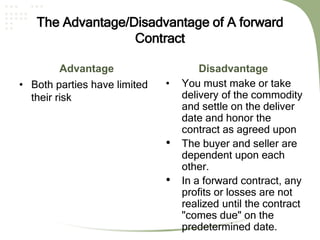
The Advantage/Disadvantage of A forward
Contract
Advantage
• Both parties have limited
their risk
Disadvantage
• You must make or take
delivery of the commodity
and settle on the deliver
date and honor the
contract as agreed upon
• The buyer and seller are
dependent upon each
other.
• In a forward contract, any
profits or losses are not
realized until the contract
"comes due" on the
predetermined date.
Futures Contract
A futures contract is an agreement between two
parties to buy or sell an asset at a certain time in
future, at a certain price.
Traded on an organised stock exchange.
Pricing Futures
When the deliverable asset exists in plentiful
supply then the price of a futures contract is
determined via arbitrage arguments. This is typical
for stock index futures, treasury bond futures, and
futures on physical commodities when they are in
supply (e.g. agricultural crops after the harvest).
Contd...
However, when the deliverable commodity is not in
plentiful supply or when it does not yet exist - for
example on crops before the harvest - the futures
price cannot be fixed by arbitrage. In this scenario
there is only one force setting the price, which is
simple supply and demand for the asset in the
future, as expressed by supply and demand for the
futures contract.
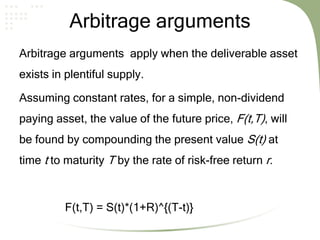
Arbitrage arguments
Arbitrage arguments apply when the deliverable asset
exists in plentiful supply.
Assuming constant rates, for a simple, non-dividend
paying asset, the value of the future price, F(t,T), will
be found by compounding the present value S(t) at
time t to maturity T by the rate of risk-free return r.
F(t,T) = S(t)*(1+R)^{(T-t)}
Pricing via expectation
When the deliverable commodity is not in plentiful
supply (or when it does not yet exist) rational
pricing cannot be applied, as the arbitrage
mechanism is not applicable. Here the price of the
futures is determined by today's supply and
demand for the underlying asset in the future.
In a liquid market, supply and demand would be
expected to balance out at a price which
represents an unbiased expectation of the future
price of the actual asset
Options (finance)
In finance, an option is a contract which gives the
buyer (the owner) the right, but not the obligation, to
buy or sell an underlying asset or instrument at a
specified strike price on or before a specified date.
The seller has the corresponding obligation to fulfil the
transaction – that is to sell or buy – if the buyer (owner)
"exercises" the option.
Contd...
The buyer pays a premium to the seller for this
right. An option which conveys to the owner the
right to buy something at a specific price is referred
to as a call; an option which conveys the right of
the owner to sell something at a specific price is
referred to as a put.
Types
1. According to the option rights
• Call option
• Put option
2. According to the underlying assets
• equity option
• bond option
• future option
• index option
• commodity option
Terminology
1. Credit spread - It involves simultaneously
buying and selling (writing) options on the
same security/index in the same month, but
at different strike prices. (This is also a
vertical spread)
2. Debit spread - results when an investor
simultaneously buys an option with a higher
premium and sells an option with a lower
premium. The investor is said to be a net
buyer and expects the premiums of the two
options
Options Payoffs
A pay off for derivative contracts is the likely
profit/loss that would occur for the market participant
with change in the price of the underlying asset.
Pricing options
An option buyer has the right but not the obligation
to exercise on the seller. The worst that can
happen to a buyer is the loss of the premium paid
by him.
Pricing stock options
The factors that affect option prices are as follows:
1- The stock price
2- Time to expiration
3- Volatility
4- Risk free interest rate
5- Dividends
Derivative market in India
Proprietary traders contribute to the major proportion
of trading volumes in the derivative segment. Foreign
Institutional investors and mutual funds are relatively
small players in this segment and so are corporate
clients.
Thank you

Derivatives

  • 1.
    Derivatives Presentation by. Mohd NazimHussain Mohd Qasim Nabeel Ahmad Neeraj Gautam Neha Vishwakarma
  • 2.
    Definition of derivatives Aderivative is a contract designed in such a way that its price is derived from the price of an underlying asset. Example- the price of a gold futures contract for October maturity is derived from the price of gold.
  • 3.
    Features of derivatives Future contract between two parties.  It is always derived from the value of an underlying asset.  Underlying asset can be physical or non physical.  Counter parties have specified obligation under the derivative contract.  It is secondary market instrument.
  • 4.
    Three types ofparticipants in derivative market: 1. Hedgers:- hedgers are those person who face risk associated with the price of an asset. 2. Speculators:- speculators are those who bet on future movement in price of an asset. 3. Arbitrageurs:- arbitrageurs are one who trades only to realise profit from discrepancies in the market.
  • 5.
    Forward Contracts • Agreementto buy an asset on a specified date for a specified price • Normally traded outside stock exchanges • Traded on OTC markets
  • 6.
    Features :- • Bilateralcontracts • Contract is customer designed • Contract price generally not available in public domain • On expiration date, contract has to be settled by delivery of assets
  • 7.
    The Advantage/Disadvantage ofA forward Contract Advantage • Both parties have limited their risk Disadvantage • You must make or take delivery of the commodity and settle on the deliver date and honor the contract as agreed upon • The buyer and seller are dependent upon each other. • In a forward contract, any profits or losses are not realized until the contract "comes due" on the predetermined date.
  • 8.
    Futures Contract A futurescontract is an agreement between two parties to buy or sell an asset at a certain time in future, at a certain price. Traded on an organised stock exchange.
  • 9.
    Pricing Futures When thedeliverable asset exists in plentiful supply then the price of a futures contract is determined via arbitrage arguments. This is typical for stock index futures, treasury bond futures, and futures on physical commodities when they are in supply (e.g. agricultural crops after the harvest).
  • 10.
    Contd... However, when thedeliverable commodity is not in plentiful supply or when it does not yet exist - for example on crops before the harvest - the futures price cannot be fixed by arbitrage. In this scenario there is only one force setting the price, which is simple supply and demand for the asset in the future, as expressed by supply and demand for the futures contract.
  • 11.
    Arbitrage arguments Arbitrage argumentsapply when the deliverable asset exists in plentiful supply. Assuming constant rates, for a simple, non-dividend paying asset, the value of the future price, F(t,T), will be found by compounding the present value S(t) at time t to maturity T by the rate of risk-free return r. F(t,T) = S(t)*(1+R)^{(T-t)}
  • 12.
    Pricing via expectation Whenthe deliverable commodity is not in plentiful supply (or when it does not yet exist) rational pricing cannot be applied, as the arbitrage mechanism is not applicable. Here the price of the futures is determined by today's supply and demand for the underlying asset in the future. In a liquid market, supply and demand would be expected to balance out at a price which represents an unbiased expectation of the future price of the actual asset
  • 13.
    Options (finance) In finance,an option is a contract which gives the buyer (the owner) the right, but not the obligation, to buy or sell an underlying asset or instrument at a specified strike price on or before a specified date. The seller has the corresponding obligation to fulfil the transaction – that is to sell or buy – if the buyer (owner) "exercises" the option.
  • 14.
    Contd... The buyer paysa premium to the seller for this right. An option which conveys to the owner the right to buy something at a specific price is referred to as a call; an option which conveys the right of the owner to sell something at a specific price is referred to as a put.
  • 15.
    Types 1. According tothe option rights • Call option • Put option 2. According to the underlying assets • equity option • bond option • future option • index option • commodity option
  • 16.
    Terminology 1. Credit spread- It involves simultaneously buying and selling (writing) options on the same security/index in the same month, but at different strike prices. (This is also a vertical spread) 2. Debit spread - results when an investor simultaneously buys an option with a higher premium and sells an option with a lower premium. The investor is said to be a net buyer and expects the premiums of the two options
  • 17.
    Options Payoffs A payoff for derivative contracts is the likely profit/loss that would occur for the market participant with change in the price of the underlying asset.
  • 18.
    Pricing options An optionbuyer has the right but not the obligation to exercise on the seller. The worst that can happen to a buyer is the loss of the premium paid by him.
  • 19.
    Pricing stock options Thefactors that affect option prices are as follows: 1- The stock price 2- Time to expiration 3- Volatility 4- Risk free interest rate 5- Dividends
  • 20.
    Derivative market inIndia Proprietary traders contribute to the major proportion of trading volumes in the derivative segment. Foreign Institutional investors and mutual funds are relatively small players in this segment and so are corporate clients.
  • 21.