Diagnosis of Pregnancy
Jayashree ajith DIRECTOR NURSINH JINR
GWALIOR
Diagnosis of Early
Pregnancy
 SUBJECTIVE CHANGES
 History and symptoms
1. Amenorrhea
1) The first and the most important symptom
2) emotional tension, chronic disease and certain
medications → delayed menses endocrine
factors
3) lactation, IUD and dysfunction of endocrine
→ pregnancy
CONT........
 Psychological factors – emotional shock
 fear of pregnancy infection
 Systemic disease – tuberculosis ,
malignancy
Diagnosis of Early
Pregnancy
2. Morning sickness
1) Fatigue, swirling, nausea and vomiting (the
6th week↑ → the 12th week↓ ).
2) Hyperemesis gravidarum protracted
vomiting necessitating hospitalization.
3) Causes: HCG, delayed gastric emptying(P↑ )
Diagnosis of Early
Pregnancy
3. Urinary symptoms
1) Bladder irritability, frequency and nocturia
2) Causes: increased circulation in pelvis (E and
P↑), enlargement of the uterus.
3) urinary infection must be ruled out
Diagnosis of Early
Pregnancy
4. Mastodynia
1) the development of mammary ducts (E↑)
and alveolar system (P↑)
2) circulation↑→ engorgement of the breasts
5. Constipation
smooth muscle relaxant (P↑)
6. Weight gain
Diagnosis of Early
Pregnancy
 OBJECTIVE SIGNS
 Signs
 Breast changes
1. The changes of pelvic organs
1) Chadwick,s sign: Vagina bluish or purple discoloration
(congested pelvic vasculature). Increased vaginal discharge (E
and P↑)
2) Cevix: softening and bluish discoloration. The cervical
mucus→ a granular pattern goodell,s sign
3) Uterocervical junction
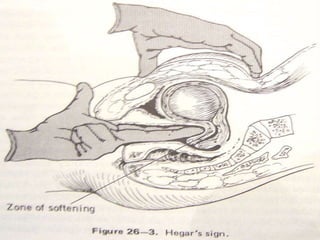
Hegar’s sign: a widened zone of softness coupled with
compressibility, resulting in a doughnut-shaped, slightly
spongy configuration.(softening of the isthmus of the uterus
Hegar’s sign
Diagnosis of Early
Pregnancy
4) Mcdonald,s sign .flexing the body of the uterus
aganist the cervix
5) Abdominal enlargement
Enlargement of uterus (noticed at the 12th
week)
2. Breast changes
1) Enlargement and vascular engorgement (6th –
8th week)
2) Montgomery’s tubercles 6th –8th week, E and
P↑
3) Colostrum secretion (16th week) or secondary
breasts
CONT......
6. Braxton Hicks Contraction- twenty eighth
weeks.
7. Uterine souffle- Increase uterine blood
flow and blood pulsating through the
placenta
8. Changes in pigmentation of the skin –
linea nigra, striae, facial cholasma
9. Ballottement-
Diagnosis of Early
Pregnancy
 Laboratory tests
1. Pregnancy test
1) Urine HCG test (one step): + or –
2) β-HCG: >25mIU/L
2. Ultrasonography
1) Enlargement of uterus
2) Gestational sac
3) Embryo or fetal pulse
Diagnosis of Early
Pregnancy
3. Other tests
1) Progesterone test
2) Cervical mucus examination
3) Basal body temperature (BBT)
Diagnosis of mid or late
pregnancy
 SECOND TRIMESTER
 Symptoms
 Quickening feeling opf life felt in 18 th week
 GENERAL Examinaton
 Cholasma pigmentation over the head and cheek
 BREAST CHANGES secondary areola 2oth week
montagomery,s tubercle prominent colostrums become thick
16th week striae r visible.
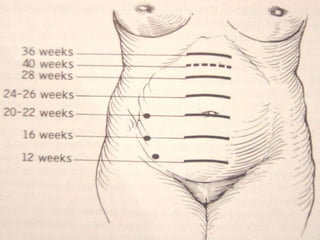
1. EDC: +9 or –3 (month), +7 (day)
2. Enlargement of uterus
1) 12th week: 2 finger above the symphysis
2) 16th week: midway between the symphysis and the umbilicus.
3) 20th – 22nd week: at the umbilicus
Diagnosis of mid or late
pregnancy
3. POSITIVE CHANGES
4. 15Fetal movement (FM)
1) The first perception: in the 18th – 20th weeks
2) Diagnosis of pregnancy, duration of
pregnancy, the safety of fetus
3) Count: 3 times per day, 1 hour per time.
sum×4= FM/12 hours. Normal:≥ 30/12 hours
Diagnosis of mid or late
pregnancy
4. Fetal heart tones
1) Heared: the 18th – 20th weeks
2) Normal rate: 120-160bpm
3) Differentiation: umbilical souffle
4) Fetal body
Palpated: outlines of the fetus (the 20th week).
Diagnosis of mid or late
pregnancy
 Laboratory tests
1. Ultrasonography
1) The number of fetus
2) Fetal lie
3) Fetal presentation
4) Fetal position
5) Fetal dead or not
6) Placenta and cord (velocity of flow)
7) Size of fetus
Fetal Attitude
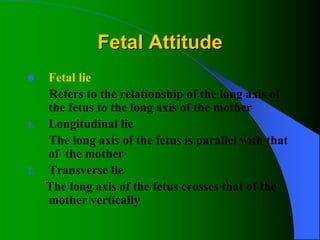
 Fetal lie
Refers to the relationship of the long axis of
the fetus to the long axis of the mother
1. Longitudinal lie
The long axis of the fetus is parallel with that
of the mother
2. Transverse lie
The long axis of the fetus crosses that of the
mother vertically
Fetal Attitude
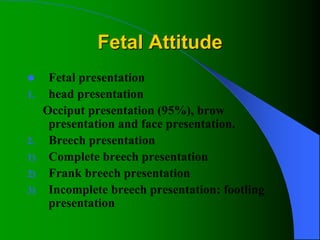
 Fetal presentation
1. head presentation
Occiput presentation (95%), brow
presentation and face presentation.
2. Breech presentation
1) Complete breech presentation
2) Frank breech presentation
3) Incomplete breech presentation: footling
presentation
Fetal Attitude
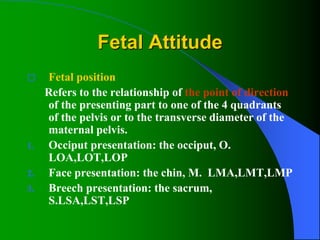
 Fetal position
Refers to the relationship of the point of direction
of the presenting part to one of the 4 quadrants
of the pelvis or to the transverse diameter of the
maternal pelvis.
1. Occiput presentation: the occiput, O.
LOA,LOT,LOP
2. Face presentation: the chin, M. LMA,LMT,LMP
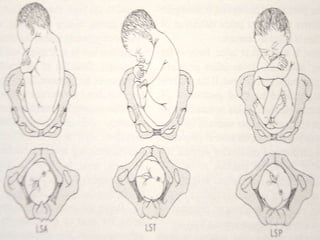
3. Breech presentation: the sacrum,
S.LSA,LST,LSP
END
MOTHER HOOD IS THE PRECIOUS GIFT OF GOD
REMARCABLE CARE

Diagnosisofpregnancy

  • 1.
    Diagnosis of Pregnancy Jayashreeajith DIRECTOR NURSINH JINR GWALIOR
  • 2.
    Diagnosis of Early Pregnancy SUBJECTIVE CHANGES  History and symptoms 1. Amenorrhea 1) The first and the most important symptom 2) emotional tension, chronic disease and certain medications → delayed menses endocrine factors 3) lactation, IUD and dysfunction of endocrine → pregnancy
  • 3.
    CONT........  Psychological factors– emotional shock  fear of pregnancy infection  Systemic disease – tuberculosis , malignancy
  • 4.
    Diagnosis of Early Pregnancy 2.Morning sickness 1) Fatigue, swirling, nausea and vomiting (the 6th week↑ → the 12th week↓ ). 2) Hyperemesis gravidarum protracted vomiting necessitating hospitalization. 3) Causes: HCG, delayed gastric emptying(P↑ )
  • 5.
    Diagnosis of Early Pregnancy 3.Urinary symptoms 1) Bladder irritability, frequency and nocturia 2) Causes: increased circulation in pelvis (E and P↑), enlargement of the uterus. 3) urinary infection must be ruled out
  • 6.
    Diagnosis of Early Pregnancy 4.Mastodynia 1) the development of mammary ducts (E↑) and alveolar system (P↑) 2) circulation↑→ engorgement of the breasts 5. Constipation smooth muscle relaxant (P↑) 6. Weight gain
  • 7.
    Diagnosis of Early Pregnancy OBJECTIVE SIGNS  Signs  Breast changes 1. The changes of pelvic organs 1) Chadwick,s sign: Vagina bluish or purple discoloration (congested pelvic vasculature). Increased vaginal discharge (E and P↑) 2) Cevix: softening and bluish discoloration. The cervical mucus→ a granular pattern goodell,s sign 3) Uterocervical junction Hegar’s sign: a widened zone of softness coupled with compressibility, resulting in a doughnut-shaped, slightly spongy configuration.(softening of the isthmus of the uterus
  • 8.
  • 9.
    Diagnosis of Early Pregnancy 4)Mcdonald,s sign .flexing the body of the uterus aganist the cervix 5) Abdominal enlargement Enlargement of uterus (noticed at the 12th week) 2. Breast changes 1) Enlargement and vascular engorgement (6th – 8th week) 2) Montgomery’s tubercles 6th –8th week, E and P↑ 3) Colostrum secretion (16th week) or secondary breasts
  • 10.
    CONT...... 6. Braxton HicksContraction- twenty eighth weeks. 7. Uterine souffle- Increase uterine blood flow and blood pulsating through the placenta 8. Changes in pigmentation of the skin – linea nigra, striae, facial cholasma 9. Ballottement-
  • 11.
    Diagnosis of Early Pregnancy Laboratory tests 1. Pregnancy test 1) Urine HCG test (one step): + or – 2) β-HCG: >25mIU/L 2. Ultrasonography 1) Enlargement of uterus 2) Gestational sac 3) Embryo or fetal pulse
  • 12.
    Diagnosis of Early Pregnancy 3.Other tests 1) Progesterone test 2) Cervical mucus examination 3) Basal body temperature (BBT)
  • 13.
    Diagnosis of midor late pregnancy  SECOND TRIMESTER  Symptoms  Quickening feeling opf life felt in 18 th week  GENERAL Examinaton  Cholasma pigmentation over the head and cheek  BREAST CHANGES secondary areola 2oth week montagomery,s tubercle prominent colostrums become thick 16th week striae r visible. 1. EDC: +9 or –3 (month), +7 (day) 2. Enlargement of uterus 1) 12th week: 2 finger above the symphysis 2) 16th week: midway between the symphysis and the umbilicus. 3) 20th – 22nd week: at the umbilicus
  • 15.
    Diagnosis of midor late pregnancy 3. POSITIVE CHANGES 4. 15Fetal movement (FM) 1) The first perception: in the 18th – 20th weeks 2) Diagnosis of pregnancy, duration of pregnancy, the safety of fetus 3) Count: 3 times per day, 1 hour per time. sum×4= FM/12 hours. Normal:≥ 30/12 hours
  • 16.
    Diagnosis of midor late pregnancy 4. Fetal heart tones 1) Heared: the 18th – 20th weeks 2) Normal rate: 120-160bpm 3) Differentiation: umbilical souffle 4) Fetal body Palpated: outlines of the fetus (the 20th week).
  • 17.
    Diagnosis of midor late pregnancy  Laboratory tests 1. Ultrasonography 1) The number of fetus 2) Fetal lie 3) Fetal presentation 4) Fetal position 5) Fetal dead or not 6) Placenta and cord (velocity of flow) 7) Size of fetus
  • 18.
    Fetal Attitude  Fetallie Refers to the relationship of the long axis of the fetus to the long axis of the mother 1. Longitudinal lie The long axis of the fetus is parallel with that of the mother 2. Transverse lie The long axis of the fetus crosses that of the mother vertically
  • 19.
    Fetal Attitude  Fetalpresentation 1. head presentation Occiput presentation (95%), brow presentation and face presentation. 2. Breech presentation 1) Complete breech presentation 2) Frank breech presentation 3) Incomplete breech presentation: footling presentation
  • 20.
    Fetal Attitude  Fetalposition Refers to the relationship of the point of direction of the presenting part to one of the 4 quadrants of the pelvis or to the transverse diameter of the maternal pelvis. 1. Occiput presentation: the occiput, O. LOA,LOT,LOP 2. Face presentation: the chin, M. LMA,LMT,LMP 3. Breech presentation: the sacrum, S.LSA,LST,LSP
  • 22.
    END MOTHER HOOD ISTHE PRECIOUS GIFT OF GOD
  • 23.