MATATAG Curriculum
DEPARTMENT OF EDUCATION
CONTEXT OF THE K TO 12 CURRICULUM
2
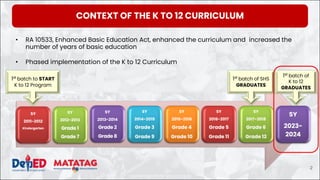
• RA 10533, Enhanced Basic Education Act, enhanced the curriculum and increased the
number of years of basic education
• Phased implementation of the K to 12 Curriculum
SY
2011-2012
Kindergarten
SY
2012-2013
Grade 1
Grade 7
SY
2013-2014
Grade 2
Grade 8
SY
2014-2015
Grade 3
Grade 9
SY
2015-2016
Grade 4
Grade 10
SY
2016-2017
Grade 5
Grade 11
SY
2017-2018
Grade 6
Grade 12
SY
2023-
2024
1st
batch to START
K to 12 Program
1st
batch of SHS
GRADUATES
1st
batch of
K to 12
GRADUATES
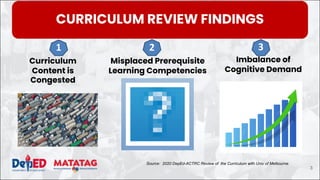
Curriculum
Content is
Congested
Misplaced Prerequisite
Learning Competencies
Imbalance of
Cognitive Demand
1 2 3
Source: 2020 DepEd-ACTRC Review of the Curriculum with Univ of Melbourne
CURRICULUM REVIEW FINDINGS
3
DEPARTMENT OF EDUCATION
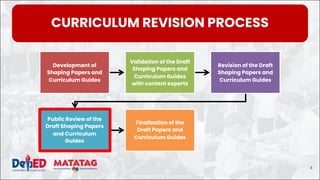
Development of
Shaping Papers and
Curriculum Guides
Validation of the Draft
Shaping Papers and
Curriculum Guides
with content experts
Revision of the Draft
Shaping Papers and
Curriculum Guides
Public Review of the
Draft Shaping Papers
and Curriculum
Guides
Finalization of the
Draft Papers and
Curriculum Guides
CURRICULUM REVISION PROCESS
4
DEPARTMENT OF EDUCATION
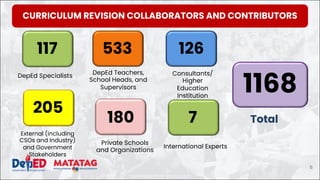
DepEd Specialists
DepEd Teachers,
School Heads, and
Supervisors
Consultants/
Higher
Education
Institution
Experts
Private Schools
and Organizations
External (including
CSOs and Industry)
and Government
Stakeholders
Total
117 533 126
180
205
1168
International Experts
7
CURRICULUM REVISION COLLABORATORS AND CONTRIBUTORS
5
DEPARTMENT OF EDUCATION
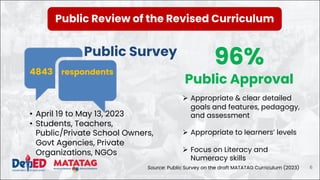
Public Survey
• April 19 to May 13, 2023
• Students, Teachers,
Public/Private School Owners,
Govt Agencies, Private
Organizations, NGOs
96%
Public Approval
Ø Appropriate & clear detailed
goals and features, pedagogy,
and assessment
Ø Appropriate to learners’ levels
Ø Focus on Literacy and
Numeracy skills
Public Review of the Revised Curriculum
4843 respondents
6
Source: Public Survey on the draft MATATAG Curriculum (2023)
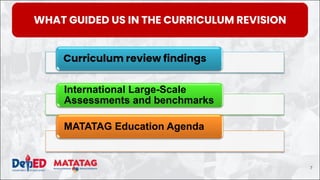
Curriculum review findings
International Large-Scale
Assessments and benchmarks
MATATAG Education Agenda
WHAT GUIDED US IN THE CURRICULUM REVISION
7
DEPARTMENT OF EDUCATION
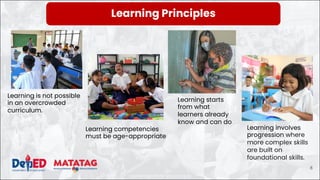
Learning involves
progression where
more complex skills
are built on
foundational skills.
Learning Principles
Learning is not possible
in an overcrowded
curriculum.
Learning competencies
must be age-appropriate
Learning starts
from what
learners already
know and can do
8
9
Curriculum
DEPARTMENT OF EDUCATION
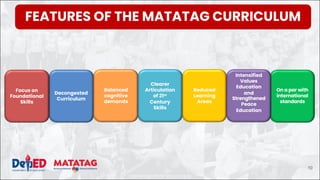
Decongested
Curriculum
Focus on
Foundational
Skills
Balanced
cognitive
demands
Clearer
Articulation
of 21st
Century
Skills
Reduced
Learning
Areas
On a par with
international
standards
Intensified
Values
Education
and
Strengthened
Peace
Education
FEATURES OF THE MATATAG CURRICULUM
10
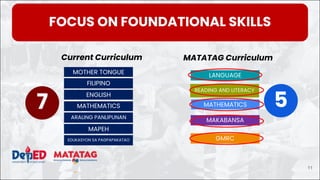
MOTHER TONGUE
FILIPINO
ENGLISH
MATHEMATICS
ARALING PANLIPUNAN
MAPEH
EDUKASYON SA PAGPAPAKATAO
LANGUAGE
READING AND LITERACY
MATHEMATICS
MAKABANSA
GMRC
7
Current Curriculum MATATAG Curriculum
5
FOCUS ON FOUNDATIONAL SKILLS
11
DEPARTMENT OF EDUCATION
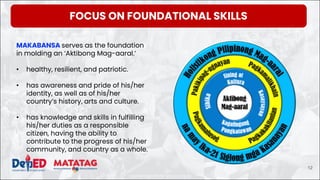
MAKABANSA serves as the foundation
in molding an ‘Aktibong Mag-aaral.’
• healthy, resilient, and patriotic.
• has awareness and pride of his/her
identity, as well as of his/her
country’s history, arts and culture.
• has knowledge and skills in fulfilling
his/her duties as a responsible
citizen, having the ability to
contribute to the progress of his/her
community, and country as a whole.
FOCUS ON FOUNDATIONAL SKILLS
12
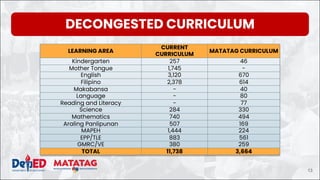
LEARNING AREA
CURRENT
CURRICULUM
MATATAG CURRICULUM
Kindergarten 257 46
Mother Tongue 1,745 -
English 3,120 670
Filipino 2,378 614
Makabansa - 40
Language - 80
Reading and Literacy - 77
Science 284 330
Mathematics 740 494
Araling Panlipunan 507 169
MAPEH 1,444 224
EPP/TLE 883 561
GMRC/VE 380 259
TOTAL 11,738 3,664
DECONGESTED CURRICULUM
13
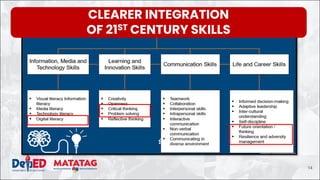
CLEARER INTEGRATION
OF 21ST CENTURY SKILLS
14
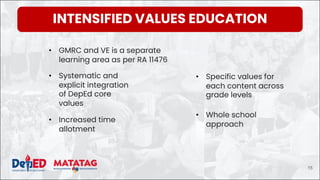
INTENSIFIED VALUES EDUCATION
• Systematic and
explicit integration
of DepEd core
values
• Increased time
allotment
• Specific values for
each content across
grade levels
• Whole school
approach
• GMRC and VE is a separate
learning area as per RA 11476
15
DEPARTMENT OF EDUCATION
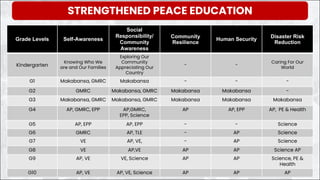
Grade Levels Self-Awareness
Social
Responsibility/
Community
Awareness
Community
Resilience
Human Security
Disaster Risk
Reduction
Kindergarten
Knowing Who We
are and Our Families
Exploring Our
Community
Appreciating Our
Country
- -
Caring For Our
World
G1 Makabansa, GMRC Makabansa - - -
G2 GMRC Makabansa, GMRC Makabansa Makabansa -
G3 Makabansa, GMRC Makabansa, GMRC Makabansa Makabansa Makabansa
G4 AP, GMRC, EPP AP,GMRC,
EPP, Science
AP AP, EPP AP, PE & Health
G5 AP, EPP AP, EPP - - Science
G6 GMRC AP, TLE - AP Science
G7 VE AP, VE, - AP Science
G8 VE AP,VE AP AP Science AP
G9 AP, VE VE, Science AP AP Science, PE &
Health
G10 AP, VE AP, VE, Science AP AP AP
STRENGTHENED PEACE EDUCATION
17
18
ready to
succeed in life
nationalistic
and
global
equipped with
21st century
skills
prepared with
strong
literacy and
numeracy
foundation
19
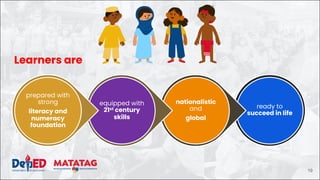
Learners are
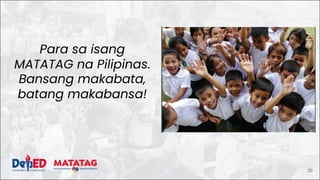
Para sa isang
MATATAG na Pilipinas.
Bansang makabata,
batang makabansa!
20
MARAMING SALAMAT!

DEPED MATATAG-Curriculum-Presentation.pdf

  • 1.
  • 2.
    DEPARTMENT OF EDUCATION CONTEXTOF THE K TO 12 CURRICULUM 2 • RA 10533, Enhanced Basic Education Act, enhanced the curriculum and increased the number of years of basic education • Phased implementation of the K to 12 Curriculum SY 2011-2012 Kindergarten SY 2012-2013 Grade 1 Grade 7 SY 2013-2014 Grade 2 Grade 8 SY 2014-2015 Grade 3 Grade 9 SY 2015-2016 Grade 4 Grade 10 SY 2016-2017 Grade 5 Grade 11 SY 2017-2018 Grade 6 Grade 12 SY 2023- 2024 1st batch to START K to 12 Program 1st batch of SHS GRADUATES 1st batch of K to 12 GRADUATES
  • 3.
    Curriculum Content is Congested Misplaced Prerequisite LearningCompetencies Imbalance of Cognitive Demand 1 2 3 Source: 2020 DepEd-ACTRC Review of the Curriculum with Univ of Melbourne CURRICULUM REVIEW FINDINGS 3
  • 4.
    DEPARTMENT OF EDUCATION Developmentof Shaping Papers and Curriculum Guides Validation of the Draft Shaping Papers and Curriculum Guides with content experts Revision of the Draft Shaping Papers and Curriculum Guides Public Review of the Draft Shaping Papers and Curriculum Guides Finalization of the Draft Papers and Curriculum Guides CURRICULUM REVISION PROCESS 4
  • 5.
    DEPARTMENT OF EDUCATION DepEdSpecialists DepEd Teachers, School Heads, and Supervisors Consultants/ Higher Education Institution Experts Private Schools and Organizations External (including CSOs and Industry) and Government Stakeholders Total 117 533 126 180 205 1168 International Experts 7 CURRICULUM REVISION COLLABORATORS AND CONTRIBUTORS 5
  • 6.
    DEPARTMENT OF EDUCATION PublicSurvey • April 19 to May 13, 2023 • Students, Teachers, Public/Private School Owners, Govt Agencies, Private Organizations, NGOs 96% Public Approval Ø Appropriate & clear detailed goals and features, pedagogy, and assessment Ø Appropriate to learners’ levels Ø Focus on Literacy and Numeracy skills Public Review of the Revised Curriculum 4843 respondents 6 Source: Public Survey on the draft MATATAG Curriculum (2023)
  • 7.
    Curriculum review findings InternationalLarge-Scale Assessments and benchmarks MATATAG Education Agenda WHAT GUIDED US IN THE CURRICULUM REVISION 7
  • 8.
    DEPARTMENT OF EDUCATION Learninginvolves progression where more complex skills are built on foundational skills. Learning Principles Learning is not possible in an overcrowded curriculum. Learning competencies must be age-appropriate Learning starts from what learners already know and can do 8
  • 9.
  • 10.
    DEPARTMENT OF EDUCATION Decongested Curriculum Focuson Foundational Skills Balanced cognitive demands Clearer Articulation of 21st Century Skills Reduced Learning Areas On a par with international standards Intensified Values Education and Strengthened Peace Education FEATURES OF THE MATATAG CURRICULUM 10
  • 11.
    MOTHER TONGUE FILIPINO ENGLISH MATHEMATICS ARALING PANLIPUNAN MAPEH EDUKASYONSA PAGPAPAKATAO LANGUAGE READING AND LITERACY MATHEMATICS MAKABANSA GMRC 7 Current Curriculum MATATAG Curriculum 5 FOCUS ON FOUNDATIONAL SKILLS 11
  • 12.
    DEPARTMENT OF EDUCATION MAKABANSAserves as the foundation in molding an ‘Aktibong Mag-aaral.’ • healthy, resilient, and patriotic. • has awareness and pride of his/her identity, as well as of his/her country’s history, arts and culture. • has knowledge and skills in fulfilling his/her duties as a responsible citizen, having the ability to contribute to the progress of his/her community, and country as a whole. FOCUS ON FOUNDATIONAL SKILLS 12
  • 13.
    LEARNING AREA CURRENT CURRICULUM MATATAG CURRICULUM Kindergarten257 46 Mother Tongue 1,745 - English 3,120 670 Filipino 2,378 614 Makabansa - 40 Language - 80 Reading and Literacy - 77 Science 284 330 Mathematics 740 494 Araling Panlipunan 507 169 MAPEH 1,444 224 EPP/TLE 883 561 GMRC/VE 380 259 TOTAL 11,738 3,664 DECONGESTED CURRICULUM 13
  • 14.
    CLEARER INTEGRATION OF 21STCENTURY SKILLS 14
  • 15.
    INTENSIFIED VALUES EDUCATION •Systematic and explicit integration of DepEd core values • Increased time allotment • Specific values for each content across grade levels • Whole school approach • GMRC and VE is a separate learning area as per RA 11476 15
  • 16.
    DEPARTMENT OF EDUCATION GradeLevels Self-Awareness Social Responsibility/ Community Awareness Community Resilience Human Security Disaster Risk Reduction Kindergarten Knowing Who We are and Our Families Exploring Our Community Appreciating Our Country - - Caring For Our World G1 Makabansa, GMRC Makabansa - - - G2 GMRC Makabansa, GMRC Makabansa Makabansa - G3 Makabansa, GMRC Makabansa, GMRC Makabansa Makabansa Makabansa G4 AP, GMRC, EPP AP,GMRC, EPP, Science AP AP, EPP AP, PE & Health G5 AP, EPP AP, EPP - - Science G6 GMRC AP, TLE - AP Science G7 VE AP, VE, - AP Science G8 VE AP,VE AP AP Science AP G9 AP, VE VE, Science AP AP Science, PE & Health G10 AP, VE AP, VE, Science AP AP AP STRENGTHENED PEACE EDUCATION
  • 17.
  • 18.
  • 19.
    ready to succeed inlife nationalistic and global equipped with 21st century skills prepared with strong literacy and numeracy foundation 19 Learners are
  • 20.
    Para sa isang MATATAGna Pilipinas. Bansang makabata, batang makabansa! 20
  • 21.