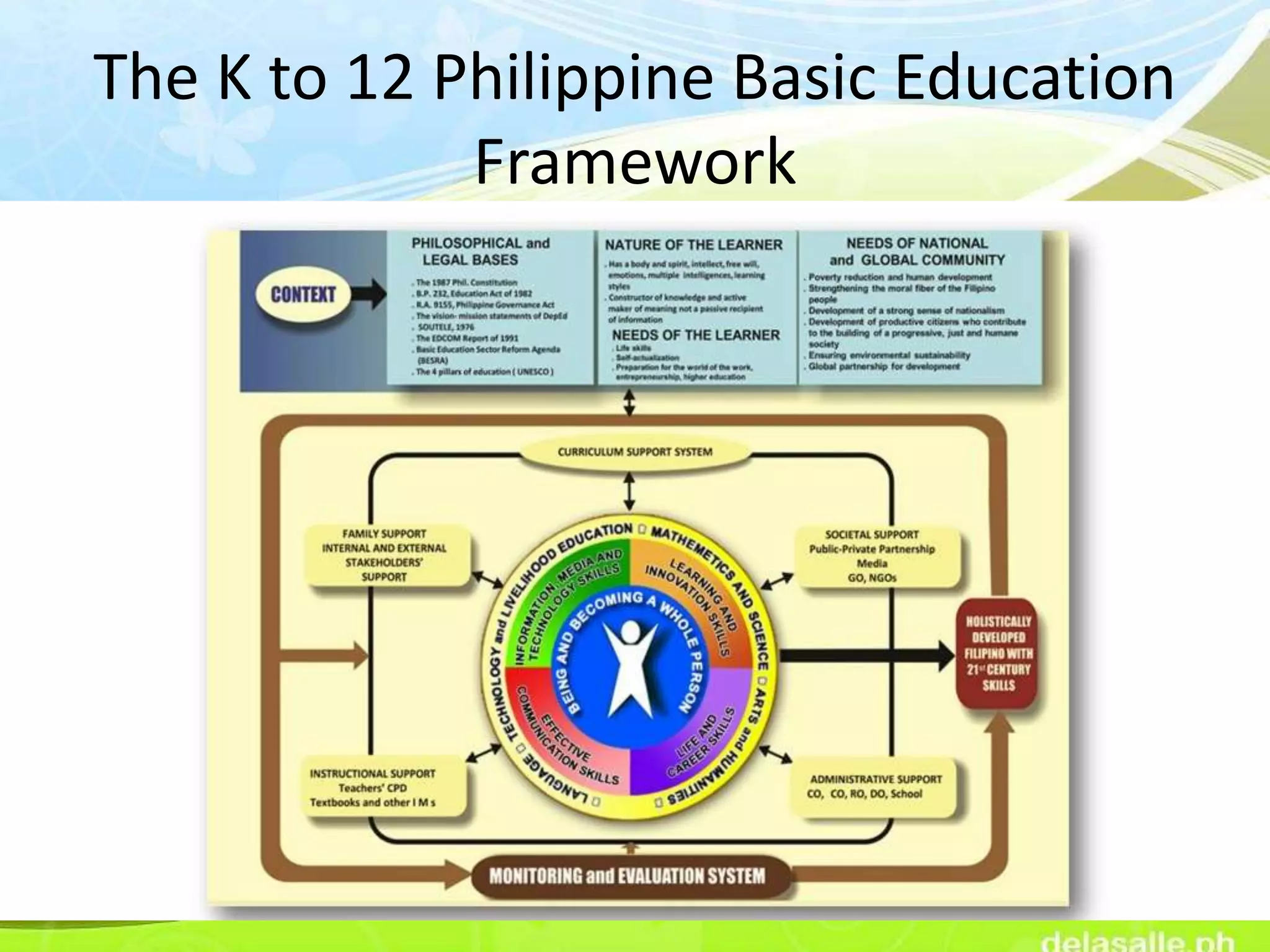
Republic Act No. 10533, known as the Enhanced Basic Education Act of 2013, aims to strengthen the Philippine basic education system by enhancing the curriculum and extending the duration of basic education. The K to 12 curriculum focuses on holistic development, preparing learners with 21st-century skills and competencies, while emphasizing inclusiveness, flexibility, and contextual relevance. It incorporates principles such as learner-centered education, integration of diverse curricular concerns, and the use of technology, ensuring students acquire essential skills for higher education, employment, and entrepreneurship.
REPUBLIC ACT NO.10533
An act entitled: “Enhancing the
Philippine Basic Education
system by Strengthening its
Curriculum and Increasing the
Number of Years for Basic Education,
Appropriating Funds Therefore and
for Other Purposes,” otherwise known
as the “Enhanced Basic Education
Act of 2013.”
2.
Standard and Principlesin Developing
the Enhanced Basic Education
Curriculum
The DepEd shall adhere to the following
standards and principles, when appropriate,
in developing the enhanced basic education
curriculum:
The curriculum shall be learner-centered,
inclusive and developmentally appropriate.
The curriculum shall be relevant,
responsive and research-based.
The curriculum shall be gender- and culture-
sensitive.
3.
The curriculumshall be contextualized and global.
The curriculum shall use pedagogical approaches
that are constructivist, inquiry-based, reflective,
collaborative and integrative.
The curriculum shall adhere to the principles and
framework of Mother Tongue Based Multilingual
Education (MTB-MLE) which starts from where the
learners are and from what they already know
proceeding from the known to the unknown;
instructional materials and capable teachers to
implement the MTB-MLE curriculum shall be
available. For this purpose, MTB-MLE refers to
formal or non-formal education in which the
learner’s mother tongue and additional languages
are used in the classroom.
4.
The curriculum shalluse the spiral
progression approach to ensure mastery
of knowledge and skills after each level.
The curriculum shall be flexible enough to
enable and allow schools to localize,
indigenize and enhance the same based
on their respective educational and social
contexts.
5.
The Overall Goalof the K to 12
Curriculum
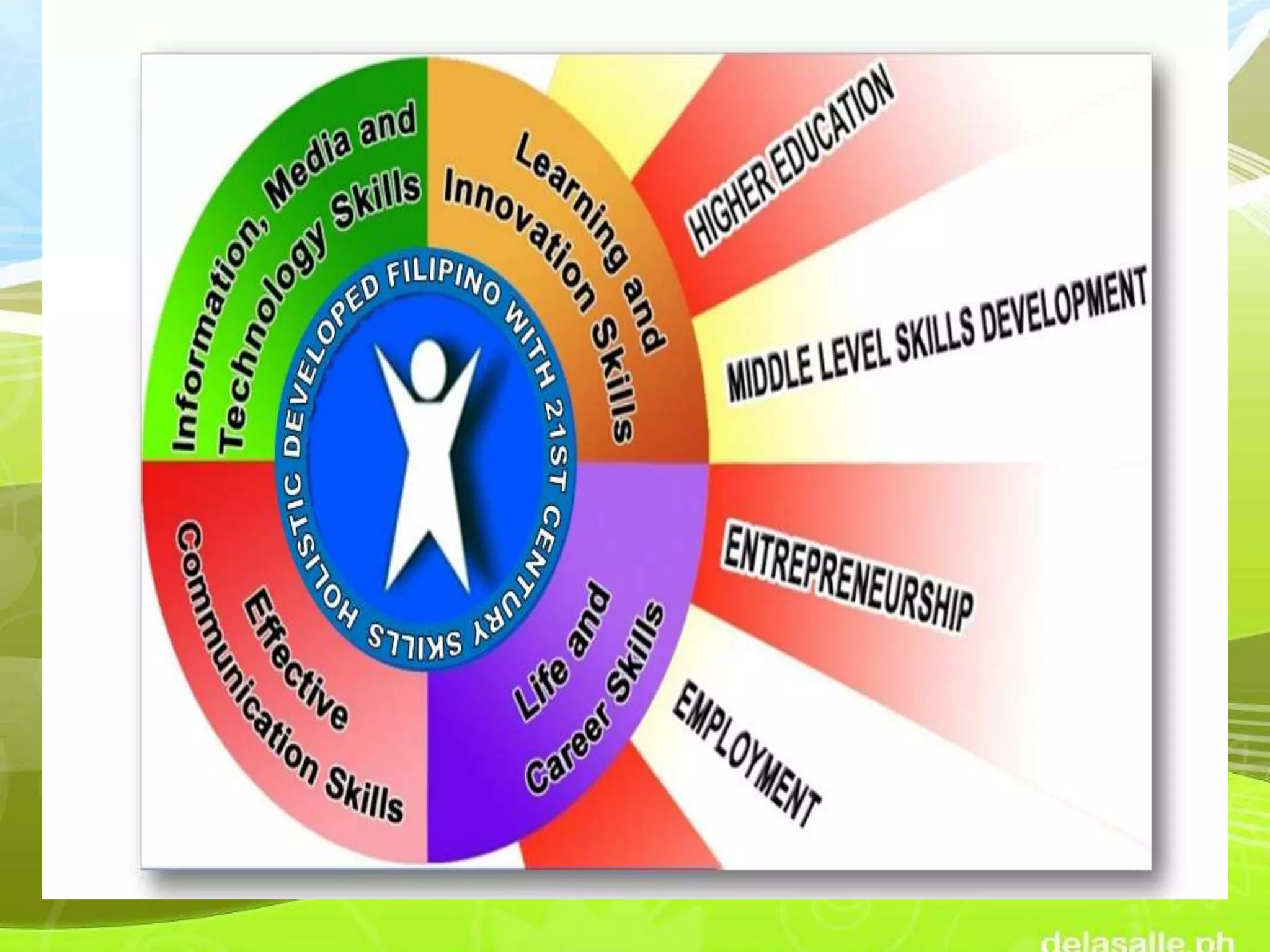
The K to 12 Curriculum has its overarching
goal, the holistic development of every
Filipino learner with 21st century skills who
is adequately prepared for work,
entrepreneurship, middle level skills
development and higher education.
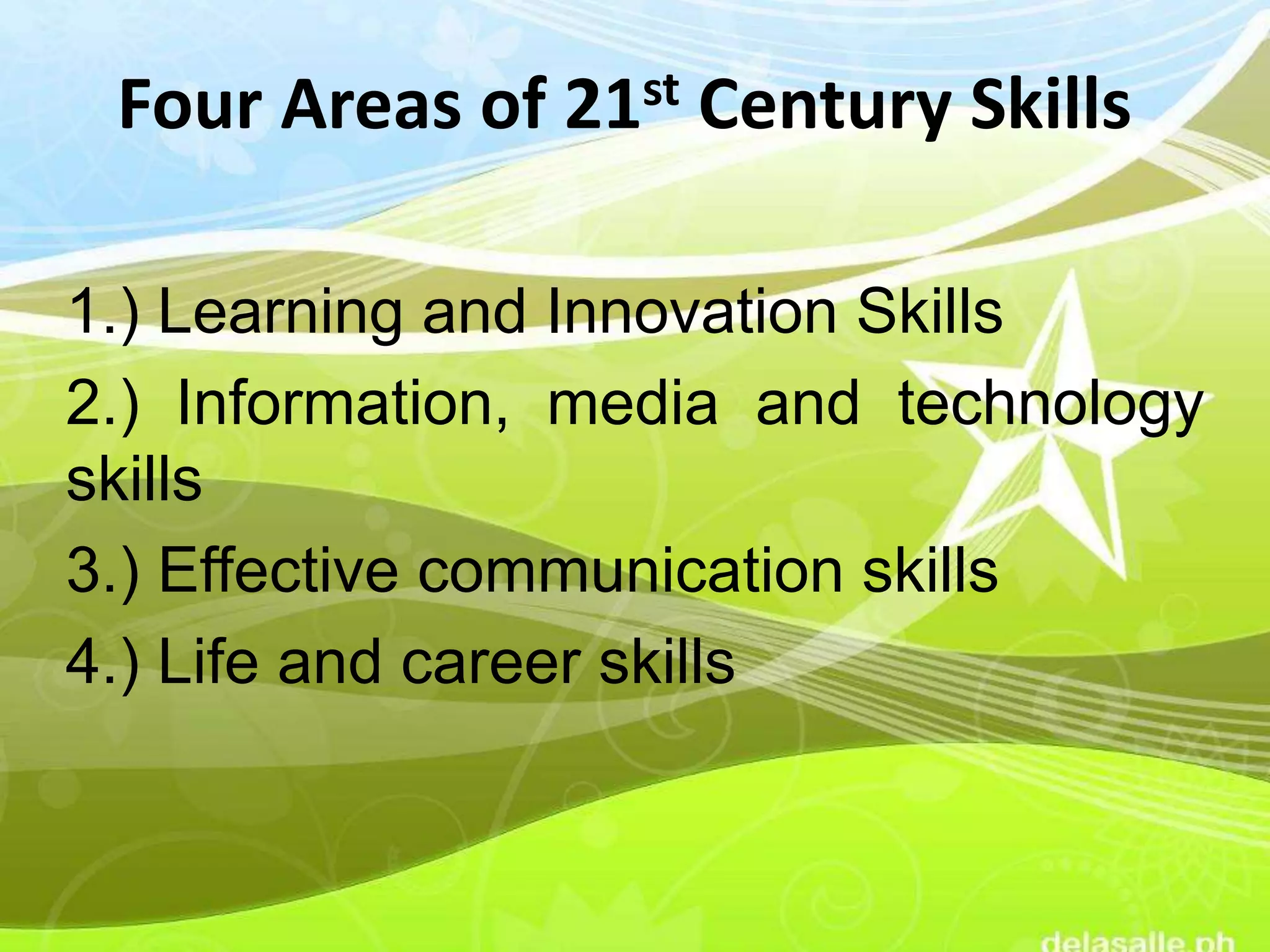
Four Areas of21st Century Skills
1.) Learning and Innovation Skills
2.) Information, media and technology
skills
3.) Effective communication skills
4.) Life and career skills
11.
3 Important Componentsof the
Curriculum
1.) Let the students acquire the basic competencies
for learning such as reading, writing,
mathematics and learning to learn skills.
2.) Emotionally aware and socially proactive in
order to them to developed and becoming whole
person.
3.) They should adequately prepared for Higher
Education, Middle-Level Skills Development,
Employment and Entrepreneurship or outcome-
based. The Curriculum focuses on the holistic
development of the learners.
12.
4 Principles ofthe Curriculum
First, Inclusive education who providing
education to all diverse learners;
Second, It is based on child and youth
development principles;
Third, One is learning and teaching principles,
and
Lastly, Assessment principles.
13.
Features of theCurriculum
Learner-
Centered
Decongested
Seamless
Responsive
Enriched
14.
Features of theCurriculum
The curriculum is:
Learner-centered focuses on the holistic
development of learners. The topics are
developmentally appropriate or age appropriate.
Decongested because it allows students’ mastery
of the competencies.
Seamless, the content and performance content
standard are all in continuum, following an
expanded spiral progression model---increasing
complexity or difficulty. There’s no gap or
overlaps because it observes horizontal and
vertical alignment of content and performance
standards.
15.
Flexible, it allowsflexibility responsive to local
and community needs as well as the needs of the
learners.
Enriched, it is integrative addresses diverse
curricular concern, there is integration to avoid
congestion to the curriculum and it is also
inquiry-based. The curriculum is constructivist
which means, learners should construct their
own knowledge based on their understanding.
Lastly, the curriculum is enriched with the use of
technology including ICT.
16.
K to 12Curriculum Model
Grade 11 - 12 (New HS Years 5-6)
* Science, Math, English, Contemporary
Issues and Specialization
Grade 9 – 10 (New HS Years 3-4)
* Core Learning Areas plus TLE of the
student’s choice
Grade 7 – 8 (New HS Years 1-2)
* Core Learning Areas and TLE
Grade 1 – 6
* Core Learning Areas plus Mother
Tongue until Grade 3; Science starting
Grade 3 and EPP starting Grade 4
Kindergarten
* Learning Domains
Academic Specialization
(HUMSS, STEM, ABM,
GAS)
Technical-Vocational
Specialization
Sports Specialization
Arts and Design
Specialization
19.
“A curriculum needsto be
developed regularly, not only to
incorporate new knowledge but
also to adapt to changing
environment, social,
technological and global
context.”
---Dr. Allan Bernardo---