
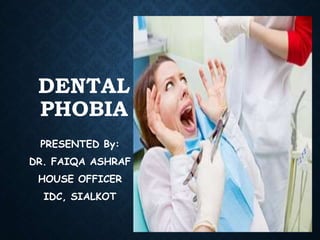





DENTAL
PHOBIA
PRESENTED By:
DR. FAIQA ASHRAF
HOUSE OFFICER
IDC, SIALKOT
“BEING BRAVE IS NOT THE
ABSENCE OF FEAR.
BEING BRAVE IS HAVING
THAT FEAR BUT FINDING A
WAY THROUGH IT.”
-BEAR GRYLLS
LEARNING OBJECTIVES
⮚To Define Dental Phobia
⮚To Differentiate Between Anxiety, Fear And Phobia
⮚To Discuss Types Of Dental Phobia
⮚To Determine Causes Of Dental Phobia
⮚To Study Prevalence Of Dental Phobia
⮚To Diagnose And Manage Patients Of Dental Phobia
CONTENTS
• DEFINITION OF DENTAL PHOBIA
• TYPES OF DENTAL PHOBIA
• SIGNS AND SYMPTOMS
• CAUSES
• PREVALENCE
• DIAGNOSIS
• MANAGEMENT
• CONCLUSION
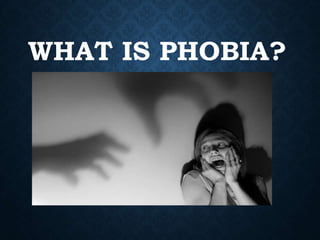
WHAT IS PHOBIA?
• PHOBIA:
A Type of anxiety disorder.
Defined as:
“An extreme, irritational fear of a specific
object, activity or situation that leads to a
compelling desire to avoid it.”
⮚Fear of needles (Trypanophobia)
⮚Fear of Flying (Aerophobia)
⮚Fear of being Alone (Monophobia)
https://en.oxforddictionaries.com/explore/phobias-list
HOW TO TELL IF YOUR FEAR IS
A PHOBIA?
• It’s normal to experience fear, and most people have
at least one or two irrational fears. However,
sometimes fears can turn into phobias and begin to
interfere with your normal living.
• A Phobia is an intense fear.
https://www.google.com.pk/amp/s/m.wikihow.com/Tell-If-Your-Fear-Is-a-Phobia
TERMINOLOGIES
▪ ANXIETY:
Reaction to an unknown danger.
▪ FEAR:
Reaction to a known danger.
Involves “Fight or Flight” response.
▪ PHOBIA:
Same as fear, but is more intense.
The Biology of fear- and anxiety-related behaviors Thierry Steimer, PhD 2002 Sep; 4 (3)
DENTAL PHOBIA
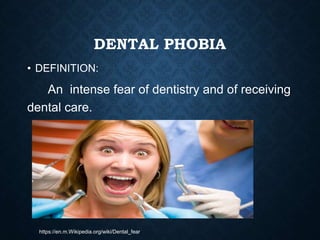
• DEFINITION:
An intense fear of dentistry and of receiving
dental care.
https://en.m.Wikipedia.org/wiki/Dental_fear
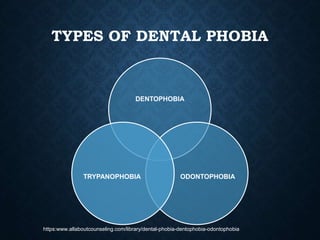
TYPES OF DENTAL PHOBIA
DENTOPHOBIA
ODONTOPHOBIATRYPANOPHOBIA
https:www.allaboutcounseling.com/library/dental-phobia-dentophobia-odontophobia
TYPES OF DENTAL PHOBIA
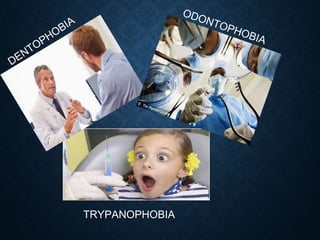
❑Dentophobia :
Fear of dentists.
❑Odontophobia:
Fear of dental treatments.
❑Trypanophobia :
Fear of needles or injections.
https:www.allaboutcounseling.com/library/dental-phobia-dentophobia-odontophobia
TRYPANOPHOBIA
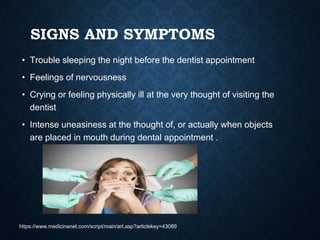
SIGNS AND SYMPTOMS
• Trouble sleeping the night before the dentist appointment
• Feelings of nervousness
• Crying or feeling physically ill at the very thought of visiting the
dentist
• Intense uneasiness at the thought of, or actually when objects
are placed in mouth during dental appointment .
https://www.medicinenet.com/script/main/art.asp?articlekey=43089
CAUSES OF DENTAL PHOBIA
DIRECT
EXPERIENCES
INDIRECT
EXPERIENCES:
• 1.Vicarious
Learning
• 2.Mass Media
• 3.Lack of control
Fear Of The Dentist – Causes and Cures for Dental Anxiety - Oradyne July 2016
DIRECT EXPERIENCES
DIRECT EXPERIENCES
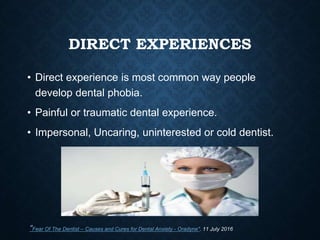
• Direct experience is most common way people
develop dental phobia.
• Painful or traumatic dental experience.
• Impersonal, Uncaring, uninterested or cold dentist.
"Fear Of The Dentist – Causes and Cures for Dental Anxiety - Oradyne". 11 July 2016
INDIRECT EXPERIENCES
1. Vicarious Learning
2. Mass media
3. Helplessness and perceived lack of control
"Fear Of The Dentist – Causes and Cures for Dental Anxiety - Oradyne". 11 July 2016
1.VICARIOUS LEARNING
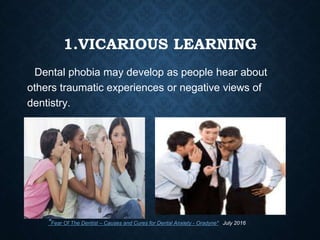
Dental phobia may develop as people hear about
others traumatic experiences or negative views of
dentistry.
"Fear Of The Dentist – Causes and Cures for Dental Anxiety - Oradyne". July 2016
2.MASS MEDIA
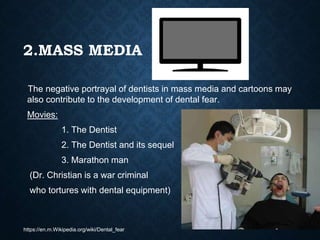
The negative portrayal of dentists in mass media and cartoons may
also contribute to the development of dental fear.
Movies:
1. The Dentist
2. The Dentist and its sequel
3. Marathon man
(Dr. Christian is a war criminal
who tortures with dental equipment)
https://en.m.Wikipedia.org/wiki/Dental_fear
MARATHONE MAN
3. HELPLESSNESS AND
PERCEIVED LACK OF CONTROL
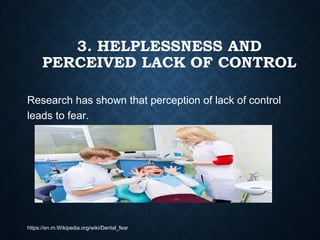
Research has shown that perception of lack of control
leads to fear.
https://en.m.Wikipedia.org/wiki/Dental_fear
SOME COMMON CAUSES AND
THEIR MANAGEMENT:
CAUSES
• Prior negative experience
• Helplessness and lack of control
• Embarrassment
HOW TO MANAGE?
• Reassurance
• Patients need to be reminded
that they can stop the procedure
at any time.
• Patients with embarrassment on
condition of their teeth need to be
reminded that dentists see their
teeth in all conditions & don’t
judge their patients for poor oral
health.
https://www.dentalfearcentral.org/fears/dental-phobia
PREVALENCE
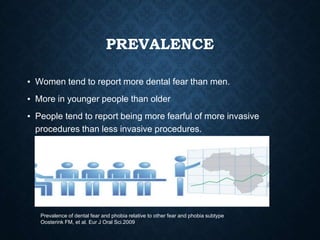
▪ Women tend to report more dental fear than men.
▪ More in younger people than older
▪ People tend to report being more fearful of more invasive
procedures than less invasive procedures.
Prevalence of dental fear and phobia relative to other fear and phobia subtype
Oosterink FM, et al. Eur J Oral Sci.2009
PREVALENCE
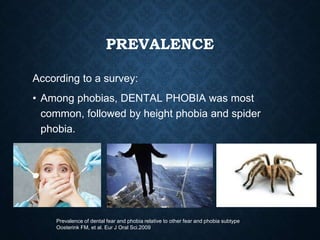
According to a survey:
• Among phobias, DENTAL PHOBIA was most
common, followed by height phobia and spider
phobia.
Prevalence of dental fear and phobia relative to other fear and phobia subtype
Oosterink FM, et al. Eur J Oral Sci.2009
IMPACTS OF DENTAL PHOBIA
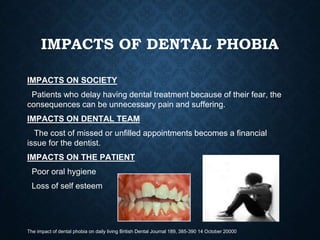
IMPACTS ON SOCIETY
Patients who delay having dental treatment because of their fear, the
consequences can be unnecessary pain and suffering.
IMPACTS ON DENTAL TEAM
The cost of missed or unfilled appointments becomes a financial
issue for the dentist.
IMPACTS ON THE PATIENT
Poor oral hygiene
Loss of self esteem
The impact of dental phobia on daily living British Dental Journal 189, 385-390 14 October 20000
DIAGNOSIS
Phobia of dental care is diagnosed by:
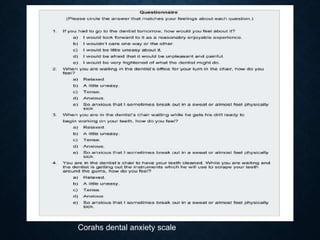
• Corah’s dental anxiety scale
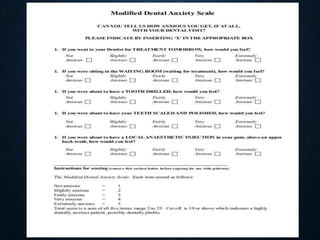
• Modified dental anxiety scale
Humphris G M, Morrison T, Linday S J. The Modified Dental Anxiety Scale: validation and United Kingdom
norms.Community Dent Health 1995;12:143-
Corahs dental anxiety scale
MANAGEMENT
• Combination of pharmacological and behavioral
techniques.
Strategies to manage patients with dental anxiety and dental phobia: literature review Deva Priya Appukuttan 2016
BEHAVIORAL TECHNIQUES
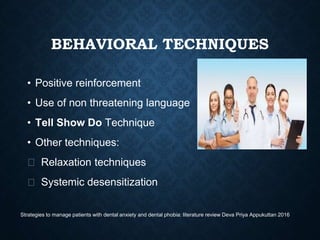
• Positive reinforcement
• Use of non threatening language
• Tell Show Do Technique
• Other techniques:
⮚ Relaxation techniques
⮚ Systemic desensitization
Strategies to manage patients with dental anxiety and dental phobia: literature review Deva Priya Appukuttan 2016
“TELL, SHOW
DO
TECHNIQUE”
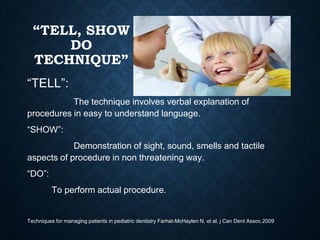
“TELL”:
The technique involves verbal explanation of
procedures in easy to understand language.
“SHOW”:
Demonstration of sight, sound, smells and tactile
aspects of procedure in non threatening way.
“DO”:
To perform actual procedure.
Techniques for managing patients in pediatric dentistry Farhat-McHaylen N, et al. j Can Dent Assoc.2009
PHARMACOLOGICAL
MANAGEMENT
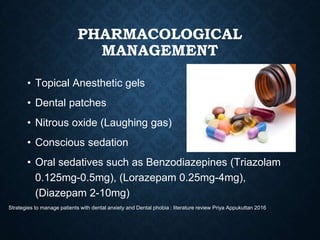
• Topical Anesthetic gels
• Dental patches
• Nitrous oxide (Laughing gas)
• Conscious sedation
• Oral sedatives such as Benzodiazepines (Triazolam
0.125mg-0.5mg), (Lorazepam 0.25mg-4mg),
(Diazepam 2-10mg)
Strategies to manage patients with dental anxiety and Dental phobia : literature review Priya Appukuttan 2016
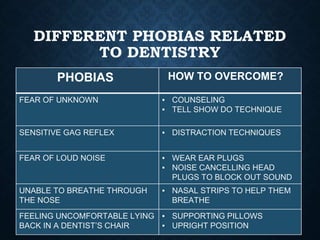
DIFFERENT PHOBIAS RELATED
TO DENTISTRY
PHOBIAS HOW TO OVERCOME?
FEAR OF UNKNOWN ▪ COUNSELING
▪ TELL SHOW DO TECHNIQUE
SENSITIVE GAG REFLEX ▪ DISTRACTION TECHNIQUES
FEAR OF LOUD NOISE ▪ WEAR EAR PLUGS
▪ NOISE CANCELLING HEAD
PLUGS TO BLOCK OUT SOUND
UNABLE TO BREATHE THROUGH
THE NOSE
▪ NASAL STRIPS TO HELP THEM
BREATHE
FEELING UNCOMFORTABLE LYING
BACK IN A DENTIST’S CHAIR
▪ SUPPORTING PILLOWS
▪ UPRIGHT POSITION
CONCLUSION
• Dental anxiety and phobia can have adverse impacts on a person’s
quality of life, and hence it is imperative to identify and alleviate these
significant obstacles to pave the way for better oral health and overall
well-being of the individual.
• It is the duty and responsibility of the dentist to provide excellent dental
care to these patients with special needs as well.
• Management of these patients should be an integral part of clinical
practice, as a substantial proportion of the population suffers from
anxiety and fear.
REFERENCES
• Fear of the dentists- causes and cures for dental anxiety-Oradyne 11July 2016
• https://en.wikipedia.org/wiki/Dental_fear
• Gatchel RJ, Ingersoll BD, Bowman L, Robertson MC, Walker C (October 1983). “The
prevalence of dental fear and avoidance:a recent survey study.”
• https://www.ncbi.nlm.nih.gov/pmc/articles/PMC4790493/
• Strategies to manage patients with dental anxiety and dental phobia: literature review Deva
Priya Appukuttan 2016
• Techniques for managing patients in pediatric dentistry Farhat-McHaylen N, et al. j Can Dent
Assoc.2009
• https://webmd.com/oral-health/easing-dental-fear-adults
• https://www.oral-health/basics/dental-visits/what-is-dental-anxiety-and-phobia
• Humphris G M, Morrison T, Linday S J. The Modified Dental Anxiety Scale: validation and United Kingdom
norms.Community Dent Health 1995;12:143-
Dental Phobia

Dental Phobia

  • 2.
    DENTAL PHOBIA PRESENTED By: DR. FAIQAASHRAF HOUSE OFFICER IDC, SIALKOT
  • 3.
    “BEING BRAVE ISNOT THE ABSENCE OF FEAR. BEING BRAVE IS HAVING THAT FEAR BUT FINDING A WAY THROUGH IT.” -BEAR GRYLLS
  • 4.
    LEARNING OBJECTIVES ⮚To DefineDental Phobia ⮚To Differentiate Between Anxiety, Fear And Phobia ⮚To Discuss Types Of Dental Phobia ⮚To Determine Causes Of Dental Phobia ⮚To Study Prevalence Of Dental Phobia ⮚To Diagnose And Manage Patients Of Dental Phobia
  • 5.
    CONTENTS • DEFINITION OFDENTAL PHOBIA • TYPES OF DENTAL PHOBIA • SIGNS AND SYMPTOMS • CAUSES • PREVALENCE • DIAGNOSIS • MANAGEMENT • CONCLUSION
  • 6.
  • 7.
    • PHOBIA: A Typeof anxiety disorder. Defined as: “An extreme, irritational fear of a specific object, activity or situation that leads to a compelling desire to avoid it.” ⮚Fear of needles (Trypanophobia) ⮚Fear of Flying (Aerophobia) ⮚Fear of being Alone (Monophobia) https://en.oxforddictionaries.com/explore/phobias-list
  • 8.
    HOW TO TELLIF YOUR FEAR IS A PHOBIA? • It’s normal to experience fear, and most people have at least one or two irrational fears. However, sometimes fears can turn into phobias and begin to interfere with your normal living. • A Phobia is an intense fear. https://www.google.com.pk/amp/s/m.wikihow.com/Tell-If-Your-Fear-Is-a-Phobia
  • 9.
    TERMINOLOGIES ▪ ANXIETY: Reaction toan unknown danger. ▪ FEAR: Reaction to a known danger. Involves “Fight or Flight” response. ▪ PHOBIA: Same as fear, but is more intense. The Biology of fear- and anxiety-related behaviors Thierry Steimer, PhD 2002 Sep; 4 (3)
  • 10.
    DENTAL PHOBIA • DEFINITION: Anintense fear of dentistry and of receiving dental care. https://en.m.Wikipedia.org/wiki/Dental_fear
  • 11.
    TYPES OF DENTALPHOBIA DENTOPHOBIA ODONTOPHOBIATRYPANOPHOBIA https:www.allaboutcounseling.com/library/dental-phobia-dentophobia-odontophobia
  • 12.
    TYPES OF DENTALPHOBIA ❑Dentophobia : Fear of dentists. ❑Odontophobia: Fear of dental treatments. ❑Trypanophobia : Fear of needles or injections. https:www.allaboutcounseling.com/library/dental-phobia-dentophobia-odontophobia
  • 13.
  • 14.
    SIGNS AND SYMPTOMS •Trouble sleeping the night before the dentist appointment • Feelings of nervousness • Crying or feeling physically ill at the very thought of visiting the dentist • Intense uneasiness at the thought of, or actually when objects are placed in mouth during dental appointment . https://www.medicinenet.com/script/main/art.asp?articlekey=43089
  • 15.
    CAUSES OF DENTALPHOBIA DIRECT EXPERIENCES INDIRECT EXPERIENCES: • 1.Vicarious Learning • 2.Mass Media • 3.Lack of control Fear Of The Dentist – Causes and Cures for Dental Anxiety - Oradyne July 2016
  • 16.
  • 17.
    DIRECT EXPERIENCES • Directexperience is most common way people develop dental phobia. • Painful or traumatic dental experience. • Impersonal, Uncaring, uninterested or cold dentist. "Fear Of The Dentist – Causes and Cures for Dental Anxiety - Oradyne". 11 July 2016
  • 18.
  • 19.
    INDIRECT EXPERIENCES 1. VicariousLearning 2. Mass media 3. Helplessness and perceived lack of control "Fear Of The Dentist – Causes and Cures for Dental Anxiety - Oradyne". 11 July 2016
  • 20.
    1.VICARIOUS LEARNING Dental phobiamay develop as people hear about others traumatic experiences or negative views of dentistry. "Fear Of The Dentist – Causes and Cures for Dental Anxiety - Oradyne". July 2016
  • 21.
    2.MASS MEDIA The negativeportrayal of dentists in mass media and cartoons may also contribute to the development of dental fear. Movies: 1. The Dentist 2. The Dentist and its sequel 3. Marathon man (Dr. Christian is a war criminal who tortures with dental equipment) https://en.m.Wikipedia.org/wiki/Dental_fear
  • 22.
  • 23.
    3. HELPLESSNESS AND PERCEIVEDLACK OF CONTROL Research has shown that perception of lack of control leads to fear. https://en.m.Wikipedia.org/wiki/Dental_fear
  • 24.
    SOME COMMON CAUSESAND THEIR MANAGEMENT: CAUSES • Prior negative experience • Helplessness and lack of control • Embarrassment HOW TO MANAGE? • Reassurance • Patients need to be reminded that they can stop the procedure at any time. • Patients with embarrassment on condition of their teeth need to be reminded that dentists see their teeth in all conditions & don’t judge their patients for poor oral health. https://www.dentalfearcentral.org/fears/dental-phobia
  • 25.
    PREVALENCE ▪ Women tendto report more dental fear than men. ▪ More in younger people than older ▪ People tend to report being more fearful of more invasive procedures than less invasive procedures. Prevalence of dental fear and phobia relative to other fear and phobia subtype Oosterink FM, et al. Eur J Oral Sci.2009
  • 26.
    PREVALENCE According to asurvey: • Among phobias, DENTAL PHOBIA was most common, followed by height phobia and spider phobia. Prevalence of dental fear and phobia relative to other fear and phobia subtype Oosterink FM, et al. Eur J Oral Sci.2009
  • 27.
    IMPACTS OF DENTALPHOBIA IMPACTS ON SOCIETY Patients who delay having dental treatment because of their fear, the consequences can be unnecessary pain and suffering. IMPACTS ON DENTAL TEAM The cost of missed or unfilled appointments becomes a financial issue for the dentist. IMPACTS ON THE PATIENT Poor oral hygiene Loss of self esteem The impact of dental phobia on daily living British Dental Journal 189, 385-390 14 October 20000
  • 28.
    DIAGNOSIS Phobia of dentalcare is diagnosed by: • Corah’s dental anxiety scale • Modified dental anxiety scale Humphris G M, Morrison T, Linday S J. The Modified Dental Anxiety Scale: validation and United Kingdom norms.Community Dent Health 1995;12:143-
  • 29.
  • 31.
    MANAGEMENT • Combination ofpharmacological and behavioral techniques. Strategies to manage patients with dental anxiety and dental phobia: literature review Deva Priya Appukuttan 2016
  • 32.
    BEHAVIORAL TECHNIQUES • Positivereinforcement • Use of non threatening language • Tell Show Do Technique • Other techniques: ⮚ Relaxation techniques ⮚ Systemic desensitization Strategies to manage patients with dental anxiety and dental phobia: literature review Deva Priya Appukuttan 2016
  • 33.
    “TELL, SHOW DO TECHNIQUE” “TELL”: The techniqueinvolves verbal explanation of procedures in easy to understand language. “SHOW”: Demonstration of sight, sound, smells and tactile aspects of procedure in non threatening way. “DO”: To perform actual procedure. Techniques for managing patients in pediatric dentistry Farhat-McHaylen N, et al. j Can Dent Assoc.2009
  • 34.
    PHARMACOLOGICAL MANAGEMENT • Topical Anestheticgels • Dental patches • Nitrous oxide (Laughing gas) • Conscious sedation • Oral sedatives such as Benzodiazepines (Triazolam 0.125mg-0.5mg), (Lorazepam 0.25mg-4mg), (Diazepam 2-10mg) Strategies to manage patients with dental anxiety and Dental phobia : literature review Priya Appukuttan 2016
  • 35.
    DIFFERENT PHOBIAS RELATED TODENTISTRY PHOBIAS HOW TO OVERCOME? FEAR OF UNKNOWN ▪ COUNSELING ▪ TELL SHOW DO TECHNIQUE SENSITIVE GAG REFLEX ▪ DISTRACTION TECHNIQUES FEAR OF LOUD NOISE ▪ WEAR EAR PLUGS ▪ NOISE CANCELLING HEAD PLUGS TO BLOCK OUT SOUND UNABLE TO BREATHE THROUGH THE NOSE ▪ NASAL STRIPS TO HELP THEM BREATHE FEELING UNCOMFORTABLE LYING BACK IN A DENTIST’S CHAIR ▪ SUPPORTING PILLOWS ▪ UPRIGHT POSITION
  • 36.
    CONCLUSION • Dental anxietyand phobia can have adverse impacts on a person’s quality of life, and hence it is imperative to identify and alleviate these significant obstacles to pave the way for better oral health and overall well-being of the individual. • It is the duty and responsibility of the dentist to provide excellent dental care to these patients with special needs as well. • Management of these patients should be an integral part of clinical practice, as a substantial proportion of the population suffers from anxiety and fear.
  • 37.
    REFERENCES • Fear ofthe dentists- causes and cures for dental anxiety-Oradyne 11July 2016 • https://en.wikipedia.org/wiki/Dental_fear • Gatchel RJ, Ingersoll BD, Bowman L, Robertson MC, Walker C (October 1983). “The prevalence of dental fear and avoidance:a recent survey study.” • https://www.ncbi.nlm.nih.gov/pmc/articles/PMC4790493/ • Strategies to manage patients with dental anxiety and dental phobia: literature review Deva Priya Appukuttan 2016 • Techniques for managing patients in pediatric dentistry Farhat-McHaylen N, et al. j Can Dent Assoc.2009 • https://webmd.com/oral-health/easing-dental-fear-adults • https://www.oral-health/basics/dental-visits/what-is-dental-anxiety-and-phobia • Humphris G M, Morrison T, Linday S J. The Modified Dental Anxiety Scale: validation and United Kingdom norms.Community Dent Health 1995;12:143-