Density of Metals Aim To be able to calculate the density  of a metal by measuring the volume  and mass.
Risk Assessment Risk: Hazard: Control Measure:
Equipment Diagram
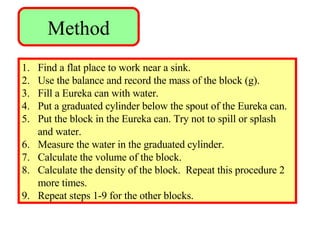
Method Find a flat place to work near a sink. Use the balance and record the mass of the block (g). Fill a Eureka can with water. Put a graduated cylinder below the spout of the Eureka can. Put the block in the Eureka can. Try not to spill or splash and water. Measure the water in the graduated cylinder. Calculate the volume of the block. Calculate the density of the block.  Repeat this procedure 2 more times. Repeat steps 1-9 for the other blocks.
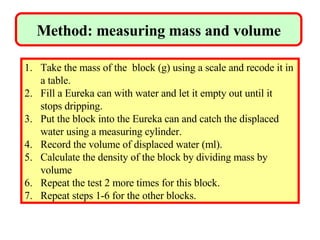
Method: measuring mass and volume Take the mass of the  block (g) using a scale and recode it in a table. Fill a Eureka can with water and let it empty out until it stops dripping. Put the block into the Eureka can and catch the displaced water using a measuring cylinder. Record the volume of displaced water (ml). Calculate the density of the block by dividing mass by volume Repeat the test 2 more times for this block. Repeat steps 1-6 for the other blocks.
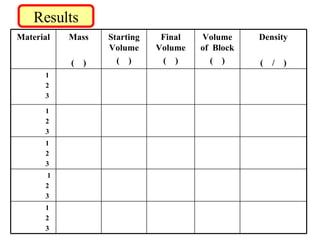
Results 1  2 3 1  2 3 1  2 3 1  2 3 1  2 3 Density (  /  ) Volume of  Block (  ) Final Volume (  ) Starting Volume (  ) Mass (  ) Material
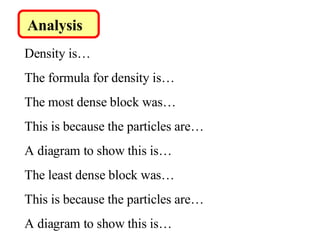
Analysis   Density is… The formula for density is… The most dense block was…  This is because the particles are… A diagram to show this is… The least dense block was… This is because the particles are… A diagram to show this is…
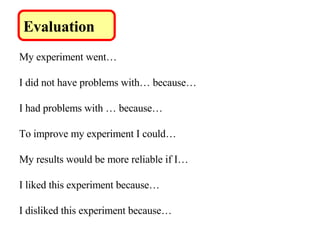
Evaluation   My experiment went… I did not have problems with… because… I had problems with … because… To improve my experiment I could… My results would be more reliable if I… I liked this experiment because… I disliked this experiment because…

Density

  • 1.
    Density of MetalsAim To be able to calculate the density of a metal by measuring the volume and mass.
  • 2.
    Risk Assessment Risk:Hazard: Control Measure:
  • 3.
  • 4.
    Method Find aflat place to work near a sink. Use the balance and record the mass of the block (g). Fill a Eureka can with water. Put a graduated cylinder below the spout of the Eureka can. Put the block in the Eureka can. Try not to spill or splash and water. Measure the water in the graduated cylinder. Calculate the volume of the block. Calculate the density of the block. Repeat this procedure 2 more times. Repeat steps 1-9 for the other blocks.
  • 5.
    Method: measuring massand volume Take the mass of the block (g) using a scale and recode it in a table. Fill a Eureka can with water and let it empty out until it stops dripping. Put the block into the Eureka can and catch the displaced water using a measuring cylinder. Record the volume of displaced water (ml). Calculate the density of the block by dividing mass by volume Repeat the test 2 more times for this block. Repeat steps 1-6 for the other blocks.
  • 6.
    Results 1 2 3 1 2 3 1 2 3 1 2 3 1 2 3 Density ( / ) Volume of Block ( ) Final Volume ( ) Starting Volume ( ) Mass ( ) Material
  • 7.
    Analysis Density is… The formula for density is… The most dense block was… This is because the particles are… A diagram to show this is… The least dense block was… This is because the particles are… A diagram to show this is…
  • 8.
    Evaluation My experiment went… I did not have problems with… because… I had problems with … because… To improve my experiment I could… My results would be more reliable if I… I liked this experiment because… I disliked this experiment because…