DENSITY
CONTENTS
1. Introduction
2. Definition
3. Unit
4. Calculation of density
5. Relationship between density, mass & volume
6. Importance in chemistry
7. Application
8. Examples
9. Summary
10. References
Introduction
• Densityis a physical characteristic used in chemistry to determine how much mass
is present in a given volume of a substance.
• It is a fundamentalconcept in chemistry that allows us to understandthe
relationshipbetween mass and volume.
• It has practical applications in various fields and is a useful tool for scientists to
characterize and analyzesubstances.
Definition
- Density is a fundamental concept in chemistry
that describes how much mass is contained
within a given volume of substance.
- Mathematically, it is defined as the mass of a
substance per unit volume.
- Formula:
Density(ρ) = Mass (m) / Volume(V)
Figure showing formula of density
Figure showing formula of
density
Unit of density
• Units of density include grams per cubic
centimetre (g/cm³)
and kilograms per cubic meter (kg/m³).
• Other units include
(a)pounds per cubic inch (lb./in³)
(b)ounces per fluid ounce (oz./fl. oz.).
Calculation of density
How to calculate???
• To calculate density, we need to know the
mass and volume of a substance.
• On substituting the mass and volume of the
substance with corresponding unit the
volume can be calculated easily.
Example
 If a substance has a mass of 50 grams
and a volume of 10 cm³, the density
would be?
Answer:
 Given,
mass(m)= 50g & volume (v)= 10cm³
 ρ= m/ v
 ρ= 50/10 = 5 g/cm³
Therefore, the density would be 5 g/cm³.
Relationship between mass volume and
density
Densityis directly proportionalto
mass.
 If volume remains constant, as the
mass increases the density also
increases and vice-versa.
 ρ α m (when volume remains
constant)
Densityis inverselyproportional to
volume.
 If mass remains constant, as the
volume increases the density
decreases and vice-versa.
 ρα1/v (when mass remains
constant)
Importance of density in chemistry
Classification of substances
 Density helps to classify materials
as solids,liquids or gases based
on their characteristics.
 By knowing the density the state of
the substance can be predicted.
Figure showing the density of ice with water
Identifications of objects
 It can be used to identify unknown
substances by comparing their
densities to known values.
 If density is known the value mass
and volume can be calculated i.e.,
by knowing any two values the
third values can be calculated
easily.
Figure showing different states of
matter
Application
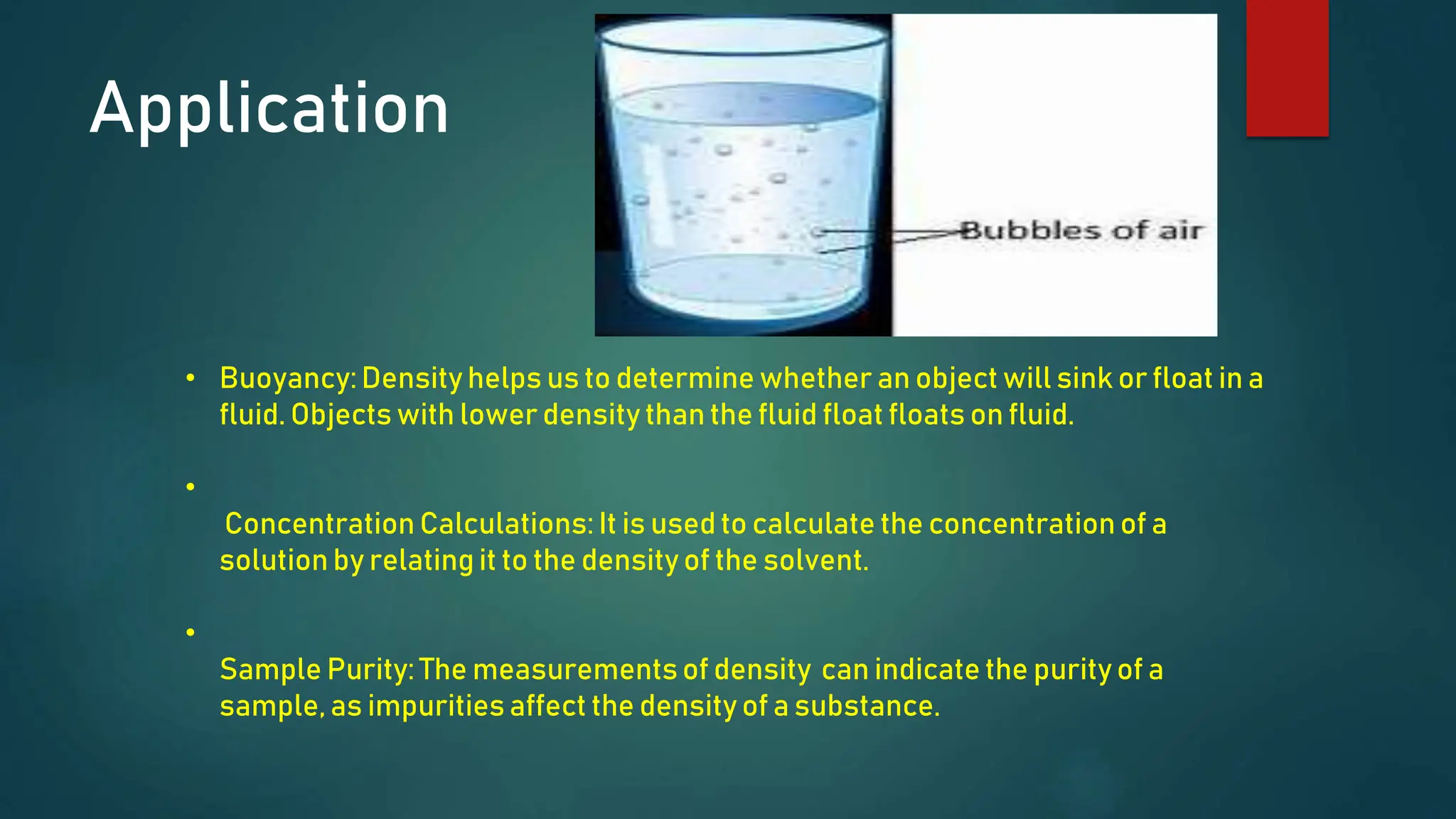
• Buoyancy:Density helps us to determine whether an object will sink or float in a
fluid. Objects with lower density than the fluid float floats on fluid.
•
Concentration Calculations: It is used to calculate the concentration of a
solution by relating it to the density of the solvent.
•
Sample Purity: The measurementsof density can indicate the purity of a
sample, as impurities affect the density of a substance.
Examples
• Water: If we see the density of water is approximately1 g/cm³ at 4°C. Ice has a lower
densitythan liquid water.
Ice floating on water
Gases: Gases have much lower densities than solids
and liquids due to their low mass and high
intermoleculardistances.
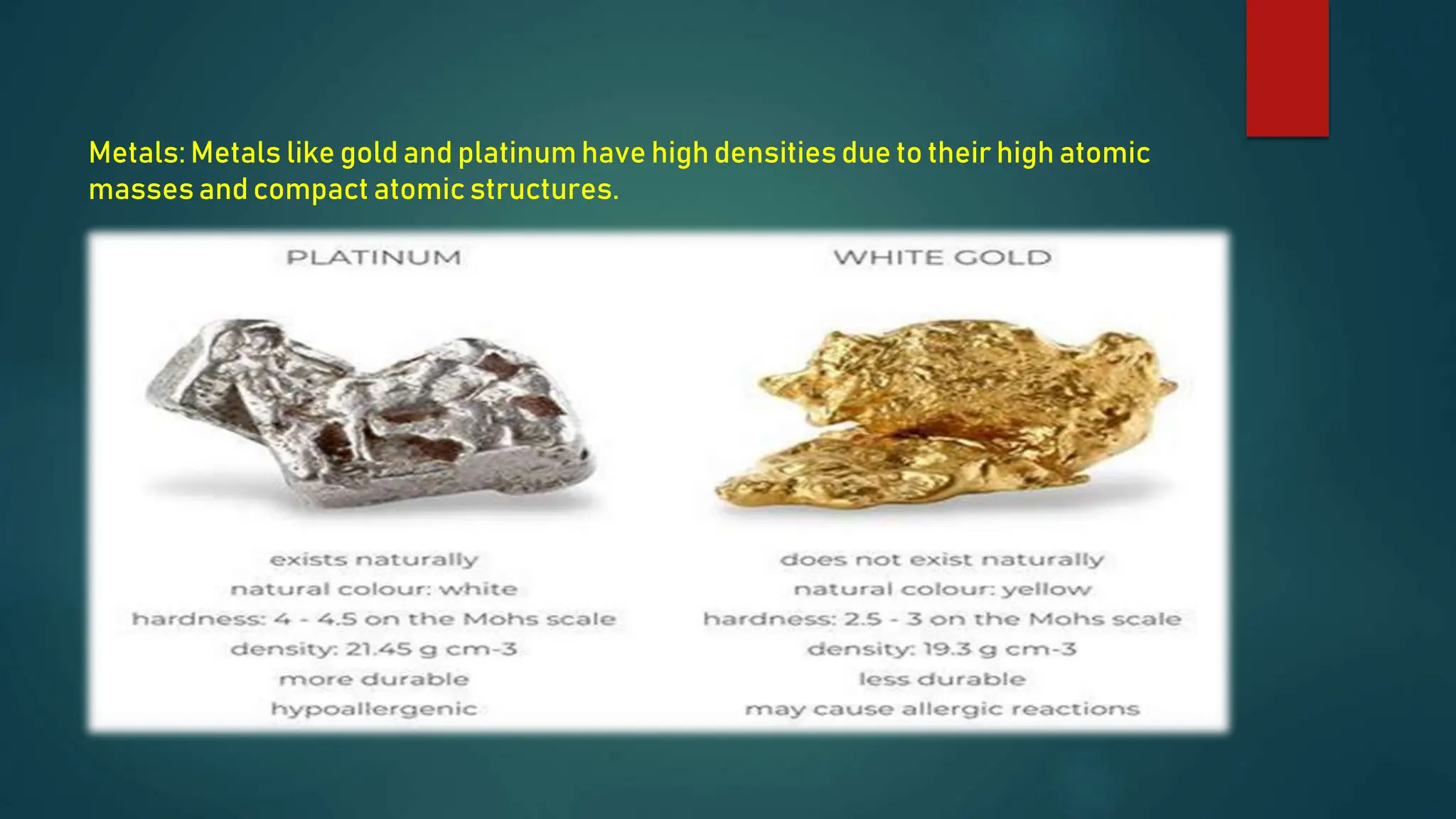
Metals: Metals like gold and platinum have high densities due to their high atomic
masses and compact atomic structures.
Summary
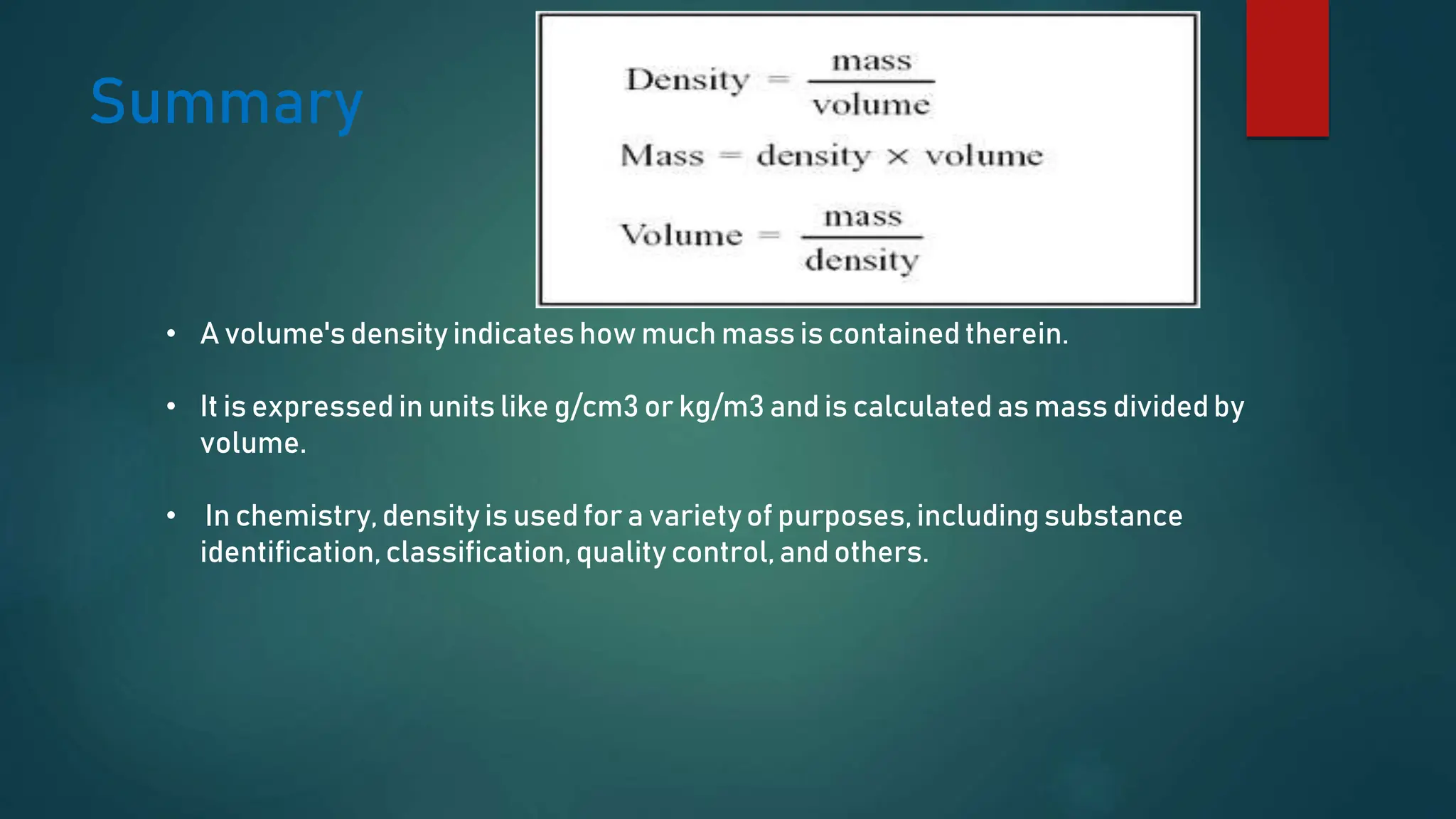
• A volume's density indicates how much mass is contained therein.
• It is expressed in units like g/cm3 or kg/m3 and is calculated as mass dividedby
volume.
• In chemistry,density is used for a varietyof purposes, including substance
identification,classification, quality control, and others.
References
• https://www.bing.com/images/search?q=ice+floating+on+water+in+glass&qs=n
&form=QBIR&sp=-
1&lq=0&pq=ice%20floating%20on%20water%20in%20glass&sc=7-
30&cvid=BEFF1612919342C3B97AE2EBFA6C132A&ghsh=0&ghacc=0&first=1&cw=1
499&ch=741
• Goggle , Wikipedia
• NCERT class 10th.
Explanation about the concept Density...

Explanation about the concept Density...

  • 1.
  • 2.
    CONTENTS 1. Introduction 2. Definition 3.Unit 4. Calculation of density 5. Relationship between density, mass & volume 6. Importance in chemistry 7. Application 8. Examples 9. Summary 10. References
  • 3.
    Introduction • Densityis aphysical characteristic used in chemistry to determine how much mass is present in a given volume of a substance. • It is a fundamentalconcept in chemistry that allows us to understandthe relationshipbetween mass and volume. • It has practical applications in various fields and is a useful tool for scientists to characterize and analyzesubstances.
  • 4.
    Definition - Density isa fundamental concept in chemistry that describes how much mass is contained within a given volume of substance. - Mathematically, it is defined as the mass of a substance per unit volume. - Formula: Density(ρ) = Mass (m) / Volume(V)
  • 5.
    Figure showing formulaof density Figure showing formula of density
  • 6.
    Unit of density •Units of density include grams per cubic centimetre (g/cm³) and kilograms per cubic meter (kg/m³). • Other units include (a)pounds per cubic inch (lb./in³) (b)ounces per fluid ounce (oz./fl. oz.).
  • 7.
    Calculation of density Howto calculate??? • To calculate density, we need to know the mass and volume of a substance. • On substituting the mass and volume of the substance with corresponding unit the volume can be calculated easily. Example  If a substance has a mass of 50 grams and a volume of 10 cm³, the density would be? Answer:  Given, mass(m)= 50g & volume (v)= 10cm³  ρ= m/ v  ρ= 50/10 = 5 g/cm³ Therefore, the density would be 5 g/cm³.
  • 8.
    Relationship between massvolume and density Densityis directly proportionalto mass.  If volume remains constant, as the mass increases the density also increases and vice-versa.  ρ α m (when volume remains constant) Densityis inverselyproportional to volume.  If mass remains constant, as the volume increases the density decreases and vice-versa.  ρα1/v (when mass remains constant)
  • 9.
    Importance of densityin chemistry Classification of substances  Density helps to classify materials as solids,liquids or gases based on their characteristics.  By knowing the density the state of the substance can be predicted. Figure showing the density of ice with water
  • 10.
    Identifications of objects It can be used to identify unknown substances by comparing their densities to known values.  If density is known the value mass and volume can be calculated i.e., by knowing any two values the third values can be calculated easily. Figure showing different states of matter
  • 11.
    Application • Buoyancy:Density helpsus to determine whether an object will sink or float in a fluid. Objects with lower density than the fluid float floats on fluid. • Concentration Calculations: It is used to calculate the concentration of a solution by relating it to the density of the solvent. • Sample Purity: The measurementsof density can indicate the purity of a sample, as impurities affect the density of a substance.
  • 12.
    Examples • Water: Ifwe see the density of water is approximately1 g/cm³ at 4°C. Ice has a lower densitythan liquid water.
  • 13.
    Ice floating onwater Gases: Gases have much lower densities than solids and liquids due to their low mass and high intermoleculardistances.
  • 14.
    Metals: Metals likegold and platinum have high densities due to their high atomic masses and compact atomic structures.
  • 15.
    Summary • A volume'sdensity indicates how much mass is contained therein. • It is expressed in units like g/cm3 or kg/m3 and is calculated as mass dividedby volume. • In chemistry,density is used for a varietyof purposes, including substance identification,classification, quality control, and others.
  • 16.