PHYSICS
CLASS : VIII
Chapter-2
PHYSICAL QUANTITIES AND
MEASUREMENT
CONCEPTS IN MODULE
 Density
Relative density
Floating and Sinking
Comparison of Densities in the three states of matter.
Numerical problems.
Glossary
Evaluation
INTRODUCTION
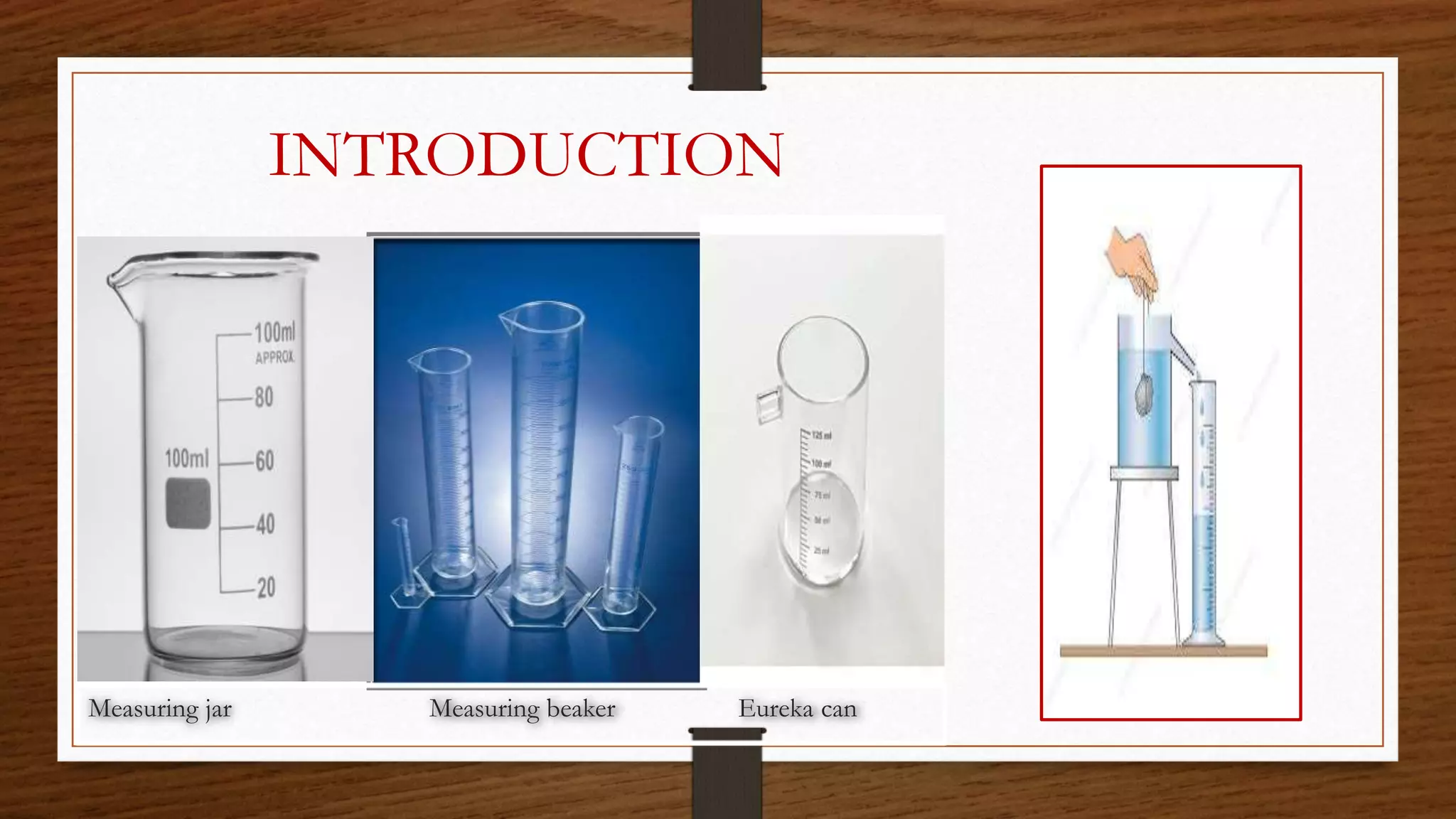
Measuring jar Measuring beaker Eureka can
How can you find the volume of irregular shaped solids?
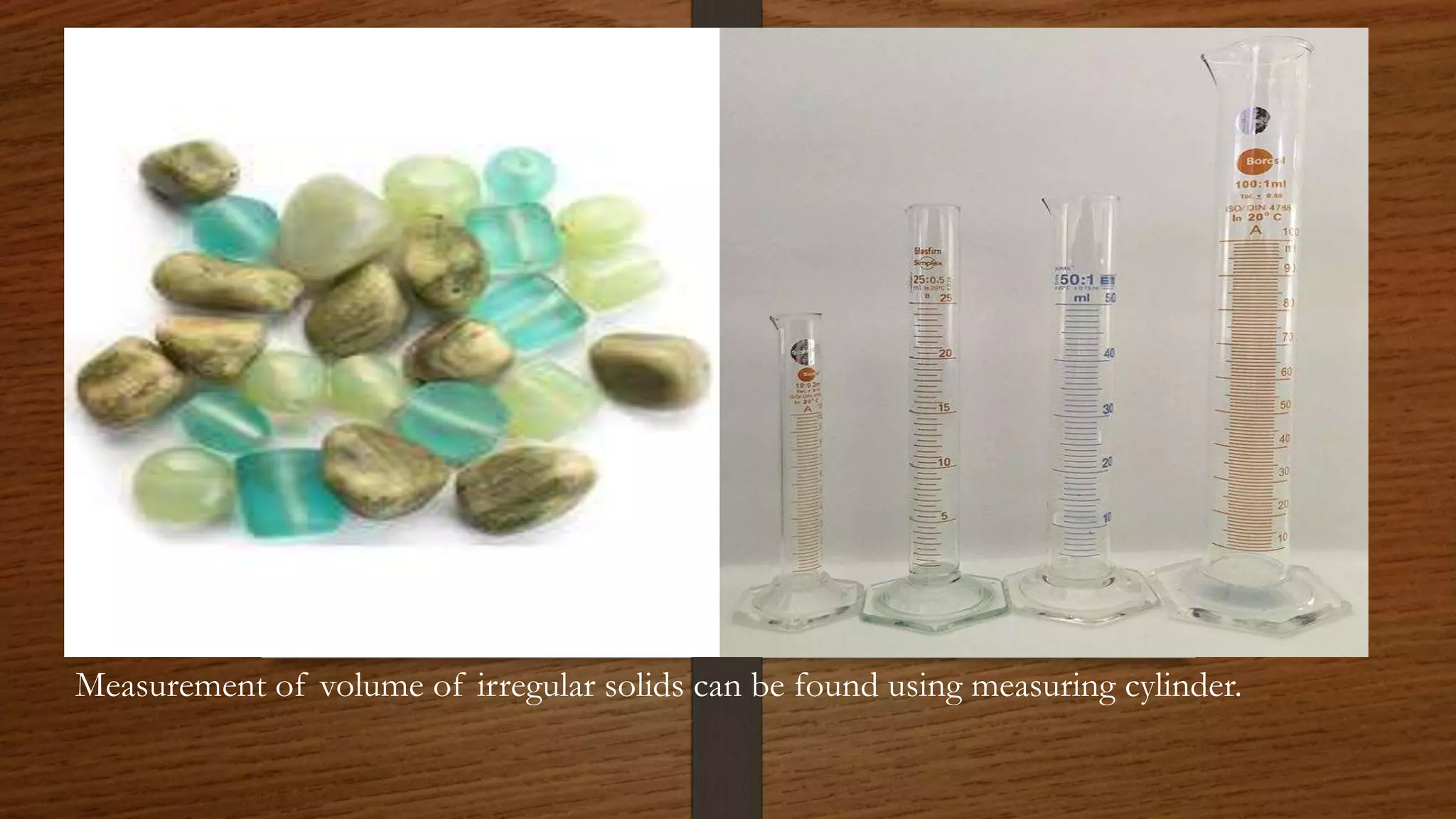
Measurement of volume of irregular solids can be found using measuring cylinder.
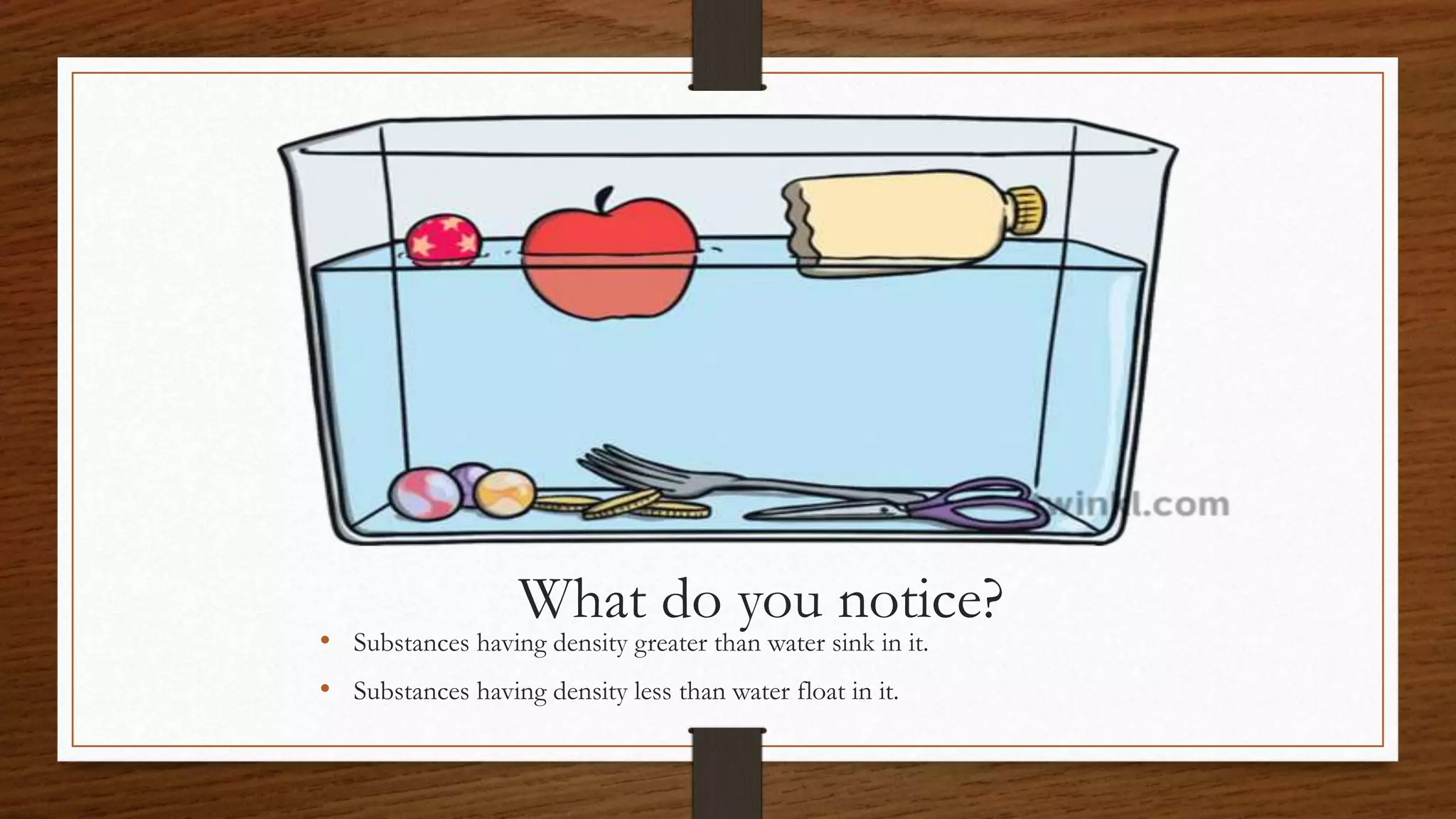
What do you notice?
• Substances having density greater than water sink in it.
• Substances having density less than water float in it.
DENSITY
Density of a substance
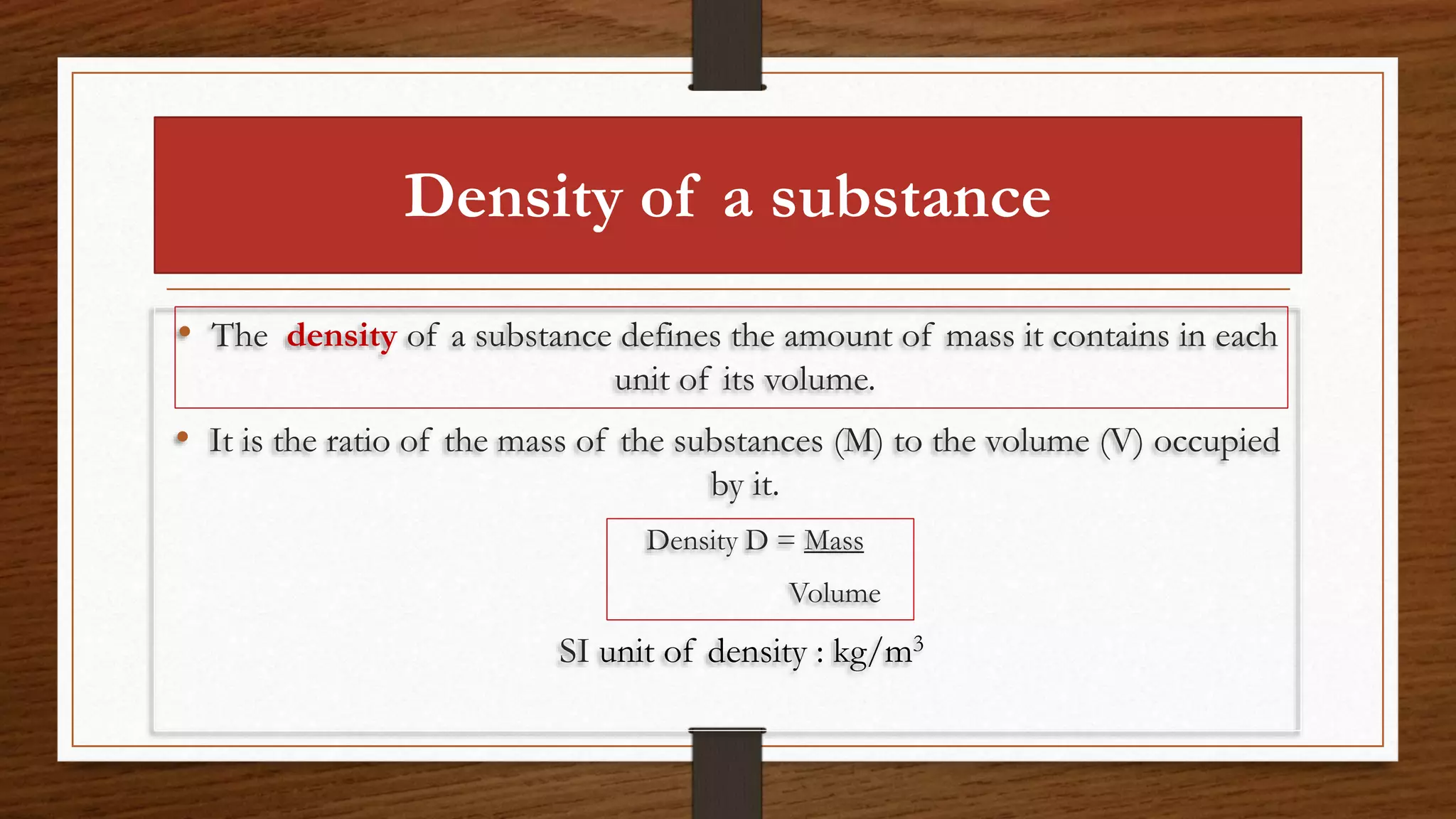
• The density of a substance defines the amount of mass it contains in each
unit of its volume.
• It is the ratio of the mass of the substances (M) to the volume (V) occupied
by it.
Density D = Mass
Volume
SI unit of density : kg/m3
Every body has a certain mass and definite volume
Equal masses of different
substances have different
volume.
• For example
volume of cotton is greater than
volume of an equal mass of lead.
Equal volume of different
substances have different
masses.
• For example
Mass of iron is greater than the mass
of an equal volume of wood.
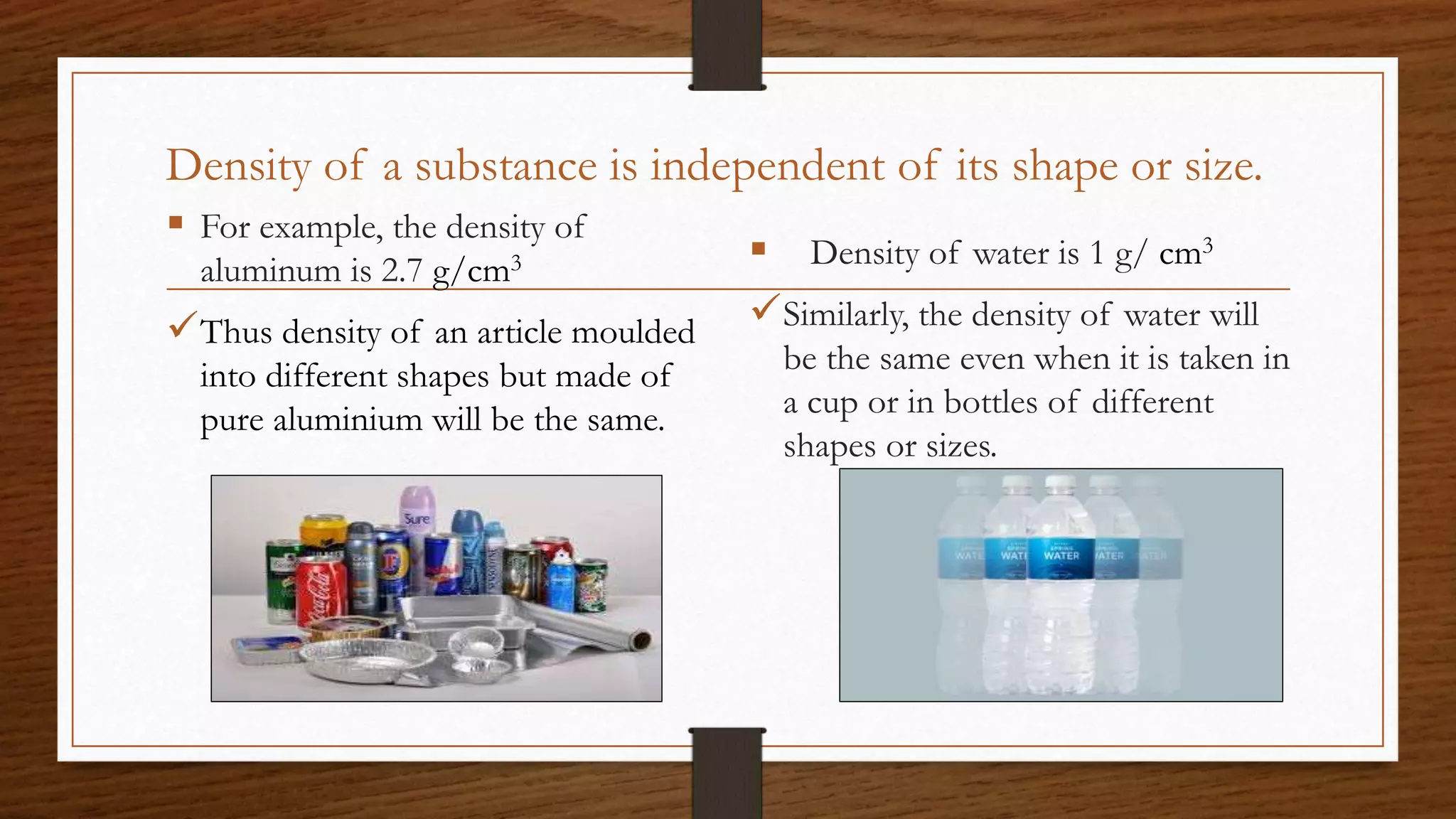
Density of a substance is independent of its shape or size.
 For example, the density of
aluminum is 2.7 g/cm3
Thus density of an article moulded
into different shapes but made of
pure aluminium will be the same.
 Density of water is 1 g/ cm3
Similarly, the density of water will
be the same even when it is taken in
a cup or in bottles of different
shapes or sizes.
ACTIVITY - 1
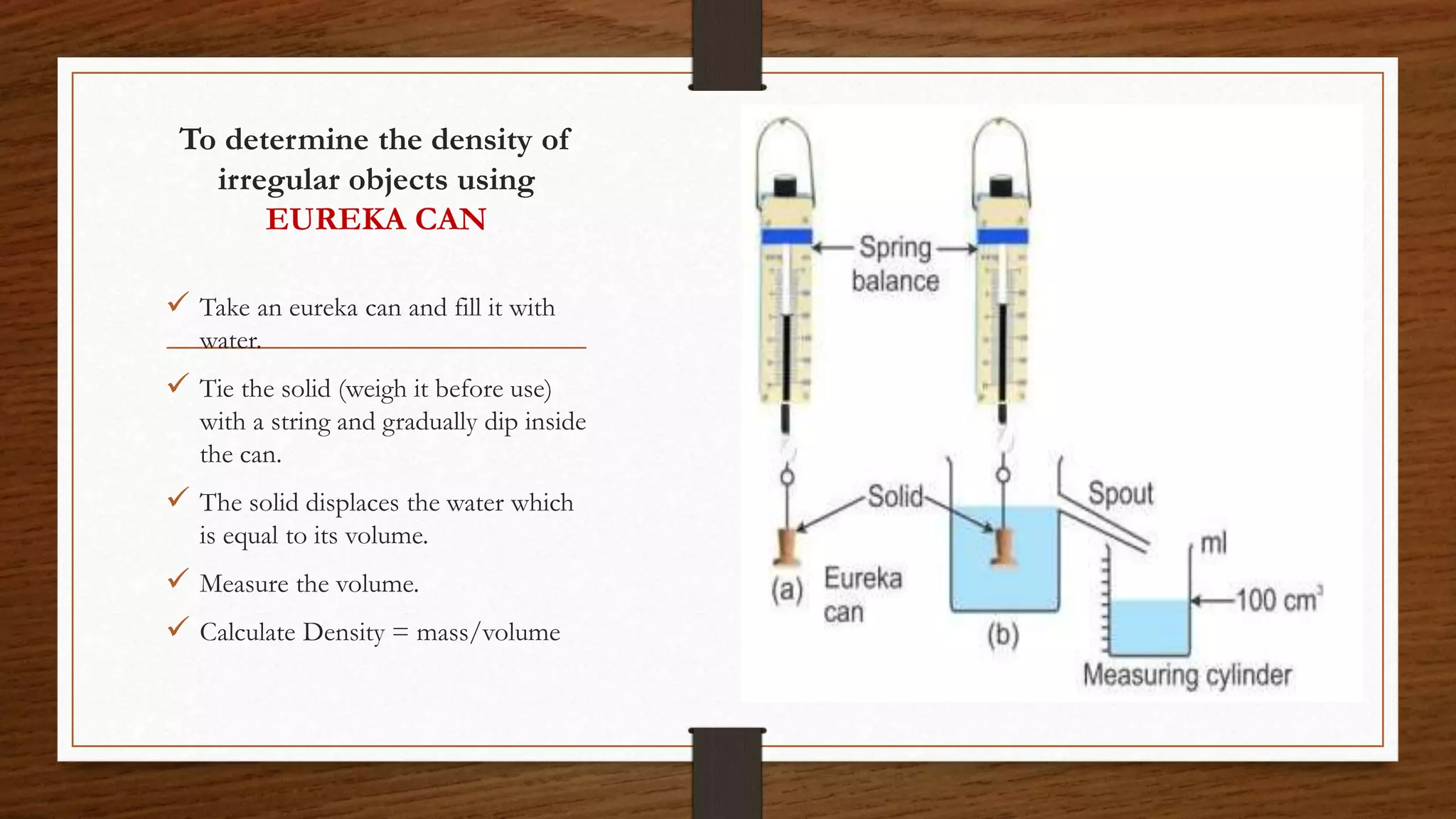
To determine the density of
irregular objects using
EUREKA CAN
 Take an eureka can and fill it with
water.
 Tie the solid (weigh it before use)
with a string and gradually dip inside
the can.
 The solid displaces the water which
is equal to its volume.
 Measure the volume.
 Calculate Density = mass/volume
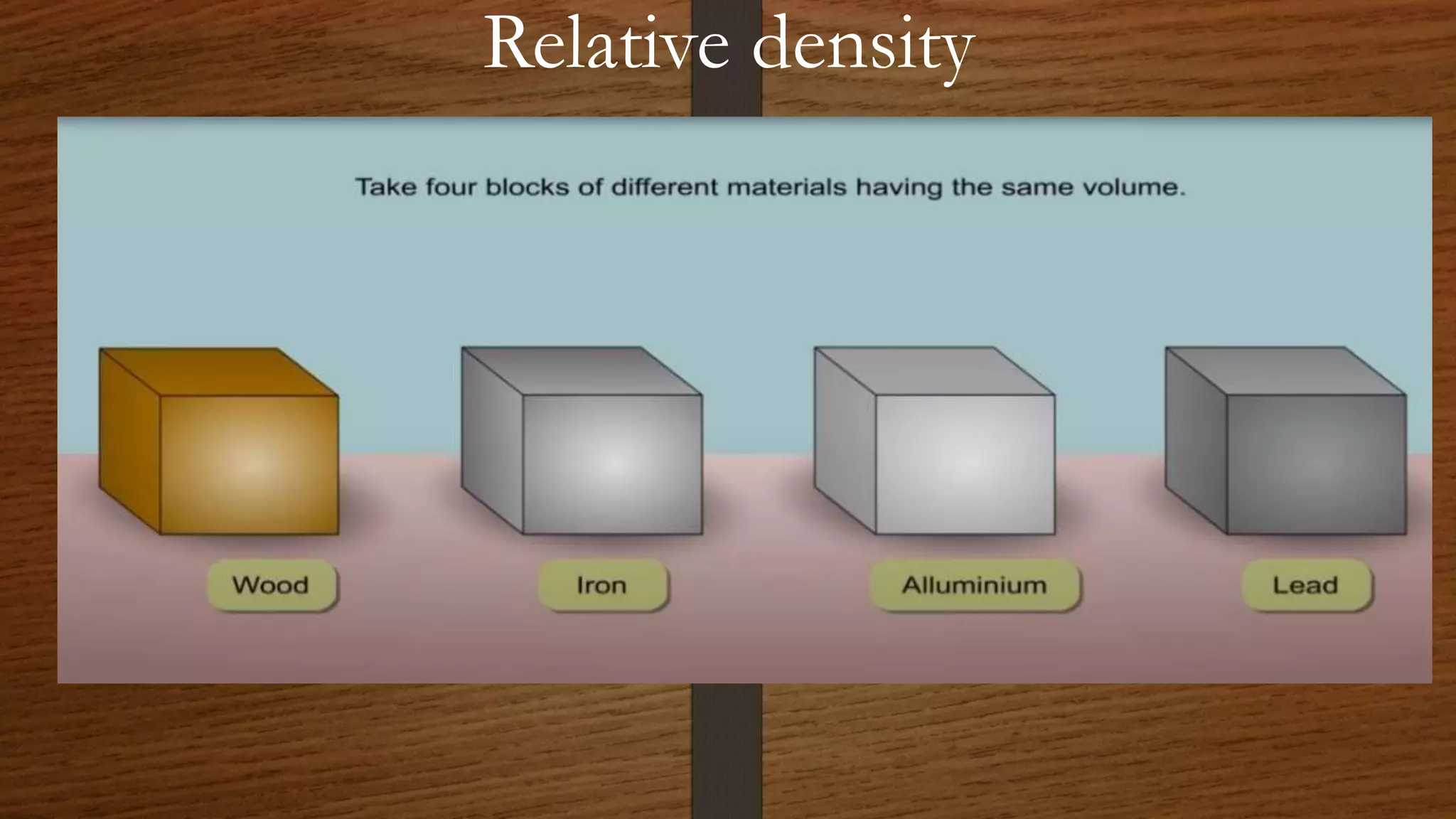
RELATIVE DENSITY
Relative density
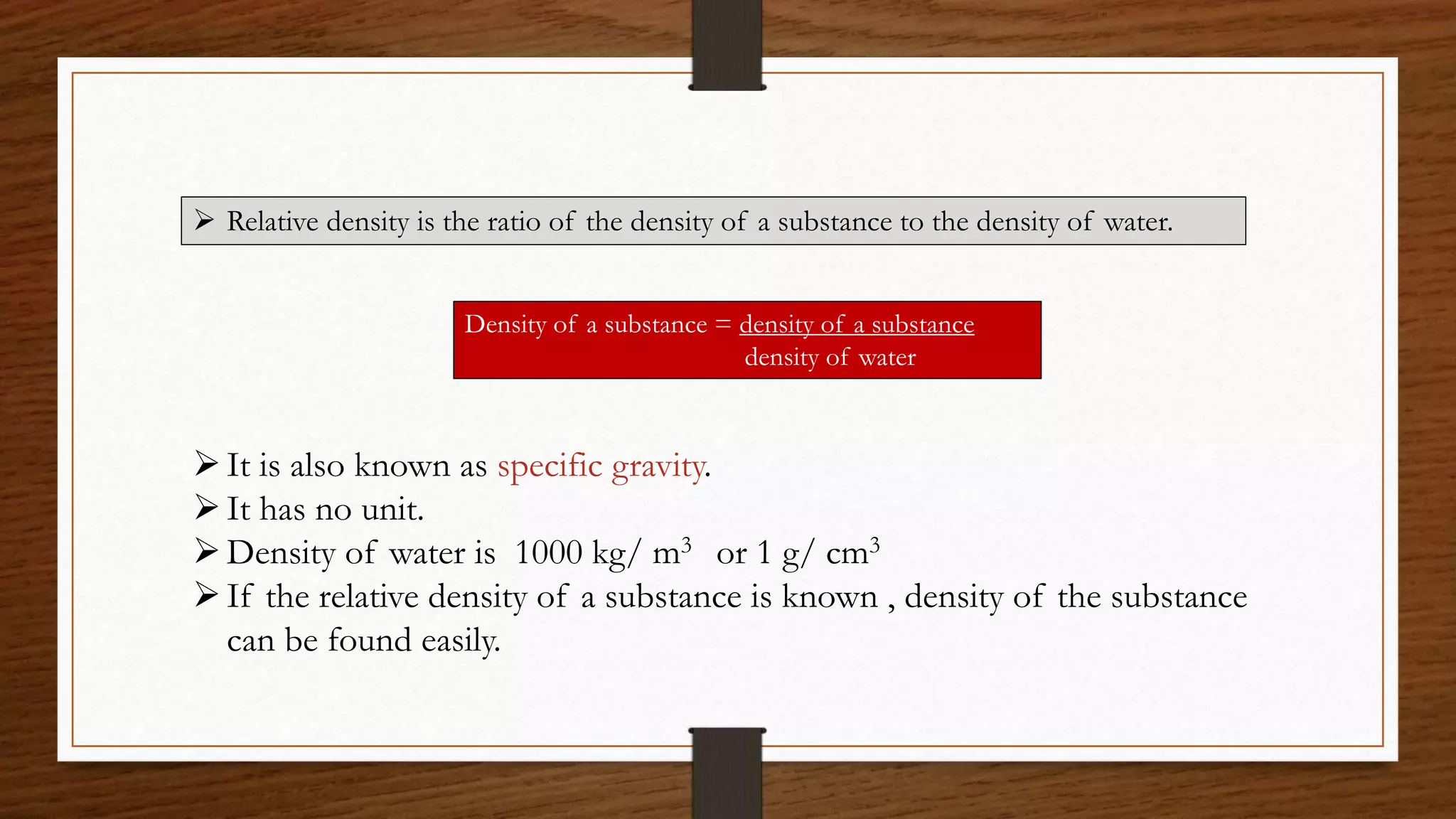
 Relative density is the ratio of the density of a substance to the density of water.
Density of a substance = density of a substance
density of water
It is also known as specific gravity.
It has no unit.
Density of water is 1000 kg/ m3 or 1 g/ cm3
If the relative density of a substance is known , density of the substance
can be found easily.
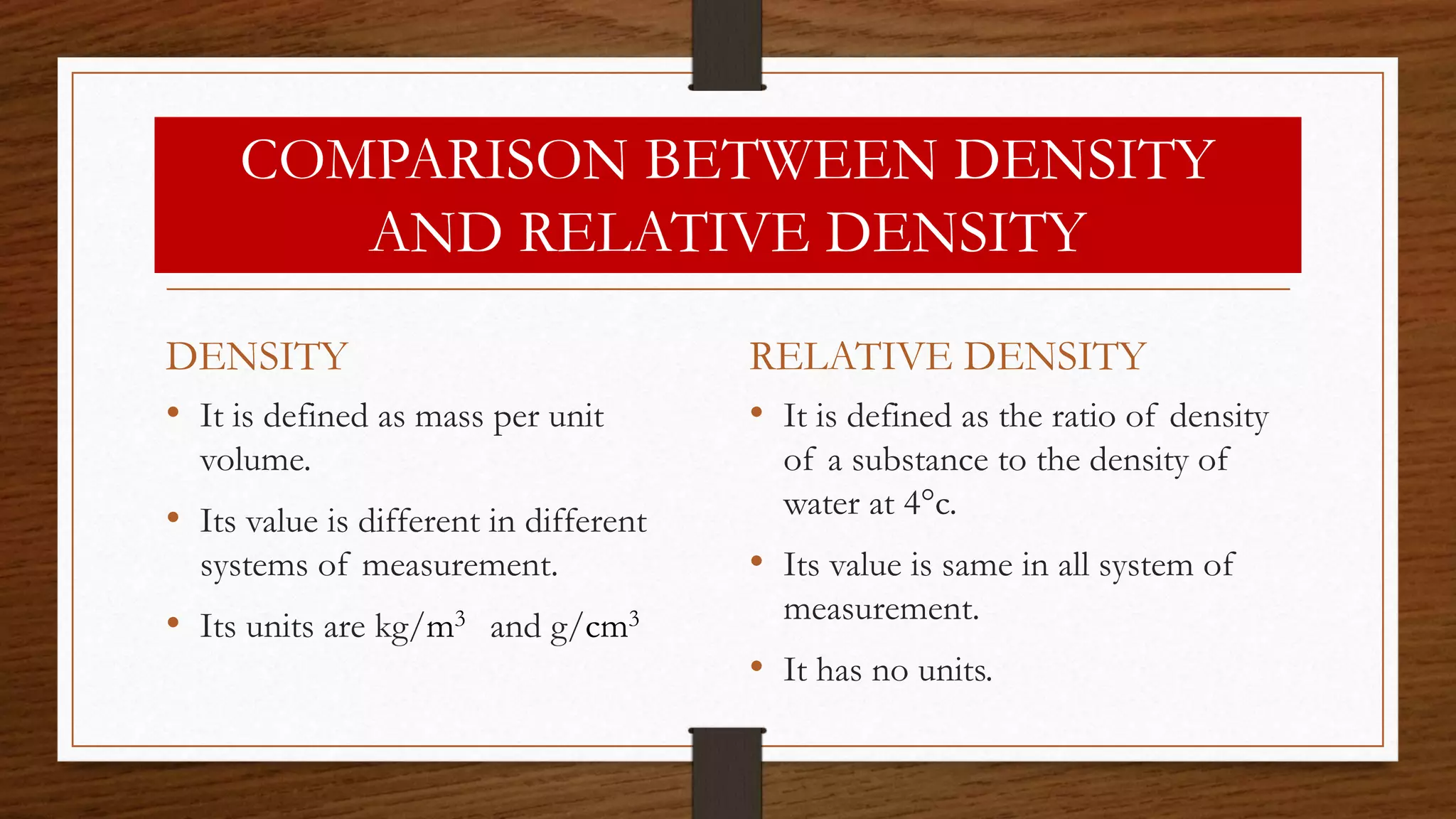
COMPARISON BETWEEN DENSITY
AND RELATIVE DENSITY
DENSITY
• It is defined as mass per unit
volume.
• Its value is different in different
systems of measurement.
• Its units are kg/m3 and g/cm3
RELATIVE DENSITY
• It is defined as the ratio of density
of a substance to the density of
water at 4°c.
• Its value is same in all system of
measurement.
• It has no units.
NUMERICAL PROBLEMS
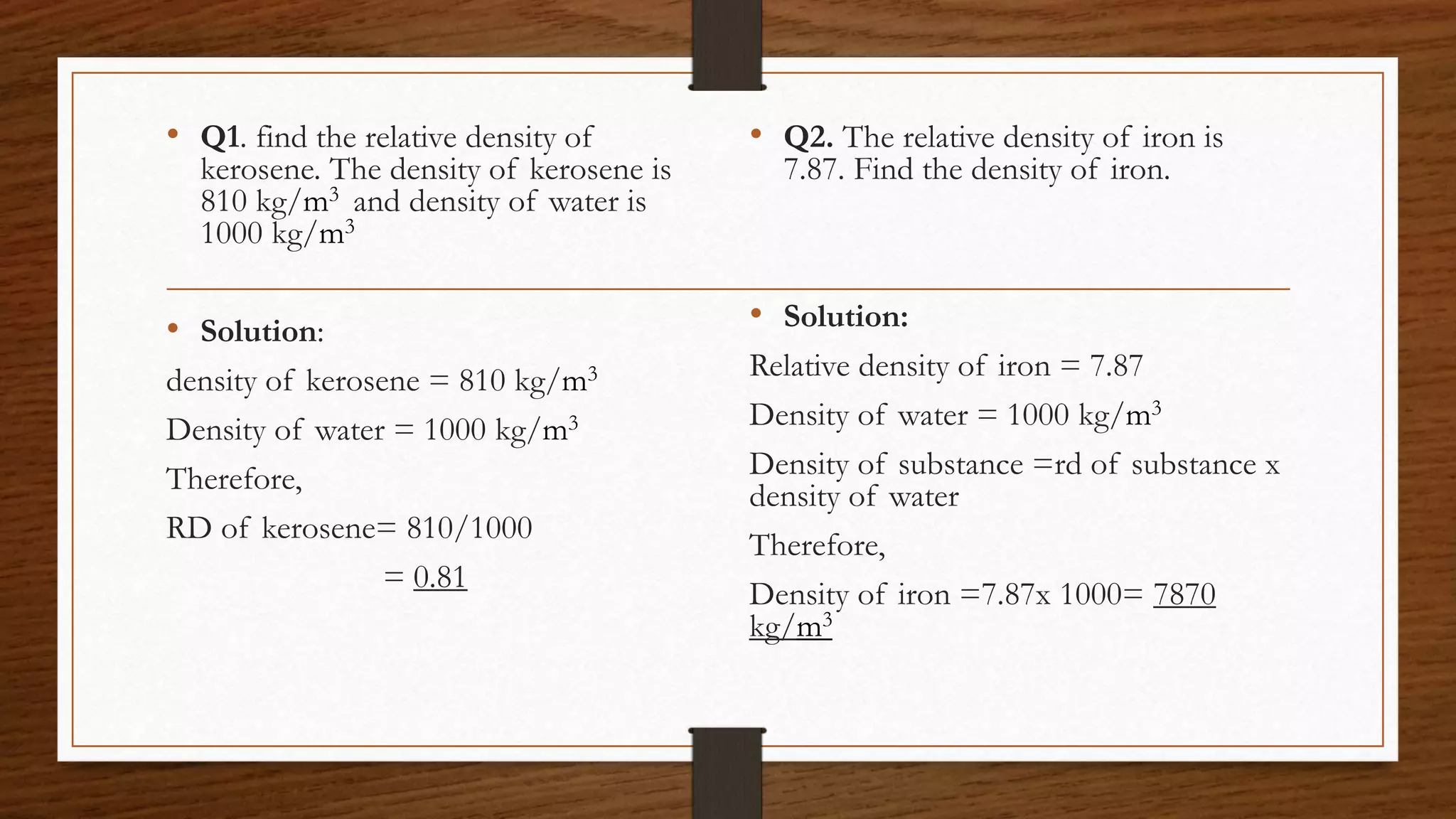
• Q1. find the relative density of
kerosene. The density of kerosene is
810 kg/m3 and density of water is
1000 kg/m3
• Solution:
density of kerosene = 810 kg/m3
Density of water = 1000 kg/m3
Therefore,
RD of kerosene= 810/1000
= 0.81
• Q2. The relative density of iron is
7.87. Find the density of iron.
• Solution:
Relative density of iron = 7.87
Density of water = 1000 kg/m3
Density of substance =rd of substance x
density of water
Therefore,
Density of iron =7.87x 1000= 7870
kg/m3
FLOATING Or SINKING
(based on density)
https://www.youtube.com/watch?v=2dyCe1GPagE
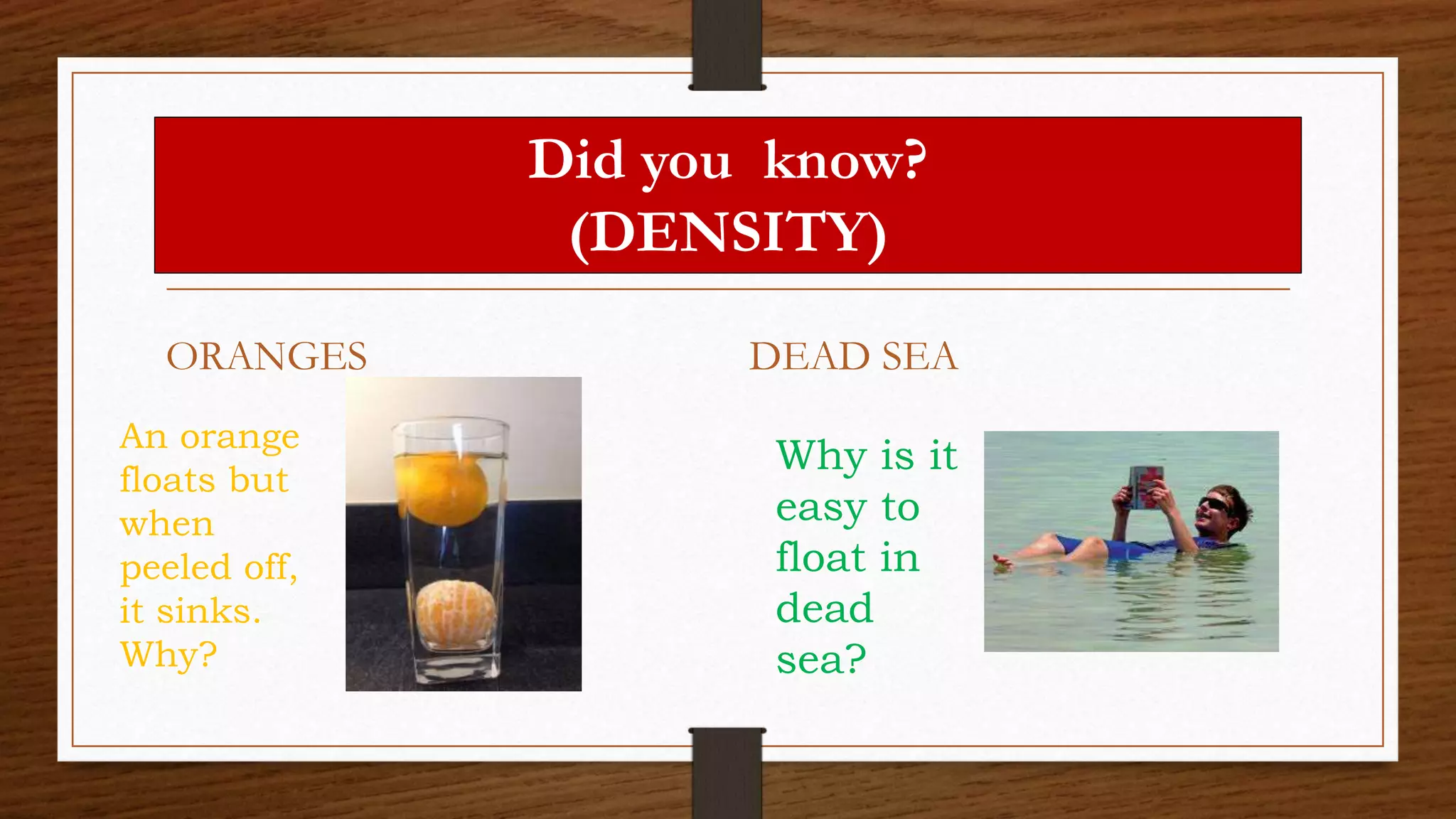
Did you know?
(DENSITY)
ORANGES DEAD SEA
An orange
floats but
when
peeled off,
it sinks.
Why?
Why is it
easy to
float in
dead
sea?
ACTIVITY - 2
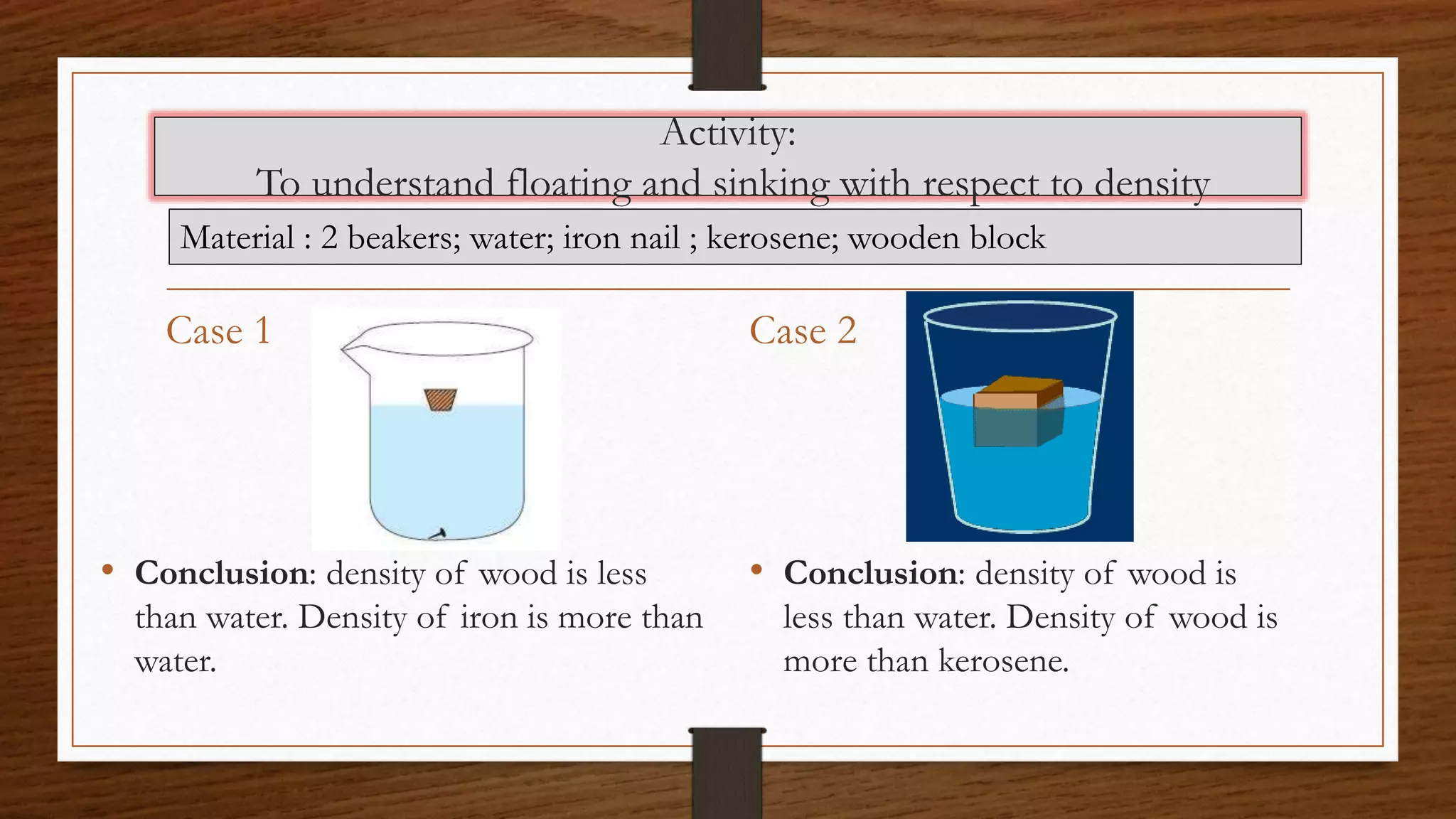
Activity:
To understand floating and sinking with respect to density
Case 1
• Conclusion: density of wood is less
than water. Density of iron is more than
water.
Case 2
• Conclusion: density of wood is
less than water. Density of wood is
more than kerosene.
Material : 2 beakers; water; iron nail ; kerosene; wooden block
ACTIVITY - 3
ACTIVITY:
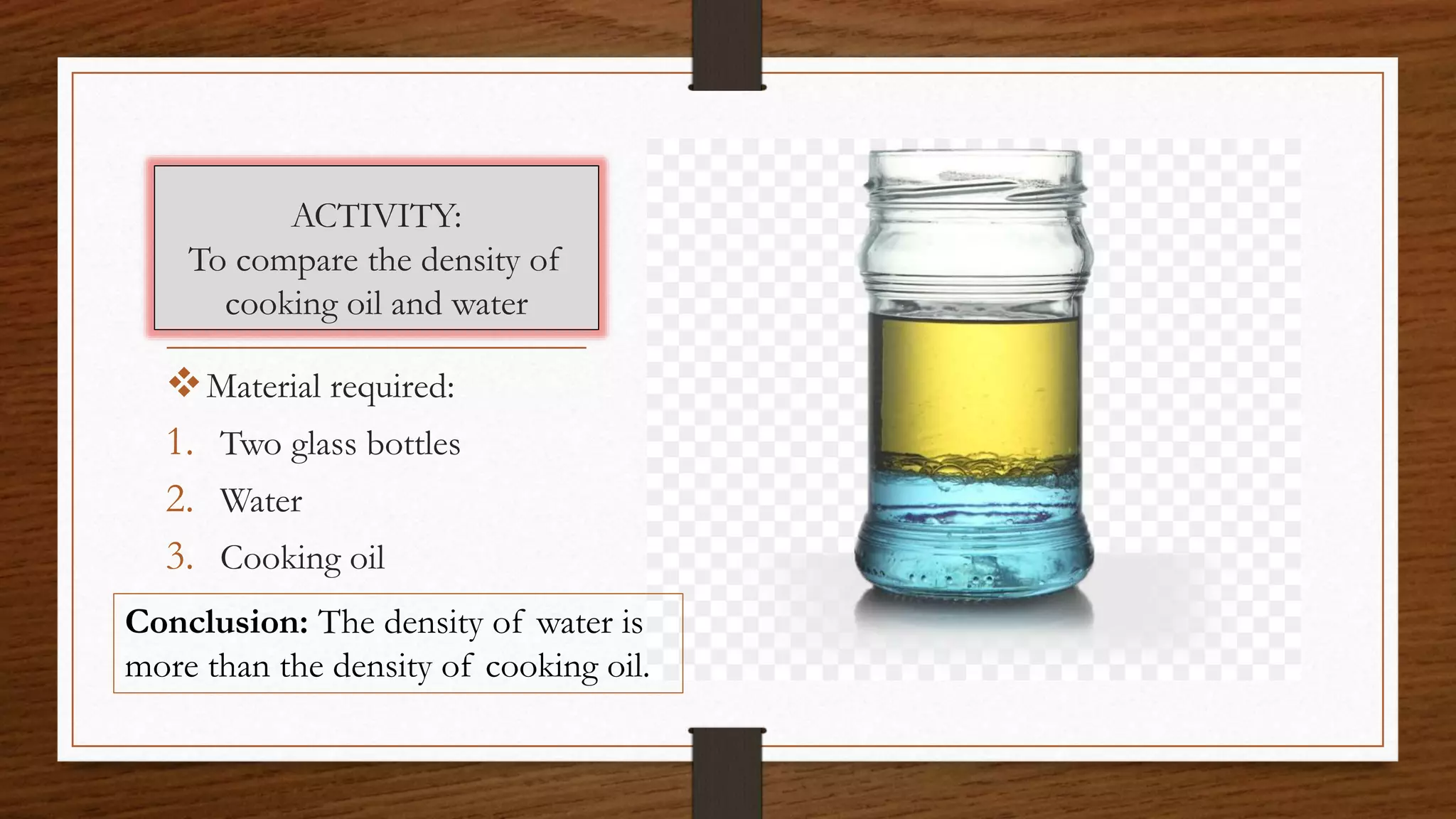
To compare the density of
cooking oil and water
Material required:
1. Two glass bottles
2. Water
3. Cooking oil
Conclusion: The density of water is
more than the density of cooking oil.
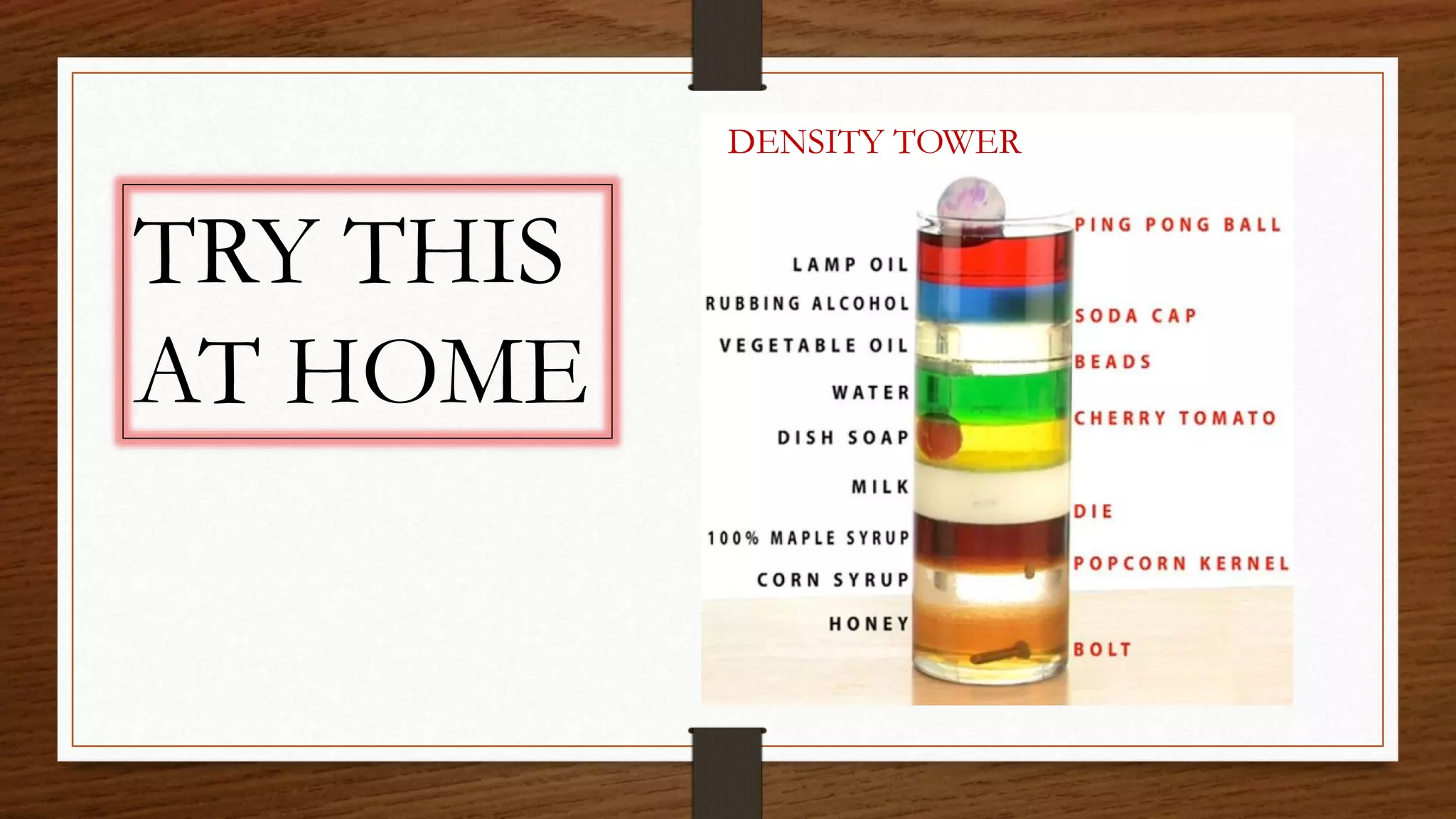
TRY THIS
AT HOME
DENSITY TOWER
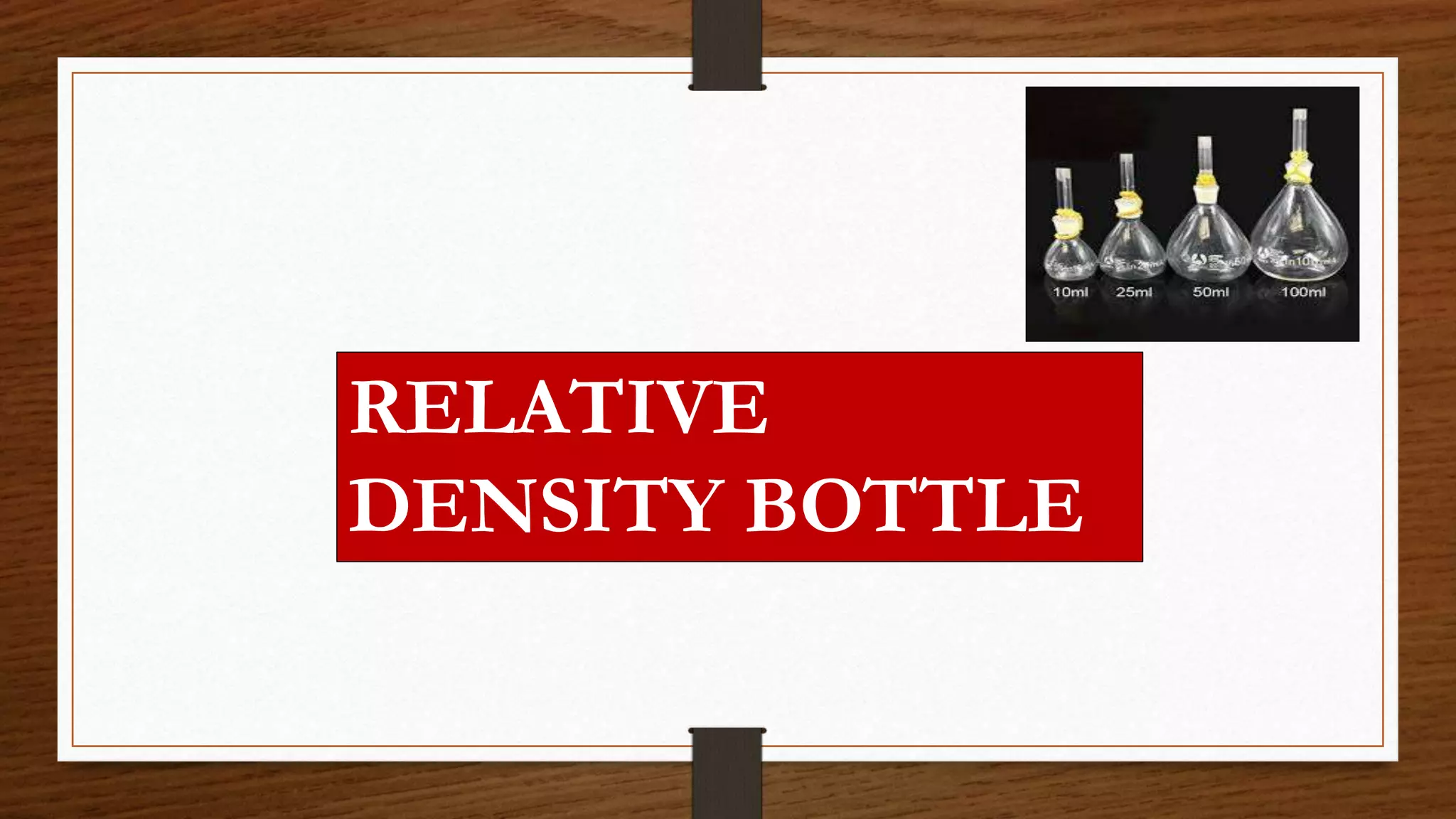
RELATIVE
DENSITY BOTTLE
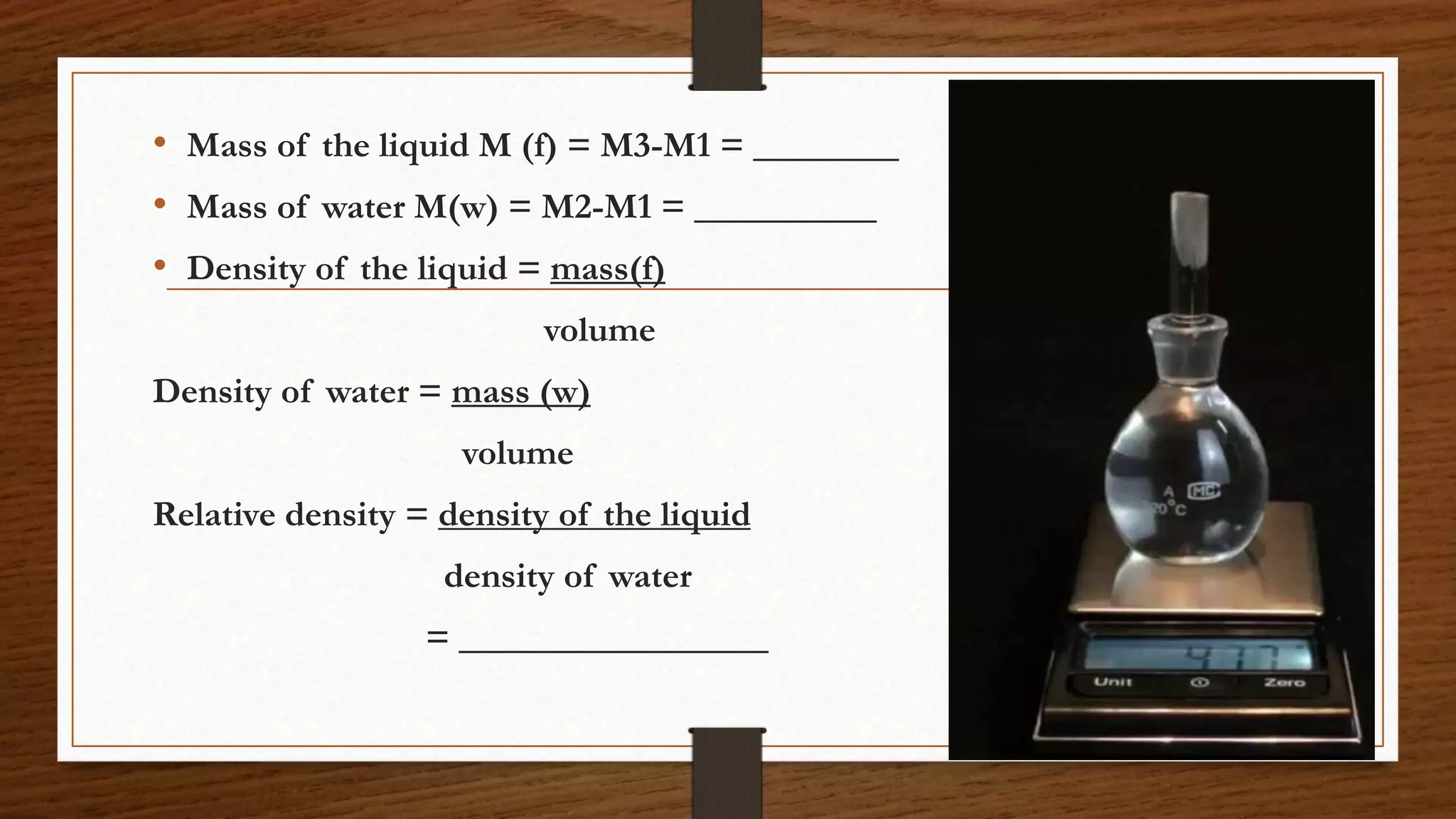
It is a small thin bottle.
Also known as specific gravity bottle.
It is a bottle of fixed capacity
It has a glass stopper with a fine
hole.
Relative density of a liquid can be
found using it.
description
ACTIVITY - 4
(To find the relative density of a liquid usinf a relative density bottle)
• Mass of the liquid M (f) = M3-M1 = ________
• Mass of water M(w) = M2-M1 = __________
• Density of the liquid = mass(f)
volume
Density of water = mass (w)
volume
Relative density = density of the liquid
density of water
= _________________
COMPARISON OF
DENSITIES IN THE THREE
STATES OF MATTER
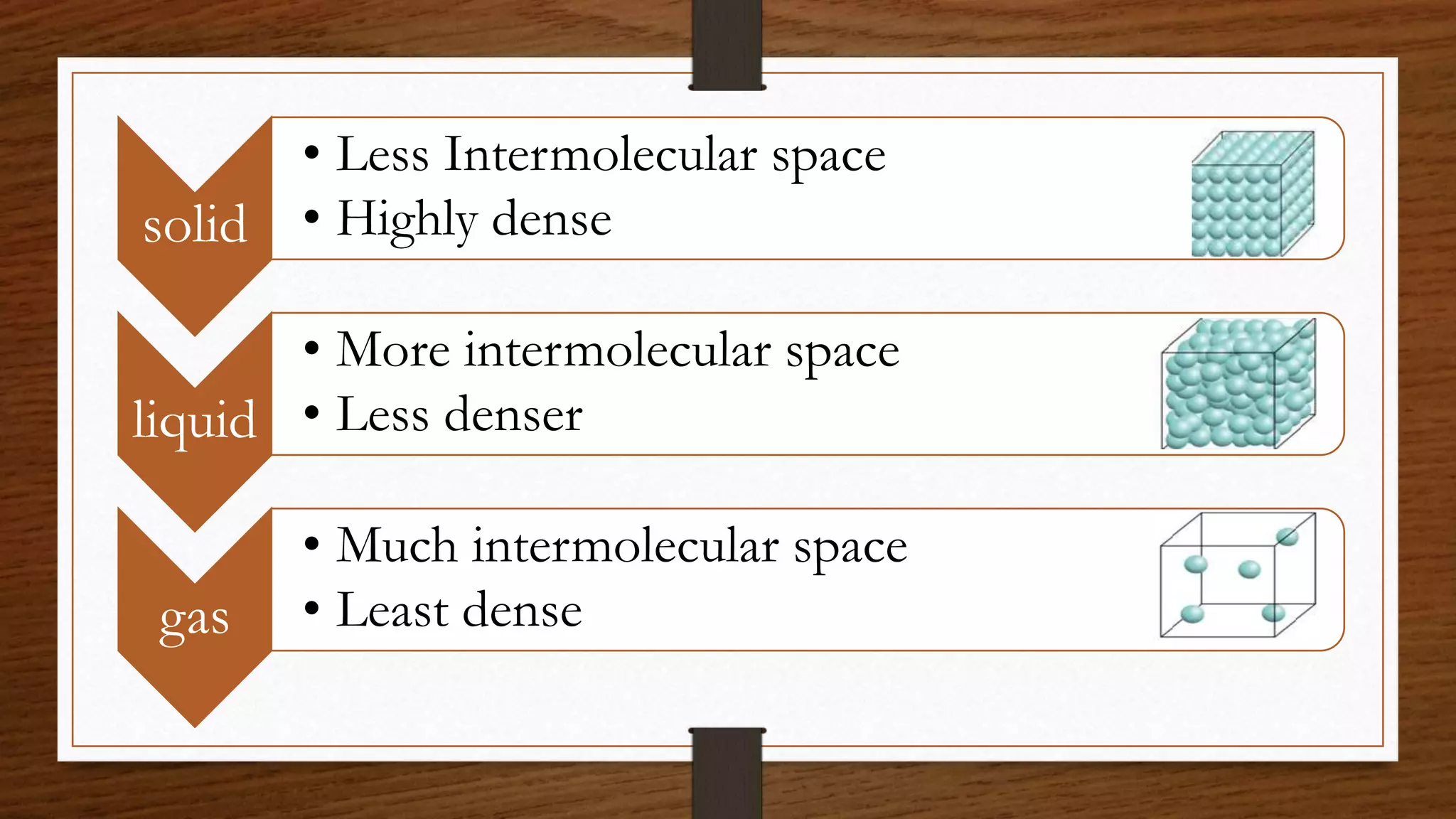
solid
• Less Intermolecular space
• Highly dense
liquid
• More intermolecular space
• Less denser
gas
• Much intermolecular space
• Least dense
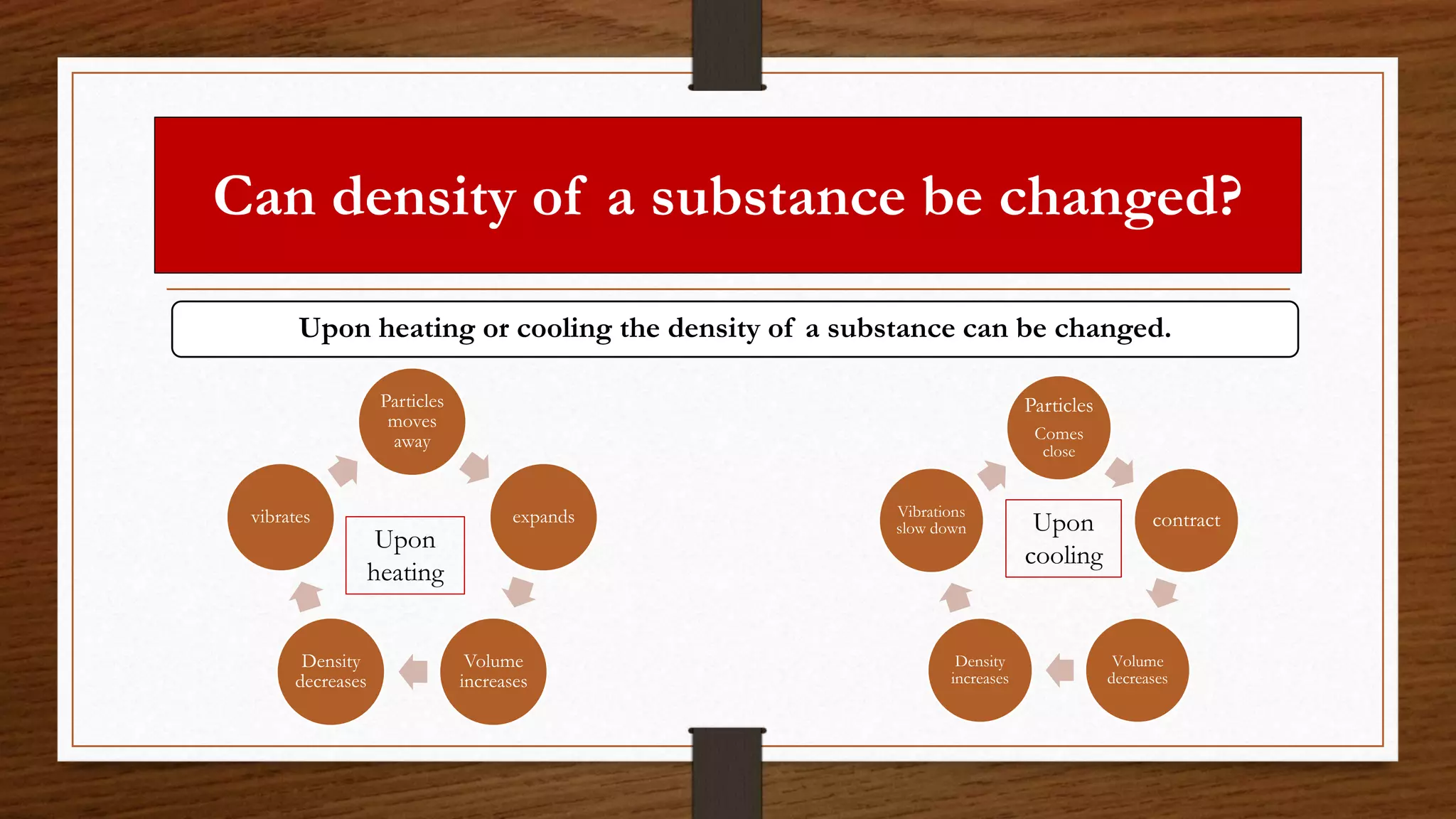
Can density of a substance be changed?
Upon heating or cooling the density of a substance can be changed.
Particles
moves
away
expands
Volume
increases
Density
decreases
vibrates
Particles
Comes
close
contract
Volume
decreases
Density
increases
Vibrations
slow down
Upon
heating
Upon
cooling
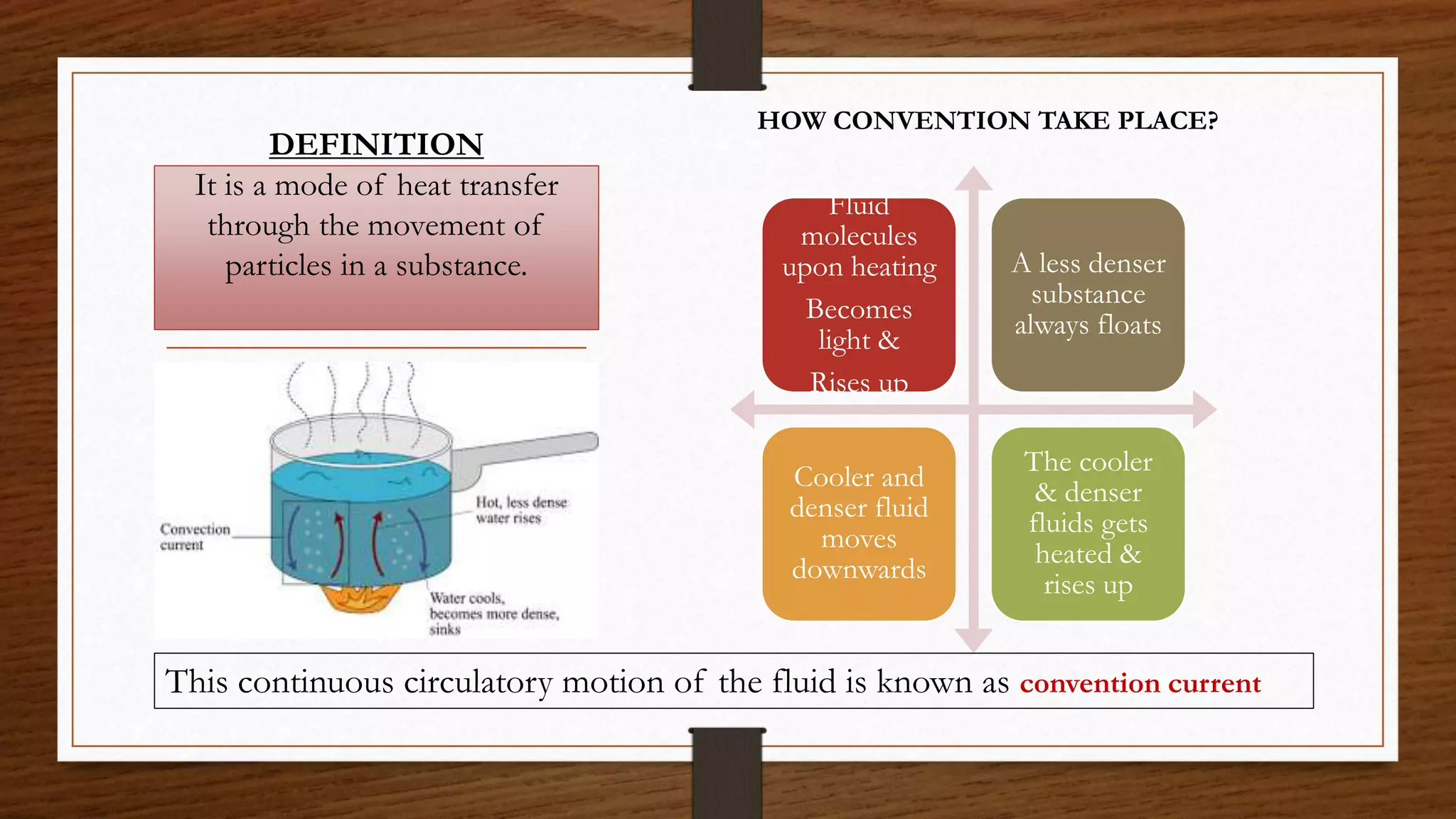
CONVENTION
DEFINITION
It is a mode of heat transfer
through the movement of
particles in a substance.
Fluid
molecules
upon heating
Becomes
light &
Rises up
A less denser
substance
always floats
Cooler and
denser fluid
moves
downwards
The cooler
& denser
fluids gets
heated &
rises up
HOW CONVENTION TAKE PLACE?
This continuous circulatory motion of the fluid is known as convention current
Applications
Room heaters
Land breeze Sea breeze
House ventilators
RECAPTULATION
• The space occupied by a substance is known as volume.
• The capacity of any vessel to accommodate more amount of liquid is called holding
capacity.
• Measuring cylinder, beaker eureka can, etc. are used for measuring volume of liquid.

• Measurement of volume of regularly shaped solid can be found using formula.
• Measurement of volume of irregular solid can be found using eureka can.
• The density of a substance is defined as the mass per unit volume of a substance.
• The relative density is equal to the mass of the given volume of the substance divided by
mass of equal volume of water. This forms the basic principle of working of a density
bottle
EVALUATION
Fill in the blanks
1. The capacity of any vessel to accommodate more amount of liquid is called
its _________.
2. The volume of the solid substances is measured in ________.
3. The substance having density higher than that of water will _______ in
water.
4. Land and sea breeze is an application of ___________.
5. More the density ________ is the intermolecular space in the matter.
ANSWER THE FOLLOWING
1. Describe density.
2. How can we find the volume of an irregular shaped solid?
3. What is density bottle ?
4. What is the formula of relative density?
5. What is convention current?
physical quantities and measurement (part 2)

physical quantities and measurement (part 2)

  • 1.
    PHYSICS CLASS : VIII Chapter-2 PHYSICALQUANTITIES AND MEASUREMENT
  • 2.
    CONCEPTS IN MODULE Density Relative density Floating and Sinking Comparison of Densities in the three states of matter. Numerical problems. Glossary Evaluation
  • 3.
  • 4.
    How can youfind the volume of irregular shaped solids?
  • 5.
    Measurement of volumeof irregular solids can be found using measuring cylinder.
  • 6.
    What do younotice? • Substances having density greater than water sink in it. • Substances having density less than water float in it.
  • 7.
  • 8.
    Density of asubstance • The density of a substance defines the amount of mass it contains in each unit of its volume. • It is the ratio of the mass of the substances (M) to the volume (V) occupied by it. Density D = Mass Volume SI unit of density : kg/m3
  • 9.
    Every body hasa certain mass and definite volume Equal masses of different substances have different volume. • For example volume of cotton is greater than volume of an equal mass of lead. Equal volume of different substances have different masses. • For example Mass of iron is greater than the mass of an equal volume of wood.
  • 10.
    Density of asubstance is independent of its shape or size.  For example, the density of aluminum is 2.7 g/cm3 Thus density of an article moulded into different shapes but made of pure aluminium will be the same.  Density of water is 1 g/ cm3 Similarly, the density of water will be the same even when it is taken in a cup or in bottles of different shapes or sizes.
  • 11.
  • 12.
    To determine thedensity of irregular objects using EUREKA CAN  Take an eureka can and fill it with water.  Tie the solid (weigh it before use) with a string and gradually dip inside the can.  The solid displaces the water which is equal to its volume.  Measure the volume.  Calculate Density = mass/volume
  • 13.
  • 14.
  • 15.
     Relative densityis the ratio of the density of a substance to the density of water. Density of a substance = density of a substance density of water It is also known as specific gravity. It has no unit. Density of water is 1000 kg/ m3 or 1 g/ cm3 If the relative density of a substance is known , density of the substance can be found easily.
  • 16.
    COMPARISON BETWEEN DENSITY ANDRELATIVE DENSITY DENSITY • It is defined as mass per unit volume. • Its value is different in different systems of measurement. • Its units are kg/m3 and g/cm3 RELATIVE DENSITY • It is defined as the ratio of density of a substance to the density of water at 4°c. • Its value is same in all system of measurement. • It has no units.
  • 17.
  • 18.
    • Q1. findthe relative density of kerosene. The density of kerosene is 810 kg/m3 and density of water is 1000 kg/m3 • Solution: density of kerosene = 810 kg/m3 Density of water = 1000 kg/m3 Therefore, RD of kerosene= 810/1000 = 0.81 • Q2. The relative density of iron is 7.87. Find the density of iron. • Solution: Relative density of iron = 7.87 Density of water = 1000 kg/m3 Density of substance =rd of substance x density of water Therefore, Density of iron =7.87x 1000= 7870 kg/m3
  • 19.
    FLOATING Or SINKING (basedon density) https://www.youtube.com/watch?v=2dyCe1GPagE
  • 20.
    Did you know? (DENSITY) ORANGESDEAD SEA An orange floats but when peeled off, it sinks. Why? Why is it easy to float in dead sea?
  • 21.
  • 22.
    Activity: To understand floatingand sinking with respect to density Case 1 • Conclusion: density of wood is less than water. Density of iron is more than water. Case 2 • Conclusion: density of wood is less than water. Density of wood is more than kerosene. Material : 2 beakers; water; iron nail ; kerosene; wooden block
  • 24.
  • 25.
    ACTIVITY: To compare thedensity of cooking oil and water Material required: 1. Two glass bottles 2. Water 3. Cooking oil Conclusion: The density of water is more than the density of cooking oil.
  • 26.
  • 27.
  • 28.
    It is asmall thin bottle. Also known as specific gravity bottle. It is a bottle of fixed capacity It has a glass stopper with a fine hole. Relative density of a liquid can be found using it. description
  • 29.
    ACTIVITY - 4 (Tofind the relative density of a liquid usinf a relative density bottle)
  • 30.
    • Mass ofthe liquid M (f) = M3-M1 = ________ • Mass of water M(w) = M2-M1 = __________ • Density of the liquid = mass(f) volume Density of water = mass (w) volume Relative density = density of the liquid density of water = _________________
  • 31.
    COMPARISON OF DENSITIES INTHE THREE STATES OF MATTER
  • 32.
    solid • Less Intermolecularspace • Highly dense liquid • More intermolecular space • Less denser gas • Much intermolecular space • Least dense
  • 33.
    Can density ofa substance be changed? Upon heating or cooling the density of a substance can be changed. Particles moves away expands Volume increases Density decreases vibrates Particles Comes close contract Volume decreases Density increases Vibrations slow down Upon heating Upon cooling
  • 34.
  • 35.
    DEFINITION It is amode of heat transfer through the movement of particles in a substance. Fluid molecules upon heating Becomes light & Rises up A less denser substance always floats Cooler and denser fluid moves downwards The cooler & denser fluids gets heated & rises up HOW CONVENTION TAKE PLACE? This continuous circulatory motion of the fluid is known as convention current
  • 36.
    Applications Room heaters Land breezeSea breeze House ventilators
  • 37.
    RECAPTULATION • The spaceoccupied by a substance is known as volume. • The capacity of any vessel to accommodate more amount of liquid is called holding capacity. • Measuring cylinder, beaker eureka can, etc. are used for measuring volume of liquid. • Measurement of volume of regularly shaped solid can be found using formula. • Measurement of volume of irregular solid can be found using eureka can. • The density of a substance is defined as the mass per unit volume of a substance. • The relative density is equal to the mass of the given volume of the substance divided by mass of equal volume of water. This forms the basic principle of working of a density bottle
  • 38.
  • 39.
    Fill in theblanks 1. The capacity of any vessel to accommodate more amount of liquid is called its _________. 2. The volume of the solid substances is measured in ________. 3. The substance having density higher than that of water will _______ in water. 4. Land and sea breeze is an application of ___________. 5. More the density ________ is the intermolecular space in the matter.
  • 40.
    ANSWER THE FOLLOWING 1.Describe density. 2. How can we find the volume of an irregular shaped solid? 3. What is density bottle ? 4. What is the formula of relative density? 5. What is convention current?