Moving Bed Biofilm Reactor
MBBR
for Nitrification/Denitrification
By
Corey Bjornberg
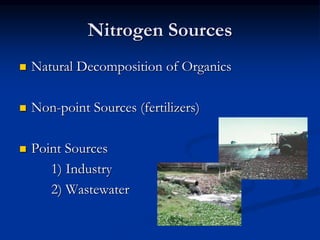
Nitrogen Sources
 Natural Decomposition of Organics
 Non-point Sources (fertilizers)
 Point Sources
1) Industry
2) Wastewater
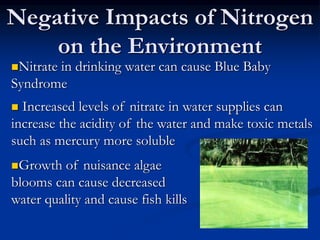
Negative Impacts of Nitrogen
on the Environment
Nitrate in drinking water can cause Blue Baby
Syndrome
 Increased levels of nitrate in water supplies can
increase the acidity of the water and make toxic metals
such as mercury more soluble
Growth of nuisance algae
blooms can cause decreased
water quality and cause fish kills
Nitrification
•Two Step Biological Process
•Aerobic Autotrophic Bacteria
NH4-N oxidized
NO2-N oxidized
NO3-N
NH4-N oxidized
NO2-N (Nitrosomonas)
NO2-N oxidized
NO3-N (Nitrobacter)
•Note these are documented as dominate bacteria but others exist in each step
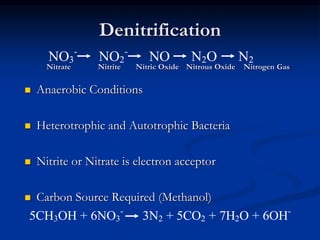
Denitrification
 Anaerobic Conditions
 Heterotrophic and Autotrophic Bacteria
 Nitrite or Nitrate is electron acceptor
 Carbon Source Required (Methanol)
NO3
-
NO2
-
NO N2O N2
Nitrate Nitrite Nitric Oxide Nitrous Oxide Nitrogen Gas
5CH3OH + 6NO3
-
3N2 + 5CO2 + 7H2O + 6OH-
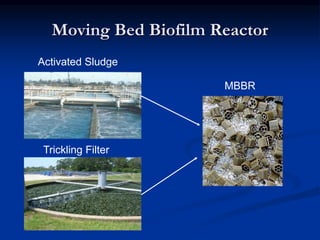
Moving Bed Biofilm Reactor
Activated Sludge
Trickling Filter
MBBR
Advantages of MBBR
 Smaller Footprint
 Utilize whole tank volume for biomass
 Less Sludge Produced (Better Settling)
 No Return Activated Sludge
 Easy Expansion (more media)
 No Media Clogging
 Reliability and Ease of Operation
 Easy to Retrofit Existing Basins
Design Example
Outline
 Nitrogen Removal
 Tertiary Treatment
 Nitrification
 Denitrification
 Municipal
Wastewater
Goals
 Ammonia-N<5 mg/L
 Nitrate-N<5 mg/L
 Total N<15 mg/L
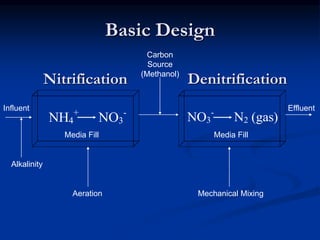
Basic Design
NH4
+
NO3
-
Carbon
Source
(Methanol)
Aeration
Media Fill Media Fill
Mechanical Mixing
Influent Effluent
Nitrification Denitrification
NO3
-
N2 (gas)
Alkalinity
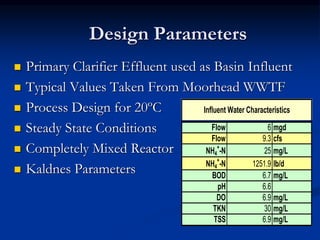
Flow 6 mgd
Flow 9.3 cfs
NH4
+
-N 25 mg/L
NH4
+
-N 1251.9 lb/d
BOD 6.7 mg/L
pH 6.6
DO 6.9 mg/L
TKN 30 mg/L
TSS 6.9 mg/L
Influent Water Characteristics
Design Parameters
 Primary Clarifier Effluent used as Basin Influent
 Typical Values Taken From Moorhead WWTF
 Process Design for 20ºC
 Steady State Conditions
 Completely Mixed Reactor
 Kaldnes Parameters
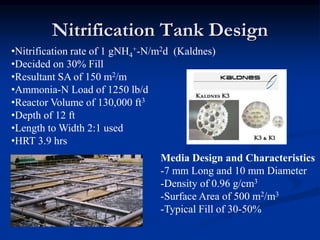
Nitrification Tank Design
•Nitrification rate of 1 gNH4
+-N/m2d (Kaldnes)
•Decided on 30% Fill
•Resultant SA of 150 m2/m
•Ammonia-N Load of 1250 lb/d
•Reactor Volume of 130,000 ft3
•Depth of 12 ft
•Length to Width 2:1 used
•HRT 3.9 hrs
Media Design and Characteristics
-7 mm Long and 10 mm Diameter
-Density of 0.96 g/cm3
-Surface Area of 500 m2/m3
-Typical Fill of 30-50%
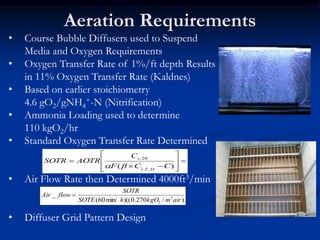
Aeration Requirements
• Course Bubble Diffusers used to Suspend
Media and Oxygen Requirements
• Oxygen Transfer Rate of 1%/ft depth Results
in 11% Oxygen Transfer Rate (Kaldnes)
• Based on earlier stoichiometry
4.6 gO2/gNH4
+-N (Nitrification)
• Ammonia Loading used to determine
110 kgO2/hr
• Standard Oxygen Transfer Rate Determined
• Air Flow Rate then Determined 4000ft3/min
• Diffuser Grid Pattern Design












)
( ,
,
20
,
C
C
F
C
AOTR
SOTR
H
T
s
s


)
/
270
.
0
)((
min/
60
(
_ 3
2 air
m
kgO
h
SOTE
SOTR
flow
Air 
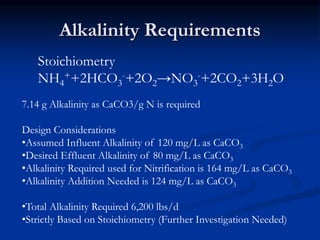
Alkalinity Requirements
Stoichiometry
NH4
++2HCO3
-+2O2→NO3
-+2CO2+3H2O
7.14 g Alkalinity as CaCO3/g N is required
Design Considerations
•Assumed Influent Alkalinity of 120 mg/L as CaCO3
•Desired Effluent Alkalinity of 80 mg/L as CaCO3
•Alkalinity Required used for Nitrification is 164 mg/L as CaCO3
•Alkalinity Addition Needed is 124 mg/L as CaCO3
•Total Alkalinity Required 6,200 lbs/d
•Strictly Based on Stoichiometry (Further Investigation Needed)
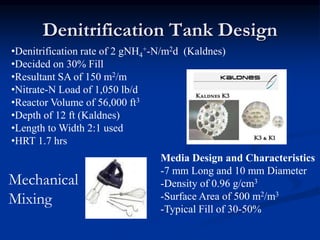
Denitrification Tank Design
•Denitrification rate of 2 gNH4
+-N/m2d (Kaldnes)
•Decided on 30% Fill
•Resultant SA of 150 m2/m
•Nitrate-N Load of 1,050 lb/d
•Reactor Volume of 56,000 ft3
•Depth of 12 ft (Kaldnes)
•Length to Width 2:1 used
•HRT 1.7 hrs
Media Design and Characteristics
-7 mm Long and 10 mm Diameter
-Density of 0.96 g/cm3
-Surface Area of 500 m2/m3
-Typical Fill of 30-50%
Mechanical
Mixing
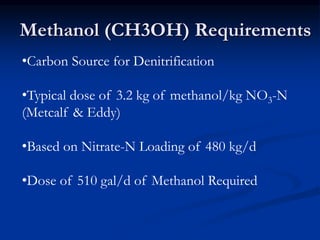
Methanol (CH3OH) Requirements
•Carbon Source for Denitrification
•Typical dose of 3.2 kg of methanol/kg NO3-N
(Metcalf & Eddy)
•Based on Nitrate-N Loading of 480 kg/d
•Dose of 510 gal/d of Methanol Required
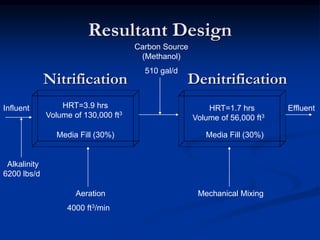
Resultant Design
Carbon Source
(Methanol)
510 gal/d
Aeration
4000 ft3/min
Media Fill (30%) Media Fill (30%)
Mechanical Mixing
Influent Effluent
Nitrification Denitrification
Alkalinity
6200 lbs/d
HRT=3.9 hrs
Volume of 130,000 ft3
HRT=1.7 hrs
Volume of 56,000 ft3
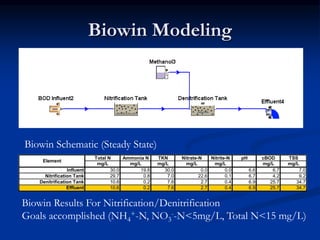
Biowin Modeling
Total N Ammonia N TKN Nitrate-N Nitrite-N pH cBOD TSS
mg/L mg/L mg/L mg/L mg/L mg/L mg/L
30.0 19.8 30.0 0.0 0.0 6.6 6.7 7.0
29.7 0.8 7.0 22.6 0.1 6.7 4.2 9.2
10.6 0.2 7.6 2.7 0.4 6.9 25.7 34.7
10.6 0.2 7.6 2.7 0.4 6.9 25.7 34.7
Element
Influent
Nitrification Tank
Denitrification Tank
Effluent
Biowin Schematic (Steady State)
Biowin Results For Nitrification/Denitrification
Goals accomplished (NH4
+-N, NO3
--N<5mg/L, Total N<15 mg/L)
Other Considerations
•Simultaneous Removal of Carbon and Nitrogen
•Sedimentation Tank due to Increased Solids
•More Detailed Design for Alkalinity
•Ability to Utilize Existing Infrastructure
•Variable Temperature, Flow, and Loading Conditions
Thank You!
Questions???

Denitrification.ppt

  • 1.
    Moving Bed BiofilmReactor MBBR for Nitrification/Denitrification By Corey Bjornberg
  • 2.
    Nitrogen Sources  NaturalDecomposition of Organics  Non-point Sources (fertilizers)  Point Sources 1) Industry 2) Wastewater
  • 3.
    Negative Impacts ofNitrogen on the Environment Nitrate in drinking water can cause Blue Baby Syndrome  Increased levels of nitrate in water supplies can increase the acidity of the water and make toxic metals such as mercury more soluble Growth of nuisance algae blooms can cause decreased water quality and cause fish kills
  • 4.
    Nitrification •Two Step BiologicalProcess •Aerobic Autotrophic Bacteria NH4-N oxidized NO2-N oxidized NO3-N NH4-N oxidized NO2-N (Nitrosomonas) NO2-N oxidized NO3-N (Nitrobacter) •Note these are documented as dominate bacteria but others exist in each step
  • 5.
    Denitrification  Anaerobic Conditions Heterotrophic and Autotrophic Bacteria  Nitrite or Nitrate is electron acceptor  Carbon Source Required (Methanol) NO3 - NO2 - NO N2O N2 Nitrate Nitrite Nitric Oxide Nitrous Oxide Nitrogen Gas 5CH3OH + 6NO3 - 3N2 + 5CO2 + 7H2O + 6OH-
  • 6.
    Moving Bed BiofilmReactor Activated Sludge Trickling Filter MBBR
  • 7.
    Advantages of MBBR Smaller Footprint  Utilize whole tank volume for biomass  Less Sludge Produced (Better Settling)  No Return Activated Sludge  Easy Expansion (more media)  No Media Clogging  Reliability and Ease of Operation  Easy to Retrofit Existing Basins
  • 8.
    Design Example Outline  NitrogenRemoval  Tertiary Treatment  Nitrification  Denitrification  Municipal Wastewater Goals  Ammonia-N<5 mg/L  Nitrate-N<5 mg/L  Total N<15 mg/L
  • 9.
    Basic Design NH4 + NO3 - Carbon Source (Methanol) Aeration Media FillMedia Fill Mechanical Mixing Influent Effluent Nitrification Denitrification NO3 - N2 (gas) Alkalinity
  • 10.
    Flow 6 mgd Flow9.3 cfs NH4 + -N 25 mg/L NH4 + -N 1251.9 lb/d BOD 6.7 mg/L pH 6.6 DO 6.9 mg/L TKN 30 mg/L TSS 6.9 mg/L Influent Water Characteristics Design Parameters  Primary Clarifier Effluent used as Basin Influent  Typical Values Taken From Moorhead WWTF  Process Design for 20ºC  Steady State Conditions  Completely Mixed Reactor  Kaldnes Parameters
  • 11.
    Nitrification Tank Design •Nitrificationrate of 1 gNH4 +-N/m2d (Kaldnes) •Decided on 30% Fill •Resultant SA of 150 m2/m •Ammonia-N Load of 1250 lb/d •Reactor Volume of 130,000 ft3 •Depth of 12 ft •Length to Width 2:1 used •HRT 3.9 hrs Media Design and Characteristics -7 mm Long and 10 mm Diameter -Density of 0.96 g/cm3 -Surface Area of 500 m2/m3 -Typical Fill of 30-50%
  • 12.
    Aeration Requirements • CourseBubble Diffusers used to Suspend Media and Oxygen Requirements • Oxygen Transfer Rate of 1%/ft depth Results in 11% Oxygen Transfer Rate (Kaldnes) • Based on earlier stoichiometry 4.6 gO2/gNH4 +-N (Nitrification) • Ammonia Loading used to determine 110 kgO2/hr • Standard Oxygen Transfer Rate Determined • Air Flow Rate then Determined 4000ft3/min • Diffuser Grid Pattern Design             ) ( , , 20 , C C F C AOTR SOTR H T s s   ) / 270 . 0 )(( min/ 60 ( _ 3 2 air m kgO h SOTE SOTR flow Air 
  • 13.
    Alkalinity Requirements Stoichiometry NH4 ++2HCO3 -+2O2→NO3 -+2CO2+3H2O 7.14 gAlkalinity as CaCO3/g N is required Design Considerations •Assumed Influent Alkalinity of 120 mg/L as CaCO3 •Desired Effluent Alkalinity of 80 mg/L as CaCO3 •Alkalinity Required used for Nitrification is 164 mg/L as CaCO3 •Alkalinity Addition Needed is 124 mg/L as CaCO3 •Total Alkalinity Required 6,200 lbs/d •Strictly Based on Stoichiometry (Further Investigation Needed)
  • 14.
    Denitrification Tank Design •Denitrificationrate of 2 gNH4 +-N/m2d (Kaldnes) •Decided on 30% Fill •Resultant SA of 150 m2/m •Nitrate-N Load of 1,050 lb/d •Reactor Volume of 56,000 ft3 •Depth of 12 ft (Kaldnes) •Length to Width 2:1 used •HRT 1.7 hrs Media Design and Characteristics -7 mm Long and 10 mm Diameter -Density of 0.96 g/cm3 -Surface Area of 500 m2/m3 -Typical Fill of 30-50% Mechanical Mixing
  • 15.
    Methanol (CH3OH) Requirements •CarbonSource for Denitrification •Typical dose of 3.2 kg of methanol/kg NO3-N (Metcalf & Eddy) •Based on Nitrate-N Loading of 480 kg/d •Dose of 510 gal/d of Methanol Required
  • 16.
    Resultant Design Carbon Source (Methanol) 510gal/d Aeration 4000 ft3/min Media Fill (30%) Media Fill (30%) Mechanical Mixing Influent Effluent Nitrification Denitrification Alkalinity 6200 lbs/d HRT=3.9 hrs Volume of 130,000 ft3 HRT=1.7 hrs Volume of 56,000 ft3
  • 17.
    Biowin Modeling Total NAmmonia N TKN Nitrate-N Nitrite-N pH cBOD TSS mg/L mg/L mg/L mg/L mg/L mg/L mg/L 30.0 19.8 30.0 0.0 0.0 6.6 6.7 7.0 29.7 0.8 7.0 22.6 0.1 6.7 4.2 9.2 10.6 0.2 7.6 2.7 0.4 6.9 25.7 34.7 10.6 0.2 7.6 2.7 0.4 6.9 25.7 34.7 Element Influent Nitrification Tank Denitrification Tank Effluent Biowin Schematic (Steady State) Biowin Results For Nitrification/Denitrification Goals accomplished (NH4 +-N, NO3 --N<5mg/L, Total N<15 mg/L)
  • 18.
    Other Considerations •Simultaneous Removalof Carbon and Nitrogen •Sedimentation Tank due to Increased Solids •More Detailed Design for Alkalinity •Ability to Utilize Existing Infrastructure •Variable Temperature, Flow, and Loading Conditions
  • 19.