Assessing and enhancing the
      public value of telehealthcare

            Masterclass - Imperial College London

                       September 17, 2009


24-Sep-09               D. Protti - University of Victoria   1
A plethora of terminologies and
                      viewpoints
    Telehealthcare
    Telehealth
    Telemedicine
    Telecare
    Telemonitoring
    Telematics
    Tele…. etc.
    eHealth
    mHealth
24-Sep-09              D. Protti - University of Victoria   2
Cochrane review definition
    'Telehealthcare' has the following elements (adapted
     from Miller 2007):
       Information from the patient whether voice, video,
        other audio, electrocardiography, oxygen saturation or
        other.
       Electronic transfer of such information over a distance.
       There is personalised patient feedback from a
        healthcare professional who exercises their skills and
        judgement.
    Interventions captured within the terms telehealthcare
     include both synchronous and asynchronous (store and
     forward) technologies.’

24-Sep-09                  D. Protti - University of Victoria      3
EUROPEAN COMMISSION WORKING PAPER

    Telemedicine is the provision of a healthcare service to a
     patient in situations where the patient and the health
     professional (or two health professionals cooperating on
     a specific patient) are not in the same location.
    It involves secure transmission of medical data and
     information, such as biological/physiological
     measurements, alerts, images, audio, video, or any
     other type of data needed for prevention, diagnosis,
     treatment and follow-up monitoring of patients.
                Telemedicine for the benefit of patients, healthcare systems and society
                                     EUROPEAN COMMISSION STAFF WORKING PAPER
                                                                      SEC(2009)943 final
                                                                              June 2009


24-Sep-09                        D. Protti - University of Victoria                    4
Definition of Telemedicine
• Telemedicine (or telehealth)
    - Delivery of healthcare services when the clinician and patient
      are at different locations
    - Data, images, audio, video
    - Excludes tele-education
    - Excludes CPR, EMR, HIE and phone calls
• Telemedicine covers five healthcare processes
    - Monitoring
    - Diagnosis
    - Triage
    - Consultation
    - Procedure
• Telemedicine is part of telecare: patient safety at home
    - Fall detectors, bed monitors, panic alarms
e-Health - Definitions
       Claudia Pagliari and colleagues
        e-Health is an emerging field of medical
        informatics, referring to the organisation and
        delivery of health services and information using the
        Internet and related technologies. In a broader
        sense, the term characterizes not only a technical
        development, but also a new way of working, an
        attitude, and a commitment for networked, global
        thinking, to improve health care locally, regionally,
        and worldwide by using information and
        communication technology.

24-Sep-09                  D. Protti - University of Victoria   6
A new term has entered the arena
    Mobile health (mHealth) is a recently coined term,
     largely defined as health practice supported by mobile
     devices.
       Mobile health practice includes public health, clinical
        medicine, and self-monitoring supported by mobile
        phones and personal digital assistants (PDAs).
    Currently active mobile health applications include the
     use of PDAs in collecting community health data; using
     the mobile phone to deliver health care information to
     practitioners, patients, and non-patients; and real-time
     monitoring for citizens, both patients and non-patients.


24-Sep-09                 D. Protti - University of Victoria      7
Health Informatics, eHealth, TeleHealth, etc.

    It is really all about the use of Information
     and Communications Technologies (ICT)
     in health and health care delivery to
     support the decision making needs of
     individuals, their supporters, and their
     clinicians.


24-Sep-09            D. Protti - University of Victoria   8
Assessing
   the value of
    telehealth?


First the good news


 24-Sep-09       D. Protti - University of Victoria   9
 Edinburgh City Council has announced it is to spend almost
  £1m on telecare this year, more than doubling the amount it
  has spent in previous years.
    Edinburgh launched its telecare programme in 2006 and
      has invested an average of £400,000 over the past three
      years with more than 700 people on the existing telecare
      programme.
 The latest plans will mean 1500 people will be supported to
  live in their own homes and 700 carers supported in caring for
  relatives using telecare systems.
    The Council estimated that its cash injection would save an
     estimated 3,000 hospital bed days and 3,000 care home days
     per year.
                                                           Edinburgh to invest £1m in telecare
                                                                 Ehealth Insider, 17 Aug 2009

24-Sep-09                 D. Protti - University of Victoria                                10
    In August 1996, Norway became the first
     country to implement an official telemedicine fee
     schedule making telemedicine services
     reimbursable by the national health insurer.
           Telemedicine is widely used in Northern Norway which is
            characterized by a scattered population and a scarcity of health
            service specialists, most of whom are in Tromsø.
    Since the late 1980’s, Norway has had
     experience in a wide range of areas including:
     teleradiology, telecare, telepsychiatry, and the
     electronic delivery of laboratory results.


24-Sep-09                        D. Protti - University of Victoria            11
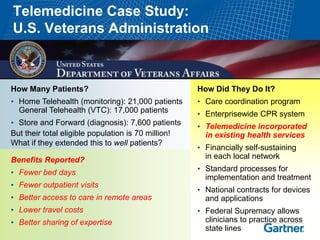
Telemedicine Case Study:
U.S. Veterans Administration


How Many Patients?                                   How Did They Do It?
• Home Telehealth (monitoring): 21,000 patients      • Care coordination program
  General Telehealth (VTC): 17,000 patients          • Enterprisewide CPR system
• Store and Forward (diagnosis): 7,600 patients      • Telemedicine incorporated
But their total eligible population is 70 million!     in existing health services
What if they extended this to well patients?
                                                     • Financially self-sustaining
Benefits Reported?                                     in each local network

• Fewer bed days                                     • Standard processes for
                                                       implementation and treatment
• Fewer outpatient visits
                                                     • National contracts for devices
• Better access to care in remote areas                and applications
• Lower travel costs                                 • Federal Supremacy allows
• Better sharing of expertise                          clinicians to practice across
                                                       state lines
Assessing
 the value of
  telehealth

             The less
            good news


24-Sep-09               D. Protti - University of Victoria   13
    Telehealth has great potential to improve
     access to care but its adoption in routine
     health care has been slow. The lack of
     clarity about the value of telehealth
     implementations has been one reason
     cited for this slow adoption.
                                                                   Cusack CM et al.
                           The value proposition in the widespread use of telehealth
                                         Journal of Telemedicine and Telecare 2008


24-Sep-09           D. Protti - University of Victoria                            14
    A recent Manhattan Research survey found that 39% of doctors
     said they have communicated with patients online, up from 31%
     in 2007 and 19% in 2003.
       However, a survey of Rhode Island physicians and electronic
         health record software vendors found little use in the state of
            readily available online tools and a general reluctance among
            doctors to adopt such tools.
 A large percentage of the state's doctors treat older patients,
  and "people believe that our aging population can't connect with
  that."
 No health insurance companies in the state are paying for online
  patient communication and that doctors are reluctant to take on
  work they will not be reimbursed for.
 Liability issues also deter doctors in the state from
  communicating online with patients.
                             Rhode Island Doctors Reluctant To Embrace Online Communication
                                                                   Providence Business News
                                                                                July 27, 2009


24-Sep-09                        D. Protti - University of Victoria                        15
The Business Case for Telemedicine
• The evidence base for telemedicine is weak
   - AHRQ study
      • Store-and-forward services: "the evidence for their efficacy is mixed"
      • Home monitoring: "required additional resources and dedicated staff"
      • VTC: "most effective for verbal interactions"
   - JAMIA study
      •   Effects on patients' conditions: inconclusive
      •   Patient compliance is high
      •   Effect on resource utilization is mixed
      •   Minimal evidence of economic benefit
• The current evidence emphasizes
    • soft benefits (quality, patient satisfaction, access)
    • indirect economic benefits
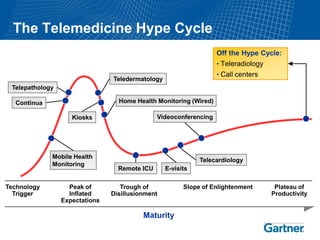
The Telemedicine Hype Cycle
                                                                   Off the Hype Cycle:
                                                                   • Teleradiology
                                                                   • Call centers
                                Teledermatology
 Telepathology

  Continua                        Home Health Monitoring (Wired)

                    Kiosks                     Videoconferencing


             Mobile Health
                                                             Telecardiology
             Monitoring
                                  Remote ICU      E-visits

Technology         Peak of         Trough of            Slope of Enlightenment        Plateau of
  Trigger          Inflated     Disillusionment                                      Productivity
                 Expectations

                                          Maturity
Enhancing
the value
    of
telehealth


24-Sep-09    D. Protti - University of Victoria   18
How Gartner Evaluates
Telemedicine Applications
• Adoption and Readiness                  • Potential Impact
  for Adoption                              - Potential financial impact
  - Market penetration                         • How much money will it save for
     • What percentage of care delivery          patients, providers and payers?
       organizations in North America       - Potential clinical impact
       and Western Europe are using            • Will the application help clinicians
       this application?                         provide better quality care?
  - Patient readiness
     • Will patients want to use
       the application?                   • Time to Value
  - Clinician readiness                     - How soon is the application likely
     • Will clinicians want to use it?        to provide a return on investment?
  - Market readiness
     • Will payers want to pay for it?
  - Technological readiness
     • Is the application experimental
       or mature?
  - Vendor maturity
     • Is it sold by start-up companies
       or well-established vendors?
Remote Monitoring:
Great Potential but Minimal Usage
                         Market        Potential   Potential   Patient     Market      Technological   Vendor
                         penetration   financial   clinical    readiness   readiness   readiness       maturity
                                       impact      impact


Home health monitoring   <1%           Very high   Very high   Very high   Low         Moderate        Low


Remote ICU               <1%           High        High        High        Moderate    Moderate        Moderate
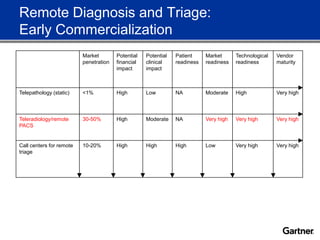
Remote Diagnosis and Triage:
Early Commercialization
                          Market        Potential   Potential   Patient     Market      Technological   Vendor
                          penetration   financial   clinical    readiness   readiness   readiness       maturity
                                        impact      impact


Telepathology (static)    <1%           High        Low         NA          Moderate    High            Very high


Teleradiology/remote      30-50%        High        Moderate    NA          Very high   Very high       Very high
PACS


Call centers for remote   10-20%        High        High        High        Low         Very high       Very high
triage
Remote Consultation and Procedure:
Beware the Hype!
                    Market        Potential   Potential   Patient     Market      Technological   Vendor
                    penetration   financial   clinical    readiness   readiness   readiness       maturity
                                  impact      impact


E-visits            <1%           High        Moderate    Very high   Moderate    Moderate        Moderate


Videoconferencing   1-5%          High        Moderate    High        Moderate    Moderate        Moderate


Telesurgery         0%            Low         Low         Very low    Very low    Low             Very low
Adoption, Impact and Time to Value
High
                                                                  Teleradiology
                                           Call Centers


                             Standard                             Essential
Current Adoption


                                                                                                 Time to Value
                                                                                                 Short
                                      Telecard. Services         Video teleconferencing          Medium
                                                                    E-visits                     Long
                    Telepath. (static)
                                            Telederma-
                                               tology
                                                           Transformational
                   Nice to Have                                      Home Health
                                                                    Monitoring (wired)
                                                 Remote ICU
Low                      Clinical Kiosks                   Mobile Health Monitoring
                   Low                                                                    High
                                           Potential Impact
Conclusion


24-Sep-09    D. Protti - University of Victoria   24
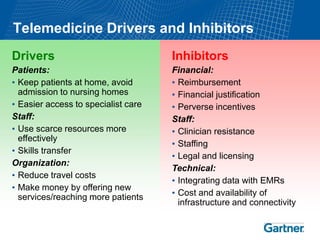
Telemedicine Drivers and Inhibitors
Drivers                              Inhibitors
Patients:                            Financial:
• Keep patients at home, avoid       • Reimbursement
  admission to nursing homes         • Financial justification
• Easier access to specialist care   • Perverse incentives
Staff:                               Staff:
• Use scarce resources more          • Clinician resistance
  effectively
                                     • Staffing
• Skills transfer
                                     • Legal and licensing
Organization:
                                     Technical:
• Reduce travel costs
                                     • Integrating data with EMRs
• Make money by offering new
  services/reaching more patients    • Cost and availability of
                                       infrastructure and connectivity
EUROPEAN COMMISSION WORKING PAPER

Barriers to the wider deployment of telemedicine

1. Confidence in and acceptance of telemedicine
   services
           Telemedicine changes traditional working methods and brings
            new ways of practising medicine and delivering care.
           New roles for health professionals, new skills and new actors
            (e.g. telemedicine call centres) appear in the process of
            healthcare delivery.
           Understanding and implementing these changes in an
            acceptable and coherent manner is essential to enable wider
            deployment.


24-Sep-09                        D. Protti - University of Victoria         26
EUROPEAN COMMISSION STAFF WORKING PAPER

2. Legal clarity
           Typical examples of the legal obstacles that wider
            deployment of telemedicine is facing are the need for
            physicians to be registered in all EU countries where they
            are providing services via telemedicine (e.g. interpretation
         of radiographs received via teleradiology), or the legal
         requirement for all medical acts to be carried out in the
         physical and simultaneous presence of the health
         professional and patient.
        By not recognising telemedicine services specifically (the
         definition of healthcare services often does not include the
         concept of “at a distance”), most Member States
         discourage its wider use.

24-Sep-09                       D. Protti - University of Victoria     27
EUROPEAN COMMISSION STAFF WORKING PAPER

3. Technical issues and facilitating market deployment
           Issues linked to infrastructure, such as access to broadband and
            the ability for the provider to enable full connectivity across the
            European territory from urban, highly-populated areas to
            remote, rural, scarcely-populated areas, still represent a major
            challenge.
           The security of the network, the reliability and accuracy of
            certain types of telemedicine applications (for instance, using
            GSM lines to measure certain vital signs) are additional
            challenges.
           On the other hand, for other types of telemedicine solutions, for
            instance the remote monitoring of cardiovascular implantable
            electronic devices, reliability and accuracy of the measurements
            are considered to be sufficient.

24-Sep-09                         D. Protti - University of Victoria          28
    “There is evidence that, when combined with
     proper organisation, leadership and skills,
     telemedicine and innovative Information and
     Communication Technologies (ICT) can help to
     address some of the societal challenges to
     Europe’s healthcare systems. Its benefits range
     over different levels, from individual patients,
     through healthcare systems as a whole and to
     the wider European economy.”
             Telemedicine for the benefit of patients, healthcare systems and society
                                  EUROPEAN COMMISSION STAFF WORKING PAPER
                                                                   SEC(2009)943 final
                                                                           June 2009


24-Sep-09                     D. Protti - University of Victoria                   29
Finite


24-Sep-09   D. Protti - University of Victoria   30

Denis Protti

  • 1.
    Assessing and enhancingthe public value of telehealthcare Masterclass - Imperial College London September 17, 2009 24-Sep-09 D. Protti - University of Victoria 1
  • 2.
    A plethora ofterminologies and viewpoints  Telehealthcare  Telehealth  Telemedicine  Telecare  Telemonitoring  Telematics  Tele…. etc.  eHealth  mHealth 24-Sep-09 D. Protti - University of Victoria 2
  • 3.
    Cochrane review definition  'Telehealthcare' has the following elements (adapted from Miller 2007):  Information from the patient whether voice, video, other audio, electrocardiography, oxygen saturation or other.  Electronic transfer of such information over a distance.  There is personalised patient feedback from a healthcare professional who exercises their skills and judgement.  Interventions captured within the terms telehealthcare include both synchronous and asynchronous (store and forward) technologies.’ 24-Sep-09 D. Protti - University of Victoria 3
  • 4.
    EUROPEAN COMMISSION WORKINGPAPER  Telemedicine is the provision of a healthcare service to a patient in situations where the patient and the health professional (or two health professionals cooperating on a specific patient) are not in the same location.  It involves secure transmission of medical data and information, such as biological/physiological measurements, alerts, images, audio, video, or any other type of data needed for prevention, diagnosis, treatment and follow-up monitoring of patients. Telemedicine for the benefit of patients, healthcare systems and society EUROPEAN COMMISSION STAFF WORKING PAPER SEC(2009)943 final June 2009 24-Sep-09 D. Protti - University of Victoria 4
  • 5.
    Definition of Telemedicine •Telemedicine (or telehealth) - Delivery of healthcare services when the clinician and patient are at different locations - Data, images, audio, video - Excludes tele-education - Excludes CPR, EMR, HIE and phone calls • Telemedicine covers five healthcare processes - Monitoring - Diagnosis - Triage - Consultation - Procedure • Telemedicine is part of telecare: patient safety at home - Fall detectors, bed monitors, panic alarms
  • 6.
    e-Health - Definitions  Claudia Pagliari and colleagues e-Health is an emerging field of medical informatics, referring to the organisation and delivery of health services and information using the Internet and related technologies. In a broader sense, the term characterizes not only a technical development, but also a new way of working, an attitude, and a commitment for networked, global thinking, to improve health care locally, regionally, and worldwide by using information and communication technology. 24-Sep-09 D. Protti - University of Victoria 6
  • 7.
    A new termhas entered the arena  Mobile health (mHealth) is a recently coined term, largely defined as health practice supported by mobile devices.  Mobile health practice includes public health, clinical medicine, and self-monitoring supported by mobile phones and personal digital assistants (PDAs).  Currently active mobile health applications include the use of PDAs in collecting community health data; using the mobile phone to deliver health care information to practitioners, patients, and non-patients; and real-time monitoring for citizens, both patients and non-patients. 24-Sep-09 D. Protti - University of Victoria 7
  • 8.
    Health Informatics, eHealth,TeleHealth, etc.  It is really all about the use of Information and Communications Technologies (ICT) in health and health care delivery to support the decision making needs of individuals, their supporters, and their clinicians. 24-Sep-09 D. Protti - University of Victoria 8
  • 9.
    Assessing the value of telehealth? First the good news 24-Sep-09 D. Protti - University of Victoria 9
  • 10.
     Edinburgh CityCouncil has announced it is to spend almost £1m on telecare this year, more than doubling the amount it has spent in previous years.  Edinburgh launched its telecare programme in 2006 and has invested an average of £400,000 over the past three years with more than 700 people on the existing telecare programme.  The latest plans will mean 1500 people will be supported to live in their own homes and 700 carers supported in caring for relatives using telecare systems.  The Council estimated that its cash injection would save an estimated 3,000 hospital bed days and 3,000 care home days per year. Edinburgh to invest £1m in telecare Ehealth Insider, 17 Aug 2009 24-Sep-09 D. Protti - University of Victoria 10
  • 11.
    In August 1996, Norway became the first country to implement an official telemedicine fee schedule making telemedicine services reimbursable by the national health insurer.  Telemedicine is widely used in Northern Norway which is characterized by a scattered population and a scarcity of health service specialists, most of whom are in Tromsø.  Since the late 1980’s, Norway has had experience in a wide range of areas including: teleradiology, telecare, telepsychiatry, and the electronic delivery of laboratory results. 24-Sep-09 D. Protti - University of Victoria 11
  • 12.
    Telemedicine Case Study: U.S.Veterans Administration How Many Patients? How Did They Do It? • Home Telehealth (monitoring): 21,000 patients • Care coordination program General Telehealth (VTC): 17,000 patients • Enterprisewide CPR system • Store and Forward (diagnosis): 7,600 patients • Telemedicine incorporated But their total eligible population is 70 million! in existing health services What if they extended this to well patients? • Financially self-sustaining Benefits Reported? in each local network • Fewer bed days • Standard processes for implementation and treatment • Fewer outpatient visits • National contracts for devices • Better access to care in remote areas and applications • Lower travel costs • Federal Supremacy allows • Better sharing of expertise clinicians to practice across state lines
  • 13.
    Assessing the valueof telehealth The less good news 24-Sep-09 D. Protti - University of Victoria 13
  • 14.
    Telehealth has great potential to improve access to care but its adoption in routine health care has been slow. The lack of clarity about the value of telehealth implementations has been one reason cited for this slow adoption. Cusack CM et al. The value proposition in the widespread use of telehealth Journal of Telemedicine and Telecare 2008 24-Sep-09 D. Protti - University of Victoria 14
  • 15.
    A recent Manhattan Research survey found that 39% of doctors said they have communicated with patients online, up from 31% in 2007 and 19% in 2003.  However, a survey of Rhode Island physicians and electronic health record software vendors found little use in the state of readily available online tools and a general reluctance among doctors to adopt such tools.  A large percentage of the state's doctors treat older patients, and "people believe that our aging population can't connect with that."  No health insurance companies in the state are paying for online patient communication and that doctors are reluctant to take on work they will not be reimbursed for.  Liability issues also deter doctors in the state from communicating online with patients. Rhode Island Doctors Reluctant To Embrace Online Communication Providence Business News July 27, 2009 24-Sep-09 D. Protti - University of Victoria 15
  • 16.
    The Business Casefor Telemedicine • The evidence base for telemedicine is weak - AHRQ study • Store-and-forward services: "the evidence for their efficacy is mixed" • Home monitoring: "required additional resources and dedicated staff" • VTC: "most effective for verbal interactions" - JAMIA study • Effects on patients' conditions: inconclusive • Patient compliance is high • Effect on resource utilization is mixed • Minimal evidence of economic benefit • The current evidence emphasizes • soft benefits (quality, patient satisfaction, access) • indirect economic benefits
  • 17.
    The Telemedicine HypeCycle Off the Hype Cycle: • Teleradiology • Call centers Teledermatology Telepathology Continua Home Health Monitoring (Wired) Kiosks Videoconferencing Mobile Health Telecardiology Monitoring Remote ICU E-visits Technology Peak of Trough of Slope of Enlightenment Plateau of Trigger Inflated Disillusionment Productivity Expectations Maturity
  • 18.
    Enhancing the value of telehealth 24-Sep-09 D. Protti - University of Victoria 18
  • 19.
    How Gartner Evaluates TelemedicineApplications • Adoption and Readiness • Potential Impact for Adoption - Potential financial impact - Market penetration • How much money will it save for • What percentage of care delivery patients, providers and payers? organizations in North America - Potential clinical impact and Western Europe are using • Will the application help clinicians this application? provide better quality care? - Patient readiness • Will patients want to use the application? • Time to Value - Clinician readiness - How soon is the application likely • Will clinicians want to use it? to provide a return on investment? - Market readiness • Will payers want to pay for it? - Technological readiness • Is the application experimental or mature? - Vendor maturity • Is it sold by start-up companies or well-established vendors?
  • 20.
    Remote Monitoring: Great Potentialbut Minimal Usage Market Potential Potential Patient Market Technological Vendor penetration financial clinical readiness readiness readiness maturity impact impact Home health monitoring <1% Very high Very high Very high Low Moderate Low Remote ICU <1% High High High Moderate Moderate Moderate
  • 21.
    Remote Diagnosis andTriage: Early Commercialization Market Potential Potential Patient Market Technological Vendor penetration financial clinical readiness readiness readiness maturity impact impact Telepathology (static) <1% High Low NA Moderate High Very high Teleradiology/remote 30-50% High Moderate NA Very high Very high Very high PACS Call centers for remote 10-20% High High High Low Very high Very high triage
  • 22.
    Remote Consultation andProcedure: Beware the Hype! Market Potential Potential Patient Market Technological Vendor penetration financial clinical readiness readiness readiness maturity impact impact E-visits <1% High Moderate Very high Moderate Moderate Moderate Videoconferencing 1-5% High Moderate High Moderate Moderate Moderate Telesurgery 0% Low Low Very low Very low Low Very low
  • 23.
    Adoption, Impact andTime to Value High Teleradiology Call Centers Standard Essential Current Adoption Time to Value Short Telecard. Services Video teleconferencing Medium E-visits Long Telepath. (static) Telederma- tology Transformational Nice to Have Home Health Monitoring (wired) Remote ICU Low Clinical Kiosks Mobile Health Monitoring Low High Potential Impact
  • 24.
    Conclusion 24-Sep-09 D. Protti - University of Victoria 24
  • 25.
    Telemedicine Drivers andInhibitors Drivers Inhibitors Patients: Financial: • Keep patients at home, avoid • Reimbursement admission to nursing homes • Financial justification • Easier access to specialist care • Perverse incentives Staff: Staff: • Use scarce resources more • Clinician resistance effectively • Staffing • Skills transfer • Legal and licensing Organization: Technical: • Reduce travel costs • Integrating data with EMRs • Make money by offering new services/reaching more patients • Cost and availability of infrastructure and connectivity
  • 26.
    EUROPEAN COMMISSION WORKINGPAPER Barriers to the wider deployment of telemedicine 1. Confidence in and acceptance of telemedicine services  Telemedicine changes traditional working methods and brings new ways of practising medicine and delivering care.  New roles for health professionals, new skills and new actors (e.g. telemedicine call centres) appear in the process of healthcare delivery.  Understanding and implementing these changes in an acceptable and coherent manner is essential to enable wider deployment. 24-Sep-09 D. Protti - University of Victoria 26
  • 27.
    EUROPEAN COMMISSION STAFFWORKING PAPER 2. Legal clarity  Typical examples of the legal obstacles that wider deployment of telemedicine is facing are the need for physicians to be registered in all EU countries where they are providing services via telemedicine (e.g. interpretation of radiographs received via teleradiology), or the legal requirement for all medical acts to be carried out in the physical and simultaneous presence of the health professional and patient.  By not recognising telemedicine services specifically (the definition of healthcare services often does not include the concept of “at a distance”), most Member States discourage its wider use. 24-Sep-09 D. Protti - University of Victoria 27
  • 28.
    EUROPEAN COMMISSION STAFFWORKING PAPER 3. Technical issues and facilitating market deployment  Issues linked to infrastructure, such as access to broadband and the ability for the provider to enable full connectivity across the European territory from urban, highly-populated areas to remote, rural, scarcely-populated areas, still represent a major challenge.  The security of the network, the reliability and accuracy of certain types of telemedicine applications (for instance, using GSM lines to measure certain vital signs) are additional challenges.  On the other hand, for other types of telemedicine solutions, for instance the remote monitoring of cardiovascular implantable electronic devices, reliability and accuracy of the measurements are considered to be sufficient. 24-Sep-09 D. Protti - University of Victoria 28
  • 29.
    “There is evidence that, when combined with proper organisation, leadership and skills, telemedicine and innovative Information and Communication Technologies (ICT) can help to address some of the societal challenges to Europe’s healthcare systems. Its benefits range over different levels, from individual patients, through healthcare systems as a whole and to the wider European economy.” Telemedicine for the benefit of patients, healthcare systems and society EUROPEAN COMMISSION STAFF WORKING PAPER SEC(2009)943 final June 2009 24-Sep-09 D. Protti - University of Victoria 29
  • 30.
    Finite 24-Sep-09 D. Protti - University of Victoria 30