CaP particle stimulation of dendritic cells for
vaccine development
Stephen Braunewell
Wake Forest University
2014 College Intern
Immunotope, Inc.
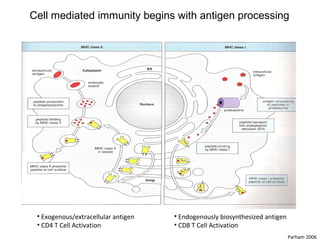
Cell mediated immunity begins with antigen processing
• Endogenously biosynthesized antigen
• CD8 T Cell Activation
• Exogenous/extracellular antigen
• CD4 T Cell Activation
Parham 2006
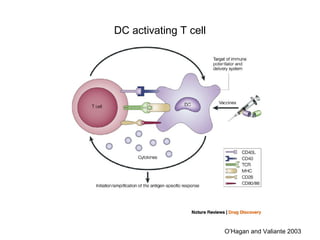
DC activating T cell
O’Hagan and Valiante 2003
My Project
• The goal: Determine if Calcium phosphate nanoparticles are capable of inducing
dendritic cell maturation
• Readout: Expression of cell surface proteins on dendritic cell that are key to T cell
activation.
• MHC Class I, Class II, CD80, and CD86 molecules on cell surface.
• Importance: Up regulation of these molecules are vital in the production of potent
vaccines.
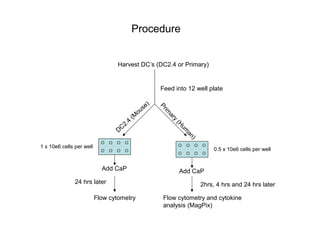
Procedure
Harvest DC’s (DC2.4 or Primary)
Feed into 12 well plate
DC2.4
(M
ouse)
Prim
ary
(H
um
an)
Add CaP Add CaP
Flow cytometry and cytokine
analysis (MagPix)
Flow cytometry
2hrs, 4 hrs and 24 hrs later24 hrs later
1 x 10e6 cells per well
0.5 x 10e6 cells per well
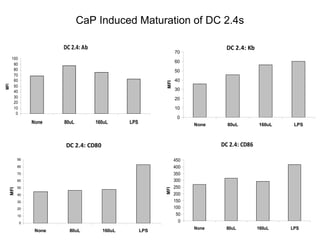
CaP Induced Maturation of DC 2.4s
DC 2.4: Ab
0
10
20
30
40
50
60
70
80
90
100
None 80uL 160uL LPS
MFI
DC 2.4: Kb
0
10
20
30
40
50
60
70
None 80uL 160uL LPS
MFI
DC 2.4: CD80
0
10
20
30
40
50
60
70
80
90
None 80uL 160uL LPS
MFI
DC 2.4: CD86
0
50
100
150
200
250
300
350
400
450
None 80uL 160uL LPS
MFI
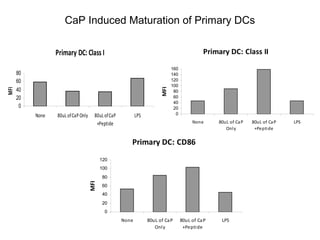
Primary DC: Class II
0
20
40
60
80
100
120
140
160
None 80uL of CaP
Only
80uL of CaP
+Peptide
LPS
MFI
CaP Induced Maturation of Primary DCs
Primary DC: Class I
0
20
40
60
80
None 80uL ofCaP Only 80uL ofCaP
+Peptide
LPS
MFI
Primary DC: CD86
0
20
40
60
80
100
120
None 80uL of CaP
Only
80uL of CaP
+Peptide
LPS
MFI
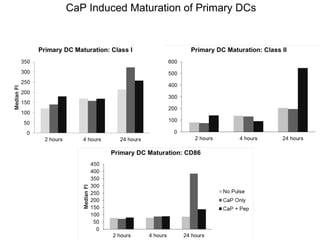
CaP Induced Maturation of Primary DCs
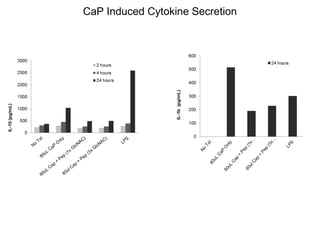
CaP Induced Cytokine Secretion
Conclusion/Next Steps
• CaP nano particles have potential to be a useful adjuvant in the creation of more
potent vaccines.
• Next step would be to repeat this assay and see if there is statistical significance in
the data.
• Test nanoparticles using T cell activation assays.
Lessons/Techniques Learned
• Cell culture
• Flow Cytometry
• MagPix
• Immune system information
Acknowledgments
A huge thank you to everyone who made this experience possible:
Immunotope
Ramilia Philip, PhD
Joseph Comber, PhD
Aykan Karabudak
Xiaofang Huang, PhD
Tulin Morcol, PhD
Hepatitis B Foundation
Timothy Block, PhD
Pamela Norton, PhD
Peggy Farley, MBA
Joan Block, RN, BSN

CaP Particle Presentation

  • 1.
    CaP particle stimulationof dendritic cells for vaccine development Stephen Braunewell Wake Forest University 2014 College Intern Immunotope, Inc.
  • 2.
    Cell mediated immunitybegins with antigen processing • Endogenously biosynthesized antigen • CD8 T Cell Activation • Exogenous/extracellular antigen • CD4 T Cell Activation Parham 2006
  • 3.
    DC activating Tcell O’Hagan and Valiante 2003
  • 4.
    My Project • Thegoal: Determine if Calcium phosphate nanoparticles are capable of inducing dendritic cell maturation • Readout: Expression of cell surface proteins on dendritic cell that are key to T cell activation. • MHC Class I, Class II, CD80, and CD86 molecules on cell surface. • Importance: Up regulation of these molecules are vital in the production of potent vaccines.
  • 5.
    Procedure Harvest DC’s (DC2.4or Primary) Feed into 12 well plate DC2.4 (M ouse) Prim ary (H um an) Add CaP Add CaP Flow cytometry and cytokine analysis (MagPix) Flow cytometry 2hrs, 4 hrs and 24 hrs later24 hrs later 1 x 10e6 cells per well 0.5 x 10e6 cells per well
  • 6.
    CaP Induced Maturationof DC 2.4s DC 2.4: Ab 0 10 20 30 40 50 60 70 80 90 100 None 80uL 160uL LPS MFI DC 2.4: Kb 0 10 20 30 40 50 60 70 None 80uL 160uL LPS MFI DC 2.4: CD80 0 10 20 30 40 50 60 70 80 90 None 80uL 160uL LPS MFI DC 2.4: CD86 0 50 100 150 200 250 300 350 400 450 None 80uL 160uL LPS MFI
  • 7.
    Primary DC: ClassII 0 20 40 60 80 100 120 140 160 None 80uL of CaP Only 80uL of CaP +Peptide LPS MFI CaP Induced Maturation of Primary DCs Primary DC: Class I 0 20 40 60 80 None 80uL ofCaP Only 80uL ofCaP +Peptide LPS MFI Primary DC: CD86 0 20 40 60 80 100 120 None 80uL of CaP Only 80uL of CaP +Peptide LPS MFI
  • 8.
    CaP Induced Maturationof Primary DCs
  • 9.
  • 10.
    Conclusion/Next Steps • CaPnano particles have potential to be a useful adjuvant in the creation of more potent vaccines. • Next step would be to repeat this assay and see if there is statistical significance in the data. • Test nanoparticles using T cell activation assays. Lessons/Techniques Learned • Cell culture • Flow Cytometry • MagPix • Immune system information
  • 11.
    Acknowledgments A huge thankyou to everyone who made this experience possible: Immunotope Ramilia Philip, PhD Joseph Comber, PhD Aykan Karabudak Xiaofang Huang, PhD Tulin Morcol, PhD Hepatitis B Foundation Timothy Block, PhD Pamela Norton, PhD Peggy Farley, MBA Joan Block, RN, BSN