
Matthew P. Caggia
Through various incentives, CONSUMERS 
seek to maximize their satisfaction 
Consumers want to get the most 
for their money 
The behavior of consumers is called . . .
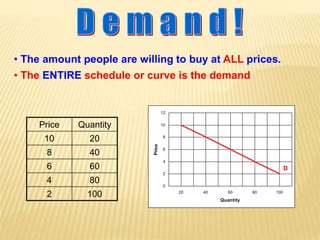
• The amount people are willing to buy at ALL prices. 
• The ENTIRE schedule or curve is the demand 
Price Quantity 
10 20 
8 40 
6 60 
4 80 
2 100 
12 
10 
8 
6 
4 
2 
0 
20 40 60 80 100 
Quantity 
Price 
D
12 
10 
8 
6 
4 
2 
0 
D 
20 40 60 80 100 
Quantity 
Price 
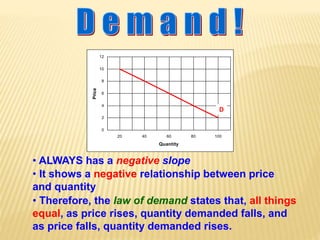
• ALWAYS has a negative slope 
• It shows a negative relationship between price 
and quantity 
• Therefore, the law of demand states that, all things 
equal, as price rises, quantity demanded falls, and 
as price falls, quantity demanded rises.
12 
10 
8 
6 
4 
2 
0 
D2 
20 40 60 80 100 
Quantity 
Price 
D 
D1 
• Sometimes, the demand for a product will change, at 
ALL prices 
• It may cause an increase in demand, 
• or a decrease in demand
Variables that cause a change in demand are called 
Determinants of Demand 
They are: 
Income 
Prices of Related Goods 
Number of Buyers 
Tastes 
Expectations
Determinants of Demand 
Income 
The number of items people are willing to buy is 
determined by how much money they have. Simply, the 
more money you have the more you can buy. 
If the demand for an item falls when income falls, the 
good is called a normal good 
If the demand for an item rises when income falls, the 
good is called an inferior good
Determinants of Demand 
Tastes 
What people want at any given moment 
Usually reflected in what is popular as opposed to what 
is unpopular at the time
Determinants of Demand 
Prices of Related Goods 
A change in the price of one good can cause a change in 
the demand for another, related good 
Substitutes 
• Items that may be used in place of each other 
• when a fall in the price of one good reduces the 
demand for another good, or when a rise in the price of 
one good increases the demand for another good
Determinants of Demand 
Prices of Related Goods 
A change in the price of one good can cause a change in 
the demand for another, related good 
Complements 
• Items that are often used together 
• when a fall in the price of one good increases the 
demand for another good, or when a rise in the price of 
one good reduces the demand for another good
Determinants of Demand 
Number of Buyers 
Population of a given area (more or less buyers) 
An increase in population results in an increase in demand 
A decrease in population results in a decrease in demand
Determinants of Demand 
Expectations 
The ability to predict what will come will cause people to 
react differently in the market
Quantity Demanded is a specific point on the curve or 
schedule. 
12 
10 
8 
6 
4 
2 
0 
20 40 60 80 100 
Quantity 
Price 
12 
10 
8 
6 
4 
2 
0 
20 40 60 80 100 
Quantity 
Price 
Demand 
Quantity 
Demanded at 
$6 
Price Quantity 
10 20 
8 40 
6 60 
4 80 
2 100 
Price Quantity 
6 60 
Demand 
Quantity 
Demanded at 
$6 
It shows the quantity of an item that will be 
purchased at a single given price
12 
10 
8 
6 
4 
2 
0 
The Quantity 
Demanded 
changed from 
60 to 40 
20 40 60 80 100 
Quantity 
Price 
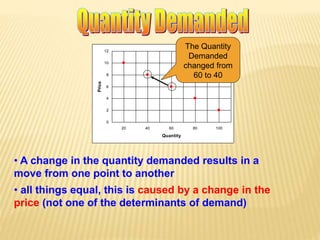
• A change in the quantity demanded results in a 
move from one point to another 
• all things equal, this is caused by a change in the 
price (not one of the determinants of demand)
Supply

Demand (for AP)

  • 1.
  • 2.
    Through various incentives,CONSUMERS seek to maximize their satisfaction Consumers want to get the most for their money The behavior of consumers is called . . .
  • 3.
    • The amountpeople are willing to buy at ALL prices. • The ENTIRE schedule or curve is the demand Price Quantity 10 20 8 40 6 60 4 80 2 100 12 10 8 6 4 2 0 20 40 60 80 100 Quantity Price D
  • 4.
    12 10 8 6 4 2 0 D 20 40 60 80 100 Quantity Price • ALWAYS has a negative slope • It shows a negative relationship between price and quantity • Therefore, the law of demand states that, all things equal, as price rises, quantity demanded falls, and as price falls, quantity demanded rises.
  • 5.
    12 10 8 6 4 2 0 D2 20 40 60 80 100 Quantity Price D D1 • Sometimes, the demand for a product will change, at ALL prices • It may cause an increase in demand, • or a decrease in demand
  • 6.
    Variables that causea change in demand are called Determinants of Demand They are: Income Prices of Related Goods Number of Buyers Tastes Expectations
  • 7.
    Determinants of Demand Income The number of items people are willing to buy is determined by how much money they have. Simply, the more money you have the more you can buy. If the demand for an item falls when income falls, the good is called a normal good If the demand for an item rises when income falls, the good is called an inferior good
  • 8.
    Determinants of Demand Tastes What people want at any given moment Usually reflected in what is popular as opposed to what is unpopular at the time
  • 9.
    Determinants of Demand Prices of Related Goods A change in the price of one good can cause a change in the demand for another, related good Substitutes • Items that may be used in place of each other • when a fall in the price of one good reduces the demand for another good, or when a rise in the price of one good increases the demand for another good
  • 10.
    Determinants of Demand Prices of Related Goods A change in the price of one good can cause a change in the demand for another, related good Complements • Items that are often used together • when a fall in the price of one good increases the demand for another good, or when a rise in the price of one good reduces the demand for another good
  • 11.
    Determinants of Demand Number of Buyers Population of a given area (more or less buyers) An increase in population results in an increase in demand A decrease in population results in a decrease in demand
  • 12.
    Determinants of Demand Expectations The ability to predict what will come will cause people to react differently in the market
  • 14.
    Quantity Demanded isa specific point on the curve or schedule. 12 10 8 6 4 2 0 20 40 60 80 100 Quantity Price 12 10 8 6 4 2 0 20 40 60 80 100 Quantity Price Demand Quantity Demanded at $6 Price Quantity 10 20 8 40 6 60 4 80 2 100 Price Quantity 6 60 Demand Quantity Demanded at $6 It shows the quantity of an item that will be purchased at a single given price
  • 15.
    12 10 8 6 4 2 0 The Quantity Demanded changed from 60 to 40 20 40 60 80 100 Quantity Price • A change in the quantity demanded results in a move from one point to another • all things equal, this is caused by a change in the price (not one of the determinants of demand)
  • 16.