TALENT MANAGEMENT
ASSIGNMENT
TALENT ACQUISITION
SHRADDHA DARAK
2001088
PGDM-B
INTRODUCTION
• Deloitte Touche Tohmatsu Limited, commonly referred to as Deloitte, is
a multinational professional services network with offices in over 150 countries and territories
around the world.
• Deloitte is one of the Big Four accounting organizations and the largest professional services
network in the world by revenue and number of professionals, with headquarters in London,
England.
• The firm was founded by William Welch Deloitte in London in 1845 and expanded into the
United States in 1890.[10] It merged with Haskins & Sells to form Deloitte Haskins & Sells in
1972 and with Touche Ross in the US to form Deloitte & Touche in 1989. In 1993, the
international firm was renamed Deloitte Touche Tohmatsu, later abbreviated to Deloitte.
• Deloitte provides audit, consulting, financial advisory, risk advisory, tax, and legal services
with approximately 334,800 professionals globally.
TALENT ACQUISITION
Talent acquisition is a tricky business.
• Talent acquisition is one of the most important tasks your HR operation will
undertake.
• In today’s expanding and competitive global economy, a company’s capacity to innovate
and increase market share lies in its ability to attract and retain the best possible
workforce.
• Identifying the right candidate on a timely basis, and getting them excited about the
opportunity to contribute to your company’s success is an art rather than a skill.
• The nature of talent acquisition remains the same; needs and requirements rise and fall
in waves.
TALENT ACQUISITION PRACTISES
• Defining talent management vision
• Defining critical workforce segments
• Developing the talent management road map
• Compensation, benefits, and rewards
• Talent management approach incorporates an integrated process
that helps design a talent program and the related infrastructure
for attracting and developing critical talent, their right positioning
in the organization as well as ensuring their commitment.
The characteristics of a talented workforce are:
• Innovative contribution capacity not only through forecasting the market, but also
in creating it.
• Choosing the best place to work in terms of talent development.
• Choosing a working environment that provides coaching and training
opportunities and that encourages experience sharing and network development.
• The ability to work on multiple issues during difficult times and also to grow
stronger because of such periods.
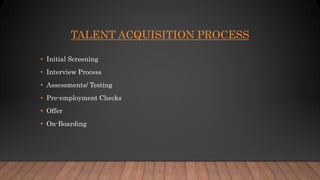
TALENT ACQUISITION PROCESS
• Initial Screening
• Interview Process
• Assessments/ Testing
• Pre-employment Checks
• Offer
• On-Boarding
CONCLUSION
• The significant changes taking place in the business world have increased the demand
for a talented workforce; as a result it has become more difficult to find the right talent.
• Keeping up with the dramatic changes to the global workforce is even more challenging.
The classic model of talent, recruitment, and retention strategies are neither relevant
nor successful anymore. Talent has become a focal point both for a functional team (i.e.
finance, information technologies, sales, etc.) and on HR managers’ agendas, because
talent is crucial for a company’s success.
• Due to the scarcity of supply in the workforce market, it is of the utmost importance to
support business and functional strategies with talent strategies and programs.
Becoming a high-performing organization depends on the success in attracting,
developing, and retaining a talented workforce.
THANK YOU

Deloitte talent acquisition

  • 1.
  • 3.
    INTRODUCTION • Deloitte ToucheTohmatsu Limited, commonly referred to as Deloitte, is a multinational professional services network with offices in over 150 countries and territories around the world. • Deloitte is one of the Big Four accounting organizations and the largest professional services network in the world by revenue and number of professionals, with headquarters in London, England. • The firm was founded by William Welch Deloitte in London in 1845 and expanded into the United States in 1890.[10] It merged with Haskins & Sells to form Deloitte Haskins & Sells in 1972 and with Touche Ross in the US to form Deloitte & Touche in 1989. In 1993, the international firm was renamed Deloitte Touche Tohmatsu, later abbreviated to Deloitte. • Deloitte provides audit, consulting, financial advisory, risk advisory, tax, and legal services with approximately 334,800 professionals globally.
  • 4.
    TALENT ACQUISITION Talent acquisitionis a tricky business. • Talent acquisition is one of the most important tasks your HR operation will undertake. • In today’s expanding and competitive global economy, a company’s capacity to innovate and increase market share lies in its ability to attract and retain the best possible workforce. • Identifying the right candidate on a timely basis, and getting them excited about the opportunity to contribute to your company’s success is an art rather than a skill. • The nature of talent acquisition remains the same; needs and requirements rise and fall in waves.
  • 5.
    TALENT ACQUISITION PRACTISES •Defining talent management vision • Defining critical workforce segments • Developing the talent management road map • Compensation, benefits, and rewards • Talent management approach incorporates an integrated process that helps design a talent program and the related infrastructure for attracting and developing critical talent, their right positioning in the organization as well as ensuring their commitment.
  • 6.
    The characteristics ofa talented workforce are: • Innovative contribution capacity not only through forecasting the market, but also in creating it. • Choosing the best place to work in terms of talent development. • Choosing a working environment that provides coaching and training opportunities and that encourages experience sharing and network development. • The ability to work on multiple issues during difficult times and also to grow stronger because of such periods.
  • 7.
    TALENT ACQUISITION PROCESS •Initial Screening • Interview Process • Assessments/ Testing • Pre-employment Checks • Offer • On-Boarding
  • 8.
    CONCLUSION • The significantchanges taking place in the business world have increased the demand for a talented workforce; as a result it has become more difficult to find the right talent. • Keeping up with the dramatic changes to the global workforce is even more challenging. The classic model of talent, recruitment, and retention strategies are neither relevant nor successful anymore. Talent has become a focal point both for a functional team (i.e. finance, information technologies, sales, etc.) and on HR managers’ agendas, because talent is crucial for a company’s success. • Due to the scarcity of supply in the workforce market, it is of the utmost importance to support business and functional strategies with talent strategies and programs. Becoming a high-performing organization depends on the success in attracting, developing, and retaining a talented workforce.
  • 9.