Delay Tolerant Streaming Services

Thomas Plagemann
on behalf of the DT-Stream Team
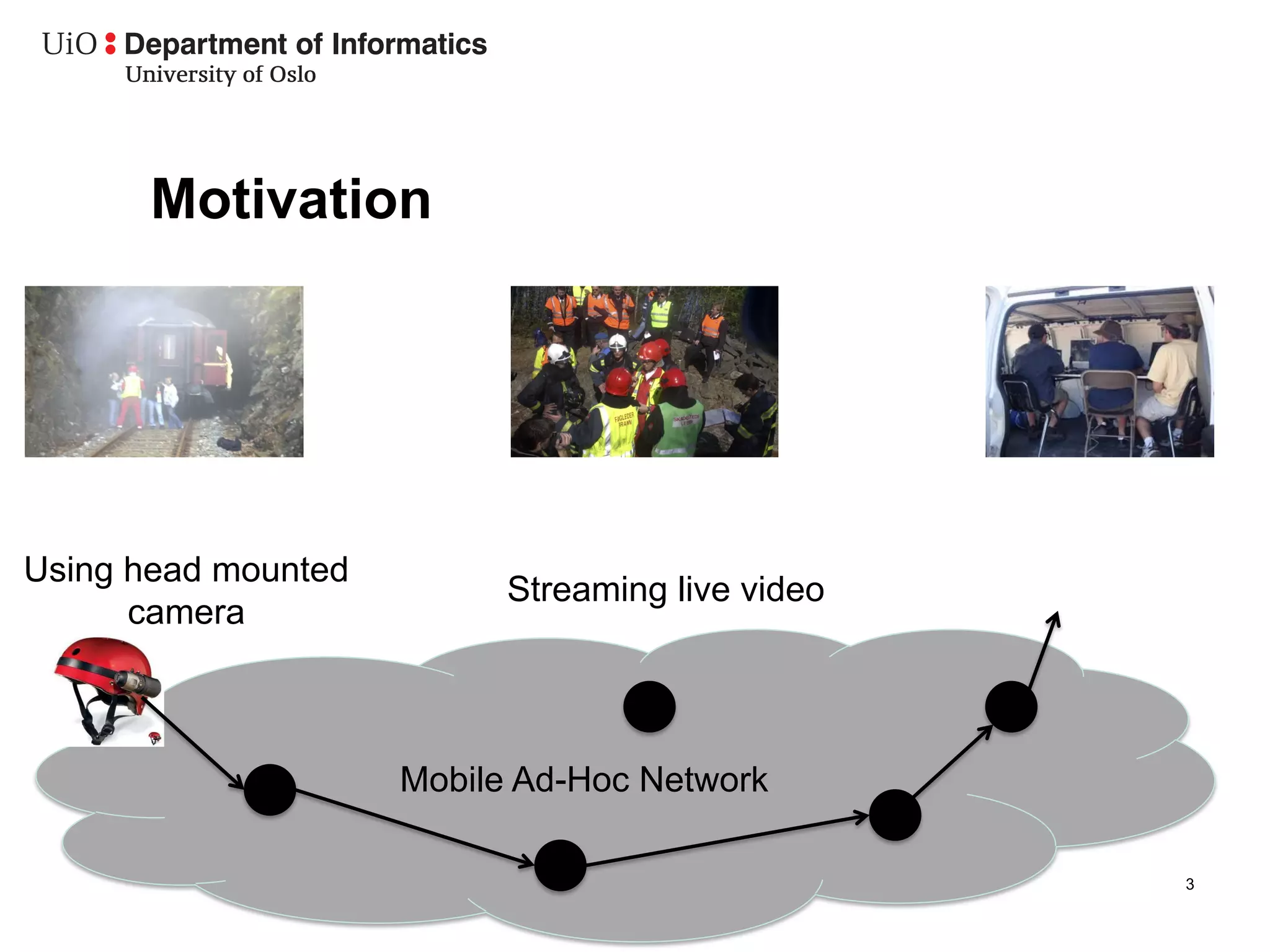
Motivation


Using head mounted
                           Streaming live video
      camera


                     Mobile Ad-Hoc Network

                                                  3
Motivation (cont.)
•  Communication to CCC using head mounted
   cameras
•  Networking infrastructure might not be available
   è use mobile phones to establish wireless ad-hoc
   network
•  Problem: mobile, unstable, partitioned network
•  Opportunity: video can also be useful when it arrives
   late


                                                           4
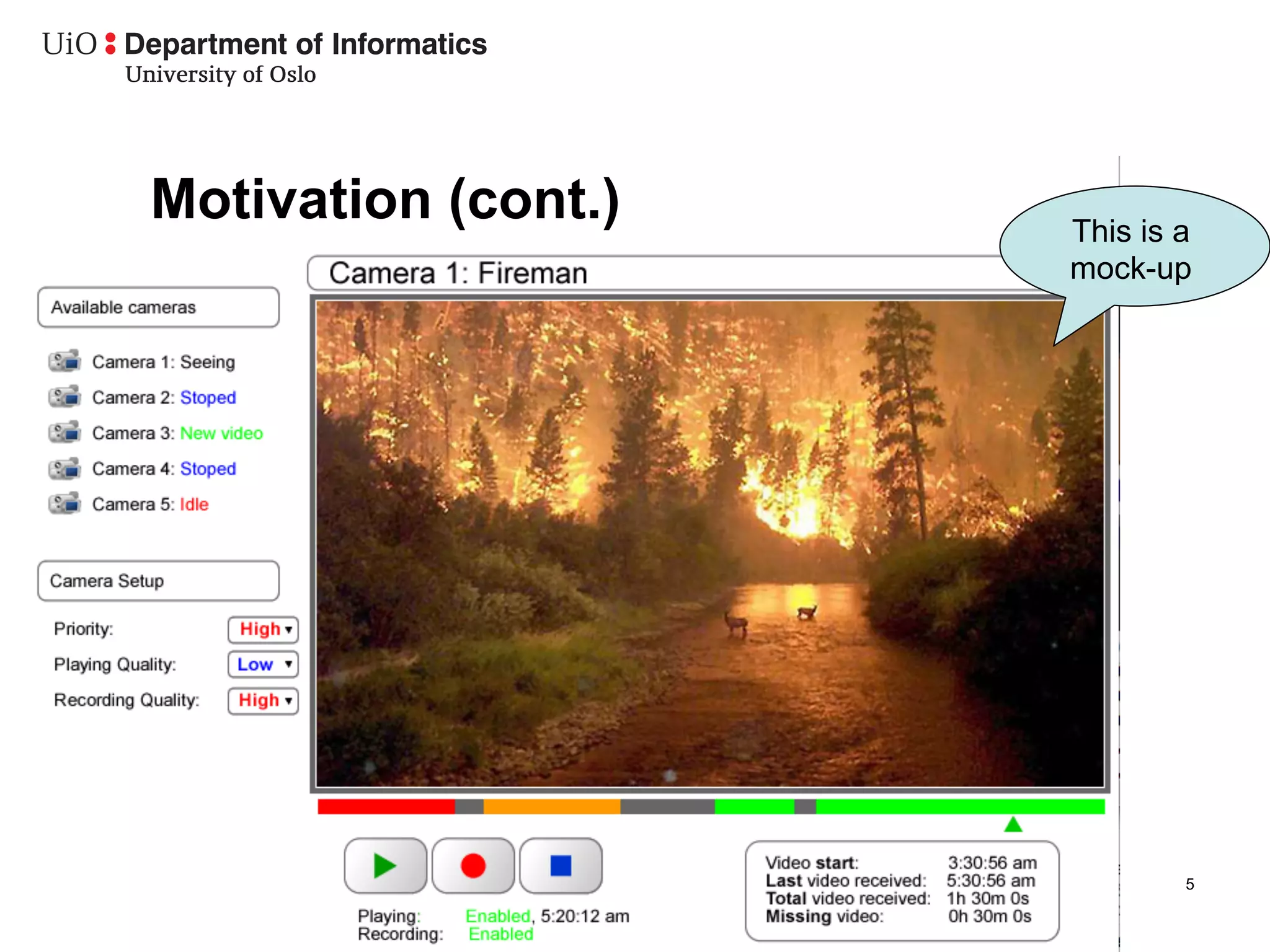
Motivation (cont.)   This is a
                     mock-up


                             5
History and Funding
•  Pre-project in 2008 at UiO
   –  4 Master students
   –  Collaboration with University of Oviedo (Spain)
•  Verdikt funding: 3 PhDs & 1 PostDoc (2008 – 2012)


•  University of Oviedo funding: 1 PhD


                                                        6
Technical Challenges
•  Mobile wireless space – how to be always
   best connected?
•  Mobile phones have resource restrictions and
   therefore the network they create
  –  Network topology awareness
  –  Cross-layer optimization
  –  Simulation tools not appropriate


                                              7
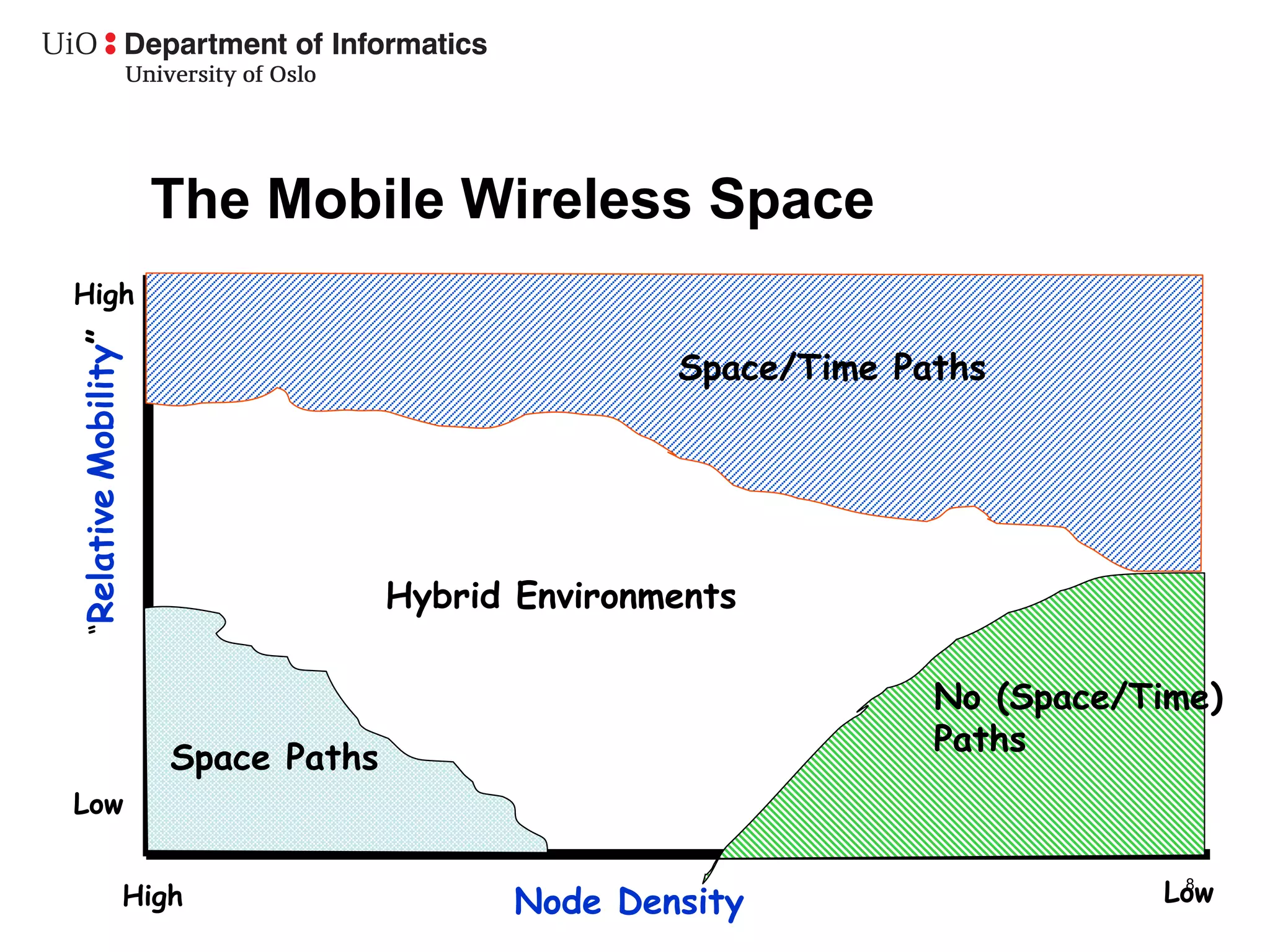
The Mobile Wireless Space
High
“Relative Mobility”


                                                   Space/Time Paths


                                    Hybrid Environments

                                                                No (Space/Time)
                                                                Paths
                      Space Paths
Low


                  High                    Node Density                     Low
                                                                            8
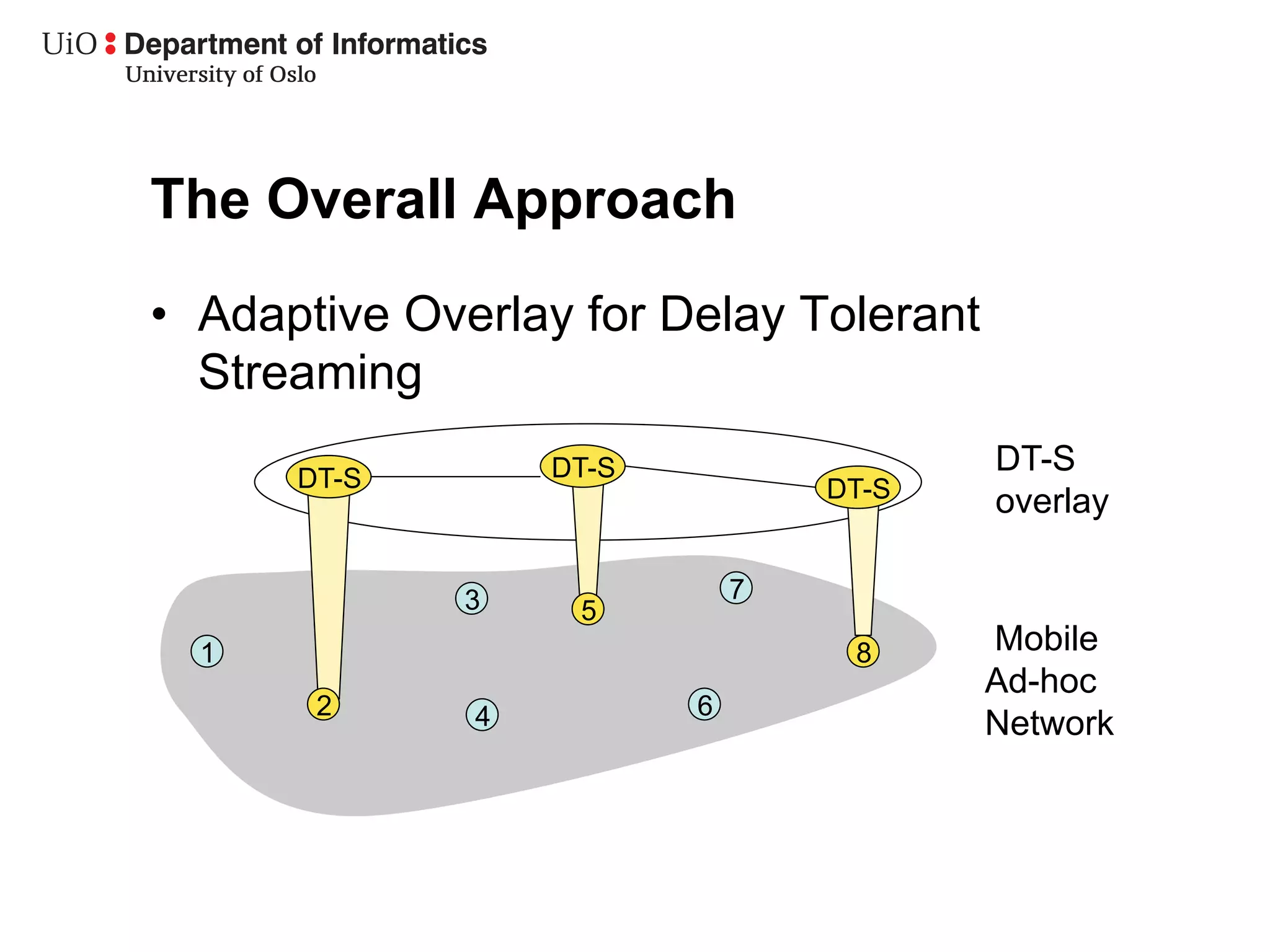
The Overall Approach
•  Adaptive Overlay for Delay Tolerant
   Streaming

      DT-S        DT-S                   DT-S
                                 DT-S
                                         overlay

              3              7
                   5
  1                               8      Mobile
                                         Ad-hoc
       2      4          6
                                         Network
A few Results Highlighted
•  Early results used to focus the research:
   –  Survey of video streaming over MANETs
   –  Real world experiments
•  Recent results:
   –  Modeling mobile nodes in network simulators
   –  Systematic cross-layer optimization
   –  At home in heterogeneous networks
   –  Non-intrusive network clustering

                                                    10
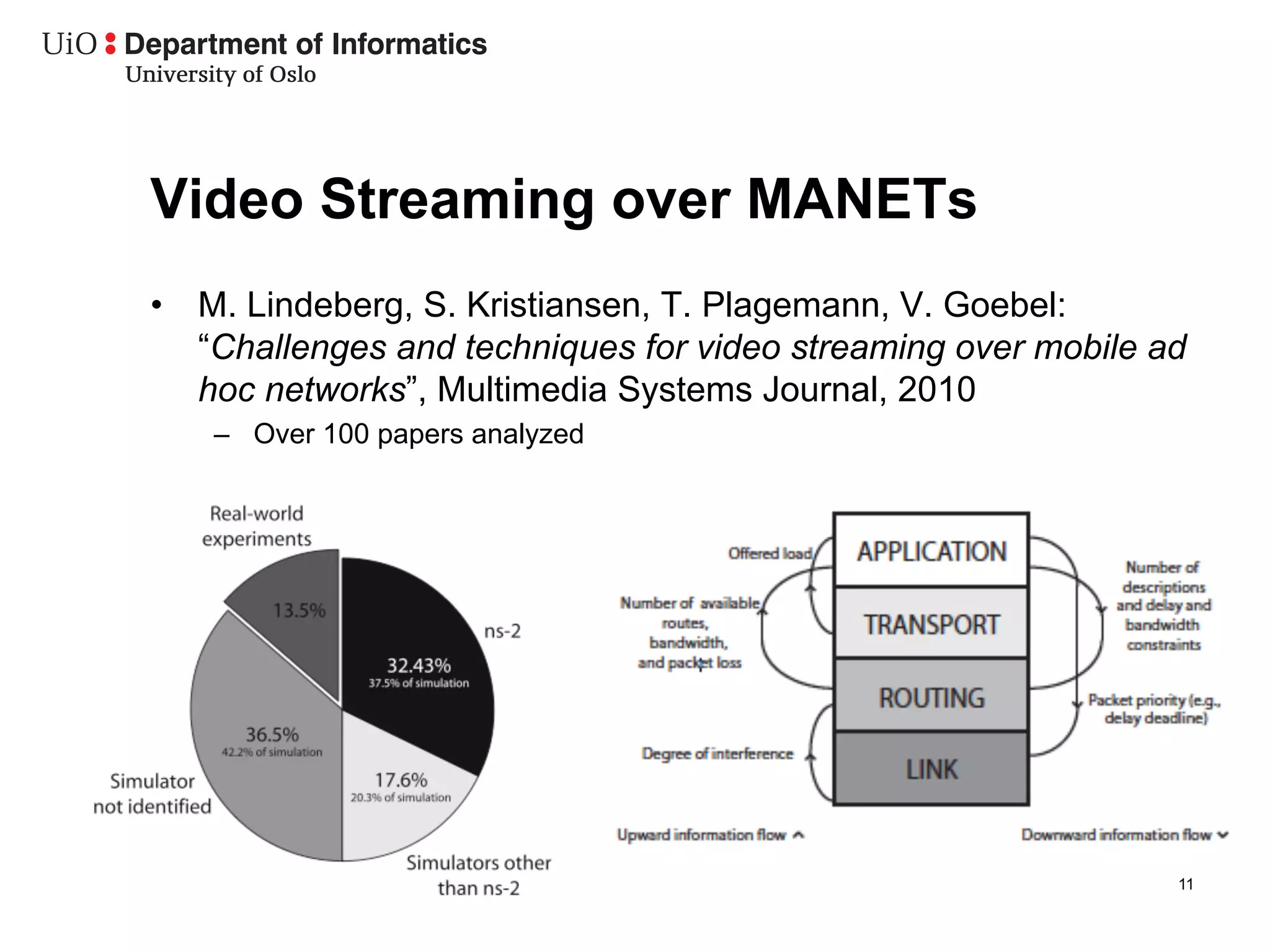
Video Streaming over MANETs
•  M. Lindeberg, S. Kristiansen, T. Plagemann, V. Goebel:
   “Challenges and techniques for video streaming over mobile ad
   hoc networks”, Multimedia Systems Journal, 2010
   –  Over 100 papers analyzed


                                                               11
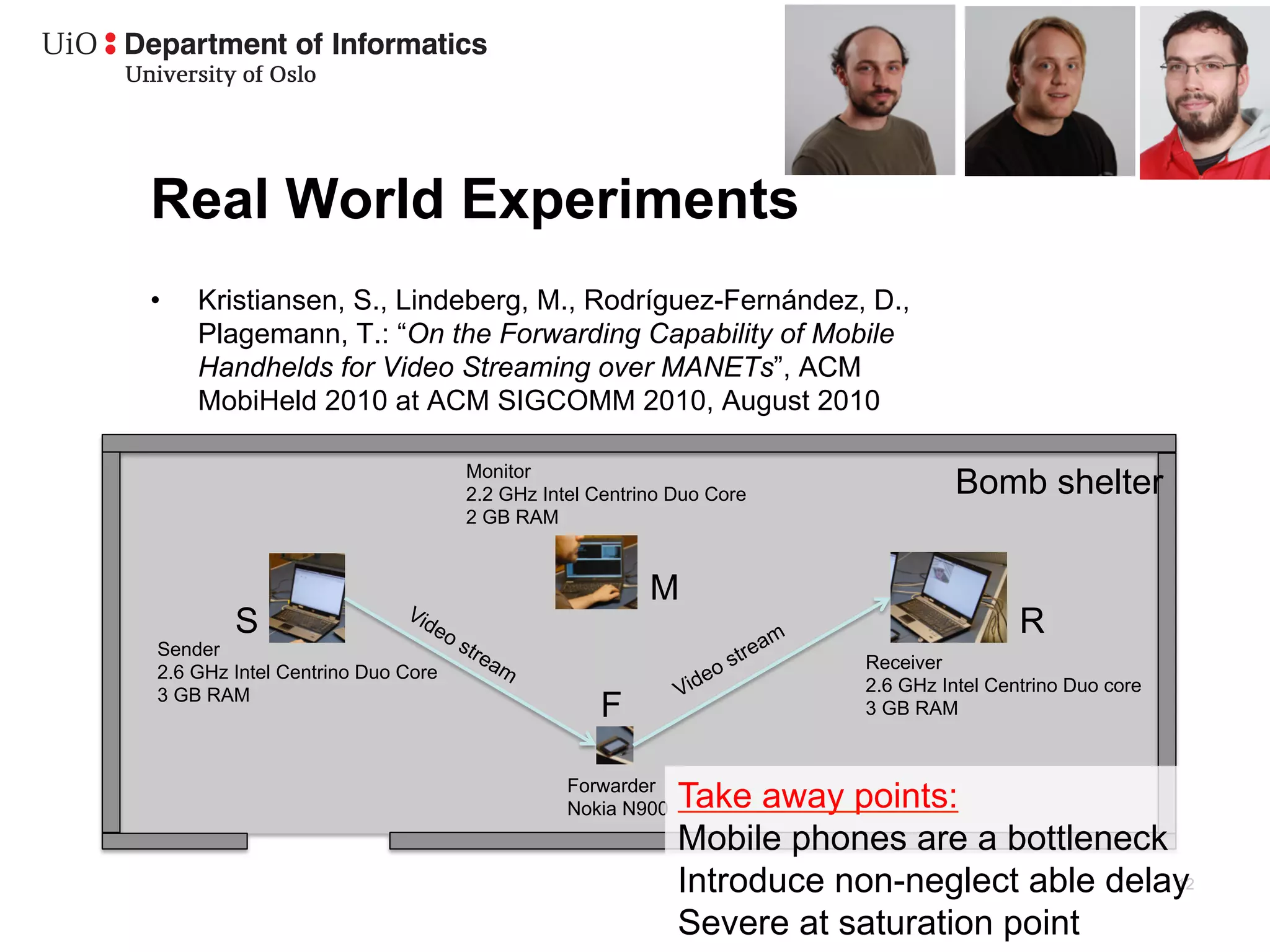
Real World Experiments
•    Kristiansen, S., Lindeberg, M., Rodríguez-Fernández, D.,
     Plagemann, T.: “On the Forwarding Capability of Mobile
     Handhelds for Video Streaming over MANETs”, ACM
     MobiHeld 2010 at ACM SIGCOMM 2010, August 2010

                                   Monitor
                                   2.2 GHz Intel Centrino Duo Core              Bomb shelter
                                   2 GB RAM


                                                       M
         S                                                                             R
 Sender
                                                                      Receiver
 2.6 GHz Intel Centrino Duo Core
                                                                      2.6 GHz Intel Centrino Duo core
 3 GB RAM
                                                 F                    3 GB RAM


                                              Forwarder
                                              Nokia N900   Take away points:
                                                           Mobile phones are a bottleneck
                                                           Introduce non-neglect able delay
                                                                                          12

                                                           Severe at saturation point
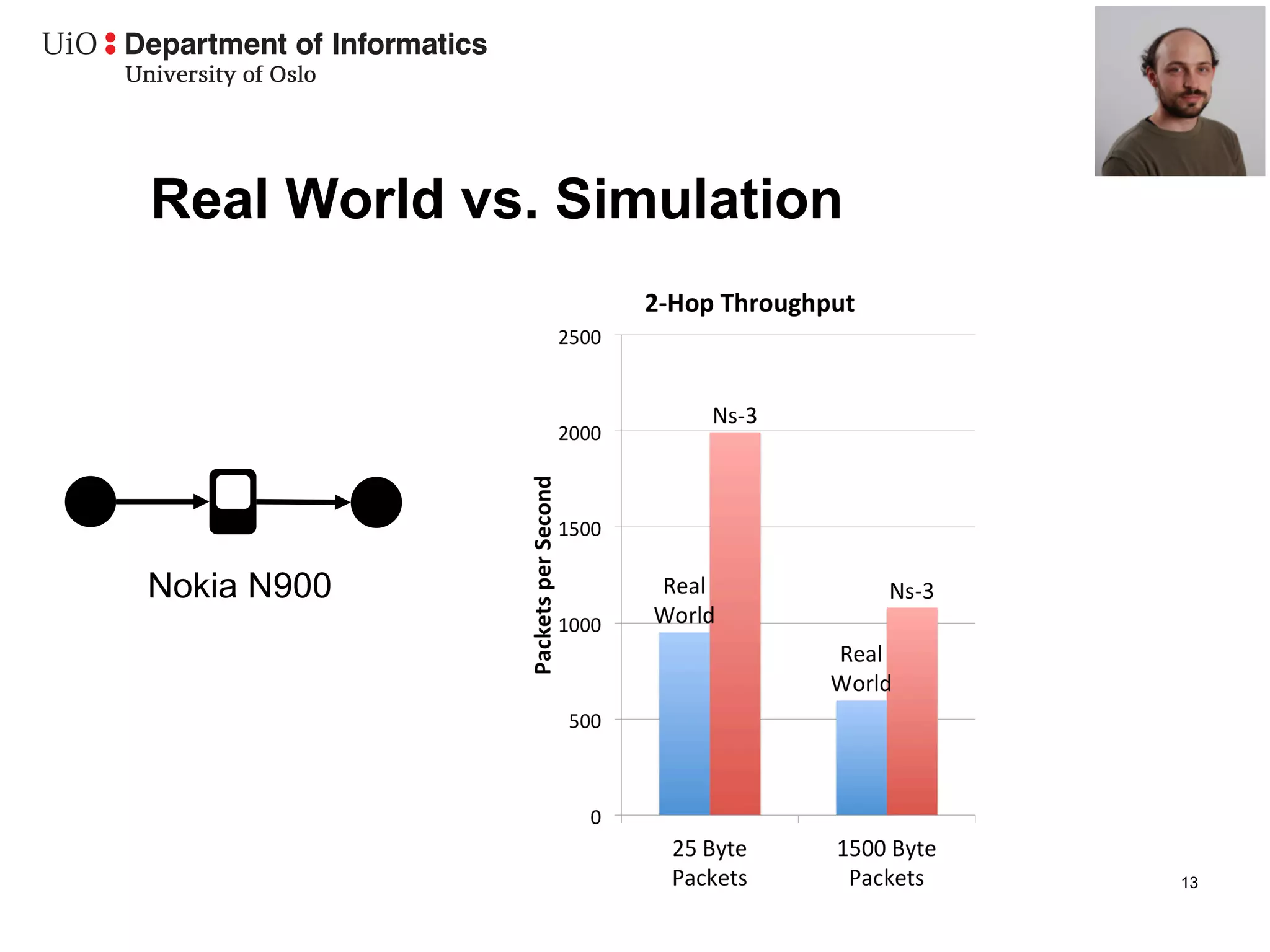
Real World vs. Simulation


Nokia N900


                            13
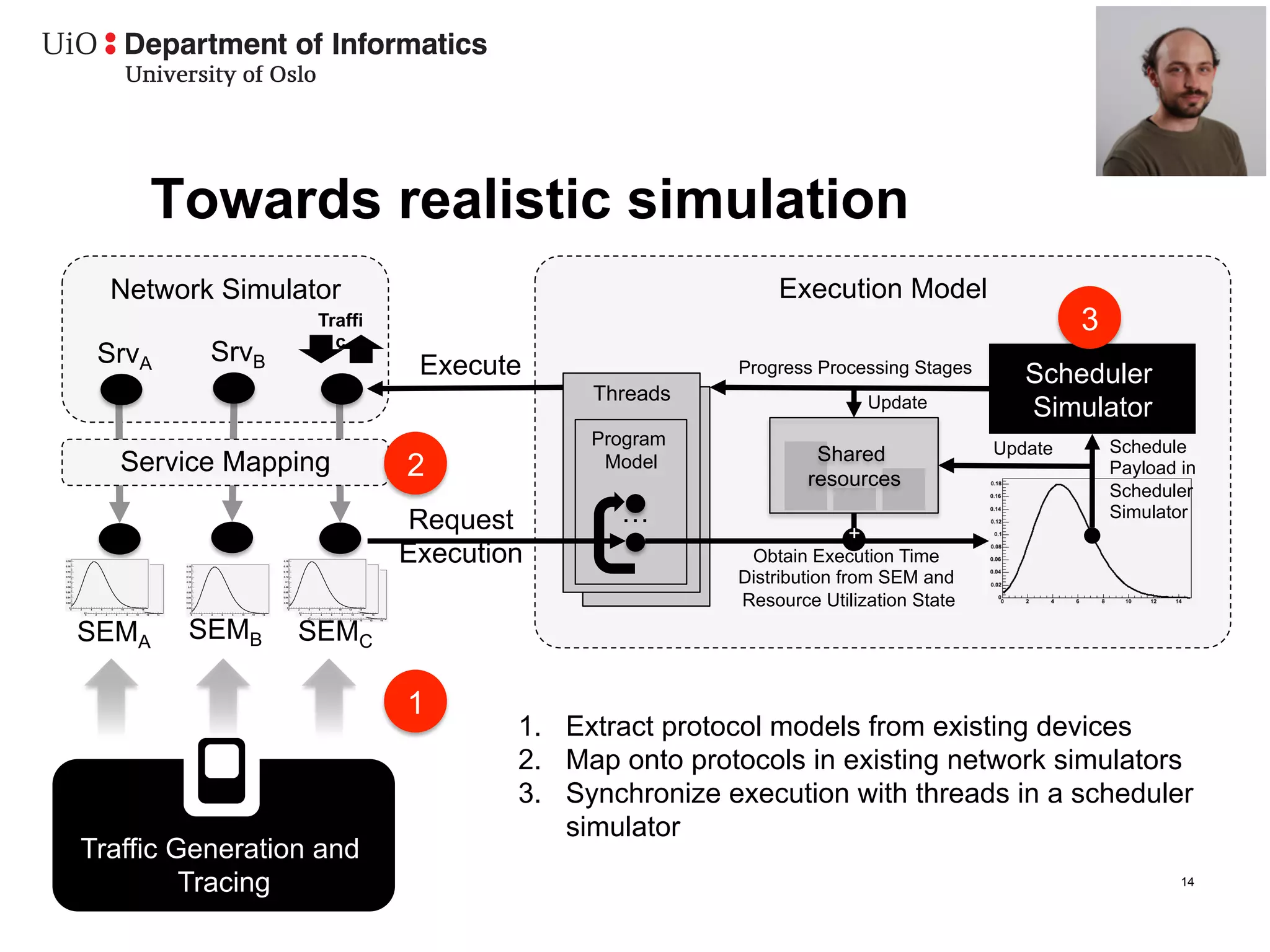
Towards realistic simulation
  Network Simulator                                     Execution Model
                  Traffi                                                                  3
                    c
 SrvA     SrvB              Execute                 Progress Processing Stages
                                                                                    Scheduler
                                        Threads                      Update         Simulator
                                        Program                                  Update       Schedule
   Service Mapping                                           Shared
                           2             Model
                                                            resources
                                                                                              Payload in
                                                                                              Scheduler
                           Request         …                                                  Simulator
                                                                 +
                           Execution                 Obtain Execution Time
                                                    Distribution from SEM and
                                                    Resource Utilization State
SEMA    SEMB     SEMC

                           1
                                   1.  Extract protocol models from existing devices
                                   2.  Map onto protocols in existing network simulators
                                   3.  Synchronize execution with threads in a scheduler
                                       simulator
Traffic Generation and
         Tracing                                                                                      14
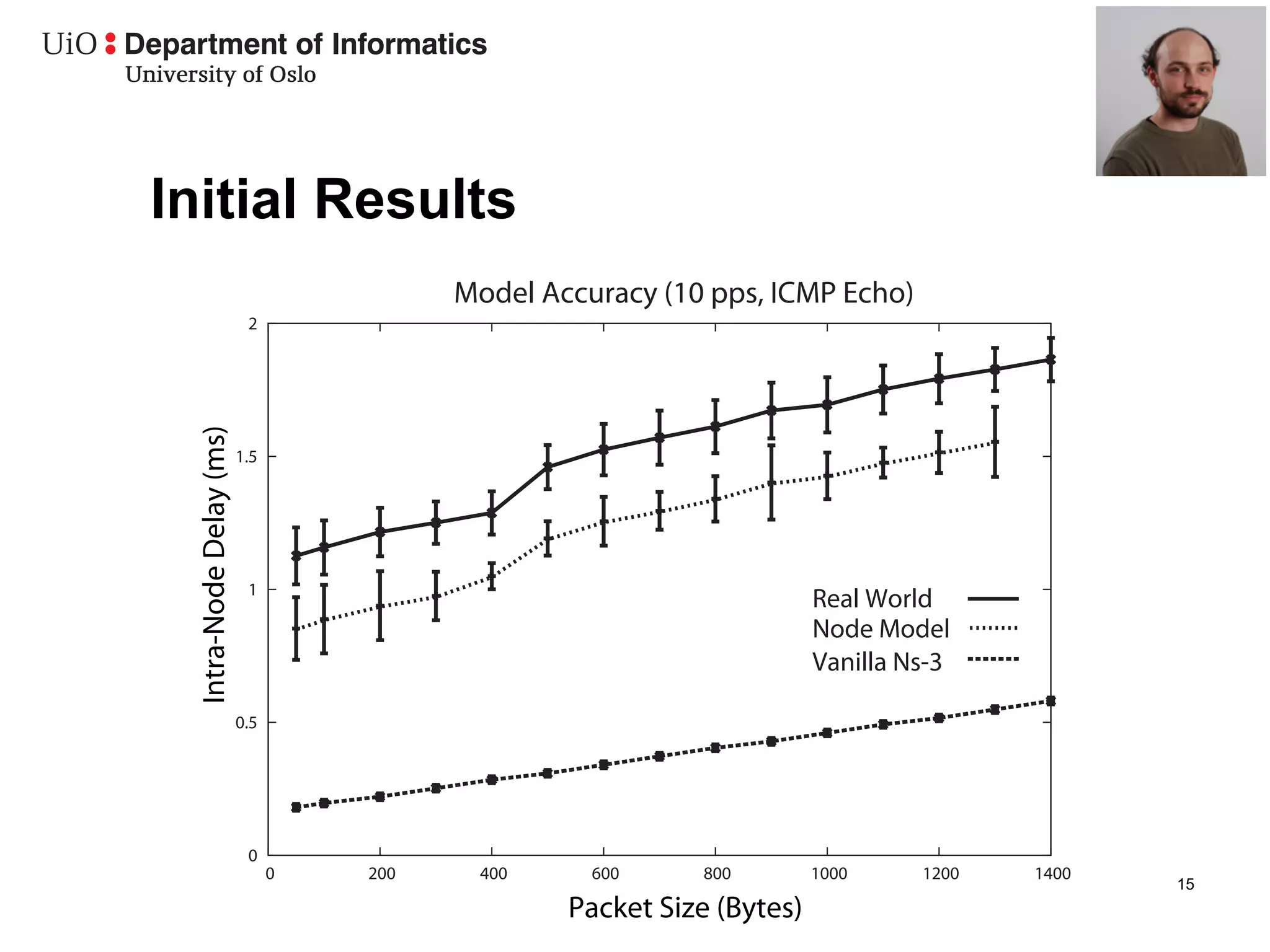
Initial Results
                                         Model Accuracy (10 pps, ICMP Echo)
                          2
 Intra-Node Delay (ms)


                         1.5


                          1
                                                                       Real World
                                                                       Node Model
                                                                       Vanilla Ns-3

                         0.5


                          0
                               0   200    400      600     800         1000     1200   1400
                                                                                              15
                                                 Packet Size (Bytes)
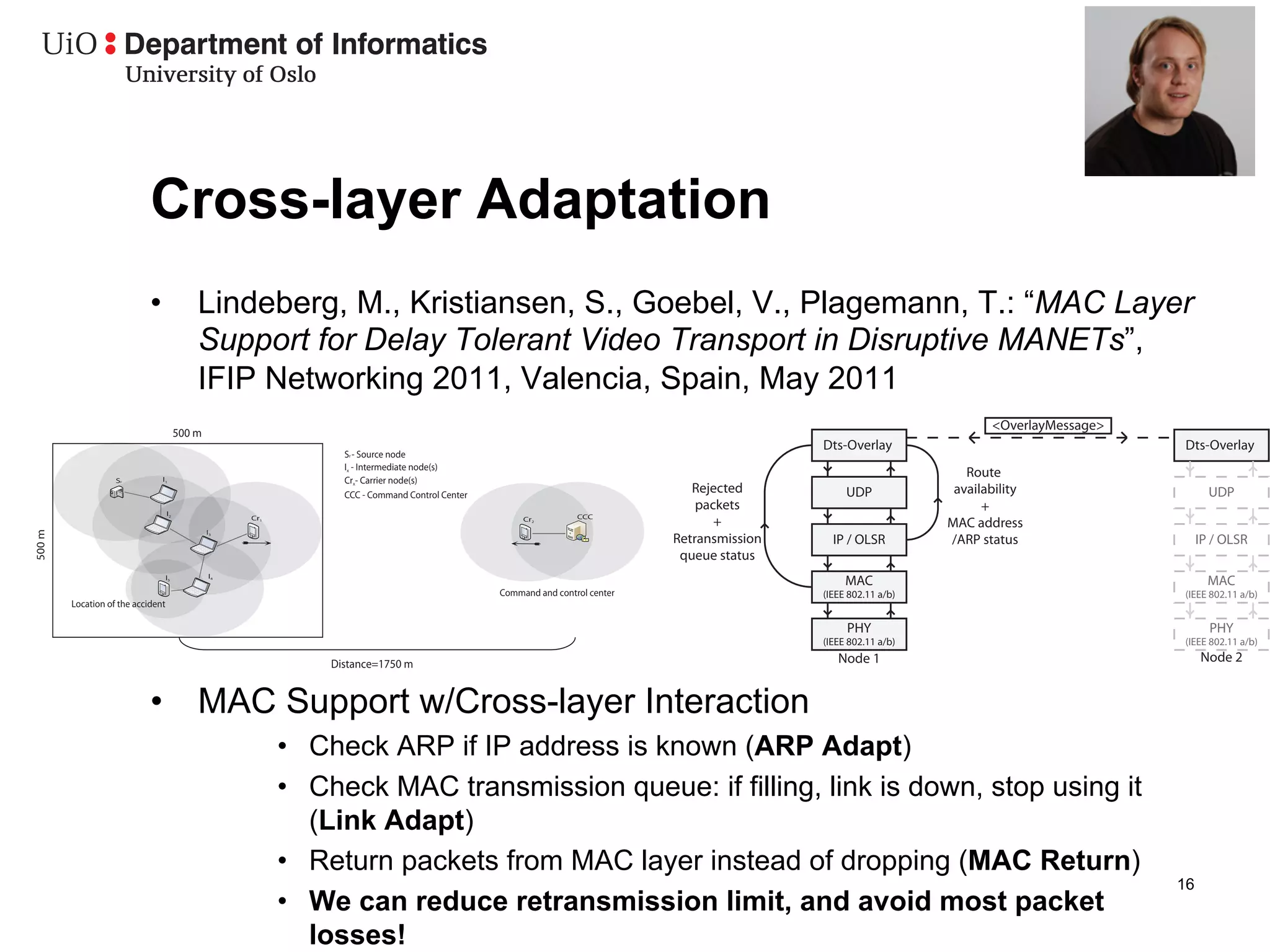
Cross-layer Adaptation
                            •               Lindeberg, M., Kristiansen, S., Goebel, V., Plagemann, T.: “MAC Layer
                                            Support for Delay Tolerant Video Transport in Disruptive MANETs”,
                                            IFIP Networking 2011, Valencia, Spain, May 2011
                                                                                                                                                                         <OverlayMessage>
                                        500 m
                                                                                                                                              Dts-Overlay                                   Dts-Overlay
                                                                 Sr - Source node
                                                                 Ix - Intermediate node(s)
                   Sr          I1                                Crx- Carrier node(s)
                                                                                                                                                                     Route
                                                                 CCC - Command Control Center
                                                                                                                                Rejected           UDP             availability                    UDP
                                   I2
                                                                                                                                 packets                                +
                                                                                                                 CCC
                                                     Cr1                                             Cr2
                                                                                                                                    +                             MAC address
                                                I3
500 m


                                                                                                                             Retransmission     IP / OLSR         /ARP status                    IP / OLSR
                                                                                                                              queue status
                                                I4
                                   I5
                                                                                                                                                   MAC                                             MAC
                                                                                                Command and control center                    (IEEE 802.11 a/b)                             (IEEE 802.11 a/b)
        Location of the accident

                                                                                                                                                   PHY                                             PHY
                                                                                                                                              (IEEE 802.11 a/b)                             (IEEE 802.11 a/b)

                                                               Distance=1750 m                                                                   Node 1                                          Node 2


                            •  MAC Support w/Cross-layer Interaction
                                                           •  Check ARP if IP address is known (ARP Adapt)
                                                           •  Check MAC transmission queue: if filling, link is down, stop using it
                                                              (Link Adapt)
                                                           •  Return packets from MAC layer instead of dropping (MAC Return)
                                                                                                                                                                                            16
                                                           •  We can reduce retransmission limit, and avoid most packet
                                                              losses!
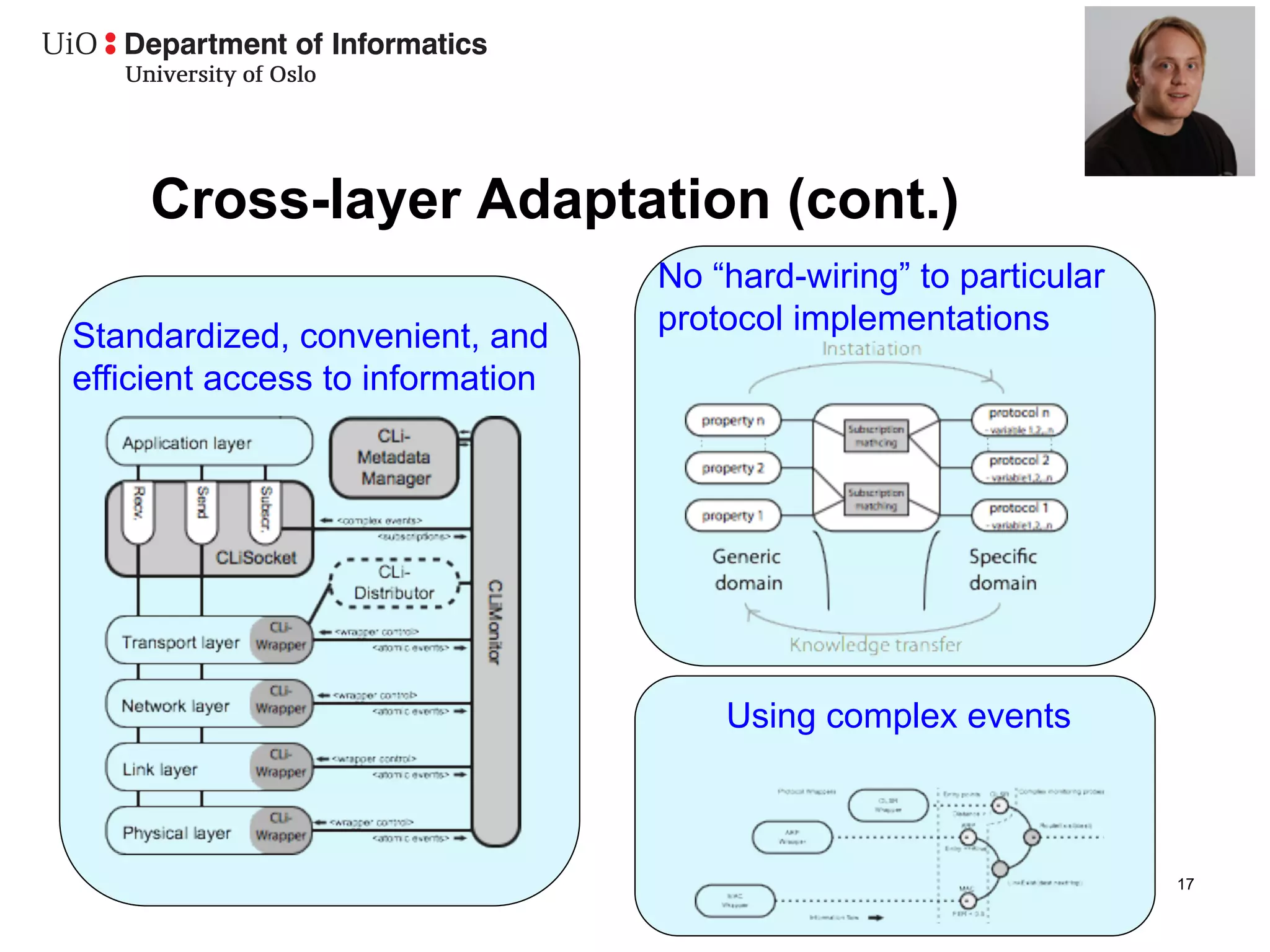
Cross-layer Adaptation (cont.)
                                  No “hard-wiring” to particular
                                  protocol implementations
Standardized, convenient, and
efficient access to information


                                      Using complex events


                                                                   17
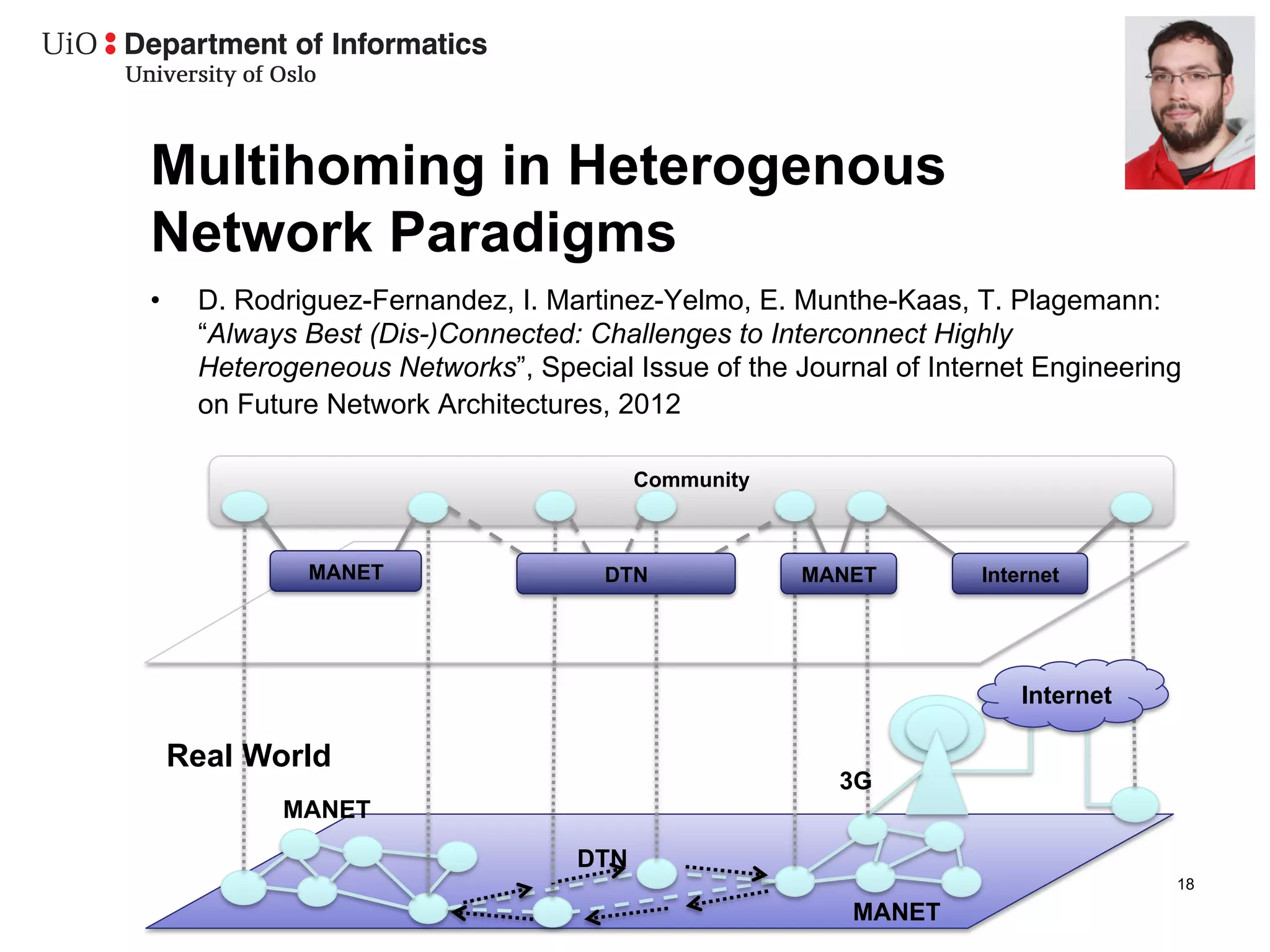
Multihoming in Heterogenous
Network Paradigms
•     D. Rodriguez-Fernandez, I. Martinez-Yelmo, E. Munthe-Kaas, T. Plagemann:
      “Always Best (Dis-)Connected: Challenges to Interconnect Highly
      Heterogeneous Networks”, Special Issue of the Journal of Internet Engineering
      on Future Network Architectures, 2012

                                         Community


              MANET                  DTN             MANET         Internet


                                                                       Internet

     Real World
                                                        3G
            MANET
                                   DTN
                                                                                  18
                                                         MANET
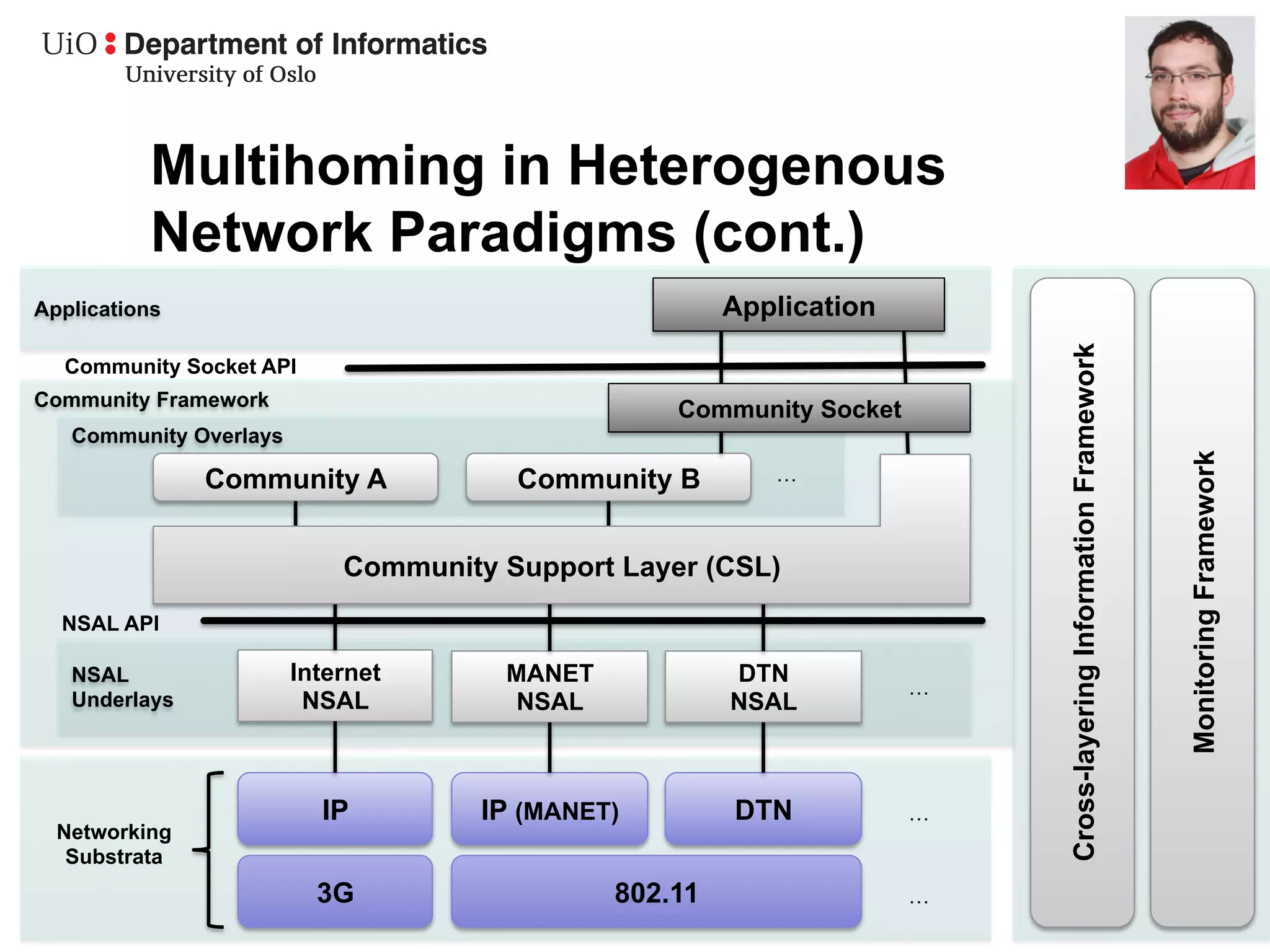
Multihoming in Heterogenous
          Network Paradigms (cont.)
Applications                                           Application


                                                                         Cross-layering Information Framework
  Community Socket API
Community Framework
                                                  Community Socket
   Community Overlays


                                                                                                                 Monitoring Framework
               Community A             Community B        …


                            Community Support Layer (CSL)
  NSAL API

   NSAL                 Internet      MANET            DTN
                                                                     …
   Underlays             NSAL          NSAL            NSAL


                          IP         IP (MANET)        DTN           …
  Networking
   Substrata
                                                                                                                19
                          3G                  802.11                 …
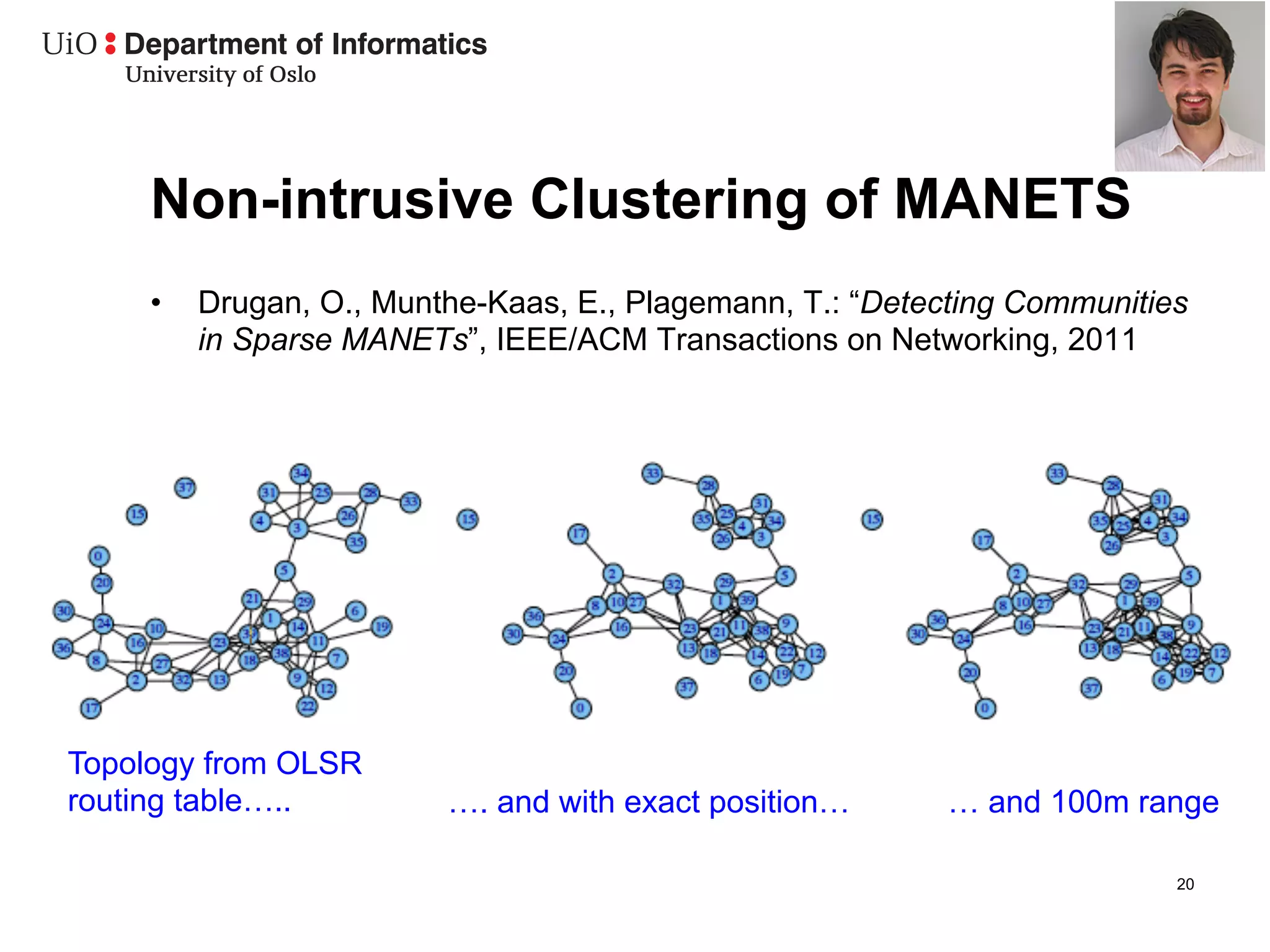
Non-intrusive Clustering of MANETS
     •    Drugan, O., Munthe-Kaas, E., Plagemann, T.: “Detecting Communities
          in Sparse MANETs”, IEEE/ACM Transactions on Networking, 2011


Topology from OLSR
routing table…..          …. and with exact position…      … and 100m range

                                                                           20
Where are we now?
•  All PhD students scheduled to submit their
   thesis in 2012
•  A good set of papers is published but several
   are in the queue
•  Most results are useful far beyond DT-
   Stream (cf. highlights)
•  Many of the core pieces are implemented for
   an integrated demo prototype (also with
   numerous MSc Theses)
                                               21
Where do we go …
•  Look for funding to move basic research
   results of DT-Stream to applied research
   results, i.e., integrated demo prototype ++

•  Head for further long term challenges
   … next slides


                                                 22
Future Technological Developments
•  Bigger, faster, higher resolution, more media,
   more Ds
   –  Data centers, scientific computing, home entertainment
•  Smaller, everywhere, new range of I/O devices,
   energy concerns
   –  Smart phones, sensors, actuators
•  Ever increasing heterogeneity in computing and
   networking

•  è diversity, separation, and seamless integration
                                                               23
Rethink Fundamentals
•  “there is a need to deeply rethink the
   modelling and architecting of future pervasive
   systems”
   M. Conti et al., CNR

•  “to fully realize the potential of CPS, the core
   abstractions of computing need to be
   rethought”
   A. Lee, Stanford University
                                                      24
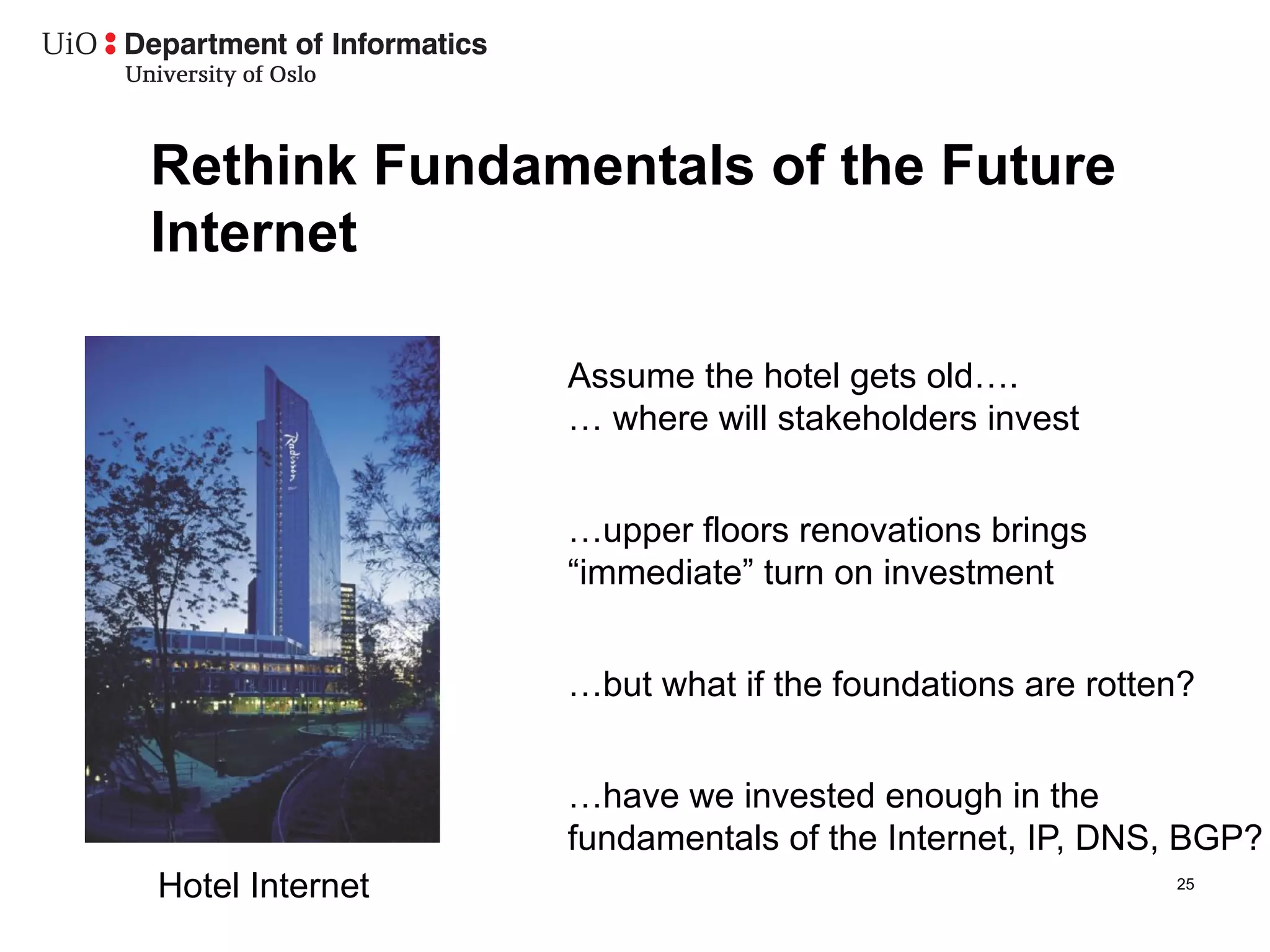
Rethink Fundamentals of the Future
Internet

                 Assume the hotel gets old….
                 … where will stakeholders invest


                 …upper floors renovations brings
                 “immediate” turn on investment


                 …but what if the foundations are rotten?


                 …have we invested enough in the
                 fundamentals of the Internet, IP, DNS, BGP?
Hotel Internet                                         25
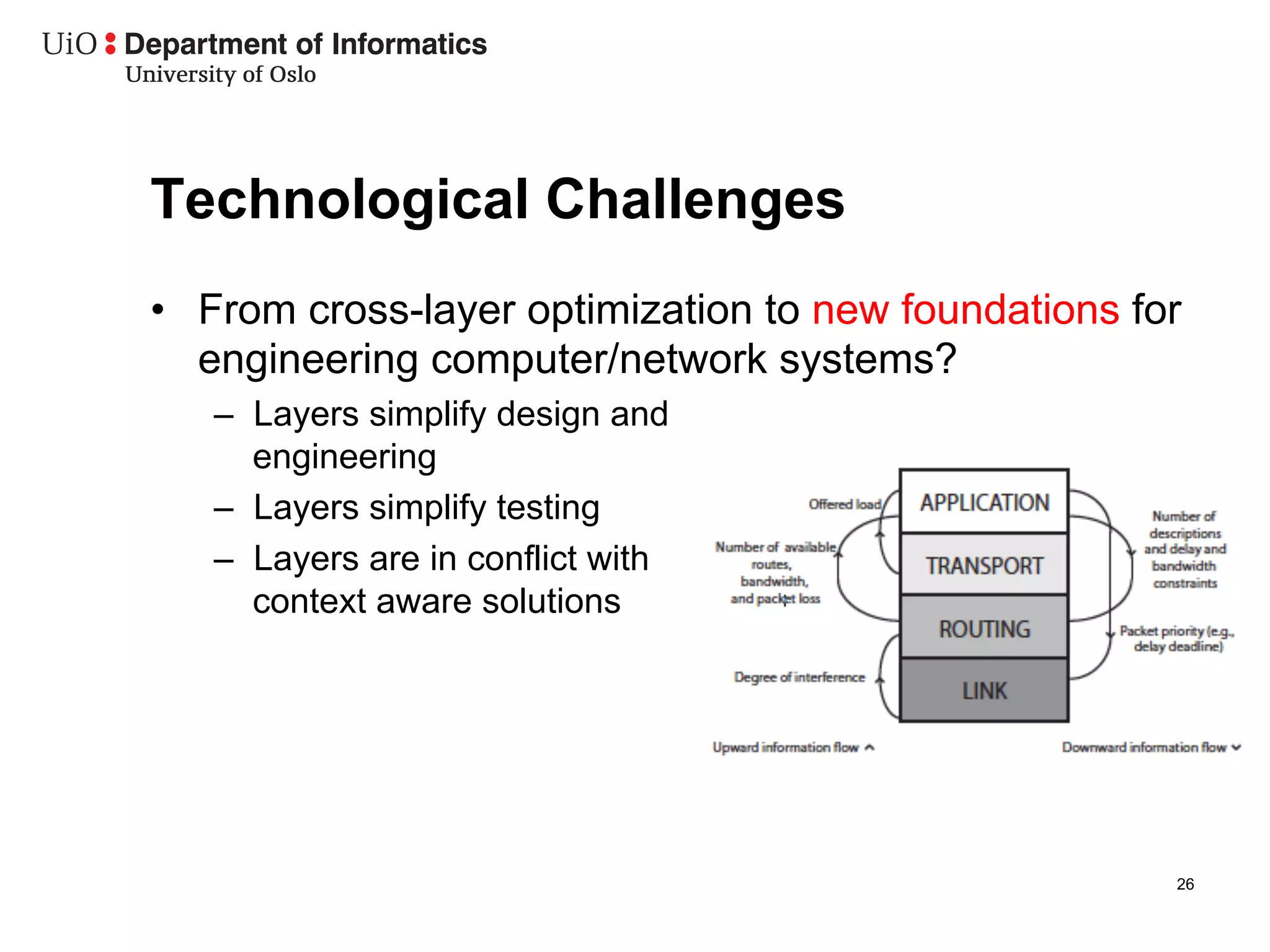
Technological Challenges
•  From cross-layer optimization to new foundations for
   engineering computer/network systems?
   –  Layers simplify design and
      engineering
   –  Layers simplify testing
   –  Layers are in conflict with
      context aware solutions


                                                      26
Technological Challenges
•  Smart phones and wireless sensors and
   actuators:
  –  Promise to solve many challenges society faces,
     e.g., sustainable environment etc., demographic
     change ++
  –  Sharing enables many new solutions, e.g.,
     pervasive sensing vs. privacy and ownership
  –  From application specific solutions to foundations
     that span several/all application domains?

                                                          27
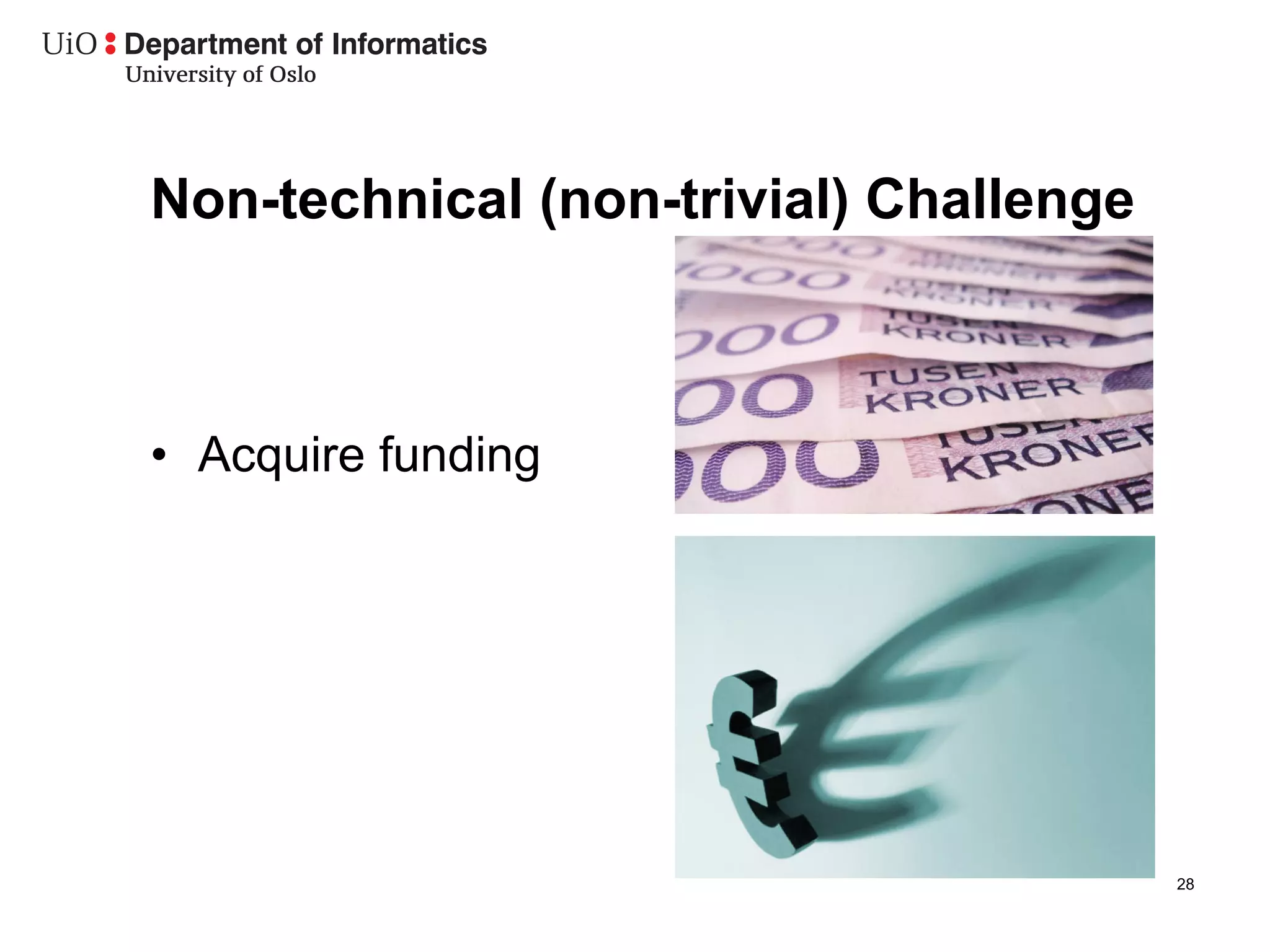
Non-technical (non-trivial) Challenge


•  Acquire funding


                                        28
Questions?


             29

Delay Tolerant Streaming Services, Thomas Plagemann, UiO

  • 1.
    Delay Tolerant StreamingServices Thomas Plagemann on behalf of the DT-Stream Team
  • 2.
    Motivation Using head mounted Streaming live video camera Mobile Ad-Hoc Network 3
  • 3.
    Motivation (cont.) •  Communicationto CCC using head mounted cameras •  Networking infrastructure might not be available è use mobile phones to establish wireless ad-hoc network •  Problem: mobile, unstable, partitioned network •  Opportunity: video can also be useful when it arrives late 4
  • 4.
    Motivation (cont.) This is a mock-up 5
  • 5.
    History and Funding • Pre-project in 2008 at UiO –  4 Master students –  Collaboration with University of Oviedo (Spain) •  Verdikt funding: 3 PhDs & 1 PostDoc (2008 – 2012) •  University of Oviedo funding: 1 PhD 6
  • 6.
    Technical Challenges •  Mobilewireless space – how to be always best connected? •  Mobile phones have resource restrictions and therefore the network they create –  Network topology awareness –  Cross-layer optimization –  Simulation tools not appropriate 7
  • 7.
    The Mobile WirelessSpace High “Relative Mobility” Space/Time Paths Hybrid Environments No (Space/Time) Paths Space Paths Low High Node Density Low 8
  • 8.
    The Overall Approach • Adaptive Overlay for Delay Tolerant Streaming DT-S DT-S DT-S DT-S overlay 3 7 5 1 8 Mobile Ad-hoc 2 4 6 Network
  • 9.
    A few ResultsHighlighted •  Early results used to focus the research: –  Survey of video streaming over MANETs –  Real world experiments •  Recent results: –  Modeling mobile nodes in network simulators –  Systematic cross-layer optimization –  At home in heterogeneous networks –  Non-intrusive network clustering 10
  • 10.
    Video Streaming overMANETs •  M. Lindeberg, S. Kristiansen, T. Plagemann, V. Goebel: “Challenges and techniques for video streaming over mobile ad hoc networks”, Multimedia Systems Journal, 2010 –  Over 100 papers analyzed 11
  • 11.
    Real World Experiments •  Kristiansen, S., Lindeberg, M., Rodríguez-Fernández, D., Plagemann, T.: “On the Forwarding Capability of Mobile Handhelds for Video Streaming over MANETs”, ACM MobiHeld 2010 at ACM SIGCOMM 2010, August 2010 Monitor 2.2 GHz Intel Centrino Duo Core Bomb shelter 2 GB RAM M S R Sender Receiver 2.6 GHz Intel Centrino Duo Core 2.6 GHz Intel Centrino Duo core 3 GB RAM F 3 GB RAM Forwarder Nokia N900 Take away points: Mobile phones are a bottleneck Introduce non-neglect able delay 12 Severe at saturation point
  • 12.
    Real World vs.Simulation Nokia N900 13
  • 13.
    Towards realistic simulation Network Simulator Execution Model Traffi 3 c SrvA SrvB Execute Progress Processing Stages Scheduler Threads Update Simulator Program Update Schedule Service Mapping Shared 2 Model resources Payload in Scheduler Request … Simulator + Execution Obtain Execution Time Distribution from SEM and Resource Utilization State SEMA SEMB SEMC 1 1.  Extract protocol models from existing devices 2.  Map onto protocols in existing network simulators 3.  Synchronize execution with threads in a scheduler simulator Traffic Generation and Tracing 14
  • 14.
    Initial Results Model Accuracy (10 pps, ICMP Echo) 2 Intra-Node Delay (ms) 1.5 1 Real World Node Model Vanilla Ns-3 0.5 0 0 200 400 600 800 1000 1200 1400 15 Packet Size (Bytes)
  • 15.
    Cross-layer Adaptation •  Lindeberg, M., Kristiansen, S., Goebel, V., Plagemann, T.: “MAC Layer Support for Delay Tolerant Video Transport in Disruptive MANETs”, IFIP Networking 2011, Valencia, Spain, May 2011 <OverlayMessage> 500 m Dts-Overlay Dts-Overlay Sr - Source node Ix - Intermediate node(s) Sr I1 Crx- Carrier node(s) Route CCC - Command Control Center Rejected UDP availability UDP I2 packets + CCC Cr1 Cr2 + MAC address I3 500 m Retransmission IP / OLSR /ARP status IP / OLSR queue status I4 I5 MAC MAC Command and control center (IEEE 802.11 a/b) (IEEE 802.11 a/b) Location of the accident PHY PHY (IEEE 802.11 a/b) (IEEE 802.11 a/b) Distance=1750 m Node 1 Node 2 •  MAC Support w/Cross-layer Interaction •  Check ARP if IP address is known (ARP Adapt) •  Check MAC transmission queue: if filling, link is down, stop using it (Link Adapt) •  Return packets from MAC layer instead of dropping (MAC Return) 16 •  We can reduce retransmission limit, and avoid most packet losses!
  • 16.
    Cross-layer Adaptation (cont.) No “hard-wiring” to particular protocol implementations Standardized, convenient, and efficient access to information Using complex events 17
  • 17.
    Multihoming in Heterogenous NetworkParadigms •  D. Rodriguez-Fernandez, I. Martinez-Yelmo, E. Munthe-Kaas, T. Plagemann: “Always Best (Dis-)Connected: Challenges to Interconnect Highly Heterogeneous Networks”, Special Issue of the Journal of Internet Engineering on Future Network Architectures, 2012 Community MANET DTN MANET Internet Internet Real World 3G MANET DTN 18 MANET
  • 18.
    Multihoming in Heterogenous Network Paradigms (cont.) Applications Application Cross-layering Information Framework Community Socket API Community Framework Community Socket Community Overlays Monitoring Framework Community A Community B … Community Support Layer (CSL) NSAL API NSAL Internet MANET DTN … Underlays NSAL NSAL NSAL IP IP (MANET) DTN … Networking Substrata 19 3G 802.11 …
  • 19.
    Non-intrusive Clustering ofMANETS •  Drugan, O., Munthe-Kaas, E., Plagemann, T.: “Detecting Communities in Sparse MANETs”, IEEE/ACM Transactions on Networking, 2011 Topology from OLSR routing table….. …. and with exact position… … and 100m range 20
  • 20.
    Where are wenow? •  All PhD students scheduled to submit their thesis in 2012 •  A good set of papers is published but several are in the queue •  Most results are useful far beyond DT- Stream (cf. highlights) •  Many of the core pieces are implemented for an integrated demo prototype (also with numerous MSc Theses) 21
  • 21.
    Where do wego … •  Look for funding to move basic research results of DT-Stream to applied research results, i.e., integrated demo prototype ++ •  Head for further long term challenges … next slides 22
  • 22.
    Future Technological Developments • Bigger, faster, higher resolution, more media, more Ds –  Data centers, scientific computing, home entertainment •  Smaller, everywhere, new range of I/O devices, energy concerns –  Smart phones, sensors, actuators •  Ever increasing heterogeneity in computing and networking •  è diversity, separation, and seamless integration 23
  • 23.
    Rethink Fundamentals •  “thereis a need to deeply rethink the modelling and architecting of future pervasive systems” M. Conti et al., CNR •  “to fully realize the potential of CPS, the core abstractions of computing need to be rethought” A. Lee, Stanford University 24
  • 24.
    Rethink Fundamentals ofthe Future Internet Assume the hotel gets old…. … where will stakeholders invest …upper floors renovations brings “immediate” turn on investment …but what if the foundations are rotten? …have we invested enough in the fundamentals of the Internet, IP, DNS, BGP? Hotel Internet 25
  • 25.
    Technological Challenges •  Fromcross-layer optimization to new foundations for engineering computer/network systems? –  Layers simplify design and engineering –  Layers simplify testing –  Layers are in conflict with context aware solutions 26
  • 26.
    Technological Challenges •  Smartphones and wireless sensors and actuators: –  Promise to solve many challenges society faces, e.g., sustainable environment etc., demographic change ++ –  Sharing enables many new solutions, e.g., pervasive sensing vs. privacy and ownership –  From application specific solutions to foundations that span several/all application domains? 27
  • 27.
  • 28.