Defining statistical perceptions
with an empirical Bayes approach
Satohiro Tajima
Perception of image statistics is an empirical Bayes estimation.
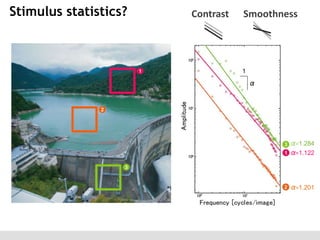
Stimulus statistics?

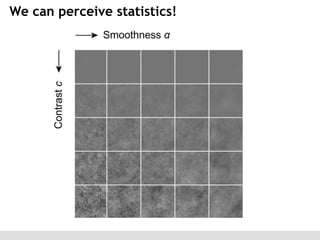
Contrast

Smoothness

1

α

α=1.284
α=1.122

α=1.201
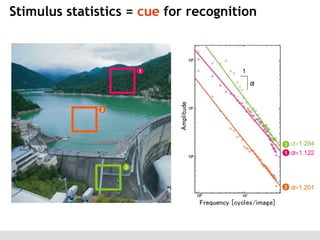
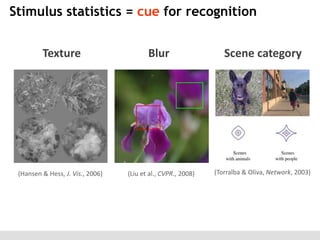
Stimulus statistics = cue for recognition

1

α

α=1.284
α=1.122

α=1.201
Stimulus statistics = cue for recognition
Texture

(Hansen & Hess, J. Vis., 2006)

Blur

(Liu et al., CVPR., 2008)

Scene category

(Torralba & Oliva, Network, 2003)
We can perceive statistics!
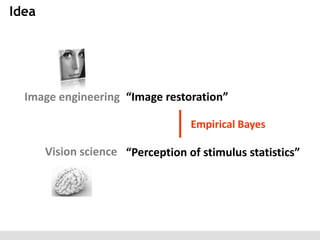
Idea

Image engineering “Image restoration”
Empirical Bayes

Vision science “Perception of stimulus statistics”
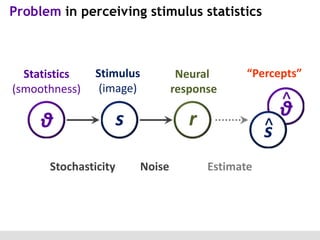
Problem in perceiving stimulus statistics

Statistics
(smoothness)

Stimulus
(image)

θ
Stochasticity

Neural
response

s

“Percepts”

r
Noise

^

^
s
Estimate

θ
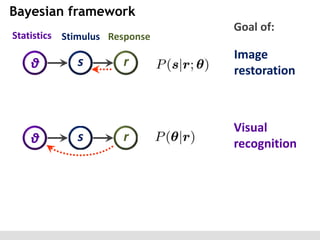
Bayesian framework
Statistics Stimulus Response

θ

θ

s

s

Goal of:

r

Image
restoration

r

Visual
recognition
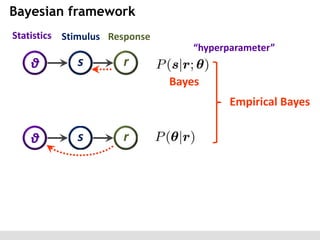
Bayesian framework
Statistics Stimulus Response
“hyperparameter”

θ

s

r
Bayes
Empirical Bayes

θ

s

r
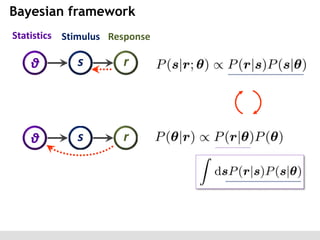
Bayesian framework
Statistics Stimulus Response

θ

s

r

θ

s

r
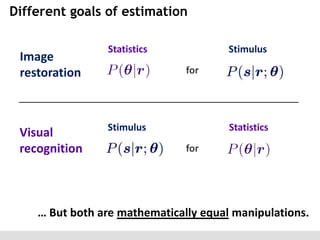
Different goals of estimation
Image
restoration

Visual
recognition

Statistics

Stimulus
for

Stimulus

Statistics
for

… But both are mathematically equal manipulations.
Different criteria
Image
restoration

Visual
recognition

Mean square error
E [ s

ˆ
s

2

/N]

Variance of
estimate

Fisher information
E [-

ln P ( r | θ )]

ˆ ] -1
Var [

(Ideal observer)
Different criteria
Image
restoration

Visual
recognition

Mean square error
E [ s

ˆ
s

2

/N]
Signal detection
theory

Fisher information
E [-

ln P ( r | θ )]

(d ' )

(Ideal observer)

2
Application
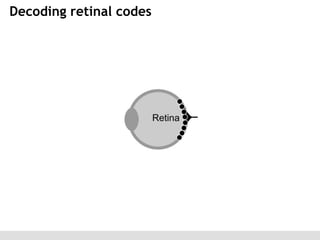
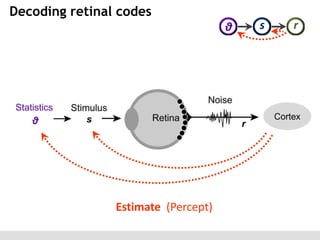
Decoding retinal codes
θ

s

r

Statistics
Cortex

θ

Estimate (Percept)
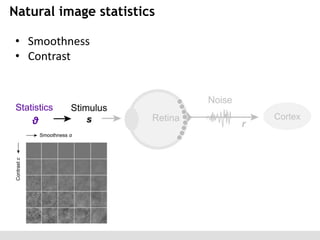
Natural image statistics
• Smoothness
• Contrast

Statistics

θ

Cortex
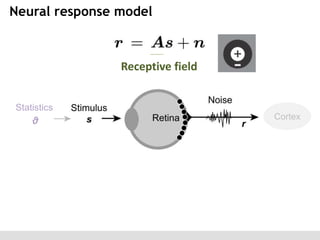
Neural response model

Receptive field
Statistics

θ

Cortex
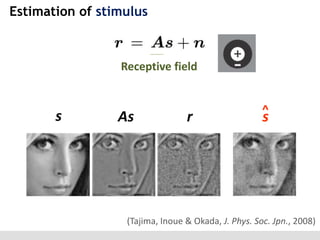
Estimation of stimulus

Receptive field

s

As

r

^

s

(Tajima, Inoue & Okada, J. Phys. Soc. Jpn., 2008)
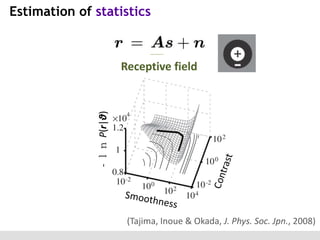
Estimation of statistics

- ln P(r|θ)

Receptive field

(Tajima, Inoue & Okada, J. Phys. Soc. Jpn., 2008)
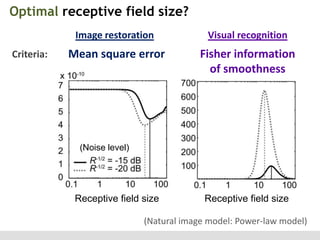
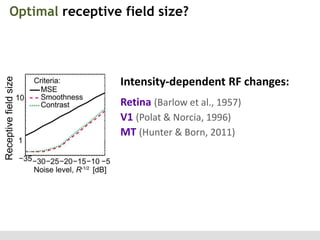
Optimal receptive field size?
Image restoration
Criteria:

Visual recognition

Mean square error

Fisher information
of smoothness

(Noise level)

Receptive field size

Receptive field size

(Natural image model: Power-law model)
Receptive field size

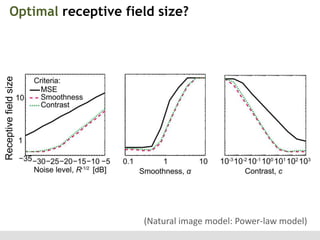
Optimal receptive field size?

(Natural image model: Power-law model)
Receptive field size

Optimal receptive field size?

Intensity-dependent RF changes:
Retina (Barlow et al., 1957)
V1 (Polat & Norcia, 1996)
MT (Hunter & Born, 2011)
Receptive field size

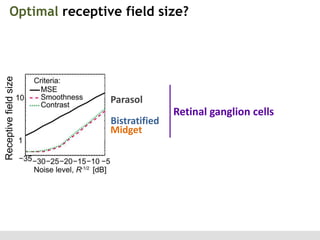
Optimal receptive field size?

Parasol

Bistratified
Midget

Retinal ganglion cells
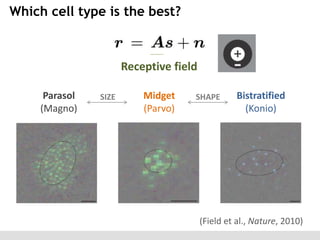
Which cell type is the best?

Receptive field
Parasol
(Magno)

SIZE

Midget
(Parvo)

SHAPE

Bistratified
(Konio)

(Field et al., Nature, 2010)
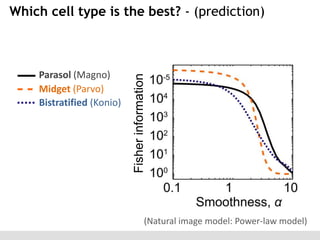
Parasol (Magno)
Midget (Parvo)
Bistratified (Konio)

Fisher information

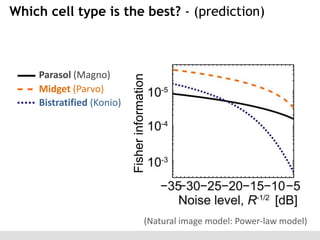
Which cell type is the best? - (prediction)

(Natural image model: Power-law model)
Parasol (Magno)
Midget (Parvo)
Bistratified (Konio)

Fisher information

Which cell type is the best? - (prediction)

(Natural image model: Power-law model)
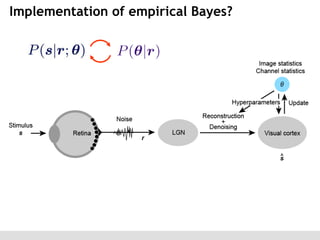
Implementation of empirical Bayes?
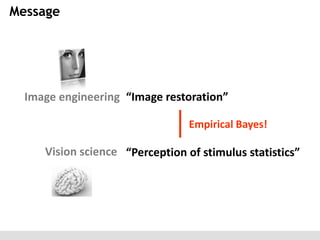
Message

Image engineering “Image restoration”
Empirical Bayes!

Vision science “Perception of stimulus statistics”
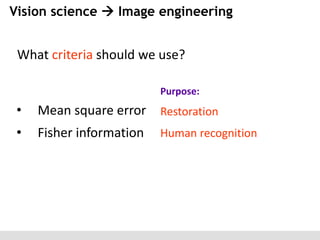
Vision science  Image engineering

What criteria should we use?
Purpose:

•

Mean square error Restoration

•

Fisher information

Human recognition
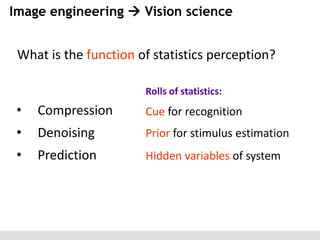
Image engineering  Vision science

What is the function of statistics perception?
Rolls of statistics:

•

Compression

Cue for recognition

•

Denoising

Prior for stimulus estimation

•

Prediction

Hidden variables of system
Perception of image statistics is empirical Bayes estimation.
Satohiro Tajima.
Defining statistical perceptions with an empirical Bayesian approach.
Physical Review E, 87(4):042707, (2013).
https://sites.google.com/site/satohirotajima/

Defining statistical perceptions with an empirical Bayesian approach.