LEARNING OUTCOMES
After demonstration,all nursing staff should
be able to
Explain what an Defibrillator is.
Define defibrillation.
Explain the use and indications of defibrillation.
Explain effects of delayed treatment.
Demonstrate how to check if the defibrillator
functions properly.
4.
LEARNING OUTCOMES
Explainrationale for actions taken.
Know what actions to take when the
device does not pass the test or
malfunction.
Record the action performed.
5.
INTRODUCTION
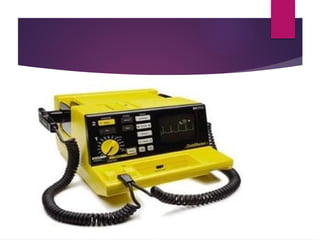
A defibrillatorMachine is an electronic device that
automatically diagnoses the life-threatening cardiac
arrhythmias of ventricular fibrillation and
pulseless ventricular tachycardia in a patient, and is
able to treat them through defibrillation, the
application of electrical therapy which stops the
arrhythmia, allowing the heart to re-establish an
effective rhythm.
7.
INTRODUCTION
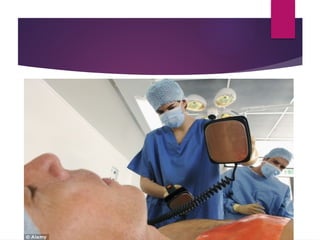
The procedureinvolves the delivery of an electric shock
to the heart which causes depolarisation of the heart
muscles and re-establishes normal conduction of the
heart’s electrical impulse. The machine used to deliver
this therapeutic shock to the heart is called a
defibrillator
With simple audio and visual commands, the
defibrillator machine allows for easy testing or checking
and most machines are self testing.
9.
QUESTIONS
Why isit important to know what a defibrillator
machine is?
When should the defibrillator be checked for
functionality and readiness?
Why is it crucial to check functionality of the
defibrillator daily?
Why do we have to record actions performed?
10.
BACKGROUND
Defibrillation wasfirst presented by Prevost and Batelli,
two physiologists from University of Geneva, Switzerland
in 1899. In animal studies, they observed that small
electric shocks delivered to the heart could trigger
ventricular fibrillation, while the delivery of large
electrical charges could reverse the fibrillation.
In 1947, the procedure was used for the first time in a
human patient. Claude Beck, Professor of surgery, at
Case Western Reserve University treated a 14 year old
boy undergoing a surgical procedure for a chest defect
and managed to restore a normal sinus rhythm in the
boy’s heart
11.
INDICATIONS FOR USE
A defibrillator is used in cases of life-threatening
cardiac arrhythmias which lead to cardiac arrest. The
rhythms that the device will treat are usually limited
to:
Pulseless Ventricular tachycardia (shortened to VT or
V-Tach)
Ventricular fibrillation (shortened to VF or V-Fib)
In each of these two types of shockable cardiac
arrhythmia, the heart is electrically active, but in a
dysfunctional pattern that does not allow it to pump
and circulate blood.
12.
CONDITIONS THAT THEDEVICE
TREATS
In ventricular fibrillation, the electrical activity of the heart
becomes chaotic, preventing the ventricle from
effectively pumping blood. The fibrillation in the heart
decreases over time, and will eventually reach asystole.
AEDs, like all defibrillators, are not designed to shock
asystole ('flat line' patterns) as this will not have a positive
clinical outcome.
The asystolic patient only has a chance of survival if,
through a combination of CPR and cardiac stimulant
drugs, one of the shockable rhythms can be established,
which makes it imperative for CPR to be carried out prior
to the arrival of a defibrillator
13.
EFFECTS OF DELAYEDTREATMENT
Uncorrected, these cardiac conditions (ventricular
tachycardia, ventricular fibrillation, asystole) rapidly lead to
irreversible brain damage and death, once cardiac arrest
takes place.
After approximately three to five minutes in cardiac
arrest, irreversible brain/tissue damage may begin to occur.
For every minute that a person in cardiac arrest goes
without being successfully treated (by defibrillation), the
chance of survival decreases by 7 percent per minute in
the first 3 minutes, and decreases by 10 percent per minute
as time advances beyond ~3 minutes.
14.
PREPARATION
We willneed a defibrillator machine
All nursing staff needs to know where the defibrillator
is located.
15.
Action Motivation
Do asocial hand wash
procedure
Infection prevention and
control
Check that your supplies
are adequate and
readily available. Hands-
free therapy electrodes,
ECG electrodes, gel,
razors, etc., should be
adequately stocked and
conveniently organized.
For a quick response in
an emergency situation.
16.
Action Motivation
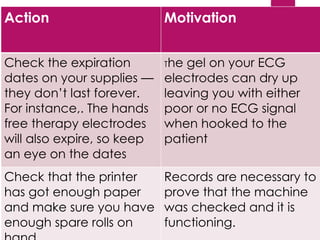
Check theexpiration
dates on your supplies —
they don’t last forever.
For instance,. The hands
free therapy electrodes
will also expire, so keep
an eye on the dates
The gel on your ECG
electrodes can dry up
leaving you with either
poor or no ECG signal
when hooked to the
patient
Check that the printer
has got enough paper
and make sure you have
enough spare rolls on
Records are necessary to
prove that the machine
was checked and it is
functioning.
17.
Action Motivation
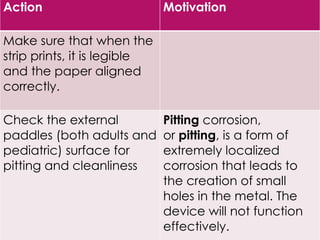
Make surethat when the
strip prints, it is legible
and the paper aligned
correctly.
Check the external
paddles (both adults and
pediatric) surface for
pitting and cleanliness
Pitting corrosion,
or pitting, is a form of
extremely localized
corrosion that leads to
the creation of small
holes in the metal. The
device will not function
effectively.
18.
t
Action Motivation
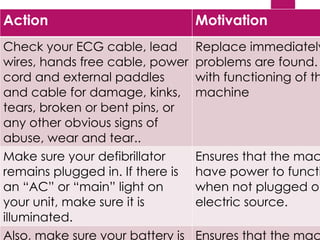
Check yourECG cable, lead
wires, hands free cable, power
cord and external paddles
and cable for damage, kinks,
tears, broken or bent pins, or
any other obvious signs of
abuse, wear and tear..
Replace immediately
problems are found.
with functioning of th
machine
Make sure your defibrillator
remains plugged in. If there is
an “AC” or “main” light on
your unit, make sure it is
illuminated.
Ensures that the mac
have power to functi
when not plugged on
electric source.
Also, make sure your battery is Ensures that the mac
19.
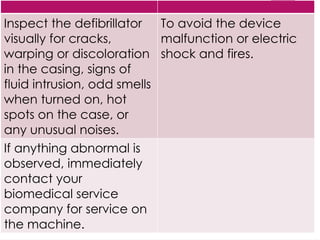
Inspect the defibrillator
visuallyfor cracks,
warping or discoloration
in the casing, signs of
fluid intrusion, odd smells
when turned on, hot
spots on the case, or
any unusual noises.
To avoid the device
malfunction or electric
shock and fires.
If anything abnormal is
observed, immediately
contact your
biomedical service
company for service on
the machine.
20.
Action Motivation
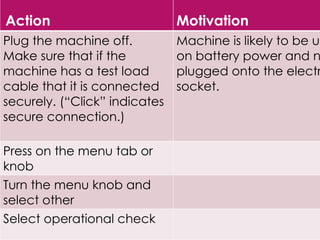
Plug themachine off.
Make sure that if the
machine has a test load
cable that it is connected
securely. (“Click” indicates
secure connection.)
Machine is likely to be us
on battery power and n
plugged onto the electr
socket.
Press on the menu tab or
knob
Turn the menu knob and
select other
Select operational check
21.
Action Motivation
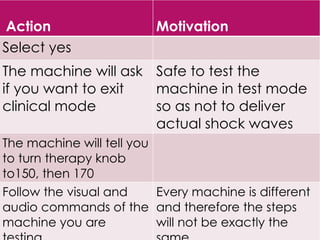
Select yes
Themachine will ask
if you want to exit
clinical mode
Safe to test the
machine in test mode
so as not to deliver
actual shock waves
The machine will tell you
to turn therapy knob
to150, then 170
Follow the visual and
audio commands of the
machine you are
Every machine is different
and therefore the steps
will not be exactly the
22.
Q& A
It isimportant to record
the test results
accurately and report
any malfunction.
Keep practicing.
23.
SOURCES
Billings, DM& Halstead, JA.2009. a guide for faculty.
ST Louise: Elsevier
Only study guide for HSE2603. 2010. Health sciences
Edcation Practica. Department of Health Studies.
University of South Africa.
https://en.wikipedia.org/wiki/Defibrillation