SQA
DEFECT MATRIX
Defect Matrix
• Defect metrics are measurements used to quantify and track defects
in software development projects. They provide insights into the
quality of the software by measuring the number, severity, and
resolution time of defects. Defect metrics help in identifying trends,
prioritizing efforts, and making data-driven decisions to improve
software quality.
• Here are some commonly used types of defect metrics:
Reasons of using defect matrix
• 1. Defect Density: Defect density measures the number of defects per
unit of code or functionality. It is calculated by dividing the total
number of defects by the size of the software (e.g., lines of code,
function points). Defect density helps in comparing the quality of
different modules or releases and identifying areas with higher defect
rates.
• 2. Defect Leakage: Defect leakage measures the number of defects
that escape the testing phase and are discovered by customers or
end-users. It is calculated by dividing the number of defects found in
production by the total number of defects found during testing.
Defect leakage indicates the effectiveness of testing activities and the
overall quality of the software.
Reasons of using defect matrix
• 3. Defect Removal Efficiency (DRE): DRE measures the effectiveness of the
defect removal process in finding and fixing defects. It is calculated by
dividing the total number of defects found and fixed before release by the
total number of defects found during development and testing. DRE helps
in assessing the efficiency of development and testing efforts and
identifying areas for improvement.
• 4. Mean Time to Detect (MTTD): MTTD measures the average time taken to
detect a defect from the time it was introduced. It is calculated by dividing
the total time taken to detect defects by the number of defects found.
MTTD helps in assessing the efficiency of defect detection processes and
identifying bottlenecks or delays in finding defects.
Reasons of using defect matrix
• 5. Mean Time to Repair (MTTR): MTTR measures the average time
taken to fix or resolve a defect. It is calculated by dividing the total
time taken to fix defects by the number of defects resolved. MTTR
helps in assessing the efficiency of defect resolution processes and
identifying areas for improvement in terms of response and
resolution times.
• 6. Severity Distribution: Severity distribution measures the
distribution of defects based on their severity levels (e.g., critical,
major, minor). It helps in understanding the impact of defects on the
software and prioritizing efforts based on the severity of the issues.
Calculations
• To calculate defect metrics, you need to collect data on defects, their
severity, detection time, resolution time, and other relevant information.
This data can be obtained from defect tracking tools, testing reports,
customer feedback, and production logs. Once you have the data, you can
apply the formulas or calculations specific to each metric to derive the
corresponding values.It's important to note that defect metrics should be
used in conjunction with other quality metrics and should not be the sole
basis for decision-making. They provide valuable insights into the defect
landscape but should be interpreted and analyzed in the context of the
software development process, project goals, and customer expectations.
• Here are the formulas to calculate some commonly used defect metrics:
Calculations
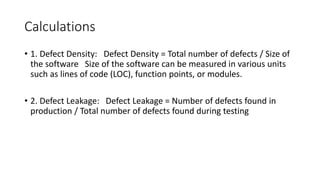
• 1. Defect Density: Defect Density = Total number of defects / Size of
the software Size of the software can be measured in various units
such as lines of code (LOC), function points, or modules.
• 2. Defect Leakage: Defect Leakage = Number of defects found in
production / Total number of defects found during testing
Calculations
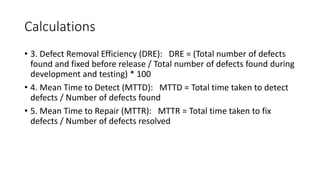
• 3. Defect Removal Efficiency (DRE): DRE = (Total number of defects
found and fixed before release / Total number of defects found during
development and testing) * 100
• 4. Mean Time to Detect (MTTD): MTTD = Total time taken to detect
defects / Number of defects found
• 5. Mean Time to Repair (MTTR): MTTR = Total time taken to fix
defects / Number of defects resolved
Important to note:
• It's important to note that these formulas provide a general framework for
calculating defect metrics. The specific calculation may vary depending on
the context, organization, and the units used to measure defects and
software size. It is recommended to customize the formulas based on the
specific requirements and definitions used within your organization.
• Additionally, it's crucial to capture accurate and reliable data for defect
metrics calculations. This requires proper tracking and documentation of
defects, their severity, detection time, resolution time, and other relevant
information. Using defect tracking tools or software quality management
systems can help streamline data collection and improve the accuracy of
defect metrics calculations.
• --------------------------------the end-------------------------------

Defect matrix in software quality assurance.pptx

  • 1.
  • 2.
    Defect Matrix • Defectmetrics are measurements used to quantify and track defects in software development projects. They provide insights into the quality of the software by measuring the number, severity, and resolution time of defects. Defect metrics help in identifying trends, prioritizing efforts, and making data-driven decisions to improve software quality. • Here are some commonly used types of defect metrics:
  • 3.
    Reasons of usingdefect matrix • 1. Defect Density: Defect density measures the number of defects per unit of code or functionality. It is calculated by dividing the total number of defects by the size of the software (e.g., lines of code, function points). Defect density helps in comparing the quality of different modules or releases and identifying areas with higher defect rates. • 2. Defect Leakage: Defect leakage measures the number of defects that escape the testing phase and are discovered by customers or end-users. It is calculated by dividing the number of defects found in production by the total number of defects found during testing. Defect leakage indicates the effectiveness of testing activities and the overall quality of the software.
  • 4.
    Reasons of usingdefect matrix • 3. Defect Removal Efficiency (DRE): DRE measures the effectiveness of the defect removal process in finding and fixing defects. It is calculated by dividing the total number of defects found and fixed before release by the total number of defects found during development and testing. DRE helps in assessing the efficiency of development and testing efforts and identifying areas for improvement. • 4. Mean Time to Detect (MTTD): MTTD measures the average time taken to detect a defect from the time it was introduced. It is calculated by dividing the total time taken to detect defects by the number of defects found. MTTD helps in assessing the efficiency of defect detection processes and identifying bottlenecks or delays in finding defects.
  • 5.
    Reasons of usingdefect matrix • 5. Mean Time to Repair (MTTR): MTTR measures the average time taken to fix or resolve a defect. It is calculated by dividing the total time taken to fix defects by the number of defects resolved. MTTR helps in assessing the efficiency of defect resolution processes and identifying areas for improvement in terms of response and resolution times. • 6. Severity Distribution: Severity distribution measures the distribution of defects based on their severity levels (e.g., critical, major, minor). It helps in understanding the impact of defects on the software and prioritizing efforts based on the severity of the issues.
  • 6.
    Calculations • To calculatedefect metrics, you need to collect data on defects, their severity, detection time, resolution time, and other relevant information. This data can be obtained from defect tracking tools, testing reports, customer feedback, and production logs. Once you have the data, you can apply the formulas or calculations specific to each metric to derive the corresponding values.It's important to note that defect metrics should be used in conjunction with other quality metrics and should not be the sole basis for decision-making. They provide valuable insights into the defect landscape but should be interpreted and analyzed in the context of the software development process, project goals, and customer expectations. • Here are the formulas to calculate some commonly used defect metrics:
  • 7.
    Calculations • 1. DefectDensity: Defect Density = Total number of defects / Size of the software Size of the software can be measured in various units such as lines of code (LOC), function points, or modules. • 2. Defect Leakage: Defect Leakage = Number of defects found in production / Total number of defects found during testing
  • 8.
    Calculations • 3. DefectRemoval Efficiency (DRE): DRE = (Total number of defects found and fixed before release / Total number of defects found during development and testing) * 100 • 4. Mean Time to Detect (MTTD): MTTD = Total time taken to detect defects / Number of defects found • 5. Mean Time to Repair (MTTR): MTTR = Total time taken to fix defects / Number of defects resolved
  • 9.
    Important to note: •It's important to note that these formulas provide a general framework for calculating defect metrics. The specific calculation may vary depending on the context, organization, and the units used to measure defects and software size. It is recommended to customize the formulas based on the specific requirements and definitions used within your organization. • Additionally, it's crucial to capture accurate and reliable data for defect metrics calculations. This requires proper tracking and documentation of defects, their severity, detection time, resolution time, and other relevant information. Using defect tracking tools or software quality management systems can help streamline data collection and improve the accuracy of defect metrics calculations. • --------------------------------the end-------------------------------