Understanding
Deferred Taxes
By Darayus Bajan
The term “Deferred” as per the dictionary means
a) to postpone or to delay
OR
b) Withhold until a future date
What is the meaning of the term
“Deferred”?
2
Deferred Tax in very simple terms is the difference in TAX
between Accounting/Book profits and Taxable profits.
For e.g. If the Tax Rate is say 30%.
On Book Profits of Rs. 1,000, tax at 30% shall be Rs. 300
On Taxable Profits of Rs. 1,200, tax at 30% shall be Rs. 360
In the above e.g. Deferred Tax (DT) is Rs. 60
Now let us analyze this difference in profits as per books (as
per Cos Act and AS) and profits as per tax laws (taxable
profits)
What is Deferred Tax?
3
Main Reason – differences between provisions of AS/Cos Act
and those under Tax Laws (Income Tax Act).
Examples of differences:
1) Depreciation computation between Cos Act and Income
Tax Act
a) different rates,
b) 180 days Vs. actual no. of days,
c) Diff methods - SLM vs. WDV etc.
2) Certain expenditure allowed on only payment basis under
Income Tax Act – for e.g. Payment of Bonus/Gratuity etc.
Why & what are the differences in
book and tax profits ?
4
The differences between the book profits and taxable profits
can be broadly split into two types:
A. Temporary differences
Where an item of expenditure is disallowed in one
year but allowed in another year say depreciation,
payment of gratuity etc.
B. Permanent Differences
When an item of expenditure is NEVER allowed as a tax
deductible item. Say contribution to a political party,
donations not exempt u/s 80 etc.
What are the types/nature of
differences in taxable profits?
5
When the book and tax profits are different, the effective tax
rate is significantly different than the enacted tax rate.
In our earlier example, the book profits are Rs. 1,000 but the
actual tax required to be paid to the government is Rs. 360,
so the tax rate becomes 36% instead of 30%.
Similarly in Year 2, the book profits shall be Rs. 1,000, but the
tax shall be computed as Rs. 800 * 30% = Rs. 240, the
effective tax rate becomes 24%
Also summarized in table on the next slide
What happens when there are
differences in book and tax profits ?
6
What happens when there are
differences in book and tax profits ?
7
Whenever there are differences between
book profits and taxable profits on account
of differences between the two laws the
actual tax charge distorts the profits after tax
as the effective tax rate is very different from
the enacted tax rate. This creates volatility in
performance of the company.
What is the Conclusion?
8
To eliminate volatility in the performance of
the company PL we need to account for taxes
using Deferred Tax.
Let us now evaluate how accounting for tax
on Def tax basis removes the volatility in our
earlier example.
How do we do to eliminate the
volatility in profits after tax?
9
Use of Deferred Tax
10
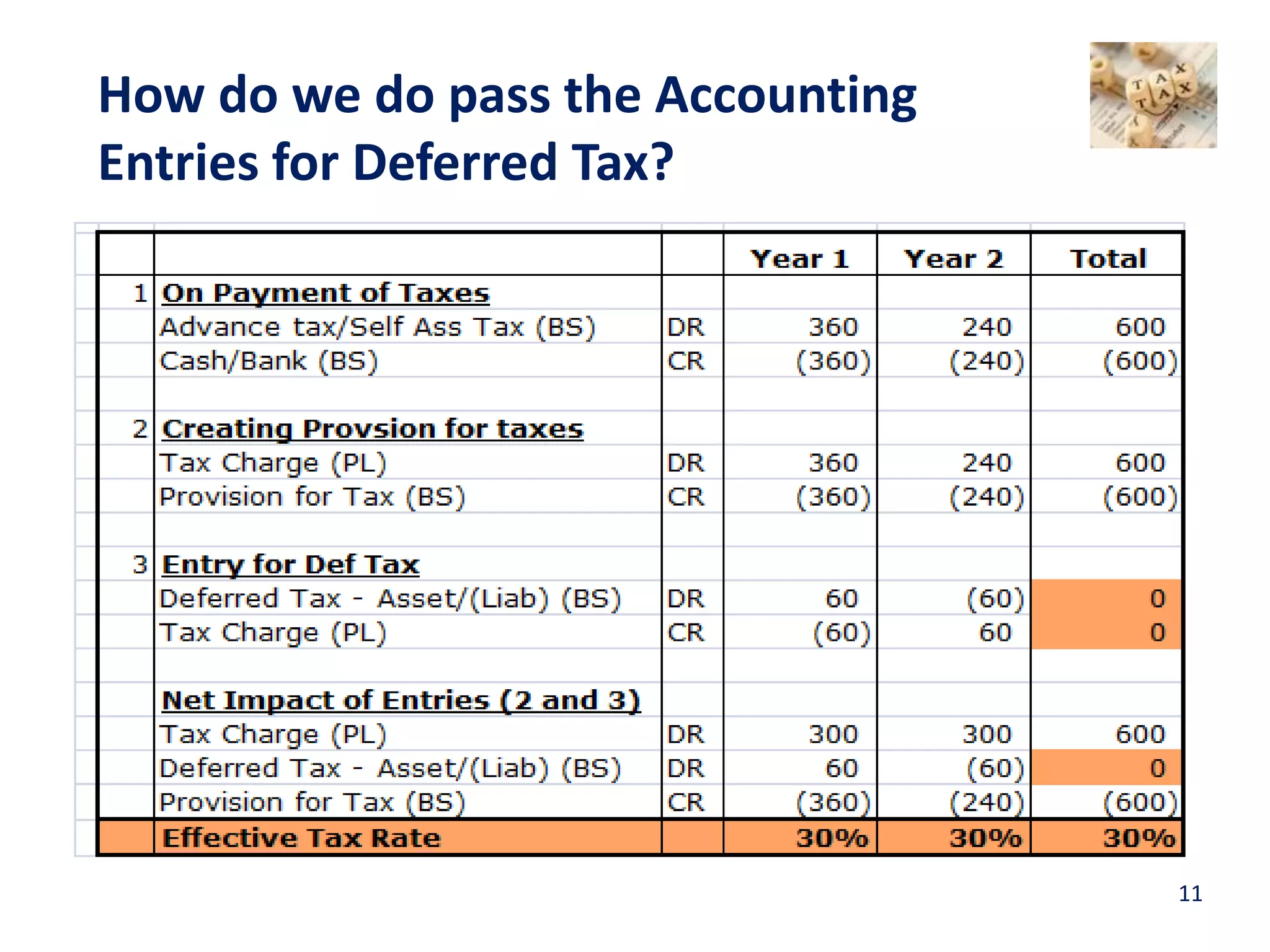
How do we do pass the Accounting
Entries for Deferred Tax?
11
Def Tax Asset – when tax paid in a year is HIGHER than what
is required to be paid as per the books, an asset is created
which can be used to reduce tax impact in future. For e.g.
expenses allowed only on payment basis – bonus, gratuity
etc.
Def Tax Liability – when tax paid is LOWER than what is
required as per the books, a liability is created which shall
need to be paid in future. For e.g. higher rates of
depreciation allowed under tax laws.
What is a Deferred Tax Asset and a
Deferred tax liability?
12
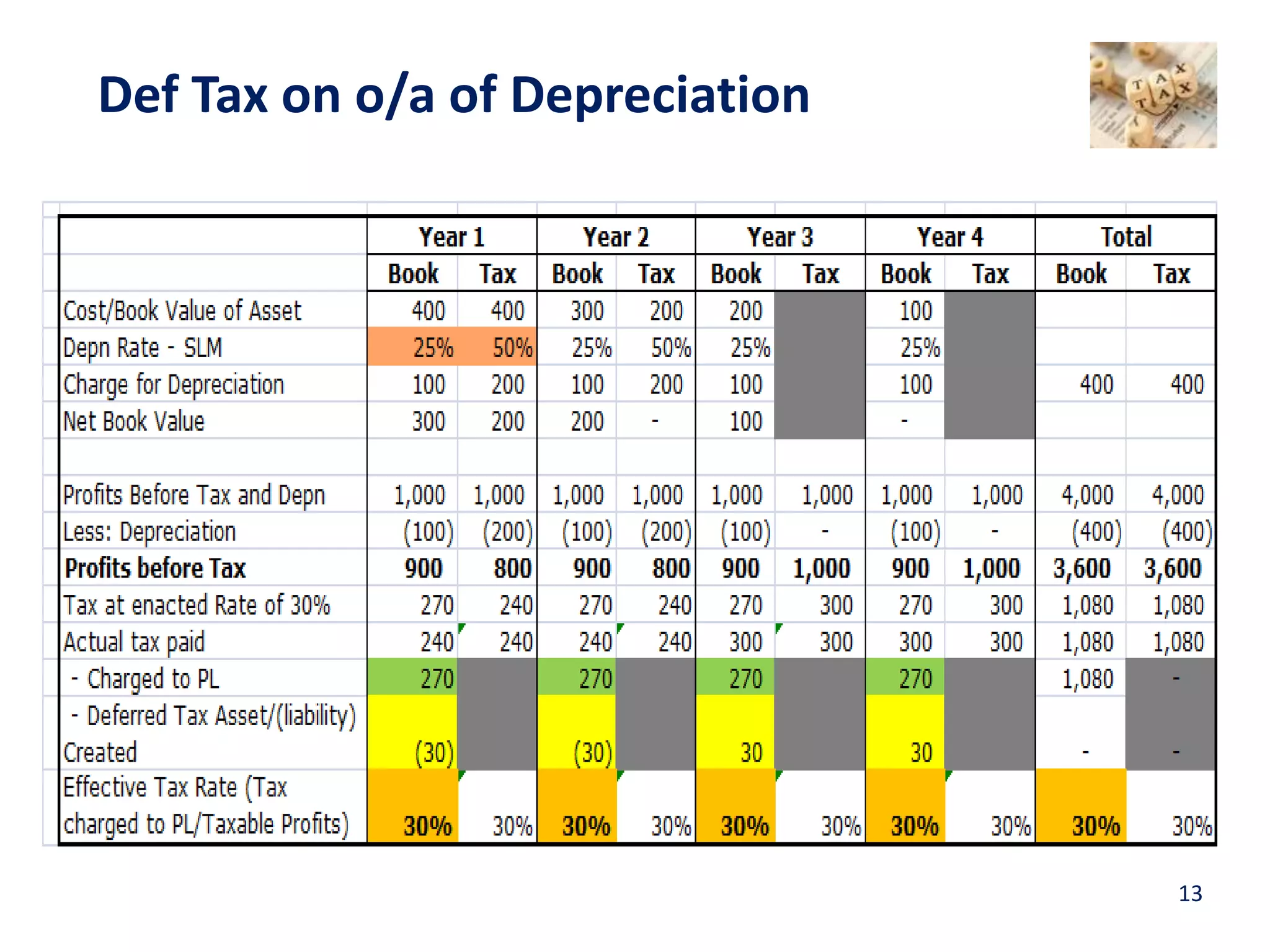
Def Tax on o/a of Depreciation
13
Deferred tax can eliminate volatility only in
respect of temporary differences. In case of
permanent differences, the effective tax rate
is actually higher than the enacted tax rate.
Can Accounting for Deferred Tax take
care of all differences?
14
QUESTIONS?

Def tax

  • 1.
  • 2.
    The term “Deferred”as per the dictionary means a) to postpone or to delay OR b) Withhold until a future date What is the meaning of the term “Deferred”? 2
  • 3.
    Deferred Tax invery simple terms is the difference in TAX between Accounting/Book profits and Taxable profits. For e.g. If the Tax Rate is say 30%. On Book Profits of Rs. 1,000, tax at 30% shall be Rs. 300 On Taxable Profits of Rs. 1,200, tax at 30% shall be Rs. 360 In the above e.g. Deferred Tax (DT) is Rs. 60 Now let us analyze this difference in profits as per books (as per Cos Act and AS) and profits as per tax laws (taxable profits) What is Deferred Tax? 3
  • 4.
    Main Reason –differences between provisions of AS/Cos Act and those under Tax Laws (Income Tax Act). Examples of differences: 1) Depreciation computation between Cos Act and Income Tax Act a) different rates, b) 180 days Vs. actual no. of days, c) Diff methods - SLM vs. WDV etc. 2) Certain expenditure allowed on only payment basis under Income Tax Act – for e.g. Payment of Bonus/Gratuity etc. Why & what are the differences in book and tax profits ? 4
  • 5.
    The differences betweenthe book profits and taxable profits can be broadly split into two types: A. Temporary differences Where an item of expenditure is disallowed in one year but allowed in another year say depreciation, payment of gratuity etc. B. Permanent Differences When an item of expenditure is NEVER allowed as a tax deductible item. Say contribution to a political party, donations not exempt u/s 80 etc. What are the types/nature of differences in taxable profits? 5
  • 6.
    When the bookand tax profits are different, the effective tax rate is significantly different than the enacted tax rate. In our earlier example, the book profits are Rs. 1,000 but the actual tax required to be paid to the government is Rs. 360, so the tax rate becomes 36% instead of 30%. Similarly in Year 2, the book profits shall be Rs. 1,000, but the tax shall be computed as Rs. 800 * 30% = Rs. 240, the effective tax rate becomes 24% Also summarized in table on the next slide What happens when there are differences in book and tax profits ? 6
  • 7.
    What happens whenthere are differences in book and tax profits ? 7
  • 8.
    Whenever there aredifferences between book profits and taxable profits on account of differences between the two laws the actual tax charge distorts the profits after tax as the effective tax rate is very different from the enacted tax rate. This creates volatility in performance of the company. What is the Conclusion? 8
  • 9.
    To eliminate volatilityin the performance of the company PL we need to account for taxes using Deferred Tax. Let us now evaluate how accounting for tax on Def tax basis removes the volatility in our earlier example. How do we do to eliminate the volatility in profits after tax? 9
  • 10.
  • 11.
    How do wedo pass the Accounting Entries for Deferred Tax? 11
  • 12.
    Def Tax Asset– when tax paid in a year is HIGHER than what is required to be paid as per the books, an asset is created which can be used to reduce tax impact in future. For e.g. expenses allowed only on payment basis – bonus, gratuity etc. Def Tax Liability – when tax paid is LOWER than what is required as per the books, a liability is created which shall need to be paid in future. For e.g. higher rates of depreciation allowed under tax laws. What is a Deferred Tax Asset and a Deferred tax liability? 12
  • 13.
    Def Tax ono/a of Depreciation 13
  • 14.
    Deferred tax caneliminate volatility only in respect of temporary differences. In case of permanent differences, the effective tax rate is actually higher than the enacted tax rate. Can Accounting for Deferred Tax take care of all differences? 14
  • 15.