IAS-12 Income Tax
C R
General Definitions
Accounting Profit: Net profit or loss for the period before deducting tax expense
Taxable Profit/Loss: The profit/loss determined for the period in accordance with the
rules established by the tax authorities
Tax Expense: The aggregate amount included in the determination of Net profit/loss
in respect of Current and deferred tax
Debit SOPL ( tax charge)
Credit Tax liability ( SOFP)
Current Tax: Amount of tax actually payable to tax authorities in relation to the
trading activities of the entity
Deferred Tax: An accounting measure used to match the tax effects of the
transactions with their accounting impact
Recognition of Current Tax Liabilities and Asset
Any Unpaid tax paid in respect of current or prior periods is
recognized as Liability
Any Excess tax paid in respect of current or prior periods is
recognized as Asset
Any Tax Loss than can be carried back to recover the
current tax of a previous period is to also be recognized as
an Asset
Temporary and Permanent differences
• Permanent difference- when certain items of expense or revenue is excluded
from computation of taxable profits eg. Entertainment expenses not allowed in
tax regime
• Temporary difference- where income or revenue is considered in both
accounting and taxable profits- but not in the same accounting period.
• These are timing differences and even out in subsequent accounting periods
• Tax base Amount attributed to Asset/Liability for tax computation. Different
jurisdictions have different tax rules and these rules determine the tax base.
Deferred tax arise due to temporary differences
Deferred tax is an accounting measure used to match up -
the tax effects of transactions with their accounting impact
• All taxable temporary Differences – Deferred Tax Liability
• -amounts that will be taxed but will be in future when carrying value of asset
value is recovered or liability is settled
• All deductible temporary Differences – Deferred Tax Asset
• - amounts that will be deductible future when carrying value of asset value is
recovered or liability is settled
Issue of Deferred Tax
• Some items of income and expense are included in the accounting
profit of one period but included in the tax determination of
another period
• This happens because the accounting rules follow the principles of
IFRS whereas tax is determined by the tax rules established by the
authorities
• To remove this discrepancy, a deferred tax adjustment is made
Example of temporary differences
1)Accrued Income is included in the financial statements on an accrual basis. If
chargeable for tax on cash basis, the tax base is NIL since the cash has not yet
been received. If chargeable for tax on accrual basis, then the tax base would be
same as the carrying value.
2) Interest revenue included in SOPL on accrual basis. Included in tax profit on
cash basis
3) Sale of goods included in accounting profit when goods are delivered, but
included in tax profit only when cash is received
4) Development costs which have been capitalized to b amortised in SOPL , but
deducted in full from taxable profits in the period they were incurred
Calculate Tax Base and Difference
1) A machine costs $10,000 and has carrying amount of $8,000. For tax
purposes, depreciation of $3,000 has already been deducted in the current
and prior periods. Revenue generated by using the machine is taxable and
any gain on disposal will be taxable and any loss will be deductible for tax
purposes. Calculate deferred tax liability at 30%
2)Interest receivable has carrying amount of $1,000. Related interest
revenue will be taxed on cash basis.
3)Trade receivables has a carrying amount of $10,000. The related revenue
has already been included for taxable profit.
4)Current liabilities include accrued expenses with a carrying amount of
$1,000. Related expense will be deducted for tax purpose on a cash basis.
5) A loan payable has a carrying value of $2 mn. Repayment of the loan will
have no tax consequences.
6) Current liabilities include accrued expenses with a carrying value of
$2,000. the related expense has already been deducted for tax purpose
Answer
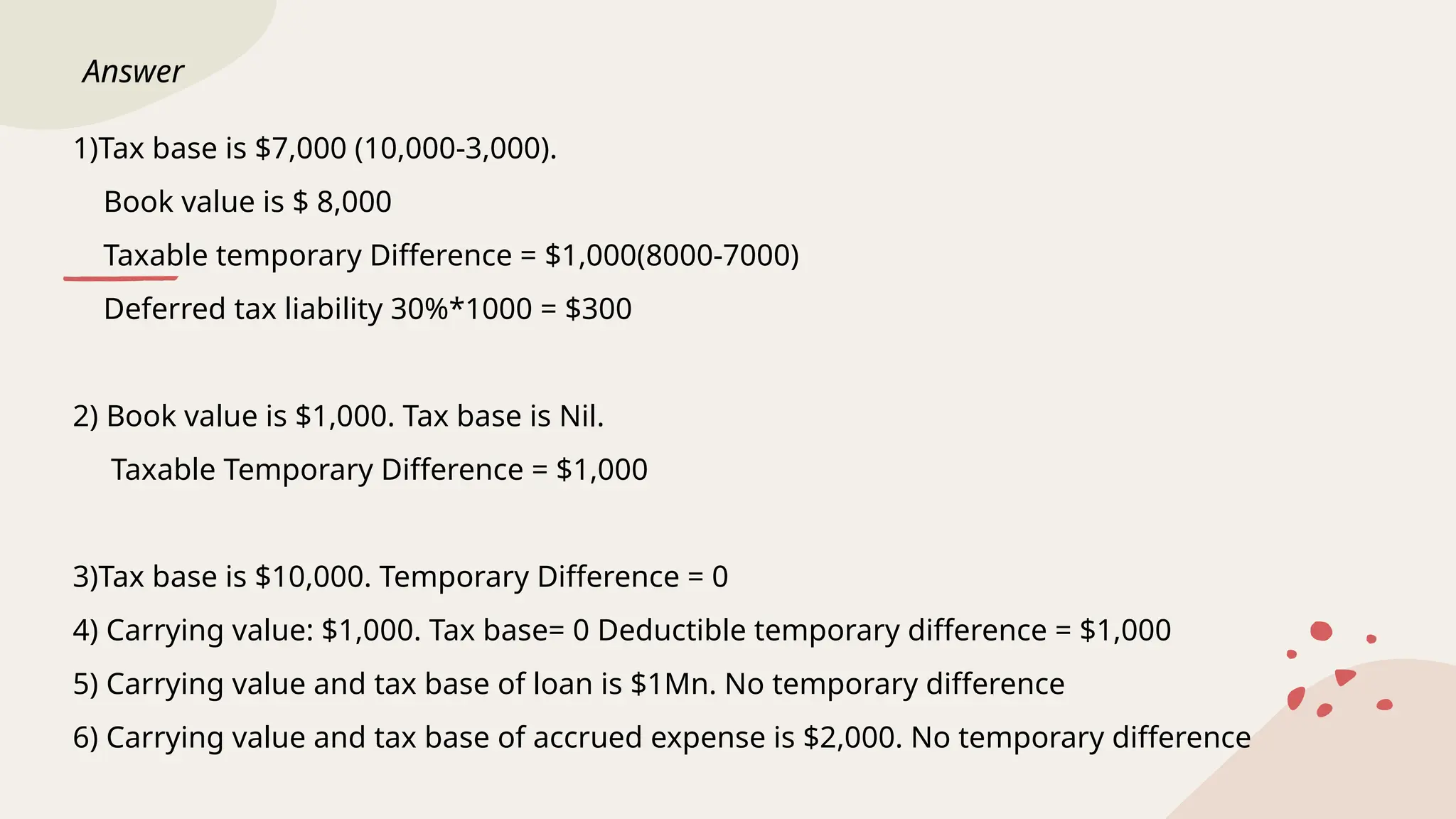
1)Tax base is $7,000 (10,000-3,000).
Book value is $ 8,000
Taxable temporary Difference = $1,000(8000-7000)
Deferred tax liability 30%*1000 = $300
2) Book value is $1,000. Tax base is Nil.
Taxable Temporary Difference = $1,000
3)Tax base is $10,000. Temporary Difference = 0
4) Carrying value: $1,000. Tax base= 0 Deductible temporary difference = $1,000
5) Carrying value and tax base of loan is $1Mn. No temporary difference
6) Carrying value and tax base of accrued expense is $2,000. No temporary difference
Example
Charlton revalued a property from a carrying value of $2
Million to its fair value of $2.5 Million during the reporting
period. The property cost $2.2 Million, and its tax base is
$1.8 Million. The tax rate is 30%. Explain the deferred tax
implications at the end of the reporting period.
Answer
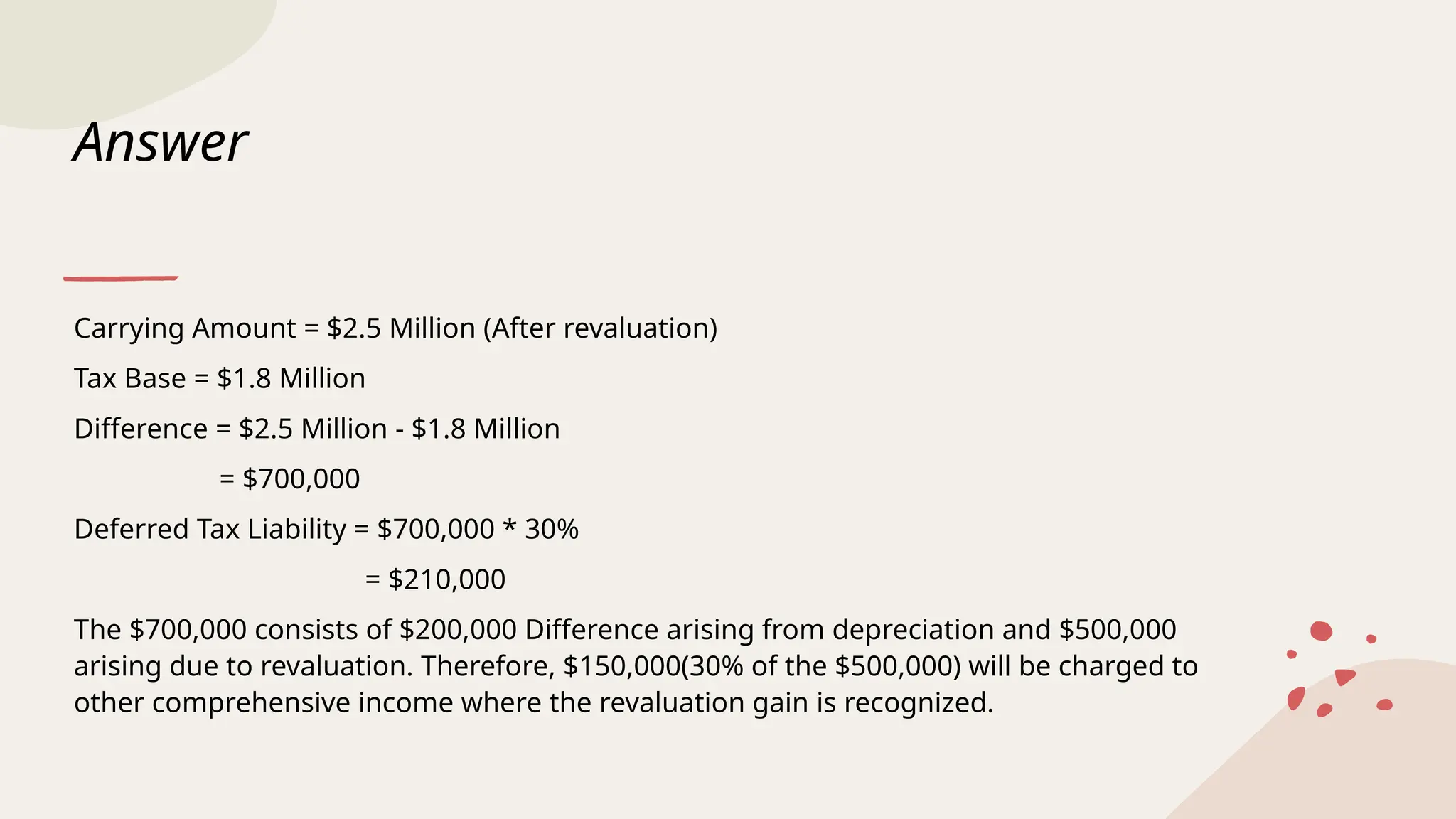
Carrying Amount = $2.5 Million (After revaluation)
Tax Base = $1.8 Million
Difference = $2.5 Million - $1.8 Million
= $700,000
Deferred Tax Liability = $700,000 * 30%
= $210,000
The $700,000 consists of $200,000 Difference arising from depreciation and $500,000
arising due to revaluation. Therefore, $150,000(30% of the $500,000) will be charged to
other comprehensive income where the revaluation gain is recognized.
Question
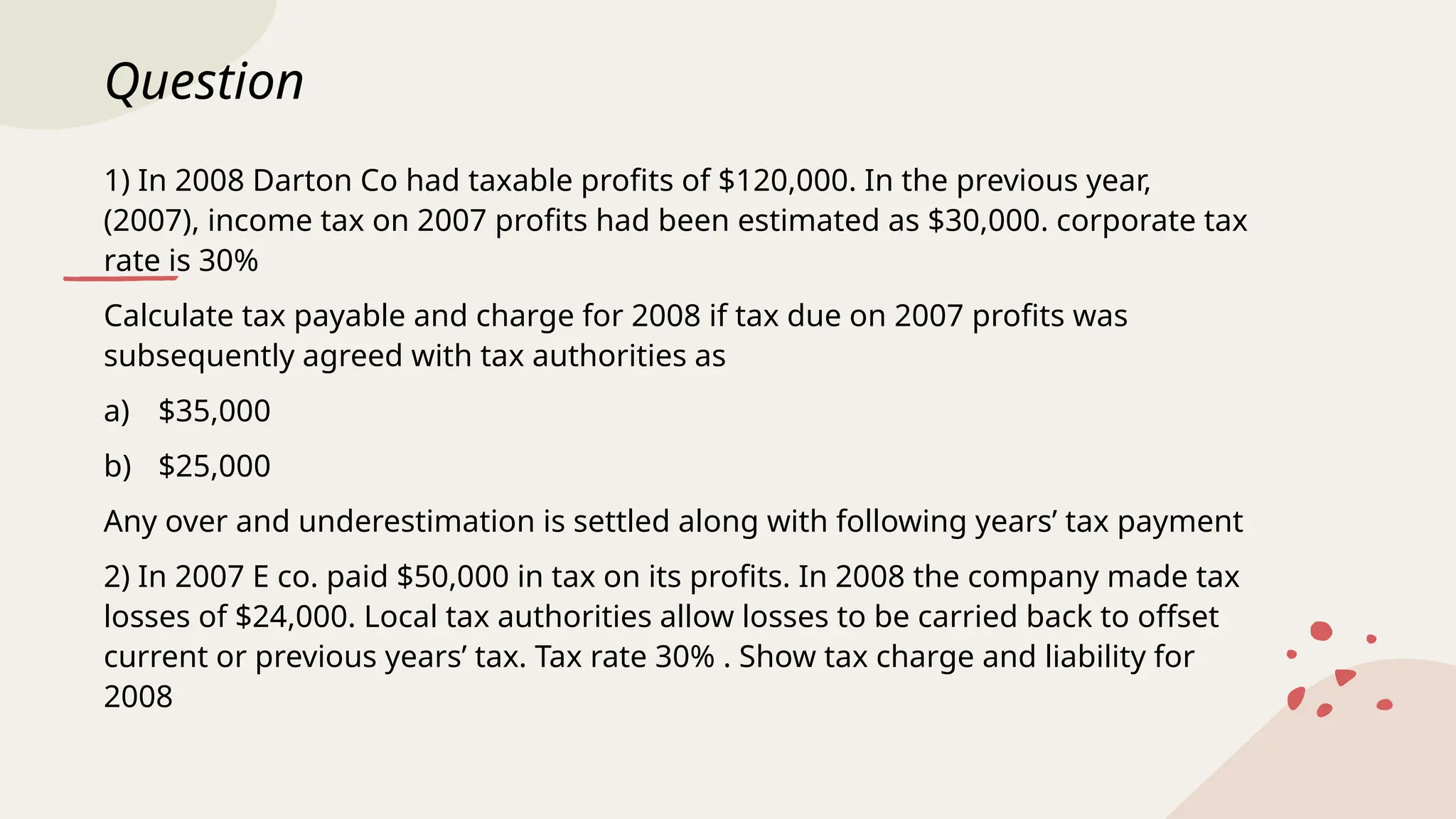
1) In 2008 Darton Co had taxable profits of $120,000. In the previous year,
(2007), income tax on 2007 profits had been estimated as $30,000. corporate tax
rate is 30%
Calculate tax payable and charge for 2008 if tax due on 2007 profits was
subsequently agreed with tax authorities as
a) $35,000
b) $25,000
Any over and underestimation is settled along with following years’ tax payment
2) In 2007 E co. paid $50,000 in tax on its profits. In 2008 the company made tax
losses of $24,000. Local tax authorities allow losses to be carried back to offset
current or previous years’ tax. Tax rate 30% . Show tax charge and liability for
2008
Answer
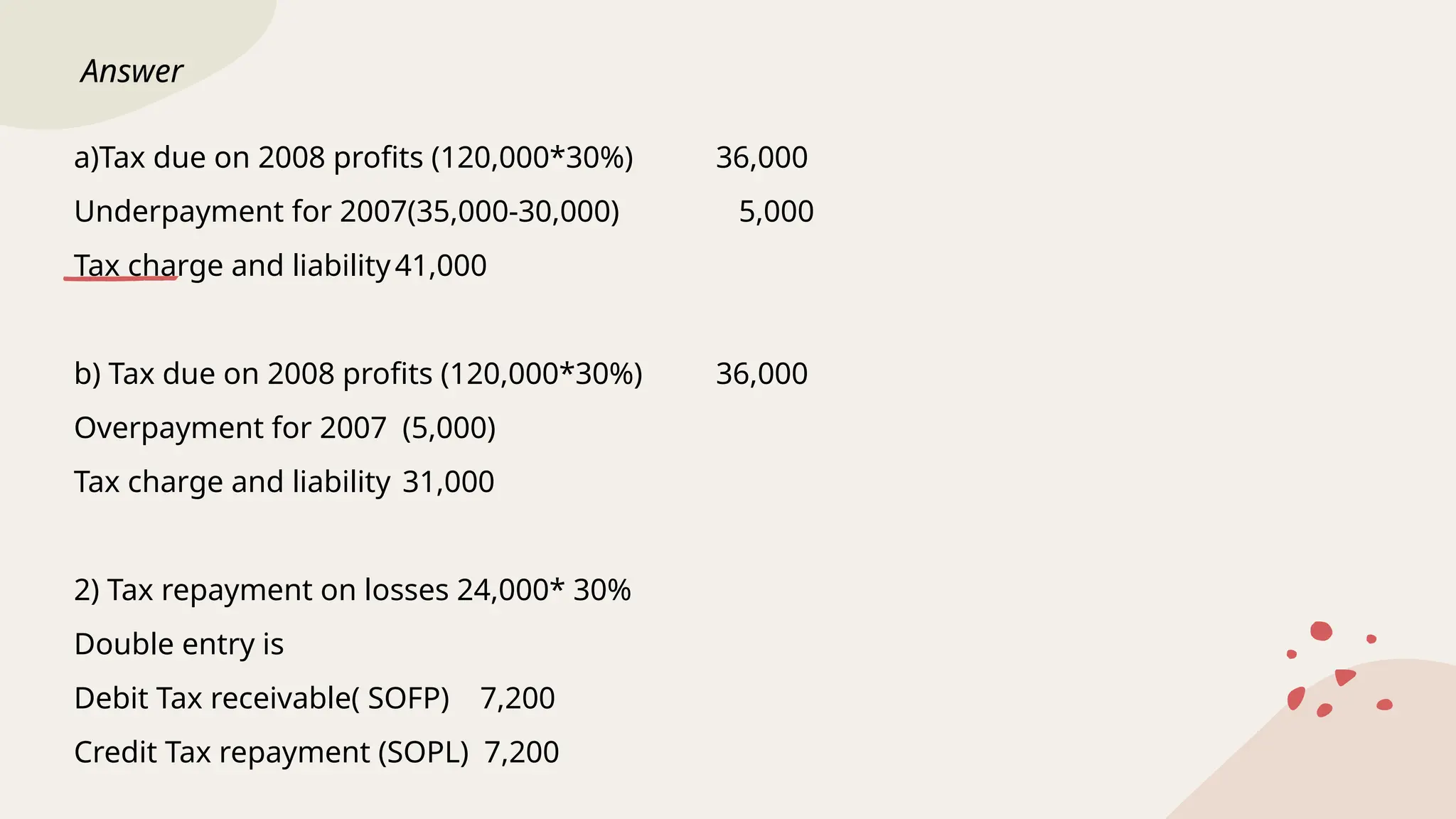
a)Tax due on 2008 profits (120,000*30%) 36,000
Underpayment for 2007(35,000-30,000) 5,000
Tax charge and liability41,000
b) Tax due on 2008 profits (120,000*30%) 36,000
Overpayment for 2007 (5,000)
Tax charge and liability 31,000
2) Tax repayment on losses 24,000* 30%
Double entry is
Debit Tax receivable( SOFP) 7,200
Credit Tax repayment (SOPL) 7,200
Exemption
No deferred tax should be recognized on the initial recognition of :
Asset/Liability, acquired in a business combination that has no effect on the
taxable or accounting profit
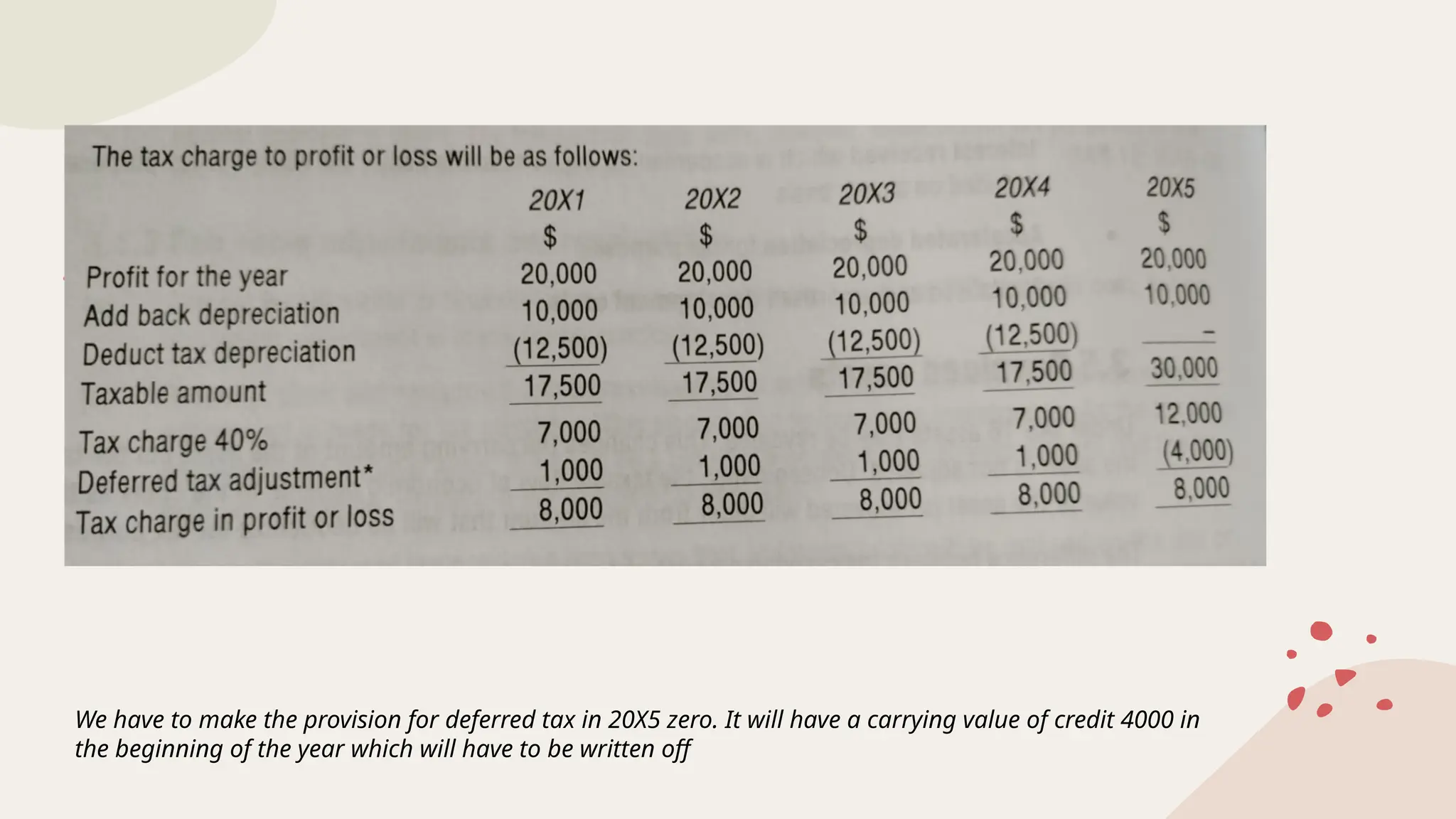
We have to make the provision for deferred tax in 20X5 zero. It will have a carrying value of credit 4000 in the
beginning of the year which will have to be written off
We have to make the provision for deferred tax in 20X5 zero. It will have a carrying value of credit 4000 in
the beginning of the year which will have to be written off
Group Financial Statements
• When temporary differences arise in a business combination, the
carrying amount taken would be the value in the consolidated
statement of financial position.
• Tax base is determined by the applicable tax rules. Authorities
usually calculate tax on the profits of the individual entities and
not group profits.
Fair Value Adjustments
Since IFRS 3 requires the assets and liabilities assumed on acquisition to be
consolidated at their fair value, a temporary difference arises.
If fair value gain – Deferred Tax Liability
Debit Goodwill
Credit Deferred Tax Liability
If fair value loss – Deferred Tax Asset
Debit Deferred Tax Asset
Credit Goodwill
Example
On 1st April 20X5, Alpha purchased 100% ordinary shares of Beta.
The fair value of the assets and liabilities were considered to be
equal to their carrying amounts with the exception of equipment,
which had a fair value of $54 Million. The tax base of equipment on
1st April 20X5 was $50 Million. The tax rate is 25% and fair value
adjustment does not affect the tax base. Calculate Deferred tax
asset/liability
Answer
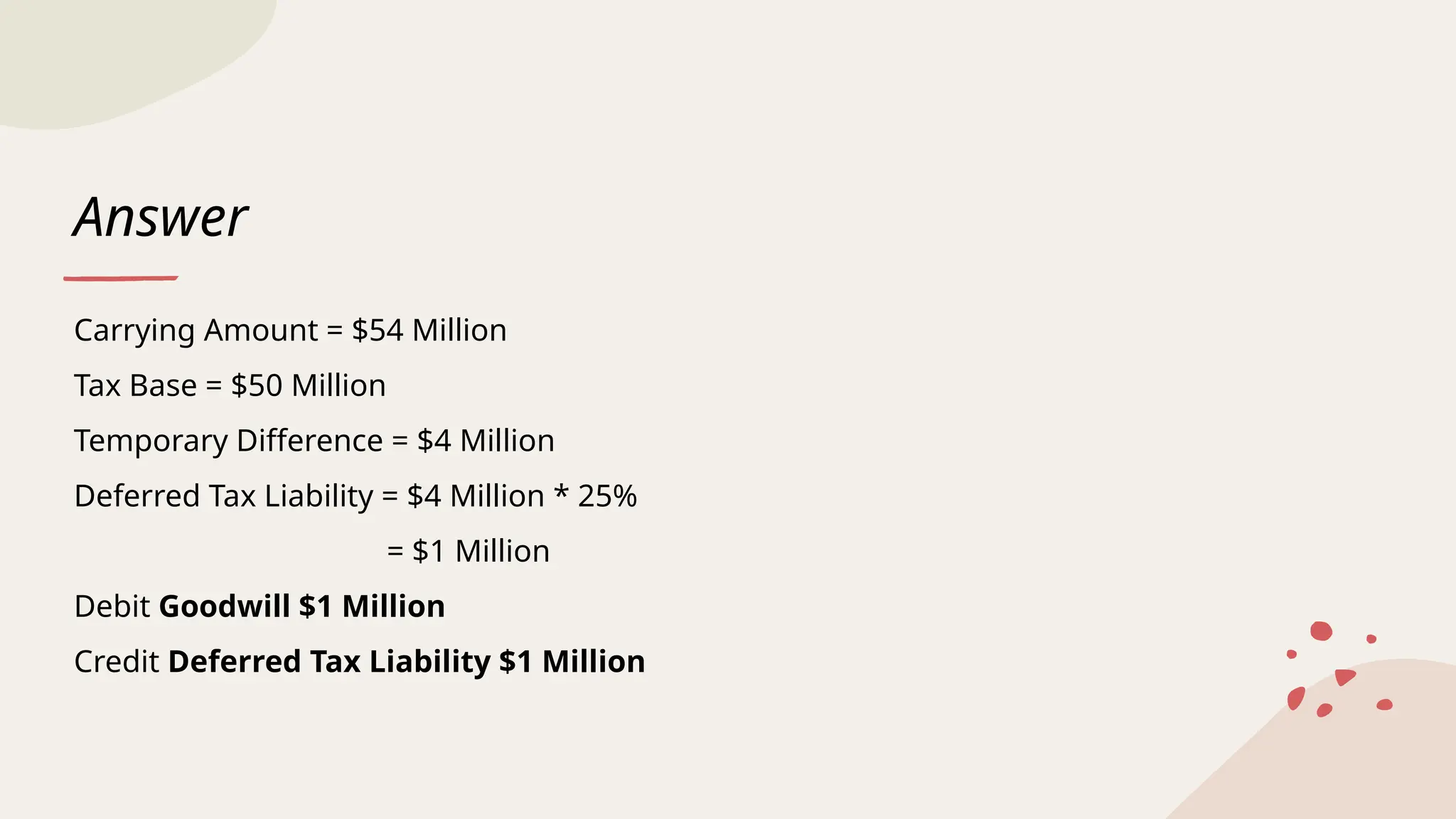
Carrying Amount = $54 Million
Tax Base = $50 Million
Temporary Difference = $4 Million
Deferred Tax Liability = $4 Million * 25%
= $1 Million
Debit Goodwill $1 Million
Credit Deferred Tax Liability $1 Million
Deferred tax :
Other temporary differences
1. Depreciation difference
Revaluation of assets
Unused tax loss and tax credits
incometaxes christ university bangalore india

incometaxes christ university bangalore india

  • 1.
  • 2.
    General Definitions Accounting Profit:Net profit or loss for the period before deducting tax expense Taxable Profit/Loss: The profit/loss determined for the period in accordance with the rules established by the tax authorities Tax Expense: The aggregate amount included in the determination of Net profit/loss in respect of Current and deferred tax Debit SOPL ( tax charge) Credit Tax liability ( SOFP) Current Tax: Amount of tax actually payable to tax authorities in relation to the trading activities of the entity Deferred Tax: An accounting measure used to match the tax effects of the transactions with their accounting impact
  • 3.
    Recognition of CurrentTax Liabilities and Asset Any Unpaid tax paid in respect of current or prior periods is recognized as Liability Any Excess tax paid in respect of current or prior periods is recognized as Asset Any Tax Loss than can be carried back to recover the current tax of a previous period is to also be recognized as an Asset
  • 4.
    Temporary and Permanentdifferences • Permanent difference- when certain items of expense or revenue is excluded from computation of taxable profits eg. Entertainment expenses not allowed in tax regime • Temporary difference- where income or revenue is considered in both accounting and taxable profits- but not in the same accounting period. • These are timing differences and even out in subsequent accounting periods • Tax base Amount attributed to Asset/Liability for tax computation. Different jurisdictions have different tax rules and these rules determine the tax base.
  • 5.
    Deferred tax arisedue to temporary differences Deferred tax is an accounting measure used to match up - the tax effects of transactions with their accounting impact • All taxable temporary Differences – Deferred Tax Liability • -amounts that will be taxed but will be in future when carrying value of asset value is recovered or liability is settled • All deductible temporary Differences – Deferred Tax Asset • - amounts that will be deductible future when carrying value of asset value is recovered or liability is settled
  • 6.
    Issue of DeferredTax • Some items of income and expense are included in the accounting profit of one period but included in the tax determination of another period • This happens because the accounting rules follow the principles of IFRS whereas tax is determined by the tax rules established by the authorities • To remove this discrepancy, a deferred tax adjustment is made
  • 7.
    Example of temporarydifferences 1)Accrued Income is included in the financial statements on an accrual basis. If chargeable for tax on cash basis, the tax base is NIL since the cash has not yet been received. If chargeable for tax on accrual basis, then the tax base would be same as the carrying value. 2) Interest revenue included in SOPL on accrual basis. Included in tax profit on cash basis 3) Sale of goods included in accounting profit when goods are delivered, but included in tax profit only when cash is received 4) Development costs which have been capitalized to b amortised in SOPL , but deducted in full from taxable profits in the period they were incurred
  • 8.
    Calculate Tax Baseand Difference 1) A machine costs $10,000 and has carrying amount of $8,000. For tax purposes, depreciation of $3,000 has already been deducted in the current and prior periods. Revenue generated by using the machine is taxable and any gain on disposal will be taxable and any loss will be deductible for tax purposes. Calculate deferred tax liability at 30% 2)Interest receivable has carrying amount of $1,000. Related interest revenue will be taxed on cash basis. 3)Trade receivables has a carrying amount of $10,000. The related revenue has already been included for taxable profit. 4)Current liabilities include accrued expenses with a carrying amount of $1,000. Related expense will be deducted for tax purpose on a cash basis. 5) A loan payable has a carrying value of $2 mn. Repayment of the loan will have no tax consequences. 6) Current liabilities include accrued expenses with a carrying value of $2,000. the related expense has already been deducted for tax purpose
  • 9.
    Answer 1)Tax base is$7,000 (10,000-3,000). Book value is $ 8,000 Taxable temporary Difference = $1,000(8000-7000) Deferred tax liability 30%*1000 = $300 2) Book value is $1,000. Tax base is Nil. Taxable Temporary Difference = $1,000 3)Tax base is $10,000. Temporary Difference = 0 4) Carrying value: $1,000. Tax base= 0 Deductible temporary difference = $1,000 5) Carrying value and tax base of loan is $1Mn. No temporary difference 6) Carrying value and tax base of accrued expense is $2,000. No temporary difference
  • 10.
    Example Charlton revalued aproperty from a carrying value of $2 Million to its fair value of $2.5 Million during the reporting period. The property cost $2.2 Million, and its tax base is $1.8 Million. The tax rate is 30%. Explain the deferred tax implications at the end of the reporting period.
  • 11.
    Answer Carrying Amount =$2.5 Million (After revaluation) Tax Base = $1.8 Million Difference = $2.5 Million - $1.8 Million = $700,000 Deferred Tax Liability = $700,000 * 30% = $210,000 The $700,000 consists of $200,000 Difference arising from depreciation and $500,000 arising due to revaluation. Therefore, $150,000(30% of the $500,000) will be charged to other comprehensive income where the revaluation gain is recognized.
  • 12.
    Question 1) In 2008Darton Co had taxable profits of $120,000. In the previous year, (2007), income tax on 2007 profits had been estimated as $30,000. corporate tax rate is 30% Calculate tax payable and charge for 2008 if tax due on 2007 profits was subsequently agreed with tax authorities as a) $35,000 b) $25,000 Any over and underestimation is settled along with following years’ tax payment 2) In 2007 E co. paid $50,000 in tax on its profits. In 2008 the company made tax losses of $24,000. Local tax authorities allow losses to be carried back to offset current or previous years’ tax. Tax rate 30% . Show tax charge and liability for 2008
  • 13.
    Answer a)Tax due on2008 profits (120,000*30%) 36,000 Underpayment for 2007(35,000-30,000) 5,000 Tax charge and liability41,000 b) Tax due on 2008 profits (120,000*30%) 36,000 Overpayment for 2007 (5,000) Tax charge and liability 31,000 2) Tax repayment on losses 24,000* 30% Double entry is Debit Tax receivable( SOFP) 7,200 Credit Tax repayment (SOPL) 7,200
  • 14.
    Exemption No deferred taxshould be recognized on the initial recognition of : Asset/Liability, acquired in a business combination that has no effect on the taxable or accounting profit
  • 17.
    We have tomake the provision for deferred tax in 20X5 zero. It will have a carrying value of credit 4000 in the beginning of the year which will have to be written off
  • 18.
    We have tomake the provision for deferred tax in 20X5 zero. It will have a carrying value of credit 4000 in the beginning of the year which will have to be written off
  • 21.
    Group Financial Statements •When temporary differences arise in a business combination, the carrying amount taken would be the value in the consolidated statement of financial position. • Tax base is determined by the applicable tax rules. Authorities usually calculate tax on the profits of the individual entities and not group profits.
  • 22.
    Fair Value Adjustments SinceIFRS 3 requires the assets and liabilities assumed on acquisition to be consolidated at their fair value, a temporary difference arises. If fair value gain – Deferred Tax Liability Debit Goodwill Credit Deferred Tax Liability If fair value loss – Deferred Tax Asset Debit Deferred Tax Asset Credit Goodwill
  • 23.
    Example On 1st April20X5, Alpha purchased 100% ordinary shares of Beta. The fair value of the assets and liabilities were considered to be equal to their carrying amounts with the exception of equipment, which had a fair value of $54 Million. The tax base of equipment on 1st April 20X5 was $50 Million. The tax rate is 25% and fair value adjustment does not affect the tax base. Calculate Deferred tax asset/liability
  • 24.
    Answer Carrying Amount =$54 Million Tax Base = $50 Million Temporary Difference = $4 Million Deferred Tax Liability = $4 Million * 25% = $1 Million Debit Goodwill $1 Million Credit Deferred Tax Liability $1 Million
  • 25.
    Deferred tax : Othertemporary differences 1. Depreciation difference
  • 27.
  • 29.
    Unused tax lossand tax credits