ADVANCED FINANCIAL
ACCOUNTING I
WOLLEGA UNIVERSITY
ACFN DEPARTMENT
CHAPTER ONE
Income Taxes (IAS 12)
AS 12 prescribes the accounting treatment for income taxes
Income taxes include all domestic and foreign taxes that are
based on taxable profits.
Current tax for current and prior periods is, to the extent that it is
unpaid, recognized as a liability.
Overpayment of current tax is recognized as an asset.
Income tax is a tax on the total income of a particular assessment
year.
Income of previous year is chargeable to tax in the next following
assessment year at the tax rates applicable for the assessment year.
Cont..
• The term income includes:
Profits and gains
Dividend
Voluntary contributions
Receipts by employees
Incomes from business
Any capital gains
The concept of tax base
A tax base is the total amount of property, consumption, assets,
transactions, income, or other sort of economic activity that is subject to
taxation by an authority,
A narrow tax base is non-neutral and inefficient. A broad tax base reduces
tax administration costs and allows more revenue to be raised at lower
rates. A tax base may be narrow, rather than broad, due to:
Tax expenditures that result in reduced tax revenue, such as credits, exemptions, and deductions
Deductions that reduce taxable income when certain conditions are met
Exemptions that keep things from being subject to taxation due to category, class, or status
Tax expenditures such as the standard deduction against taxable income, child tax credits, and
certain sales tax exemptions
Services, since taxing services is administratively challenging
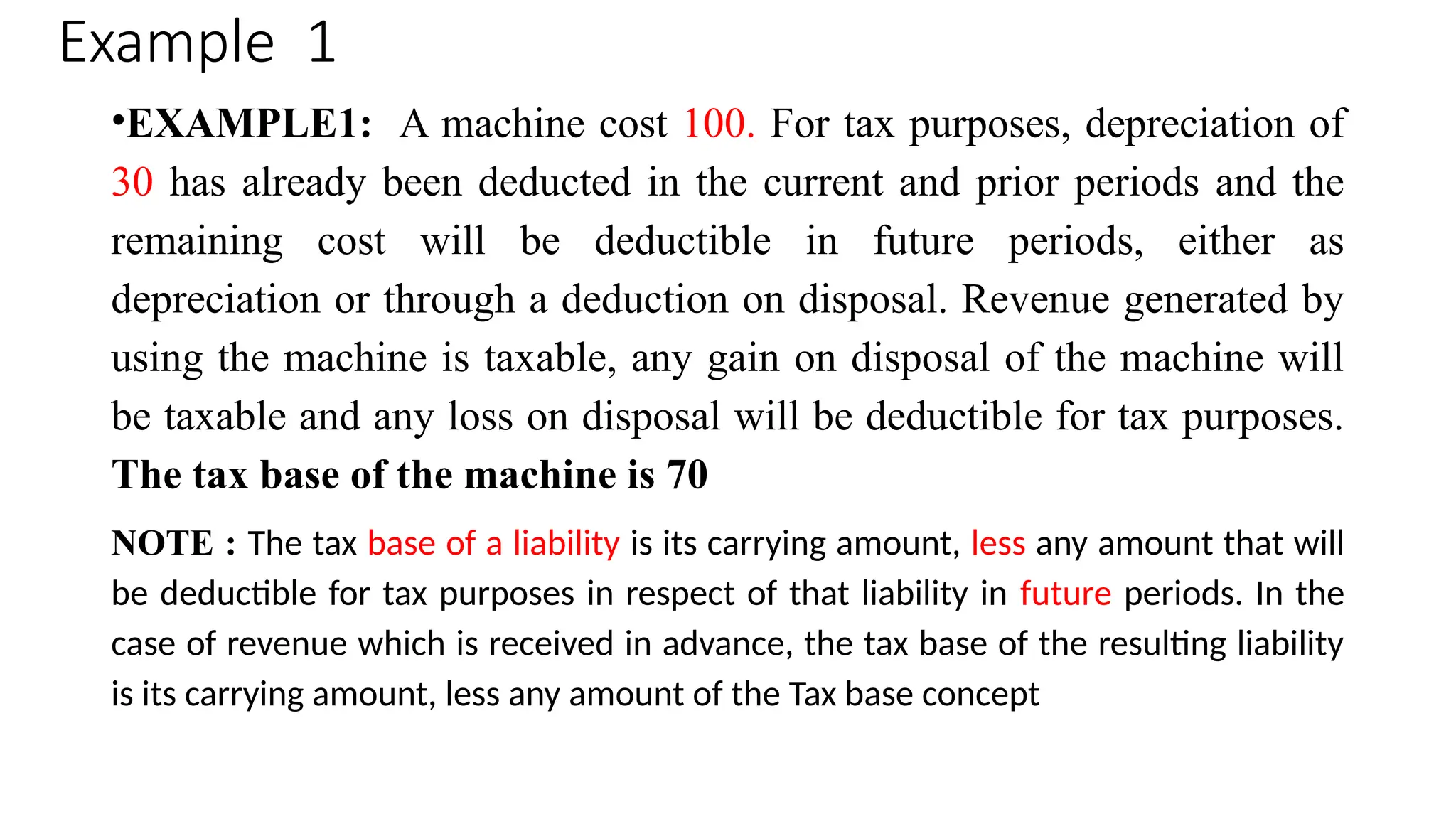
Example 1
•EXAMPLE1: A machine cost 100. For tax purposes, depreciation of
30 has already been deducted in the current and prior periods and the
remaining cost will be deductible in future periods, either as
depreciation or through a deduction on disposal. Revenue generated by
using the machine is taxable, any gain on disposal of the machine will
be taxable and any loss on disposal will be deductible for tax purposes.
The tax base of the machine is 70
NOTE : The tax base of a liability is its carrying amount, less any amount that will
be deductible for tax purposes in respect of that liability in future periods. In the
case of revenue which is received in advance, the tax base of the resulting liability
is its carrying amount, less any amount of the Tax base concept
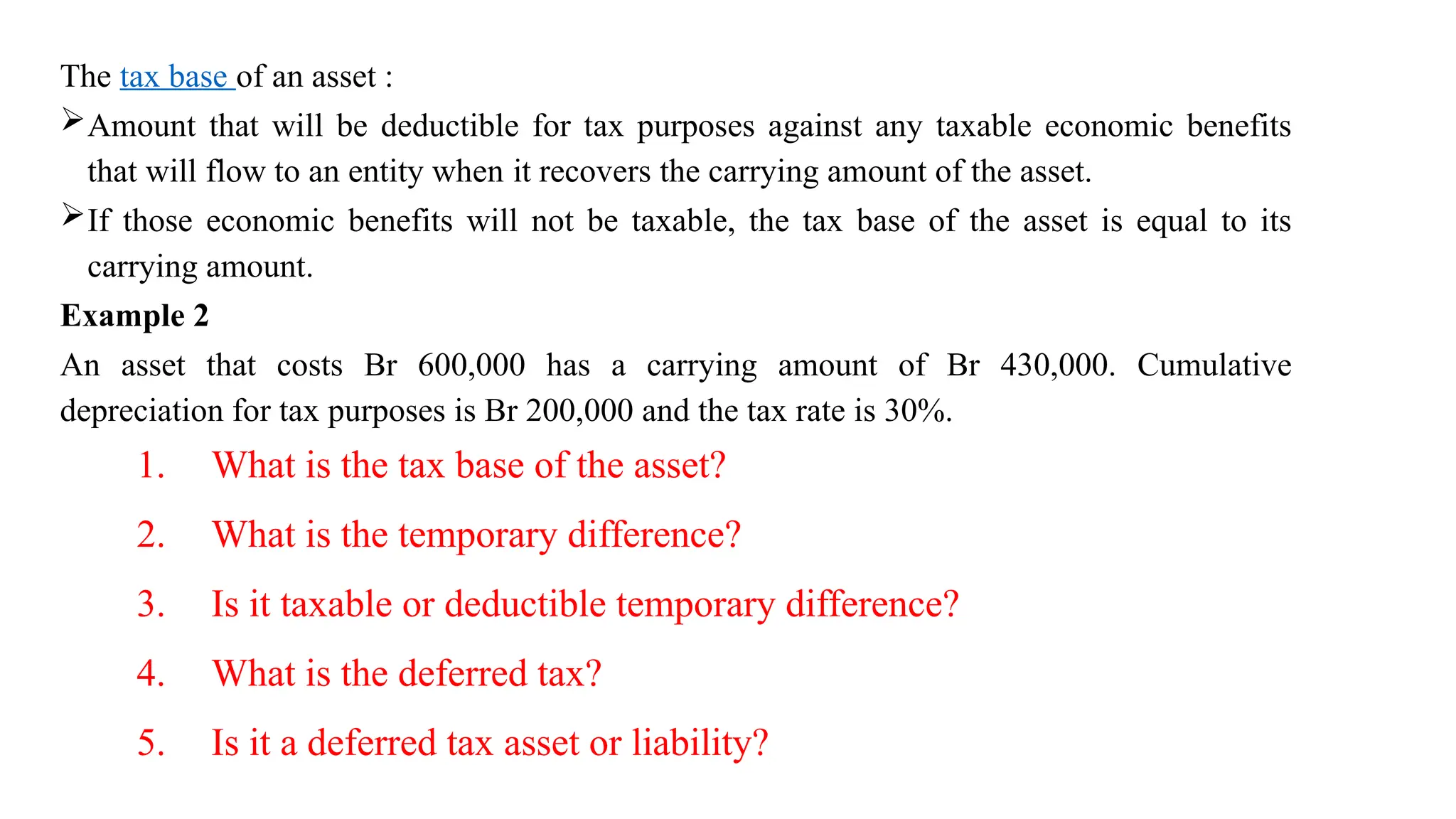
The tax base of an asset :
Amount that will be deductible for tax purposes against any taxable economic benefits
that will flow to an entity when it recovers the carrying amount of the asset.
If those economic benefits will not be taxable, the tax base of the asset is equal to its
carrying amount.
Example 2
An asset that costs Br 600,000 has a carrying amount of Br 430,000. Cumulative
depreciation for tax purposes is Br 200,000 and the tax rate is 30%.
1. What is the tax base of the asset?
2. What is the temporary difference?
3. Is it taxable or deductible temporary difference?
4. What is the deferred tax?
5. Is it a deferred tax asset or liability?
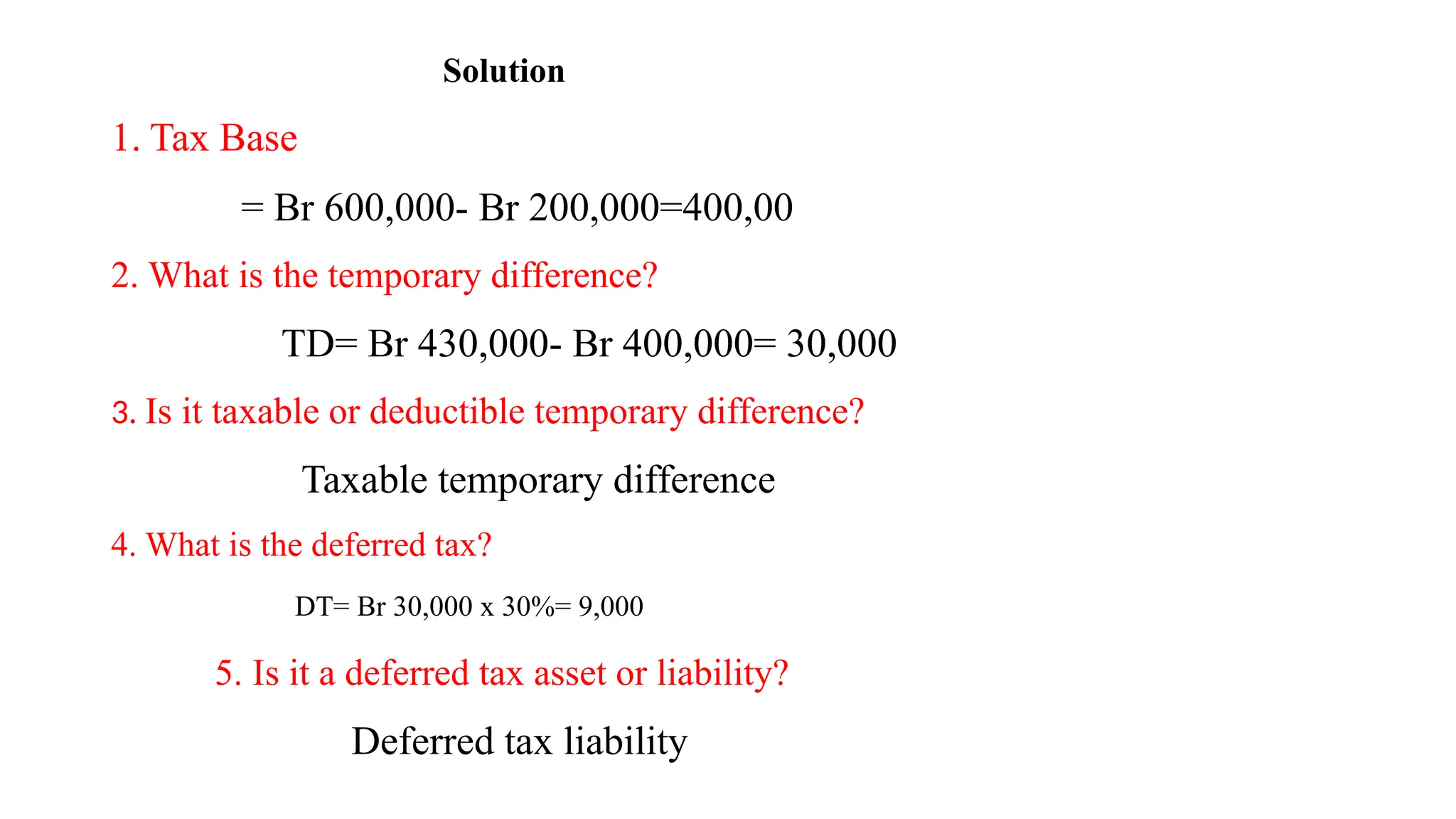
Solution
1. Tax Base
= Br 600,000- Br 200,000=400,00
2. What is the temporary difference?
TD= Br 430,000- Br 400,000= 30,000
3. Is it taxable or deductible temporary difference?
Taxable temporary difference
4. What is the deferred tax?
DT= Br 30,000 x 30%= 9,000
5. Is it a deferred tax asset or liability?
Deferred tax liability
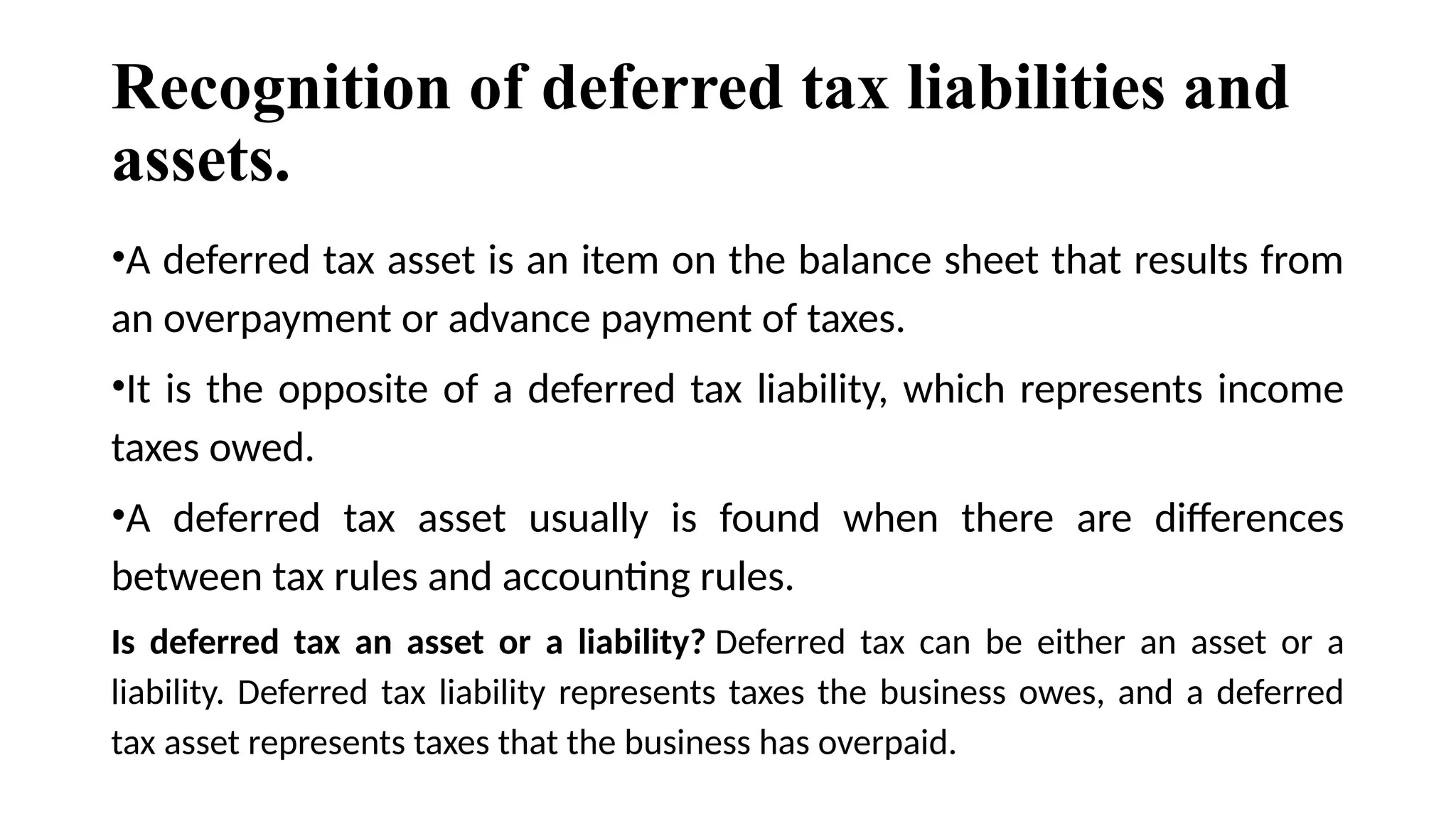
Recognition of deferred tax liabilities and
assets.
•A deferred tax asset is an item on the balance sheet that results from
an overpayment or advance payment of taxes.
•It is the opposite of a deferred tax liability, which represents income
taxes owed.
•A deferred tax asset usually is found when there are differences
between tax rules and accounting rules.
Is deferred tax an asset or a liability? Deferred tax can be either an asset or a
liability. Deferred tax liability represents taxes the business owes, and a deferred
tax asset represents taxes that the business has overpaid.
Recognition of Deferred Tax Liabilities
Deferred Tax Liabilities are the amounts of income taxes payable in future
periods in respect of taxable temporary differences.
A deferred tax liability is the result of differences in the way a company
does its financial accounting for reporting purposes.
Deferred taxes arising from temporary differences
Carrying amount - Tax base = Temporary difference
Deferred tax asset/liability = Taxable Temporary Differences * tax rate (future)
The tax that you owe to the government as per the income you earn is
known as your tax liability. This is the amount that you are liable to pay to
the tax authorities.
Are you asset or liablity?
Answer:
To be an asset, you need to be indispensable.
You need to be someone that people cannot do without.
Take a moment to reflect on your current role and ask
yourself, "Can they do it without me easily?" If the answer is
yes, then you are a liability.
However, if the answer is no, then you are an asset
• Deferred tax liability examples
Depreciation of assets: The IFRS uses an advanced asset depreciation model
which results in a difference between the company’s balance sheet value and the
value of it for tax purposes. This is the most common example of a deferred tax
liability.
Tax underpayment: The Company didn’t pay enough tax in the previous cycle, and
will have to make up for it in the next cycle.
Installment sale: When a product is paid for in installments, the company lists the
full value of the sale in their balance sheet, but only pays taxes for each annual
installment. The company recognizes that they have a deferred tax liability for
future payments on that sale.
•Deferred tax liability is the deferred tax consequences attributable to
taxable temporary differences. In other words, a deferred tax liability
represents the increase in taxes payable in future years as a result of taxable
temporary differences existing at the end of the current year.
•Deferred tax liability Is a taxable amount in the future. Taxable
amounts increase taxable income in future years.
Taxable income = pretax financial income
Less: taxable temporary difference
Plus: Deductible temporary difference
Current tax expense = taxable income x tax rate
Deferred tax expenses = ending deferred tax liability – beginning deferred tax
liability
Income tax expenses = current tax expense (income tax payable) + deferred tax
expenses
Deferred tax expenses = deferred tax liability – deferred tax asset
EXAMPLE
At the beginning of 2013, GK Company purchased equipment for Br 200,000. The equipment had
a carrying amount of Br 180,000 at the beginning of 2014 and Br 160,000 at the end of 2014. The
accumulated depreciation of the item as per the income tax law is Br 50,000 at the beginning of
2014 and Br 80,000 at the end of 2014. The tax rate is 30%. The accounting income before tax is
Br 700,000 for 2013 and Br 900,000 for 2014.
1. What was the tax base of the equipment for 2013 and 2014?
2. What is the temporary difference for 2013 and 2014? Is it taxable or deductible temporary
difference?
3. What is the deferred tax for 2013 and 2014? Is it deferred tax asset or deferred tax liability?
4. What is the taxable income for 2013 and 2014?
5. What is the current tax expense for 2013 and 2014?
6. What is the deferred tax expense for 2013 and 2014?
7. What is the appropriate journal entry for 2013 and 2014?
Solution
End of 2013 End of 2014
Carrying value Br 180,000 Br 160,000
Tax base 150,000 120,000
Taxable temporary difference 30,000 40,000
Deferred tax liability (30%) 9,000 12,000
Taxable income 670,000 860,000
Current tax expense 201,000 258,000
Deferred tax expenses 9,000 3,000
Income tax expenses 210,000 261,000
Taxable income = pretax financial income
Less: taxable temporary difference
Plus: Deductible temporary difference
2013 Taxable income = $700,000
Less: $30,000
Plus: 0 = $670,000
2014 taxable income =$ 900,000
-40,000
+ 0 =
$ 860,000
Current tax expense of 2013 = taxable income x tax rate
= 670,000x 30%= $201,000
Current tax expense of 2014 = taxable income x tax rate
= 860,000 x30% = $258,000
Deferred tax expenses of 2013 = ending deferred tax liability –
beginning deferred tax liability
= $9,000 – 0 = $9,000
•Deferred tax expenses of 2014 = ending deferred tax
liability of 2014 – beginning deferred tax liability of
2013
• = $12,000
– $9,000 =$3,000
•Income tax expenses of 2013 = current tax expense
(income tax payable) of 2013 + deferred tax
expenses of 2013
• = $201,000+ $9,000 = $210,000
•ITE of 2014 = $258,000 + $3000 =261,00
•Journal entry at the end of 2013
•Income tax expense—Current ………. 201,000
•Income tax expense—Deferred ……... 9,000
• Deferred tax liability………………… 9,000
• Income taxes payable ………………..201,000
Journal entry at the end of 2014
Income tax expense—Current……………… 258,000
Income tax expense—Deferred ………...... 3,000
Deferred tax liability………………………………………….. 3,000
Income taxes payable …………………………………………258,000
Recognition of Deferred Tax Assets
Deferred Tax assets are the amounts of income taxes recoverable in future period in respect of
Deductible temporary differences.
The carry forward of unused tax losses and
The carry forward of unused tax credits.
A deferred tax asset is the deferred tax consequence attributable to deductible temporary differences.
In other words, a deferred tax asset represents the increase in taxes refundable (or saved) in future
years as a result of deductible temporary differences existing at the end of the current year.
A deferred tax asset shall be recognized for all deductible differences to
the extent that it is probable that taxable profit will be available against
which the deductible temporary differences can be utilized
Examples of deferred tax assets
 Net operating loss: The business incurred a financial loss for that period.
 Tax overpayment: You paid too much in taxes in the previous period.
 Business expenses: When expenses are recognized in one accounting
method but not the other.
 Revenue: Instances where revenue is collected during one accounting
period, but recognized in another.
 Bad debt: Before an unpaid debt is written off as uncollectible, it’s
reported as revenue. When the unpaid receivable is finally recognized,
that bad debt becomes a deferred tax asset.
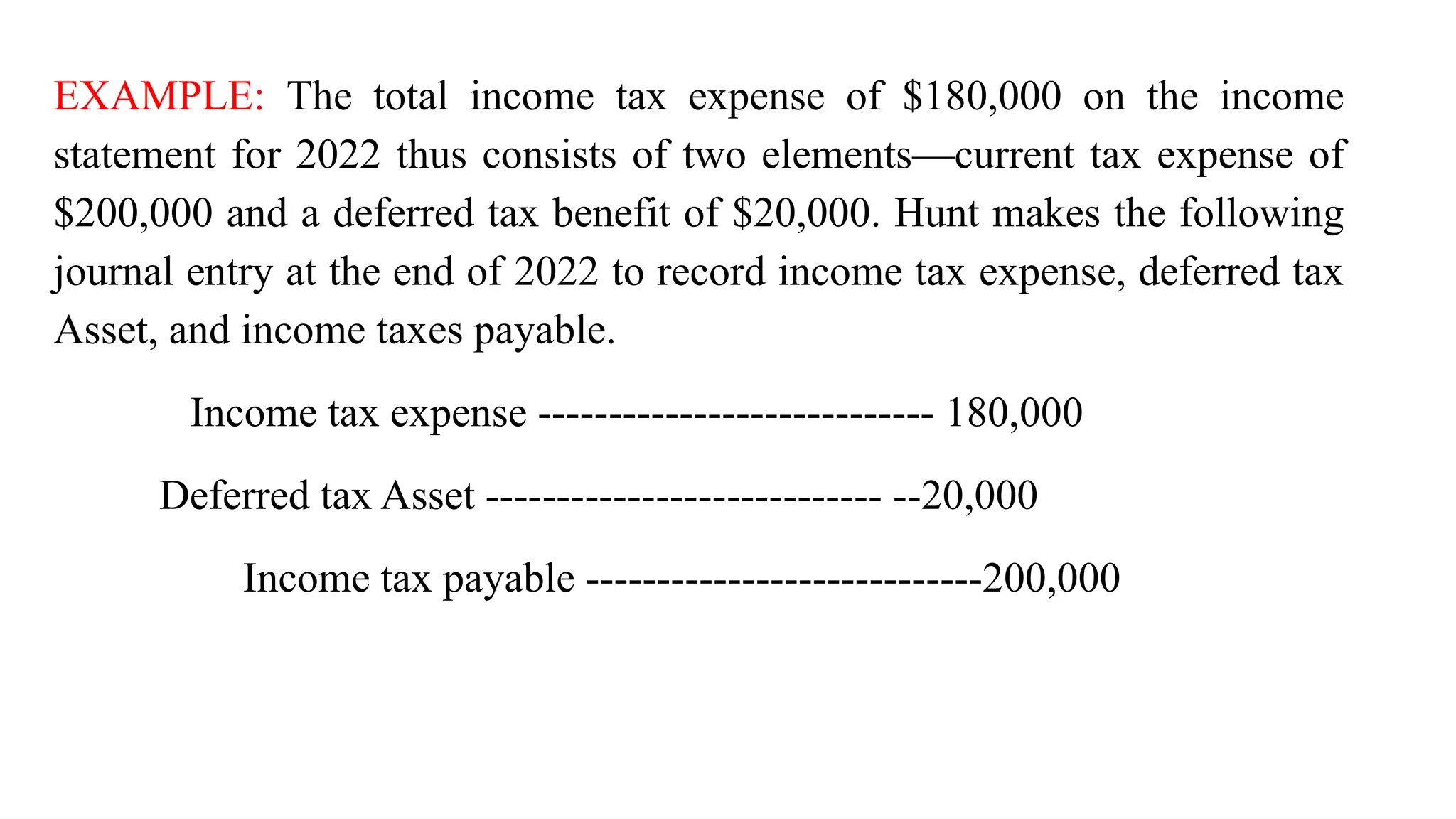
EXAMPLE: The total income tax expense of $180,000 on the income
statement for 2022 thus consists of two elements—current tax expense of
$200,000 and a deferred tax benefit of $20,000. Hunt makes the following
journal entry at the end of 2022 to record income tax expense, deferred tax
Asset, and income taxes payable.
Income tax expense ---------------------------- 180,000
Deferred tax Asset ---------------------------- --20,000
Income tax payable ----------------------------200,000
1. Future taxable temporary differences Reading assignment
2. Future deductible temporary differences
•
Current tax
 It is the tax that the entity expects to pay (recover)
in respect of a financial period. It is that
determined in accordance with the rules
established by the tax authorities, upon which
income taxes are payable (recoverable)
 IAS 12’s basic requirement is that, to the extent
that current tax for the current and prior reporting
periods is unpaid, it should be recognized as a
liability. Conversely, if the amount already paid in
respect of current and prior period exceeds the
amount due for those periods, the excess should
be recognized as an asset (IAS 12:12).
 Similarly, an asset is recognized if a tax loss can be
carried back or recovers the current tax paid in an
earlier period.
 Generally, Current tax is recognized in profit and
loss.
• In other cases, it is recognized in equity through
other comprehensive income
Deferred tax
 IAS 12 focuses on the balance sheet by
recognizing the tax effects of temporary
differences. Deferred tax liabilities are defined as
the amounts of income taxes payable in future
peri
 ods in respect of taxable temporary differences.
[IAS 12:5]
 Deferred tax assets are defined as the amounts of
income taxes recoverable in future periods in
respect of:
− Deductible temporary differences;
− The carry forward of unused tax losses; and
− The carry forward of unused tax credits.
 Deferred tax should:
Be recognized in respect of all timing differences that
have originated but not reversed by the balance sheet
date;
Not be recognized on permanent differences.
Income tax presentation and disclosures
A. Income tax Presentation
The requirements for Statement of Financial Position are:
− Deferred tax asset and liability and current assets and liabilities should be presented separately from other assets and liabilities
in the Statement of Financial Position
− Deferred tax assets and liabilities should not be classified within current assets and liabilities, if the Statement of Financial
Position makes such a distinction.
•Income tax Disclosures
For each type of temporary difference, the amount of the deferred tax asset and liabilities recognized in the Statement of
Financial Position.
For each type of temporary differences, the amount of the deferred tax income or expense recognized in the Statement of
Comprehensive Income, if the information is not evident from the movement in Statement of Financial Position amounts.
Temporary Difference Reversals: the deferred tax expense relating to the organization or reversal of temporary differences and
changes in tax rates or to the importation of new taxes.
Reduction of taxes: by using previously unrecognized tax loss, tax credit or temporary difference of a prior period.
The written down of a deferred tax asset.
Deductible Temporary Difference: the amount and expiry date (if any) of deductible temporary differences, unused tax losses,
and unused tax credits for which no deferred tax asset is recognized in the Statement of Financial Position.
The aggregate amount of temporary differences related to specific Investments.
Deferred tax relating to items that are charged or credited to equity.
• Future taxable profits: the amount of deferred tax asset and the nature of the evidence supporting its recognition. When its
utilization depends on future taxable profits exceeding
•THE END

ADVANCED FINANCIAL ACCOUNTING I ppt.pptx

  • 1.
    ADVANCED FINANCIAL ACCOUNTING I WOLLEGAUNIVERSITY ACFN DEPARTMENT
  • 2.
    CHAPTER ONE Income Taxes(IAS 12) AS 12 prescribes the accounting treatment for income taxes Income taxes include all domestic and foreign taxes that are based on taxable profits. Current tax for current and prior periods is, to the extent that it is unpaid, recognized as a liability. Overpayment of current tax is recognized as an asset. Income tax is a tax on the total income of a particular assessment year. Income of previous year is chargeable to tax in the next following assessment year at the tax rates applicable for the assessment year.
  • 3.
    Cont.. • The termincome includes: Profits and gains Dividend Voluntary contributions Receipts by employees Incomes from business Any capital gains
  • 4.
    The concept oftax base A tax base is the total amount of property, consumption, assets, transactions, income, or other sort of economic activity that is subject to taxation by an authority, A narrow tax base is non-neutral and inefficient. A broad tax base reduces tax administration costs and allows more revenue to be raised at lower rates. A tax base may be narrow, rather than broad, due to: Tax expenditures that result in reduced tax revenue, such as credits, exemptions, and deductions Deductions that reduce taxable income when certain conditions are met Exemptions that keep things from being subject to taxation due to category, class, or status Tax expenditures such as the standard deduction against taxable income, child tax credits, and certain sales tax exemptions Services, since taxing services is administratively challenging
  • 5.
    Example 1 •EXAMPLE1: Amachine cost 100. For tax purposes, depreciation of 30 has already been deducted in the current and prior periods and the remaining cost will be deductible in future periods, either as depreciation or through a deduction on disposal. Revenue generated by using the machine is taxable, any gain on disposal of the machine will be taxable and any loss on disposal will be deductible for tax purposes. The tax base of the machine is 70 NOTE : The tax base of a liability is its carrying amount, less any amount that will be deductible for tax purposes in respect of that liability in future periods. In the case of revenue which is received in advance, the tax base of the resulting liability is its carrying amount, less any amount of the Tax base concept
  • 6.
    The tax baseof an asset : Amount that will be deductible for tax purposes against any taxable economic benefits that will flow to an entity when it recovers the carrying amount of the asset. If those economic benefits will not be taxable, the tax base of the asset is equal to its carrying amount. Example 2 An asset that costs Br 600,000 has a carrying amount of Br 430,000. Cumulative depreciation for tax purposes is Br 200,000 and the tax rate is 30%. 1. What is the tax base of the asset? 2. What is the temporary difference? 3. Is it taxable or deductible temporary difference? 4. What is the deferred tax? 5. Is it a deferred tax asset or liability?
  • 7.
    Solution 1. Tax Base =Br 600,000- Br 200,000=400,00 2. What is the temporary difference? TD= Br 430,000- Br 400,000= 30,000 3. Is it taxable or deductible temporary difference? Taxable temporary difference 4. What is the deferred tax? DT= Br 30,000 x 30%= 9,000 5. Is it a deferred tax asset or liability? Deferred tax liability
  • 8.
    Recognition of deferredtax liabilities and assets. •A deferred tax asset is an item on the balance sheet that results from an overpayment or advance payment of taxes. •It is the opposite of a deferred tax liability, which represents income taxes owed. •A deferred tax asset usually is found when there are differences between tax rules and accounting rules. Is deferred tax an asset or a liability? Deferred tax can be either an asset or a liability. Deferred tax liability represents taxes the business owes, and a deferred tax asset represents taxes that the business has overpaid.
  • 9.
    Recognition of DeferredTax Liabilities Deferred Tax Liabilities are the amounts of income taxes payable in future periods in respect of taxable temporary differences. A deferred tax liability is the result of differences in the way a company does its financial accounting for reporting purposes. Deferred taxes arising from temporary differences Carrying amount - Tax base = Temporary difference Deferred tax asset/liability = Taxable Temporary Differences * tax rate (future) The tax that you owe to the government as per the income you earn is known as your tax liability. This is the amount that you are liable to pay to the tax authorities.
  • 10.
    Are you assetor liablity? Answer: To be an asset, you need to be indispensable. You need to be someone that people cannot do without. Take a moment to reflect on your current role and ask yourself, "Can they do it without me easily?" If the answer is yes, then you are a liability. However, if the answer is no, then you are an asset
  • 11.
    • Deferred taxliability examples Depreciation of assets: The IFRS uses an advanced asset depreciation model which results in a difference between the company’s balance sheet value and the value of it for tax purposes. This is the most common example of a deferred tax liability. Tax underpayment: The Company didn’t pay enough tax in the previous cycle, and will have to make up for it in the next cycle. Installment sale: When a product is paid for in installments, the company lists the full value of the sale in their balance sheet, but only pays taxes for each annual installment. The company recognizes that they have a deferred tax liability for future payments on that sale. •Deferred tax liability is the deferred tax consequences attributable to taxable temporary differences. In other words, a deferred tax liability represents the increase in taxes payable in future years as a result of taxable temporary differences existing at the end of the current year.
  • 12.
    •Deferred tax liabilityIs a taxable amount in the future. Taxable amounts increase taxable income in future years. Taxable income = pretax financial income Less: taxable temporary difference Plus: Deductible temporary difference Current tax expense = taxable income x tax rate Deferred tax expenses = ending deferred tax liability – beginning deferred tax liability Income tax expenses = current tax expense (income tax payable) + deferred tax expenses Deferred tax expenses = deferred tax liability – deferred tax asset
  • 13.
    EXAMPLE At the beginningof 2013, GK Company purchased equipment for Br 200,000. The equipment had a carrying amount of Br 180,000 at the beginning of 2014 and Br 160,000 at the end of 2014. The accumulated depreciation of the item as per the income tax law is Br 50,000 at the beginning of 2014 and Br 80,000 at the end of 2014. The tax rate is 30%. The accounting income before tax is Br 700,000 for 2013 and Br 900,000 for 2014. 1. What was the tax base of the equipment for 2013 and 2014? 2. What is the temporary difference for 2013 and 2014? Is it taxable or deductible temporary difference? 3. What is the deferred tax for 2013 and 2014? Is it deferred tax asset or deferred tax liability? 4. What is the taxable income for 2013 and 2014? 5. What is the current tax expense for 2013 and 2014? 6. What is the deferred tax expense for 2013 and 2014? 7. What is the appropriate journal entry for 2013 and 2014?
  • 14.
    Solution End of 2013End of 2014 Carrying value Br 180,000 Br 160,000 Tax base 150,000 120,000 Taxable temporary difference 30,000 40,000 Deferred tax liability (30%) 9,000 12,000 Taxable income 670,000 860,000 Current tax expense 201,000 258,000 Deferred tax expenses 9,000 3,000 Income tax expenses 210,000 261,000 Taxable income = pretax financial income Less: taxable temporary difference Plus: Deductible temporary difference
  • 15.
    2013 Taxable income= $700,000 Less: $30,000 Plus: 0 = $670,000 2014 taxable income =$ 900,000 -40,000 + 0 = $ 860,000 Current tax expense of 2013 = taxable income x tax rate = 670,000x 30%= $201,000 Current tax expense of 2014 = taxable income x tax rate = 860,000 x30% = $258,000 Deferred tax expenses of 2013 = ending deferred tax liability – beginning deferred tax liability = $9,000 – 0 = $9,000 •Deferred tax expenses of 2014 = ending deferred tax liability of 2014 – beginning deferred tax liability of 2013 • = $12,000 – $9,000 =$3,000 •Income tax expenses of 2013 = current tax expense (income tax payable) of 2013 + deferred tax expenses of 2013 • = $201,000+ $9,000 = $210,000 •ITE of 2014 = $258,000 + $3000 =261,00 •Journal entry at the end of 2013 •Income tax expense—Current ………. 201,000 •Income tax expense—Deferred ……... 9,000 • Deferred tax liability………………… 9,000 • Income taxes payable ………………..201,000
  • 16.
    Journal entry atthe end of 2014 Income tax expense—Current……………… 258,000 Income tax expense—Deferred ………...... 3,000 Deferred tax liability………………………………………….. 3,000 Income taxes payable …………………………………………258,000 Recognition of Deferred Tax Assets Deferred Tax assets are the amounts of income taxes recoverable in future period in respect of Deductible temporary differences. The carry forward of unused tax losses and The carry forward of unused tax credits. A deferred tax asset is the deferred tax consequence attributable to deductible temporary differences. In other words, a deferred tax asset represents the increase in taxes refundable (or saved) in future years as a result of deductible temporary differences existing at the end of the current year.
  • 17.
    A deferred taxasset shall be recognized for all deductible differences to the extent that it is probable that taxable profit will be available against which the deductible temporary differences can be utilized Examples of deferred tax assets  Net operating loss: The business incurred a financial loss for that period.  Tax overpayment: You paid too much in taxes in the previous period.  Business expenses: When expenses are recognized in one accounting method but not the other.  Revenue: Instances where revenue is collected during one accounting period, but recognized in another.  Bad debt: Before an unpaid debt is written off as uncollectible, it’s reported as revenue. When the unpaid receivable is finally recognized, that bad debt becomes a deferred tax asset.
  • 18.
    EXAMPLE: The totalincome tax expense of $180,000 on the income statement for 2022 thus consists of two elements—current tax expense of $200,000 and a deferred tax benefit of $20,000. Hunt makes the following journal entry at the end of 2022 to record income tax expense, deferred tax Asset, and income taxes payable. Income tax expense ---------------------------- 180,000 Deferred tax Asset ---------------------------- --20,000 Income tax payable ----------------------------200,000
  • 19.
    1. Future taxabletemporary differences Reading assignment 2. Future deductible temporary differences
  • 20.
    • Current tax  Itis the tax that the entity expects to pay (recover) in respect of a financial period. It is that determined in accordance with the rules established by the tax authorities, upon which income taxes are payable (recoverable)  IAS 12’s basic requirement is that, to the extent that current tax for the current and prior reporting periods is unpaid, it should be recognized as a liability. Conversely, if the amount already paid in respect of current and prior period exceeds the amount due for those periods, the excess should be recognized as an asset (IAS 12:12).  Similarly, an asset is recognized if a tax loss can be carried back or recovers the current tax paid in an earlier period.  Generally, Current tax is recognized in profit and loss. • In other cases, it is recognized in equity through other comprehensive income Deferred tax  IAS 12 focuses on the balance sheet by recognizing the tax effects of temporary differences. Deferred tax liabilities are defined as the amounts of income taxes payable in future peri  ods in respect of taxable temporary differences. [IAS 12:5]  Deferred tax assets are defined as the amounts of income taxes recoverable in future periods in respect of: − Deductible temporary differences; − The carry forward of unused tax losses; and − The carry forward of unused tax credits.  Deferred tax should: Be recognized in respect of all timing differences that have originated but not reversed by the balance sheet date; Not be recognized on permanent differences.
  • 21.
    Income tax presentationand disclosures A. Income tax Presentation The requirements for Statement of Financial Position are: − Deferred tax asset and liability and current assets and liabilities should be presented separately from other assets and liabilities in the Statement of Financial Position − Deferred tax assets and liabilities should not be classified within current assets and liabilities, if the Statement of Financial Position makes such a distinction. •Income tax Disclosures For each type of temporary difference, the amount of the deferred tax asset and liabilities recognized in the Statement of Financial Position. For each type of temporary differences, the amount of the deferred tax income or expense recognized in the Statement of Comprehensive Income, if the information is not evident from the movement in Statement of Financial Position amounts. Temporary Difference Reversals: the deferred tax expense relating to the organization or reversal of temporary differences and changes in tax rates or to the importation of new taxes. Reduction of taxes: by using previously unrecognized tax loss, tax credit or temporary difference of a prior period. The written down of a deferred tax asset. Deductible Temporary Difference: the amount and expiry date (if any) of deductible temporary differences, unused tax losses, and unused tax credits for which no deferred tax asset is recognized in the Statement of Financial Position. The aggregate amount of temporary differences related to specific Investments. Deferred tax relating to items that are charged or credited to equity. • Future taxable profits: the amount of deferred tax asset and the nature of the evidence supporting its recognition. When its utilization depends on future taxable profits exceeding
  • 22.