Presented By:
SUSHIL KUMAR 1BY16EC103
Under the guidance of
Prof. Sabina R
Assistant Professor , BMSIT&M
Department Of Electronics and Communication Engineering
Deep Learning Algorithm Using Virtual Environment Data
For Self-Driving Car
 Introduction
 Abstract
 Motivation
 Objectives
 Literature Survey
 Design/Method
 Experimental study
 Applications
 Conclusion
 References
CONTENTS:
INTRODUCTION
• Computer vision is the field of computer science that deals
with how computers can to identify and process objects in
images and videos in the same way that humans do.
• Early experiments in computer vision started in the 1950s
and it was first put to use commercially to distinguish
between typed and handwritten text.
• As the field of computer vision has grown with new
hardware and algorithms so has the accuracy rates for object
identification..
Department of ECE, BMSIT&M 3
ABSTRACT
• Computer Vision help computers see and understand the
content of digital images such as photographs and videos.
• Computer vision is all about extracting information from
images. The image data can take many forms, such as video
sequences, views from multiple cameras, multi-dimensional
data from a 3D scanner or medical scanning device.
• The goal of computer vision is to understand the content of
digital images.
Department of ECE, BMSIT&M 4
MOTIVATION
• Autonomous systems are more reliable and consistent than
human drivers
• More than 1 million people lose their lives on the road due to
car accidents.
• 60% of total energy consumed by transportation is from
automobiles.
• These numbers show that cars cause serious casualties and
are major source of greenhouse gas emission.
Department of ECE, BMSIT&M 5
OBJECTIVES
• The desire to reclaim and retain travel and commuting time.
• To enable access to vehicles for more population.
• To improve traffic safety and reduce accidents.
• To reduce carbon emissions.
• To improve car safety and efficacy.
Department of ECE, BMSIT&M 6
LITERATURE SURVEY
Department of ECE, BMSIT&M 7
Sl.
No
Paper Title Year of
Public
ation
Author’
s Name
Problem
Description
Observations
1. 2017 IEEE Region 10
Symposium
(TENSYMP)
2017 Gowdha
m
Prabhak
ar,
Binsu
Kailath
On-road obstacle
detection and
classification in high
speed autonomous
driving
A vision-based object
detection system for
on-road
obstacles was realized
using Faster R-CNN
and implemented
on GPU.
2. 2018 IEEE
International
Conference on
Artificial Intelligence
and Virtual Reality
(AIVR)
2018 Wen-
Yen Lin,
Wang-
Hsin
Hsu, Yi-
Yuan
Chiang
Develop an agent
that can imitate the
behavior of humans
driving a car.
Built and trained a
model that learned
where the position of
the car is in a simulator
using deep neural
networks.
Department of ECE, BMSIT&M 8
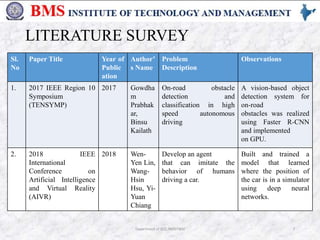
3 2017 4th International
Conference on Electric
Vehicular Technology
(ICEVT)
2017 Mochamad
Vicky Ghani
Aziz, Ary
Setijadi
Prihatmanto
Implementation
of lane
detection
algorithm on toll
road Cipularang
as parts of
selfdriving car
system.
The result shows
the algorithm
needed to be add
some
method that can
changing the
parameters
during day and
night
adaptively.
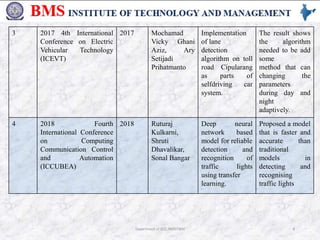
4 2018 Fourth
International Conference
on Computing
Communication Control
and Automation
(ICCUBEA)
2018 Ruturaj
Kulkarni,
Shruti
Dhavalikar,
Sonal Bangar
Deep neural
network based
model for reliable
detection and
recognition of
traffic lights
using transfer
learning.
Proposed a model
that is faster and
accurate than
traditional
models in
detecting and
recognising
traffic lights
DESIGN/METHOD
To design an autonomous system, we need the following tools
• Cameras
• Sensors
• Lasers
• Radar
• Lidar
• GPS system
• A computer system embedded in the vehicle
• Machine learning algorithms to process the data
Department of ECE, BMSIT&M 9
System design
Camera Array
• Cameras are used for:
• lane finding
• road curvature estimation
• obstacle detection and classification
• traffic sign detection and classification
• traffic light detection and classification
Detection and Classification
• The computer has to both find where objects are in a camera image
(detection) and also determine what they are (classification).
• The computer has to do this fast enough to hand off the results to the rest
of the driving system, so other components of the system can use the data
to make decisions.
Department of ECE, BMSIT&M 10
System design
Deep Learning
• We feed the machine with thousands of images related to the
object we want to detect, and it gradually learns to classify
them.
• Computer vision focus on color spaces, gradients and edges
in the image, regions of interest within the image, and other
machine learning techniques to extract intermediate
"features" from the image.
Department of ECE, BMSIT&M 11
Experimental study
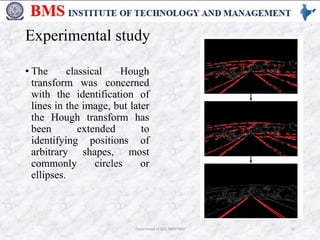
• The classical Hough
transform was concerned
with the identification of
lines in the image, but later
the Hough transform has
been extended to
identifying positions of
arbitrary shapes, most
commonly circles or
ellipses.
Department of ECE, BMSIT&M 12
APPLICATIONS
Department of ECE, BMSIT&M 13
Lane Detection
• Lane detection is used to detect and keep track of the road
that the autonomous vehicle drives on.
• Late detection refers to identifying the lane we are moving
on. This was done using image processing techniques like
smoothing followed by Edge detection and thresholding.
• Using image processing techniques we could maek out the
lanes on the road.
Department of ECE, BMSIT&M 14
Road Sign Identification
• Road signs are an integral part of the road network that is put
in to place to reduce the road accidents and to maintain an
order in the road network.
• Traditionally, standard computer vision methods were
employed to detect and classify traffic signs, but these
required considerable and time-consuming manual work to
handcraft important features in images.
• Instead, by applying deep learning to this problem, we create
a model that reliably classifies traffic signs, learning to
identify the most appropriate features for this problem by
itself.
Department of ECE, BMSIT&M 15
Steering Angle Prediction
• Using computer vision, we can steer the vehicle while
avoiding the obstacles, following lanes and traffic rules.
• For the vehicle to steer autonomously, with the help of
computer vision, we can predict the necessary angle required
to steer the vehicle in an orderly manner.
Department of ECE, BMSIT&M 16
Vehicle Detection and Proximity
Detection for Collision Avoidance
• The road is full of obstacles the we need to keep track of and
avoid. This is required to successfully develop an
autonomous vehicle.
• To perform image classification, a convolutional neural
network is trained to recognize various objects, like traffic
and pedestrians. However CNNs are restrictive.
• We use sliding windows to detect various obstacles on the
road.
Department of ECE, BMSIT&M 17
CONCLUSION
• Government data identifies driver behavior or error as a
factor in 94 percent of crashes, and self-driving vehicles can
help reduce driver error.
• People with disabilities, like the blind, are capable of self-
sufficiency, and highly automated vehicles can help them live
the life they want.
• Autonomous vehicles result in fewer traffic jams, save fuel
and reduce greenhouse gases from needless idling.
Department of ECE, BMSIT&M 18
REFERENCES
[1] W. Lin, W. Hsu and Y. Chiang, "A Combination of Feedback
Control and Vision-Based Deep Learning Mechanism for
Guiding Self-Driving Cars," 2018 IEEE International
Conference on Artificial Intelligence and Virtual Reality
(AIVR), Taichung, Taiwan, 2018, pp. 262-266.
[2] M. V. G. Aziz, A. S. Prihatmanto and H. Hindersah,
"Implementation of lane detection algorithm for self-driving car
on toll road cipularang using Python language," 2017 4th
International Conference on Electric Vehicular Technology
(ICEVT), Sanur, 2017, pp. 144-148.
[3] R. Kulkarni, S. Dhavalikar and S. Bangar, "Traffic Light
Detection and Recognition for Self Driving Cars Using Deep
Learning," 2018 Fourth International Conference on Computing
Communication Control and Automation (ICCUBEA), Pune,
India, 2018, pp. 1-4.
Department of ECE, BMSIT&M 19
[4] E. Nunes, A. Conci, and A. Sanchez, “Robust background
subtraction on traffic videos,” in 2011 18th International
Conference on Systems, Signals and Image Processing
(IWSSIP), 2011, pp. 1–4
[5] G. Prabhakar, B. Kailath, S. Natarajan and R. Kumar, "Obstacle
detection and classification using deep learning for tracking in
high-speed autonomous driving," 2017 IEEE Region 10
Symposium (TENSYMP), Cochin, 2017, pp. 1-6.
[6] Dwi H. Widyantoro & Kevin I. Saputra, “Traffic Lights
Detection and Recognition based on Color Segmentation and
Circle Hough Transform” in International Conference on Data
and Software Engineering 2015.
[7] N. Dalal, B. Triggs, ”Histograms of oriented gradients for
human detection”, CVPR ’05, 2005.
[8] Wei Liu, Dragomir Anguelov, Dumitru Erhan, Christian
Szegedy, Scott Reed, Cheng-Yang Fu, Alexander C. Berg; SSD:
Single Shot MultiBox Detector, ECCV,2016.Department of ECE, BMSIT&M 20

Deep Learning Algorithm Using Virtual Environment Data For Self-Driving Car

  • 1.
    Presented By: SUSHIL KUMAR1BY16EC103 Under the guidance of Prof. Sabina R Assistant Professor , BMSIT&M Department Of Electronics and Communication Engineering Deep Learning Algorithm Using Virtual Environment Data For Self-Driving Car
  • 2.
     Introduction  Abstract Motivation  Objectives  Literature Survey  Design/Method  Experimental study  Applications  Conclusion  References CONTENTS:
  • 3.
    INTRODUCTION • Computer visionis the field of computer science that deals with how computers can to identify and process objects in images and videos in the same way that humans do. • Early experiments in computer vision started in the 1950s and it was first put to use commercially to distinguish between typed and handwritten text. • As the field of computer vision has grown with new hardware and algorithms so has the accuracy rates for object identification.. Department of ECE, BMSIT&M 3
  • 4.
    ABSTRACT • Computer Visionhelp computers see and understand the content of digital images such as photographs and videos. • Computer vision is all about extracting information from images. The image data can take many forms, such as video sequences, views from multiple cameras, multi-dimensional data from a 3D scanner or medical scanning device. • The goal of computer vision is to understand the content of digital images. Department of ECE, BMSIT&M 4
  • 5.
    MOTIVATION • Autonomous systemsare more reliable and consistent than human drivers • More than 1 million people lose their lives on the road due to car accidents. • 60% of total energy consumed by transportation is from automobiles. • These numbers show that cars cause serious casualties and are major source of greenhouse gas emission. Department of ECE, BMSIT&M 5
  • 6.
    OBJECTIVES • The desireto reclaim and retain travel and commuting time. • To enable access to vehicles for more population. • To improve traffic safety and reduce accidents. • To reduce carbon emissions. • To improve car safety and efficacy. Department of ECE, BMSIT&M 6
  • 7.
    LITERATURE SURVEY Department ofECE, BMSIT&M 7 Sl. No Paper Title Year of Public ation Author’ s Name Problem Description Observations 1. 2017 IEEE Region 10 Symposium (TENSYMP) 2017 Gowdha m Prabhak ar, Binsu Kailath On-road obstacle detection and classification in high speed autonomous driving A vision-based object detection system for on-road obstacles was realized using Faster R-CNN and implemented on GPU. 2. 2018 IEEE International Conference on Artificial Intelligence and Virtual Reality (AIVR) 2018 Wen- Yen Lin, Wang- Hsin Hsu, Yi- Yuan Chiang Develop an agent that can imitate the behavior of humans driving a car. Built and trained a model that learned where the position of the car is in a simulator using deep neural networks.
  • 8.
    Department of ECE,BMSIT&M 8 3 2017 4th International Conference on Electric Vehicular Technology (ICEVT) 2017 Mochamad Vicky Ghani Aziz, Ary Setijadi Prihatmanto Implementation of lane detection algorithm on toll road Cipularang as parts of selfdriving car system. The result shows the algorithm needed to be add some method that can changing the parameters during day and night adaptively. 4 2018 Fourth International Conference on Computing Communication Control and Automation (ICCUBEA) 2018 Ruturaj Kulkarni, Shruti Dhavalikar, Sonal Bangar Deep neural network based model for reliable detection and recognition of traffic lights using transfer learning. Proposed a model that is faster and accurate than traditional models in detecting and recognising traffic lights
  • 9.
    DESIGN/METHOD To design anautonomous system, we need the following tools • Cameras • Sensors • Lasers • Radar • Lidar • GPS system • A computer system embedded in the vehicle • Machine learning algorithms to process the data Department of ECE, BMSIT&M 9
  • 10.
    System design Camera Array •Cameras are used for: • lane finding • road curvature estimation • obstacle detection and classification • traffic sign detection and classification • traffic light detection and classification Detection and Classification • The computer has to both find where objects are in a camera image (detection) and also determine what they are (classification). • The computer has to do this fast enough to hand off the results to the rest of the driving system, so other components of the system can use the data to make decisions. Department of ECE, BMSIT&M 10
  • 11.
    System design Deep Learning •We feed the machine with thousands of images related to the object we want to detect, and it gradually learns to classify them. • Computer vision focus on color spaces, gradients and edges in the image, regions of interest within the image, and other machine learning techniques to extract intermediate "features" from the image. Department of ECE, BMSIT&M 11
  • 12.
    Experimental study • Theclassical Hough transform was concerned with the identification of lines in the image, but later the Hough transform has been extended to identifying positions of arbitrary shapes, most commonly circles or ellipses. Department of ECE, BMSIT&M 12
  • 13.
  • 14.
    Lane Detection • Lanedetection is used to detect and keep track of the road that the autonomous vehicle drives on. • Late detection refers to identifying the lane we are moving on. This was done using image processing techniques like smoothing followed by Edge detection and thresholding. • Using image processing techniques we could maek out the lanes on the road. Department of ECE, BMSIT&M 14
  • 15.
    Road Sign Identification •Road signs are an integral part of the road network that is put in to place to reduce the road accidents and to maintain an order in the road network. • Traditionally, standard computer vision methods were employed to detect and classify traffic signs, but these required considerable and time-consuming manual work to handcraft important features in images. • Instead, by applying deep learning to this problem, we create a model that reliably classifies traffic signs, learning to identify the most appropriate features for this problem by itself. Department of ECE, BMSIT&M 15
  • 16.
    Steering Angle Prediction •Using computer vision, we can steer the vehicle while avoiding the obstacles, following lanes and traffic rules. • For the vehicle to steer autonomously, with the help of computer vision, we can predict the necessary angle required to steer the vehicle in an orderly manner. Department of ECE, BMSIT&M 16
  • 17.
    Vehicle Detection andProximity Detection for Collision Avoidance • The road is full of obstacles the we need to keep track of and avoid. This is required to successfully develop an autonomous vehicle. • To perform image classification, a convolutional neural network is trained to recognize various objects, like traffic and pedestrians. However CNNs are restrictive. • We use sliding windows to detect various obstacles on the road. Department of ECE, BMSIT&M 17
  • 18.
    CONCLUSION • Government dataidentifies driver behavior or error as a factor in 94 percent of crashes, and self-driving vehicles can help reduce driver error. • People with disabilities, like the blind, are capable of self- sufficiency, and highly automated vehicles can help them live the life they want. • Autonomous vehicles result in fewer traffic jams, save fuel and reduce greenhouse gases from needless idling. Department of ECE, BMSIT&M 18
  • 19.
    REFERENCES [1] W. Lin,W. Hsu and Y. Chiang, "A Combination of Feedback Control and Vision-Based Deep Learning Mechanism for Guiding Self-Driving Cars," 2018 IEEE International Conference on Artificial Intelligence and Virtual Reality (AIVR), Taichung, Taiwan, 2018, pp. 262-266. [2] M. V. G. Aziz, A. S. Prihatmanto and H. Hindersah, "Implementation of lane detection algorithm for self-driving car on toll road cipularang using Python language," 2017 4th International Conference on Electric Vehicular Technology (ICEVT), Sanur, 2017, pp. 144-148. [3] R. Kulkarni, S. Dhavalikar and S. Bangar, "Traffic Light Detection and Recognition for Self Driving Cars Using Deep Learning," 2018 Fourth International Conference on Computing Communication Control and Automation (ICCUBEA), Pune, India, 2018, pp. 1-4. Department of ECE, BMSIT&M 19
  • 20.
    [4] E. Nunes,A. Conci, and A. Sanchez, “Robust background subtraction on traffic videos,” in 2011 18th International Conference on Systems, Signals and Image Processing (IWSSIP), 2011, pp. 1–4 [5] G. Prabhakar, B. Kailath, S. Natarajan and R. Kumar, "Obstacle detection and classification using deep learning for tracking in high-speed autonomous driving," 2017 IEEE Region 10 Symposium (TENSYMP), Cochin, 2017, pp. 1-6. [6] Dwi H. Widyantoro & Kevin I. Saputra, “Traffic Lights Detection and Recognition based on Color Segmentation and Circle Hough Transform” in International Conference on Data and Software Engineering 2015. [7] N. Dalal, B. Triggs, ”Histograms of oriented gradients for human detection”, CVPR ’05, 2005. [8] Wei Liu, Dragomir Anguelov, Dumitru Erhan, Christian Szegedy, Scott Reed, Cheng-Yang Fu, Alexander C. Berg; SSD: Single Shot MultiBox Detector, ECCV,2016.Department of ECE, BMSIT&M 20