
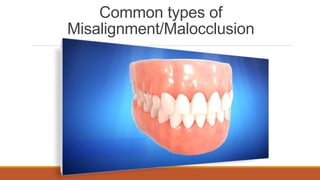


Common types of
Misalignment/Malocclusion
What is Deep Bite?
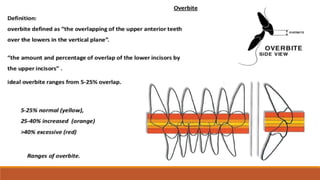
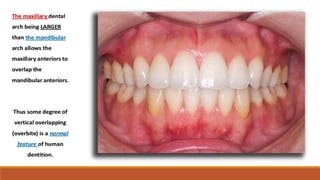
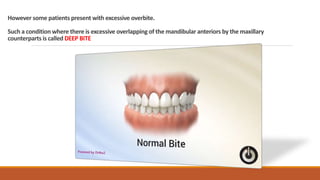
However some patients present with excessive overbite.
Such a condition where there is excessive overlapping of the mandibular anteriors by the maxillary
counterparts is called DEEP BITE
The prevalence of severe deep bite varies between racial groups twice as
common in Caucasian Americans compared to African Americans and Hispanics.
Prevalence
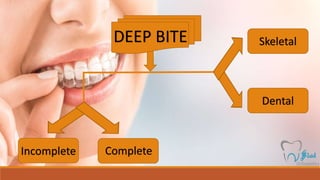
Incomplete Complete
Dental
SkeletalDEEP BITE
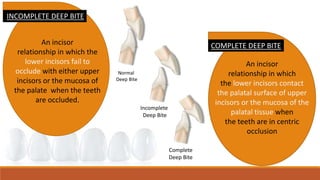
An incisor
relationship in which the
lower incisors fail to
occlude with either upper
incisors or the mucosa of
the palate when the teeth
are occluded.
An incisor
relationship in which
the lower incisors contact
the palatal surface of upper
incisors or the mucosa of the
palatal tissue when
the teeth are in centric
occlusion
INCOMPLETE DEEP BITE
COMPLETE DEEP BITE
Normal
Deep Bite
Incomplete
Deep Bite
Complete
Deep Bite
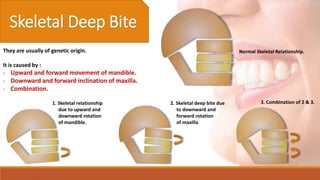
Skeletal Deep Bite
They are usually of genetic origin.
It is caused by :
- Upward and forward movement of mandible.
- Downward and forward inclination of maxilla.
- Combination.
Normal Skeletal Relationship.
1. Skeletal relationship
due to upward and
downward rotation
of mandible.
2. Skeletal deep bite due
to downward and
forward rotation
of maxilla
3. Combination of 2 & 3.
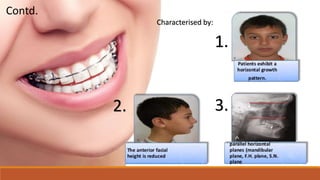
Characterised by:
1.
2. 3.
Contd.
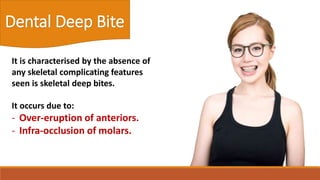
Dental Deep Bite
It is characterised by the absence of
any skeletal complicating features
seen is skeletal deep bites.
It occurs due to:
- Over-eruption of anteriors.
- Infra-occlusion of molars.
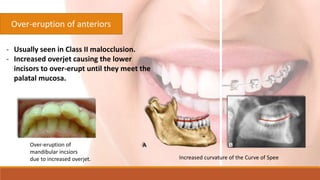
Over-eruption of anteriors
- Usually seen in Class II malocclusion.
- Increased overjet causing the lower
incisors to over-erupt until they meet the
palatal mucosa.
Increased curvature of the Curve of Spee
Over-eruption of
mandibular incsiors
due to increased overjet.
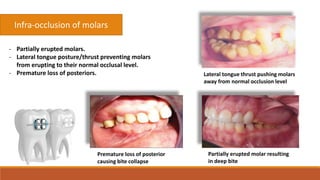
Infra-occlusion of molars
- Partially erupted molars.
- Lateral tongue posture/thrust preventing molars
from erupting to their normal occlusal level.
- Premature loss of posteriors. Lateral tongue thrust pushing molars
away from normal occlusion level
Partially erupted molar resulting
in deep bite
Premature loss of posterior
causing bite collapse
Do deep bites
require correction?
Treatment modalities
for Deep Bite
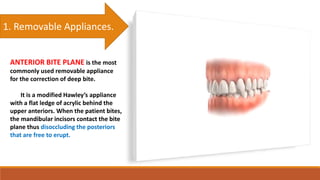
1. Removable Appliances.
ANTERIOR BITE PLANE is the most
commonly used removable appliance
for the correction of deep bite.
It is a modified Hawley’s appliance
with a flat ledge of acrylic behind the
upper anteriors. When the patient bites,
the mandibular incisors contact the bite
plane thus disoccluding the posteriors
that are free to erupt.
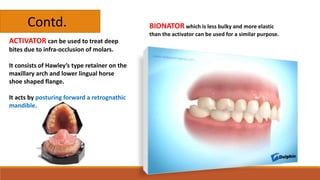
ACTIVATOR can be used to treat deep
bites due to infra-occlusion of molars.
It consists of Hawley’s type retainer on the
maxillary arch and lower lingual horse
shoe shaped flange.
It acts by posturing forward a retrognathic
mandible.
BIONATOR which is less bulky and more elastic
than the activator can be used for a similar purpose.
Contd.
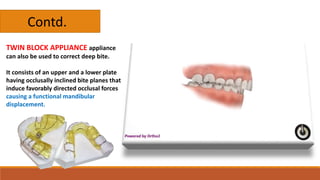
TWIN BLOCK APPLIANCE appliance
can also be used to correct deep bite.
It consists of an upper and a lower plate
having occlusally inclined bite planes that
induce favorably directed occlusal forces
causing a functional mandibular
displacement.
Contd.
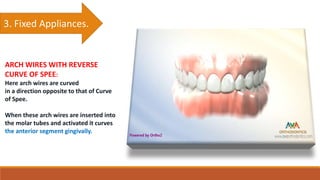
3. Fixed Appliances.
ARCH WIRES WITH REVERSE
CURVE OF SPEE:
Here arch wires are curved
in a direction opposite to that of Curve
of Spee.
When these arch wires are inserted into
the molar tubes and activated it curves
the anterior segment gingivally.
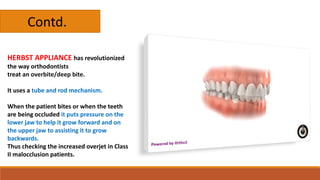
HERBST APPLIANCE has revolutionized
the way orthodontists
treat an overbite/deep bite.
It uses a tube and rod mechanism.
When the patient bites or when the teeth
are being occluded it puts pressure on the
lower jaw to help it grow forward and on
the upper jaw to assisting it to grow
backwards.
Thus checking the increased overjet in Class
II malocclusion patients.
Contd.
4. Orthognathic Surgery
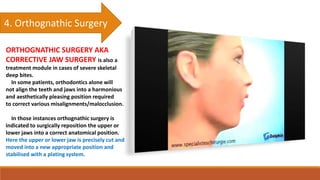
ORTHOGNATHIC SURGERY AKA
CORRECTIVE JAW SURGERY is also a
treatment module in cases of severe skeletal
deep bites.
In some patients, orthodontics alone will
not align the teeth and jaws into a harmonious
and aesthetically pleasing position required
to correct various misalignments/malocclusion.
In those instances orthognathic surgery is
indicated to surgically reposition the upper or
lower jaws into a correct anatomical position.
Here the upper or lower jaw is precisely cut and
moved into a new appropriate position and
stabilised with a plating system.
Thank You

Deep Bite

  • 2.
  • 3.
  • 6.
    However some patientspresent with excessive overbite. Such a condition where there is excessive overlapping of the mandibular anteriors by the maxillary counterparts is called DEEP BITE
  • 7.
    The prevalence ofsevere deep bite varies between racial groups twice as common in Caucasian Americans compared to African Americans and Hispanics. Prevalence
  • 8.
  • 9.
    An incisor relationship inwhich the lower incisors fail to occlude with either upper incisors or the mucosa of the palate when the teeth are occluded. An incisor relationship in which the lower incisors contact the palatal surface of upper incisors or the mucosa of the palatal tissue when the teeth are in centric occlusion INCOMPLETE DEEP BITE COMPLETE DEEP BITE Normal Deep Bite Incomplete Deep Bite Complete Deep Bite
  • 10.
    Skeletal Deep Bite Theyare usually of genetic origin. It is caused by : - Upward and forward movement of mandible. - Downward and forward inclination of maxilla. - Combination. Normal Skeletal Relationship. 1. Skeletal relationship due to upward and downward rotation of mandible. 2. Skeletal deep bite due to downward and forward rotation of maxilla 3. Combination of 2 & 3.
  • 11.
  • 12.
    Dental Deep Bite Itis characterised by the absence of any skeletal complicating features seen is skeletal deep bites. It occurs due to: - Over-eruption of anteriors. - Infra-occlusion of molars.
  • 13.
    Over-eruption of anteriors -Usually seen in Class II malocclusion. - Increased overjet causing the lower incisors to over-erupt until they meet the palatal mucosa. Increased curvature of the Curve of Spee Over-eruption of mandibular incsiors due to increased overjet.
  • 14.
    Infra-occlusion of molars -Partially erupted molars. - Lateral tongue posture/thrust preventing molars from erupting to their normal occlusal level. - Premature loss of posteriors. Lateral tongue thrust pushing molars away from normal occlusion level Partially erupted molar resulting in deep bite Premature loss of posterior causing bite collapse
  • 15.
  • 19.
  • 20.
    1. Removable Appliances. ANTERIORBITE PLANE is the most commonly used removable appliance for the correction of deep bite. It is a modified Hawley’s appliance with a flat ledge of acrylic behind the upper anteriors. When the patient bites, the mandibular incisors contact the bite plane thus disoccluding the posteriors that are free to erupt.
  • 21.
    ACTIVATOR can beused to treat deep bites due to infra-occlusion of molars. It consists of Hawley’s type retainer on the maxillary arch and lower lingual horse shoe shaped flange. It acts by posturing forward a retrognathic mandible. BIONATOR which is less bulky and more elastic than the activator can be used for a similar purpose. Contd.
  • 22.
    TWIN BLOCK APPLIANCEappliance can also be used to correct deep bite. It consists of an upper and a lower plate having occlusally inclined bite planes that induce favorably directed occlusal forces causing a functional mandibular displacement. Contd.
  • 23.
    3. Fixed Appliances. ARCHWIRES WITH REVERSE CURVE OF SPEE: Here arch wires are curved in a direction opposite to that of Curve of Spee. When these arch wires are inserted into the molar tubes and activated it curves the anterior segment gingivally.
  • 24.
    HERBST APPLIANCE hasrevolutionized the way orthodontists treat an overbite/deep bite. It uses a tube and rod mechanism. When the patient bites or when the teeth are being occluded it puts pressure on the lower jaw to help it grow forward and on the upper jaw to assisting it to grow backwards. Thus checking the increased overjet in Class II malocclusion patients. Contd.
  • 25.
    4. Orthognathic Surgery ORTHOGNATHICSURGERY AKA CORRECTIVE JAW SURGERY is also a treatment module in cases of severe skeletal deep bites. In some patients, orthodontics alone will not align the teeth and jaws into a harmonious and aesthetically pleasing position required to correct various misalignments/malocclusion. In those instances orthognathic surgery is indicated to surgically reposition the upper or lower jaws into a correct anatomical position. Here the upper or lower jaw is precisely cut and moved into a new appropriate position and stabilised with a plating system.
  • 26.