www.edureka.co/r-for-analytics
Decoding the Science of Decision Trees!
Learn from Experts
Slide 2Slide 2Slide 2 www.edureka.co/r-for-analytics
Today we will take you through the following:
 The Classic Banking Challenge !!.. Have you already guessed it??
 The Available Options for Solution
 Why Decision Tree?
 How Decision Tree Methodology Works ?
Agenda
Slide 3Slide 3Slide 3 www.edureka.co/r-for-analytics
The Classic Situation…
Slide 4Slide 4Slide 4 www.edureka.co/r-for-analytics
A bank wants to classify its future customers into two categories “Risky” and “Good” based on customer’s
available attributes.
Let’s say a customer xyz has the following attributes. How will the bank know to which category this
customer belong.
Undergrad Marital Status Taxable Income City Population Work Experience (Yrs) Urban Category
No Married 98,727 1,01,894 14 NO ????
The Problem?
Slide 5Slide 5Slide 5 www.edureka.co/r-for-analytics
# A manager has to decide whether he should hire more
human resources or not in order to optimize the work load
balance
# An individual has to make a decision such as whether or not
to undertake a capital project, or must chose between two
competing ventures
Let See Few More Cases..
Slide 6Slide 6Slide 6 www.edureka.co/r-for-analytics
The Available Solution Options…
Slide 7Slide 7Slide 7 www.edureka.co/r-for-analytics
Algorithms that can help..
Such type of problems comes under “classification”
It is the separation or ordering of objects into classes
There are few techniques in classification method, like:
 Decision Tree
 Naïve Bayes
 k-Nearest Neighbor
 Support Vector Machine etc..
Slide 8Slide 8Slide 8 www.edureka.co/r-for-analytics
Why Decision Tree is Favorable..?
DT NB KNN SVM
Simple visual representation of a decision situation YES NO NO NO
Easy to interpret and explain to executives (Non-programmers)! YES NO NO NO
Illustrates a variety of decisions and also the impact of each decision if different
decisions were to be taken
YES NO NO NO
Allow us to predict, explain, describe, or classify an outcome altogether YES NO NO NO
Help determine worst, best and expected values for different scenarios YES NO NO NO
Able to handle both numerical and categorical data YES NO NO NO
Advantages of Decision Tree Methodology
Decision Tree (DT)
Naïve Bayes (NB)
k-Nearest Neighbor (KNN)
Support Vector Machine (SVM)
Slide 9Slide 9Slide 9 www.edureka.co/r-for-analytics
Decision Trees are
"white boxes" : The acquired knowledge can be expressed in a readable form,
while KNN,SVM,NB are
“black boxes”, :You cannot read the acquired knowledge in a comprehensible way
e.g. To Explain a suitable Weather Condition for Playing in Decision Tree format..
If weather is nice and wind is normal and the day is sunny then only play ( *Readable Format)
Decision Tree Advantages..
Easy to interpret and explain to executives (Non-programmers)!
Cond. 1 Cond. 2 Cond. 3
Slide 10Slide 10Slide 10 www.edureka.co/r-for-analytics
If stays for 6 months with the company
If doesn’t stay for 6 months with the company
If stays for 6 months with the company
If doesn’t stay for 6 months with the company
With 50 % success, $100
With 50 % fail, -$40
With 50 % success, $90
With 50 % fail, -$20
50%($100) – 50% ($40) = $30
50%($90) – 50% ($20) = $35
Permanent
Outsourced
Manager
Illustrates a variety of decisions and also the impact of each decision if different decisions were to be taken
Decision Tree Advantages..contd
Slide 11Slide 11Slide 11 www.edureka.co/r-for-analytics
Let’s Understand it More
… What is Decision Tree?
Slide 12Slide 12Slide 12 www.edureka.co/r-for-analytics
Decision Tree
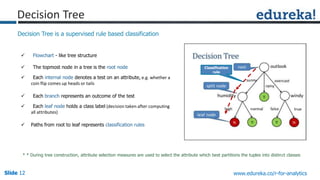
Decision Tree is a supervised rule based classification
* * During tree construction, attribute selection measures are used to select the attribute which best partitions the tuples into distinct classes
Classification
rule
 Flowchart - like tree structure
 The topmost node in a tree is the root node
 Each internal node denotes a test on an attribute, e.g. whether a
coin flip comes up heads or tails
 Each branch represents an outcome of the test
 Each leaf node holds a class label (decision taken after computing
all attributes)
 Paths from root to leaf represents classification rules
Slide 13Slide 13Slide 13 www.edureka.co/r-for-analytics
Under
-grad
Marital
Status
Taxable
Income
City
Population
Work
Experience
Urban Category
Yes Married 98,727 1,01,894 14 NO Risky
No Single 44,000 10,18,945 12 YES Good
No Divorced 50,000 10,15,845 14 YES Good
No Single 32,100 12,58,945 12 NO Risky
Yes Married 28,000 1,22,945 8 YES Risky
No Single 35,100 12,56,845 10 NO Good
No Divorced 38,100 18,95,945 7 NO Good
Under
-grad
Marital
Status
Taxable
Income
City
Population
Work
Experience
Urban Category
Yes Divorced 98,727 1,01,894 14 NO ????
DT Can Be used With Machine Learning
When Coupled with Machine Learning, Decision Tree can be used for Prediction
Slide 14Slide 14Slide 14 www.edureka.co/r-for-analytics
How it Works..
Let’s Build a Decision Tree Model !
Slide 15Slide 15Slide 15 www.edureka.co/r-for-analytics
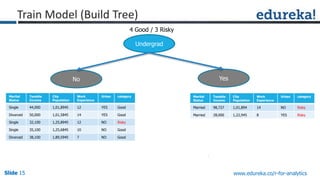
Train Model (Build Tree)
Undergrad
4 Good / 3 Risky
No Yes
Marital
Status
Taxable
Income
City
Population
Work
Experience
Urban category
Single 44,000 1,01,8945 12 YES Good
Divorced 50,000 1,01,5845 14 YES Good
Single 32,100 1,25,8945 12 NO Risky
Single 35,100 1,25,6845 10 NO Good
Divorced 38,100 1,89,5945 7 NO Good
Marital
Status
Taxable
Income
City
Population
Work
Experience
Urban category
Married 98,727 1,01,894 14 NO Risky
Married 28,000 1,22,945 8 YES Risky
Slide 16Slide 16Slide 16 www.edureka.co/r-for-analytics
Train Model (Build Tree)
Undergrad
4 Good / 3 Risky
No Yes
Marital
Status
Taxable
Income
City
Population
Work
Experience
Urban category
Single 44,000 1,01,8945 12 YES Good
Divorced 50,000 1,01,5845 14 YES Good
Single 32,100 1,25,8945 12 NO Risky
Single 35,100 1,25,6845 10 NO Good
Divorced 38,100 1,89,5945 7 NO Good
Marital
Status
Taxable
Income
City
Population
Work
Experience
Urban category
Married 98,727 1,01,894 14 NO Risky
Married 28,000 1,22,945 8 YES Risky
2 Risky
Pure Subset
4 Good/1 Risky
Split Further
Slide 17Slide 17Slide 17 www.edureka.co/r-for-analytics
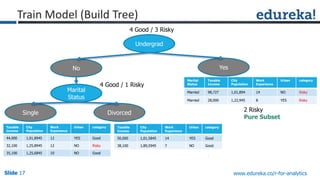
Train Model (Build Tree)
Undergrad
4 Good / 1 Risky
No Yes
Marital
Status
Taxable
Income
City
Population
Work
Experience
Urban category
Married 98,727 1,01,894 14 NO Risky
Married 28,000 1,22,945 8 YES Risky
Marital
Status
Taxable
Income
City
Population
Work
Experience
Urban category
50,000 1,01,5845 14 YES Good
38,100 1,89,5945 7 NO Good
Single Divorced
Taxable
Income
City
Population
Work
Experience
Urban category
44,000 1,01,8945 12 YES Good
32,100 1,25,8945 12 NO Risky
35,100 1,25,6845 10 NO Good
4 Good / 3 Risky
2 Risky
Pure Subset
Slide 18Slide 18Slide 18 www.edureka.co/r-for-analytics
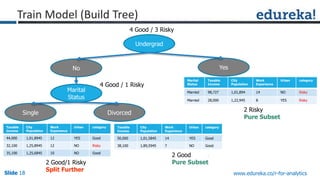
Train Model (Build Tree)
Undergrad
4 Good / 1 Risky
No Yes
Marital
Status
Taxable
Income
City
Population
Work
Experience
Urban category
Married 98,727 1,01,894 14 NO Risky
Married 28,000 1,22,945 8 YES Risky
Marital
Status
Taxable
Income
City
Population
Work
Experience
Urban category
50,000 1,01,5845 14 YES Good
38,100 1,89,5945 7 NO Good
Single Divorced
Taxable
Income
City
Population
Work
Experience
Urban category
44,000 1,01,8945 12 YES Good
32,100 1,25,8945 12 NO Risky
35,100 1,25,6845 10 NO Good
2 Good/1 Risky
Split Further
4 Good / 3 Risky
2 Risky
Pure Subset
2 Good
Pure Subset
Slide 19Slide 19Slide 19 www.edureka.co/r-for-analytics
Train Model (Build Tree)
Marital
Status
Taxable
Income
City
Population
Work
Experience
Urban category
50,000 1,01,5845 14 YES Good
38,100 1,89,5945 7 NO Good
Single Divorced
2 Good
Pure Subset
Taxable
Income
< 33000 >33000
Taxable
Income
City
Population
Work
Experience
Urban category
32,100 1,25,8945 12 NO Risky
Taxable
Income
City
Population
Work
Experience
Urban category
44,000 1,01,8945 12 YES Good
35,100 1,25,6845 10 NO Good
4 Good / 1 Risky
2 Good / 1 Risky
Slide 20Slide 20Slide 20 www.edureka.co/r-for-analytics
Train Model (Build Tree)
Marital
Status
Taxable
Income
City
Population
Work
Experience
Urban category
50,000 1,01,5845 14 YES Good
38,100 1,89,5945 7 NO Good
Single Divorced
2 Good
Pure Subset
Taxable
Income
< 33000 >33000
Taxable
Income
City
Population
Work
Experience
Urban category
32,100 1,25,8945 12 NO Risky
Taxable
Income
City
Population
Work
Experience
Urban category
44,000 1,01,8945 12 YES Good
35,100 1,25,6845 10 NO Good
2 Good
Pure Subset
1 Risky
Pure Subset
4 Good / 1 Risky
2 Good / 1 Risky
Slide 21Slide 21Slide 21 www.edureka.co/r-for-analytics
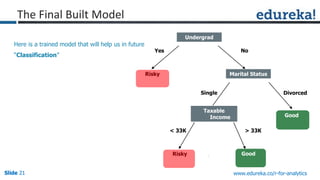
Undergrad
Marital Status
Taxable
Income
GoodRisky
Risky
Good
Yes No
DivorcedSingle
< 33K > 33K
The Final Built Model
Here is a trained model that will help us in future
“Classification”
Slide 22Slide 22Slide 22 www.edureka.co/r-for-analytics
Let’s Use our Model..
Slide 23Slide 23Slide 23 www.edureka.co/r-for-analytics
Test Data
Start from the root of tree
Under
-grad
Marital
Status
Taxable
Income
City
Population
Work
Experience
Urba
n
category
No Divorced 98727 101894 14 NO ????
Undergrad
Marital Status
Taxable Income
GoodRisky
Risky
Good
Yes No
DivorcedSingle
< 33K > 33K
Slide 24Slide 24Slide 24 www.edureka.co/r-for-analytics
Test Data
How It Works
Under
-grad
Marital
Status
Taxable
Income
City
Population
Work
Experience
Urba
n
category
No Divorced 98727 101894 14 NO ????
Undergrad
Slide 25Slide 25Slide 25 www.edureka.co/r-for-analytics
Test Data
No
How It Works
Under
-grad
Marital
Status
Taxable
Income
City
Population
Work
Experience
Urba
n
category
No Divorced 98727 101894 14 NO ????
Undergrad
Slide 26Slide 26Slide 26 www.edureka.co/r-for-analytics
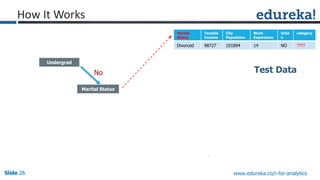
Test DataNo
How It Works
Marital
Status
Taxable
Income
City
Population
Work
Experience
Urba
n
category
Divorced 98727 101894 14 NO ????
Undergrad
Marital Status
Slide 27Slide 27Slide 27 www.edureka.co/r-for-analytics
Test Data
How It Works
Marital
Status
Taxable
Income
City
Population
Work
Experience
Urba
n
category
Divorced 98727 101894 14 NO ????
Divorced
No
Undergrad
Marital Status
Slide 28Slide 28Slide 28 www.edureka.co/r-for-analytics
Test Data
How It Works
Marital
Status
Taxable
Income
City
Population
Work
Experience
Urba
n
category
Divorced 98727 101894 14 NO Good
Divorced
Good
The customer lies in the “Good” Group and he can
be considered for all policies for a good customer
like more loans can be provided to him, his credit
card limit can be increased etc..
No
Undergrad
Marital Status
Demo
Slide 30Slide 30Slide 30 www.edureka.co/r-for-analytics
Real Life Application
Slide 31Slide 31Slide 31 www.edureka.co/r-for-analytics
Predicting tumor cells as benign or malignant!
Application of Decision Trees
Slide 32Slide 32Slide 32 www.edureka.co/r-for-analytics
Banks Using For Classifying credit card transactions !
Application of Decision Trees
Slide 33Slide 33Slide 33 www.edureka.co/r-for-analytics
Categorizing news stories as finance, weather etc…
Application of Decision Trees
Questions
Slide 34
Slide 35Slide 35Slide 35 www.edureka.co/r-for-analytics
Conclusion!
When to Apply Decision Tree ??
Whenever you are making a future complex decision
When you have are just experimenting with the decisions and you want to evaluate
and visualize your decision and the impact
When you want to present your decision and its comparison with other decisions on
the same problem
Slide 36
Your feedback is vital for us, be it a compliment, a suggestion or a complaint. It helps us to make your
experience better!
Please spare few minutes to take the survey after the webinar.
Survey
Decoding the science of Decision trees

Decoding the science of Decision trees

  • 1.
    www.edureka.co/r-for-analytics Decoding the Scienceof Decision Trees! Learn from Experts
  • 2.
    Slide 2Slide 2Slide2 www.edureka.co/r-for-analytics Today we will take you through the following:  The Classic Banking Challenge !!.. Have you already guessed it??  The Available Options for Solution  Why Decision Tree?  How Decision Tree Methodology Works ? Agenda
  • 3.
    Slide 3Slide 3Slide3 www.edureka.co/r-for-analytics The Classic Situation…
  • 4.
    Slide 4Slide 4Slide4 www.edureka.co/r-for-analytics A bank wants to classify its future customers into two categories “Risky” and “Good” based on customer’s available attributes. Let’s say a customer xyz has the following attributes. How will the bank know to which category this customer belong. Undergrad Marital Status Taxable Income City Population Work Experience (Yrs) Urban Category No Married 98,727 1,01,894 14 NO ???? The Problem?
  • 5.
    Slide 5Slide 5Slide5 www.edureka.co/r-for-analytics # A manager has to decide whether he should hire more human resources or not in order to optimize the work load balance # An individual has to make a decision such as whether or not to undertake a capital project, or must chose between two competing ventures Let See Few More Cases..
  • 6.
    Slide 6Slide 6Slide6 www.edureka.co/r-for-analytics The Available Solution Options…
  • 7.
    Slide 7Slide 7Slide7 www.edureka.co/r-for-analytics Algorithms that can help.. Such type of problems comes under “classification” It is the separation or ordering of objects into classes There are few techniques in classification method, like:  Decision Tree  Naïve Bayes  k-Nearest Neighbor  Support Vector Machine etc..
  • 8.
    Slide 8Slide 8Slide8 www.edureka.co/r-for-analytics Why Decision Tree is Favorable..? DT NB KNN SVM Simple visual representation of a decision situation YES NO NO NO Easy to interpret and explain to executives (Non-programmers)! YES NO NO NO Illustrates a variety of decisions and also the impact of each decision if different decisions were to be taken YES NO NO NO Allow us to predict, explain, describe, or classify an outcome altogether YES NO NO NO Help determine worst, best and expected values for different scenarios YES NO NO NO Able to handle both numerical and categorical data YES NO NO NO Advantages of Decision Tree Methodology Decision Tree (DT) Naïve Bayes (NB) k-Nearest Neighbor (KNN) Support Vector Machine (SVM)
  • 9.
    Slide 9Slide 9Slide9 www.edureka.co/r-for-analytics Decision Trees are "white boxes" : The acquired knowledge can be expressed in a readable form, while KNN,SVM,NB are “black boxes”, :You cannot read the acquired knowledge in a comprehensible way e.g. To Explain a suitable Weather Condition for Playing in Decision Tree format.. If weather is nice and wind is normal and the day is sunny then only play ( *Readable Format) Decision Tree Advantages.. Easy to interpret and explain to executives (Non-programmers)! Cond. 1 Cond. 2 Cond. 3
  • 10.
    Slide 10Slide 10Slide10 www.edureka.co/r-for-analytics If stays for 6 months with the company If doesn’t stay for 6 months with the company If stays for 6 months with the company If doesn’t stay for 6 months with the company With 50 % success, $100 With 50 % fail, -$40 With 50 % success, $90 With 50 % fail, -$20 50%($100) – 50% ($40) = $30 50%($90) – 50% ($20) = $35 Permanent Outsourced Manager Illustrates a variety of decisions and also the impact of each decision if different decisions were to be taken Decision Tree Advantages..contd
  • 11.
    Slide 11Slide 11Slide11 www.edureka.co/r-for-analytics Let’s Understand it More … What is Decision Tree?
  • 12.
    Slide 12Slide 12Slide12 www.edureka.co/r-for-analytics Decision Tree Decision Tree is a supervised rule based classification * * During tree construction, attribute selection measures are used to select the attribute which best partitions the tuples into distinct classes Classification rule  Flowchart - like tree structure  The topmost node in a tree is the root node  Each internal node denotes a test on an attribute, e.g. whether a coin flip comes up heads or tails  Each branch represents an outcome of the test  Each leaf node holds a class label (decision taken after computing all attributes)  Paths from root to leaf represents classification rules
  • 13.
    Slide 13Slide 13Slide13 www.edureka.co/r-for-analytics Under -grad Marital Status Taxable Income City Population Work Experience Urban Category Yes Married 98,727 1,01,894 14 NO Risky No Single 44,000 10,18,945 12 YES Good No Divorced 50,000 10,15,845 14 YES Good No Single 32,100 12,58,945 12 NO Risky Yes Married 28,000 1,22,945 8 YES Risky No Single 35,100 12,56,845 10 NO Good No Divorced 38,100 18,95,945 7 NO Good Under -grad Marital Status Taxable Income City Population Work Experience Urban Category Yes Divorced 98,727 1,01,894 14 NO ???? DT Can Be used With Machine Learning When Coupled with Machine Learning, Decision Tree can be used for Prediction
  • 14.
    Slide 14Slide 14Slide14 www.edureka.co/r-for-analytics How it Works.. Let’s Build a Decision Tree Model !
  • 15.
    Slide 15Slide 15Slide15 www.edureka.co/r-for-analytics Train Model (Build Tree) Undergrad 4 Good / 3 Risky No Yes Marital Status Taxable Income City Population Work Experience Urban category Single 44,000 1,01,8945 12 YES Good Divorced 50,000 1,01,5845 14 YES Good Single 32,100 1,25,8945 12 NO Risky Single 35,100 1,25,6845 10 NO Good Divorced 38,100 1,89,5945 7 NO Good Marital Status Taxable Income City Population Work Experience Urban category Married 98,727 1,01,894 14 NO Risky Married 28,000 1,22,945 8 YES Risky
  • 16.
    Slide 16Slide 16Slide16 www.edureka.co/r-for-analytics Train Model (Build Tree) Undergrad 4 Good / 3 Risky No Yes Marital Status Taxable Income City Population Work Experience Urban category Single 44,000 1,01,8945 12 YES Good Divorced 50,000 1,01,5845 14 YES Good Single 32,100 1,25,8945 12 NO Risky Single 35,100 1,25,6845 10 NO Good Divorced 38,100 1,89,5945 7 NO Good Marital Status Taxable Income City Population Work Experience Urban category Married 98,727 1,01,894 14 NO Risky Married 28,000 1,22,945 8 YES Risky 2 Risky Pure Subset 4 Good/1 Risky Split Further
  • 17.
    Slide 17Slide 17Slide17 www.edureka.co/r-for-analytics Train Model (Build Tree) Undergrad 4 Good / 1 Risky No Yes Marital Status Taxable Income City Population Work Experience Urban category Married 98,727 1,01,894 14 NO Risky Married 28,000 1,22,945 8 YES Risky Marital Status Taxable Income City Population Work Experience Urban category 50,000 1,01,5845 14 YES Good 38,100 1,89,5945 7 NO Good Single Divorced Taxable Income City Population Work Experience Urban category 44,000 1,01,8945 12 YES Good 32,100 1,25,8945 12 NO Risky 35,100 1,25,6845 10 NO Good 4 Good / 3 Risky 2 Risky Pure Subset
  • 18.
    Slide 18Slide 18Slide18 www.edureka.co/r-for-analytics Train Model (Build Tree) Undergrad 4 Good / 1 Risky No Yes Marital Status Taxable Income City Population Work Experience Urban category Married 98,727 1,01,894 14 NO Risky Married 28,000 1,22,945 8 YES Risky Marital Status Taxable Income City Population Work Experience Urban category 50,000 1,01,5845 14 YES Good 38,100 1,89,5945 7 NO Good Single Divorced Taxable Income City Population Work Experience Urban category 44,000 1,01,8945 12 YES Good 32,100 1,25,8945 12 NO Risky 35,100 1,25,6845 10 NO Good 2 Good/1 Risky Split Further 4 Good / 3 Risky 2 Risky Pure Subset 2 Good Pure Subset
  • 19.
    Slide 19Slide 19Slide19 www.edureka.co/r-for-analytics Train Model (Build Tree) Marital Status Taxable Income City Population Work Experience Urban category 50,000 1,01,5845 14 YES Good 38,100 1,89,5945 7 NO Good Single Divorced 2 Good Pure Subset Taxable Income < 33000 >33000 Taxable Income City Population Work Experience Urban category 32,100 1,25,8945 12 NO Risky Taxable Income City Population Work Experience Urban category 44,000 1,01,8945 12 YES Good 35,100 1,25,6845 10 NO Good 4 Good / 1 Risky 2 Good / 1 Risky
  • 20.
    Slide 20Slide 20Slide20 www.edureka.co/r-for-analytics Train Model (Build Tree) Marital Status Taxable Income City Population Work Experience Urban category 50,000 1,01,5845 14 YES Good 38,100 1,89,5945 7 NO Good Single Divorced 2 Good Pure Subset Taxable Income < 33000 >33000 Taxable Income City Population Work Experience Urban category 32,100 1,25,8945 12 NO Risky Taxable Income City Population Work Experience Urban category 44,000 1,01,8945 12 YES Good 35,100 1,25,6845 10 NO Good 2 Good Pure Subset 1 Risky Pure Subset 4 Good / 1 Risky 2 Good / 1 Risky
  • 21.
    Slide 21Slide 21Slide21 www.edureka.co/r-for-analytics Undergrad Marital Status Taxable Income GoodRisky Risky Good Yes No DivorcedSingle < 33K > 33K The Final Built Model Here is a trained model that will help us in future “Classification”
  • 22.
    Slide 22Slide 22Slide22 www.edureka.co/r-for-analytics Let’s Use our Model..
  • 23.
    Slide 23Slide 23Slide23 www.edureka.co/r-for-analytics Test Data Start from the root of tree Under -grad Marital Status Taxable Income City Population Work Experience Urba n category No Divorced 98727 101894 14 NO ???? Undergrad Marital Status Taxable Income GoodRisky Risky Good Yes No DivorcedSingle < 33K > 33K
  • 24.
    Slide 24Slide 24Slide24 www.edureka.co/r-for-analytics Test Data How It Works Under -grad Marital Status Taxable Income City Population Work Experience Urba n category No Divorced 98727 101894 14 NO ???? Undergrad
  • 25.
    Slide 25Slide 25Slide25 www.edureka.co/r-for-analytics Test Data No How It Works Under -grad Marital Status Taxable Income City Population Work Experience Urba n category No Divorced 98727 101894 14 NO ???? Undergrad
  • 26.
    Slide 26Slide 26Slide26 www.edureka.co/r-for-analytics Test DataNo How It Works Marital Status Taxable Income City Population Work Experience Urba n category Divorced 98727 101894 14 NO ???? Undergrad Marital Status
  • 27.
    Slide 27Slide 27Slide27 www.edureka.co/r-for-analytics Test Data How It Works Marital Status Taxable Income City Population Work Experience Urba n category Divorced 98727 101894 14 NO ???? Divorced No Undergrad Marital Status
  • 28.
    Slide 28Slide 28Slide28 www.edureka.co/r-for-analytics Test Data How It Works Marital Status Taxable Income City Population Work Experience Urba n category Divorced 98727 101894 14 NO Good Divorced Good The customer lies in the “Good” Group and he can be considered for all policies for a good customer like more loans can be provided to him, his credit card limit can be increased etc.. No Undergrad Marital Status
  • 29.
  • 30.
    Slide 30Slide 30Slide30 www.edureka.co/r-for-analytics Real Life Application
  • 31.
    Slide 31Slide 31Slide31 www.edureka.co/r-for-analytics Predicting tumor cells as benign or malignant! Application of Decision Trees
  • 32.
    Slide 32Slide 32Slide32 www.edureka.co/r-for-analytics Banks Using For Classifying credit card transactions ! Application of Decision Trees
  • 33.
    Slide 33Slide 33Slide33 www.edureka.co/r-for-analytics Categorizing news stories as finance, weather etc… Application of Decision Trees
  • 34.
  • 35.
    Slide 35Slide 35Slide35 www.edureka.co/r-for-analytics Conclusion! When to Apply Decision Tree ?? Whenever you are making a future complex decision When you have are just experimenting with the decisions and you want to evaluate and visualize your decision and the impact When you want to present your decision and its comparison with other decisions on the same problem
  • 36.
    Slide 36 Your feedbackis vital for us, be it a compliment, a suggestion or a complaint. It helps us to make your experience better! Please spare few minutes to take the survey after the webinar. Survey