Barcelona declaration
on the contribution of the regions and
territorial authorities regarding the
organization and promotion of
training mobility of individuals
in initial vocational education
and training


The undersigned regions and territorial authorities, gathered in Barcelona on the 26th and
27th of May 2009 at the European Conference of the Regions for the promotion of mobility
in Initial Vocational Educational and Training, are aware of:

•	 the	importance	of	mobility	in	IVET,
•	 the	existing	obstacles	to	mobility,
•	 the	recent	efforts	aimed	at	improving	transparency	and	validation	of	the	professional	
   qualifications,
•	 the	growing	role	of	the	regions	and	territorial	authorities	in	training	mobility	actions,

and	wish	to	promote	debate	and	active	participation	amongst	these	regions	and	territorial	
authorities.	Therefore,	and	under	the	proposal	of	the	Government	of	Catalonia,	they	
approve	the	following	Barcelona declaration on the contribution of the regions and
territorial authorities regarding the organization and promotion of training mobility
of individuals in initial vocational education and training.

This Declaration is not intended to create legally binding obligations between the
undersigned regions and territorial authorities.
I. Preamble
Taking into account the strategies included in the following documents:

1. The Lisbon Strategy1

2.	 Bordeaux	Statement	on	the	reinforced	European	Co-operation	concerning	Education	and	
    Vocational Training2

3. European Parliament and Council’s Recommendation, regarding the creation of a European
   credit system for Education and Professional Training (ECVET)3

which	have	materialised	in:

4.	 Lifelong	Learning	Programme	2007-20134

which in turn is based on:

5. The European Quality Charter for Mobility5

6.	 Final	conclusions	of	the	MoVE-iT:	Study on the obstacles to cross-national Mobility faced by
    apprentices and other young people in Initial Vocational Training and on ways of overcoming
    them6


II. The growing importance of the role of the regions and
territorial authorities
Taking into account that

7. The decentralisation process which has taken place in Europe in the last 30 years has
   resulted in the acquisition of new competencies by the regions and other territorial
   authorities	at	different	levels	according	to	the	constitutional	structure	of	each	State.

and that

8. The intermediary authorities (regional or sectoral), acting as an interface between the
   training	centres	and	the	competent	national	ministries,	have	developed	a	fundamental	role	
   in	the	innovation	of	measures	covering	the	regional	training	and	education	systems.


1. Conclusions of the Presidency, European Council of Lisbon, 23rd and 24th March 2000 [5256/00 + Add 1
COR 1].
2. Communication of the European Ministers of Education and VET, the European social agents and the
European	Commission,	done	in	Bordeaux	on	26	November	2008	to	review	the	priorities	and	strategies	of	the	
Copenhagen process.
3.	Voted	in	plenary	session	of	the	European	Parliament	on	15	December	2008	to	its	formal	adoption	by	the	
European Parliament and the Council under the presidency of the Czech Republic during the first semester of
2009.
4.	Agreement	number.	1720/2006/CE	of	the	European	Parliament	and	the	European	Council,	15th	November	
2006, in which an action programme on Lifelong learning has been designed [Official Journal L 327/45 de
24.11.2006].
5.	Recommendation	(CE)	number.	2006/961/CE	of	the	European	Parliament	and	the	European	Council,	18th	
December 2006 [Official Journal L 394 de 30.12.2006].
6. Report financed and written to be used by the European Commission, the General Direction.
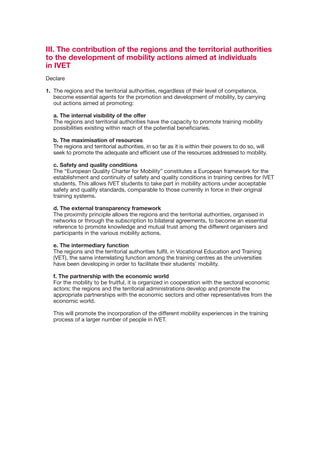
III. The contribution of the regions and the territorial authorities
to the development of mobility actions aimed at individuals
in IVET
Declare

1.	 The	regions	and	the	territorial	authorities,	regardless	of	their	level	of	competence,	
    become	essential	agents	for	the	promotion	and	development	of	mobility,	by	carrying	
    out actions aimed at promoting:

    a. The internal visibility of the offer
    The	regions	and	territorial	authorities	have	the	capacity	to	promote	training	mobility	
    possibilities	existing	within	reach	of	the	potential	beneficiaries.

    b. The maximisation of resources
    The regions and territorial authorities, in so far as it is within their powers to do so, will
    seek to promote the adequate and efficient use of the resources addressed to mobility.

    c. Safety and quality conditions
    The “European Quality Charter for Mobility” constitutes a European framework for the
    establishment and continuity of safety and quality conditions in training centres for IVET
    students. This allows IVET students to take part in mobility actions under acceptable
    safety and quality standards, comparable to those currently in force in their original
    training systems.

    d. The external transparency framework
    The	proximity	principle	allows	the	regions	and	the	territorial	authorities,	organised	in	
    networks or through the subscription to bilateral agreements, to become an essential
    reference to promote knowledge and mutual trust among the different organisers and
    participants	in	the	various	mobility	actions.

    e. The intermediary function
    The regions and the territorial authorities fulfil, in Vocational Education and Training
    (VET),	the	same	interrelating	function	among	the	training	centres	as	the	universities	
    have	been	developing	in	order	to	facilitate	their	students’	mobility.

    f. The partnership with the economic world
    For the mobility to be fruitful, it is organized in cooperation with the sectoral economic
    actors;	the	regions	and	the	territorial	administrations	develop	and	promote	the	
    appropriate	partnerships	with	the	economic	sectors	and	other	representatives	from	the	
    economic world.

	   This	will	promote	the	incorporation	of	the	different	mobility	experiences	in	the	training	
    process of a larger number of people in IVET.
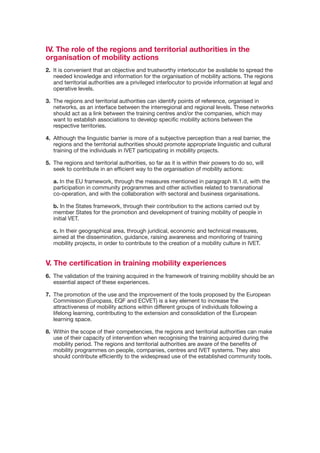
IV. The role of the regions and territorial authorities in the
organisation of mobility actions
2.	 It	is	convenient	that	an	objective	and	trustworthy	interlocutor	be	available	to	spread	the	
    needed knowledge and information for the organisation of mobility actions. The regions
    and	territorial	authorities	are	a	privileged	interlocutor	to	provide	information	at	legal	and	
    operative	levels.

3. The regions and territorial authorities can identify points of reference, organised in
   networks,	as	an	interface	between	the	interregional	and	regional	levels.	These	networks	
   should act as a link between the training centres and/or the companies, which may
   want	to	establish	associations	to	develop	specific	mobility	actions	between	the	
   respective	territories.

4.	 Although	the	linguistic	barrier	is	more	of	a	subjective	perception	than	a	real	barrier,	the	
    regions and the territorial authorities should promote appropriate linguistic and cultural
    training	of	the	individuals	in	IVET	participating	in	mobility	projects.	

5. The regions and territorial authorities, so far as it is within their powers to do so, will
   seek to contribute in an efficient way to the organisation of mobility actions:

   a. In the EU framework, through the measures mentioned in paragraph III.1.d, with the
   participation	in	community	programmes	and	other	activities	related	to	transnational	
   co-operation,	and	with	the	collaboration	with	sectoral	and	business	organisations.

   b. In the States framework, through their contribution to the actions carried out by
   member	States	for	the	promotion	and	development	of	training	mobility	of	people	in	
   initial VET.

   c.	In	their	geographical	area,	through	juridical,	economic	and	technical	measures,	
   aimed at the dissemination, guidance, raising awareness and monitoring of training
   mobility	projects,	in	order	to	contribute	to	the	creation	of	a	mobility	culture	in	IVET.


V. The certification in training mobility experiences
6.	 The	validation	of	the	training	acquired	in	the	framework	of	training	mobility	should	be	an	
    essential	aspect	of	these	experiences.

7.	 The	promotion	of	the	use	and	the	improvement	of	the	tools	proposed	by	the	European	
    Commission (Europass, EQF and ECVET) is a key element to increase the
    attractiveness	of	mobility	actions	within	different	groups	of	individuals	following	a	
    lifelong	learning,	contributing	to	the	extension	and	consolidation	of	the	European	
    learning space.

8. Within the scope of their competencies, the regions and territorial authorities can make
   use	of	their	capacity	of	intervention	when	recognising	the	training	acquired	during	the	
   mobility period. The regions and territorial authorities are aware of the benefits of
   mobility programmes on people, companies, centres and IVET systems. They also
   should contribute efficiently to the widespread use of the established community tools.

Declaració de Barcelona (English)

  • 1.
    Barcelona declaration on thecontribution of the regions and territorial authorities regarding the organization and promotion of training mobility of individuals in initial vocational education and training The undersigned regions and territorial authorities, gathered in Barcelona on the 26th and 27th of May 2009 at the European Conference of the Regions for the promotion of mobility in Initial Vocational Educational and Training, are aware of: • the importance of mobility in IVET, • the existing obstacles to mobility, • the recent efforts aimed at improving transparency and validation of the professional qualifications, • the growing role of the regions and territorial authorities in training mobility actions, and wish to promote debate and active participation amongst these regions and territorial authorities. Therefore, and under the proposal of the Government of Catalonia, they approve the following Barcelona declaration on the contribution of the regions and territorial authorities regarding the organization and promotion of training mobility of individuals in initial vocational education and training. This Declaration is not intended to create legally binding obligations between the undersigned regions and territorial authorities.
  • 2.
    I. Preamble Taking intoaccount the strategies included in the following documents: 1. The Lisbon Strategy1 2. Bordeaux Statement on the reinforced European Co-operation concerning Education and Vocational Training2 3. European Parliament and Council’s Recommendation, regarding the creation of a European credit system for Education and Professional Training (ECVET)3 which have materialised in: 4. Lifelong Learning Programme 2007-20134 which in turn is based on: 5. The European Quality Charter for Mobility5 6. Final conclusions of the MoVE-iT: Study on the obstacles to cross-national Mobility faced by apprentices and other young people in Initial Vocational Training and on ways of overcoming them6 II. The growing importance of the role of the regions and territorial authorities Taking into account that 7. The decentralisation process which has taken place in Europe in the last 30 years has resulted in the acquisition of new competencies by the regions and other territorial authorities at different levels according to the constitutional structure of each State. and that 8. The intermediary authorities (regional or sectoral), acting as an interface between the training centres and the competent national ministries, have developed a fundamental role in the innovation of measures covering the regional training and education systems. 1. Conclusions of the Presidency, European Council of Lisbon, 23rd and 24th March 2000 [5256/00 + Add 1 COR 1]. 2. Communication of the European Ministers of Education and VET, the European social agents and the European Commission, done in Bordeaux on 26 November 2008 to review the priorities and strategies of the Copenhagen process. 3. Voted in plenary session of the European Parliament on 15 December 2008 to its formal adoption by the European Parliament and the Council under the presidency of the Czech Republic during the first semester of 2009. 4. Agreement number. 1720/2006/CE of the European Parliament and the European Council, 15th November 2006, in which an action programme on Lifelong learning has been designed [Official Journal L 327/45 de 24.11.2006]. 5. Recommendation (CE) number. 2006/961/CE of the European Parliament and the European Council, 18th December 2006 [Official Journal L 394 de 30.12.2006]. 6. Report financed and written to be used by the European Commission, the General Direction.
  • 3.
    III. The contributionof the regions and the territorial authorities to the development of mobility actions aimed at individuals in IVET Declare 1. The regions and the territorial authorities, regardless of their level of competence, become essential agents for the promotion and development of mobility, by carrying out actions aimed at promoting: a. The internal visibility of the offer The regions and territorial authorities have the capacity to promote training mobility possibilities existing within reach of the potential beneficiaries. b. The maximisation of resources The regions and territorial authorities, in so far as it is within their powers to do so, will seek to promote the adequate and efficient use of the resources addressed to mobility. c. Safety and quality conditions The “European Quality Charter for Mobility” constitutes a European framework for the establishment and continuity of safety and quality conditions in training centres for IVET students. This allows IVET students to take part in mobility actions under acceptable safety and quality standards, comparable to those currently in force in their original training systems. d. The external transparency framework The proximity principle allows the regions and the territorial authorities, organised in networks or through the subscription to bilateral agreements, to become an essential reference to promote knowledge and mutual trust among the different organisers and participants in the various mobility actions. e. The intermediary function The regions and the territorial authorities fulfil, in Vocational Education and Training (VET), the same interrelating function among the training centres as the universities have been developing in order to facilitate their students’ mobility. f. The partnership with the economic world For the mobility to be fruitful, it is organized in cooperation with the sectoral economic actors; the regions and the territorial administrations develop and promote the appropriate partnerships with the economic sectors and other representatives from the economic world. This will promote the incorporation of the different mobility experiences in the training process of a larger number of people in IVET.
  • 4.
    IV. The roleof the regions and territorial authorities in the organisation of mobility actions 2. It is convenient that an objective and trustworthy interlocutor be available to spread the needed knowledge and information for the organisation of mobility actions. The regions and territorial authorities are a privileged interlocutor to provide information at legal and operative levels. 3. The regions and territorial authorities can identify points of reference, organised in networks, as an interface between the interregional and regional levels. These networks should act as a link between the training centres and/or the companies, which may want to establish associations to develop specific mobility actions between the respective territories. 4. Although the linguistic barrier is more of a subjective perception than a real barrier, the regions and the territorial authorities should promote appropriate linguistic and cultural training of the individuals in IVET participating in mobility projects. 5. The regions and territorial authorities, so far as it is within their powers to do so, will seek to contribute in an efficient way to the organisation of mobility actions: a. In the EU framework, through the measures mentioned in paragraph III.1.d, with the participation in community programmes and other activities related to transnational co-operation, and with the collaboration with sectoral and business organisations. b. In the States framework, through their contribution to the actions carried out by member States for the promotion and development of training mobility of people in initial VET. c. In their geographical area, through juridical, economic and technical measures, aimed at the dissemination, guidance, raising awareness and monitoring of training mobility projects, in order to contribute to the creation of a mobility culture in IVET. V. The certification in training mobility experiences 6. The validation of the training acquired in the framework of training mobility should be an essential aspect of these experiences. 7. The promotion of the use and the improvement of the tools proposed by the European Commission (Europass, EQF and ECVET) is a key element to increase the attractiveness of mobility actions within different groups of individuals following a lifelong learning, contributing to the extension and consolidation of the European learning space. 8. Within the scope of their competencies, the regions and territorial authorities can make use of their capacity of intervention when recognising the training acquired during the mobility period. The regions and territorial authorities are aware of the benefits of mobility programmes on people, companies, centres and IVET systems. They also should contribute efficiently to the widespread use of the established community tools.