Date: in 12 ptsEducation
and Culture
QUALITY LINQ 2013
Quality improvement
in
learning outcomes
Antonio Silva Mendes
DG Education and Culture
Director
16 May 2013
Education
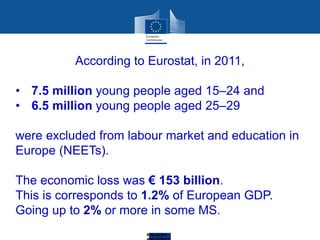
According to Eurostat, in 2011,
• 7.5 million young people aged 15–24 and
• 6.5 million young people aged 25–29
were excluded from labour market and education in
Europe (NEETs).
The economic loss was € 153 billion.
This is corresponds to 1.2% of European GDP.
Going up to 2% or more in some MS.
Date: in 12 pts
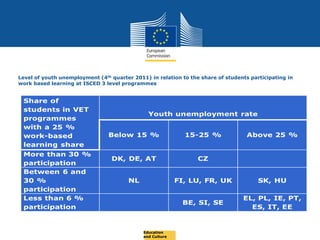
Level of youth unemployment (4th quarter 2011) in relation to the share of students participating in
work based learning at ISCED 3 level programmes
Education
and Culture
Education
Education and Training Context
In this period where the Education
landscape has been shaken by an economic
earthquake:
• Education budgets under pressure; do
more with less;
• Teaching workforce seriously affected
(20 national education systems with
frozen or cuts in salaries)
Education
Education and Training Context (cont)
At the same time we are witnessing a
tsunami in the Education field:
• Massive increase in global demand for
education
• Massive impact of IT in education
provision and methods;
• Massive retirement of teachers and staff
shortages in some areas
Date: in 12 pts
Quality in Education and Training
to improve quality of learning
opportunities aiming at:
Developing outcomes and skills to
better match society and labour
market needs
Education
Education
Quality in Education and Training
promotes better quality in the design,
organization, content, delivery,
assessment and validation of learning
Providing national policy makers,
institutions, and education and
training providers with policy
guidance and practical instruments
Education
Quality in Education and Training
Research demonstrates that quality of
teachers has the greatest potential for
improving learning.
"poor quality teaching has a debilitating
and cumulative effect on student
outcomes, … and is more strongly related
to student achievements than classes size
or other spendings"
Education
Two levels of intervention:
• What Member States need to do;
• The European Union can help
Education
What Member States need to do for
Teachers
• Define competencies and qualities;
• Redesign recruitment systems to select
the best;
• Ensure induction and LLL
• Provide regular feedback
• Focus on learning not on administration
• Reinforce out of the box partnerships
Education
The EU can help …
• By strengthening the link between EU policy
and spending priorities; financing actions
that benefit teaching professions.
• By stepping up our role in helping Members
States learn from each other; supporting
benchmarking activities.
Rethinking Education
Erasmus for All Program
Date: in 12 pts
Rethinking Education package
Investing in skills for better socio-economic outcomes:
Skills for 21st century (basic and tranversal – special
focus on STEM and entrepreneurship; vocational with a
focus on WBL and excellence)
Open and flexible learning (learning outcomes,
transparency and recognition of qualifications – EQF,
ECVET; use of ICT and OER; teachers)
Collaborative effort (maintain investments in E&T,
efficiency of funding, cost-sharing in HE and I- and
CVET; partnerships)
Education
Date: in 12 ptsEducation
Open-up Education
The potential of ICT and Open Educational
Resources for improving access, quality and
efficiency of education and training is not fully
exploited.
• Digital competences, European
competitiveness and equity;
• Access, efficiency and quality of education
and training systems:
Date: in 12 ptsEducation
eTwinning
Platform for teachers to connect,
develop collaborative projects and share
ideas in Europe
200 000 teachers; 28 018 schools; 105 207 projects
http://www.etwinning.net/en/pub/index.htm
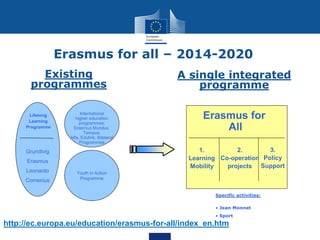
Youth in Action
Programme
International
higher education
programmes:
Erasmus Mundus,
Tempus,
Alfa, Edulink, Bilateral
Programmes
Grundtvig
Erasmus
Leonardo
Comenius
Lifelong
Learning
Programme
A single integrated
programme
Existing
programmes
Erasmus for all – 2014-2020
Erasmus for
All
1.
Learning
Mobility
3.
Policy
Support
2.
Co-operation
projects
Specific activities:
• Jean Monnet
• Sport
http://ec.europa.eu/education/erasmus-for-all/index_en.htm
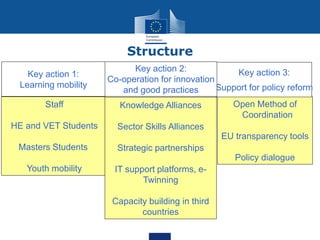
Staff
HE and VET Students
Masters Students
Youth mobility
Key action 1:
Learning mobility
Open Method of
Coordination
EU transparency tools
Policy dialogue
Key action 3:
Support for policy reform
Knowledge Alliances
Sector Skills Alliances
Strategic partnerships
IT support platforms, e-
Twinning
Capacity building in third
countries
Key action 2:
Co-operation for innovation
and good practices
Structure
Date: in 12 pts
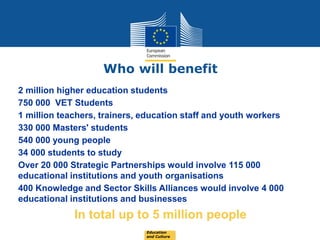
Who will benefit
Education
and Culture
2 million higher education students
750 000 VET Students
1 million teachers, trainers, education staff and youth workers
330 000 Masters' students
540 000 young people
34 000 students to study
Over 20 000 Strategic Partnerships would involve 115 000
educational institutions and youth organisations
400 Knowledge and Sector Skills Alliances would involve 4 000
educational institutions and businesses
In total up to 5 million people
Date: in 12 ptsEducation
Excellence in Vocational, Education
and Training
Increasing quality in the learning outcomes
of VET, to equip workforce with skills that
can strengthen productivity, innovation and
facilitate economic restructuring (e.g.
transition towards a greener economy)
Date: in 12 ptsEducation
Increase the potential of VET to
support growth
• Alignment of VET with regional/local
economic strategies; Sectoral skills
Alliances; Reinforce partnerships
• Providing high level vocational
opportunities;
• Promote dual system principles
Date: in 12 ptsEducation
Increase the potential of VET to
support growth (cont.)
• Increase work-based learning; the
European Alliances for Apprenticeships;
• Promote Flexible learning pathways;
• Promote a Culture of quality; European
Quality reference framework EQAVET
Date: in 12 ptsEducation
High Quality opportunities for Adult
Learners
Crises highlighted the need for adults (low
skilled and older workers) to be able to
adapt to changes in the labour market and
in the society. We must be able to increase
their employability by ensuring a greater
interaction with continuous VET
Date: in 12 ptsEducation
High Quality opportunities for Adult
Learners (cont)
• Design courses/curricula based on
learning outcomes relevant to the needs
of learners/market
• Collective effort of schools, Universities,
vocational centers, policy makers,
business, ONGs/Society.
Date: in 12 ptsEducation
Final Remarks
• Time for action
• European dimension to support
concrete National intervention
• Interaction between all stakeholders,
but greater participation of Business
into education
Date: in 12 ptsEducation
Final Remarks (cont)
• Greater use of work-based-learning to
facilitate transition from Education to
market World
• Modernization of the Education world
through a generalized use of new
technologies
Date: in 12 pts
Thank you for your attention.
Education
and Culture

Linq 2013 plenary_keynote_silva_mendes

  • 1.
    Date: in 12ptsEducation and Culture QUALITY LINQ 2013 Quality improvement in learning outcomes Antonio Silva Mendes DG Education and Culture Director 16 May 2013
  • 2.
    Education According to Eurostat,in 2011, • 7.5 million young people aged 15–24 and • 6.5 million young people aged 25–29 were excluded from labour market and education in Europe (NEETs). The economic loss was € 153 billion. This is corresponds to 1.2% of European GDP. Going up to 2% or more in some MS.
  • 3.
    Date: in 12pts Level of youth unemployment (4th quarter 2011) in relation to the share of students participating in work based learning at ISCED 3 level programmes Education and Culture
  • 4.
    Education Education and TrainingContext In this period where the Education landscape has been shaken by an economic earthquake: • Education budgets under pressure; do more with less; • Teaching workforce seriously affected (20 national education systems with frozen or cuts in salaries)
  • 5.
    Education Education and TrainingContext (cont) At the same time we are witnessing a tsunami in the Education field: • Massive increase in global demand for education • Massive impact of IT in education provision and methods; • Massive retirement of teachers and staff shortages in some areas
  • 6.
    Date: in 12pts Quality in Education and Training to improve quality of learning opportunities aiming at: Developing outcomes and skills to better match society and labour market needs Education
  • 7.
    Education Quality in Educationand Training promotes better quality in the design, organization, content, delivery, assessment and validation of learning Providing national policy makers, institutions, and education and training providers with policy guidance and practical instruments
  • 8.
    Education Quality in Educationand Training Research demonstrates that quality of teachers has the greatest potential for improving learning. "poor quality teaching has a debilitating and cumulative effect on student outcomes, … and is more strongly related to student achievements than classes size or other spendings"
  • 9.
    Education Two levels ofintervention: • What Member States need to do; • The European Union can help
  • 10.
    Education What Member Statesneed to do for Teachers • Define competencies and qualities; • Redesign recruitment systems to select the best; • Ensure induction and LLL • Provide regular feedback • Focus on learning not on administration • Reinforce out of the box partnerships
  • 11.
    Education The EU canhelp … • By strengthening the link between EU policy and spending priorities; financing actions that benefit teaching professions. • By stepping up our role in helping Members States learn from each other; supporting benchmarking activities. Rethinking Education Erasmus for All Program
  • 12.
    Date: in 12pts Rethinking Education package Investing in skills for better socio-economic outcomes: Skills for 21st century (basic and tranversal – special focus on STEM and entrepreneurship; vocational with a focus on WBL and excellence) Open and flexible learning (learning outcomes, transparency and recognition of qualifications – EQF, ECVET; use of ICT and OER; teachers) Collaborative effort (maintain investments in E&T, efficiency of funding, cost-sharing in HE and I- and CVET; partnerships) Education
  • 13.
    Date: in 12ptsEducation Open-up Education The potential of ICT and Open Educational Resources for improving access, quality and efficiency of education and training is not fully exploited. • Digital competences, European competitiveness and equity; • Access, efficiency and quality of education and training systems:
  • 14.
    Date: in 12ptsEducation eTwinning Platform for teachers to connect, develop collaborative projects and share ideas in Europe 200 000 teachers; 28 018 schools; 105 207 projects http://www.etwinning.net/en/pub/index.htm
  • 15.
    Youth in Action Programme International highereducation programmes: Erasmus Mundus, Tempus, Alfa, Edulink, Bilateral Programmes Grundtvig Erasmus Leonardo Comenius Lifelong Learning Programme A single integrated programme Existing programmes Erasmus for all – 2014-2020 Erasmus for All 1. Learning Mobility 3. Policy Support 2. Co-operation projects Specific activities: • Jean Monnet • Sport http://ec.europa.eu/education/erasmus-for-all/index_en.htm
  • 16.
    Staff HE and VETStudents Masters Students Youth mobility Key action 1: Learning mobility Open Method of Coordination EU transparency tools Policy dialogue Key action 3: Support for policy reform Knowledge Alliances Sector Skills Alliances Strategic partnerships IT support platforms, e- Twinning Capacity building in third countries Key action 2: Co-operation for innovation and good practices Structure
  • 17.
    Date: in 12pts Who will benefit Education and Culture 2 million higher education students 750 000 VET Students 1 million teachers, trainers, education staff and youth workers 330 000 Masters' students 540 000 young people 34 000 students to study Over 20 000 Strategic Partnerships would involve 115 000 educational institutions and youth organisations 400 Knowledge and Sector Skills Alliances would involve 4 000 educational institutions and businesses In total up to 5 million people
  • 18.
    Date: in 12ptsEducation Excellence in Vocational, Education and Training Increasing quality in the learning outcomes of VET, to equip workforce with skills that can strengthen productivity, innovation and facilitate economic restructuring (e.g. transition towards a greener economy)
  • 19.
    Date: in 12ptsEducation Increase the potential of VET to support growth • Alignment of VET with regional/local economic strategies; Sectoral skills Alliances; Reinforce partnerships • Providing high level vocational opportunities; • Promote dual system principles
  • 20.
    Date: in 12ptsEducation Increase the potential of VET to support growth (cont.) • Increase work-based learning; the European Alliances for Apprenticeships; • Promote Flexible learning pathways; • Promote a Culture of quality; European Quality reference framework EQAVET
  • 21.
    Date: in 12ptsEducation High Quality opportunities for Adult Learners Crises highlighted the need for adults (low skilled and older workers) to be able to adapt to changes in the labour market and in the society. We must be able to increase their employability by ensuring a greater interaction with continuous VET
  • 22.
    Date: in 12ptsEducation High Quality opportunities for Adult Learners (cont) • Design courses/curricula based on learning outcomes relevant to the needs of learners/market • Collective effort of schools, Universities, vocational centers, policy makers, business, ONGs/Society.
  • 23.
    Date: in 12ptsEducation Final Remarks • Time for action • European dimension to support concrete National intervention • Interaction between all stakeholders, but greater participation of Business into education
  • 24.
    Date: in 12ptsEducation Final Remarks (cont) • Greater use of work-based-learning to facilitate transition from Education to market World • Modernization of the Education world through a generalized use of new technologies
  • 25.
    Date: in 12pts Thank you for your attention. Education and Culture