Decisicion Traps 6
Making The Choices


 Febri Andika 29011018
Based on the book
Decision Traps, J Edward Russo and Paul J. H. Shoemaker


 Ten Most Dangerous Decision Traps

 •1) Plunging In –

 •2) Frame Blindness –

 •3) Lack of Frame Control –

 •4) Overconfidence in Your Judgment –

 •5) Shortsighted Shortcuts –

 •6) Shooting From The Hip –

 •7) Group Failure –

 •8) Fooling Yourself About Feedback –

 •9) Not Keeping Track –

 10) Failure to Audit Your Decision Process –
Decision Traps # 6

Decision Trap no. 6: shooting from the hip: believing you cap keep straight in your
head all the info you've discovered, and therefore winging it rather than following
a systematic procedure when making the final choice
Outline “Making A Choice

• Simple Approach
• Systematic Approach
• Conclusion
Simple Approach
Intuition
• Definition: mind process of part or all information
   automatically, quickly, & without awareness of any details
• affected by evidence, fatigue, boredom, distraction, &
   recollection of a fight
The limits of intuition
• less consistency
• suffer from information overload
Ex: Consulting to A doctor in Clinic
Some simple but limited alternatives to intuition


 1. Pure intuition

 2. Simple screening & ranking rules

 3. Occupation-specific rules of thumb
Some simple but limited alternatives to intuition

People use to make choices by simple approaches:
1. Pure intuition
2. Simple screening & ranking rules
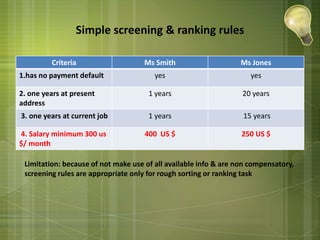
  Threshold rule: useful in quickly eliminating numerous unsuitable
  alternative and random inconsistency of purely intuitive approaches
  Exp : Decide for Credit card approval


  Criteria:
     1. has no payment default
     2. one years at present address
     3. one years at current job
     4. Salary minimum 300 us $/ month
Simple screening & ranking rules

         Criteria                    Ms Smith                     Ms Jones
1.has no payment default                yes                         yes

2. one years at present               1 years                     20 years
address
3. one years at current job           1 years                     15 years

4. Salary minimum 300 us             400 US $                     250 US $
$/ month

 Limitation: because of not make use of all available info & are non compensatory,
 screening rules are appropriate only for rough sorting or ranking task
Some simple but limited alternatives to intuition

3.Occupation-specific rules of thumb
• Ex Of Thumb: In restaurant , often price meals by
  taking the cost of the raw food and multiplying by
  three.
Systematic Approach or Linear Model
Background
In making final choices, the biggest problems are overcoming:
1. own random inconsistency
2. own inability to effectively process the large quantity of
available information


                    Linear Model
                       Solution
Linear Model
Linear model solution:
   1.maximize chances of making the best choice if we find a
   systematic way to evaluate all the evidence favorable or
   unfavorable to each possible choice
   2.compare the strength of evidence on each side rigorously
   3.pick the choice that our system indicates the evidence
     favors                        Subjective Linear
                                     Model
        Linear Model

                                 Objective Linear
                                     Model
Subjective Linear Model
Procedure :
        1. list each factor that provides evidence for or
        against various alternative


             2. assign weights to each factor to reflect their
             relative importance


                   3. make a numerical rating of the extent to
                   which the evidence about each factor favors (or
                   argues against) each alternative

                        4. multiply the score each alternative receives
                        on each factor by the weight assigned to that
                        factor, then add up all the results to get an
                        overall score for each alternative
Subjective Linear Model
   Example: How To choose the destination for yours first International
                            conference?


Option:
1. Genting
2. Paris
3. Boston
4. Bandung
Subjective Linear Modeltive Linear
                 Model
 Country    Difficulties   Fun        Experience   Cost   Overall
                                                           Score
1 Genting       60         60            60        80       66

 2 Paris        80         100           80        30       69

3 Boston       100         80            80        30       56

4 Bandung       50         50            50        100      65

 Weight        30%         20%           20%       30 %
  Used

Weight system based on my percetion
Bootstrapping
Bootstrapping As Solution

   T o choose weights is through a procedure called
   bootstrapping


                   infer statistically through a " regression analysis"
                   what weights implicitly using to arrive at the
                   particular ranking

   seek to build a model of an expert using his/her own
  intuitive predictions, and then use that model to
  outperform the expert on new cases


                    eliminate the random noise/inconsistencies and retain the core wisdom
                    of the human expert, thus it produces a standard procedure for
                    judgment
Objective Linear Model
Conditions for building an objective linear
     model
 1. if the same decision is made repeatedly
 2. if data on the outcomes of past decisions
     are available
 3. if you have good reason to expect that
     the future will resemble the past
Step
• Construct an objective linear model in
     the same way as a subjective linear
     model
• The difference is the weight infer by
     statistic from actual past result rather
     than subjectivity of expert
Choosing the right techniques for your decision


• Multiattribute utililty Analysis
  1. For simple decisions, where little is at stake, intuitively or with simple
  decision rules
  2. Use statistical decision rules based on an objective linear model to
  make any important decisions or judgments that are faced repeatedly if
  data exist to create an objective linear model
  3. Subjective linear model when making important decision that cannot
  be addressed with an objective linear model
Conclusion
Conclusion
1. Avoid Shooting from the Hip
2. Intuition achieve much less consistency than generally
   suspected so we must using linear model
3. The future of decision making is using
   Formal decision rules and systematic models
Thank You

Decisicion traps

  • 1.
    Decisicion Traps 6 MakingThe Choices Febri Andika 29011018
  • 2.
    Based on thebook Decision Traps, J Edward Russo and Paul J. H. Shoemaker Ten Most Dangerous Decision Traps •1) Plunging In – •2) Frame Blindness – •3) Lack of Frame Control – •4) Overconfidence in Your Judgment – •5) Shortsighted Shortcuts – •6) Shooting From The Hip – •7) Group Failure – •8) Fooling Yourself About Feedback – •9) Not Keeping Track – 10) Failure to Audit Your Decision Process –
  • 3.
    Decision Traps #6 Decision Trap no. 6: shooting from the hip: believing you cap keep straight in your head all the info you've discovered, and therefore winging it rather than following a systematic procedure when making the final choice
  • 4.
    Outline “Making AChoice • Simple Approach • Systematic Approach • Conclusion
  • 5.
  • 6.
    Intuition • Definition: mindprocess of part or all information automatically, quickly, & without awareness of any details • affected by evidence, fatigue, boredom, distraction, & recollection of a fight The limits of intuition • less consistency • suffer from information overload Ex: Consulting to A doctor in Clinic
  • 7.
    Some simple butlimited alternatives to intuition 1. Pure intuition 2. Simple screening & ranking rules 3. Occupation-specific rules of thumb
  • 8.
    Some simple butlimited alternatives to intuition People use to make choices by simple approaches: 1. Pure intuition 2. Simple screening & ranking rules Threshold rule: useful in quickly eliminating numerous unsuitable alternative and random inconsistency of purely intuitive approaches Exp : Decide for Credit card approval Criteria: 1. has no payment default 2. one years at present address 3. one years at current job 4. Salary minimum 300 us $/ month
  • 9.
    Simple screening &ranking rules Criteria Ms Smith Ms Jones 1.has no payment default yes yes 2. one years at present 1 years 20 years address 3. one years at current job 1 years 15 years 4. Salary minimum 300 us 400 US $ 250 US $ $/ month Limitation: because of not make use of all available info & are non compensatory, screening rules are appropriate only for rough sorting or ranking task
  • 10.
    Some simple butlimited alternatives to intuition 3.Occupation-specific rules of thumb • Ex Of Thumb: In restaurant , often price meals by taking the cost of the raw food and multiplying by three.
  • 11.
  • 12.
    Background In making finalchoices, the biggest problems are overcoming: 1. own random inconsistency 2. own inability to effectively process the large quantity of available information Linear Model Solution
  • 13.
    Linear Model Linear modelsolution: 1.maximize chances of making the best choice if we find a systematic way to evaluate all the evidence favorable or unfavorable to each possible choice 2.compare the strength of evidence on each side rigorously 3.pick the choice that our system indicates the evidence favors Subjective Linear Model Linear Model Objective Linear Model
  • 14.
    Subjective Linear Model Procedure: 1. list each factor that provides evidence for or against various alternative 2. assign weights to each factor to reflect their relative importance 3. make a numerical rating of the extent to which the evidence about each factor favors (or argues against) each alternative 4. multiply the score each alternative receives on each factor by the weight assigned to that factor, then add up all the results to get an overall score for each alternative
  • 15.
    Subjective Linear Model Example: How To choose the destination for yours first International conference? Option: 1. Genting 2. Paris 3. Boston 4. Bandung
  • 16.
    Subjective Linear ModeltiveLinear Model Country Difficulties Fun Experience Cost Overall Score 1 Genting 60 60 60 80 66 2 Paris 80 100 80 30 69 3 Boston 100 80 80 30 56 4 Bandung 50 50 50 100 65 Weight 30% 20% 20% 30 % Used Weight system based on my percetion
  • 17.
    Bootstrapping Bootstrapping As Solution T o choose weights is through a procedure called bootstrapping infer statistically through a " regression analysis" what weights implicitly using to arrive at the particular ranking seek to build a model of an expert using his/her own intuitive predictions, and then use that model to outperform the expert on new cases eliminate the random noise/inconsistencies and retain the core wisdom of the human expert, thus it produces a standard procedure for judgment
  • 18.
    Objective Linear Model Conditionsfor building an objective linear model 1. if the same decision is made repeatedly 2. if data on the outcomes of past decisions are available 3. if you have good reason to expect that the future will resemble the past Step • Construct an objective linear model in the same way as a subjective linear model • The difference is the weight infer by statistic from actual past result rather than subjectivity of expert
  • 19.
    Choosing the righttechniques for your decision • Multiattribute utililty Analysis 1. For simple decisions, where little is at stake, intuitively or with simple decision rules 2. Use statistical decision rules based on an objective linear model to make any important decisions or judgments that are faced repeatedly if data exist to create an objective linear model 3. Subjective linear model when making important decision that cannot be addressed with an objective linear model
  • 20.
  • 21.
    Conclusion 1. Avoid Shootingfrom the Hip 2. Intuition achieve much less consistency than generally suspected so we must using linear model 3. The future of decision making is using Formal decision rules and systematic models
  • 22.